Disclosure: Some links in this post are affiliate links. As an Amazon Associate I earn from qualifying purchases, at no extra cost to you. Learn more
Specs are compiled from manufacturer listings and verified buyer reviews and can change over time — please confirm the key details on the product page before buying.
You just finished painting a run of white door casing, and every old nail hole is still staring back at you as a shallow crater. The right filler shrinks minimally, sands flush to the trim face, and takes paint without flashing through. This guide narrows the field to five products that actually behave on white trim, and tells you which one to grab for a quick touch-up versus a whole-house repaint.
This guide is built by comparing the manufacturers’ published specifications and the patterns across verified customer reviews, so you get each pick’s real strengths and trade-offs instead of marketing spin.
A filler that sags out of a vertical nail hole or dries harder than the surrounding pine leaves a worse repair than the bare hole. Below you’ll find the drying times, cure times, weights and kit contents that decide which of these belongs in your toolbox. Each pick below earns its spot by how it handles nail holes in white trim.
Top Picks
How To Choose A Filler That Disappears Under White Paint
The job sounds trivial: push paste into a nail hole, let it dry, sand it flush, paint over it. A repair you never notice depends on three moments: how the filler goes in, how it dries, and how it sands. Here is what to weigh before you commit to one tub.
Sandability Decides The Repair
A trim nail hole sits maybe an eighth of an inch deep, and the surrounding surface is usually a latex-painted casing or baseboard. If the filler dries harder than that paint, your sandpaper bites the trim and skips across the patch, leaving a small ridge. Look for a filler whose listing or reviews describe it as sanding to a flat finish. Vinyl-based spackle and light spackling paste both tend to feather well, while epoxy putty hardens into something you can shape but that resists smoothing.
Dry Time Versus Working Time
You want to paint the same afternoon, so fast-setting paste sounds ideal. But a paste that sets almost instantly can skin over before you have worked it flush into a row of holes along a door frame. Watch two different numbers: full cure time (when the product is fully hardened) and dry time (when it is safe to sand and coat). One pick here lists a 20-minute full cure plus a separate dry stage.
Shrinkage And Sag On A Vertical Face
Trim is vertical. A thin paste can slump out of the hole before it grabs, and a high-shrink filler leaves a dimple you have to top off a second time. Fillers described as staying put without sagging save you a whole second pass. Also plan on two thin coats over anything deeper than a nail hole, which is normal practice on dents and chips.
Color, Packaging, And What Comes In The Box
White trim is forgiving because you are painting over the repair anyway, but a filler that flashes through paint is a problem. Some epoxy putties are not stainable and must be painted instead, which is fine on trim. Pay attention to packaging too: a resealable tub, a screw-top stick, or a metal tin all keep leftover filler alive differently, and one of the picks below has owners swearing by its tin. Check whether a scraper or mesh tape is included so you are not hunting for a putty knife before you start.
Side-by-Side Comparison
| Model | Best For | Form | Cure / Dry Time | Size | Amazon |
|---|---|---|---|---|---|
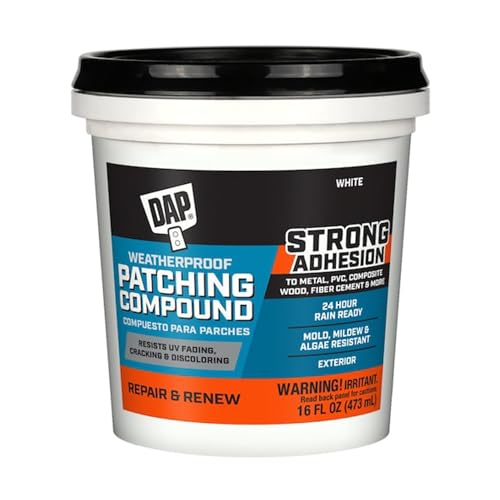
| DAP Weatherproof Patching Compound, White, 16 Oz★ Best Overall | Interior and exterior touch-ups | Paste (tub) | — | 16 Oz | Amazon |
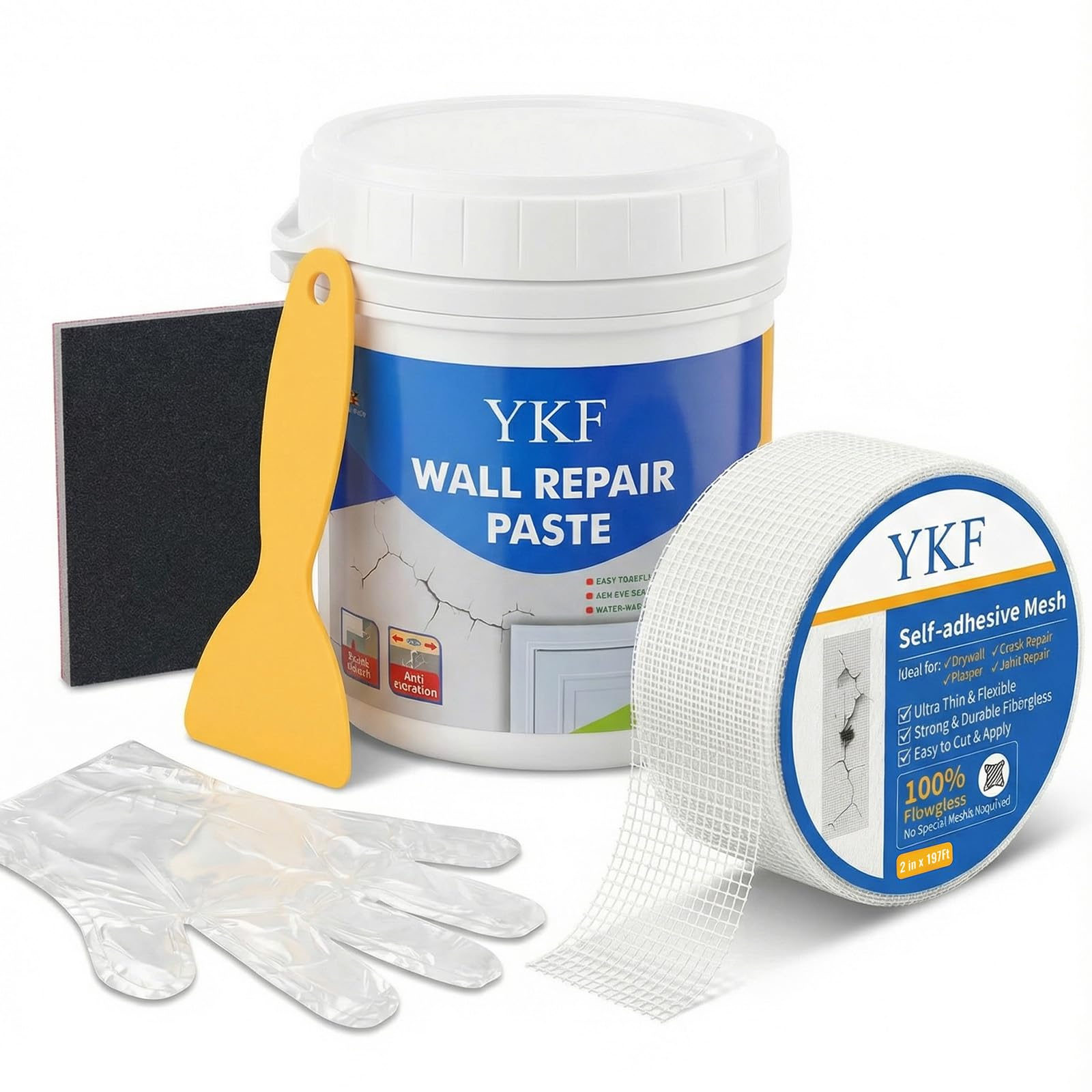
| YKF Drywall Repair Kit, 18 ozComplete Kit | One-stop kit for small holes | Paste (kit) | Dries in minutes | 18 oz | Amazon |
| Mohawk Epoxy Putty Stick, White M743-1520 | Holes in stained or painted wood | Two-part stick | 20 minutes | 1.6 ounces | Amazon |
| INC. 31904 Quart Spackling Paste | Trim, cabinets, large repaint jobs | Paste (quart tin) | Very fast; prime within hours | 1 Quart | Amazon |
| Elmers ProBond Wood Filler, 32 Ounce Tub | Wood defects and painted molding | Paste (tub) | 24 hour dry time / 12 hour full cure | 32 Ounce | Amazon |
Detailed Reviews
1. DAP Weatherproof Patching Compound 16 Oz
Our pick — 4.5+★ from 2,000+ verified ratings; the strongest balance of quality and price.
The all-rounder that sands like spackle and still survives a wet exterior wall.
If you want one tub that handles the nail holes on your door trim and the chips on the siding outside, this is the strongest compromise on the list. What wins people over is the working texture: it spreads far enough to level a rough face, then sands down like a light spackling paste rather than gumming up the paper. Owners describe it as a genuine middle ground between an oil-based patching compound and plain spackle, which is exactly the behaviour you want when a hole sits on a flat painted casing.
The durability question is where the honest picture gets textured. Many buyers report it locking up hard and standing up to rain on exterior repairs, and one buyer repainted an entire run of siding using several tubs of it. A smaller group reports cracks appearing within days, so treat this as a filler that wants sound backing underneath it rather than a bridge over a moving gap. Closed up tight, it keeps well; leave the lid loose and it hardens into a rock you cannot use.
Compared with the YKF kit, this tub gives you the compound without a scraper or mesh tape, so you supply your own blade. It is also the smaller footprint of the two: the DAP tub measures 4.45 x 3.78 x 3.66 inches against the INC. quart pail’s 13 x 4.88 x 17.25 inches, so it tucks into a drawer rather than owning a shelf. The crowd on this one is big and largely happy — 4.5+ stars across 2,000+ ratings — and the recurring gripes are mild and predictable: it is not the cheapest per ounce, and the lid discipline matters.
What earns it the top slot
- Spreads to level rough faces, then sands flat like spackle
- Dries hard enough for both interior trim and exterior patching
- Water-resistant enough that owners trust it outdoors
- Compact 16 Oz tub that stores easily between jobs
Where it asks for care
- A minority report cracking within days on unsound surfaces
- Lid must go on tight or the paste hardens in the tub
- No scraper or mesh included
Go for it when: you want one compound for trim holes, siding chips, and general touch-ups around the house.
Look elsewhere if: you are filling a deep moving crack that needs a flexible, reinforced bridge rather than a hard fill.
2. YKF Drywall Repair Kit 18 oz
Everything in one box, so you can start filling holes without hunting for a blade.
This is the pick for someone who owns no putty knife and wants to deal with a wall of nail holes in one pass. You get 18 oz of acrylic paste, a scraper, and self-adhesive mesh tape, and the paste is described as quick-dry and waterproof — meaning it claims to hold in a bathroom or basement where moisture is constant. The mesh is the piece that matters for anything larger than a nail hole; it reinforces the patch so a screw hole or a dent does not crack back open under paint.
Volume is where this kit gets scrutinized. The 18 oz tub covers a healthy run of nail holes and small cracks, but owners who took on two large dog-made holes found the paste ran short and had to buy more. That is a fair expectation to set going in: it is a small-to-medium repair kit, not a whole-wall renovation pack. On the plus side, the brand pitches it for move-out repairs and rental turnovers, which is precisely the nail-hole-and-dent workload white trim sees most.
Instructions are the loose thread here. The kit relies on you knowing the sequence — scrape, fill, mesh if needed, sand, paint — and at least a few buyers opened the box to find no guidance at all. If you have patched a wall before, that is nothing. If this is your first time, plan on a quick search first. It still holds 4.0+ stars across 200+ ratings, and the quality of the paste itself is the most-praised part of the package, with the mesh and scraper close behind.
Speed you can bank on: The fast-setting formula means you can sand and paint the same day, and the waterproof claim covers humid rooms where a cheap spackle would soften.
The volume caveat: Budget for a second tub if you are fixing anything bigger than nail holes and small dents, because 18 oz goes fast on large openings.
Reach for this if: you want a single purchase that covers paste, tool, and reinforcement for a weekend of touch-ups.
Think twice if: you are repairing multiple oversized holes and would rather buy volume in one go.
3. Mohawk Epoxy Putty Stick, White M743-1520
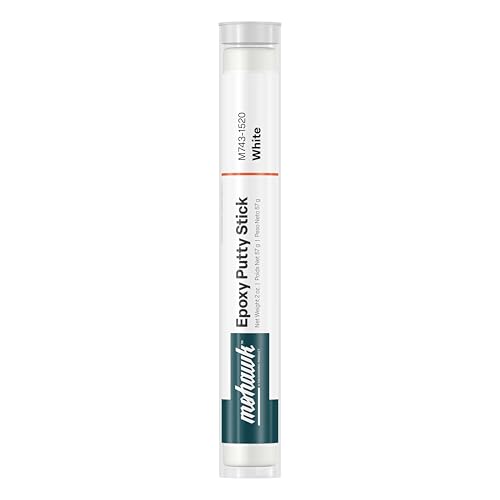
A kneadable stick that fills a nail hole and cures hard in 20 minutes flat.
When the hole is in stained or clear-coated wood rather than painted trim, paste is the wrong tool — you want something you can press in, shape, and sand flush without a wet mess. This two-part epoxy stick cures in 20 minutes, arrives as a single 1.6-ounce stick, and is listed as compatible with wood, metal, glass, ceramic, plastic, fiberglass, brass, nylon, and aluminum. For white trim that has been painted over, it works as a fill you then coat; for bare wood floor nail holes, it is the cleaner answer.
Ease of use is what carries it, and sanding follows close behind — it shapes and sands down like wood rather than fighting the paper. Buyers have pressed it straight from the tube into hardwood floor nail holes and blended the color to tone down a bleached board. It also reports a strong smell as it kicks off, which is normal for a two-part epoxy and clears as it cures. Note that it is not stainable in every case; at least one owner had to paint over it instead.
Hardness is the split opinion on this one, and it is a real one to weigh. Some repairs want the putty to harden into something you could almost machine; others find it tough to work once it starts setting, and it rewards a little practice with a light water spray to smooth it. At 1.6 ounces it is also a small stick, so a large row of holes will eat through it faster than a tub would. Owners use it on hardwood floor nail holes, kitchen cabinets, and even a broken statue.
Why woodworkers keep it around
- Cures in 20 minutes, so you sand the same session
- Sands and shapes like wood rather than gumming up
- Bonds to wood, metal, glass, ceramic, plastic, and more
- Works straight from the stick with no mixing tubs
What to plan around
- Strong off-gassing smell while it sets
- 1.6-ounce stick runs out on bigger jobs
- Not always stainable; often needs paint instead
The right call for: nail holes in stained wood floors, cabinets, and furniture where a paste would look out of place.
Not the one for: a whole-house trim repaint where you need bulk paste and a fast, wipe-clean application.
4. INC. 31904 Quart Spackling Paste

The quart tin that professional painters reach for on trim and cabinet work.
This one earns its spot on flat-sanding performance: a painter with decades on the job called it the best spackle they had used, and it sands to a flat finish. That flat finish matters most on a vertical casing, because no bulge means no shadow line once the white paint goes on. The quart tin is labeled ready-to-use, sandable, paintable, low-odor, and VOC-compliant (low in fumes from volatile organic compounds). It is uniform enough to skip mixing and stays put without sagging or bulging. Pick it for a serious repaint where trim, casing, and cabinet faces all need filling in the same afternoon.
The functional numbers line up too. It dries very fast, adheres well to both wall and paint, and is ready to prime within hours, which keeps a repaint moving. It is vinyl-based and sold in a metal tin, and the tin is the quiet hero: buyers describe cans still usable after many years, far outlasting the plastic tubs that dry out. One caveat that shows up repeatedly is the packaging itself — metal tins can rust, so store it somewhere dry rather than a damp garage corner.
Expect two friction points: price and availability. It is not the cheapest option per quart, and shipping has been unreliable enough that some buyers had to reorder after a lost delivery. It is also far bigger than the DAP tub — the quart pail measures 13 x 4.88 x 17.25 inches versus the DAP’s 4.45 x 3.78 x 3.66 inches — so plan shelf space, not a drawer. For a full-house trim job, that volume and the flat-sanding finish are what you pay for. It holds 4.5+ stars across 250+ ratings.
The trim-work case: Uniform consistency, no sagging on vertical faces, and a flat sanded finish make it a natural fit for casings and cabinet fronts.
The honest catch: Metal packaging can rust in damp storage, and availability has been spotty enough that some orders arrived late or had to be replaced.
Buy this one if: you are repainting a whole run of trim or cabinets and want a big tin of paste that sands dead flat.
Pass if: you only have a handful of nail holes and want something that fits in a drawer.
5. Elmers ProBond Wood Filler 32 Ounce

A big resealable tub of wood filler built to take stain and survive outside.
For trim that has been painted white, this is the overkill option — and that is not a criticism. The 32-ounce resealable tub carries a 24-hour dry time and a 12-hour full cure, holds real wood fibers, and is designed to work with all stains and paints. On painted molding and baseboard, those wood fibers and the ceramic microspheres in the formula mean it sets up hard and sands by hand or under a high-speed sander without crumbling. The brand lists it as suitable for holes, dents, scratches, and defects on wood, wallboard, molding, and painted surfaces.
Owners reach for it on awkward jobs: a large defect in half-log siding filled in layers, edge chip-outs, and rotting sills and clapboard that got sanded, primed, and painted after filling. It bonds strongly and holds up under a stain coat, which is more than most spackles can claim. The trade-off is texture. Some owners mention it feels gritty and spreads differently depending on the surface. Drying has also been uneven for a few buyers who expected it to set overnight and found it had not.
Container discipline is the recurring theme. Left open during a long session, it skins over and dries out; covering the tub with plastic wrap before lidding keeps it workable. Compared with the Mohawk stick’s 20-minute cure, this one is a patient product — 12 hours to full cure against the Mohawk’s much quicker set — so it suits a planned repaint rather than a same-hour touch-up. It sits at 4.0+ stars across 600+ ratings, and its following is built on how much material you get for a wood-repair job.
Where it shines: Bulk volume plus stainable, paint-friendly wood fibers make it the pick for real wood defects rather than hairline nail holes.
The slowing factor: A 24-hour dry time and gritty texture mean it rewards patience and sealing the tub between uses.
Pick this for: repairing genuine wood damage on molding, siding, and sills where you want a stainable, exterior-rated fill.
Skip it for: a fast afternoon of nail holes on painted trim, where a quick-dry paste wins on speed.
Know the Specs
Full Cure Time Versus Dry Time
These are two different checkpoints, and mixing them up is how people sand too early. Dry time is when the surface is firm enough to sand and paint; full cure time is when the whole fill has hardened through. The Mohawk stick lists a 20-minute full cure, while the Elmers tub lists a 24-hour dry time and a 12-hour full cure. Read both before you plan your workflow — a fast dry does not always mean a fast full cure, and a slow one can stall a repaint.
Form: Paste, Stick, Or Kit
For nail holes on flat trim, paste in a tub or tin is the classic choice: you scoop, press, and wipe. A two-part epoxy stick (two components you knead together to activate) is pressed and shaped, which suits wood you can sand and blend. A kit bundles paste, a scraper, and mesh tape so larger holes get reinforced. No single form wins on every job. The form decides how much setup and cleanup you accept, and whether you must buy a tool separately.
Sandability And Shrinkage
Sandability is how cleanly the dried filler feathers into the surrounding surface without gouging it. Shrinkage is how much the fill sinks as it dries — visible as a dimple you have to top off. On white trim, a filler that sands to a flat finish and stays put without sagging is what keeps the repair invisible under paint. Owner reviews report both traits more reliably than any spec sheet, so read them closely.
Size, Packaging, And Shelf Life
Sizes across these picks range from a 1.6-ounce stick to a 32-ounce tub, and the container type affects how long leftovers survive. Metal tins can outlast plastic tubs but can rust in damp storage; resealable tubs are convenient but harden if left open. Match the size to your job: 18 oz for small-to-medium touch-ups, a quart tin or 32-ounce tub for whole-house repaints and multiple rooms.
Common Questions
Can I use wood filler on painted white trim instead of spackle?
How deep should I fill a nail hole in white trim?
Do I need to sand filler before painting white trim?
Will epoxy putty stick work for nail holes in painted wood?
How long does spackling paste last once opened?
Does patching compound shrink as it dries on vertical trim?
Is a drywall repair kit better than a plain tub for nail holes?
Can I paint over epoxy putty or does it need a primer?
What is the difference between spackling paste and wood filler for trim?
How much filler do I need to cover a whole room of nail holes?
The Bottom Line
For most trim touch-ups, the best nail hole filler for white trim is the DAP Weatherproof Patching Compound. It spreads, dries hard, and sands like spackle, so it disappears under white paint and tolerates a wet exterior wall if the job wanders outside. Want one purchase that includes a scraper and mesh tape for larger holes? Grab the YKF Drywall Repair Kit. For a whole-house repaint of trim and cabinets, reach for the INC. Quart Spackling Paste — a flat-sanding paste in a tin that keeps for years. Round out the toolbox with the Mohawk Epoxy Putty Stick for stained wood and the Elmers ProBond Tub for exterior sills and siding.
How we choose
We do not accept paid placement. Every pick is matched to a real buyer and a real use-case; we do not hands-on test units.
Sources
Specifications: manufacturer listings and product documentation. Review insights: verified customer reviews, as of October 2026. Pricing: not shown on this page (it changes often); check the current price via the retailer link.
As an Amazon Associate, Aappliancez earns from qualifying purchases. This does not affect which products we feature.