Disclosure: Some links in this post are affiliate links. As an Amazon Associate I earn from qualifying purchases, at no extra cost to you. Learn more
Specs are compiled from manufacturer listings and verified buyer reviews and can change over time — please confirm the key details on the product page before buying.
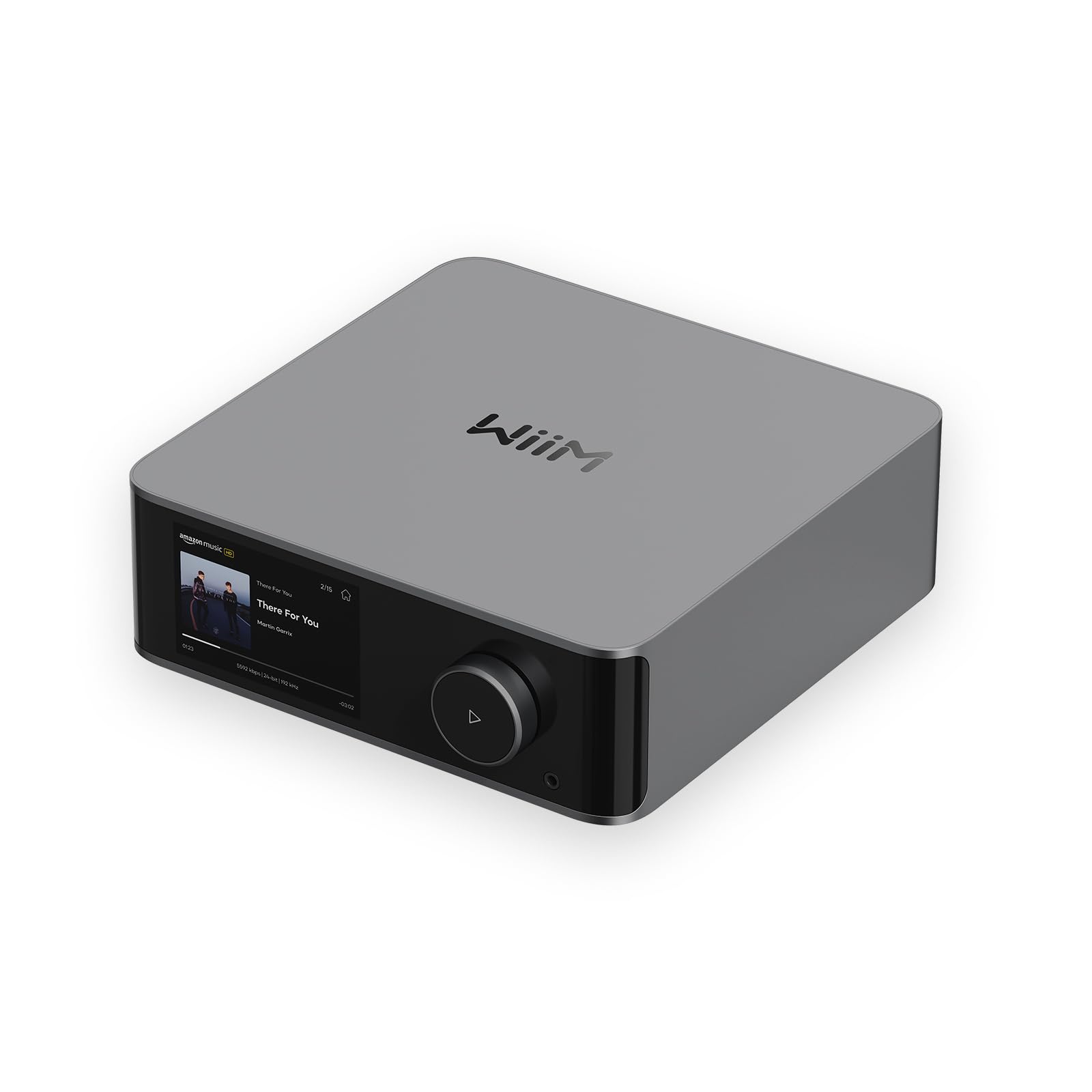
You already own a DAC you trust, so why pay for a second one inside your streamer? That is what a transport-only music streamer solves: it pulls music off your network, cleans up the digital signal, and hands it to your own converter over coax, optical, USB, AES/EBU (a pro-style digital connection) or I2S (a digital link that carries the clock separately). The best of the bunch here is the WiiM Ultra — a 4.5+ star crowd favorite across thousands of owners — but it carries its own ESS DAC (a digital-to-analog converter chip) that you can simply bypass through SPDIF (a standard digital audio connection), which is exactly how practical audiophiles use it.
This guide is built by comparing the manufacturers’ published specifications and the patterns across verified customer reviews, so you get each pick’s real strengths and trade-offs instead of marketing spin.
Some of these boxes stream only, some rip your CDs, and one is broadcast gear built to run for months untouched. The point is matching the digital output to the converter you already own. Here is how to pick the right music streamer without dac so your existing converter does the work.
Top Picks


How To Choose The Best Music Streamer Without DAC
The first thing to settle is what “without DAC” really means for your rack. A true transport has no analog stage at all — it sends a digital bitstream out and lets your own converter turn it into sound. Some units here, like the WiiM Ultra, do carry a DAC but let you bypass it over SPDIF, so you keep the flexibility without being forced to use it.
Match the digital output to the input on your converter
Coaxial, optical, AES/EBU, USB Audio and I2S are not interchangeable at the plug level, and each has its own ceiling. On the Eversolo T8, IIS and USB Audio outputs carry up to DSD512 Native and PCM 768kHz 32Bit, while its coaxial, AES/EBU and optical outputs top out at stereo PCM 192kHz 24Bit and Dop64. Buy the box whose best output matches the best input your DAC actually has.
Clocks and isolation decide how clean the handoff is
A clock is the heartbeat that keeps digital samples evenly spaced. When it drifts, the receiving DAC has to guess, and that guesswork is jitter. Look for femtosecond clocks, dual-clock inputs at 44.1kHz and 10MHz, and electrically isolated output ports. The Eversolo T8 uses dual femtosecond clocks built on AS318-B series crystal oscillators with a 49.1520 MHz core frequency, and isolates every output to ground loop noise.
Wired or wireless — decide before you buy
Streaming hi-res files is a bandwidth and stability question more than a convenience one. Wired Ethernet is the safer bet for gapless 24-bit/192 kHz playback, and several of these boxes want it. The Bluesound Vault 2i is Ethernet-only in practice, and the Cambridge MXN 10 handles Qobuz FLACs in 1-2 seconds on a 60 Mbit/s connection. Give any streamer a stable pipe and the rest gets much easier.
Side-by-Side Comparison
| Model | Best For | Top Digital Output | Max Resolution | Network | Amazon |
|---|---|---|---|---|---|
| WiiM Ultra★ Best Overall | All-round streaming hub | USB, Optical, Coaxial, HDMI ARC | 24-bit/192 kHz | Wi-Fi 6, Ethernet, Bluetooth 5.3 | Amazon |
| Cambridge Audio MXN 10Best for External DACs | Feeding an external DAC | USB | — | Wi-Fi, Bluetooth 5.0 | Amazon |
| Grace LinkRadio Specialist | Internet radio into your stereo | Digital coax | 24-bit/192 kHz | Dual-band Wi-Fi, RJ45 Ethernet | Amazon |
| Barix Exstreamer 100 | Always-on broadcast feeds | Line level stereo, 3.5mm | 8-48k sample rate | 10/100 Mbit Ethernet | Amazon |
| Bluesound Node Nano | BluOS multi-room on a budget | Stereo RCA, Optical, Coaxial, USB | 24-bit/192 kHz | Dual-band Wi-Fi, Gigabit Ethernet, aptX Adaptive | Amazon |
| S.M.S.L PL200T | CD transport into a separate DAC | Coaxial, Optical, AES/EBU, I2S | 32-bit/768 kHz, DSD512 via USB | None — disc and USB only | Amazon |
| Sonos Port | Whole-home Sonos in one rack | RCA, digital outputs | — | Ethernet, Wi-Fi, AirPlay 2 | Amazon |
| Eversolo T8 | Serious DAC owners | IIS, Coaxial, AES/EBU, USB Audio, Optical | DSD512 Native, PCM 768kHz 32Bit via IIS/USB | Wi-Fi 6, Gigabit LAN, SFP fiber | Amazon |
| Bluesound Vault 2i | Ripping a CD collection to a server | Optical | — | Ethernet, Bluetooth, AirPlay 2 | Amazon |
Detailed Reviews
1. WiiM Ultra Music Streamer
Our pick — 4.5+★ from 3,500+ verified ratings; the strongest balance of quality and price.
The one box that streams everything, and lets your own DAC take the credit.
The spec that earns this its spot is the SPDIF output path straight past the internal ESS ES9038 Q2M DAC. Practical audiophiles run coax into a Denafrips Ares 2 and report streamed Spotify sounding nearly indistinguishable from a Marantz CD6007 spinning the same track. That is the whole trick of a transport: the transport handles the network, your converter handles the sound.
Around that backbone you get a genuinely loaded hub. A 3.5-inch color touchscreen shows what is playing, and you can tap it or spin the premium volume knob. Wi-Fi 6 (the newer, faster Wi-Fi standard) and Bluetooth 5.3 cover wireless, and there is Ethernet for a wired run. Inputs stretch from USB, Optical, Coaxial and RCA to a phono stage (MM and MC, the two common turntable cartridge types), HDMI ARC (the TV audio return channel) and a subwoofer output with bass management — so a turntable and a TV can both live on the same box as your streamer.
Room correction is the sleeper feature. Owners describe being underwhelmed at first, then running Automatic Room Correction in roughly a five-minute setup and hearing the sound transform in an awkward room. A 10-way equalizer with presets sits underneath for manual tweaks. Streaming tops out at 24-bit/192 kHz with gapless playback across Spotify, Amazon Music, TIDAL, Qobuz and your own library.
What wins people over
- SPDIF out bypasses the internal DAC entirely, so your own converter runs the show.
- Automatic Room Correction takes about five minutes and reshapes sound in a difficult room.
- HDMI ARC, a phono stage and sub out mean one box for TV, vinyl and streaming.
- Wi-Fi 6 plus Ethernet keeps 24-bit/192 kHz streaming stable.
Where it asks for patience
- No AirPlay support at all — iPhone users have to stream another way.
- Purist listeners may still find the analog stage short of a dedicated converter.
Reach for this if: you want one hub for TV, turntable and streaming, and you already own a converter you like.
Think twice if: AirPlay is how your household plays music — this box cannot act as an AirPlay receiver.
2. Cambridge Audio MXN 10 Streamer
A small grey slab that turns a tired hi-fi into a modern network front end.
What owners talk about first is the sound, not the feature list. The StreamMagic Gen 4 module pulls music fast, and the ESS SABRE ES9033Q DAC handles the conversion when you want it. Feed a Modi or a Freya downstream and the digital output stays rock-solid while the analog stage gets praised for tone through quality tubes. As one summary of the owner experience puts it, the digital feed is outstanding and the Qobuz FLACs load in 1-2 seconds on a 60 Mbit/s line.
Roon Ready, Spotify Connect, TIDAL and Qobuz are built in, along with high-quality internet radio over MPEG-DASH. The StreamMagic app is smooth, and setup is quick for most people. The catch sits in the mixed reports: some units hit connection drops that a power cycle fixes, and the app has gaps — no Qobuz booklet or zoom, and Amazon Music is not supported. Apple Music only arrives through non-bit-perfect AirPlay.
Compared with the WiiM Ultra above, the MXN 10 is the narrower tool. It gives you fewer inputs and no room correction, but a sound-first build that wins on tone when paired with a good outboard converter. For a stereo-only rack that needs Spotify, TIDAL, Qobuz and Roon, that focus is the point.
The value question: this is a premium-priced compact in a crowded field, and it earns the money through sound and a two-year warranty rather than through input count. If you only ever feed one external DAC, that is money well placed.
Pick it when: your rack is stereo-only and you want Roon Ready streaming that sounds excellent through an outboard converter.
Skip the hassle if: you need Amazon Music or a CD input — neither is here.
3. Grace Link Internet Radio Tuner with Chromecast Built-in
A tuner for people who want radio stations, not a scrolling library.
Count the stations before anything else: 100,000 internet radio stations and 100 presets, with SiriusXM (subscription sold separately), Pandora, Spotify Connect, Amazon Music HD and a built-in Chromecast. The front panel gives you a 2.8-inch color display and real knobs, plus an infrared remote and a phone app. If you mostly listen to BBC, NPR, iHeartRadio or a favorite jazz station, that is a very specific strength — and it streams continuously without the “are you still there” prompts a tablet throws at you.
For a no-DAC setup, the digital coax out matters most. The internal DAC is good enough that many owners skip an outboard one altogether, and the coax keeps the connection to a hi-fi DAC simple. Hi-Res files run up to 24-bit/192 kHz, and a 5-band equalizer lets you shape the tone. Analog inputs let you push a CD player or turntable out to other rooms.
Honest limit: the interface is built for picking a station, not for deep library browsing, and a couple of owners have hit a hard freeze from an involuntary software update. Treat it as a dedicated radio appliance, and it does that job cleanly. The one thing it lacks is Toslink optical out — you get coax only.
What it does best: continuous, glitch-free internet radio into an existing receiver, with presets that hold up to 10 stations each.
Where to be careful: the software is the weak link, and support has not always moved quickly when an update goes wrong.
Best for: a listener who wants public radio and streaming services on the stereo without a screen in the room.
Look elsewhere if: you need optical output or a fully browseable music library.
4. Barix Exstreamer 100 IP Audio Stream Decoder

Broadcast gear built to sit at an antenna site for months without a reboot.
The defining number is not a sample rate — it is uptime. Owners run the Exstreamer 100 for six months at a time without a restart, relaying a studio feed to an FM antenna site. It decodes MPEG1 and 2 Layer3 (MP3), HE-AAC v2 (AAC+), WMA, Ogg Vorbis, 16-bit PCM linear, a-law and u-law at 8-48k sample rates. A 10/100 Mbit Ethernet interface does the network side, and a USB port lets you load audio from a stick.
Setup is about as close to plug-and-play as broadcast hardware gets. One owner had it working in under five minutes: RCA cables into the console, the station URL entered, and a boot time of seven seconds or less. Line-level stereo output runs at 4.2Vpp unbalanced, with a 3.5mm headphone jack for checking the feed. There is a web interface for configuration, and the low-power design keeps it cool in a rack.
This is not a consumer music streamer, and it makes no apology for that. You pick a stream, not an album. If you want to monitor a station or relay a feed, the simplicity is the whole value — the trade-off is that the feature set stops exactly where the broadcast job ends. It also wears out eventually; the longest reported run is four years of continuous use.
Suits you if: you need a set-and-forget decoder relaying one stream to a transmitter or console.
Not your tool if: you want to browse albums or cast from a phone.
5. Bluesound Node Nano Streamer

BluOS in a five-inch square — the multi-room ticket with a real DAC to bypass.
Inside sits a QUAD-CORE 1.8GHz ARM Cortex A53 processor and an ESS ES9039Q2M SABRE DAC, with streaming up to 24-bit/192 kHz. RCA, optical, coaxial and USB outputs mean you can hand the signal to your own converter or run the internal one. AirPlay 2 handles lossless and hi-res Apple Music, and Spotify Connect and TIDAL Connect are on board. Owners with tubed preamps describe the sound as impressive — and the external-DAC path is there if you want to go further.
The Nano also brings proper multi-room plumbing: dual-band Wi-Fi, Gigabit Ethernet, two-way aptX Adaptive Bluetooth and IR remote learning. Two programmable quick-touch presets jump straight to a track or station. It is small and easy to wall-mount, and setup is quick — auto software updates and a clear startup booklet make it friendlier than its price bracket suggests. Local server mode covers your own library and the BluOS platform links to other Bluesound players.
The trade-offs are documented and small. Connectivity draws mixed reports, mostly around Bluetooth and occasional Wi-Fi dropouts — Ethernet fixes the latter. The quick-start guide is thin, and one owner notes you must use the included USB-C power supply, since a third-party brick caused restarts mid-playback. There is no printed manual in the box.
Where it beats the pack: the BluOS ecosystem is the reason to buy — grouping speakers across rooms with a single app is the hard part done well.
The honest caveat: a stripped-back quick-start guide makes the first hour rougher than it should be.
Made for: a listener building a multi-room system who wants a small, capable streamer feeding an outboard converter.
Pass on it if: you want printed instructions or pristine Bluetooth.
6. S.M.S.L PL200T MQA-CD Reference Digital Transport

A CD spinner with no DAC inside, on purpose — your converter does the heavy lifting.
Read the 32-bit/768 kHz and DSD512 figures carefully: those are USB input and output limits, handled without drivers on Mac, Android or Linux. This is a transport, so there is no headphone jack and no analog stage — coaxial, optical, AES/EBU and I2S carry the signal to whatever converter you own. MQA-CDs fully unfold up to 384kHz with 8x unfolding, and dual-clock input runs at 44.1kHz and 10MHz for those matching a master clock.
The top-loading mechanism is the star of the show. Owners moving up from a cheaper player note quieter operation, a much faster initial disc read and quicker track skipping. A transparent acrylic lid lets you watch the disc spin and keeps dust off it, and the CNC-machined aluminum chassis with gold-plated ports looks the part on a shelf. Coax into a Schiit Bifrost 2 gets called the best CD sound some owners have heard — better than the WiiM Ultra streaming 24-bit over USB into the same DAC.
The limit is scope, not quality. There is no streaming here, no network port, and no way to play anything but a disc or a USB drive. It is also more fiddly to load than a tray loader, and one owner notes it lacks some settings. If your library lives on a server, this is not your box — if it lives on shelves, it is a lovely one.
Your pick when: you have a converter you love and a wall of CDs waiting for a proper transport.
Not for you if: streaming is how you listen — there is nothing network-shaped on this unit.
7. Sonos Port Streaming Component for Your Stereo Or Receiver

The shortcut back into Sonos for a stereo that predates streaming.
If the rest of the house already runs Sonos, this is the piece that puts your old receiver on the map. RCA and digital outputs feed your amp, a 12V trigger auto-powers it, and AirPlay 2 handles iPhone and iPad streaming with Siri. A line-in lets you pipe a turntable, CD player or phone into the system and send it to Sonos speakers in other rooms. Owners with a turntable and a full speaker-and-sub rig report it driving everything cleanly, with volume control moving from the preamp to the app.
Where this lives or dies is setup and network. Some installs take minutes — the app handles the basics — and others run into days of configuration, especially when the receiver integration is poorly documented. Wi-Fi dropouts show up often enough in the reports to be the headline caution. Use a wired Ethernet run where you can, and confirm your receiver’s source setup before you start.
Then there is value. The Port is a single-function box at a premium price, and the value question comes up more than any other in the owner feedback. Buy it because you are already inside Sonos and want a clean stereo bridge, not because it is the cheapest way to stream. Once it is configured correctly, owners describe it as reliable every time.
Where it shines
- Puts a legacy amp onto the Sonos network with RCA and digital outputs.
- AirPlay 2 plus Siri streaming from iPhone and iPad.
- Line-in sends vinyl and CD audio to other Sonos rooms.
- 12V trigger auto-powers the connected amp.
Where it bites
- Wi-Fi dropouts and receiver setup are the recurring friction points.
- The premium price is hard to justify outside the Sonos ecosystem.
Buy it for: whole-home Sonos integration with a stereo you already own.
Steer clear if: you are not in Sonos — a standalone transport serves you better.
8. Eversolo T8 Music Streamer Transport
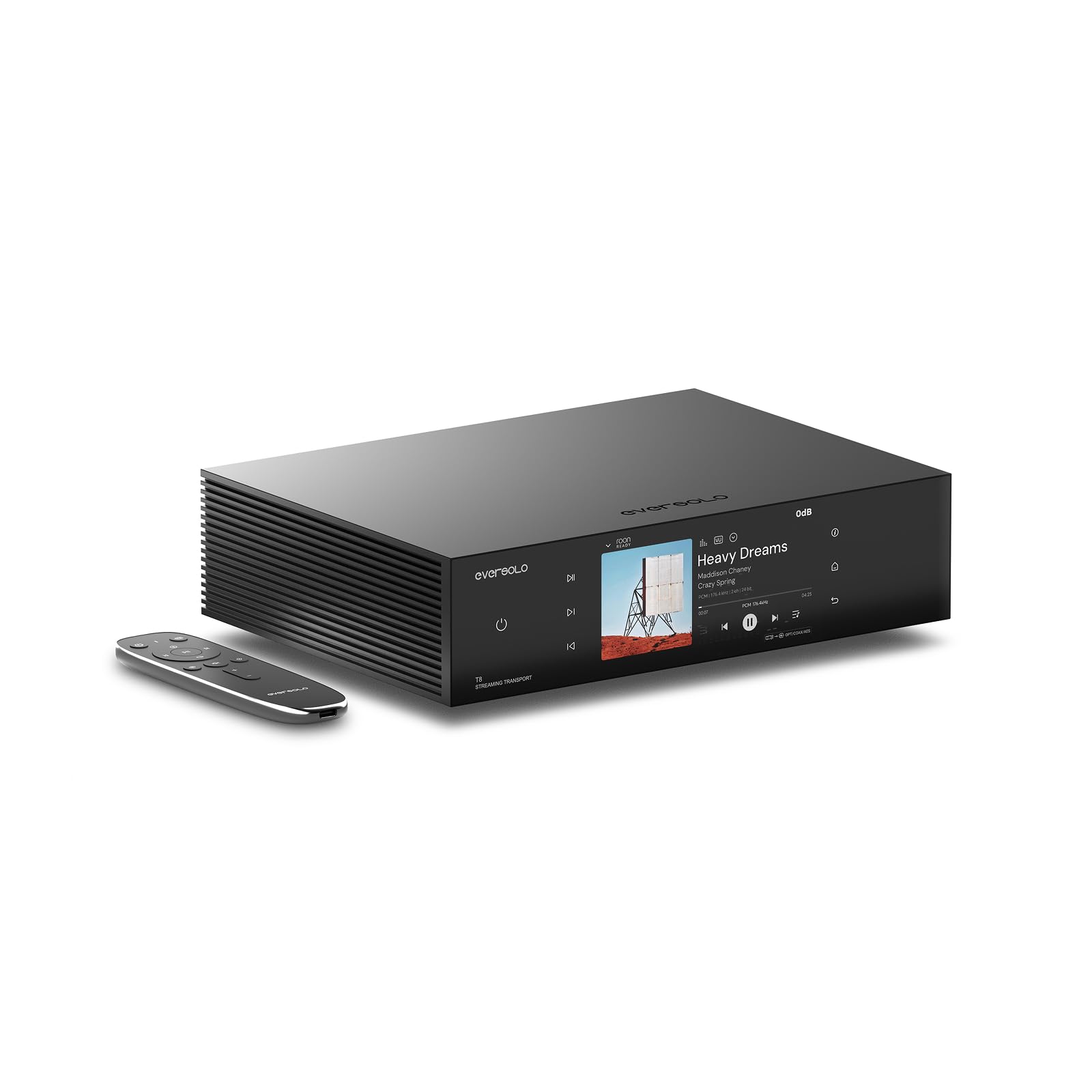
The most digital-output flexibility here, for the listener who already owns a serious DAC.
Dual ultra-high-precision femtosecond clocks are the headline. Based on AS318-B series crystal oscillators at a 49.1520 MHz core frequency, they directly drive USB Audio and AES/EBU to cut jitter at the source. Every output — IIS, coaxial, AES/EBU, USB Audio and optical — is electrically isolated against ground loop noise, and the AES/EBU port uses a fully balanced XLR design. Eight IIS pinout configurations mean it should mate with almost any DAC you own.
Resolution is the other draw. IIS and USB Audio outputs run up to DSD512 Native and PCM 768kHz 32Bit, while coaxial, AES/EBU and optical cap at stereo PCM 192kHz 24Bit and Dop64. On the network side you get Wi-Fi 6, Gigabit LAN and an electrically isolated SFP fiber module. TIDAL, Qobuz, Spotify Connect Lossless and Roon Ready are all on board, with a 10-band parametric EQ and the evotune room calibration system for shaping the sound.
The caution here is software. When it works, owners describe rich midrange, detailed vocals and punchy bass over a serious DAC chain, with a responsive 6-inch display and Qobuz Connect running rock-solid. But firmware updates have caused freezes and stutters, and Qobuz Connect has dropped audio for some users. Support responses have also been slow in a few cases. For a premium outlay, expect to keep the firmware current and keep your receipts.
The case for it: no other box here gives you isolation on every output and that much pinout flexibility for matching an exotic converter.
The catch: this is transport-only gear priced at the top of the range, and the software has not always matched the hardware.
Right for you: a fraction-second, jitter-sensitive system with a serious DAC that wants I2S or AES/EBU.
Not yet for you: you stream from Spotify Lossless only — the T8 has had gaps there.
9. Bluesound Vault 2i 2TB Hi-Res Music Server & Streamer, White

A server that swallows a thousand CDs and still has room to spare.
The number that matters is 2TB of internal storage, enough to hold up to 30,000 tracks and rip CDs in FLAC, MP3, WAV or WMA as they go in. A 1GHz dual-core ARM Cortex processor runs the show, and a USB Type-A port takes a personal collection on a stick. One owner loaded FLAC backups of a whole library and used under 10% of the drive. Stream from it with AirPlay, the BluOS app, Alexa or Siri, and link other Bluesound players around the house.
Sound quality through an optical link to an outboard DAC is genuinely good when everything is running, and internet radio works well. The caveats are about the ripping experience. Roughly 1% of discs fail to rip, the drive takes around 20 minutes per disc and struggles with scratched discs, and metadata edits need third-party software like MP3tag. The BluOS app has a steep learning curve and weak Amazon Music integration.
Two more things to know before you commit. The Vault 2i wants wired Ethernet — Wi-Fi adapters are unreliable, and a network extender is the workaround. It is also the largest investment in a house where the software history has been mixed, with some long-term units dropping streams. For most buyers the safer answer is a transport plus a separate NAS; for the buyer with shelves of discs and a wired rack, this is the turnkey way in.
Ideal owner: someone with a large CD collection and a wired network who wants ripping and streaming in one box.
The honest limit: the CD drive and the app are the weak links, so expect some fiddling along the way.
Know the Specs
Clock jitter and why femtosecond clocks matter
A clock keeps digital samples evenly spaced. When it drifts, the receiving DAC has to guess, and that guesswork is jitter. A streamer with low jitter hands over a cleaner signal, so the converter’s job gets easier. Dual femtosecond clocks, as on the Eversolo T8, and clock inputs at 44.1kHz and 10MHz are the specs to look for if this matters to you.
Electrical isolation on the outputs
Ground loop noise rides on the connection between two boxes and can muddy the digital signal. Isolated outputs break that path. The Eversolo T8 isolates every port — IIS, coaxial, AES/EBU, USB Audio and optical — and its AES/EBU port is fully balanced over XLR for better noise rejection over long runs.
Digital outputs and their ceilings
Coaxial, optical, AES/EBU and I2S top out at different rates on different boxes. On the T8, coaxial, AES/EBU and optical cap at stereo PCM 192kHz 24Bit and Dop64, while IIS and USB Audio reach DSD512 Native and PCM 768kHz 32Bit. Buy the output that matches your DAC’s best input, not the highest number on a spec sheet.
Streaming resolution and network stability
Hi-res streaming usually means 24-bit/192 kHz, which needs a steady pipe. Wired Ethernet is the safer choice for gapless playback, which is why the Vault 2i really wants a cable and the Cambridge MXN 10 handles Qobuz FLACs in 1-2 seconds on a 60 Mbit/s line. Wi-Fi 6 and dual-band radios help, but a cable is still the most reliable path.
Common Questions
What does “without DAC” actually mean in a music streamer?
Can I use the WiiM Ultra as a transport with my own DAC?
Which digital output should I use to feed my DAC — coax, optical, or USB?
Does a streamer without a DAC still need a stable network connection?
Is AirPlay 2 available on every streamer in this list?
Can the S.M.S.L PL200T stream from Tidal or Qobuz?
How much storage do I need in a CD ripping server?
Why is my streamer dropping off the network?
Do I need a separate DAC if I use the Sonos Port?
Can the Grace Link stream to other rooms in my house?
The Bottom Line
For most people, the music streamer without dac winner is the WiiM Ultra because it is the only box here that streams everything, gives you SPDIF for your own converter, and adds HDMI ARC and a phono stage for the rest of the rack — with the crowd to back it up: 4.5+ stars across 3,700+ owners. If you want a stereo-only streamer whose sound earns its money through a pair of RCA cables, grab the Cambridge Audio MXN 10. And for a system built around a serious outboard DAC with I2S or AES/EBU, the Eversolo T8 is the one to reach for. The one honest nudge: if your CDs outnumber your playlists, the S.M.S.L PL200T turns that shelf into a system — just check the firmware (the software that runs the box) on anything network-connected before you commit.
How we choose
We do not accept paid placement. Every pick is matched to a real buyer and a real use-case; we do not hands-on test units.
Sources
Specifications: manufacturer listings and product documentation. Review insights: verified customer reviews, as of October 2026. Pricing: not shown on this page (it changes often); check the current price via the retailer link.
As an Amazon Associate, Aappliancez earns from qualifying purchases. This does not affect which products we feature.