Disclosure: Some links in this post are affiliate links. As an Amazon Associate I earn from qualifying purchases, at no extra cost to you. Learn more
Specs are compiled from manufacturer listings and verified buyer reviews and can change over time — please confirm the key details on the product page before buying.
If you want the short answer: the loose dried Frontier Co-op Mullein Leaf is the one to buy when you plan to brew your own tea, and the Double Wood 1000 mg capsules are the pick when you want a no-fuss daily capsule. Everything else on this list is a variation on those two ideas — a tincture you drop under your tongue, a bigger capsule bottle, or a herbal blend with elderberry added. Mullein is a plant, not a prescription, so the two things that actually decide your choice are the form (tea, capsule, or liquid) and how long one bottle or bag lasts you. That is what this page sorts out.
This guide is built by comparing the manufacturers’ published specifications and the patterns across verified customer reviews, so you get each pick’s real strengths and trade-offs instead of marketing spin.
Read on for the picks that fit how you actually take it, so you end up with the best mullein leaf extract for your routine.
Top Picks

How To Choose The Best Mullein Leaf Extract
Before you compare brands, decide which of the three forms you will actually use every day. A bag of dried leaf that sits in the cupboard untouched helps nobody, and neither does a tincture you find fiddly. Pick the form first, then let serving count and ingredient list narrow the field.
Pick the form you will genuinely keep up with
Dried cut-and-sifted leaf is the rawest option — you measure it, steep it, and strain it. It suits anyone who already drinks herbal tea, because it slots into a habit you have. Capsules are the smallest commitment: you swallow one with water and move on, which is why they survive busy mornings best. Liquid tinctures are the middle ground — a dropper into water or straight under the tongue, with no steeping and no pill to swallow. None of these is better than the others; they simply match different temperaments.
Do the math on servings, not on package size
A big bag of loose leaf and a bottle of capsules can look like similar value until you work out how many days each one covers. Loose leaf is measured in teaspoons per cup, so the number of cups you drink sets the pace. Capsules spell it out for you — a 200-capsule bottle taken three a day is roughly a two-month run, while a 180-capsule bottle taken two a day stretches further. Tinctures are measured in servings per bottle, and a full daily dose drains a small bottle noticeably faster than you would expect. Read the serving line before you read anything else.
Check the ingredient panel and the storage
Plain mullein is just that — one botanical. Blended formulas add other herbs on purpose, so check whether the extra names are ones you actually want in your daily routine. Also look for how the container closes. Dried leaf keeps its aroma and flavour far better in a resealable bag, while a non-resealable one pushes you into a jar or clip of your own. Tinctures need the dropper to stay clean, since a sticky one is the most common everyday annoyance with liquid formulas.
Side-by-Side Comparison
| Model | Best For | Form | Serving Style | Supply | Amazon |
|---|---|---|---|---|---|
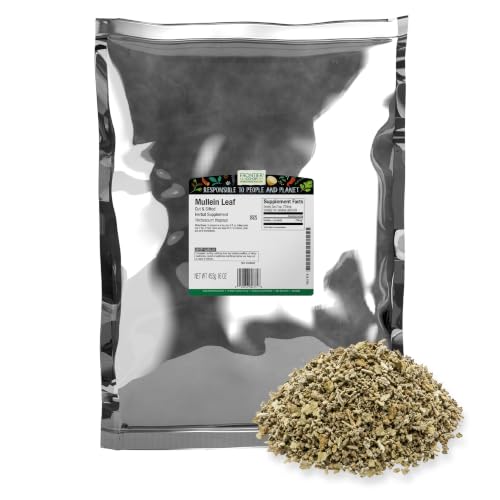
| Frontier Co-op Mullein Leaf, Cut and Sifted★ Best Overall | Brewing your own tea | Loose dried leaf | Teaspoons per cup | 16 Ounce bag | Amazon |
| Mullein Leaf, 1000mg, 180 Capsules, by DWSimple Daily Capsule | Simple daily capsules | Capsules | 1000 mg per serving | 90 servings | Amazon |
| Vitamatic Mullein Leaf 1000 mg | Long capsule supply | Capsules | 1000 mg per 3 capsules | About 66 servings | Amazon |
| Mullein Drops for Lungs with Elderberry | Mixing into a drink | Liquid tincture | Dropper under tongue or in water | 2 FL OZ bottle | Amazon |
| Fidus Mullein Drops for Lungs | Smokers and multi-herb fans | Liquid tincture | Dropper, alcohol-free | 120 servings | Amazon |
Detailed Reviews
1. Frontier Co-op Mullein Leaf, Cut and Sifted
Our pick — 4.5+★ from 900+ verified ratings; the strongest balance of quality and price.
The big bag of loose leaf that turns a kettle into your daily routine.
You get a full 16-ounce bag of cut-and-sifted dried mullein leaves — not capsules, not a tincture, just the plant. That is the whole pitch, and for anyone who already drinks herbal tea it is the most flexible option on this list. Frontier Co-op describes it as grown and harvested in Bulgaria, kosher, non-irradiated, and made with no artificial additives or chemicals used in the growing process. It is the top pick here because it works for tea, for tinctures you make yourself, and for salves and poultices, where the maker says the leaves have the same soothing effect on the skin.
What wins people over is how well it holds up cup after cup. Buyers rate effectiveness highest, then value for money, and repeatedly note that the 16-ounce bag lasts a long stretch. Taste and freshness draw steady praise, and the aroma comes up again and again; the leaf arrives dark, thick, and smelling like it was cut recently, not like it has been sitting in a warehouse. The single most-quoted line on the review pages sums it up: it started working after the first cup of tea. Brewing is simple — a few teaspoons in a glass jar with a filter top, boiling water poured over, and you are done.
Pick it for tea you brew yourself and for anything you want to blend by hand. If tea bags are your habit, though, note that this arrives as loose leaf and you will be straining it; one user with asthma and COPD switched here specifically to get away from plastic tea bags and found the loose form more economical, but it is still more steps than dropping a bag in a mug. Also worth knowing: the bag is not resealable, which is the most repeated everyday gripe. A clip or a spare jar solves it in seconds, but plan for it.
What Earns The Top Spot
- A 16-ounce bag of cut-and-sifted dried leaf that covers tea, homemade tinctures, salves, and poultices
- Non-resealable only in the sense that you supply the clip — the leaf itself arrives dark, fresh, and aromatic
- Zero additives, kosher, and non-irradiated
Where It Asks A Little More
- One owner who makes loose tea daily wished out loud for a resealable top
- Loose leaf means measuring and straining, so it is slower than a capsule
- Because it is the raw botanical, dose consistency is down to your own spoon
Reach for this if: you want one bag that covers tea, tinctures, and skin preparations, and you value a big bag over convenience.
Look elsewhere if: you want to swallow something with water and be done — that is a capsule job.
2. Mullein Leaf 1000mg 180 Capsules
Ninety full servings in one bottle — a real three-month run if you stick to the label.
Double Wood bottles a 1000 mg mullein leaf serving across 180 capsules, and the label spells out 90 servings per bottle. That is a genuinely long stretch of daily use before you need to reorder, which is the reason this one sits high here. The formula is vegetarian-safe, non-GMO, and gluten-free, manufactured in the USA from globally sourced ingredients, and the maker says it draws on careful sourcing with third-party testing.
Buyers rate effectiveness highest, then quality. Buyers report it works as an expectorant, with vivid notes describing stubborn phlegm finally loosening. The frankest account on the page is worth repeating in full, because it maps exactly onto how the label tells you to use it: “One capsule had no effect; two capsules (recommended dose) produced huge difference after 1 month: better singing range, longer walking without hyperventilation.” That buyer also noted no taste before or after, easier swallowing with juice, and a plan to continue for two more months. Value for money splits opinion, though — the dosage math is what most buyers weigh, and the honest reading is that a fuller daily dose is where this bottle is designed to be used.
Measure this against the Vitamatic bottle, which also delivers 1000 mg per serving but spreads it over three capsules and roughly 66 servings. Double Wood puts the same 1000 mg into a two-a-day rhythm and stretches to 90 servings — clearer labeling and a longer run per bottle if you care about the math. Just go in knowing the label’s recommended dose is two capsules, not one, and that a lighter dose may do little for you.
Labeling that respects your time: 90 servings stated outright, non-GMO, gluten-free, vegetarian safe, and made in the USA from globally sourced ingredients.
One number to remember: the recommended serving is 1000 mg, which means two capsules — go lighter and the feedback suggests you may feel nothing.
The straightforward call: for a two-capsule-a-day habit that runs about three months per bottle, this is the tidy choice.
Know before you buy: value for money draws mixed feelings, so judge it on servings per bottle rather than bottle size alone.
3. Vitamatic Mullein Leaf 1000 mg, 200 Capsules
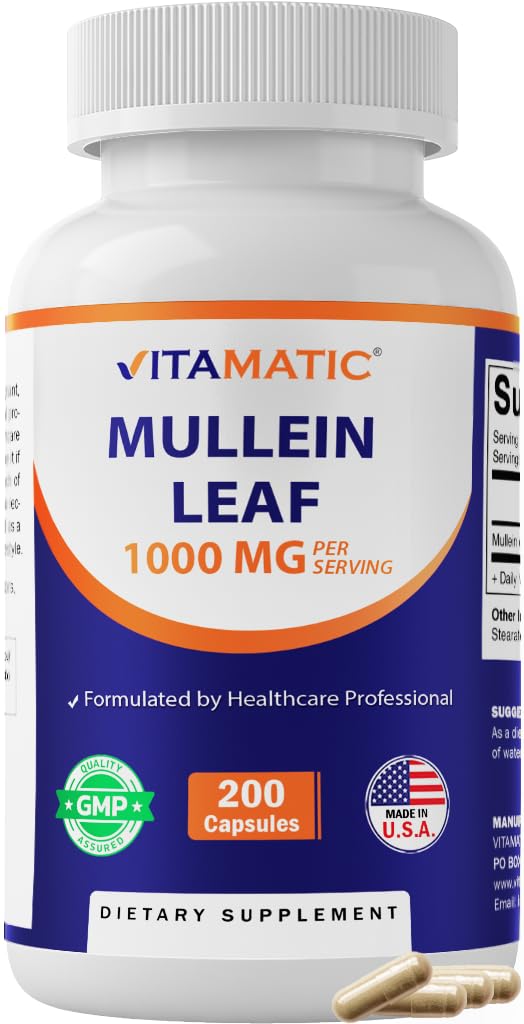
Two hundred capsules of Verbascum thapsus leaf — the biggest pill bottle in this lineup.
Vitamatic packs 200 capsules per bottle and delivers 1000 mg of mullein leaf, listed as Verbascum thapsus, per serving. Read the label carefully here, because that serving is three capsules, not one — which the maker states works out to roughly 66 servings per bottle. Two hundred capsules sounds enormous until you divide by three, and this is the number the whole decision turns on. The clean formula is free from sugar, yeast, wheat, egg, artificial colors, artificial flavors, and preservatives, and it is made in the USA in a GMP-compliant facility.
Buyers rate effectiveness highest, then easy swallowing. Buyers describe it helping with sinus and mucus issues, and the most detailed accounts describe symptoms returning after a bottle ran out and easing again when dosing resumed, with clearer morning breathing and less sinus pressure as the recurring theme. Three capsules in the morning alongside other allergy routines is how several describe using it. There is also a size note worth knowing: the bottle measures 5.3 x 2.85 x 2.8 inches against the Double Wood bottle’s 4.4 x 2.5 x 2.45 inches, so plan on a little more shelf or cabinet room for this one.
If your aim is the longest gap between reorders in capsule form, this bottle is built for that. The catch is the arithmetic — three capsules a day is a bigger daily commitment than a two-capsule routine, and if you would rather take one, this is not the format for you. Pair it with a pill organizer and the three-a-day rhythm stops being a nuisance.
Why Buyers Stick With It
- 200 capsules at 1000 mg per serving, giving roughly 66 servings per bottle
- Free from sugar, yeast, wheat, egg, artificial colors, artificial flavors, and preservatives
- Easy to swallow, which is the trait buyers single out most after effectiveness
The Arithmetic To Expect
- A serving is three capsules, so the bottle runs shorter than the capsule count suggests
- Takes up more cabinet space than the Double Wood bottle at 5.3 x 2.85 x 2.8 inches
- Made in a GMP-compliant facility, but the botanicals themselves are not sourced in the USA
Suits you when: a three-capsule morning is fine and you want the longest run between reorders in pill form.
Think again if: you would rather swallow one or two — a two-capsule bottle fits that habit better.
4. Mullein Drops Elderberry 2 FL OZ
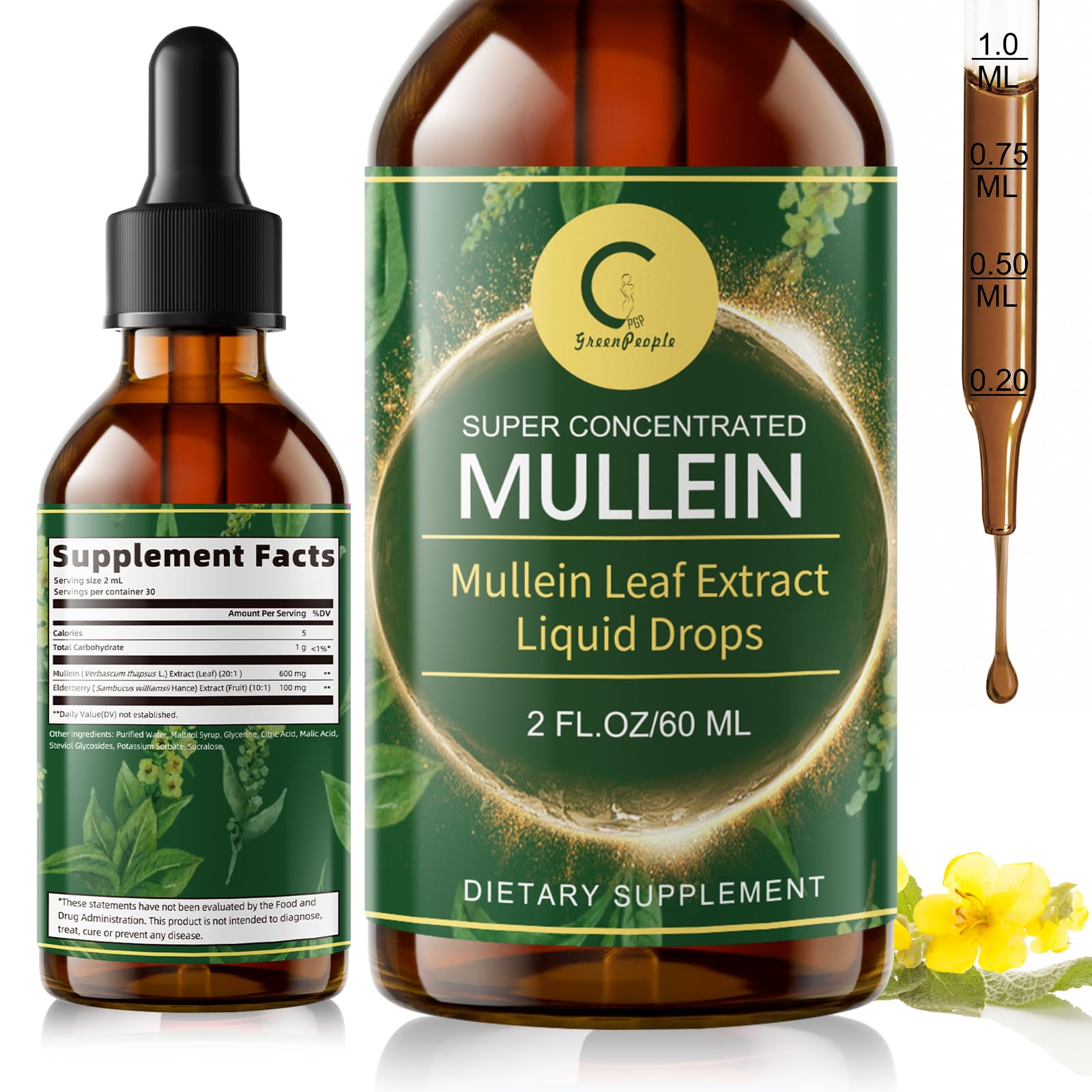
A berry-sweetened dropper you mix into coffee — no capsule, no steeping, no bitter finish.
This is the easier drinking option: a 2 FL OZ tincture that pairs mullein leaf extract with elderberry, an alcohol-free, non-GMO, vegan-friendly liquid you can stir into water or tea or hold under your tongue. The elderberry is there on purpose — the maker frames it as dual support, mullein for the respiratory side and elderberry for antioxidant support. For anyone who has given up on swallowing pills, this format removes the obstacle entirely.
Taste is where this one pulls ahead of every capsule on the list. Buyers describe a sweet berry aroma, a mild flavour, and a clean finish with no bitterness — and it goes down smoothly enough that people mix it into coffee and water rather than bracing for it. Buyers rate effectiveness highest, then breathability, with early notes describing less coughing and less throat clearing within a couple of days. The word that keeps surfacing is non-drowsy, which matters if you take it in the morning. Most owners mention it addresses excessive mucus and scratchy-throat complaints.
Two small annoyances come up honestly. The 2 FL OZ bottle is not large, and a full daily dose drains it faster than buyers expect — one review notes plainly that it “empties fast with daily full dose.” The other is the dropper itself, which tends to drip and can stain a counter if you set it down carelessly. Neither affects what is in the bottle, but both are real. Set the dropper on a saucer and the second problem disappears.
The taste advantage, stated plainly: sweet berry aroma, mild flavour, with one buyer noting it goes down smoothly and without a bitter aftertaste.
Two annoyances to plan around: the small 2 FL OZ bottle drains quickly at a full daily dose, and the dropper drips and can mark a countertop.
Built for you if: you want your mullein in a drink and taste is the reason capsules never worked out.
Worth knowing going in: keep a saucer under the dropper and buy a second bottle if you plan a full daily dose.
5. Fidus Mullein Drops Alcohol Free
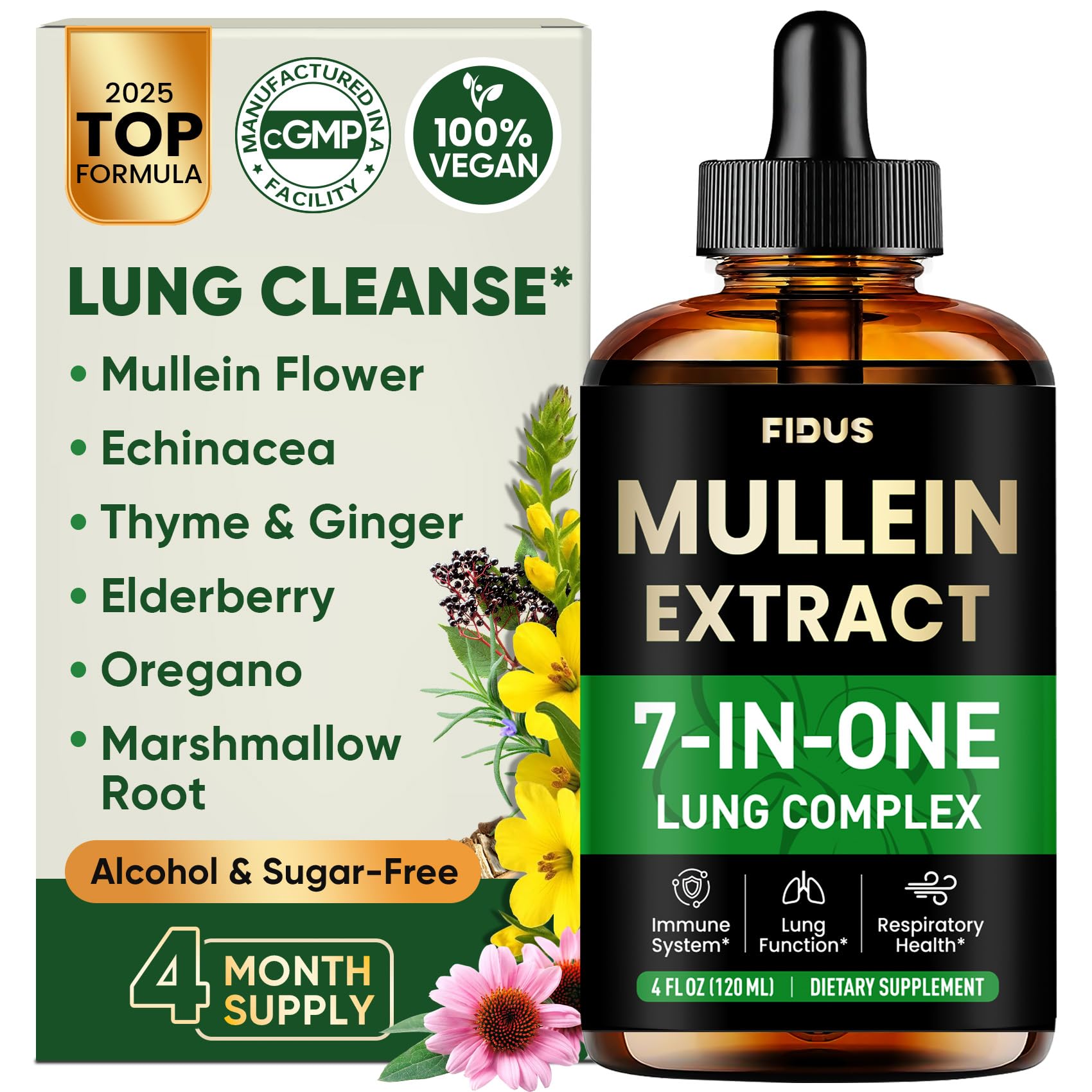
Seven herbs in one dropper, and the only formula here using both mullein flower and leaf.
Fidus goes wider than every other pick. Where the rest keep it simple, this one blends seven botanicals: mullein, thyme, and marshmallow for the respiratory side, elderberry and echinacea for mucus, and ginger and oregano for digestion and general wellness support. It is also the only formula on this list that uses both mullein flower and leaf, not leaf alone, which the maker calls a dual extraction aimed at deeper cleansing. It is alcohol-free, built for smokers and health-conscious users, and sold as 120 servings per bottle — the highest stated serving count in this lineup.
After effectiveness, buyers mention lung health most, which tells you who this attracts: people who already think about their lungs daily. The most detailed account reads like a careful shopper who had watched doctors talk about COPD, listened closely to the ingredient list, then reported less phlegm coming up day by day and feeling better overall. Others describe lungs feeling clearer within two days, less chest congestion, and a pleasant taste. One word of caution in the maker’s own copy: the liquid is a rich brown, and that colour is intentional — full-plant extraction, no artificial dyes.
The honest caveat is that opinions on safety are mixed, and value for money splits the same way — some consider it well worth it while others disagree. One buyer found results took a while to arrive, and this is not the formula for someone who wants plain single-herb mullein and nothing else. If you want the simplest possible ingredient list, the Frontier bag or the Double Wood bottle gives you just that.
The Seven-Herb Case
- Mullein, thyme, marshmallow, elderberry, echinacea, ginger, and oregano in one alcohol-free dropper
- The only formula here using both mullein flower and leaf for its dual extraction
- 120 servings per bottle, the most stated servings in this lineup, with a printed expiration date on the item
The Honest Counterpoints
- Opinions on safety are divided, so check the full ingredient list against anything you already take
- Value for money draws both praise and the opposite in the same review pages
- A seven-herb blend is not the pick if you want mullein on its own
The right fit when: you want a broad multi-herb dropper aimed at smokers and you value the flower-plus-leaf extraction.
Step back if: you prefer a single-ingredient formula you can fully account for — the plain-leaf picks suit that better.
Know the Specs
Milligrams Per Serving
This is the weight of mullein in one dose, and the trap is that the same number can hide very different capsule counts. A 1000 mg serving on one bottle means two capsules, while a 1000 mg serving on another means three. Always read the serving line before the milligram figure, because the serving is what you actually swallow each morning. If a label lists 1000 mg but you only take one capsule, you are getting less than the stated dose.
Servings Per Bottle
Servings, not capsule count, is the number that tells you how long a bottle lasts. Double Wood states a full 90 servings per bottle; Vitamatic states roughly 66; the Fidus dropper states 120. Divide those by how much you take daily and you have your real cost-per-day comparison. This is the single most useful figure on any mullein label, and it is the one most often skimmed past.
Common Questions
Is loose dried mullein leaf better than capsules?
How many capsules of mullein should I take in a day?
Does mullein extract taste bitter?
How long does one bottle of mullein last?
Is mullein extract safe to take every day?
What is the difference between mullein leaf and mullein flower?
Can I use mullein leaf for tea and for tinctures from the same bag?
Are mullein drops alcohol-free?
Can I mix mullein drops into coffee or tea?
Why is some mullein liquid dark brown?
The Bottom Line
For most people, the mullein leaf extract winner is the Frontier Co-op Mullein Leaf, Cut and Sifted, because a single 16-ounce bag of dried leaf covers tea, homemade tinctures, and skin preparations, and it holds its freshness and aroma well enough that buyers keep coming back to the same bag. If you want the simplest possible habit, reach for the Double Wood 1000 mg capsules — 90 servings stated right on the label is the cleanest three-month supply in this lineup. And for a liquid you can stir into your morning coffee with a berry flavour and no bitter finish, the Mullein Drops with Elderberry is the one to reach for. Whichever form you land on, check the serving line first and buy the format you will actually keep taking — that is the choice that decides everything else.
How we choose
We do not accept paid placement. Every pick is matched to a real buyer and a real use-case; we do not hands-on test units.
Sources
Specifications: manufacturer listings and product documentation. Review insights: verified customer reviews, as of October 2026. Pricing: not shown on this page (it changes often); check the current price via the retailer link.
As an Amazon Associate, Aappliancez earns from qualifying purchases. This does not affect which products we feature.