Disclosure: Some links in this post are affiliate links. As an Amazon Associate I earn from qualifying purchases, at no extra cost to you. Learn more
Specs are compiled from manufacturer listings and verified buyer reviews and can change over time — please confirm the key details on the product page before buying.
If you want the short answer: a dedicated player with a real digital-to-analog converter (DAC — the chip that turns digital files into actual sound waves) will beat your phone’s headphone jack, and the difference is biggest with high-impedance headphones and lossless files. The picks below cover a genuine range — from a warm analog-sounding desktop-grade machine down to an entry player that still decodes DSD. What separates them is the DAC chip, the amplification power in milliwatts (mW — a measure of how hard the player can push your headphones), and whether the operating system gets in your way.
This guide is built by comparing the manufacturers’ published specifications and the patterns across verified customer reviews, so you get each pick’s real strengths and trade-offs instead of marketing spin.
Every player here is sold as a high-resolution music source, and several decode DSD (a file format recorded at a far higher sample rate than a CD). But sound quality is only half the decision — storage limits, battery behavior, and usability decide whether a player gets used daily. Below, each pick is judged as a working music source first.
Top Picks

How To Choose The Best MP3 Player for Sound Quality
Sound quality in a portable player comes from three physical things working together: the DAC chip, the amplifier circuit that follows it, and the power delivery that keeps both stable under load. Everything else — the screen, the shell, the app store — is support structure. Here is what to weigh before you buy.
Why Sample Rate Is Not The Whole Story
A file stamped “384kHz” or “DSD256” only helps if the player’s decode chain can handle it natively, without converting it down first. Native decoding means the file plays at its original rate from chip to output. Many budget players claim high-resolution support but quietly downsample anything above CD quality. If your library is all MP3 or standard streaming files, that distinction matters far less than amplifier quality.
Balanced Output And What Actually Drives Hard Headphones
Power output quoted in milliwatts (mW) is measured into a specific load, and the same number means very different things on a 16-ohm in-ear monitor versus a 300-ohm over-ear headphone. A balanced jack — the 2.5mm or 4.4mm connection — typically supplies more voltage and separates the left and right grounds, which raises usable power and widens the stereo image. High-impedance or power-hungry planar headphones often need that balanced connection to reach comfortable volume, while sensitive IEMs are driven fine by the regular 3.5mm jack.
Storage, And Why Expandability Has Limits
Built-in storage tells you what the player boots with; the microSD slot tells you what you can actually carry. Cards are cheap, but the supported maximum varies wildly — some players accept up to 2TB while others plateau at a set figure. A lossless library also eats card space fast, and many players need the card pre-loaded from a computer rather than synced through a cloud service. Check the card format requirement too, because some models behave best with a specific one.
Side-by-Side Comparison
| Model | Best For | DAC / Output | Battery | Storage | Amazon |
|---|---|---|---|---|---|
| FiiO M33 R2R★ Best Overall | Analog warmth with real drive | R2R ladder, 1100mW balanced | 8–10 hrs | 128 GB + microSD | Amazon |
| MECHEN M30Best Value | Audiobooks and simple playback | WM8965 DAC + TI amp | 25 hrs | 64 GB card included | Amazon |
| HIFI WALKER H2Top Performer | Desktop DAC duty for a laptop | ESS ES9018K2M, 70mW at 32Ω | 8–10 hrs | 128 GB card included | Amazon |
| HIDIZS AP80 Pro-X | Pocketable with a phone as source | Dual ESS9219C | 8–11 hrs | microSD up to 512 GB | Amazon |
| Surfans F28 | Fingertip control with a big screen | Dual ESS9018 | 10 hrs | microSD up to 512 GB | Amazon |
| JadeAudio JM21 | Streaming apps on a budget | Dual CS43198, 700mW balanced | 12.5 hrs | 32 GB + microSD | Amazon |
| HiBy R4 | A modern iPod with a music app store | 4 DAC chips, Class A amplifier | 11 hrs | 32 GB + microSD to 2TB | Amazon |
| FiiO M21 | Desktop mode for long listening | Quad CS43198, 950mW | 10–13 hrs SE | 64 GB + microSD | Amazon |
| Sony NW-WM1AM2 | Reference separation and clarity | S-Master HX amplifier | 6–8 hrs | 128 GB + microSD | Amazon |
Detailed Reviews
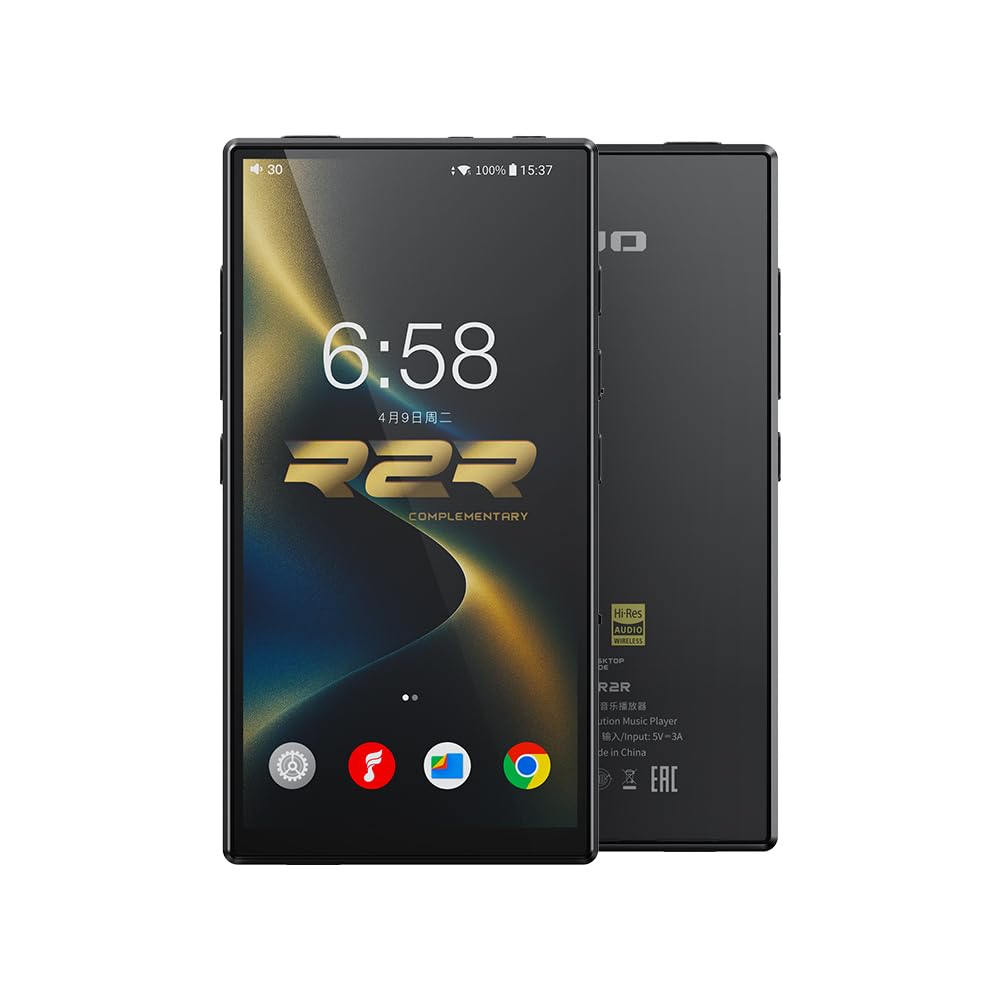
1. FiiO M33 R2R Portable HiFi Music Player
Our pick — over 4★ from 40+ verified ratings; the strongest balance of quality and price.
An R2R resistor-ladder DAC with 1100mW of balanced output for full-size headphones.
Most players convert digital audio with an off-the-shelf chip. The M33 R2R instead builds its conversion stage from a resistor ladder array — an older, physically fussier way of turning numbers into voltage that many listeners describe as smoother than the chip-based sound. It is FiiO’s first portable player built around their own R2R design, and the machine then gives you two voicings to pick between: FLAT, which is neutral, and WARM, which adds an analog-style smoothness. The idea is that you choose the flavor once and then stop fiddling.
The rest of the hardware is a small computer rather than a stripped-down music box. A Qualcomm Snapdragon 680 chip runs the show with 8GB RAM and 128GB of internal storage, so the touchscreen stays responsive and your library loads without waiting. That 5.5-inch 1080×2160 AMOLED screen can be dressed up with cassette, spectrum, or VU meter themes, which sounds like a gimmick until you realize it changes how it feels to sit with an album. On portability, the 258g body carries an AG matte glass back.
Where it earns its place on a sound-quality list is the output stage. Four INA1620 headphone amplifiers run in a fully differential TI analog circuit, pushing up to 1100mW + 1100mW from the balanced jack. In plain terms, that is enough current to drive full-size headphones rather than just sensitive in-ears. There is also a dedicated XMOS XU316 USB audio processor for low-latency playback, AUTO EQ that automatically matches your headphone’s frequency curve, plus manual and preset EQ on top of it, and line-out plus coax SPDIF if you want to feed the player into a separate headphone amp.
R2R DAC sound
- True R2R ladder conversion with FLAT and WARM profiles — two genuinely different voicings from one player.
- Balanced output rated at 1100mW + 1100mW, enough to push full-size headphones instead of just IEMs.
- 8GB RAM and 128GB built-in storage keep the interface and library fast.
- Snapdragon 680 chip means the streaming and app experience feels like a phone, not a gadget.
- AUTO EQ removes the trial-and-error of dialing in a headphone curve by hand.
slow startup
- Update the firmware to 1.01 before you judge it — a buyer reports the shipping v1.00 builds are buggy with incomplete translation.
- The documentation is wrong about the microSD slot, which actually exists.
- Bass is reported as constrained by at least one listener against a cheaper Cayin player, so this is a voicing choice, not a universal upgrade.
pick for warmth: a fit for the listener who wants a warm, analog-flavored house sound and the current to drive demanding full-size headphones from one pocket-sized box.
pass if impatient: the sound signature is a deliberate choice, and buyers report the low end is dampened against cheaper competition — if you want an analytical or bass-forward tuning, look at the HiBy R4 instead.
2. MECHEN M30 HiFi MP3 Player 64GB DAC Decoding DSD Gray
A 64GB-card player with a WM8965 DAC and a 25-hour battery for wired listening.
The M30 runs a WM8965 DAC paired with a TI TPA6530 amplifier — two dedicated chips handling the conversion and the drive, rather than a single integrated part. In practice, that two-stage setup is what gives it a clean, slightly warm presentation with the formats most people actually own: MP3, WMA, WAV, APE, FLAC, AAC, and OGG, up to DSD 128 at 5.6MHz. A 64GB microSD card is already installed, so you can load music and go. The player itself has no built-in memory beyond that card, which is worth knowing before you buy.
What makes the M30 easy to live with is the interface and the battery. There is a single rotary wheel for scrolling and a dedicated menu key plus a return key with one-key lock screen, so navigation is muscle memory within an hour. The 1500mAh battery is quoted at 25 hours of continuous playback, and a buyer reports seeing up to 10 hours of daily use on a single charge. The 2.0-inch LCD at 320×240 shows lyrics and track titles, which is more than enough for the use case here: long audiobooks and full-album listening rather than browsing through a library on a touchscreen.
The build is CNC aluminum alloy that resists fingerprints and was reportedly durable enough to survive two drops. Buyers who value simplicity find the setup takes under three minutes. The honest trade-offs: there is no Bluetooth, no WiFi, and no touchscreen, so pairing with wireless headphones is off the table. Shuffle mode is unreliable on full discs, and the scroll wheel and buttons are the parts that wear first. Those are fair caveats for a player in this tier — not dealbreakers if wired playback is what you want.
choose for DSD: for audiobook marathons, CD-collection playback, and any buyer who wants a wired player with genuine DAC hardware and no software to learn.
avoid if color matters: if you want Bluetooth, a touchscreen, or a swappable music interface — the M30 is deliberately none of those things.
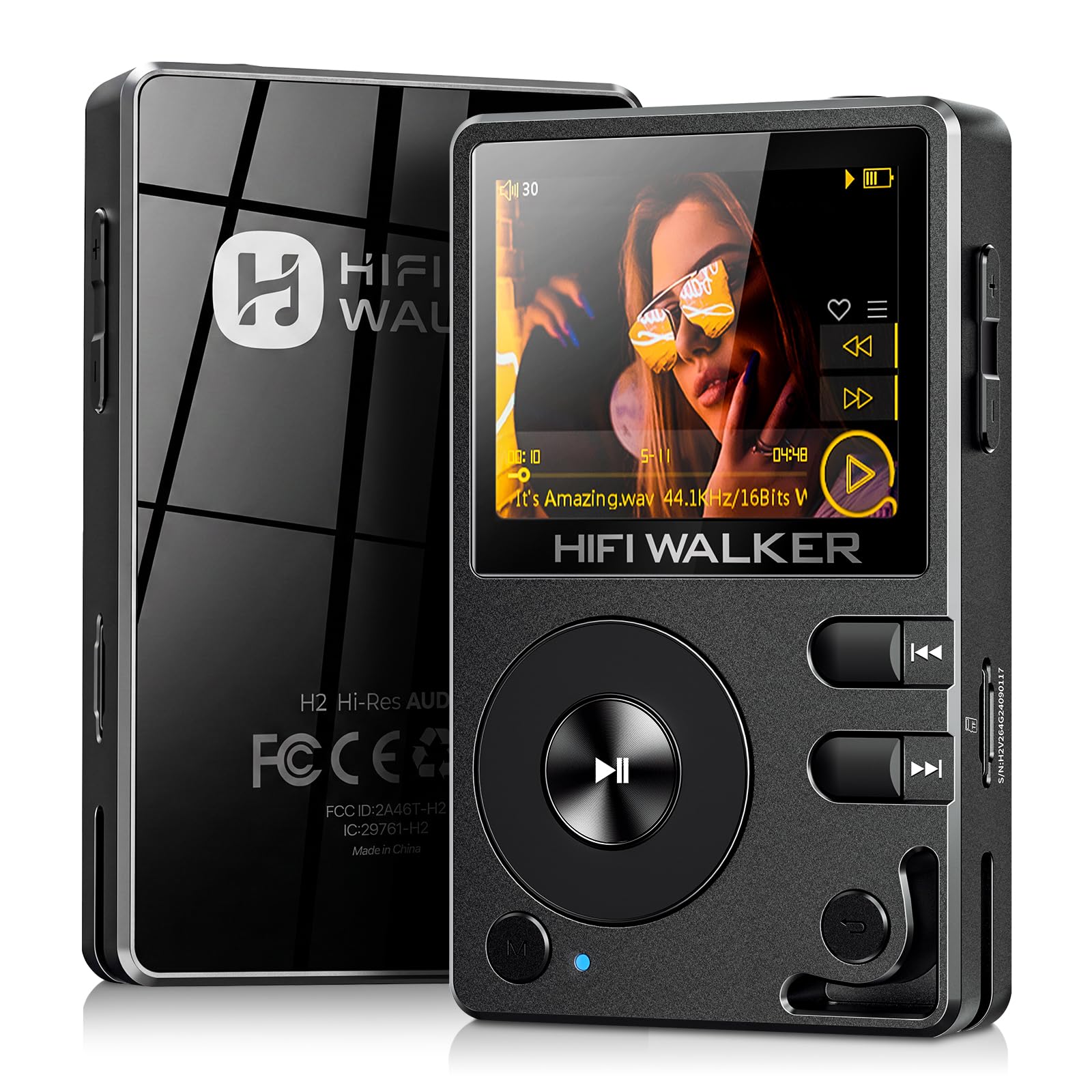
3. HIFI WALKER H2 HiFi MP3 Player with Bluetooth
An ESS ES9018K2M DAC that also works as a USB sound card for your laptop.
The H2’s headline is an ESS ES9018K2M DAC decoding at 32-bit/384kHz with native DSD128, quoted at a 107dB signal-to-noise ratio (a measure of how quiet the background between notes is) and 0.008% THD (total harmonic distortion, where lower means less added coloration). Its output is rated at 70mW at 32Ω with a 1.5V line-out — enough for most in-ears and moderate headphones, though demanding high-impedance models will want more. The storage story is unusually generous for the tier: a 128GB microSD card is already in the slot, and the player is quoted to hold up to 14,999 songs, versus 64GB from the start on the MECHEN M30 above.
Two features earn the H2 its place here. First, it works as a portable USB DAC when you plug it into a computer — it bypasses your laptop’s onboard sound and outputs the same converted audio, which is a real quality step-up for anyone doing desk listening on the same device they carry. Second, Bluetooth 5.2 runs in both directions with Qualcomm aptX, so the H2 can act as a wireless receiver for your phone or stream out to headphones and car stereos. The CNC-machined zinc alloy body and 2.0-inch screen round out a durable commuting setup. Playback is quoted at 8–10 hours wired or wireless.
The trade-offs are real but familiar for this class of player. There is no streaming and no built-in music store — you load files manually from a computer or via microSD. The stock operating system is limited, and the community fix is a Rockbox install that resolves fonts and scroll behavior. One buyer also reports that the bundled microSD card corrupted early and recommends replacing it. The result is a strong value for the listener willing to set a card up once and stop touching it.
grab for wireless: if you want a pocket player that also upgrades your laptop’s audio, and don’t mind swapping a stock card once.
leave if screen quality: if streaming apps or a modern touch interface are must-haves — the H2 is a files-first player by design.
4. HIDIZS AP80 Pro-X MP3 Player with Bluetooth
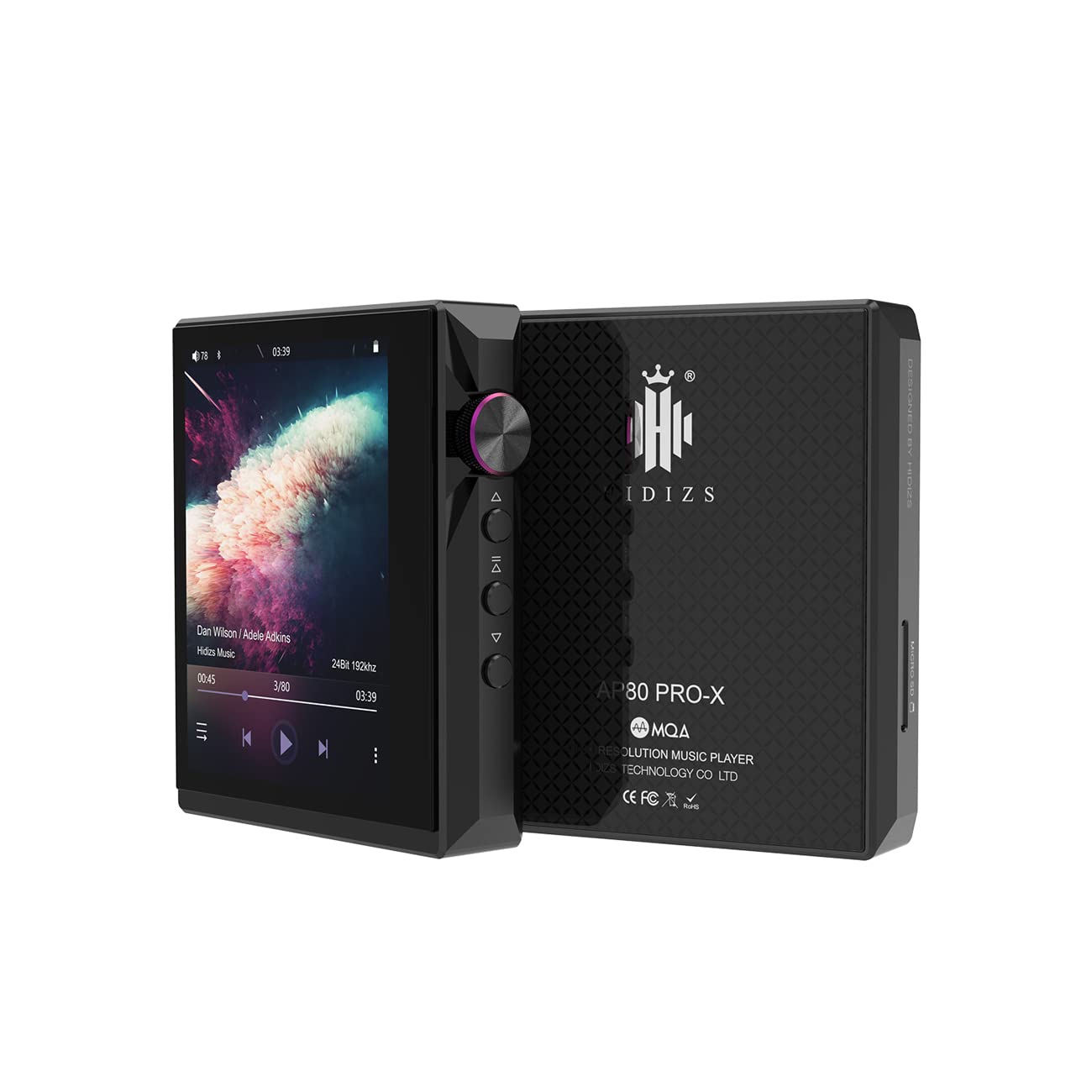
A 72g player with dual ESS9219C DACs and a 2.5mm balanced jack for harder loads.
Dual ESS9219C DACs give the AP80 Pro-X a quoted +121dB dynamic range and -114dB THD+N, decoded natively up to DSD256 via an FPGA (a programmable chip that manages the timing and conversion path). That combination is unusual in something weighing 72g. For listeners using regular wired IEMs, the 3.5mm single-ended output handles the load easily; for full-size headphones, there is a 2.5mm balanced jack, and balanced output often doubles the current the amp can deliver. A Japanese ALPS volume wheel and CNC-milled aluminum unibody give it the tactile feel of gear costing more.
The AP80 Pro-X also wears several hats. Bluetooth 4.2 runs in both directions with CSR aptX, so it can stream to headphones or receive a signal from your phone. When connected via USB, it works as a two-way USB DAC, letting your computer use its converters instead of the onboard audio. There is a step counter, e-book reading, and support for LDAC and MQA unfolding. Standby is quoted at 40 days. In practice that means it can sit in a bag for weeks and still be ready — a real convenience for anyone who reaches for a player on trips rather than every day.
The controls are where the compromise shows. The interface is built around a click wheel and a small touchscreen, and owners mention the wheel — on the rare unit that fails — is the first thing to go. There also isn’t a built-in library sorting option based on album artist, which is problematic for anyone with a large collection. For the listener who uses the AP80 as a small, dedicated source paired with a single playlist or album, those limitations vanish. It is a pocket player, not a library manager.
get for portability: you want the smallest possible rig to drive good IEMs or a headphone amp, and don’t mind loading music from a computer.
skip if need space: you have a large library that needs album-artist browsing, or you want to stream without a phone.
5. Surfans F28 Hi Res Lossless Portable Music Player

A 3.5-inch touchscreen, dual ESS9018 DACs, and a 2.5mm balanced output.
Inside the F28, an Ingenic X1000E processor runs dual ESS9018 DACs, and the decode chain handles PCM up to 24-bit/384kHz plus native DSD256. The playlist of supported filetypes is broad, covering DSF, DFF, APE, FLAC, OGG, M4A, AIFF, AAC, WAV, MP3, and WMA, so most libraries will play without conversion. Bluetooth is bidirectional with support for AAC, SBC, LDAC, and CSR aptX — the F28 can stream to a speaker as easily as it can act as a receiver for your phone. A 2.5mm balanced jack runs alongside the standard 3.5mm single-ended output, so you can use full-size headphones without an external amp.
The front-panel experience is where the F28 differs from its peers. A 3.5-inch IPS touchscreen takes up the face, wrapped in a zinc alloy chassis with a 2.5D curved glass back panel and an ALPS scroll wheel. Loading music is quick — one buyer reports moving 12,500 files (roughly 150GB) onto a 256GB card in about 45 minutes, with the database scan finishing in 4 minutes. Bluetooth pairing was reported under a minute to a Bose speaker. The F28 also physically fits a shirt pocket — its measured footprint comes in at roughly 4.7 inches tall, which is compact for a 3.5-inch screen.
The trade-off is the interface polish. Buyers describe the software as less refined than an Android player, with quirks like resetting to the first album after a power cycle, and a bright display that can wash out track text in some lighting. The back also demands care — the glass and acrylic layers are not built to shrug off drops onto hard surfaces, so a case is sensible. One reviewer noted random shutdowns across three weeks of heavy use; given how much of the rest of the ownership experience reads positive, this looks like a unit-level issue rather than a pattern, but the risk is worth noting.
take for files: you want a real screen, dual DACs, and two output stages from a pocket-sized player and can live with a software experience that isn’t slick.
ditch if streaming: you drop your gear regularly or expect Android-grade polish.
6. JadeAudio/FiiO JM21 Android 13 Hi-Res Music Player

Android 13 streaming apps, dual CS43198 DACs, and 700mW balanced output under.
The JM21 runs on a Qualcomm Snapdragon 680 — a 6nm octa-core Kryo 265 processor clocked up to 2.4GHz — paired with Android 13, so streaming apps like Spotify and Apple Music install directly from their stores. That is the real headline for listeners who want their whole library in one place but hate phone-battery anxiety. Two Cirrus Logic CS43198 DACs sit at the heart of a fully balanced architecture, backed by a pair of SGM8262 op-amps, and the balanced output is quoted at 700mW + 700mW. The physical footprint is just 13mm thick and 156g, so it sits in a pocket easily. Battery is quoted at 12.5 hours, and customers note battery drain around 10% per hour during active listening.
What wins people over is the balance of sound quality against price — the sound signature lives up to the DAC spec sheet, and the noise floor stays low enough to hear detail in dense mixes. The audio processing chain, branded by FiiO as DAPS, uses a fifth-generation FPGA and dual femtosecond crystal oscillators to keep the sampling rate intact whether you’re playing local files or outputting to an external USB DAC. There is a microSD slot (up to 2TB), plus a pre-installed screen protector and case in the box, which is a rare courtesy at this price point.
The two areas to size honestly: battery, which a few buyers find drains faster than expected in standby, and the physical durability of the case coating, with one buyer reporting flaking after a couple of months. The 3GB/32GB configuration also means you’ll be leaning on the microSD card for storage rather than the internal drive. None of that undercuts the value proposition — the JM21 is cheaper than almost anything else here that offers full Android and a balanced output — but it does mean you should plan on sourcing a card and treating the chassis with care.
select for apps: the buyer who wants an Android music player with streaming apps and real headphone drive, and is comfortable adding their own microSD card.
reject if battery life: you want a sealed appliance with no app management at all — the Android layer is the point here.
7. HiBy R4 MP3 & MP4 Player with Bluetooth and WiFi

Four DAC chips and a Class A amplifier inside an Android 12 pocket player.
The architecture here is unusual. Four DAC chips sit alongside two dedicated low-phase-noise crystals and 28 high-precision tantalum capacitors, feeding an integrated Class A headphone amplifier. In plain terms: four conversion paths can be switched independently to suit different music files, the crystals keep digital timing precise, and the Class A amp biases its transistors to stay in their most linear region — the trade-off being heat and battery draw. Playback covers up to DSD256 natively, PCM768kHz/32-bit, and MQA 16X unfolding. On paper, that’s the most aggressive sample-rate support on this list.
HiBy runs a Snapdragon SD665 octa-core processor with Android 12, 3GB RAM, and 32GB built-in storage, and a system-wide SRC bypass keeps audio passing through unmodified. Dual-band WiFi (2.4GHz and 5GHz) handles app installation and wireless song transfer, and the 4500mAh battery is quoted at roughly 11 hours.
The catch sits in the software over time. Android 12 is modified and the interface is not modern, and reviewers point out the system occasionally freezes or needs a hard reboot. Battery is quoted at around 12 hours with WiFi and Bluetooth off. The unit is also physically chunky — the price of the big screen and balanced jack — and the side buttons are easy to press accidentally unless you use the key-lock switch. For a buyer who treats the R4 as a desktop-adjacent player rather than a jogging companion, the trade-off is worth it; a few have found it not durable enough for daily carry.
pick for WiFi: you want streaming apps, room for a giant microSD library, and a Class A amp in a single device.
pass if lightweight: you need a bulletproof pocket unit for commuting every day or you want the leanest possible software stack.
8. FiiO M21 Android 13 Portable Music Player
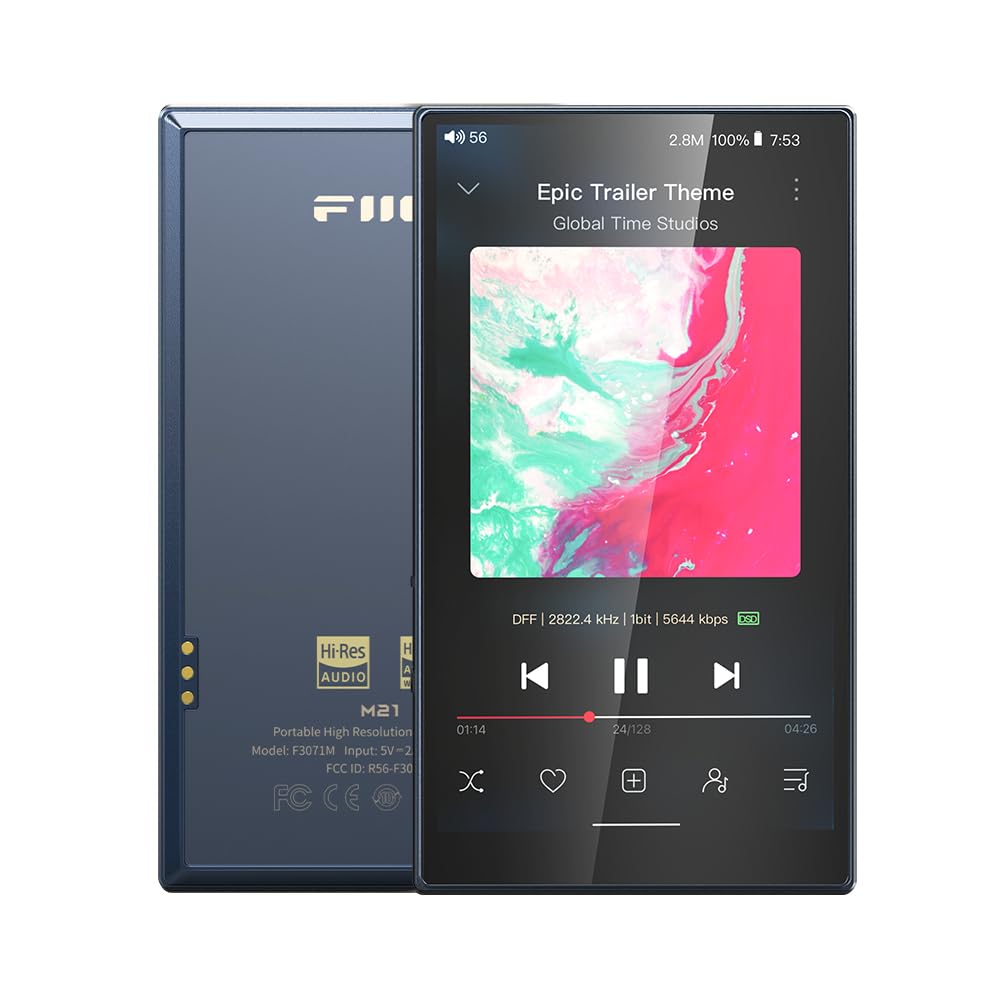
Runs off wall power for long sessions and gives four DACs room to stretch.
The M21’s defining feature is Desktop Mode: engage it and the player runs entirely from external power, with the built-in battery neither charging nor discharging, which protects the battery over long listening sessions. That is genuinely useful for a bedside or desk setup, and it’s a feature almost nothing else here offers. Around that sits a real performance platform — a Snapdragon 680 processor on a 6nm process, 4GB RAM, 64GB built-in storage, and Android 13, so streaming apps install and run as they would on a phone. Audio conversion uses four Cirrus Logic CS43198 DACs in a matrix configuration with a two-stage balanced amplifier, quoted at 950mW of output power — enough to comfortably drive most full-size headphones.
For driving harder loads, the M21 has independent line amplification circuits on both output stages, dual 3.5mm and a 4.4mm balanced headphone jack, plus SPDIF and USB audio output. FiiO quotes the SPDIF performance as reducing jitter by 70%, which matters if you want to feed the player into a separate desktop DAC. Buyers consistently note the sound as warm and musical, with strong instrument separation. Reviews also praise the physical package: tactile buttons, a solid build, and a cassette mode that has become a small cult feature among owners.
Where the M21 gets needly is reliability. Shoppers say occasional software freezes, and at least two users describe display anomalies that required replacement units. Battery life also drops sharply in balanced mode, with one buyer reporting 10–13 hours listening via the single-ended output and only 6–8 hours via 4.4mm balanced. If you plan to use the M21 at a desk in Desktop Mode, that split stops mattering. If you want it for flights and long walks, the single-ended output is the one to build around.
choose for OS: you want an Android music player that can live on your desk plugged in, and prefer a warm, full sound signature.
avoid if storage: you need sealed, always-reliable firmware, or you plan to run balanced-only and can’t tolerate the shorter runtime.
9. Sony NW-WM1AM2 Hi-Res 128GB Walkman Digital Music Player

The reference-sounding Walkman that wants to be the last player you buy.
This is the machine Sony built for listeners who have already stopped chasing features and started chasing tone. The S-Master HX digital amplifier is Sony’s own technology, paired with a large solid high-polymer capacitor and an OFC milled block, a construction that channels the analog circuitry more like a piece of hi-fi gear than a pocket player. Native DSD playback is supported directly, so no conversion step stands between the file and the output. Buyers describe the sound as smooth, analog, and warm, with rolled-off treble that many find less fatiguing for long sessions than brighter sources.
The rest of the machine is built to hold up for years. An aluminum frame supports the structure, and there is 128GB of built-in storage plus a microSD card slot for carrying a larger library — buyers have used cards up to 1TB with the player. WiFi is on board for downloading and streaming, so Spotify and other services work, which makes it far more flexible than the file-only crowd would assume. It can also be used as a USB DAC to feed a desktop setup, and high-gain mode is available for harder-to-drive headphones. At 490g, this is not a featherweight, and that is part of the point.
The honest catch is the software. Android 11 hasn’t been updated, RAM is limited enough that album art can load slowly and boot takes time, and there is no user-replaceable battery. Buyers also report the default player requires formatting the card on first use, and Sony’s Music Center for PC software gets mixed treatment. Those are things you learn to work around — but if you expect modern smartphone responsiveness, this isn’t that. The pitch is that none of it compromises the sound.
buy for brand: you want a long-term reference player with an analog-leaning tuning and are willing to accept the outdated software in exchange.
skip if budget: you need modern Android performance or a swappable battery — both are absent by design.
Know the Specs
DAC Type and What It Does
The DAC — digital-to-analog converter — is the chip that turns your files back into an electrical signal. Chip-based designs from ESS, Cirrus Logic, and Qualcomm are the mainstream approach; a resistor-ladder (R2R) design like the one inside the FiiO M33 R2R instead builds conversion from a physical resistor array, which is what gives it its famously warm, analog-flavored voicing. Neither is objectively “better” — they just sound different, and the rest of the circuit (amplifiers, capacitors, clocking) determines how much of that character actually reaches your ears.
Output Power, Impedance, and Balanced Connections
Headphones present a load measured in ohms (Ω — the resistance the amplifier has to push against). The higher the impedance and the lower the sensitivity, the more voltage and current the player needs. Balanced output on a 2.5mm or 4.4mm jack typically supplies more power than the standard 3.5mm single-ended connection, which matters for full-size headphones like high-impedance Sennheisers or planar models. For sensitive in-ear monitors, the 3.5mm jack is usually plenty. Match the jack to the headphone, not the other way around.
Battery, Standby Drain, and Desktop Mode
Battery life quoted by manufacturers is generally measured with the screen off and moderate volume, and it drops sharply when you engage balanced output, Bluetooth, or WiFi. Some players (like the FiiO M21 in Desktop Mode) can run entirely from external power so the internal battery doesn’t cycle at all. Others still sip power in standby — a few percent a night — which matters if you pick a player up after a week in a bag. If long trips or all-day listening are your use case, section modes that extend the battery draw matter as much as the raw hour figure.
Storage, File Support, and Cards
Internal storage loads the player on day one; the microSD slot decides what you actually carry long term. Support is quoted in maximum card size, but the file system the player expects (exFAT is common; some players prefer others) and how full the library can get before browsing gets slow matter just as much. Lossless files eat ten times the space of MP3s, so a 1TB card is less generous than it sounds when the library is FLAC. Load your card on a computer before first use — most of these players aren’t cloud-synced.
Common Questions
Do I need a dedicated MP3 player if I already have a phone?
Will a high-impedance headphone work with these players?
Does DSD actually sound better than FLAC or MP3?
What’s the difference between single-ended and balanced output?
How much storage do I need for a lossless library?
Can these players also work as a USB DAC for my computer?
Do these players stream Spotify and Apple Music?
How long does the battery actually last with real-world use?
Is it worth upgrading from a budget player to a premium one?
Do these players work with both wired and Bluetooth headphones?
The Bottom Line
If your goal is the warmest, most analog-sounding playback with enough current to run full-size headphones, the FiiO M33 R2R is the one to reach for — its resistor-ladder conversion and 1100mW balanced output are the reason it tops this list. If instead you want the smallest possible pocket rig that still drives demanding gear, the HIDIZS AP80 Pro-X at 72g fits a shirt pocket and offers dual DACs plus a 2.5mm balanced jack. And if you simply need a budget-first entry into lossless playback that also handles long audiobooks, the MECHEN M30 with its 1500mAh battery and 25-hour quoted runtime is the practical starting point.
How we choose
We do not accept paid placement. Every pick is matched to a real buyer and a real use-case; we do not hands-on test units.
Sources
Specifications: manufacturer listings and product documentation. Review insights: verified customer reviews, as of October 2026. Pricing: not shown on this page (it changes often); check the current price via the retailer link.
As an Amazon Associate, Aappliancez earns from qualifying purchases. This does not affect which products we feature.