Disclosure: Some links in this post are affiliate links. As an Amazon Associate I earn from qualifying purchases, at no extra cost to you. Learn more
Specs are compiled from manufacturer listings and verified buyer reviews and can change over time — please confirm the key details on the product page before buying.
You want to change a blade or scrape the deck, and the mower is sitting on the garage floor at knee level with nowhere to put a wrench. A mower lift fixes that with one clean idea: raise the front end, lock it, and get real room to work. The picks below split into two families — wheel-cradle lifts that roll a tractor onto a platform, and deck-hook lifts that grab the mower’s front edge and tilt it up. Both work. Which one fits you depends on your machine and your floor.
This guide is built by comparing the manufacturers’ published specifications and the patterns across verified customer reviews, so you get each pick’s real strengths and trade-offs instead of marketing spin.
If your mower will not roll onto the lift, the lift is the wrong size for your wheels. Three things decide that fit: steel thickness, rated capacity (how much weight it holds) and lift height. This breakdown covers nine real lifts so you can spot the one that fits your tractor. Every lift below earns its place because buyers use it for the same two jobs you will: blade swaps and deck scraping. The best mower lift is simply the one that lines up with your wheel span and your garage floor.
Top Picks


How To Choose The Best Mower Lift
The mistake almost every first-time buyer makes is shopping by capacity alone. An 880 lb platform sounds like more lift than a 500 lb one, and it is not — it is often a lighter, thinner frame built to hit a big number. What actually keeps you safe is a locking mechanism you trust, a base that does not walk on your floor, and a lifting point that matches your mower. Get those three right and the capacity label becomes the least interesting number on the box.
Match the lift to how your mower is built
A wheel-cradle lift rolls the front tyres into cradles and raises the whole front axle, so the deck rises with the frame. That is the right tool for a standard riding tractor or a zero-turn with a flat front end. A deck-hook jack, by contrast, hooks onto the mower’s front deck baffle and tilts the machine up on that edge. It is compact and cheap, and it needs a lifting tooth that actually clears your baffle — the standard tooth covers most mowers, but longer or wider baffles can need a bigger one.
Check your wheel span before anything else
Every cradle lift lists a wheel span range, and outside that range the mower simply will not sit in the cradles. A 47.5 inch ceiling will not take a wide zero-turn, and a 40.75 inch floor will not grip a narrow garden tractor. Measure the outside edge of your front tyres, not the deck — deck size tells you nothing about whether the wheels will land in the cradle. Confirm the lift’s quoted range covers your number with a little room to spare on both ends.
Manual crank, or add a drill
The manual crank handle works on every lift here and always will — no battery, no charger, no dead tool. But hand-cranking a heavy front end is slow work, and several of these lifts ship with a power-tool extension handle so you can spin the screw or winch with a cordless drill. Buyers who add a cordless drill report raising the front end in seconds instead of minutes of cranking. If you already own a cordless drill, the extension handle is the single most useful add-on in this category.
Safety hardware that earns its keep
A safety stop is a physical pin or notch that catches the lift arm if the hydraulics or screw lets go — it is the thing standing between you and a dropped deck. Look for multiple stop heights, not one, so you can work at the height you actually need. A supplied safety strap that ties the mower to the lift is the second half of the same idea, and it is worth checking that the strap is included rather than assumed.
Side-by-Side Comparison
| Model | Best For | Rated Capacity | Max Lift Height | Lift Type | Amazon |
|---|---|---|---|---|---|
| MoJack HDL500★ Best Overall | Most riders and ZTRs | 500 lbs | 24 inches | Hydraulic wheel cradle | Amazon |
| Jungle Jim’s Jungle Jack V2Best for Trailers | Trailer and job-site use | 800 lbs | 19 inches | Deck-hook, twist-arm lock | Amazon |
| MoJack MJ-PROHeaviest Rated | Commercial zero-turns | 750 lbs | 28 inches | Manual or drill winch | Amazon |
| Craftsman 45099 | Drill-powered front lifting | 500 lbs | 24 inches | Manual or drill, fold-flat | Amazon |
| VEVOR Hydraulic Jack | Wide tyre-frame cradles | 500 lbs | 25.9 inches | Hydraulic wheel cradle | Amazon |
| Pro Lift Lawn Mower Jack Lift | Foot-pedal hydraulic lifting | 300 lbs | 22 inches | Hydraulic foot pedal | Amazon |
| Pro-Lift PL5350Q | Wide-track garden tractors | 350 lbs | 23.25 inches | Hydraulic foot pedal | Amazon |
| Mulinsonfly Telescopic Jack | Tight storage, light carry | 880 lbs | 23.6 inches | Manual or drill crank | Amazon |
| LZBEITEM Lifting Platform | Occasional use on a budget | 880 lbs | 38.58 inches | Manual or drill crank | Amazon |
Detailed Reviews
1. MoJack HDL500 45501 Hydraulic Lift Jack
Our pick — 4.5+★ from 500+ verified ratings; the strongest balance of quality and price.
A hydraulic platform that holds a 500 lb front end at three locked heights and folds away after.
If you own one mower and you want the job done without second-guessing the equipment, this is the lift the rest of this list gets measured against. The working numbers are a 500 lb load capacity, a 24 inch maximum lift height with a 17.5 inch minimum, and a wheel span that adjusts from 18.5 inches out to 47.5 inches. That span range is the reason it lands under so many machines — it will cradles a narrow garden tractor and still reach a full-width residential zero-turn. The hydraulic cylinder does the heavy work, so you are pumping rather than cranking.
What wins people over is the build — the welded steel frame and the three fixed safety stops at 12, 18 and 24 inches, backed by an included safety strap. Owners crawl under the deck with confidence because the arms pin into steel stops, not fluid alone. The hydraulic action is smooth enough that a heavy lawn tractor goes up easily and sits stable, and buyers who service their own deck say the whole job turns routine instead of dreaded. It also arrives essentially assembled to the point where the extra step is pinning the tyre cradles, and it folds flat so it tucks into a garage corner rather than owning floor space year-round.
Here is the honest catch, and it is a floor problem rather than a build problem. This lift needs an absolutely level, hard surface — concrete or very flat paving. Set it on gravel or a slope and it will not behave, so if your mower lives on a dirt or crushed-stone pad you should plan the work on the driveway instead. It is also a 68 lb unit, which is 15.5 lb heavier than the VEVOR on this list but buys you the smoother hydraulic ram for it. Store it flat and dry and the mechanism stays sweet. At 4.5+ stars across 500+ ratings, it is the crowd favorite on this page, and those three physical stops are why.
Where It Delivers
- Three fixed safety stops at 12, 18 and 24 inches plus an included strap hold the load with the hydraulics off
- Wheel span adjusts from 18.5 inches to 47.5 inches, covering most residential tractors and ZTRs
- Hydraulic cylinder lifts a heavy front end smoothly instead of hand-cranking it
- Folds flat for garage storage and needs only the tyre cradles pinned on setup
What To Plan Around
- Demands a level concrete or paved surface; gravel and slopes defeat it
- 68 lb to move around and store
- Stability is the most-discussed point in the reviews, and a few owners note the boom arm opens when you roll the unit — grab the base crossbar instead
Buy this if: you have a residential tractor or zero-turn under 500 lbs and a concrete pad to work on.
Skip the upgrade path: a commercial mower over 500 lbs needs the MoJack MJ-PRO, not this one.
2. Jungle Jim’s Jungle Jack V2 Lawn Mower Lift Jack
Fifteen pounds of steel that hooks a deck baffle and lifts a zero-turn 19 inches.
Every other lift on this page is a platform you roll a mower onto. This one is a lever that hooks the front deck baffle and tilts the machine — which is why it weighs 15 lb and takes up almost nothing in the truck bed. The rated capacity is 800 lb, the lift height is 19 inches, and the locking method is a twist handle safety arm that locks the jack in place without pulling pins. For a lawn-care operator who wants a lift riding on the trailer between jobs, that combination is close to ideal.
The safety arm is the part owners keep coming back to, along with how stable the machine feels once the arm is set. Buyers report raising and safety-barring the deck in under 30 seconds, without wrestling a floor jack that has slipped before. Assembly is the other side of that story: the manual is weak and a couple of owners found the steps tedious, with more than one pointing people to YouTube walkthroughs instead. Budget twenty minutes and a video and it goes together fine. The spring-loaded lifting tooth hooks the deck baffle, so check the tooth clears yours — the standard 2 inch tooth covers most mowers, and a 3 inch tooth exists for longer or wider baffles.
What it will not do is lift a whole front axle the way a cradle platform can. There is no safe way to hook a zero-turn at the rear because the engine weight tips it, so you lift the front only and work one end at a time. On a 36 inch Scag the tooth also needs offsetting from the centre anti-scalp wheels, and the deck has to be raised to max to hook it. If your mower is a wheel-cradle machine through and through, the MoJack HDL500 is the better fit — but for a trailer, a small shop or a tight shed, this is the lightest and most portable answer here.
The real advantage: at 15 lb it is the only lift here you can carry one-handed to a job site, and the twist-arm lock makes deck scraping a two-minute chore instead of a pin-fumbling session.
Set your expectations: it lifts the front end, not the axle, and a heavy mower still takes some strength to lever — plenty for a lighter machine, less pleasant on a big commercial deck.
Reach for this if: you mow for a living and want the lift on the trailer with you.
Look elsewhere if: you want a whole-axle platform for a single residential tractor — a cradle lift handles that better.
3. MoJack MJ-PRO 00145 Commercial Mower Lift Jack
The commercial-duty answer for zero-turns that laugh at consumer lifts — 750 lbs up to 28 inches.
Run a zero-turn with a 60 inch deck and the consumer lifts below stop making sense — the front end alone pushes their numbers. The MJ-PRO is built for exactly that: a 750 lb rated capacity, a 28 inch lift height (four inches higher than the HDL500 above) and a wheel span that reaches from 31.5 inches out to 62.5 inches. On a 1,175 lb commercial ZTR with a 60 inch deck, it lifts the front cleanly and holds it. It also accepts the MoJack Workbench attachment if you want to expand the frame into a workshop tool.
What this rig buys you is time. With a half-inch cordless drill on the winch, a blade change that eats a whole afternoon drops to about three-quarters of an hour, and the latching pawl plus strap lock the machine solidly while you work. Buyers servicing several mowers a season single out the safety straps and lift lock as the reason they trust it. Assembly is straightforward though the unit is heavy, and it needs wheel chocks separately to stop the mower rolling — the strap holds the mower to the lift, not the lift to the floor.
The honest caveat is that the crank and tower need looking after. The lifting mechanism is the most-discussed point across the reviews, and it splits both ways — some find the drill makes it nothing, while hand-cranking a heavy front end is real effort. One owner’s crank seized after roughly six weeks until oiling it quieted and freed it, so treat lubrication as routine maintenance, not a repair. Durability is still the least-loved aspect, so store it dry. For the money it is a serious tool built for volume, and it shows.
Built for: commercial crews and big-deck ZTR owners who need 28 inches of clearance and 750 lbs of rated lift.
Think twice if: you only mow a small residential lawn — this is more lift than that job needs.
4. Craftsman 45099 Zero Turn Mower Lift Jack

Same 500 lb and 24 inch numbers as the top pick — with a drill doing the cranking.
You raise this lift with a drill trigger instead of a lever, and that is the one place it beats the MoJack HDL500. On paper the two read close: 500 lb front lifting capacity, 24 inches of lift, and a wheel span of 18.5 to 47.5 inches that fits a wide set of residential ZTRs (zero-turn riders) and tractors. A drill takes the mower up quickly, and lowering is simple once you learn the lock. It folds flat for storage, which matters if the garage is already full.
Stability is the second thing everyone mentions, and the redundant safety straps holding the front wheels are what put most owners at ease. It lifts a 52 inch Husqvarna lawn tractor and a 345Z John Deere zero-turn when the adjustable wheel slots are pushed in fully. Fit is fussy about that one detail — push the slots home and the cradles grip; leave them loose and the mower does not sit right. Assembly is straightforward with clear instructions, and hand-cranking works fine if your drill is flat.
Set expectations on two counts. The lift height is enough for blade work but not generous for full under-deck scraping, so a taller machine may leave you crouching. And the lowering mechanism wants discipline — a couple of owners found it would disengage mid-lower even with the safety handle held up, leaving them cranking awkwardly. Hold the lock deliberately every time and treat it gently, and it does the job it is sold for. This is the pick for a Craftsman or comparable residential machine and a drill you already own.
Fastest on the drill: raise and lower with your drill instead of a lever, which is the whole point of this model.
The catch: the lowering lock needs a firm, deliberate grip — rush it and the mechanism can disengage.
Own the drill? Yes: this is the smoothest manual-or-drill lift for a residential zero-turn.
Second-guess it if: you need maximum under-deck clearance for heavy scraping — the 24 inch height runs tight.
5. VEVOR Lawn Mower Lift with Hydraulic Jack

Four tyre-frame settings per end and a 25.9 inch ceiling — the widest-span cradle here.
Start with the span numbers, because they are why this one earns its place. The carbon steel tyre-frame arms carry four settings on each end and stretch to fit front wheel outer edges from 40.4 inches to 48.2 inches, which covers a lot of the wide-track zero-turns the narrower cradles miss. It lifts to a maximum of 25.9 inches — nearly two inches above the 24 inch picks — so the deck sits higher while you work. Capacity is 500 lbs, and the hydraulic ram takes the front end up smoothly. As a buyer puts it: “Hydraulic lift smoothly raises 420lb Cub Cadet LT46 to ~25in; spring-loaded locking pins secure arms if jack fails.”
Those spring-loaded locking pins plus three base slots let you secure the mower at the height you choose, and non-slip rubber covers on both sides of the base keep the platform from shifting. At 52.5 lb it is the lighter of the full-size hydraulics here — 15.5 lb lighter than the HDL500 — which makes rolling it out and stowing it far less of a chore. Folding the two tyre frames off and collapsing the main support leaves it compact for a shed. On a Cub Cadet 46 inch riding mower on a concrete garage floor, it lifts fast and the blade swaps come easier.
Two things to know before you buy. Assembly has annoyed a few owners — the drive nut welds can be sloppy and take some fiddling to seat — so set an hour aside and be patient. It also tends to slide on grass, so like most hydraulic platforms it wants a hard level surface rather than turf. And the wheel brackets sit a couple of inches off the floor, which makes loading a touch awkward if a belt is off and the wheels need steering in. Sort those out and the higher lift and wider span make it a strong alternative to the HDL500 for a wide-track mower.
Why It Stands Out
- The widest tyre-frame adjustment on this list — outer edges from 40.4 inches to 48.2 inches
- 25.9 inch max height puts the deck higher than the 24 inch picks for scraping
- 52.5 lb is lighter than the HDL500 and collapses with the tyre frames removed
- Spring-loaded locking pins plus three base slots secure it at working height
The Honest Trade-offs
- Weld fitment on the drive nut makes assembly fussy for some buyers
- Slides on grass; needs a level concrete or paved surface
- Wheel brackets sit a couple of inches off the floor, complicating loading
Pick it for: a wide-track ZTR that squeezes the narrower cradles or needs a higher deck.
Steer clear if: you want zero assembly fuss — this one asks for patience at the welds.
6. Pro Lift Lawn Mower Jack Lift

A rubber-padded hydraulic foot pedal that pumps a light front end to 22 inches while you keep both hands free.
You pump this lift with your foot, so your back does the easy part. A non-slip hydraulic foot pedal (a pedal that pushes fluid to raise the load) pumps the mower up to 22 inches from ground to wheel saddle. No crank to spin, no drill to charge. The 300 lb capacity suits a smaller garden tractor or a light zero-turn, not a half-ton machine. The wheel span adjusts from 17.25 inches to 41.25 inches, so it takes a small tractor up to a mid-size ZTR. A rubber-padded platform keeps the deck paint free of scratches.
Two safety latches hold the mower up, not the fluid, so you are never trusting a hydraulic pedal over your head. Owners value that redundant pair (two latches doing the same job) most. Four steel wheels make it roll where you want it, and the whole thing folds down for storage under a truck or in a corner. Quality is the most-praised point across the reviews, and the simple assembly reinforces it. It lifts a 46 inch Cub Cadet deck to blade-change height without complaint.
The trade-off to weigh is that durability and value divide opinion here more than on the bigger MoJack plattforms — most are happy, but a minority report the rate-the-return feeling. More practically, a handful of units arrive short of a bolt or nut, so check the box before you start. And a 300 lb ceiling is firm — the 516 lb Craftsman T3300 it is often paired with is lifted at the front only, which is what it is designed for. Confirm your front-end weight sits under 300 lbs and this is a smart, easy-handling choice.
Easiest on the body: the hydraulic foot pedal plus dual latches lets you pump and go hands-free, which suits anyone who finds a crank hard on the wrists.
Size the load: 300 lbs rated means front-end lifting only for a heavier tractor — check that number before you commit.
Fits best: a light garden tractor or compact ZTR and an owner who prefers a foot pedal to a crank.
Not for: a mower whose front end creeps past 300 lbs — step up to a 500 lb platform.
7. Pro-Lift PL5350Q Lawn Mower Lift Jack

A 49.25 inch span and a 23.25 inch lift for the wide-track tractors that defeat narrower cradles.
A wide front end is the reason to pick the PL5350Q over the other Pro-Lift on this list. Its wheel track takes an outside span from 40.75 inches to 49.25 inches, the widest lower and upper bound of the hydraulic pedal lifts here. With a 350 lb capacity and a 23.25 inch maximum lift, it handles a front end that looks too wide for a foot-pedal unit. The welded solid steel frame, four steel wheels and rubber-padded platform all carry over. The non-slip foot pedal does the raising, so you are not dragging a crank.
Fitting a mid-size zero-turn is what it does well. It goes under a 54 inch John Deere ZTR without trouble and has no wobble at maximum lift. The steel wheels let you roll the lift into place and it lays flat for storage, so it takes up less shed space than its footprint suggests. Buyers who want to scrape a lawn tractor’s deck without unbolting anything get the clearance they need, and the safety lock keeps it parked there while they work.
Watch the pump and the build consistency. A few of these arrive with a bottle jack (the small hydraulic pump that raises the lift) that has leaked on the way over. Getting a replacement means returning the whole heavy unit rather than just the pump, so open the box fast and pump it once before the return window closes. The lift wheels can also drift while you are working, so chock the mower. On a good unit it is a capable, wide-track foot-pedal lift; just be ready to inspect it on arrival.
Choose it for: a wide-track zero-turn that needs 49.25 inches of cradle span and a hands-free foot pedal.
Check on arrival: pump the bottle jack once from the start — the occasional leaky unit needs returning promptly.
8. Mulinsonfly Ride-On Mower Jack Lift
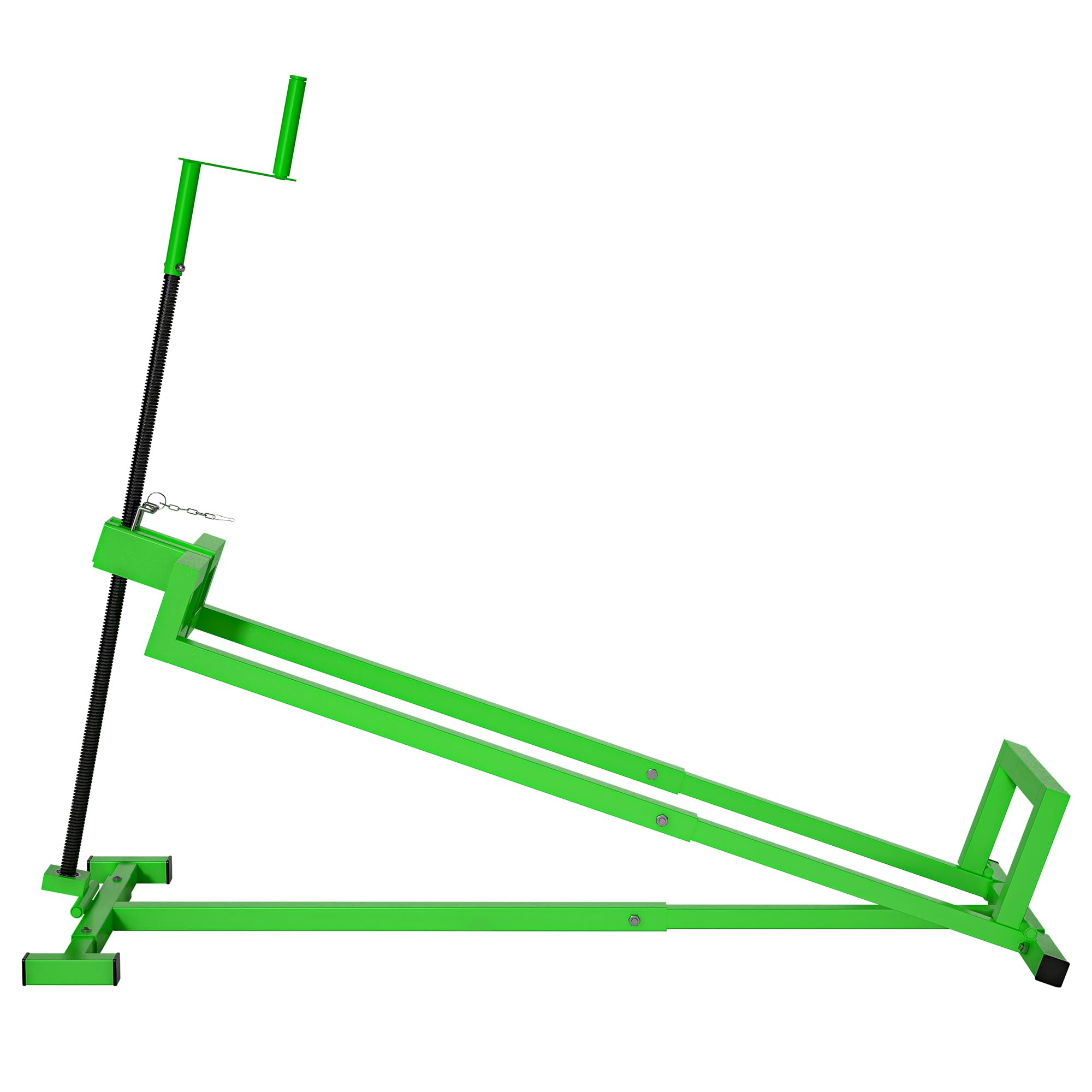
A 22.9 lb telescopic jack rated to 880 lbs that folds into a corner of the shed.
This is a different animal from the hydraulic platforms — a telescopic maintenance jack with two handles, a manual crank and a power-tool extension, so you hand-crank or drive it with a drill. The headline is an 880 lb rated capacity in a 22.9 lb frame, which is a huge capacity-to-weight ratio and the reason it is so easy to carry and store. Maximum lift height is 23.6 inches, the angle adjusts to a maximum of 45 degrees for reaching under the deck, and it folds down for the shed.
You stop pressing your face to the ground to peer under the deck. With a drill on the handle it lifts a 42 inch John Deere with ease, and you raise it and hose off the bottom instead. The crank handle works better than the specs suggest, taking the mower up quickly if you skip the drill. One owner’s take: sit a jack stand under it before crawling in, which is common-sense safety on any lifting device.
Two real catches. It is rated for a maximum mower width of 41.9 inches — beyond that you lift the front wheels only, so measure your machine before you buy. And assembly has divided buyers: some call it simple, while others found the instructions confusing and a few hit a lift bolt with an off-centre mounting hole that needed drilling to fit an adapter. Read the manual picture by picture and it comes together. For a light, compact, drill-friendly lift for a mid-size mower, it is a clever pick.
Best storage footprint: at 22.9 lb folds compact, this is the full-size lift you will actually fold away rather than leave out.
Mind the width: the 41.9 inch maximum width rules out wide-deck machines, and assembly wants a careful read.
Ideal for: a mid-size mower up to 41.9 inches wide and a shed with no spare floor.
Pass on it: if your deck is wider than 41.9 inches or you refuse to read diagrams at assembly time.
9. LZBEITEM Lawn Mower Lift Jack Lifting Platform

The cheapest way onto the page, with a 38.58 inch lift height that dwarfs the big platforms.
You get the most lift for the least outlay if you change blades once or twice a year. The numbers are odd for a budget lift: an 880 lb load capacity, a maximum lifting height of 38.58 inches, far above the 24 inch platforms, and an incline that tilts to 40 degrees so you can reach blades and wheels. It is a screw-drive jack (a threaded rod that raises the load) with a manual crank and a power-tool extension, so a drill spins it up fast. Powder-coated steel makes it weather-resistant for outdoor storage, and it folds down for the garden shed.
What wins the budget buyer is that it works. It lifts a 46 inch deck lawn tractor fine, and the drill attachment raises and lowers with almost no effort — hand-cranking takes more turns but gets there. Blade sharpening drops from a 30-minute wrestle to about a quarter of an hour. The frame is a solid square-tubular build with fair welds, and for a lift that gets pulled out a couple of times a season, it does the job. Set up is quick, with clear pictures; some find the instructions confusing while others find them easy, so follow the diagrams closely.
Know what a budget jack is before you buy. Owners describe it as slightly shaky and not as solid-feeling as the heavy hydraulic platforms. The manual does have a known assembly error: one bracket needs turning 180 degrees or the mower can slide off the low side. Always add a jack stand and wheel chock as a precaution. The return is simple: it costs a fraction of a hydraulic platform and lifts a mower you can safely work under once or twice a year, as long as you respect its limits and treat the setup carefully.
Why It Earns Its Place
- A 38.58 inch lift height far above the 24 inch hydraulic picks, for a fraction of the outlay
- Drill extension spins it up and down with almost no arm effort
- Powder-coated steel shrugs off shed storage and outdoor use
- Folds compact and sets up in minutes for once-a-season blade work
Where It Shows Its Price
- Feels lighter and shakier than the welded hydraulic platforms
- The manual has an assembly error — check the bracket orientation before you load a mower
- Best for occasional use; pair it with a jack stand and wheel chock every time
Right for: a homeowner on a budget changing blades a couple of times a year.
Not right for: anyone wanting a rock-solid platform under a heavy zero-turn — step up to hydraulic.
Know the Specs
Rated Load Capacity
This is the maximum weight the lift is built to raise, usually quoted as a load capacity in pounds. It is rarely the whole mower — most of these lifts raise the front end only, so the number you compare against is your front-end weight, not the tractor’s total. Buy headroom here: a lift rated meaningfully above your front-end weight behaves with less strain on the screw or ram, and you never want to run one at its ceiling.
Maximum Lift Height
How high the mounting point reaches off the ground, quoted in inches. More height means more room under the deck for scraping and belt work, but it also means a taller lift to store. A lift around the 22-24 inch mark clears most blade work; the taller screw jacks reach over 38 inches, which is generous clearance but usually comes with a lighter, less rigid frame. Match the height to the job, not to the biggest number on the page.
Wheel Span Range
The outside distance between your front tyres that the cradles will grab, quoted as a min-to-max in inches. This is the number that decides whether a cradle lift physically fits your mower. Measure outside edge to outside edge on your front wheels and buy a lift whose range brackets that figure. A span too narrow will not seat the wheels; a span too wide will not grip them. Deck size tells you nothing here — always measure the wheels.
Safety Stops and Straps
Physical notches or pins that hold the lift arm if the ram or screw fails, plus a strap that ties the mower to the lift. Multiple stop heights let you lock at the height you need; a single stop can leave you working too high or too low. A strap, or dual latches, means the load is held by steel rather than fluid. Treat these as the most important numbers on the lift — they are what stops a mower coming down on you.
Common Questions
Will a mower lift work on a gravel driveway?
How do I measure my mower for a lift?
Is a wheel-cradle platform or a deck-hook jack better?
Can I use a cordless drill to raise my mower lift?
How much lift height do I actually need?
Do I still need jack stands if the lift has a safety lock?
How heavy are these lifts to move and store?
Will a mower lift work with a zero-turn as well as a garden tractor?
What is the difference between 880 lb and 500 lb lift ratings?
Can a mower lift damage the deck or paint?
The Bottom Line
For most riders and residential zero-turns, the MoJack HDL500 wins because its hydraulic cylinder, three safety stops at 12, 18 and 24 inches, and 18.5 to 47.5 inch wheel span cover the everyday blade swap and deck scrape with real margin, and it folds flat when the job is done. If you run a commercial zero-turn and need more reach, the MoJack MJ-PRO lifts 750 lbs to 28 inches with a 62.5 inch span for the big decks. For a lawn-care pro who wants the lift on the trailer, reach for the Jungle Jack V2: 15 lb and a 19 inch lift you can carry one-handed. The safest money in this category is the HDL500: buy the proven hydraulic platform once and stop shopping.
How we choose
We do not accept paid placement. Every pick is matched to a real buyer and a real use-case; we do not hands-on test units.
Sources
Specifications: manufacturer listings and product documentation. Review insights: verified customer reviews, as of October 2026. Pricing: not shown on this page (it changes often); check the current price via the retailer link.
As an Amazon Associate, Aappliancez earns from qualifying purchases. This does not affect which products we feature.