Disclosure: Some links in this post are affiliate links. As an Amazon Associate I earn from qualifying purchases, at no extra cost to you. Learn more
Specs are compiled from manufacturer listings and verified buyer reviews and can change over time — please confirm the key details on the product page before buying.
If your property runs past two acres, most mowers quit on you before the grass does. The real split is between machines that ride you across the field and machines that drive themselves — and the right answer depends on how steep, how rocky, and how overgrown your ground actually is. This guide covers both routes, from a tracked remote-control unit that chews through six-foot weeds on a 37° bank to a 23 HP zero-turn that finishes a wide lawn in far fewer passes.
This guide is built by comparing the manufacturers’ published specifications and the patterns across verified customer reviews, so you get each pick’s real strengths and trade-offs instead of marketing spin.
You will see cutting widths, slope ratings, runtime and weight side by side, because those numbers decide whether a machine survives your back field. Here is the honest breakdown of the mower for large acreage that actually fits your ground, your slope, and your patience for upkeep.
Top Picks

How To Choose The Best Mower for Large Acreage
On acreage, the wrong machine shows its limits within the first mowing. A machine that sails across a suburban half-acre can bog down, tear turf, or run out of battery halfway through your back pasture. Start by measuring the two things that decide everything: how many acres you truly cut, and how steep the worst part of that ground gets.
Match the drive system to your slope
Slope is expressed as a percentage, and it climbs fast. A 37° hill equals a 75% grade, which is steeper than most people guess when they eyeball a bank. Machines here list ratings from 75% up to 84% (40°). If your ground is flat, spend your budget on deck width and speed instead of slope rating. If you have a ditch bank or a hillside orchard, that rating is the first number you check.
Cutting width sets your time per acre
A 54-inch deck clears far more grass per pass than a 21-inch one, so wide-open fields favor the big decks. Narrow decks win on tight, obstacle-heavy ground where a wide machine cannot turn. Think about your gates, tree spacing, and fence lines before you chase the widest deck you can find.
Decide who does the walking
Riding mowers put you in the seat for hours. Remote-control and robotic units let you stand back or go indoors while the machine works. The right choice depends on whether your ground is rutted and rough or clear and mappable. A riding mower handles rough, rutted ground with your hands on the wheel; a robotic unit needs a clear, mapped boundary and steady satellite or LiDAR reference to run unattended.
Side-by-Side Comparison
| Model | Best For | Cutting Width | Cutting Height Range | Power / Weight | Amazon |
|---|---|---|---|---|---|
| Mowrator S1 4WD★ Best Overall | Steep, overgrown ground | 21 in | 1.5–4.3 in | 56V 18Ah · 147.7 lb | Amazon |
| Husqvarna Z254FWidest Deck | Wide open lawn, fast passes | 54 in | 1.5 cm–4.5 in | 23 HP gas · 595 lb | Amazon |
| Mammotion LUBA 3 AWDBest Mapping | Hands-off mowing, mapped zones | 40 cm | 1.0–2.7 in | 12Ah battery | Amazon |
| MOVA LiDAX Ultra 3000 | Wire-free robotic setup | 15.8 in | 1.2–3.9 in | 36V 243Wh · 52 lb | Amazon |
| Segway Navimow X430 | Up to an acre, steep banks | 17 in | 0.75–4 in | Dual 180W · 63.7 lb | Amazon |
| CRAFTSMAN 42″ | Budget riding mower | 42 in | up to 3.13 in | 17.5 HP gas · 410 lb | Amazon |
| MechMaxx 60″ Flail | Tractor owners, rough brush | 60 in | 0.6–1.8 in | PTO 540 RPM · 673 lb | Amazon |
| MechMaxx VAM48 | Ditches and embankments | 48 in | 0.65–2 in | PTO 540 RPM · 613 lb | Amazon |
| EGO Power+ TR4204 | Quiet electric riding | 42 in | 1.5–4.5 in | 56V 6.0Ah ×6 · 640 lb | Amazon |
Detailed Reviews
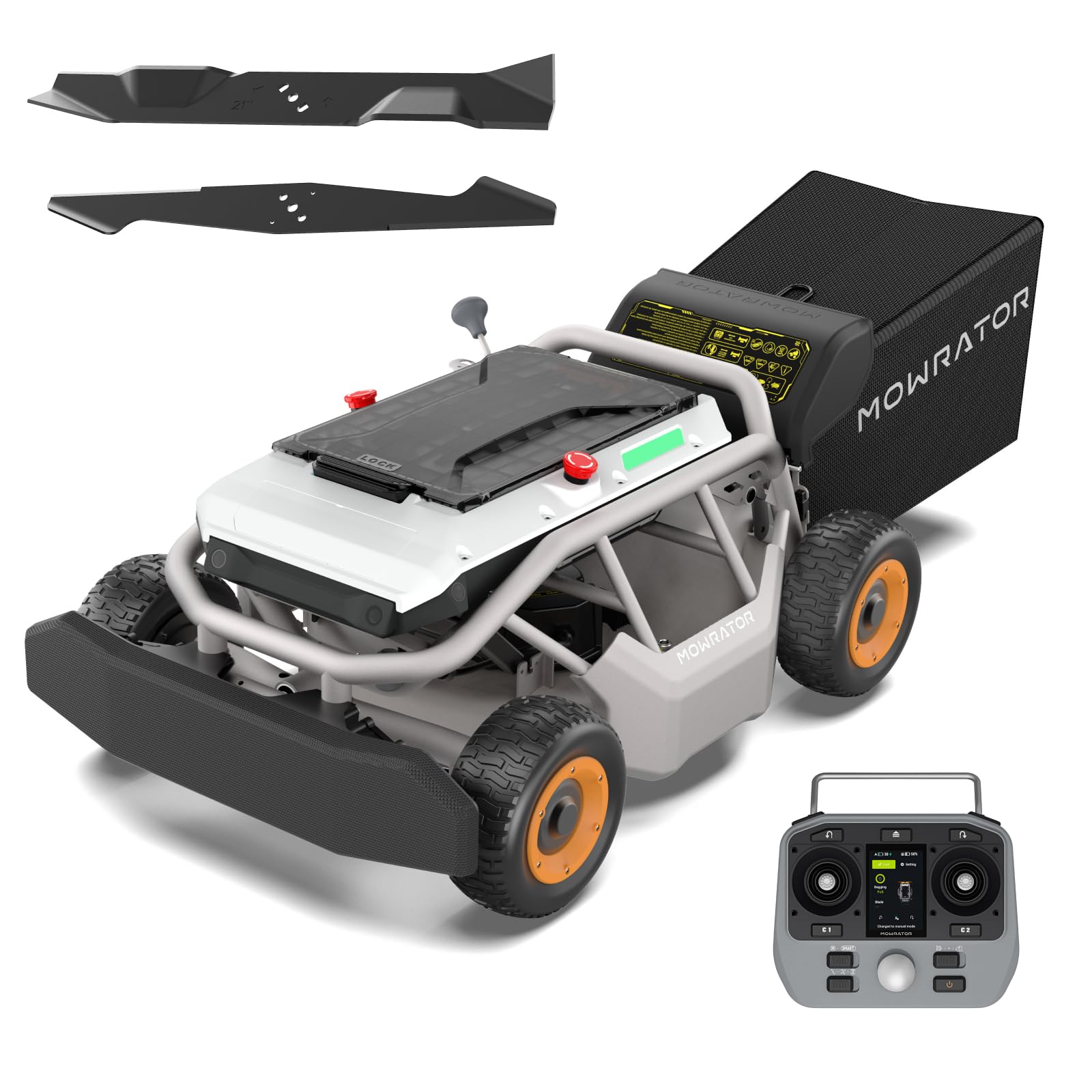
1. Mowrator S1 4WD 18Ah Remote Control Lawn Mower, 21-Inch
Our pick — 4.5+★ from 50+ verified ratings; the strongest balance of quality and price.
The tracked remote unit that stands on the bank and mows it for you.
If your worst ground is a steep, rutted bank you dread every summer, this is the machine that ends the argument. The Mowrator S1 climbs slopes up to 37° (a 75% grade) on a 4WD drivetrain, and it relays that power through a 21-inch blade spinning up to 3,200 RPM. You drive it from a low-latency remote with response times as low as 5 ms, so there is no lag between your thumb and the deck — handy when you are steering around a pond edge or a tree root.
It earns its keep on banks and ditches too steep or rutted to risk a riding mower on. Owners consistently praise how much ground it clears per hour. Owners put it to work on ground most mowers refuse: one reports it “Cuts 6-ft invasive grass on steep rocky 38-acre terrain ~10x faster than string trimmer.” Buyers also describe the build as tank-like, shrugging off farm weeds. The wide wheels and FOC E-Brake (an electronic brake that stops the blade precisely) keep it stable and controllable on ditches and uneven turf.
Runtime is a real planning number, not a guess. The 56V 18Ah LiFePO4 battery covers up to 1.125 acres per charge with up to 2.25 hours of runtime in ideal conditions, and the included 600W charger refills it in about 90 minutes. Weighed against the Husqvarna Z254F at 595 pounds, this one sits at 147.7 pounds — light enough to roll into a shed, and its 21-inch cut is a fraction of the Husqvarna’s 54-inch swath. The catch is honest: all-wheel drive can tear turf in a tight turn, and a few owners hit the occasional error stop that needs a restart. For a slope-heavy or overgrown property where a rider is dangerous, that trade is easy to accept.
What it does well
- Climbs 37° (75%) grades on 4WD, with a 1,985.6W peak blade motor for dense growth
- Zero learning curve, no RTK setup or app, works for limited-mobility owners
- Runs 2.25 hours and charges in 90 minutes on the included 600W charger
- Three modes — mulching, rear discharge, and bagging — plus a 63 dB operating level
Where it asks patience
- Wide wheels can rip turf when turning sharply, so plan your paths
- An occasional unit throws an unexplained error stop that requires a restart
Reach for it if: your acreage includes banks, ditches, or weeds too tall to walk a rider into safely.
Look past it if: you want a full afternoon of uninterrupted mowing — plan to bank a charge break.
2. Husqvarna Z254F 54 in. Zero-Turn Riding Mower
A 54-inch swath turned by a 23 HP Kawasaki, built to finish big open lawn fast.
On wide, flat, dry ground, a 54-inch deck beats a narrow one on time per acre. The Clearcut deck here spans 54 inches versus the Mowrator’s 21 inches, so each pass covers a far bigger strip, and the 23 HP Kawasaki engine pushes it to a top speed of 6.5 MPH. A hydrostatic transmission (a fluid drive that needs no clutch) means you steer and go without shifting, and the whole thing rides on a comfortable seat with an anti-slip foot area.
Owners come back to the same word — performance. That is the praise it earns across the line, and it lands squarely on the deck and engine. One lawn-care company owner rates it highly and notes the deck ships black rather than the orange in the older listing photo. Setup is small: seat, battery, and control arms, done in minutes with basic tools. From a value angle it does a lot of near-commercial-grade work for a homeowner budget.
The honest follow-up question is traction. The recurring gripe is the rear tires on wet grass, and as one owner puts it bluntly: “Needs better rear tires does not do well on wet grass.” That is a fit issue, not a defect — if your ground holds moisture, wait for it to dry or shop a different machine. The 54-inch deck and 4.5-inch maximum cutting height still make it the fastest way to clear a big lawn in one sitting.
The wet-grass caveat: traction is the one recurring note in an otherwise performance-first machine.
Why the wide deck wins: fewer passes across a large lawn is real hours saved every single week.
Suits you when: you own a broad, flat lawn and want to sit down and get it done at speed.
Think twice if: your ground stays damp — those rear tires are the weak point you will feel.
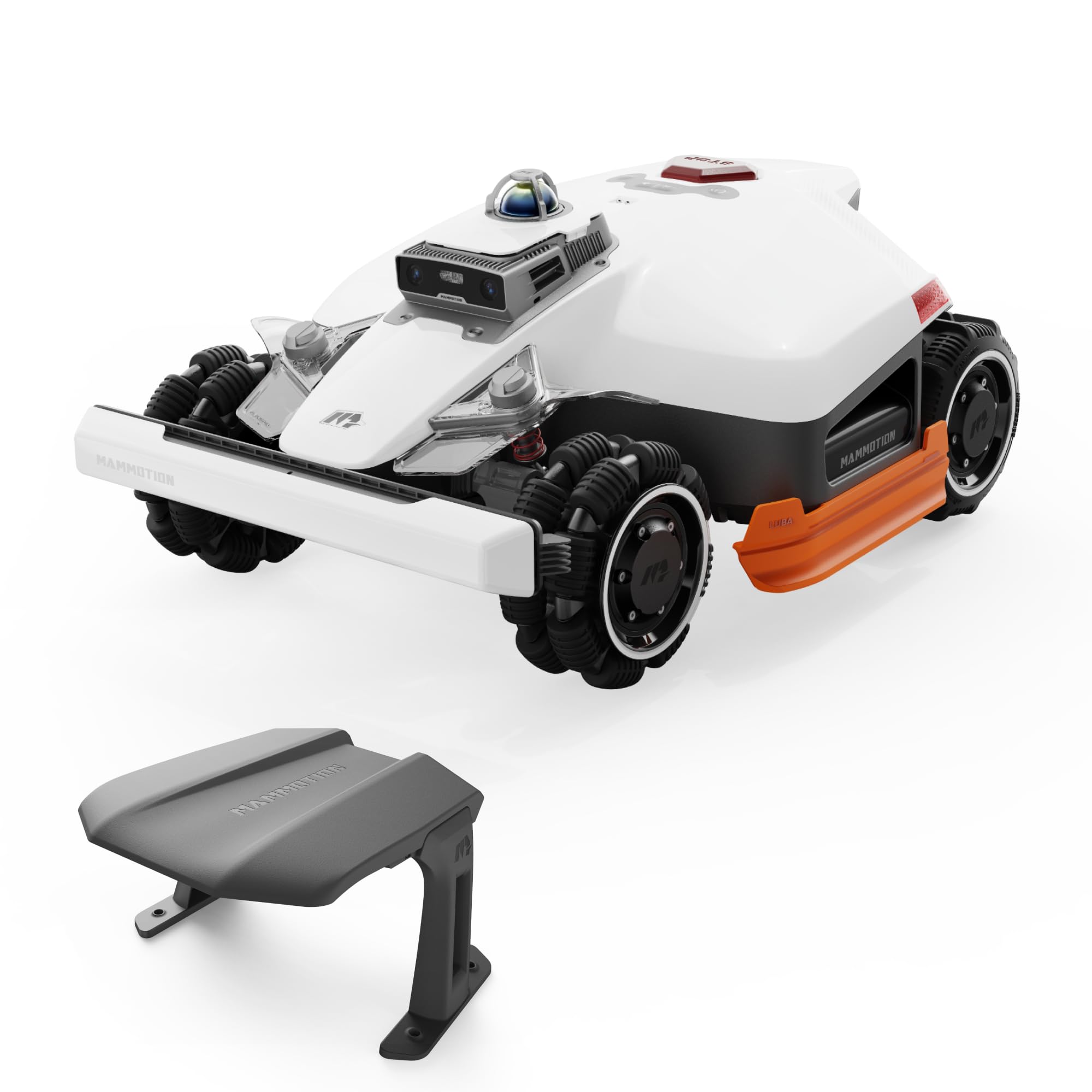
3. Mammotion LUBA 3 AWD 5000 Robot Lawn Mower with Garage
Four independent motors, 360° LiDAR, and it comes with its own garage.
The LUBA 3 is the robot for a lawn with real terrain. Its four separately driven motors climb slopes up to 80% (38.6°), and an adaptive suspension system steps over curbs and roots up to 50 mm high without stalling. The 360° LiDAR (a laser scanner that builds a live map of your yard) sweeps a 59° vertical view out to a range of up to 230 ft, so it can read ground level and tree canopy at the same time.
Setup and the look of the thing both land well. Owners describe mapping four zones with six no-go areas in about an hour, and the digital map can be redrawn segment by segment rather than starting over. Cutting is handled by two 165W motors on 6-blade discs, and the 12Ah battery runs up to 175 minutes per charge while covering up to 500m²/h. It also recognizes over 300 obstacle types with AI vision, which means it will route around toys, pets, and garden furniture on its own.
The fair question is time and cutting consistency. For tough or narrow corners, the cleanup pass can drag, and some buyers find the software settings fussy — the “channel” versus mapping language confuses people and settings do not always carry over per area. An occasional unit has been reported tripping false emergency stops after a firmware update. None of that erases a machine that saves hours weekly; it just means you should expect a tuning period before it runs clean.
What sets it up to succeed: 80% slope capability plus 300+ obstacle types recognized makes it one of the few robots suited to genuinely rough ground.
What you should plan for: budget a tuning week — the map settings take adjusting before it settles in.
Worth it if: you want a self-driving mower for a rough, multi-zone yard and do not mind dialing in settings once.
Hold off if: you expect it to be perfect from day one with zero software fiddling.
4. MOVA LiDAX Ultra 3000 AWD Robot Lawn Mower
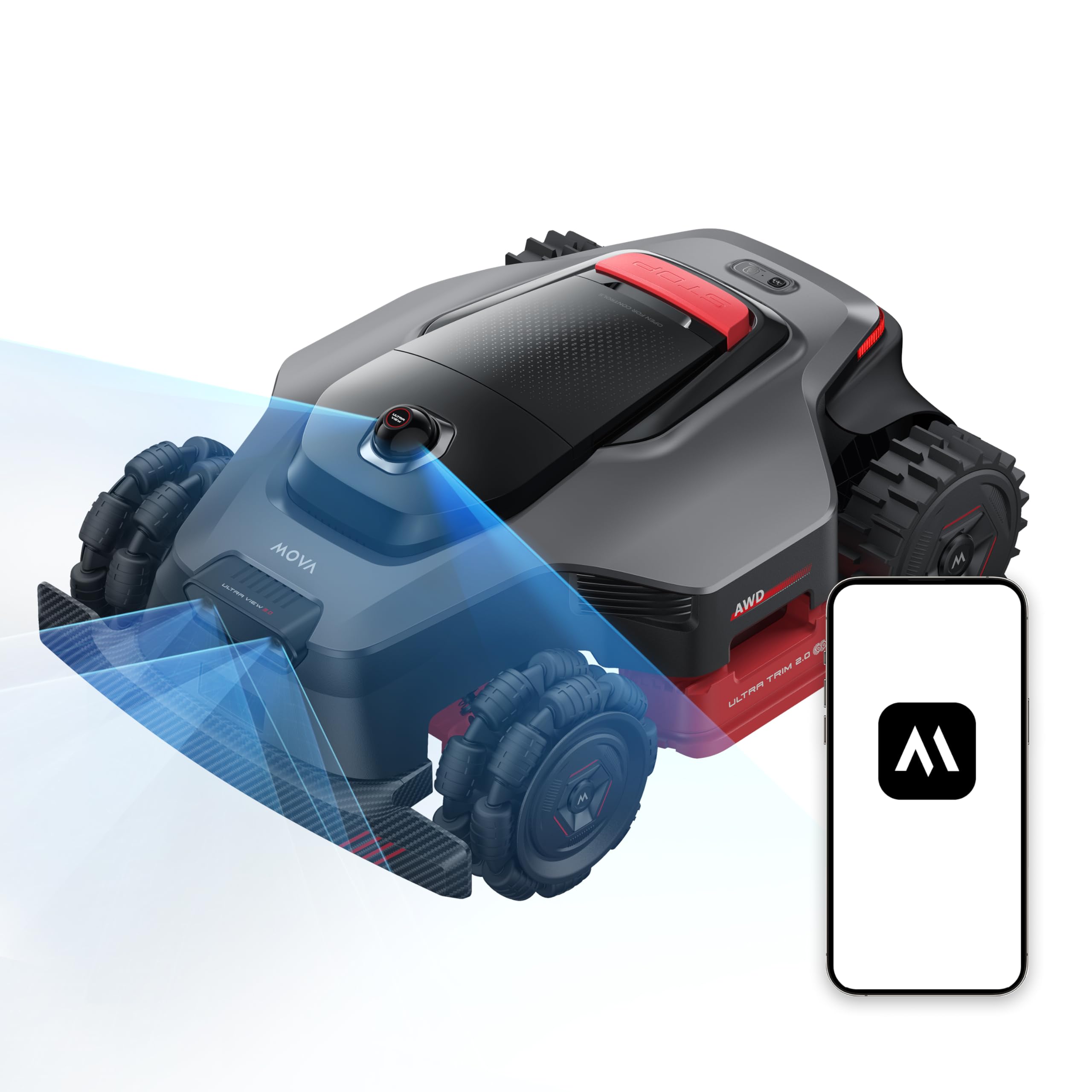
Power on, let it map, and it trims the edges down to 1.2 inches.
Most wire-free robots still ask for a base station; this one does not. The MOVA LiDAX Ultra 3000 uses 360° 3D LiDAR plus AI dual vision to build a centimeter-accurate map with no boundary wire and no RTK base, so you switch it on and it starts learning your yard. Four 116W hub motors carry it over slopes up to 80% and obstacles up to 2.4 inches, and a floating cutting disc adapts to uneven ground.
The specs that do the daily work: a 36V 243Wh battery, dual discs carrying 12 blades, and a 15.8-inch cutting width. EdgeRiding and UltraTrim 2.0 cut the uncut margin to just 1.2 inches, which means less time behind a string trimmer on Saturday. Mowing performance and the clear lift in efficiency are what owners talk about most, and the setup draws praise for needing no RTK installation at all.
Where the experience can wobble is speed and service. A few buyers find it methodical rather than quick on a cut-up lot, and one warranty case dragged with a cryptic “robot is lifted” error and a long wait for repair. Treat it as a reliable weekday mower for a smaller acreage, not a racehorse, and it delivers.
Best fit: a homeowner who wants genuine wire-free setup and tight edge trimming on a lot under an acre.
Reconsider if: you need daylight speed on a sprawling property — the methodical pace is by design.
5. Segway Navimow X430 Robot Lawn Mower, 4WD
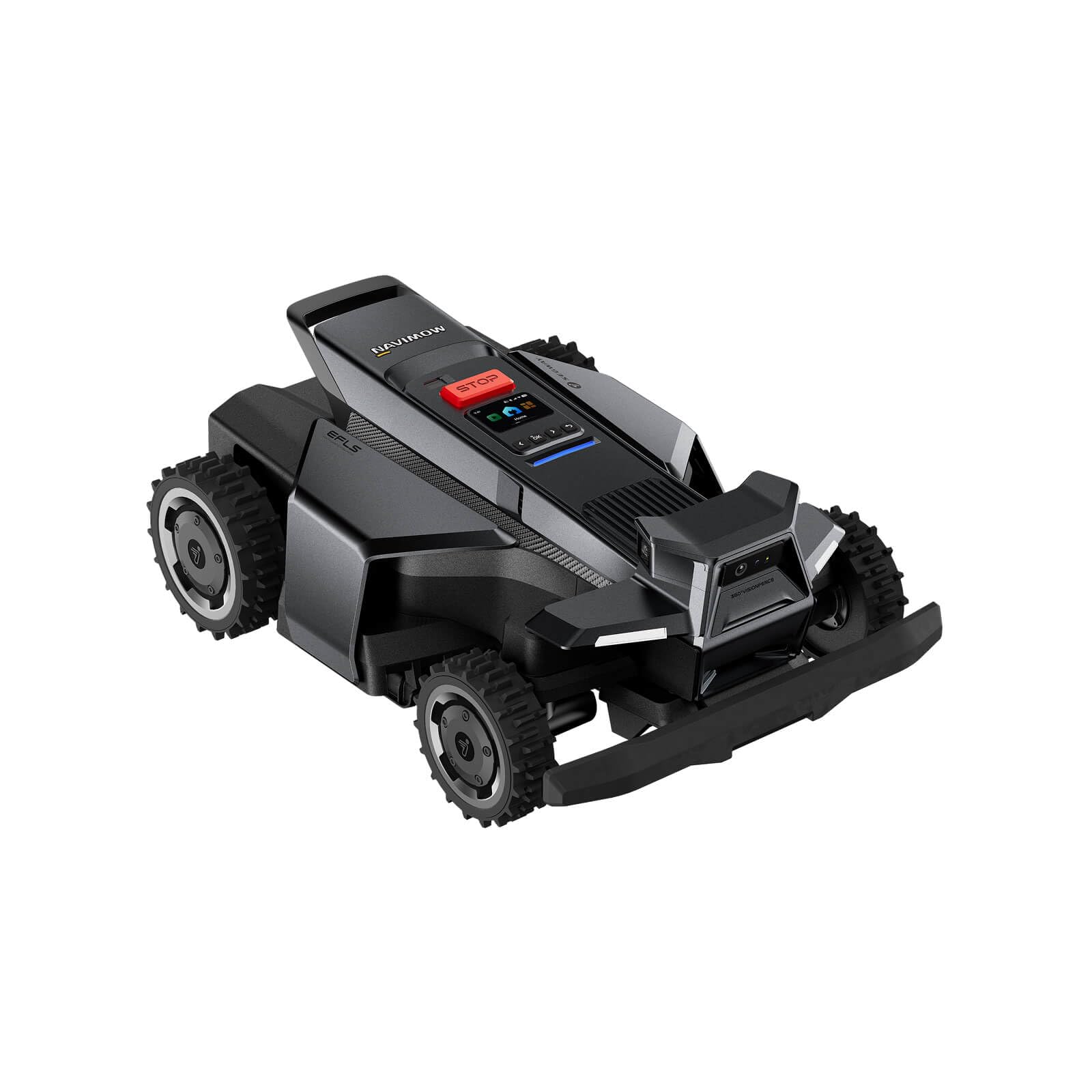
Built to climb 40° banks and steer without scuffing the turf underneath.
For an acre with a real hillside, this is the robot that takes the terrain seriously. The X430 climbs slopes up to 84% (40°) on all-wheel drive and clears obstacles up to 2.8 inches, and its ORV-tuned dual suspension keeps it planted on rough ground. The double 180W motors drive dual 12-blade discs across a 17-inch width, and EdgeSense pulls the trim margin to under 2 inches.
The steering deserves its own line. Xero-Turn AWD uses eccentric front-wheel steering and smart traction control to pivot without tearing the lawn — a fix aimed squarely at the turf-scuffing that plagues many AWD robots. Position accuracy comes from EFLS tri-frequency Network RTK combined with 360° Vision and VIO, holding centimeter-level precision even under trees and along fences, while AI VisionFence recognizes over 200 obstacle types.
The performance tally is what carries it — it is the strongest-rated machine in this group, and setup draws steady praise for the one-tap Auto Mapping. Range is the honest limiter: a full charge plus a couple of recharges can stretch a half-acre mow across a long day, and a rare unit has overheated in strong heat. Plan around mid-mow recharging and it handles a sloped acre comfortably.
The turf-friendly standout: zero-turn steering plus traction control means fewer scuffed corners than you expect from a heavy AWD robot.
The number to respect: runtime, not slope, is what will slow you down on a large lot.
Pick this when: your acre has a serious gradient and you want to keep the lawn looking unscarred.
Keep looking if: your lot is huge and mostly flat — you would be paying for slope ability you never use.
6. CRAFTSMAN 42″ Gas Riding Lawn Mower
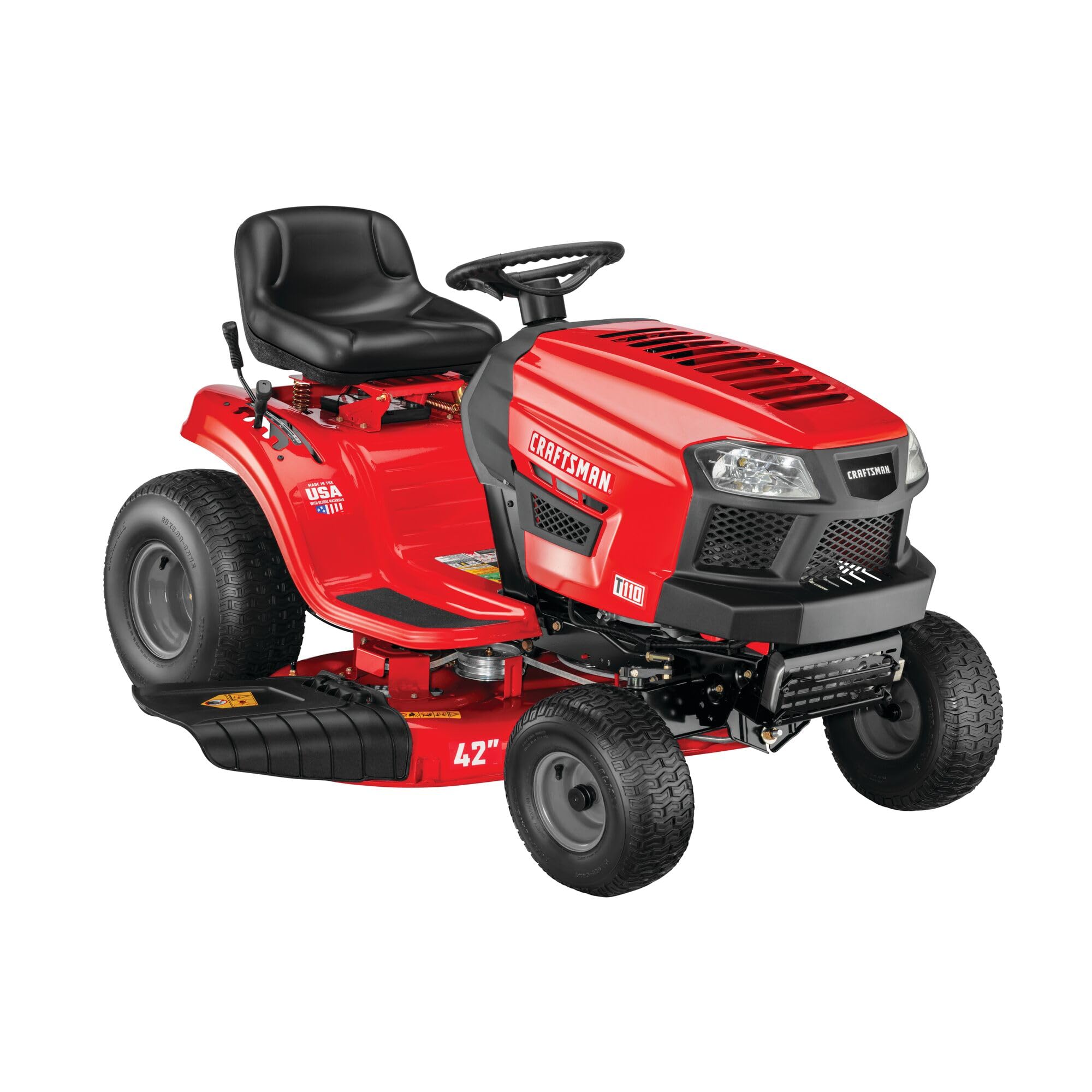
A gas tractor that cuts up to two acres with a straightforward seven-speed gearbox.
If budget and simplicity lead your list, this is the honest entry point. The 42-inch stamped steel deck cuts up to 2 acres of grass, driven by a 17.5 HP Briggs and Stratton single-cylinder engine. A 7-speed manual transmission lets you pick your pace, and the 18-inch turning radius plus 15×6/20×8 wheels let you work around beds and trees without three-point turns.
Performance is what carries this mower, and it is easier to live with than a full commercial unit. Owners note it is easy to work on, starts right up after a straightforward assembly of just the seat and steering wheel, and arrives with oil pre-filled. It suits a homeowner cutting a couple of acres on weekends, not a crew mowing daily.
The things to know up front: several buyers hit deck belt issues over time, and the reverse lockout kills the engine if you back up with blades engaged. One recurring nitpick is the fuel tank held by only a single tie wrap. Weigh that against the low running cost and the 2-acre reach, and it is a fair value for the price tier.
Where it earns its keep
- 42-inch deck cuts up to 2 acres on a 17.5 HP engine
- 7-speed transmission and a tight 18-inch turning radius
- Easy assembly and pre-filled oil, ready to run on day one
Where it asks you to adapt
- Cannot reverse with blades engaged without stalling the engine
- Deck belt loosening is a reported issue over time
Makes sense for: a weekend homeowner who wants gas simplicity and a low entry cost on a couple of acres.
skip it if: you need to reverse often in tight spots — the blade lockout will test you.
7. MechMaxx 60″ PTO Powered 3 Point Flail Mower
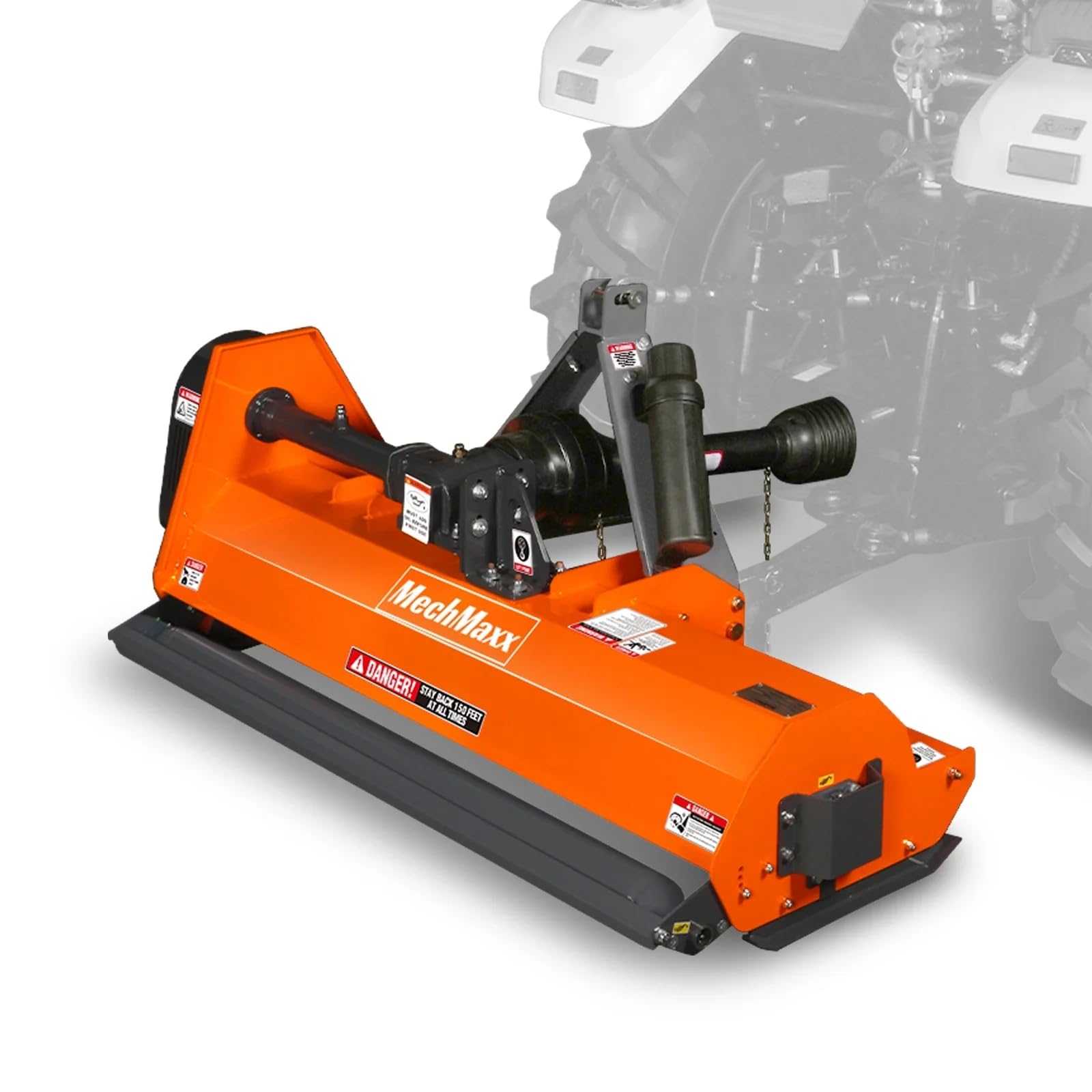
Hang it on your tractor and pulverize brush a rotary mower would choke on.
If you already own a tractor in the 15–35 HP range, a PTO flail mower turns it into a brush-eating machine. This MechMaxx spins its rotor at 540 RPM through belt transmission, and 24 hammers chew material up to 0.75 inch in diameter across a 60-inch working width. Front safety chains block flying debris, sealed tapered roller bearings keep it running, and a kickstand makes storage easy.
What makes it a smart buy is how it handles ground a zero-turn cannot touch. Owners rate it durable and reliable on rough, rocky terrain and call it a real step up from a rotary mower on bushy ground. The PTO shaft connects easily to a category 1, 3-point hitch, and a sealed gearbox takes the abuse of rocks and thick growth.
The honest caveats are worth a paragraph. It ships without assembly instructions, and one A-frame weld gap plus a bit of welding slag in a bolt hole have been noted as things you may need to clear yourself. Tall, thick grass requires a slow crawl. If you are comfortable with a wrench and already have the tractor, those are minor.
Its real power: 24 hammers mulching to 0.75 inch is why it clears brush a deck mower simply cannot.
The setup tax: no instructions and the odd weld cleanup means a Saturday afternoon with tools.
For you if: you already run a compact tractor and want to clear rough brush without buying a second machine.
Not for you if: you want a mower that unhooks and runs with zero mechanical fuss.
8. MechMaxx 48″ PTO Offset Flail Ditch Bank Mower, VAM48
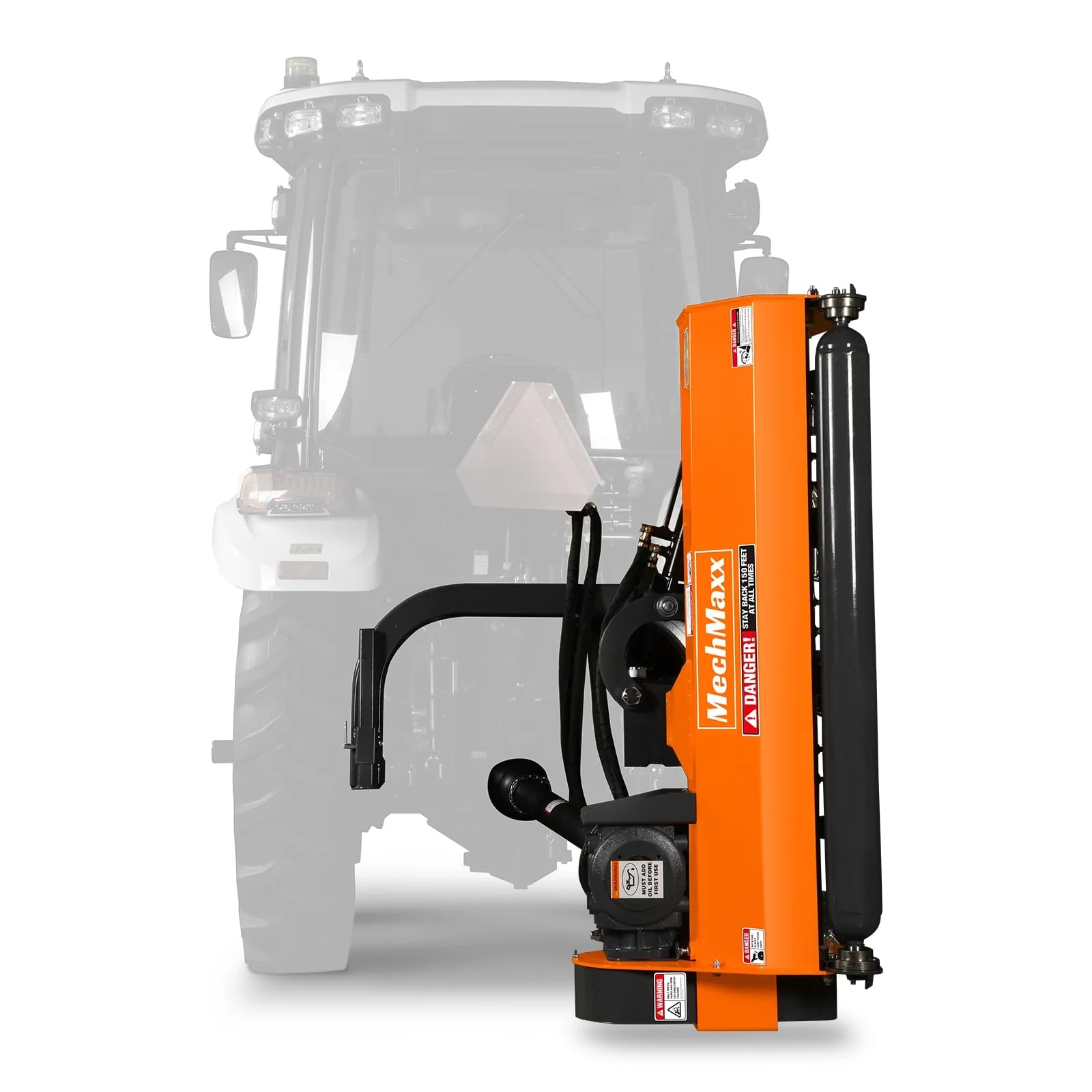
An offset hitch that leans over the ditch so your tractor stays on level ground.
Ditch banks and embankments are where ordinary mowers give up, and this attachment is built for exactly that. The 48-inch flail mounts on a category 1, 3-point hitch for 25–50 HP tractors, and the rotor spins at 2,356 RPM off a 540 RPM PTO. Hydraulic control swings it through a 60° downward and 90° upward tilt, with up to 69 inches of lateral movement from center — so you can reach down a bank without tilting your tractor.
The 20 hammers mulch material up to 1.5 inch in diameter, and a heavy rear roller smooths the finish. What owners praise is the cut quality and build: it cuts finer than a lawn mower and shreds vines, saplings, and small trees up to about 2 inches. Performance and overall quality are the two things that come up most, and both land positive.
Two honest notes. Shipping protection can be thin, with an occasional unit arriving with cosmetic damage. And the vertical reach tops out around 72 inches, so it will not clear paths at eye level. Fill the gearbox with 90wt or 80W90 gear oil before first use, and it is ready for orchard rows and long ditches.
A strong match for: orchard, vineyard, and ditch-bank properties where a tractor needs to reach sideways and down.
Mechanical owners only: the gearbox fill and alignment setup expect a torque wrench and some patience.
9. EGO Power+ TR4204 Electric Riding Lawn Mower, 42″

A belt-free electric rider that swaps gas smell for a Bluetooth port and quiet.
Want the seat of a riding mower without the gas and oil routine? This one runs on up to six EGO 56V ARC Lithium batteries, combining to deliver up to 20,000 watts of power, equivalent to a 21-horsepower gas engine. It cuts up to 1.5 acres on a single charge with the six included 6.0Ah batteries. Dual brushless cutting motors mean no belts to replace, and the 42-inch stamped steel deck adjusts across twelve cutting height positions from 1.5 to 4.5 inches.
The comfort kit is generous: a digital LCD with three blade settings and three drive speeds, cruise control, LED lights, a USB charging port, and Bluetooth. It mows at up to 6 MPH. Owners rate performance highest, then battery life, and they talk about the quiet — no gas smell, no oil changes, just plug in and go. A rear tow hitch adds hauling to the job list.
The reality check is range versus the claim. Many buyers find a full charge covers closer to a half acre than the advertised 1.5 on anything but flat, easy ground, and the ride is bumpier than a gas tractor’s. Plan your mowing around charge breaks and it makes a low-maintenance replacement for a gas rider.
Why owners like it
- No belts, no oil changes, no fuel — dual brushless motors cut maintenance to near zero
- Twelve cutting heights, three speeds, cruise control, and a rear tow hitch
- Quiet operation with no exhaust smell, plus USB and Bluetooth built in
What to plan around
- Real-world range lands closer to half an acre than the 1.5-acre figure on hilly or thick ground
- Ride quality is bumpier than a gas tractor, per buyer feedback
Right for you if: quiet, low-maintenance riding matters and you want to stay inside the EGO battery platform.
Not for you if: you need a full acre on one charge without stopping on sloped ground.
Know the Specs
Slope rating (the percentage that matters)
Slope is the steepness a mower can climb, written as a percentage or a degree figure. A 37° bank equals a 75% grade, and the machines here range from 75% up to 84% (40°). Check this first if your land has a hillside, ditch, or bank, because a mower that cannot climb it is useless no matter how wide the deck.
Cutting width (time per pass)
Cutting width is how wide a strip the deck clears in one go. A 54-inch deck covers far more ground per pass than a 21-inch one. Wide decks favor big open fields; narrow decks steer better around tight obstacles. Match width to your gates and tree spacing, not just to your acreage.
Runtime and battery capacity
Runtime is how long a battery mower cuts before it needs a charge, and capacity (in Ah or Wh) plus voltage set that ceiling. Thick or wet grass drains a battery faster than a dry lawn. If your acreage is close to a machine’s rated acreage, plan a mid-mow recharge rather than expecting the full figure.
PTO and horsepower for tractor owners
If you run a tractor, PTO (power take-off) is the shaft that drives an attachment. Flail mowers here spin at a 540 RPM PTO input and fit specific tractor horsepower ranges — 15–35 HP for the 60-inch and 25–50 HP for the 48-inch. Match the attachment’s range to your tractor’s rating before you buy.
Common Questions
How steep a slope can a mower for large acreage handle?
Is a robotic mower realistic for an acre of lawn?
How many acres does a 42-inch riding mower cut?
Do I need a tractor to use a flail mower?
Why does my mower tear the grass when it turns?
How long does a battery mower run on one charge?
Can a robotic mower handle tall, overgrown grass?
What maintenance does an electric riding mower need versus gas?
Can a ditch bank mower reach down a slope without tilting the tractor?
How fast can a zero-turn mower go?
The Bottom Line
For most acreage owners, the mower for large acreage winner is the Mowrator S1 4WD because it climbs 37° banks on 4WD, runs 2.25 hours on a 56V 18Ah battery, and reaches ground a rider cannot safely touch. If wide, flat lawn is your reality, the Husqvarna Z254F clears it fastest on a 54-inch deck. And for hands-off mowing on a sloped acre, the Segway Navimow X430 earns the nod with its 84% (40°) climb rating. Whichever you choose, measure your steepest bank and your real acreage first — those two numbers decide the pick far more than any spec sheet alone.
How we choose
We do not accept paid placement. Every pick is matched to a real buyer and a real use-case; we do not hands-on test units.
Sources
Specifications: manufacturer listings and product documentation. Review insights: verified customer reviews, as of October 2026. Pricing: not shown on this page (it changes often); check the current price via the retailer link.
As an Amazon Associate, Aappliancez earns from qualifying purchases. This does not affect which products we feature.