Disclosure: Some links in this post are affiliate links. As an Amazon Associate I earn from qualifying purchases, at no extra cost to you. Learn more
Specs are compiled from manufacturer listings and verified buyer reviews and can change over time — please confirm the key details on the product page before buying.
Most riders buy the jacket first and the pants last, and that is exactly backwards. Your legs are the part of you closest to the pavement when a bike goes down, and a pair of jeans with no armor in them is just a pair of jeans. The picks below name the armor each garment actually carries, where it sits, and whether you can wear it all day without feeling dressed for a track day.
This guide is built by comparing the manufacturers’ published specifications and the patterns across verified customer reviews, so you get each pick’s real strengths and trade-offs instead of marketing spin.
You will see shorts, overpants, riding jeans, armored shirts, leather jackets and a hard-shell protector, because a complete setup rarely comes from a single brand. Every pick below is sorted by where it protects and how it fits into your ride — the two things that matter when shopping for motorcycle protective clothing.
Top Picks

How To Choose The Best Motorcycle Protective Clothing
Protective riding gear works in two separate ways, and confusing the two is where most buyers lose money. Abrasion resistance keeps your skin from being ground away by asphalt, and that comes from the shell fabric. Impact protection keeps a bone or a joint from taking the full force of a fall, and that comes from the armor inserts. You need both, and plenty of cheap gear gives you one without the other.
Read the armor label before the fabric
A CE-rated pad has passed an impact-absorption test; a plain foam filler has not. That distinction is the single most common letdown in budget riding pants — buyers peel back the knee panel and find quarter-inch foam instead of rated armor. If a listing will not name the armor level, assume there is no rated armor inside and plan to buy inserts separately.
Match the shell to your weather, not your style
Textile shells with a zip-out liner cover the widest temperature range, since you can strip insulation when the sun comes out. Leather sheds abrasion superbly but holds heat, and vented leather with underarm or chest zips is a different animal from a solid hide. If you commute year-round through cold mornings and warm afternoons, the removable liner matters more than the brand name on the collar.
Decide if you want overpants or dedicated riding trousers
Overpants zip over whatever you wore to the office, so you arrive in clean trousers and peel the shell off in the parking lot. Dedicated armored pants feel better on long rides but force you to change clothes at the destination. Neither is wrong — it depends on how many stops your ride has.
Side-by-Side Comparison
| Model | Best For | Protection Zone | Shell Material | Armor Setup | Amazon |
|---|---|---|---|---|---|
| Leatt Brace Impact Shorts 3DF 5.0★ Best Overall | Hip and tailbone coverage under any trousers | Hip, upper hip, thigh, coccyx | MoistureCool compression with mesh | Built-in 3DF padding, 17 protection points, removable coccyx pad | Amazon |
| LOMENG CE Armor Riding PantsBest Value | Everyday commuting on a budget | Knees and hips | Denim with Aramid knee and hip lining | CE-1 hip and CE-2 knee armor, removable | Amazon |
| JAG Protective PantsBest for Cold Rides | Cold-weather dual-sport riding | Knees and hips | Water-resistant Cordura with vents | Foam knee padding, upgradeable | Amazon |
| Milwaukee Leather MPM1621 Shirt | Wearing to work without looking armored | Shoulders and elbows | 14.5oz cotton denim with DuPont Aramid thread | Removable CE shoulder and elbow armor | Amazon |
| ILM PF1 Winter Overpants | Cold commutes over your work clothes | Knees and hips | 600D Oxford, water and wind resistant | CE armor, insulated non-removable liner | Amazon |
| Commuter Buffalo Leather Jacket | Abrasion-heavy highway miles | Shoulders, elbows, back | 1.2–1.3 mm buffalo leather | 5-piece removable CE armor | Amazon |
| Milwaukee Leather MPM1730 Textile | Night riding and rainy commutes | Shoulders and elbows | 1300D nylon textile with reflective skulls | Padded armor, removable full-sleeve liner | Amazon |
| Alpinestars Bionic Action V2 | Dirt and trail riding in heat | Chest, back, shoulders, elbows | Stretch mesh frame, 10.58 oz total | Level 2 Nucleon chest and back protectors | Amazon |
| Alpinestars J-6 Waterproof Shoe | Foot and ankle coverage that looks casual | Ankle and toe | Microfiber upper, laces plus Velcro | Ankle protection, reinforced toe selector | Amazon |
Detailed Reviews
1. Leatt Brace Impact Shorts 3DF 5.0 Adult
Our pick — 4.5+★ from 600+ verified ratings; the strongest balance of quality and price.
The invisible layer that lets you wear ordinary jeans and still walk away from a hip-first fall.
Padding is the wrong word for what is happening here. These shorts carry built-in armor at the hip, upper hip, thigh and coccyx (the tailbone), and Leatt scores that coverage at a total of 17 points in its own protection rating system. The removable coccyx pad means you can tune how much bulk sits under your seat when you plant it on the saddle. What wins people over is the build quality — the shell is a compression MoistureCool material with flatlock stitching and mesh panels, and it stays quiet under a normal pair of pants instead of bunching at the waistband.
Most riders find the fit lands right, and that snug cut keeps the armor from shifting mid-ride. A rider standing 5’10” and 195 lbs in a 32 waist wears a Medium perfectly, and a 5’8″ 175 lb rider in a 32–34 waist reports the same thing. The fabric is soft and breathable enough that you stop noticing it — one rider on the review pages says “I don’t even know i’m wearing them.” It breathes well on hot days, and owners wear them under snowboarding kit as readily as on an MTB.
The honest trade-off is care. Machine washing and drying is discouraged, so the routine is a hand wash in the tub with soap and a hang dry, and that is a real friction point for anyone who rides daily and sweats through them. One more thing worth knowing before you buy: these pads overlap the thigh and will fight articulated knee braces, so if you ride braced, test the combination rather than assuming it stacks cleanly.
What earns the top slot
- Armor at four zones — hip, upper hip, thigh and removable coccyx — in a garment that disappears under jeans
- Compression MoistureCool fabric with flatlock stitching and mesh keeps the pad from reading as a diaper
- Riders across a range of waist and height combinations report the sizing lands as intended
- Breathable enough for summer wear in hot climates
Where it asks more of you
- Hand wash and hang dry only — no machine cycle, which is a chore for daily riders
- Built-in thigh padding overlaps with articulated knee braces, so brace wearers may need a different short
- Treated as a base layer, not a solo trouser — you still need the jeans on top
The case for it: this is the pick for the rider who already likes their jeans, their work trousers or their trail shorts and just wants armor under them rather than a whole new wardrobe.
Know before you buy: plan on a bucket and a drying rack, because the recommended care routine is hand wash only.
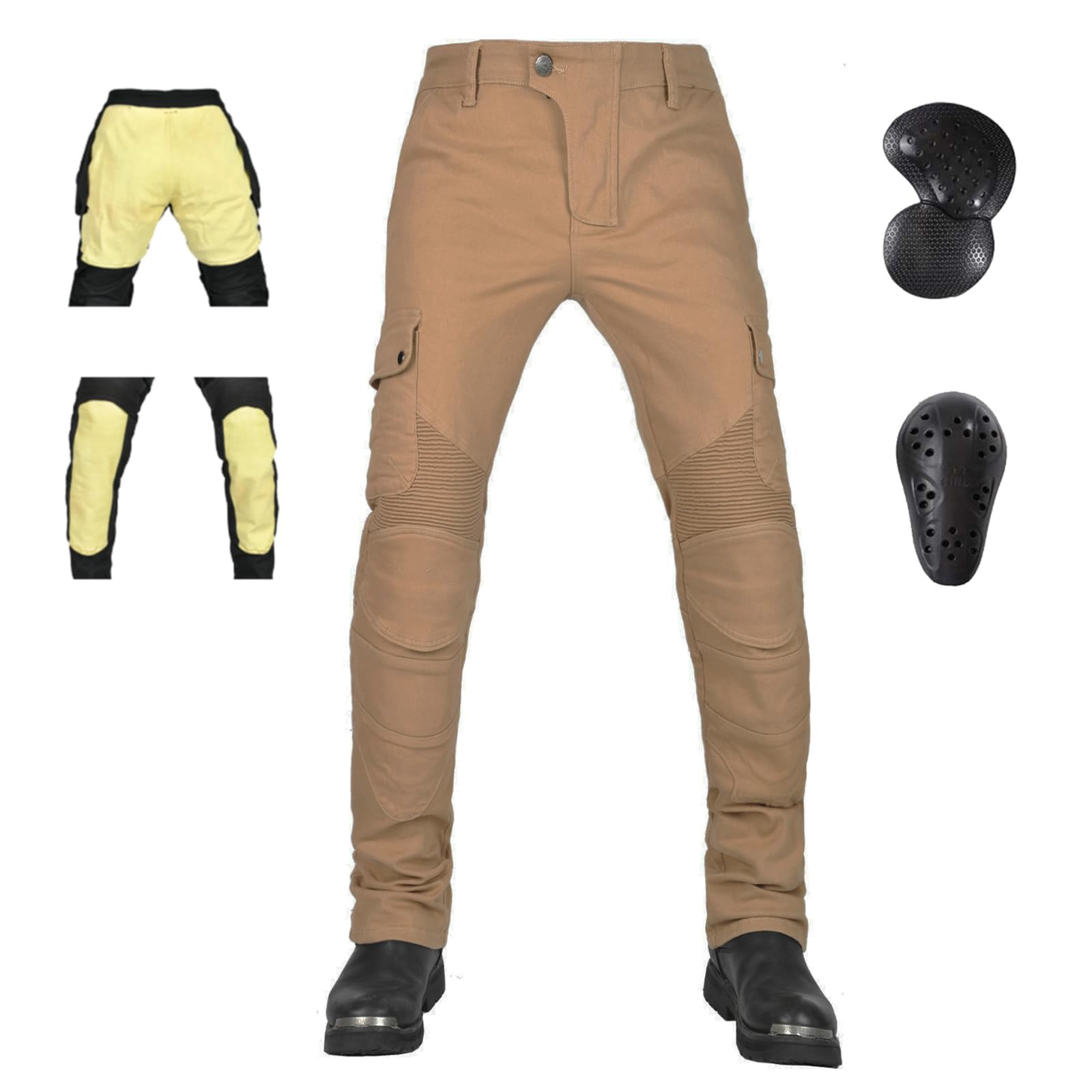
2. LOMENG Motorcycle Riding Pants Men with CE Armor
Two armored pads in the hips and two in the knees, hidden inside denim that passes for casual Friday.
This is the entry point into genuinely rated leg armor, and it deserves attention for one specific reason: the specification says CE-1 hip pads and CE-2 knee pads, both removable. CE-2 knees are the higher of the two common armor levels, and finding that in a budget-friendly pair of riding jeans is the value story here. The reinforced version adds an Aramid lining at the knees and hips for extra abrasion resistance, and the pads pull out so the pants work as regular jeans at the pub.
Pay attention to sizing rather than assume it. One buyer sized down two full sizes and landed a great fit, and another who found them running large gives the same advice. That matches a 40 waist fitting a labeled 42/30 once the adjustable tightening straps are cinched in. The knee pads are not glued in place — they shift while riding, and one rider notes the knee cover has no Velcro or snaps to hold it down, so it rides up from the wind.
Durability reports are genuinely split, and you should hear that plainly. Some buyers report the fabric and pads holding up to a low-speed side-impact slide with no damage. A minority find construction flaws — a hole after the first ride, a vinegar smell out of the package, a short zipper fly, and a decorative side zipper that is not a real pocket. Wash them before the first wear, since the black dye bleeds. If you want a first armored pair without committing heavily, this is a reasonable place to start.
Put the sizing first: treat the listed size as generous and size down, because more than one buyer found the pants larger than expected and had to exchange or cinch in.
Reach for this if: you want CE-2 knee armor in a jean you can wear off the bike and you are willing to order a size down.
Look elsewhere if: you need your knee pads pinned firmly in a fixed position — these float and can ride up under wind.
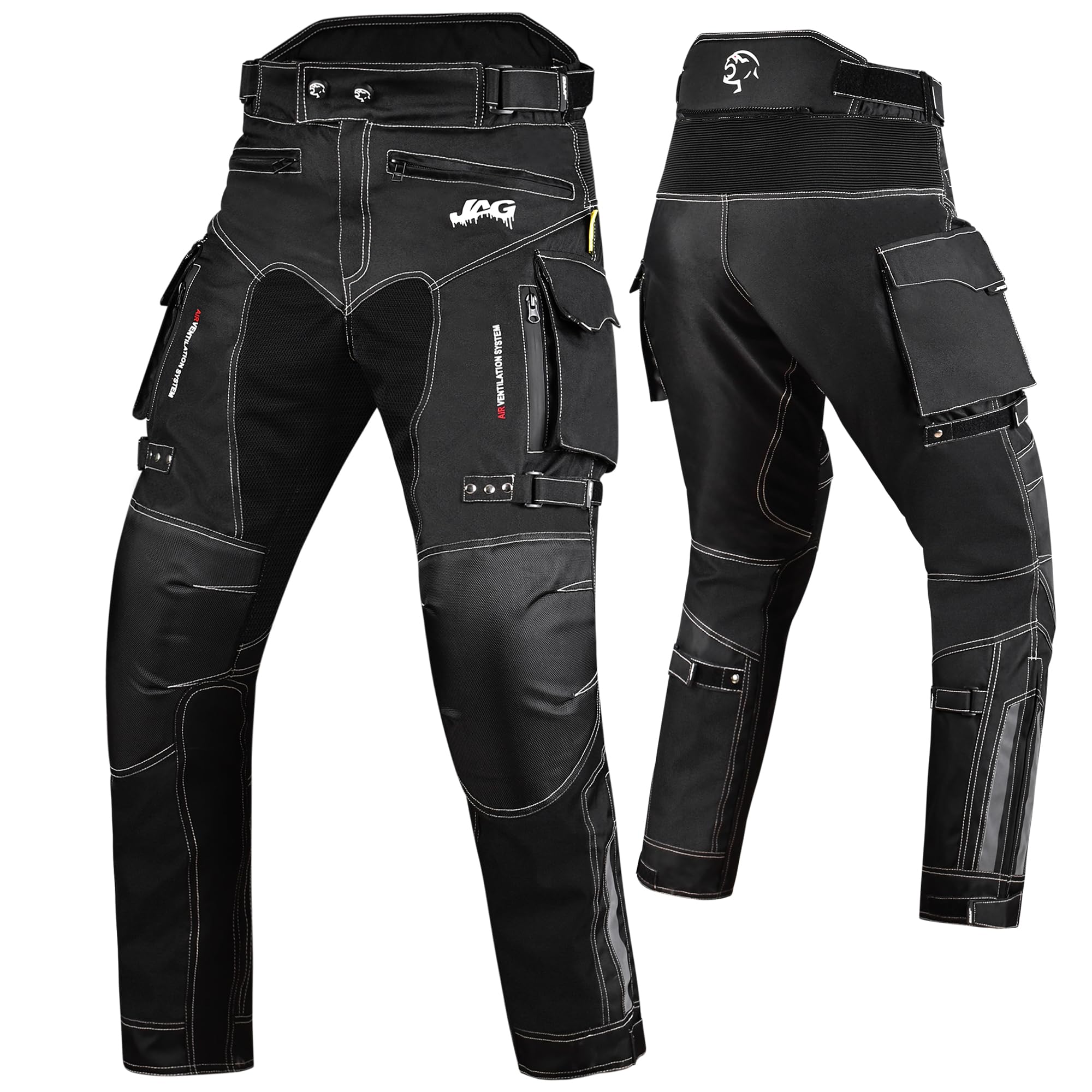
3. JAG Motorcycle Protective Pants with Armor
A water-resistant Cordura shell that keeps the wind off your legs when the temperature drops.
Cordura is a tough woven nylon family known for abrasion resistance, and here it is the outer shell of a dual-sport trouser with a padded raised back panel that blocks wind at the waist. Thigh vents let you dump heat when the day warms up, and the side pocket flaps are waterproof. The waist tightens with adjustable straps rather than a belt — which is also the reason a size 42/30 can fit an actual 40 waist once those tabs are pulled in.
What riders keep coming back to is construction. The quality count on this listing dwarfs everything else owners talk about, and the comments match: well-made, stretchy where it should be, zippered and Velcro cargo pockets, and comfortable worn straight over jeans at highway speed. Warmth is the mixed part — great news in cold weather, less so in a heatwave. One rider in Wisconsin Indian summer described sweating heavily in them and still concluding it is better to be protected and hot than unprotected.
The armor inside is the catch, and it is a serious one for anyone buying this for impact protection specifically. The knee inserts read as thin foam rather than a rated CE pad, and one pair even shipped with pads labelled for shoulders sitting in the knee pockets. Owners who cared about that detail swapped in their own aftermarket CE-2 or D3O inserts, which the pockets accept. Budget for that upgrade in your head before you order, and the pants make a lot more sense.
The reasons it ranks here
- Water-resistant Cordura shell with a raised padded back that keeps wind off your lower back
- Adjustable waist straps mean no belt needed and a wide fit window within one size
- Thigh vents and waterproof pocket flaps for mixed weather
- Machines well over jeans at highway pace, which is where overpants usually billow
Where it falls short
- The supplied knee inserts are thin foam rather than rated armor — plan an aftermarket swap
- Runs hot in genuine summer heat despite the vents
- At least one pair arrived with mislabelled pads, so check yours on delivery
The verdict: buy this as a shell and a fit, then spend a little more on real CE inserts to finish the job.
4. Milwaukee Leather MPM1621 Armored Riders Shirt

Looks like a flannel shirt from across the parking lot, carries shoulder and elbow armor on the inside.
The shell is 90% 14.5oz premium cotton denim with 10% genuine DuPont Aramid fiber thread, and Aramid is the same family of high-strength fiber used in abrasion-resistant riding gear. Reinforcement runs through the high-impact areas rather than sitting as a patch. Removable CE armor covers the shoulders and elbows, the back has a pocket ready for a separate spine pad, and underarm zipper vents let you dump heat at a standstill.
The layering story is where this one shines. It is sized to go over another shirt, closing with a hidden zipper plus snap buttons, and the lower inside back hook snaps to your belt so the hem does not lift at speed. Riders in the desert heat describe it as light enough to stay cool in Mojave conditions, and the Aramid fiber stays flexible instead of stiffening up. The vent zip, collar and snap closure together keep the breeze from ballooning the shell.
Where it gets complicated is the fabric weight in genuine humidity, and the fact that the grey version uses a heavier outer material than the plaid ones. That makes the grey warmer on cool mornings and a poor match for a hot, sticky afternoon. The pocket layout also draws a fair split — some buyers find the interior pockets impractical because items slide down and gather at the waist. Buy the back protector as an extra, since it is not included.
Word on the weight: it is closer to a mid-weight jacket than a shirt, and the grey colourway runs warmer still — a good thing in spring and autumn, a trial in a heatwave.
Pick this when: you want armor without arriving at the office looking like you came off a track day.
Think twice when: your summers are hot and humid — the heavy denim shell traps heat and the vents only go so far.
5. ILM Detachable Winter Motorcycle Riding Pants PF1

Full-length leg zippers turn getting dressed into a ten-second job, even with your boots already on.
The shell is 600D Oxford fabric, a tightly woven nylon chosen for abrasion and water resistance, and it is paired with CE armor in the knees and hips. Full-length zippers run down each leg so you can pull the pants on over your work trousers without taking your shoes off. An adjustable waistband dials in the fit, and a shoelace-link buckle at the hem ties the pant leg to your boot so the hem cannot ride up in a slide.
Cold weather is the whole point, and it delivers there. The insulated liner is not removable, which is the trade — but in exchange you get wind blocking strong enough that riders commute daily through 15°F with no cold coming through at the ankle. Long-distance riders report riding around a thousand miles over five days in 30–40°F with the wind chill held off and the warmth kept in. They layer easily over jeans or thin sweatpants, and the side zippers are chunky enough to grab with gloves on.
Sizing is the recurring headache. Several owners had to exchange upward, and one who normally wears a 30 found the right fit by sizing up. Crotch room runs tight enough that swinging a leg over a large touring bike takes some effort, and the waist clasp is a marginal snap rather than a double closure. The pants handle rain and wind well, but the maker is clear that heavy rain can seep through the zips, so do not treat them as a waterproof shell.
Why cold-weather commuters like it
- Insulated liner and tightly woven 600D Oxford block wind at serious cold-weather temperatures
- Full-length leg zippers mean you suit up in seconds, boots and all
- Shoelace-link buckle at the hem anchors the pant leg to the boot
- CE armor sits at both knees and hips
- Layerable over jeans or thin sweatpants for adjustable warmth
What to weigh first
- The liner is fixed, not removable, so this is a cold-season pant rather than a year-round one
- Runs small — most owners exchange upward one size
- The crotch cut is tight, which makes swinging a leg over a big touring bike awkward
- Heavy rain can push through the zips despite the water-resistant fabric
Go for it if: your ride starts cold and your destination has a dress code you cannot armor up for.
Give it a pass if: you need one pant for all four seasons — the liner stays in.
6. COMMUTER Men’s Buffalo Leather Jacket with CE Armor
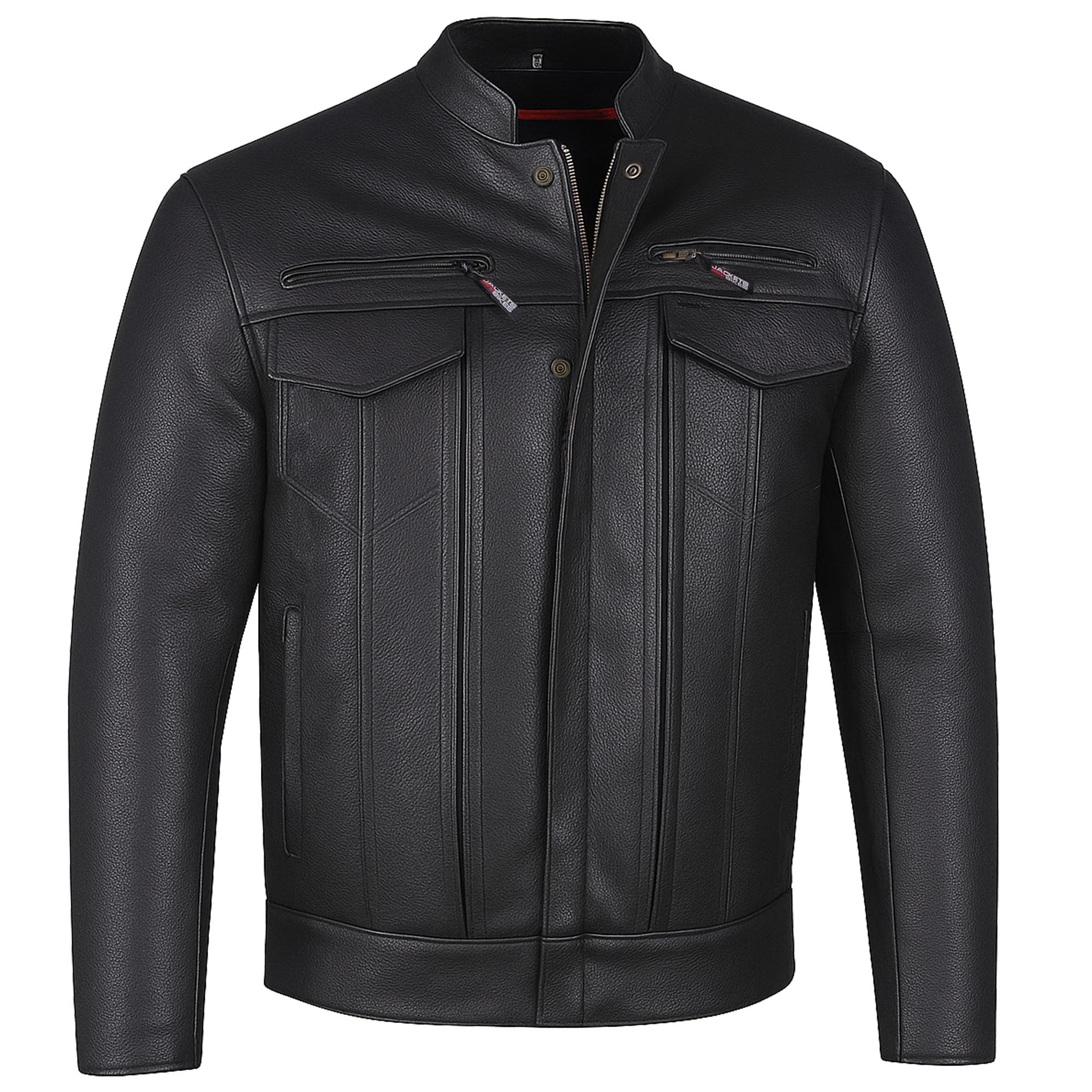
Half-inch-thick hide is the wrong phrase, but 1.2 to 1.3 mm buffalo leather is what you feel in the shoulders.
Leather is the abrasion layer of last resort, and buffalo at 1.2–1.3 mm sits at the heavier end of what you find in a riding jacket. Five pieces of CE armor come pre-installed at the shoulders, elbows and back, and the whole set is removable. The thermal quilted liner zips out for summer, at which point two chest vents and two back vents do the cooling. Genuine YKK zippers, zippered cuffs, grommets under each arm and an action back panel round out the build.
Owner experience runs long, and some of it is hard-won. One rider put 16 months and thousands of miles on theirs, including a five-hour ride in 109°F, and reports the leather holding up with regular conditioning. The same jacket came through a low-speed scooter spill with the upper body protected. That is the kind of endurance story that only shows up in leather, and it explains why the leather quality and durability dominate what buyers discuss. The eight-pocket layout — four exterior, four interior, including twin conceal-carry compartments — is generous by any standard.
Do not expect a tailored cut. This is a true American block with a straight drop, and a 42″ waist on an XXL means it hangs rather than tapers, so a larger belly makes the fit awkward. Ventilation looks small in person, and one owner flagged the shoulder seam as a weak point worth treating gently — store it on a hanger or flat, not crumpled on a hook. Expect a faint leather smell and some squeak for the first while; both fade.
The blunt read: it is a lot of leather and armor for a mid-range outlay, and the trade is a boxy silhouette rather than a fitted one.
Best match for: the highway rider who wants a shell that shrugs off a slide and still looks like a jacket you chose.
Not your jacket if: you ride in real heat and need airflow more than abrasion — the vents are small and the hide is heavy.
7. Milwaukee Leather MPM1730 Reflective Textile Jacket

Reflective skull embroidery that hides in daylight and throws light back at headlights after dark.
The shell is 1300D nylon, and that D number is the denier — the higher it goes, the denser and tougher the weave. Reflective embroidery and piping run across the chest, arms and back, and the effect is subtle up close but unmistakable from a distance in headlights. Two chest vents, arm vents and back vents all zip closed, the liner pulls out entirely for summer, and there are dual inside conceal-carry pockets plus two lower zip pockets and two chest zip pockets.
Warmth is the pleasant surprise. With the liner in, riders report being comfortable at 30°F in just a t-shirt underneath, and one owner rode through a 39°F rain and snow storm and stayed dry and warm. Quality of stitching and material carries the reputation here — the fit and finish run well above what the badge on the collar suggests. Crash durability has been tested by owners too, with one reporting a serious spill that left the jacket barely scratched.
Two quirks to plan around. The mesh stays in the sleeves after you pull the liner out, which gets uncomfortable in real heat, and the outer pockets have a thin tent-fabric feel that does not match the rest of the build. Sizing runs small — enough that owners recommend going up, particularly if you layer a hoodie under it. Removing the liner also takes the inner pockets with it, so sort your phone and keys before you strip the insulation.
The draw
- Reflective skull embroidery and piping across chest, arms and back make you visible to headlights
- 1300D nylon outer with a full zip-out liner covering summer through cold snaps
- Holds warmth well — riders report comfort at 30°F with only a t-shirt underneath
- Dual conceal-carry pockets inside, plus four zipped outer pockets
The friction
- Mesh sleeve liner stays in after the insulating liner comes out, so it gets hot above 90°F at low speed
- Outer pocket fabric feels thin against the rest of the jacket
- Sizing runs small — size up if you plan to layer
Worth your attention if: a chunk of your riding happens after sunset or in poor visibility and you want to be seen without wearing a hi-vis vest.
8. Alpinestars Bionic Action V2 Protection Jacket
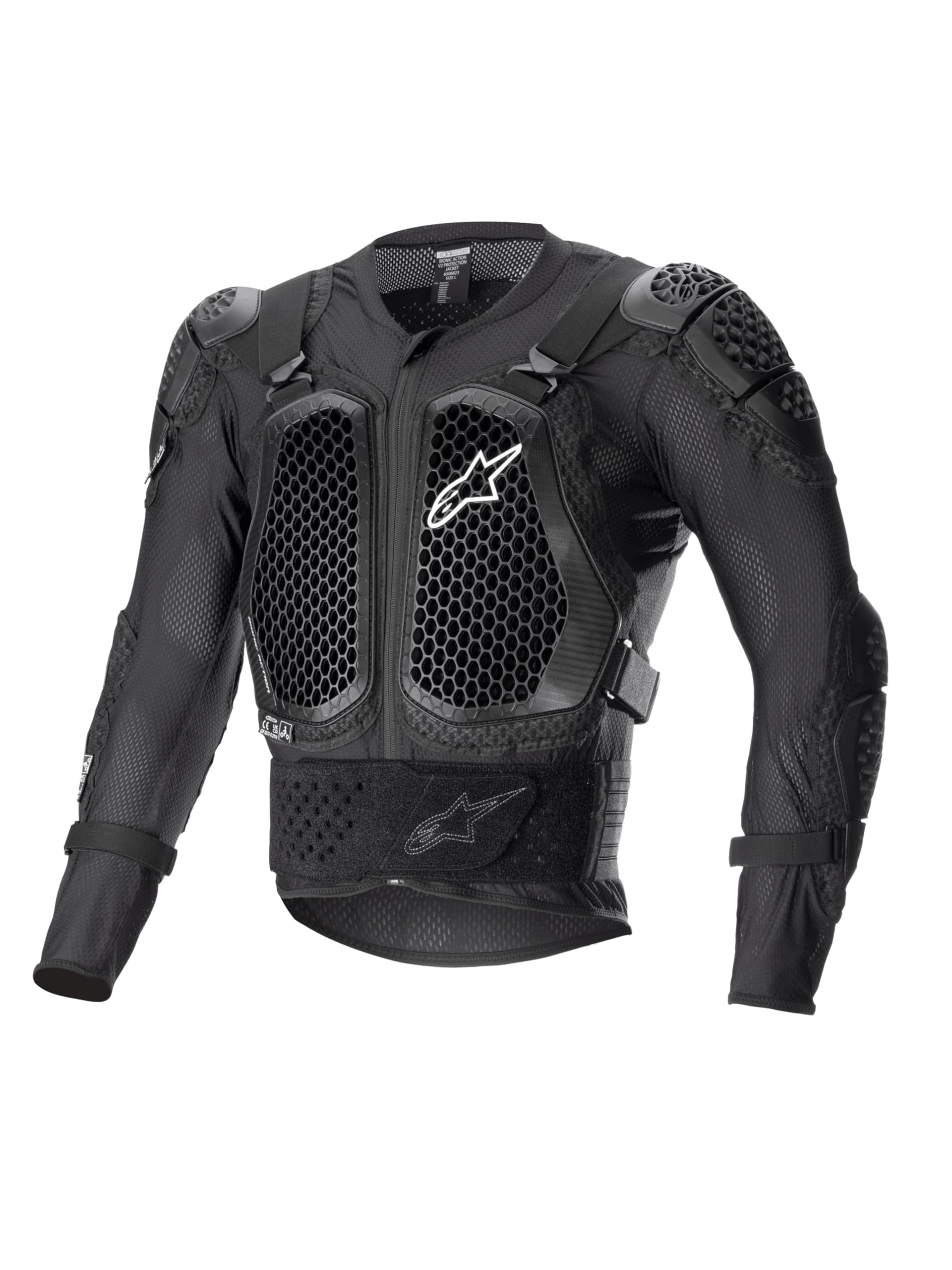
The whole jacket weighs 10.58 ounces, and it carries a Level 2 chest and back protector anyway.
This is the piece you wear under a jersey when the trail is loose and the day is hot. Alpinestars describes it as CE and UKCA certified — UKCA being the UK’s product safety marking — with a Level 2 Cell Technology chest protector and a super-ventilated Level 2 Nucleon Cell & Flex Hybrid back protector. Level 2 is the higher of the two standard impact ratings, and both front and rear protectors are backed with foam padding to keep them snug against the body. It wears next to skin or over a thin base layer, and it works with a hoodie in winter as readily as a summer jersey.
What owners say over and over is that once it is dialed in it stays put. Armor positioned right, doesn’t slide, forgettable while riding — that is the goal for a hard-shell protector and this one hits it more often than the cheaper versions. It is less bulky than a padded jacket and clearly superior in build to the budget off-brand equivalents, which is the kind of gap you feel as soon as you pick one up.
The sizing is the one thing you must not guess at. Multiple riders had to go up a size — someone 5’10” and 165 lbs found a Large too small and moved to an XL, and a 220 lb rider who normally wears XL ordered an XXL. The straps that bridge chest to shoulder and back are elastic and sewn in rather than adjustable, so the fit is what it is out of the bag. Also, the hard armor does not bend at the elbows, which makes holding a phone up or tipping a water bottle awkward. This is riding kit, not lounge kit.
The honest limit: a rigid protectors that will not flex at the elbow is exactly what you want in a fall and exactly what you notice at a coffee stop.
For you if: you ride dirt, dual sport or trails where impact is the risk and you want the highest-rated chest and back protection as a base layer.
skip it if: you want one garment for the street and the café patio — the hard shell is not meant for sitting around in.
9. Alpinestars J-6 Waterproof Shoe

A riding shoe that looks like a high-top sneaker and still shields your ankle when you go down.
The microfiber upper closes with laces plus a Velcro strap, and the shoe carries ankle protection, a reinforced selector pad at the toe for the shifter, and reflective detailing. It sits between a riding boot and a casual shoe in coverage, so you get ankle support without a tall shaft up your calf. The reinforced shifter patch is the detail that saves you from a worn-through toe after a season of upshifts.
The build quality is what everyone leads with — thick ankle support, solid soles, grip that holds on the pegs, and a weight that feels closer to a high-top sneaker than a boot. One rider described them as having the build quality of tactical motorcycle boots, the look of a Vans or Converse high-top, and the comfort of a retro Air Jordan. Flat laces stay tied. The waterproofing is reported as solid, and they hold up in the wet.
Fitting is the decision point, and it is not a small one. The J-6 runs narrow, and riders with wider feet have returned them because the toe box pinched even with the laces loosened. Sizing up a full size or a half size is the standard fix for anyone with thicker socks or a wider foot, and breaking in takes a couple of rides before the uppers soften. If you have wide feet, this may simply be the wrong last for you, however good the construction.
What you get for the outlay
- Ankle protection and a reinforced shifter pad on a shoe that passes as a casual high-top
- Microfiber upper with laces and a Velcro strap for a locked-down fit
- Waterproofing that holds up in wet weather
- Reflective detailing for low-light visibility
- Wearable off the bike without looking like you came from a race
Where it costs you
- Cut narrow — wide-footed riders may need to return rather than size up
- Uppers start stiff and take a few rides to soften
- May run warm in summer heat despite the airflow-friendly build
Pick it if: you want ankle and toe coverage that disappears into a normal wardrobe and stays dry in rain.
Look at a wider last if: you have wide feet — this one will not stretch enough to accommodate them.
Know the Specs
CE Armor Levels
CE armor is rated CE-1 or CE-2, and CE-2 absorbs more impact energy. A jacket or pant marketed with armor usually names the level; if it does not, assume there is no rated armor inside. The level matters most at the knees, hips, shoulders, elbows and back, which are the points that meet the road first. Armor that is removable lets you swap in a higher level later, which is why removable pockets matter far more than premium foam.
Denier and Shell Fabric
Denier is a measure of fiber density, so 1300D nylon is a denser, tougher weave than a lighter textile shell. Cordura, Oxford and denim all occupy different points on the abrasion scale, and an Aramid lining adds another layer at the knees and hips where slides begin. Leather, meanwhile, is measured in millimeters of thickness rather than denier — 1.2 to 1.3 mm of buffalo hide is a substantial abrasion layer. None of these stop impact on their own.
Water Resistance vs Waterproofing
Water-resistant fabric sheds light rain, while waterproofing keeps it out entirely — and neither covers zippers unless they are sealed. On overpants, water can and does creep through the zips in heavy rain even when the shell fabric holds. If your riding sees genuine downpours, the zip is the first place to check.
Fit and the Layering Window
Armored garments fit tighter than regular clothing because the armor must stay in place. Riding pants tend to run small or large depending on the brand, and the adjustable waist straps on some models stretch the usable size window. If you plan to layer underneath, add room, and if a listing offers size-down advice from owners, believe it.
Common Questions
Is CE armor the same thing as the foam padding in cheap riding pants?
Can I wear armored overpants over my regular work trousers?
Will impact shorts fit under normal jeans without showing?
How do I size riding pants that run large or small?
Is a leather jacket hotter than a textile jacket in summer?
Do these jackets include back protection?
Can I wear a hard-shell protector jacket on the street?
How should I clean armored riding pants and shorts?
Are riding shoes narrow compared with regular sneakers?
Do I need knee armor and hip armor for city commuting?
The Bottom Line
Build the setup in layers. Start with the Leatt Brace Impact Shorts 3DF 5.0 — armor at the hip, upper hip, thigh and coccyx under any trouser, and a compression cut that stays quiet all day. That is your base. Add an outer shell depending on your weather: the ILM PF1 overpants for cold commutes that end at a dress code, and the Commuter buffalo leather jacket for highway miles where abrasion is the risk. If you ride trails in heat, the Alpinestars Bionic Action V2 is the Level 2 protector that weighs almost nothing.
One honest note before you close this tab: match the gear to the roads you actually ride, not the roads you daydream about. A commuter jacket that traps heat in your local summer is thewrong purchase, and a track protector you only wear on weekends is money sitting in a closet. Buy the layer you will actually put on every time you ride.
How we choose
We do not accept paid placement. Every pick is matched to a real buyer and a real use-case; we do not hands-on test units.
Sources
Specifications: manufacturer listings and product documentation. Review insights: verified customer reviews, as of October 2026. Pricing: not shown on this page (it changes often); check the current price via the retailer link.
As an Amazon Associate, Aappliancez earns from qualifying purchases. This does not affect which products we feature.