Disclosure: Some links in this post are affiliate links. As an Amazon Associate I earn from qualifying purchases, at no extra cost to you. Learn more
Specs are compiled from manufacturer listings and verified buyer reviews and can change over time — please confirm the key details on the product page before buying.
A motion sensor light bulb solves two problems at once: it lights up the moment someone walks past, and it stops burning electricity the rest of the night. The trick is finding one whose sensor actually fires when you are still several steps away — not when your hand is inches from the bulb. The picks below are chosen for real sensing range, sensible off-delay timing, and the light quality that keeps a porch or closet usable, and each one is narrowed to a specific job so you can skip straight to the right bulb.
This guide is built by comparing the manufacturers’ published specifications and the patterns across verified customer reviews, so you get each pick’s real strengths and trade-offs instead of marketing spin.
Start with what type of sensor a bulb uses, because a radar detector and an infrared detector behave completely differently in a closed fixture. This guide breaks down sensor range, lux cutoffs, and off-delay so you can match a bulb to your porch, garage, or closet with confidence, and it covers the best motion sensor light bulb options by real-world job.
Top Picks
How To Choose The Best Motion Sensor Light Bulb
Every motion bulb on this list screws into a standard E26 socket, so the base is not the decision. What separates a bulb you love from one you uninstall is the sensor type, the darkness threshold, and how long the light lingers. Get those three right and the rest is brightness and color warmth.
Infrared vs radar sensing
A PIR bulb (passive infrared — it reads body heat moving across its field) fires when something warm crosses its view. That makes placement fussy: the sensor eye usually sits at the top of the bulb, so it needs to face the walkway and sit clear of covers. A radar bulb bounces microwaves off moving objects instead, which is why it can read through glass and acrylic and reach farther. The catch is that metal blocks radar, so an open cage fixture can interfere with it.
The lux cutoff number
Lux measures how bright the surrounding light is. Bulbs here switch on only below roughly 15 lux and hold off above roughly 40 lux. That threshold is what stops your porch bulb from blazing at noon. If a bulb feels too eager, a bright nearby lamp or reflective wall can fool its photocell into thinking it is still daytime — or the reverse.
Off-delay timing
After motion stops, most sensor bulbs wait 30 to 45 seconds before going dark. Shorter feels snappy but can drop you into darkness halfway down a hallway. Longer keeps you lit but wastes a little power. Match the delay to the path: a closet is fine with a quick cutoff, a long stairwell is not.
Color temperature and lumens
Kelvin rates the color of the light. 5000K is a crisp daylight white that reads as security lighting on a porch; 3000K is a warmer soft white that suits a hallway or living-adjacent space. Lumens are raw output — more lumens means a brighter wash of light, and you want enough to cover the whole walkway, not just the bulb’s own glow.
Side-by-Side Comparison
| Model | Best For | Output | Color Temp | Sensor Range | Amazon |
|---|---|---|---|---|---|
| Torkase 13W Motion Sensor Bulbs (3 Pack)★ Best Overall | Closets, garages, walkways | 1100 lumens (100W equivalent) | 5000K daylight | 6.5–13 ft (PIR) | Amazon |
| RIMOL Radar Motion Sensor Bulb (2 Pack)Longest Reach | Porch and driveway security | 100W equivalent | 5000K daylight | 16–32 ft (radar) | Amazon |
| ORALUCE Motion Sensor Bulbs (2 Pack) | Attic and laundry room | 900 lumens (60W equivalent) | 5000K daylight | 13 ft (PIR) | Amazon |
| LUXRITE A19 Motion Sensor Bulbs (2 Pack) | Warmer-toned entry lights | 800 lumens (60W equivalent) | 3000K soft white | 9 ft (PIR) | Amazon |
| Linkind Dusk to Dawn Bulbs (4 Pack) | Porch and post lamps, on all night | 1200 lumens (75W equivalent) | 5000K daylight | — | Amazon |
Detailed Reviews
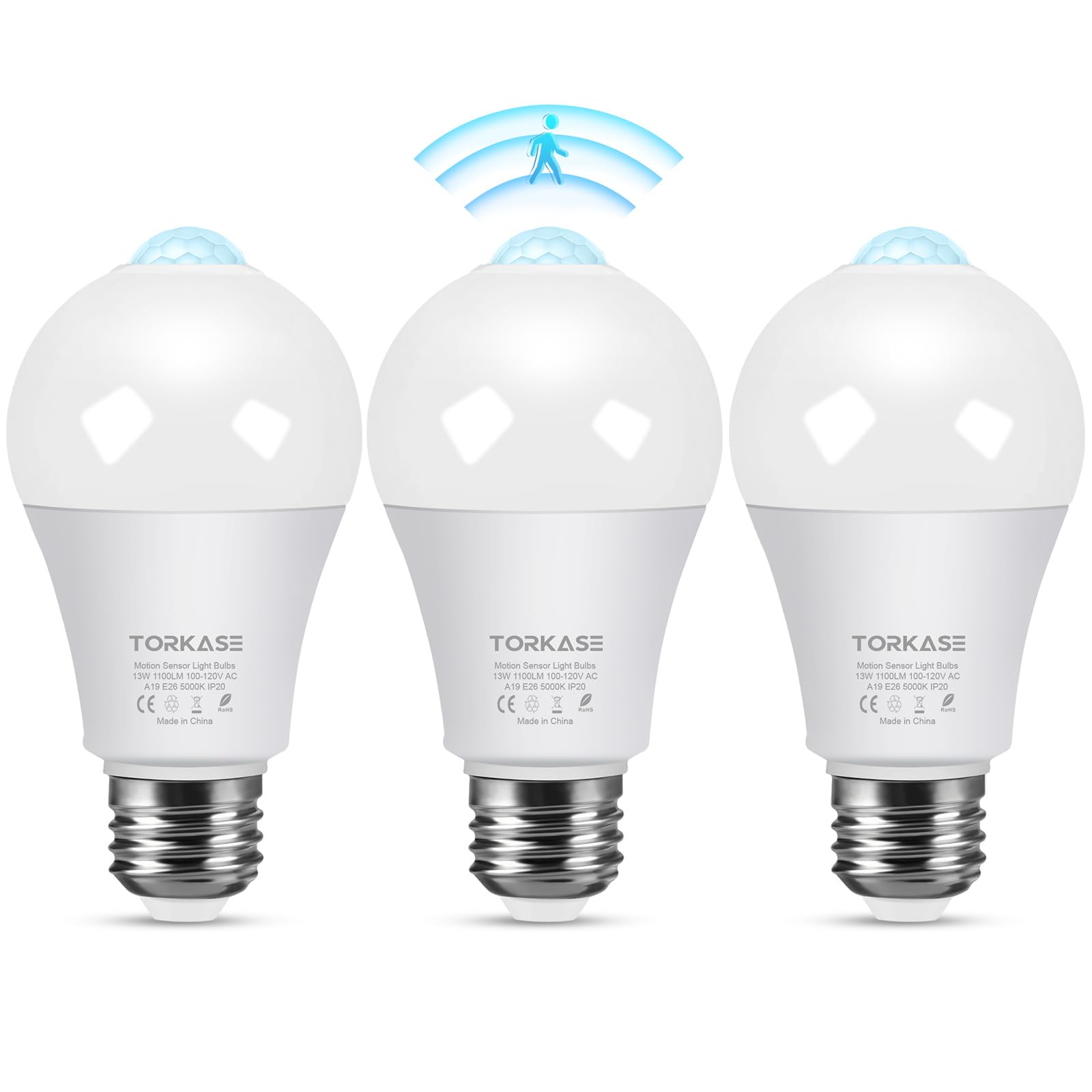
1. Motion Sensor Light Bulbs 13W 3 Pack A19 E26
Our pick — 4.0+★ from 550+ verified ratings; the strongest balance of quality and price.
Three bright daylight bulbs that only wake up in the dark — and cover a whole hallway for the price of one premium pick.
The reason this lands at the top is the packing job. You get three bulbs in the box against two from the RIMOL radar set and two from the ORALUCE set, and each bulb throws 1100 lumens of 5000K daylight — the brightest output on this list, matched by nothing else here at that count. That gives you a walkway, a back porch, and a pantry lit from one purchase instead of buying twice.
The dual-sensor setup is what makes it dependable. A photocell holds the bulb completely silent above roughly 40 lux and only arms the motion sensor below roughly 15 lux, so it will not fire in the middle of a bright afternoon. The PIR eye then reads motion across 6.5–13 feet and shuts the light off 30–45 seconds after the last movement. A color rendering index of 85 — a score for how faithfully colors read under the bulb — keeps a mailbox or doorbell button looking normal instead of washed out at night.
Owners keep coming back to the 1100-lumen brightness, the highest output on this list. It is the praise angle buyers lead with most, and the everyday version of that is simple: a walkway or porch gets a full, even wash of daylight white rather than a dim puddle. It suits a closet or storage cupboard, where the 30–45 second shutoff means the light never stays burning after you leave. The honest catch is sensitivity. Buyers report the sensing can lag when the fixture itself blocks the eye — as they put it, the sensor is a touch “delayed probably my outdoor fixture is blocking the motion sensor.” Mount it facing the walkway, keep the sensor eye exposed and clear of covers, and expect a cricket or stray movement to occasionally trip it.
Why it earns first place
- Three bulbs per pack — the widest coverage here, against two-bulb rivals
- 1100 lumens of 5000K daylight, the highest output on the list
- Dusk-to-dawn photocell keeps it dark until below ~15 lux
- CRI 85 renders colors more accurately than the RIMOL radar bulb’s 80
Before you screw it in
- Sensor must face down and stay uncovered — enclosed or frosted fixtures block it
- 6.5–13 ft sensing range is the shortest reach of the PIR picks here
- Listed 20,000+ hour LED life is a spec, not a guarantee owners always see
Grab this if: you want several spots covered from one box and need a bright, even daylight wash on a porch or in a garage.
Look elsewhere if: your fixture has an enclosed glass or frosted shade — the exposed sensor is the whole point here.
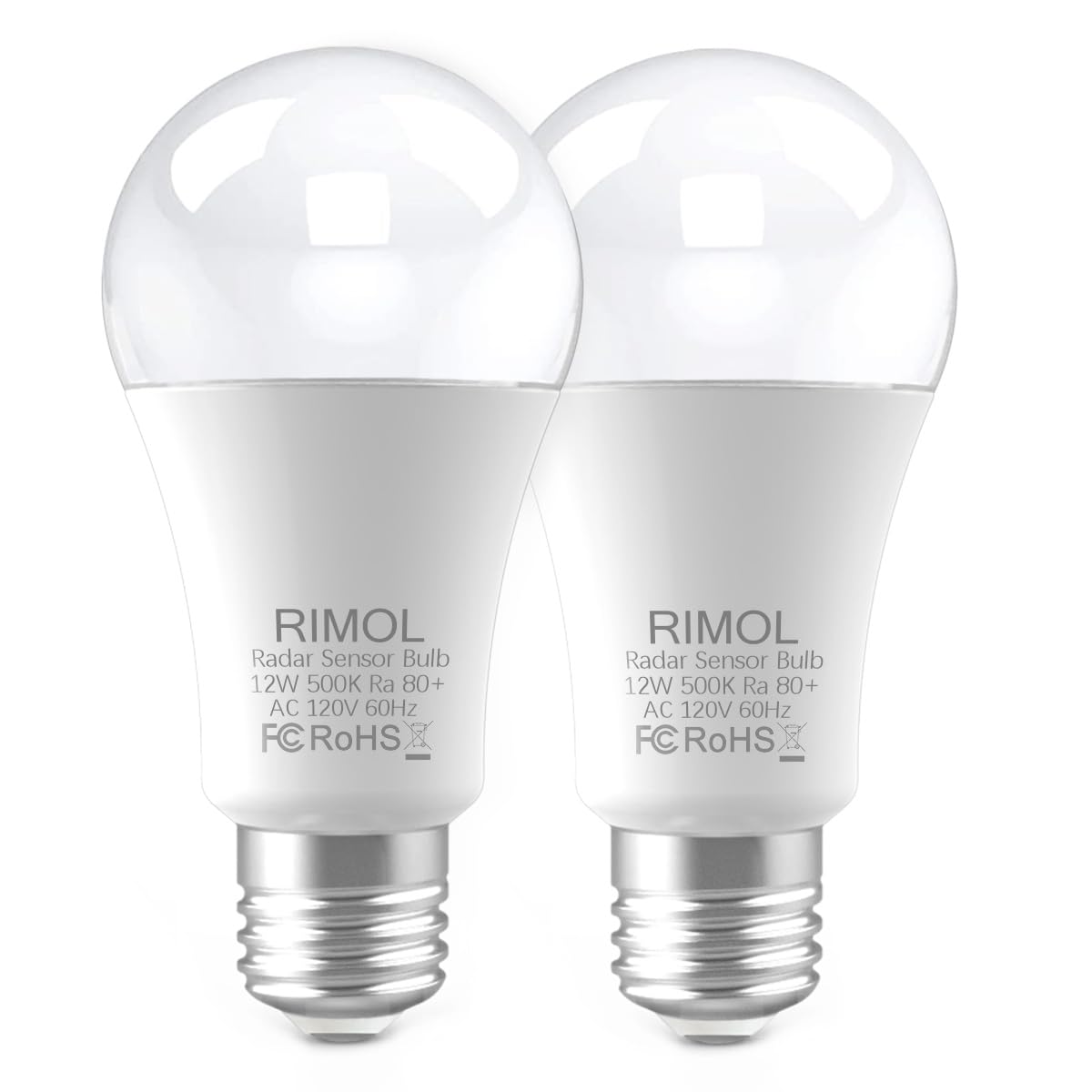
2. Radar Motion Sensor Outdoor Light Bulb 12 Watts 2 Pack
The bulb that spots you 32 feet out — and reads straight through glass and shade.
Here is the number that changes the job: 16–32 feet of detection range from a 360-degree radar field. Set that against the ORALUCE pick’s 13-foot PIR reach and the gap is immediate — this bulb notices you while you are still crossing the lawn, not when you are already on the step. Radar also pushes through acrylic, glass, and other non-metallic materials, so a covered lamp or a shaded fixture does not blind it the way it blinds a heat sensor.
The anti-interference design is what backs that up. A microwave (radar) frequency tuned to ignore false alarms means fewer phantom triggers from a swaying branch, and a photocell keeps the sensor quiet above roughly 40 lux so daytime movement does not wake it. When it does go, it shuts off after you leave the zone. Owners single out the build quality most, and it is built for a porch or garage entry light. One detail worth knowing: it may flash once on its first daytime power-up. That is a two-second self check, then it settles.
The recurring honest note is longevity at the sensor end. Some units stop switching off after a long stretch — as one long-careful buyer put it, they worked “for exactly one year” and then would not shut down, though they kept working as plain lights. Weigh that against how many people are simply happy to have motion light: owners mention plenty of “works like a charm” porch installs with no issue. Mount it pointing down, away from other light sources that can wash its photocell.
Where the range wins: 16–32 feet of radar reach beats every PIR bulb here by a wide margin, and glass and plastic covers do not stop it.
The fair warning: the sensor can eventually stop latching off after a long service stretch, and radar dislikes metal cages around the bulb.
Reach for this one: a driveway, wide porch, or long front walk where you want the light on before you reach the door.
Think twice: if your fixture is a metal cage — radar readings suffer next to metal — or if you want guaranteed hands-off switching for a decade.
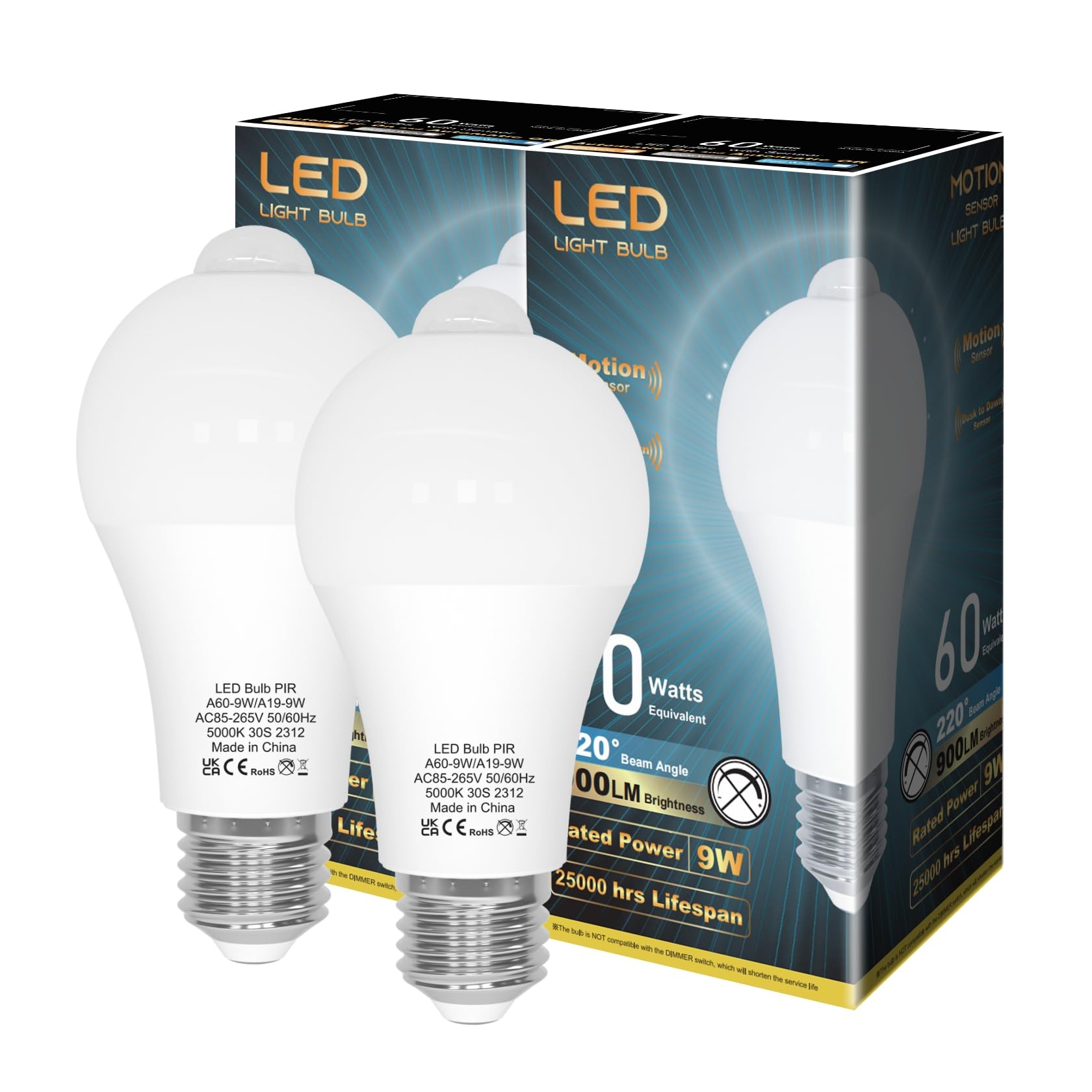
3. ORALUCE Motion Sensor Light Bulbs 60 Watt 2 Pack
A 900-lumen sensor bulb that turns a dark attic or laundry room into a hands-free light.
For spaces where you just want the light to follow you in and get out of your way, this ORALUCE set is the tidy answer. It runs 900 lumens from 9 watts — a 60W-equivalent output spread across a 220-degree beam angle, which pushes light wider around the socket than a narrow spot would. The PIR eye up top reads motion within 13 feet and cuts the bulb about 30 seconds after you stop moving.
The attic and laundry-room jobs are where this genuinely clicks. It works well mounted at a downward angle over a ladder or a doorway, and the quick 30-second shutoff means it is not sitting lit after you have gone. Owners value the hands-free switching most: no wall switch to flip and no wondering whether a light got left on. The built-in dusk-to-dawn photocell adds its own logic: it will only arm itself in the dark below roughly 15 lux, so a sunny laundry room stays dark until it actually needs to work.
Be clear-eyed on the weak spot. A short life is the fair note — a bulb can drop out after a couple of months of use, so treat the 25,000-hour rating as an aim, not a promise. There is also a fixture fit caveat: an open metal cage around the bulb can interfere with the sensor and stop it switching. Pack the bulb in a clear, exposed fixture and its indoor behavior is straightforward.
Good match for: attic hatches, laundry rooms, and closets where you want a wide 220-degree wash of daylight without touching a switch.
Not the fit for: a long hallway you walk quickly — the ~30-second cutoff can leave you reaching for the dark.
4. LUXRITE A19 LED Motion Sensor Light Bulbs 2 Pack

The one that glows warm instead of stark — 3000K soft white for an entry you actually like looking at.
Most sensor bulbs throw a clinical daylight white. This LUXRITE runs 3000K soft white — the warm, yellowish tone of a traditional bulb — which suits a front door, a sconce, or a shed where you want a cozy glow rather than a security spotlight. It puts out 800 lumens from 9 watts, the equivalent of a 60W incandescent, and it is damp rated, meaning it is built for humid or wet-ish spots that a bare interior bulb would not handle.
The sensing setup is a PIR eye with a 9-foot detection range and a 30-second timer. That is the lowest reach of the bulbs here, so place it close to the path you actually cross. Walk up to the door after dark and the light is already on before you reach for your key. Its warm tone and compact size also mean it disappears into an overhead shed fixture instead of shouting that you bolted on a gadget.
The honest trade-off is its light sensitivity, and it is the most-discussed point in reviews. The photocell is not always decisive, so the bulb can still switch on when the room is already lit. If your fixture sits beside a bright lamp or a reflective wall, expect some unnecessary triggering. Keep it in a genuinely dark spot and it behaves; the UL listing and damp rating still make it a sturdier pick than the cheapest bulbs for an exposed entry.
What stands out: 3000K soft white gives you a warm glow no other bulb on this list offers, and the damp rating handles a humid porch or shed.
Where it stumbles: 9 feet of reach is short, and the photocell can fire in a bright room — put it in a truly dark spot or it will over-trigger.
Pick it when: a warm soft-white entry light matters more than maximum brightness or reach.
Skip it when: the sensor needs to read a long approach — 9 feet will not cover a big driveway.
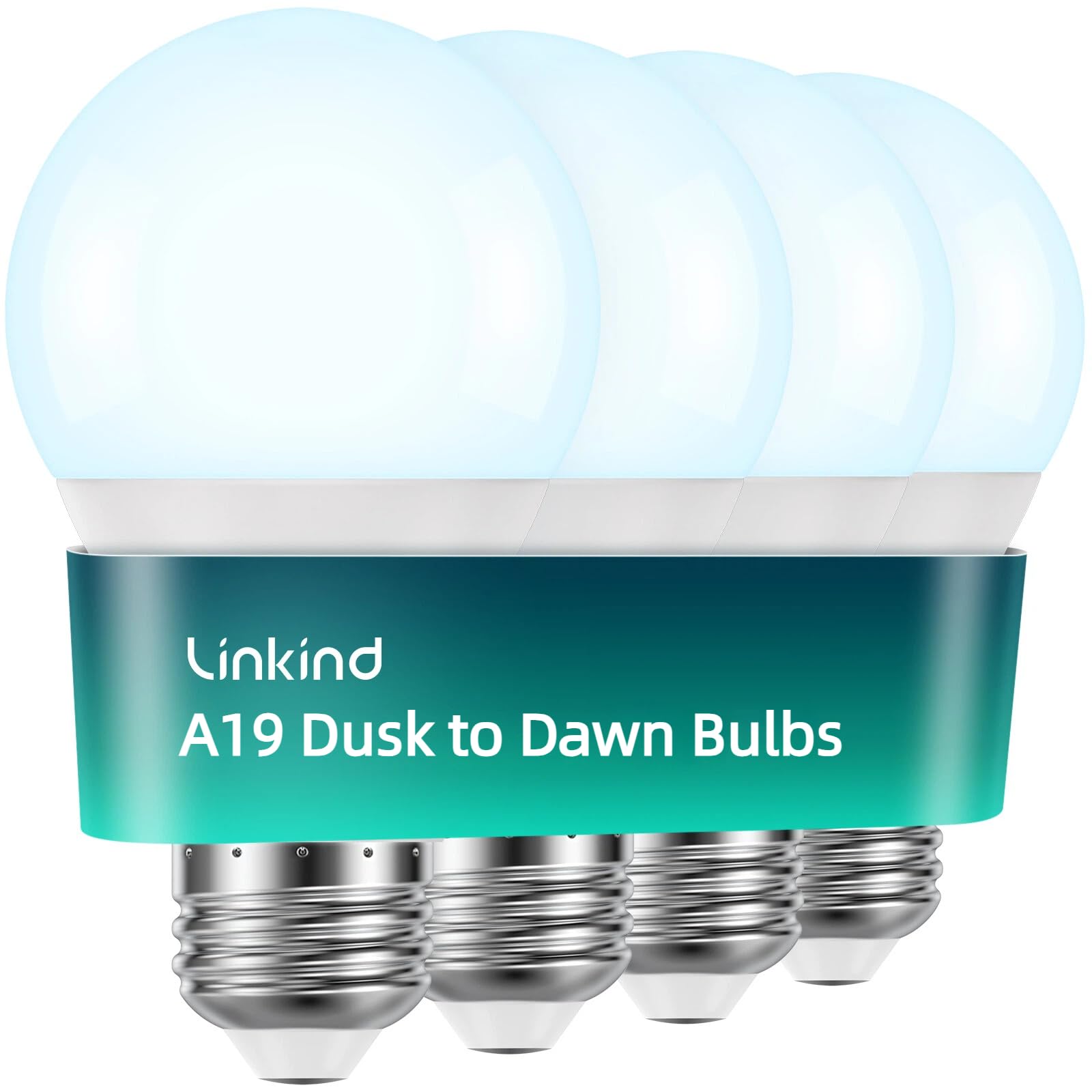
5. Linkind Dusk to Dawn Light Bulbs 9.5W 4 Pack
No motion sensor at all — these switch on at dusk and off at dawn, and give you four bulbs to light the whole exterior.
Read the label carefully, because this one is different from every other pick. There is no motion detector here — the Linkind bulbs run purely on a dusk-to-dawn photocell, so they come on when night falls and switch off when morning comes, staying lit all night at whatever is in range. If your goal is security lighting that is never dark, this is the cleanest way to get it, and the four-bulb pack makes a post lamp and a garage door cover in one go.
The output is the headline spec: 1200 lumens from 9.5 watts, a 75W-equivalent glow in crisp 5000K daylight — the most lumens of any bulb on this list, from the highest per-bulb wattage here as well. A 200-degree beam angle spreads that light around the socket, and the build is flicker-free with an ETL and FCC listing behind it. Routine switching is handled for you: no switch, no app, no wiring — you screw it in and let the photocell take over. Owners appreciate that it replaces a failed light sensor without an electrician visit or a new fixture.
The one thing everyone notices: because there is no motion element, the bulb simply burns through the night whether or not anyone is near — that is the trade for never coming home to a dark porch. Reviewers praise its 1200-lumen brightness above all, and the payoff they describe is a driveway and door lit all night. It is also non-dimmable, so pair it with a plain fixture rather than a dimmer switch.
Why it stands out
- 1200 lumens — the highest output here — from 9.5 watts and a 75W equivalent
- Four bulbs per pack, the widest count of any pick on the list
- No motion needed: fully automatic dusk-to-dawn on/off, zero app or wiring
- ETL and FCC listed, flicker-free, 200-degree beam angle
The fine print
- It stays on all night, so it uses power when no one is around
- Non-dimmable — not for a dimmer switch
- No motion sensing, so it can’t wake up only when someone approaches
Best for: a porch or driveway where you want the light on all night, every night, with nothing to press or wave at.
Choose a motion pick instead if: you want the light dark until someone actually walks up — this one never sleeps.
Know the Specs
Sensor Range and Angle
Range is the distance at which the bulb first notices you — 9 feet on the LUXRITE, up to 32 feet on the RIMOL radar. Beam angle describes how wide the light spreads from the socket; 200 to 220 degrees throws light wide around a bulb, while a narrower spread concentrates it ahead. Think about how far you walk before you want the light on and match range to that path.
Lux Cutoff and Dusk to Dawn
Lux is a brightness measurement of the surrounding daylight. Sensor bulbs here arm only below roughly 15 lux and hold silent above roughly 40 lux. That two-tier logic is what stops a porch bulb from running at noon. If a bulb over-triggers in a well-lit room, its photocell is reading the nearby light as daytime and getting it wrong.
Off-Delay Timer
Once motion stops, the bulb waits a set time before going dark — usually 30 to 45 seconds. A short timer is efficient but can leave you in the dark partway down a hall. A longer one feels safer but keeps the light on a bit longer than needed. Match the timer to the length of the path you walk.
Lumens, Kelvin, and CRI
Lumens measure raw light output — more lumens means a brighter wash over the area. Kelvin measures color temperature: 5000K is a cool daylight white that reads as security lighting, while 3000K is a warm soft white for a cozier entry. CRI (color rendering index) scores how true colors look — a score of 85 shows colors more faithfully than a score of 80.
Common Questions
Will a motion sensor bulb work in an enclosed glass fixture?
Do I leave the wall switch on all the time?
What is the difference between a motion sensor and a dusk to dawn bulb?
Why does my bulb turn on even when it is bright out?
How far away will a motion bulb detect me?
Can I use these bulbs with a dimmer switch?
Will a metal or open-cage fixture stop the sensor working?
How long should a motion sensor light bulb last?
Is 5000K or 3000K better for a porch light?
Do motion sensor bulbs need a special socket?
The Bottom Line
For most people, the motion sensor light bulb winner is the Torkase 13W 3-Pack — three bright 1100-lumen bulbs from one box, with a dusk-to-dawn photocell that keeps them silent until it actually gets dark. If your driveway or wide porch needs to light up from way out, grab the RIMOL radar bulb and its 16–32 feet of reach. And if you want a light that is simply on every night without lifting a finger, the Linkind four-pack handles dusk-to-dawn hands-free. Keep the sensor eye exposed and check your fixture type before buying, and any of these will work as intended.
How we choose
We do not accept paid placement. Every pick is matched to a real buyer and a real use-case; we do not hands-on test units.
Sources
Specifications: manufacturer listings and product documentation. Review insights: verified customer reviews, as of October 2026. Pricing: not shown on this page (it changes often); check the current price via the retailer link.
As an Amazon Associate, Aappliancez earns from qualifying purchases. This does not affect which products we feature.