Disclosure: Some links in this post are affiliate links. As an Amazon Associate I earn from qualifying purchases, at no extra cost to you. Learn more
Specs are compiled from manufacturer listings and verified buyer reviews and can change over time — please confirm the key details on the product page before buying.
You want to know the second someone steps onto your drive, into your garage, or out of bed at night — and you do not want to pay a monitoring company to tell you. A motion sensor alarm does that job on its own: a small sensor watches an area, and a plug-in receiver beeps, chimes, or shrieks the moment something moves. The trick is picking the right detection range, the right loudness, and the right kind of sensor for where you will put it. This guide breaks down eleven real options by what each one actually does well.
This guide is built by comparing the manufacturers’ published specifications and the patterns across verified customer reviews, so you get each pick’s real strengths and trade-offs instead of marketing spin.
Some units run on batteries you replace, some draw power from a wall outlet, and a few make their own power from sunlight. Range is the spec that trips most people up, because a sensor’s detection distance and its signal distance to the receiver are two different numbers. The upshot is simple: match both to your space before you commit to any best motion sensor alarm.
Top Picks


How To Choose The Best Motion Sensor Alarm
A motion sensor alarm is really two devices talking to each other: a sensor that spots movement and a receiver that makes the noise. Almost every bad buying decision comes from getting one of those two pieces wrong for the space you have. Here is what actually matters before you order.
Match detection range to the room or yard
The detection range is how far the sensor can see movement — often 16 to 26 feet on small indoor units, up to 40 feet on stronger ones, and far more on outdoor driveway kits. Put a 26-foot sensor at the end of a long hallway and it will only cover the near half. Aim it at one doorway or a short path and it covers everything you need.
Then check the receiver range separately
The transmission range is how far the sensor’s signal travels to the box that beeps — 500 feet is common, and outdoor LoRa kits reach much farther. This is the number that decides whether the receiver can live in your kitchen while the sensor sits in a detached garage. Walls and trees cut the signal, so treat the published figure as a best case.
Decide how loud you actually want it
Loudness is measured in decibels (dB), and the range across these alarms runs from a 100dB chime to a 125dB or 130dB siren. A siren is the point for deterring an intruder. For a night-time elder-care alert you often want the chime mode instead, because a shrieking alarm next to a sleeping person defeats the purpose.
Side-by-Side Comparison
| Model | Best For | Detection Range | Transmission Range | Power | Amazon |
|---|---|---|---|---|---|
| METAK PIR Detector + Receiver★ Best Overall | Whole-home door and garage alerts | 26 ft diameter, 110° | 500 ft | 3 AAA batteries or Micro USB | Amazon |
| CPVAN CP2 Pro 125dB AlarmTop Performer | Loud stand-alone shed and van security | 40 ft | 328 ft remote | Battery operated | Amazon |
| AMHEY Wireless Door Chime DW520Best Value | Business entry and door announcements | 16–26 ft, 110° | 500 ft | 2 AAA batteries | Amazon |
| Honeywell IS335 Wired PIR | Replacing a sensor in an existing wired system | 40 x 56 ft | Wired | Wired to panel | Amazon |
| Luckydeer 125dB Alarm | Car, shed and small-room deterrence | 16–26 ft | 328 ft remote | 3 AA batteries | Amazon |
| CallToU Bed Alarm | Bed-exit and hallway care alerts | PIR, aimed | 500 ft | 3 AAA batteries | Amazon |
| OUDAER Solar Outdoor Alarm | Garden and animal deterrence | PIR | Remote controlled | Solar + USB, 1200mAh | Amazon |
| SYNLETT Bed Alarm 2+1 | Caregiver freedom around the house | PIR, adjustable | 500 ft | 8 AA batteries | Amazon |
| AMHEY Door Chime DW5375 | Multi-zone store and office monitoring | 13–26 in adjustable angle | 500 ft | 6 AAA batteries | Amazon |
| TECKNET Solar Driveway Alarm | Long driveway and property line | 16 ft low / 33 ft high sensitivity | 2600 ft | Solar charged | Amazon |
| YoLink 2-Pack + SpeakerHub | Smart-home driveway with phone alerts | PIR | 2034 ft LoRa | AA batteries | Amazon |
Detailed Reviews
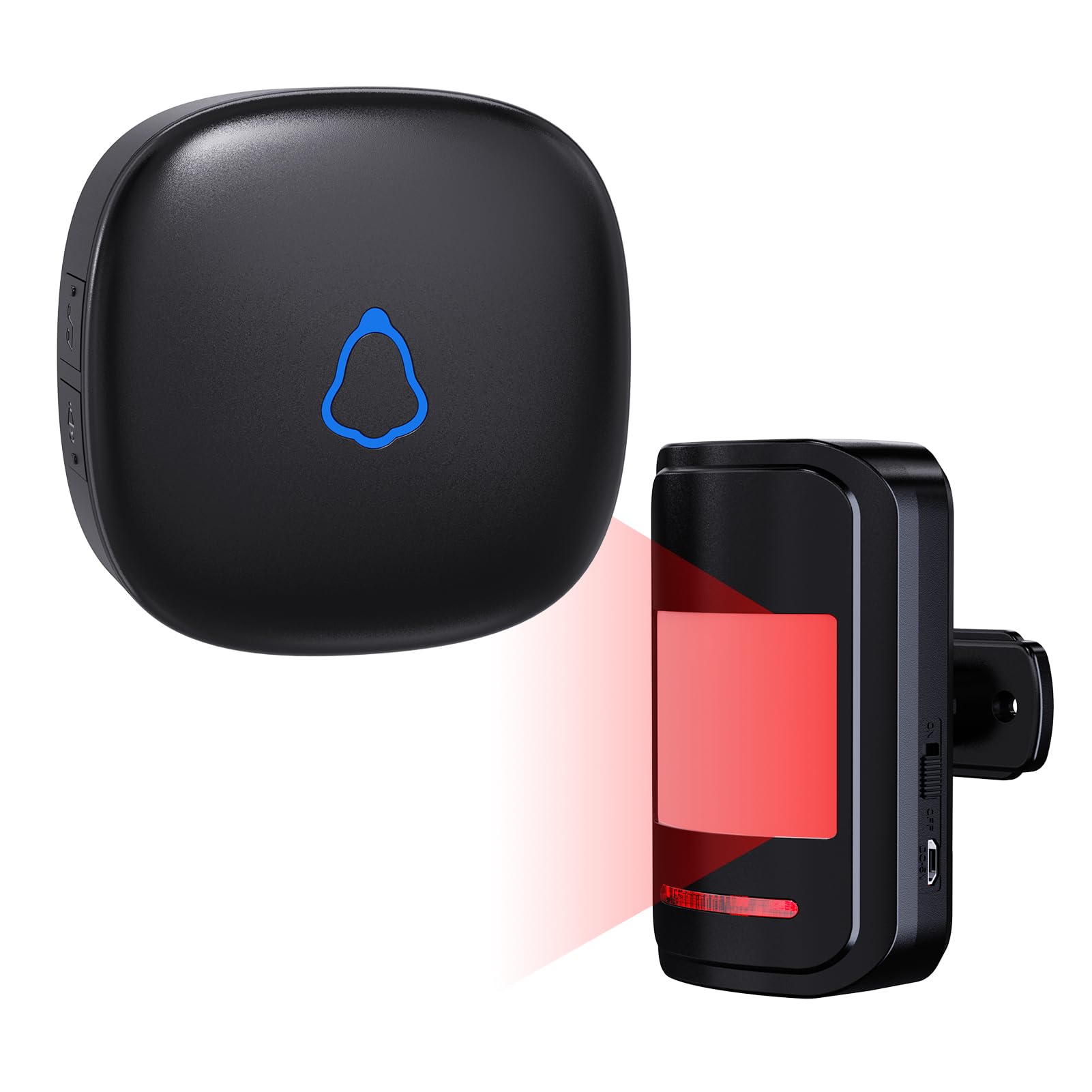
1. METAK 1 PIR Detector 1 Receiver Wireless Motion Sensor Alarm
Our pick — 4.5+★ from 400+ verified ratings; the strongest balance of quality and price.
The garage-watch alarm that reaches your office from 500 feet away.
Most people buying a motion sensor alarm want one thing: to know when someone walks up to the door or into the garage while they are in another room. The METAK pair does exactly that, and it does it across a long house. The sensor watches a 26-foot-wide zone at a 110° angle (a wide fan of coverage, not a narrow beam), and it sends the signal to the plug-in receiver over a 500-foot transmission range. That is the longest receiver range of the compact indoor kits here.
Where this unit pulls ahead is in flexibility of location. You can run the sensor on three included AAA batteries for a spot with no outlet, or switch it to Micro USB power so you never think about batteries again. The receiver offers 32 selectable ringtones and five volume levels running from silent to 110dB, so the same box can be a gentle shop-bell by day and a nagging hallway alert at night. Owners use it for doorways, mailboxes, pet areas and doorbell duty, and the set-up takes minutes.
The recurring complaint is the flip side of that loudness: even the quietest setting is louder than some people want, and a few say the lower volume steps still bark more than expected. Want to cover more ground later? It accepts up to 20 motion sensors on one receiver, so one box can watch a garage, a hallway and a back door at once.
What earns it first place
- 500-foot transmission range lets the receiver sit far from the sensor
- 26-foot, 110° detection fan covers a wide doorway in one aim
- 32 ringtones and five volume levels from silent to 110dB
- Runs on 3 AAA batteries or Micro USB — your choice per location
- Expandable to 20 sensors on a single receiver
Where it can rub you wrong
- Even the lowest volume steps are louder than some rooms need
- Plug-in receiver needs a nearby outlet for the alert box itself
- 32 tones means you will spend a few minutes picking one
Reach for this if: you want one alarm that can watch a garage, a hallway and a door from a single receiver without breaking a sweat.
Skip it instead if: you need a near-silent alert next to a sleeping person — the minimum volume still carries.
2. CPVAN 125dB Motion Sensor Alarm with 328ft Remote
A shed-and-van guard that screams first and asks questions later.
If you have ever caught someone in your shed, van, or storage unit, you know the value of being loud. The CPVAN answers with a 125dB siren (a volume that hurts close up), and it reaches 40 feet of detection — the longest detection distance of the compact indoor sirens here, and well past the AMHEY chime kit’s 16 to 26 feet. It comes with a remote that works up to 328 feet in open areas for arming and disarming.
Two modes carry the real utility: a loud siren for security, and a chime mode for gentle door notifications. The remote works through walls without line of sight, so you can arm it from the driveway or shut it off from the next room. It runs on three AA batteries (a wall-mounted setup avoids the wiring hassle) and installs with the included adhesive or screws in minutes.
Battery life is the honest trade-off. Several buyers report the three AA batteries need swapping roughly every six to eight weeks in daily use, and that low-battery beep has a habit of going off at night. That is the price for going wireless — plug-in power or a longer-life alternative would cost more. For a short-term, no-wiring guard at a shed or van, it hits the right notes.
Why it stays in the top tier: 125dB is the loudest siren of the indoor units on this list, and the 40-foot detection beats the smaller chime kits — so it scores highest on pure deterrence.
The one thing to plan for: budget for batteries every couple of months, or wire it to USB/AC power if your location allows.
Its job in one line: a wireless siren that makes any intruder think twice about your shed or van.
The catch it carries: battery-chasing — plan a rotate-and-replace routine rather than waiting for the low-battery chirp at 2am.
3. AMHEY Wireless Motion Sensor Door Chime DW520
For the shopkeeper who needs to hear the door over the noise of the business.
A doorway is not a security problem — it is a “someone walked in” problem, and you just need to know. The AMHEY chime covers a 16- to 26-foot detection zone at 110°, and its receiver sits up to 500 feet away. That is a modest detection distance compared with the CPVAN’s 40 feet, but it is enough for a single entry door or a small storefront, and the receiver range means the box can live in the back office.
You get 32 chimes, five volume levels from silent up to 110dB, and a flashing LED that gives a visual alert alongside the sound. The silent-plus-light combination is the part that matters for hearing-impaired households or for a business where an audible chime would be lost under machinery. It pairs with extra sensors and receivers, up to 20 of the former, so one receiver can announce several doors.
The complaint that comes up most is the low end of the volume dial — the quietest setting is still louder than a small room needs. There is also no physical switch on the sensor, so disabling it means pulling a battery. Both are minor for a business entry; both would annoy you at a baby’s bedside.
What the doorbell crowd likes
- 32 chimes with a silent-plus-LED mode for visual alerts
- 500-foot receiver range keeps the box where you work
- Pairs with up to 20 sensors for a multi-door setup
- Five volume levels from silent up to 110dB
What to know before it arrives
- 16 to 26 feet of detection is shorter than the CPVAN’s 40 feet
- No on/off switch on the sensor — you pull a battery to mute it
- Lowest volume still reads loud in a quiet house
Good match for: a storefront, office door, or mailbox alert where a 500-foot reach and silent visual mode matter more than long detection range.
Look elsewhere if: you are covering a long driveway or a big yard — the detection zone stays short.
4. Honeywell IS335 Wired PIR Motion Detector

The drop-in replacement that brings a twenty-year-old alarm panel back to life.
Not everyone is starting fresh. If you have an existing wired alarm system and one sensor has died, this is the part that fixes it. The IS335 is a wired PIR detector (passive infrared — it reads body heat moving across its field) covering a 40 by 56 foot zone, and it works with security systems and smart home hubs. It is the one pick here that needs no batteries and no receiver.
Wiring in a replacement takes maybe twenty minutes if you have done it before, and owners with systems a quarter-century old report it slots right in and restores the zone. There is no pairing, no app, and no battery to chase — the panel supplies power and handles the signal. That is a genuine advantage over the wireless kits if you already own the infrastructure.
The honest catch is documentation. The printed instructions give pet-immunity guidance by weight but leave out height and heat-signature details, so a curious jumping dog can still trip it. Sensitivity is also mixed according to owners, running from spot-on to slightly hot depending on how you aim it. If your system is not wired, this sensor cannot help you — you need a wireless kit instead.
The case for going wired: no batteries, no pairing, and a 40 by 56 foot coverage footprint that dwarfs the compact wireless detectors. It is the cheapest long-term option if the wire is already in the wall.
Read the manual twice: the pet-immunity notes are thin on height and jump behavior, so mount it carefully if you have animals.
Built for: anyone repairing a wired panel — this is a swap, not a new install.
Not your part if: you have no existing alarm wiring, because it has no battery and no radio of its own.
5. Luckydeer 125dB Motion Sensor Alarm with 328ft Remote

A pocket-size siren that owners zip-tie under a car to guard the catalytic converter.
This is the pick for the person who wants an alarm that goes anywhere and needs no outlet — a van, a wheel well, a boat, a bedroom. The Luckydeer runs on three AA batteries and offers a 16- to 26-foot detection range with a 125dB siren. It also has a doorbell mode and a panic button on the remote, so it doubles as a caregiver pager and a door chime.
The remote works up to 328 feet in open air, which covers a driveway or a parking spot. Setup is the easy part — screws, double-sided tape, and batteries are all in the box, and owners mention a working install in about half an hour. One crowd-sourced trick: if the detection zone has a dead spot, angling the sensor down fixes it.
The recurring note is that 125dB is loud enough to hurt in a small room, so this is not the choice beside a sleeping baby. Instructions are the other sore spot — the manual assumes some familiarity, and the pairing steps confuse a first-timer. Neither complaint is a dealbreaker for a car or shed install; both matter if you want something a grandparent can set up alone.
Made for: tucking into a van, wheel well, or shed where there is no power and you want a loud local siren.
Think twice if: you need a quiet alert in a small sleeping room — 125dB is a lot for four walls.
6. CallToU Bed Alarm with Motion Sensor and Plug-in Receiver

A “someone just got out of bed” signal that reaches across the hall without a phone.
When you are caring for an elderly parent or a child who wanders at night, the alert has to be immediate and it has to reach you in the next room. The CallToU kit does that with one motion sensor and a plug-in receiver linked over a 500-foot range, and it runs on three AAA batteries with no WiFi or app required.
The genius details are the ones you only notice after using it for a week. The receiver flashes a light as well as sounding a chime, so it works when you are half-asleep or hard of hearing. You can set it to sound only, light only, or both — the combination covers a lot of bedrooms. The 433.92 MHz radio (a simple one-way signal band) is deliberately basic: fewer moving parts, fewer things to break.
The honest risk is what happens to any budget wireless kit — a small share of units arrive defective, and one unlucky buyer got a week of service before it died. That is a quality-control tail, not a pattern, and it is worth testing the unit for a few days before you rely on it. Setup itself is simple and the included adhesive is strong enough to skip drilling.
What caregivers tell us works
- Audible chime plus flashing light — good for low-light or sleepy monitoring
- Sound-only, light-only, or both modes suit different homes
- 500-foot range covers a hallway or a second floor
- No WiFi, no app, no monthly fee
What to test before relying on it
- A small share of units arrive dead or fail early — test for a week
- Needs a nearby outlet for the receiver, so plan a spot
- Single sensor means one care point per kit
Fits: a family watching one bedroom or hallway for a night-time exit, without adding a smart-home hub.
Look at the SYNLETT instead if: you want two sensors and a carry-around pager for moving around the whole house.
7. OUDAER Solar Outdoor Motion Sensor Alarm

A garden guard that barks like a dog and charges itself from the sun.
Raccoons in the trash, deer in the tomatoes, a neighbor’s cat in the flowerbed — the OUDAER is built for that fight, and it does not need a wire run to the garden. It pairs a 130dB alarm and strobe light with a 3.7V 1200mAh (a battery big enough to run all night after a full day of sun) rechargeable lithium cell, topped up by an on-board solar panel or a USB cable when the sky is stubborn.
There are 13 sound options — dog bark, gunshot, wolf howl, eagle call, siren, and more — plus a record-your-own-message function and two working modes (24-hour motion alerts or night-only). Mounting is a ground stake or the included adjustable bracket, so you can aim it along a garden path or at a fence line. The kit includes a remote for on-the-spot mode changes.
Here is the fair warning: several owners say it is not as loud as the number on the box suggests, with one measuring more like 95–100dB on a meter than a full 130. Others find it triggers on wind or falling leaves. If you need a perimeter siren that is genuinely deafening, temper your expectations; if you want an animal-scarer that works without wiring, it earns its place.
Where it earns the outdoor slot: the solar-plus-USB charging combo and 13 recorded or preset sounds make it a self-sufficient garden deterrent, and the 24-hour or night-only modes let you tune when it barks.
Set your loudness expectation: real-world reports put the output below the 130dB headline, so treat it as a nuisance deterrent rather than a property alarm.
Best used for: gardens, orchards, and yards where you want animal deterrence without running power.
Set it back from paths and doors: false triggers from wind and leaves are the most common complaint.
8. SYNLETT Wireless Bed Alarm

A two-sensor, pocket-pager care kit that follows you around the house.
Where the CallToU keeps you in one room, the SYNLETT lets you leave it. The kit ships with two motion sensors and one portable pager, so you can watch a bedside and a doorway at the same time and carry the alert in a pocket or on a belt clip. The 500-foot open-air range covers most homes and small care units, and the sensors run on eight AA batteries (all included).
The pager has a DINGDONG chime mode for a gentle doorbell-style notification, and an ALARM mode that sounds a continuous siren when motion is picked up. The rotatable brackets mean each sensor can be wall-mounted with screws, stuck on with adhesive, or set on a flat surface with the convertible stand. During the day, the sensor is silent in the room — only the pager makes noise, so the resident is not startled.
What it does not have is a call button, which is the one thing a couple of caregivers have asked for. If your situation needs a two-way “help me” link rather than a one-way “someone moved” alert, this is not that device. For a caregiver who needs to be free to do other things while still knowing the moment a patient stands up, the two-sensor design is hard to match.
Choose it when: you are the only caregiver and you need to step out of the room without losing the alert.
Look elsewhere if: you need the patient to be able to call for help — there is no call button.
9. AMHEY Motion Sensor Door Chime DW5375

One receiver, three sensors, and a different chime for each door.
If a single doorway is not enough, this kit skips straight to the full setup: three motion sensors and one receiver in the box. The receiver pairs with up to 20 sensors total, so you can add more doors or zones later, and each sensor can carry its own chime so you know which entrance lit up the receiver. Detection runs 13 to 26 inches at an adjustable 30° to 110° angle, and the signal reaches 500 feet.
Thirty-five ringtones and five volume levels from mute to 100dB give you plenty of room to distinguish a back-door bell from a store-entry alert. The plug-in receiver is a straight plug-and-play, and the sensors mount with double-sided tape or screws. Business owners working in a back room get their customer chime; a caregiver can hear which hall was crossed without walking to check.
The recurring gripe is false alarms from the sensitivity — a few owners find theirs trips on wind. Angle the sensor away from windows and vents and that calms down. The 100dB top volume is also a little shy of the 125dB sirens here, so this is a notification device, not a deterrent.
Why it suits multi-door setups
- Three sensors included, expandable to 20 on one receiver
- Different chime per zone tells you which door opened
- Adjustable 30° to 110° detection angle
- 500-foot signal range handles a large building
Things to weigh up
- Top 100dB volume is softer than the 125dB sirens here
- Sensitive PIR can false-alarm on wind or moving air
- 13 to 26 inch detection is short-range by design
Pick this setup for: a shop, office, or multi-entry home where you want a different chime for each third door.
Not the one for: scaring off intruders — the volume is notification-grade, not siren-grade.
10. TECKNET Non-APP Solar RGB Wireless Driveway Alarm

The driveway sensor that reaches the house from the far end of a long lane.
Long driveways break most wireless kits, because the signal fades before it reaches the house. The TECKNET solves that in two ways: a 2600-foot transmission range (far beyond the 500-foot indoor kits here) and a solar panel on the sensor so you never climb a fence post to change a battery. Detection runs 16 feet on low sensitivity and 33 feet on high, with a rotating bracket to aim the sensor exactly at the lane.
The receiver offers 36 melodies, five volume levels, and four color-coded alert zones so you can tell a driveway alert from a backyard one at a glance. The multi-colored LEDs flash in sync with the sound, which helps if you are hard of hearing or the receiver sits across a noisy room. It is an IPX5-rated (water-resistant) housing built for outdoor mounting, and it is not a smart device — no app, no subscription, no pairing.
The risk comes in rural settings. One buyer on a semi-rural long driveway got 20+ false alerts a day even at the 16-foot low sensitivity setting, and another had to move the sensor closer to the house because trees cut the 2600-foot range. For most suburban and paved-lot driveways, the 36 chimes and long reach make it a strong performer; for an overgrown lane, testing the geometry first is worth the effort.
The long-reach advantage: 2600 feet of transmission and a solar trickle charge mean the sensor can sit at the property line while the receiver stays in the kitchen, no wiring and no battery swaps.
The rural caveat: trees and distance are the enemies — some owners had to trim the geometry before quieting the false alerts.
Right for: a paved driveway or paved property entrance where you need the signal to travel hundreds of feet, and get rain on it regularly.
Test before mounting: if your lane is lined with trees, aim and range-check the sensor at full height before you commit.
11. YoLink Outdoor Motion Sensor Driveway Kit

A two-sensor driveway kit that phones you when someone turns into the gate.
This is the only kit on the list that puts the alert on your phone instead of a receiver. The YoLink pair uses LoRa wireless (a long-range, low-power radio standard) to reach up to 2034 feet in open air, so a sensor at a barn, a gate, or a distant shed stays connected. The SpeakerHub has an audible chime, and it can also push an alert to your phone, a light, or an Alexa routine.
Two outdoor motion sensors come in the box, each running on AA batteries rated for up to 5+ years of typical service — the longest battery tier here, well past the CPVAN’s six-to-eight-week AA swaps. The hub supports 300+ devices, so it can grow into a small smart-home setup, and the app pairs with a QR scan. As a starting point it is the most capable sensor ecosystem in the roundup.
Two caveats to weigh. First, the sensors are designed for outdoor use but not waterproof — mount them in a sheltered spot away from direct rain and standing water. Second, the accuracy is mixed at the margins, with some owners finding nearby movement slips past. Both are manageable for a driveway where the sensor lives under an eave.
Best for: someone who wants the alert on their phone and a system that can grow to cover gates, sheds and a shop.
The condition to respect: shelter the sensors from direct rain — “outdoor” here means weather-ready housing, not submerged.
Know the Specs
Detection range vs transmission range
Detection range is how far the sensor can see a moving body — 16 to 26 feet on many indoor kits, 40 feet on stronger ones, and up to 33 feet on the outdoor driveway sensors. Transmission range is how far the signal travels to the receiver — 500 feet on most indoor kits and 2600 feet on the TECKNET driveway unit. A sensor that sees far but only transmits a short way will cover a room but not a detached garage, so match both to the layout of your property.
Decibels and volume modes
A decibel (dB) is the unit for loudness. The indoor sirens here run up to 125dB and the outdoor OUDAER claims 130dB, while the chime kits top out closer to 100dB. Volume modes matter as much as peak loudness: a siren deters an intruder, but a chime is what you want for a night-time caregiver alert. Look for a unit with adjustable levels from silent to full, and note that even the lowest setting on some units is louder than a small room needs.
Common Questions
Will a motion sensor alarm work through walls and glass?
How far does a typical wireless motion sensor alarm reach?
What is the difference between a motion sensor alarm and a door chime?
How long do batteries last in a motion sensor alarm?
Will a motion sensor alarm set off a pet or a jumping dog?
Do I need WiFi or a hub for a motion sensor alarm to work?
How do I stop false alarms from wind, leaves or passing cars?
Can I replace just one dead sensor in my existing wired alarm system?
What is the difference between a smoke alarm and a motion sensor alarm?
Will the loudest motion sensor alarm damage hearing or startle a sleeping person?
Can one receiver handle several motion sensors at once?
The Bottom Line
For most people, the right starting point is the METAK 1 PIR Detector 1 Receiver, because its 500-foot transmission range and 26-foot, 110° detection fan cover a whole house from one plug-in receiver, and it runs on batteries or Micro USB depending on where you mount it. If loud deterrence is what you need for a shed or van, the CPVAN CP2 Pro leads the indoor sirens at 125dB with 40 feet of detection. For a night-time caregiver alert, the CallToU Bed Alarm pairs a chime with a flashing light and needs no WiFi. And if your driveway is long enough that 500 feet falls short, the TECKNET Solar Driveway Alarm reaches 2600 feet with no wiring at all.
How we choose
We do not accept paid placement. Every pick is matched to a real buyer and a real use-case; we do not hands-on test units.
Sources
Specifications: manufacturer listings and product documentation. Review insights: verified customer reviews, as of October 2026. Pricing: not shown on this page (it changes often); check the current price via the retailer link.
As an Amazon Associate, Aappliancez earns from qualifying purchases. This does not affect which products we feature.