Disclosure: Some links in this post are affiliate links. As an Amazon Associate I earn from qualifying purchases, at no extra cost to you. Learn more
Specs are compiled from manufacturer listings and verified buyer reviews and can change over time — please confirm the key details on the product page before buying.
Composite toe boots protect your toes with a non-metal cap instead of steel, but plenty of them turn your feet into a sweaty, aching mess by lunchtime. The pick that gets the balance right is the Puma Safety Conquest: a waterproof work boot with a side zipper, a cushioned footbed, and a padded collar that does not need weeks of break-in. Below you get nine real options sorted by what each one actually solves — all-day standing, wet job sites, wide feet, or a lighter sneaker-style feel.
This guide is built by comparing the manufacturers’ published specifications and the patterns across verified customer reviews, so you get each pick’s real strengths and trade-offs instead of marketing spin.
Some boots here are built to shrug off concrete for twelve hours, and others are light enough to forget you laced up. What separates them is how the toe cap, cushioning, and upper material work together. These are the most comfortable composite toe boots you can put on and forget about.
Top Picks


How To Choose The Most Comfortable Composite Toe Boots
Comfort on a composite toe boot comes from three things working together: the cushioning under your foot, the room in the toe box, and how dry the inside stays. Get one of those wrong and you feel it by hour six. Here is what actually matters when you compare these boots.
Toe cap material and safety rating
A composite toe is a non-metal cap that shields your toes from impact and crushing loads. Because it carries no metal, it does not conduct cold the way steel does and it will not set off a metal detector. Look for an ASTM F2413-18 stamp on the label — that is the industry standard that confirms the boot passed impact and compression testing. Some boots here also carry an EH rating (electrical hazard), which matters if you work near live circuits.
Cushioning and footbed support
The footbed is the layer your foot actually rests on, and it decides whether you feel fresh or flattened at the end of a shift. Look for a described cushioning system — an energy-return midsole, a honeycomb heel, or a shock-absorbing EVA layer. Several boots here use removable insoles, which lets you swap in your own orthotic if the stock one runs thin.
Fit, width, and toe box room
A composite cap takes up space inside the boot, so the toe box needs to be roomy enough that your toes do not press against it. If you have wide feet or wear thick socks, sizing can shift by a half size either way. Read the fit signals carefully: some of these run narrow, some run large, and one expects you to size up. Trying them with the socks you actually work in is the safest move.
Side-by-Side Comparison
| Model | Best For | Toe Type | Waterproof | Weight | Amazon |
|---|---|---|---|---|---|
| Puma Safety Conquest★ Best Overall | All-day work with easy on/off | Composite, EH, ASTM F2413-18 | Yes (BreathActive) | 3 pounds | Amazon |
| Skechers Tilido FletchitFeatherweight Pick | Slip-on speed and light walking | Composite | — | 1.4 pounds | Amazon |
| CAT VenwardWork-to-Weekend Look | Work-to-life crossover look | Composite, SD-10 | — | 2.4 pounds | Amazon |
| Cat Invader Mid Vent | Grip on rough ground | Composite | — | 3 pounds | Amazon |
| KEEN Kenton Mid | Light-duty sneaker feel | Composite | — | 18.3 oz per shoe | Amazon |
| Wolverine I-90 | Anti-fatigue cushioning | Composite | Yes | 1.81 pounds | Amazon |
| Timberland PRO Titan EV | Support with a sneaker feel | Composite, EH | Yes | 4.21 pounds | Amazon |
| Carhartt Ground Force | Wet, muddy job sites | Composite, EH, ASTM rated | Yes (Storm Defender) | 4.5 pounds | Amazon |
| Ariat Workhog | Side-to-side stability | Composite, EH, ASTM F2413 M/I/C | Yes (DRYShield) | 5.5 pounds | Amazon |
Detailed Reviews
1. Puma Safety Conquest Work Boot
Our pick — 4.5+★ from 750+ verified ratings; the strongest balance of quality and price.
A waterproof boot with a zipper down the side and no break-in period to survive.
The Conquest earns the top spot because it solves the two complaints that ruin most safety boots at once: getting them on in a hurry and staying comfortable while you wear them. There is a YKK zipper running down the side with a gusset (a fabric fold that keeps water from sneaking through the zip), so you can step in and out without wrestling laces every morning. Under your foot sits an Evercushion footbed plus a PU midsole, which is the shock-absorbing layer that softens each step on hard floors.
Buyers praise the build quality first and the cushioned comfort second. The waterproof BreathActive lining is designed to keep rain and puddle water out while still letting moisture escape, so your socks do not turn clammy by noon. A semi driver put these through ten-hour days in mud, snow, and rain and reported dry feet with toes that stayed warm, and the zipper held up through all of it. The rubber outsole is slip, oil, and heat resistant to 572 degrees F, which matters if you are standing near hot equipment or on oily shop floors.
The composite toe meets ASTM F2413-18 M/I/C EH compliance, so you get impact protection without the cold metal feel of steel. Buyers report the sizing runs tight — “Great boots, but size up at least 1/2 size!” as the review pages put it — so order up unless you plan to wear thin socks. The zipper and the long-term fit draw mixed views, with some finding it useful and others skipping it entirely in favor of the laces. Trea the seam and tread as wear items on a boot this light.
Where it pulls ahead
- Zipper entry with a gusset for fast on/off and splash protection
- Waterproof BreathActive lining keeps rain out without trapping sweat
- Evercushion footbed and PU midsole cushioning for long shifts
- Heat, oil, and slip resistant outsole rated to 572 degrees F
Where to look closely
- Runs tight — plan to size up about a half size
- Some find the side zipper unnecessary and stick to lacing
- Long-term durability draws split opinions
Reach for this if: you want a waterproof composite toe boot that goes on fast and stays cushioned through a full shift.
Order carefully if: you are between sizes — go up, not down, because this one runs snug.
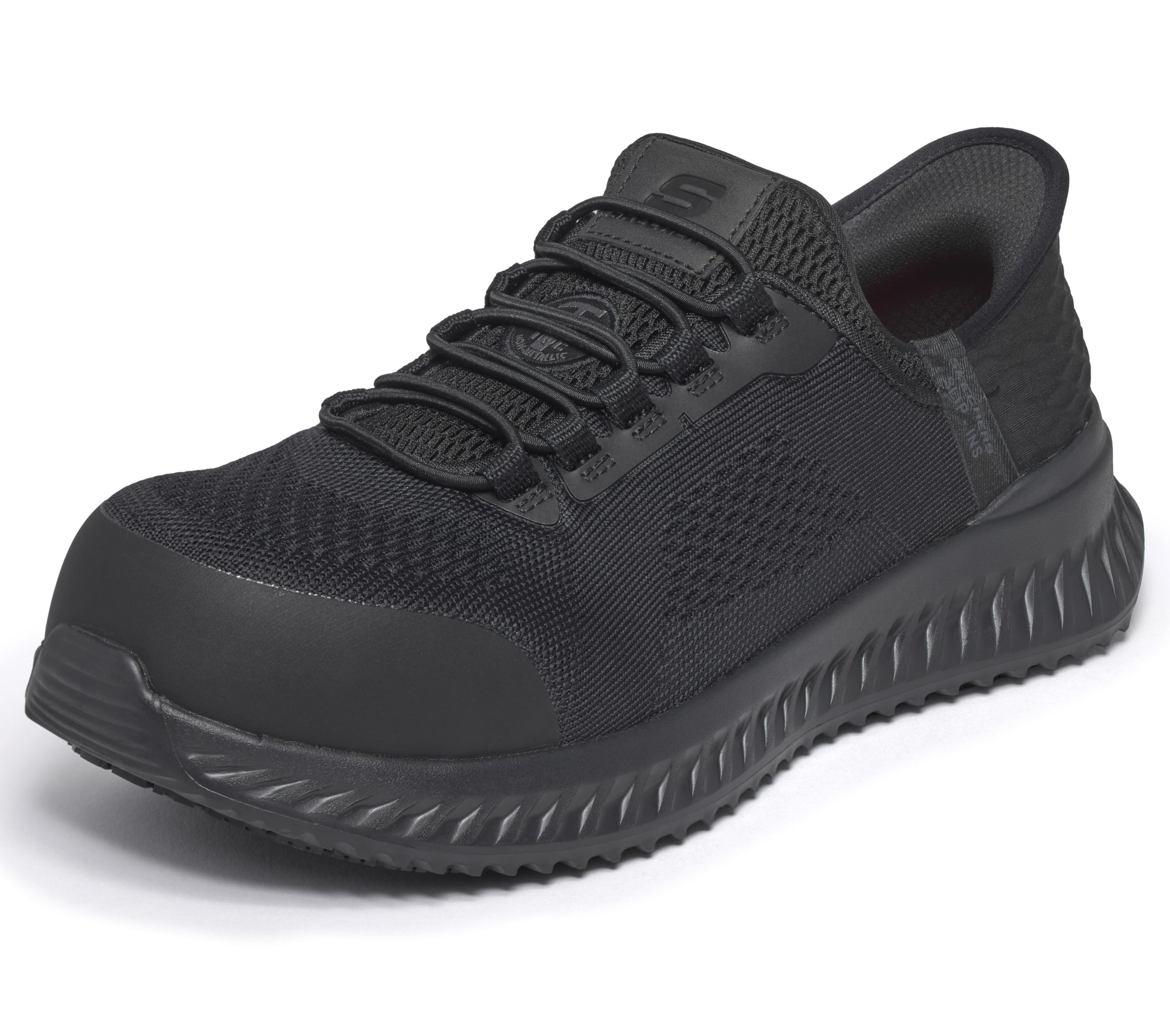
2. Skechers Men’s Hands Free Slip-ins Tilido Fletchit Comp Toe
At 1.4 pounds, this slip-on work shoe barely registers on your feet.
If your job means walking the floor rather than hauling concrete, the Tilido Fletchit is the lightest thing on this list. It weighs 1.4 pounds, which is less than half the 3 pounds of the Puma Safety Conquest above — a real difference when you are on your feet for a whole shift. The hands-free slip-in design means you step straight into it with no laces to tie, and the Air-Cooled Memory Foam insole cushions each step.
The protection story is what makes it worth considering. One owner bought a pair after her husband broke his toes, and a dropped 80lb slab on the foot caused no injury. That is the composite toe doing its job against impact. The slip-resistant outsole adds grip on smooth factory floors, and the engineered mesh upper keeps the shoe breathable instead of baking your feet.
Here is the catchworth knowing before you buy: sizing runs large, and there are no laces to tighten the fit. Owners mention sizing down works — one said their normal 14 was too big and a 13 fit perfectly. The stock insoles also leave room to improve; more than one wearer swapped in a better set for comfort over long hours. This is a light-duty shoe, not a heavy-labor boot.
The weight argument: 1.4 pounds with a composite toe and a slip-resistant outsole is a package that suits warehouse walking, factory floors, and light maintenance far better than felling trees.
A word on fit: plan to order a size down, and budget for an insole swap if the stock foam feels thin after a few weeks.
Your match if: you want to slip in, walk all day, and barely feel the shoe.
Think twice if: you need serious traction on wet mud or a boot that survives heavy labor.
3. CAT Men’s Venward Composite Toe Sd
A retro sneaker silhouette hiding a non-metallic safety toe.
The Venward is the pick for anyone who wants a work shoe that does not scream work boot. It pairs a modern sneaker look with a non-metallic safety toe, and the SD-10 rating means it is built to resist static buildup — useful if you work in environments where a spark is the last thing you want. At 2.4 pounds it sits in the middle of the pack, heavier than the Skechers above but lighter than the full leather boots further down.
Buyers praise the construction most, with the cushioned feel a close second. Construction workers wear it to stay EHS compliant while still looking sharp, and it transitions from site to dinner without raising eyebrows. The engineered comfort is aimed squarely at people who want one shoe for both.
The honest trade-off is durability. A few wearers found the material along the safety toe seam split around three months, and peeling or early breakdown comes up more than once. That is not the norm across the board, but it is worth knowing if you are rough on shoes. If you need a shoe that survives punishing conditions for years, the heavier leather boots below are the safer bet.
What earns it a spot
- SD-10 static-dissipative rating for spark-sensitive settings
- Non-metallic composite toe keeps weight down
- Retro sneaker look reads well off the clock
What to weigh
- A handful of reports of the toe-seam material splitting early
- Not built for the roughest job sites
Pick it if: you want EHS-compliant protection wrapped in a shoe you would wear on the weekend.
Skip if: your work punishes footwear and you need a boot that lasts several seasons.
4. Cat Footwear Men’s Invader Mid Vent Ct
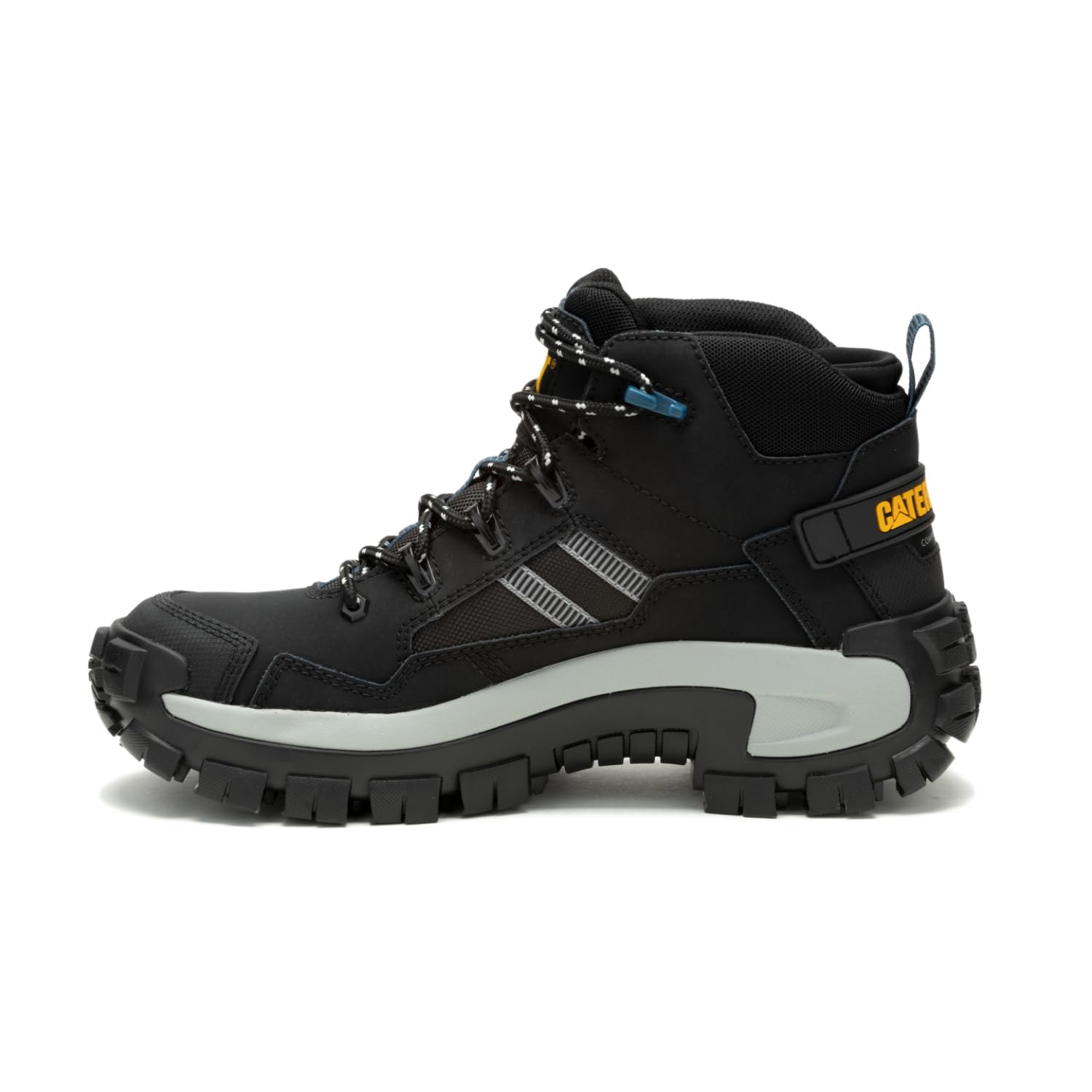
Hiker-inspired mesh panels and a lug pattern built to bite into loose ground.
The Invader Mid Vent takes the hiker route to workplace comfort. Mesh paneling and a lower cut keep the boot from feeling like a brick, while the aggressive lug pattern — those deep raised treads — digs into dirt and gravel instead of sliding. The composite toe is non-metallic, so it does not pull heat out of your toes on cold mornings. It weighs 3 pounds, the same as the Puma Safety Conquest but built closer to a trail boot than a work shoe.
Buyers mention the sturdy build most often, with the hiker styling a close second. The boot has hiker hardware and a shape that works on site and on a trail. Customers note it as “Lightweight, comfortable, good looking, sturdy and great grip” — an all-in-one summary that matches what the design is trying to do.
Two things to know. The fit runs narrow, so wide-footed wearers may need to size up or look elsewhere. And the sole is on the stiff side, which one wearer found uncomfortable for standing all day — this boot favors moving over standing. The plastic lace hooks are also a wear point worth keeping an eye on.
The grip case: where the KEEN Kenton below is a walking shoe, this one is a trail-tread work boot, tuned for moving across uneven ground rather than pacing a smooth floor.
Comfort reality: the cushioning is fine and the ankle cut can rub until it breaks in, so give it a few wears before a full shift.
Best suited to: workers who cover rough, uneven terrain and want tread that holds.
Not your boot if: you stand in one spot on concrete all day and want a pillowy sole.
5. KEEN Utility Men’s Kenton Mid Composite Toe Work Sneakers
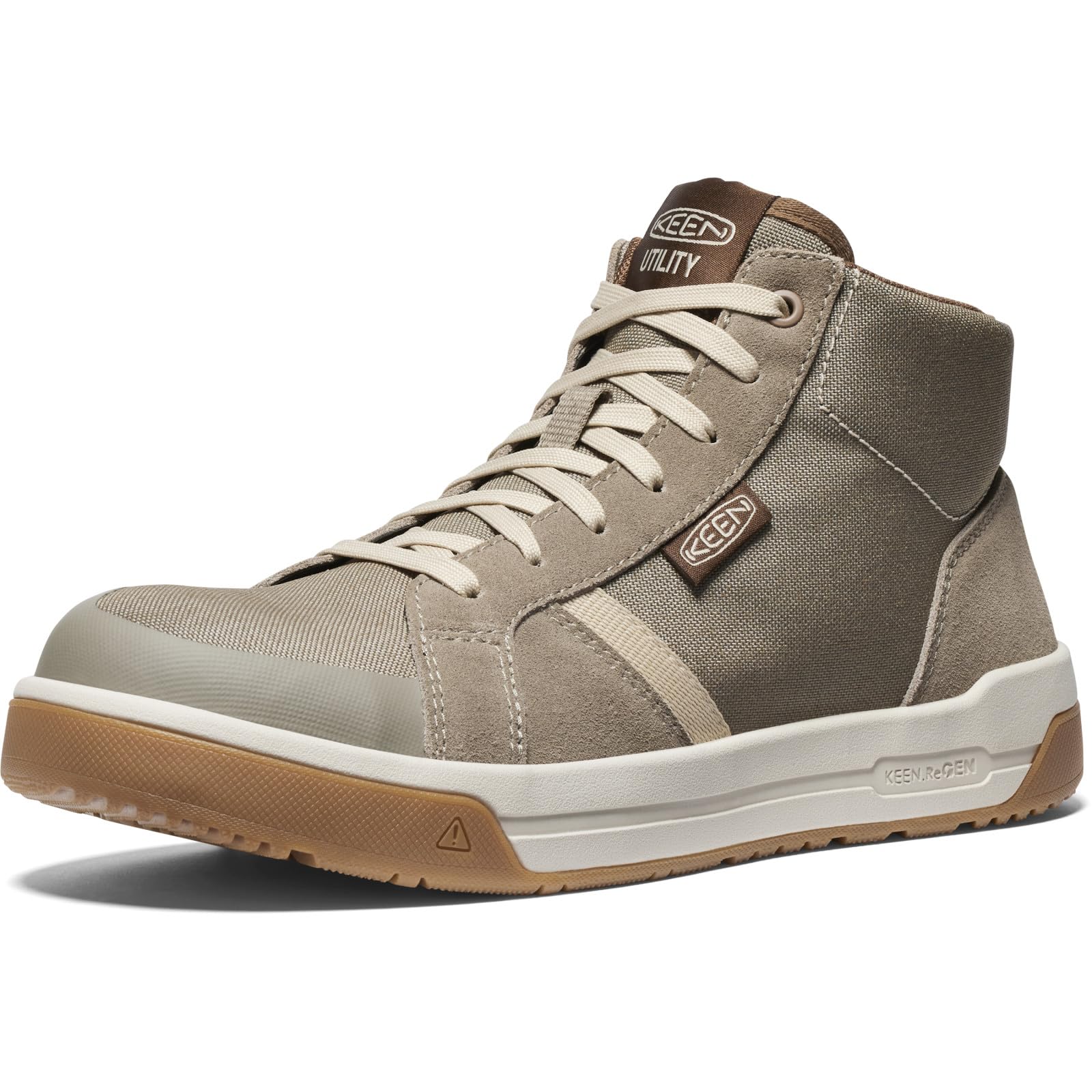
A skate-shoe silhouette from a brand that builds around a wider foot form.
KEEN builds this one at 18.3 oz (519 g) per shoe, which puts it firmly in sneaker territory. It is built off KEEN’s traditional wider footwear form, so if standard work boots pinch across the forefoot, this is the shape to try. The removable insoles let you drop in your own orthotic without fighting the stock padding, and the casual look carries from assembly line to weekend.
Buyers weigh the build quality most, with the 18.3 oz feel and skate-shoe look close behind. The composite toe does its job too — one wearer who spent years hunting for comfortable safety-toed boots called the light weight the biggest win for a safety toe. The Kenton is aimed at light-duty settings like assembly, maintenance, manufacturing, warehousing, and distribution, and the leather comes from tanneries certified by the Leather Working Group.
Sizing is the big variable here. Some find it true to size, others say it runs big enough to size down half, and a few found it ran dramatically small. The stock insole also draws complaints about being hard, so plan on adding a padded one. Give yourself a short break-in period — one wearer noted an initial pinch across the top of the foot that eased after a few ten-hour days.
Why it earns a place: the wider form plus removable insoles makes this the most forgiving pick for anyone who normally fights a tight toe box.
The fit caveat: sizing reports scatter in both directions, so order from a seller with easy returns and try your true size first.
Right for you if: you work light-duty and want a safety shoe that feels like a sneaker with room up front.
Look elsewhere if: you need waterproofing or a boot for heavy outdoor labor.
6. WOLVERINE I-90 Construction Boot

An energy-returning footbed that gives back some of what each step takes.
The I-90 is built around Wolverine’s EPX anti-fatigue technology, which uses a footbed with a honeycomb heel that expands to absorb impact and then returns energy. Add a cushioned midsole and a rubber lug outsole, and the whole system works together to take pressure off your feet step after step. At 1.81 pounds it is one of the lighter full boots here, and the waterproof full-grain leather upper with a breathable membrane keeps feet dry without turning them into a sauna.
Fit is the standout strength — wearers mention it more than any other trait. People find it comfortable right away and appreciate the lighter-than-expected feel. Value and water resistance round out the praise, and for a waterproof leather boot this one is easy to live with in wet weather.
Two caveats worth holding. The “extra wide” option runs narrower than the label suggests, so if you need genuine width, try before you commit. Durability splits opinion too, with some reporting years of service and others seeing them break down inside six months. It is a strong everyday boot, not an indestructible one.
The case for the I-90
- Honeycomb heel and EPX footbed return energy to fight fatigue
- Waterproof leather upper with a breathable membrane
- 1.81 pounds — light for a full leather construction boot
What to check first
- The extra-wide width runs tighter than expected
- Longevity reports vary — some see early breakdown
Choose this when: foot fatigue across long shifts is your main enemy and dry feet matter.
Measure up first if: you need a genuinely wide fit — this one runs tighter than the label.
7. Timberland PRO Titan Ev Composite Safety Toe
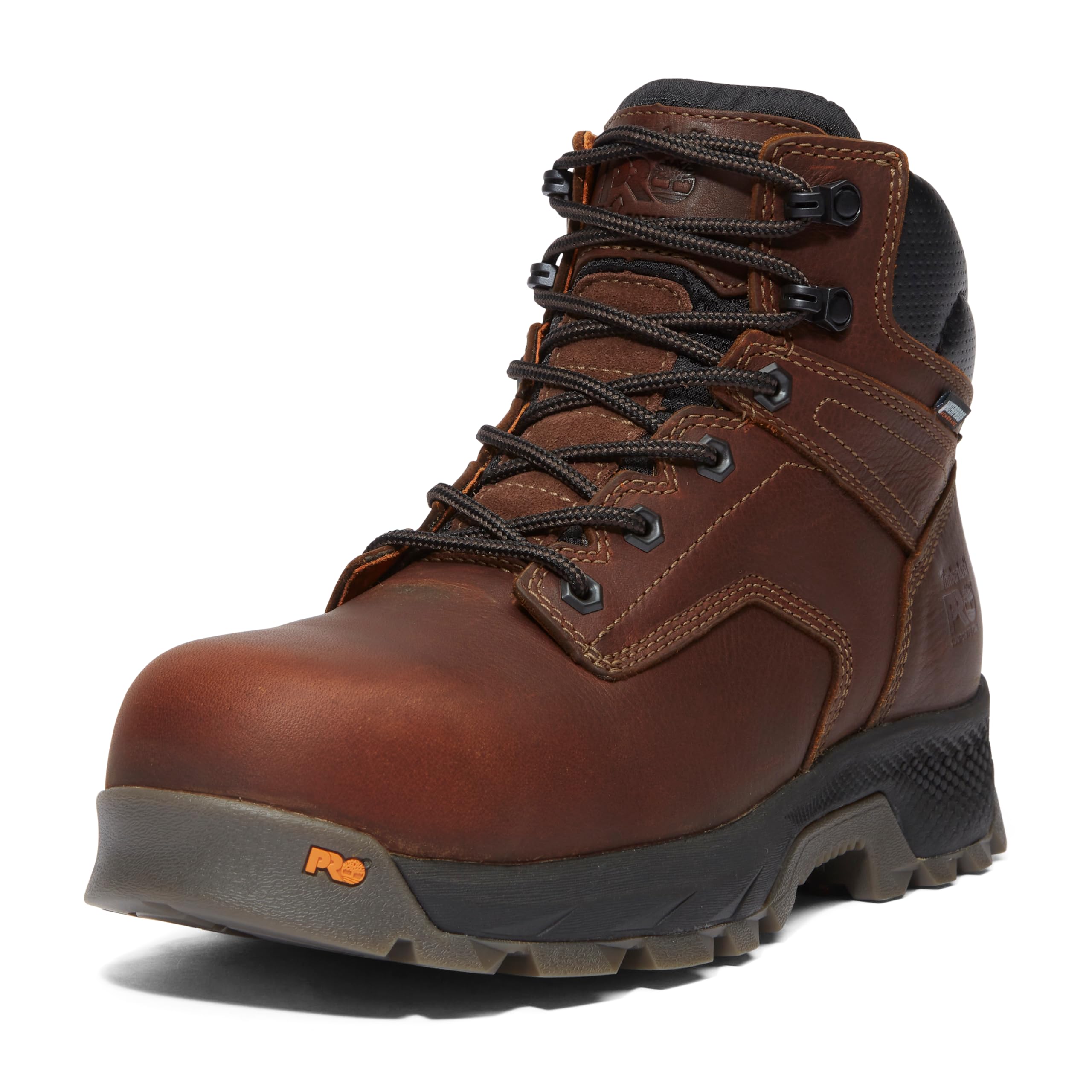
Hover Spring foam underfoot that reads like a sneaker, wrapped in waterproof leather.
The Titan EV pairs Timberland’s lightweight Hover Spring foam midsole with a premium full-grain waterproof leather upper and an internal waterproof membrane. The Anti-Fatigue Technology footbed absorbs shock and returns energy all day, and the non-marking rubber outsole is heat, oil, slip, and abrasion resistant. The breathable lining is ReBOTL fabric made with at least 50% recycled plastic — a small detail that adds up if you care about where your gear comes from.
Comfort leads here, with build quality close behind and fit earning solid agreement — the toe box is roomy and true to size. An overhead lineman working long hours called them super lightweight and more comfortable than hikers. Another found them comfortable straight through eight hours with no foot or back ache.
The honest note is durability, which is unproven for a boot this new. Some wearers of the prior generation felt the EV design traded away some of the classic’s toughness, and one long-time fan reported foot pain and loosening laces with the new eyelet design. If you loved the old Titan, this is a different boot — try it before you commit to a season.
Underfoot feel: the Hover Spring midsole is the headline — cushioning and flex closer to a running shoe than a heavy work boot.
The durability question: this is a newer design, so long-term wear is the one thing nobody can hand you a verdict on yet.
Pairs well with: long hours of ground work and bucket work where light weight and cushioning beat brute toughness.
Hesitate if: you want a proven ten-year boot — this generation has not earned that track record yet.
8. Carhartt Ground Force 10” Waterproof Wellington Boot

A pull-on Wellington built for rain, mud, and damp job sites that never dry out.
This one is for the days when the ground is a mess. The 10-inch oil-tanned leather upper combines with Storm Defender technology, which keeps water out while letting your feet breathe — the difference between a waterproof boot and a plastic bag. Inside, the FastDry lining wicks moisture and cuts odor, and the Insite footbed gives arch support to ease end-of-day foot fatigue. Underfoot, a shock-absorbing EVA midsole and a flexible Ground Force rubber outsole move with you instead of fighting your stride.
Wearers praise the pull-on looks and the all-day comfort most. The pull-on design is quick to get on, and the composite toe is built to ASTM impact and compression standards, with EH electrical-hazard protection as well. One wearer has thrashed a pair for four years and reports them still waterproof and ready for another. Another wears them in thorns and finds the sole does not let anything through.
The honest downsides are fit and long-term wear. Some find them true to size and others do not, and the break-in can rub an ankle for the first day or so. Getting them off can take a tug, especially on a muddy day. A handful report early breakdown, though plenty of long-use reports balance that out. Treat it as a boot you break in with thick socks and a little patience.
What it does well
- Storm Defender waterproofing plus a FastDry moisture-wicking lining
- Insite footbed and EVA midsole for arch support and shock absorption
- Composite toe meets ASTM impact and compression standards
- EH rated for electrical hazard protection
What to plan around
- Sizing runs mixed — not everyone gets a true fit
- The break-in can rub an ankle for the first day
- Getting them off takes effort on a muddy day
Built for: construction, farming, landscaping, and anyone working in rain, mud, or damp ground all day.
Break them in first if: you have sensitive ankles — give yourself a soft first day before a full shift.
9. Ariat Men’s Workhog Waterproof Composite Toe Work Boot

A square-toe Workhog built for side-to-side stability on uneven ground.
The Workhog is the heaviest boot here at 5.5 pounds, and that weight buys you a lot of support. It delivers side-to-side stability with a cushioning, shock-absorbing insole, and the oil and slip resistant Duratread outsole holds its grip on slick surfaces. A DRYShield waterproof membrane keeps feet dry, while an ASTM F2413 M/I/C EH rating and ASTM F3445 slip rating back up the safety claims. The 11-inch square-toe leather upper with a stitched top is built for harsh outdoor work and oil and gas exploration.
Owners rave about the build quality most, with comfort close behind, and the DRYShield membrane keeps feet dry in wet conditions. People who have worn the Workhog for years keep coming back, and plenty describe them as comfortable from the first day with a perfect wide fit.
Fit and long-term durability draw mixed reactions. The area across the top of the foot runs tight for some wearers, so if you have a high instep, look at that fit detail carefully. A small number also report issues with the toe cap splitting or premature breakdown. The weight itself is note too — at 5.5 pounds, these are not a shoe you forget you are wearing on a long day.
The stability case: where the Skechers is 1.4 pounds and all about lightness, this is 5.5 pounds and all about support — two opposite reasons to buy a composite toe boot.
Fit to watch: the tightness across the top of the foot catches some wearers, so try yours on with the socks you work in.
Best for: oil and gas work, outdoor jobs, and anyone who wants a stable, waterproof, well-built boot.
Shop around if: you have a high instep or you want a light boot — this one runs tight on top and carries real weight.
Know the Specs
Composite Toe vs Steel Toe
A composite toe is a cap made of non-metal materials that protects your toes from impact and crushing. It is lighter than steel and does not conduct cold or electricity the same way, which is why workers in cold or electrical environments favor it. Look for an ASTM F2413 stamp to confirm it was tested to the industry standard for impact and compression. The trade-off is that composite caps can feel a touch bulkier, so the toe box room in the boot matters just as much as the material.
Waterproof Membranes and Breathability
A waterproof membrane is a thin layer inside the boot that stops water from passing through while letting vapor escape. That balance matters: a boot that blocks water without breathing turns swampy inside. Brands here use names like BreathActive, Storm Defender, and DRYShield. If you work in wet conditions, this layer is what keeps your socks dry all day. If you work mostly dry and hot, a ventilated non-waterproof shoe can actually feel cooler on your feet.
Common Questions
Will a composite toe boot set off a metal detector at a plant entrance?
Do composite toe boots run true to size?
Is a composite toe as safe as a steel toe?
Can I replace the insole in a composite toe work boot?
What does EH rated mean on a work boot?
How long does a waterproof composite toe boot stay waterproof?
Are composite toe boots more comfortable than steel toe boots?
Do I need a slip-resistant outsole on a work boot?
Which boot here works best for someone with wide feet?
What are the trade-offs of a light work shoe versus a heavier boot?
The Bottom Line
For most people, the most comfortable composite toe boots winner is the Puma Safety Conquest because it combines a waterproof upper, a cushioned footbed, and a side zipper that makes getting them on and off painless. If light weight is what you want, grab the Skechers Tilido Fletchit at 1.4 pounds. And for wet, muddy job sites that demand a pull-on, the Carhartt Ground Force is the one to reach for.
If you only have one takeaway, let it be the fit. The boots here range from snug to generously cut, so paying attention to size notes before you buy is the simplest way to get a pair your feet will thank you for.
How we choose
We do not accept paid placement. Every pick is matched to a real buyer and a real use-case; we do not hands-on test units.
Sources
Specifications: manufacturer listings and product documentation. Review insights: verified customer reviews, as of October 2026. Pricing: not shown on this page (it changes often); check the current price via the retailer link.
As an Amazon Associate, Aappliancez earns from qualifying purchases. This does not affect which products we feature.