Disclosure: Some links in this post are affiliate links. As an Amazon Associate I earn from qualifying purchases, at no extra cost to you. Learn more
Specs are compiled from manufacturer listings and verified buyer reviews and can change over time — please confirm the key details on the product page before buying.
Morning glory is the vine that laughs at ordinary weed spray. Its leaves shrug off a light mist, its roots run deep, and it comes back from every scrap you leave in the soil. The concentrates below are the ones built for that fight: brush-and-vine formulas that target roots, plus fast-acting grass and weed killers for the open ground around them. Pick based on what you are actually killing — vines and brush, or everyday weeds in cracks and gravel.
This guide is built by comparing the manufacturers’ published specifications and the patterns across verified customer reviews, so you get each pick’s real strengths and trade-offs instead of marketing spin.
Each concentrate below is judged on coverage, how fast it shows die-off, and whether it reaches the root. The short answer: match the mix strength to the plant you are fighting, because the strongest label on the shelf is not always the right bottle for your driveway. The most useful place to start is the strongest morning glory herbicide for vines and brush rather than bare-ground weeds.
Top Picks

How To Choose The Best Morning Glory Herbicide
Morning glory is not a dandelion. It spreads by seed and by creeping stems that root wherever they touch soil, so a spray that browns the leaves can still leave a live plant underneath. That is why the label matters more than the bottle size.
Match the formula to what you are killing
A general weed and grass killer is built for emerged annuals in cracks, gravel, and along fences. A brush-and-vine herbicide is labeled for woody and vining plants — blackberry, poison ivy, kudzu — and works toward the root. If your target is a morning glory tangle in a fence line, you want the second type. Using the first type means repeated spraying and regrowth from the root.
Read the coverage line, not the bottle size
Two 32-ounce bottles can treat wildly different areas depending on the mix ratio. Coverage is the square footage one bottle treats after dilution, so it sets your cost per square foot. Image lists 4000 square feet from its 32-ounce bottle, while Ortho’s 32-ounce bottle lists 1,120 square feet — the same bottle size, very different ground treated.
Check the rainfast window before you spray
Rainfast means the spray has soaked in far enough that a rainfall will not wash it off. Roundup lists 30 minutes, Ortho lists 15 minutes, Spectracide lists 15 minutes, and Compare-N-Save lists 2 hours. Spray with less than that window before a storm front and the application washes off.
Plan for replanting and for the root
Some products let you plant again after a waiting period; Roundup’s label lists a 4-month window before ornamental bedding plants, trees, shrubs, sod, and seed can be planted. If you want to replant the same weekend, a 4-month interval rules this bottle out.
Side-by-Side Comparison
| Model | Best For | Coverage | Rainfast | Visible Results | Amazon |
|---|---|---|---|---|---|
| Roundup Dual Action Plus 4 Month Preventer★ Best Overall | Kill and block regrowth in gravel and cracks | 1,600 sq. ft. | 30 minutes | As fast as 6 hours | Amazon |
| Image Brush & Vine Killer ConcentrateBest for Vines | Tough vines, brush, and blackberry | 4,000 sq. ft. | — | 10+ days per label use reports | Amazon |
| Ortho GroundClear Super Concentrate1 | Fast knockdown around patios and walkways | 1,120 sq. ft. | 15 minutes | Starts working immediately | Amazon |
| Spectracide with Accumeasure System | Big driveways and walkways, easy measuring | 1,350 sq. ft. | 15 minutes | As fast as 3 hours | Amazon |
| Compare-N-Save 75324 Herbicide | Budget coverage of very large areas | 25,000 sq. ft. | 2 hours | As little as 2 to 4 days | Amazon |
Detailed Reviews
1. Roundup Dual Action Weed & Grass Killer Concentrate
Our pick — 4.5+★ from 800+ verified ratings; the strongest balance of quality and price.
Kills the green you can see — and stops the next wave from sprouting behind it.
For morning glory in gravel, driveway cracks, or along a fence line, reach for this one. Its edge is the preventer layer: it kills existing weeds and grass down to the root, then stops new seed from sprouting for up to 4 months. One 32 fl. oz. bottle treats up to 1,600 sq. ft. (a patch about 40 ft. by 40 ft.).
Speed is the other half of the story. The label lists visible results in as fast as 6 hours and a rainfast window of 30 minutes, so a spray before an afternoon shower is not a lost afternoon. What wins people over most is the mixability — you add 6 fl. oz. per gallon, stir it into a tank sprayer, and go. A reusable pump sprayer changes the whole cost picture, as buyers point out: “The biggest advantage is that it’s cheaper to mix your own in a pump sprayer.”
Check where you plan to spray before you buy. The label says ornamental bedding plants, trees, shrubs, sod, and seed can go back in 4 months after application. It also warns you to treat the entire control area, not just the emerged weeds, if you want the prevention to hold. The catch buyers keep flagging is value: this is a small bottle, and it costs more up front than plain grass killers. The mix goes far in a sprayer, but if you only want a cheap, fast knockdown in cracks, the Ortho below gets there for less outlay.
Where this bottle earns its spot
- Prevents fresh weeds for up to 4 months, not just kills the ones showing
- Rainproof in as fast as 30 minutes and visibly working in as fast as 6 hours
- 1,600 sq. ft. per 32 fl. oz. bottle, mixed at 6 fl. oz. per gallon
- Stays effective through heavy weather — it held through a tropical storm according to buyers
What to weigh before you buy
- Cost per bottle runs above plain knockdown sprays
- Prevention only works if you spray the whole area, bare spots included
- Not the pick when you need to replant the same bed this season
Reach for this if: you want one application that clears a gravel path or fence line and keeps it clear for the season.
Look elsewhere if: you are only knocking down weeds in cracks and want the lowest-cost bottle for that job.
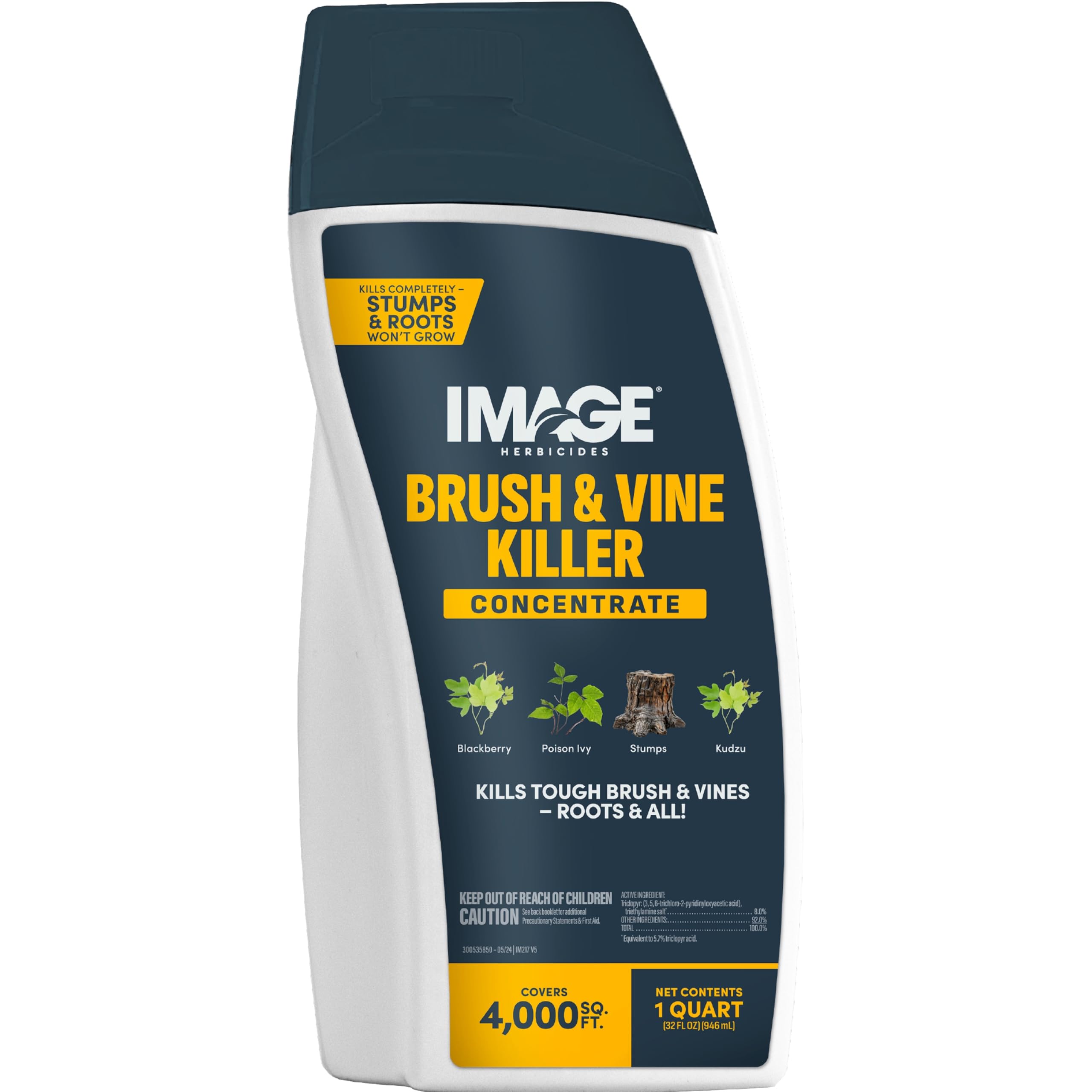
2. Image Brush & Vine Killer Concentrate, 32 oz
The one labeled for the plants that break sprayers and backs — blackberry, kudzu, poison ivy.
Image is the specialist here. It is labeled for tough weeds, grasses, vines, brush, and stumps, including poison ivy, poison oak, poison sumac, and wild blackberry, and it is built to give a complete kill with no regrowth from the roots. Coverage is the headline number: one 32-ounce bottle treats 4,000 square feet. That is the widest reach of any bottle in this group by a wide margin — Ortho’s 32-ounce bottle covers 1,120 square feet.
The active ingredient is ammonium salt of imazaquin (a root-acting herbicide), which is why this bottle behaves differently from the glyphosate-based picks. It works slower. Buyers fighting Himalayan blackberry report a 4 oz per gallon mix taking 10+ days to show effect, with most leaves yellow by three weeks. A stronger 5 oz per gallon mix on a second area responded faster, with leaves brown and dry by week 4. The same pattern shows up on poison ivy and on horsetail. If you expect overnight browning, this will feel like nothing is happening.
Patience is the price of admission, and the label concentration is the thing to respect. The honest catch: results swing with the mix you pour and the season you spray, so measure rather than eyeball, and give it weeks, not days. Owners who hit the right ratio against blackberry and poison ivy tend to stay loyal to this bottle specifically because glyphosate products kept letting the vines come back.
Why it earns a place: a 4,000 sq. ft. coverage per bottle and a label that names vines and brush rather than generic weeds.
What to expect: a slow, root-deep kill timeline measured in weeks. Read the label ratio and do not rush the verdict.
This is your bottle if: morning glory, blackberry, or poison ivy keeps returning after other sprays and you want the roots addressed.
Give it a pass if: you need browning on the leaves today and are spraying light annual weeds in cracks.
3. Ortho GroundClear Weed & Grass Killer Super Concentrate1
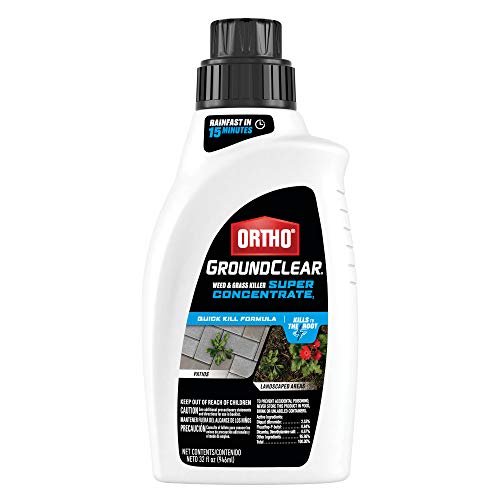
Fifteen minutes to rainproof, and it starts working the moment it hits the leaf.
Ortho is the spray for the ground you walk on: patios, paths, sidewalks, sidewalk cracks, walkways, driveways, and around trees, shrubs, and fences. The 32 fl. oz. bottle treats up to 1,120 sq. ft. It kills the toughest weeds and grasses to the root, naming clover, dandelion, oxalis, chickweed, and crabgrass, and it starts working immediately with a 15-minute rainfast window.
What buyers talk about most is the value — the concentrate goes a long way for what you pay, and it is easy to mix. One buyer’s experience is the useful caution here: at the recommended concentration it killed a little more than half the weeds, with some coming back after a few weeks, while a double-strength mix killed every plant. That is a mix-rate story, not a bad-bottle story, and it tells you to read the label rate against how stubborn your growth is.
The instructions are specific and worth following exactly: mix with water in a tank sprayer, spray when weeds are actively growing, and spray when the air temperature is above 60°F. The one real limitation is timing — below that temperature, this bottle waits. Spray in warm weather with 15 minutes of dry window and it will do its job. Expect a chemical odor at application that clears, as buyers describe.
The value read: 1,120 sq. ft. per bottle with a 15-minute rainfast window and immediate action on contact — a strong mid-range choice for hardscapes.
The one caveat: stubborn growth may need a stronger mix than the label’s base rate, so buy for the area and the strength you actually plan to spray.
Best fit: driveways, patios, and walkway cracks where you want fast browning and can spray in warm weather.
Not the one for: cold-weather spraying or a morning glory thicket that needs a vine-labeled formula.
4. Spectracide Weed and Grass Killer Concentrate 32 Oz
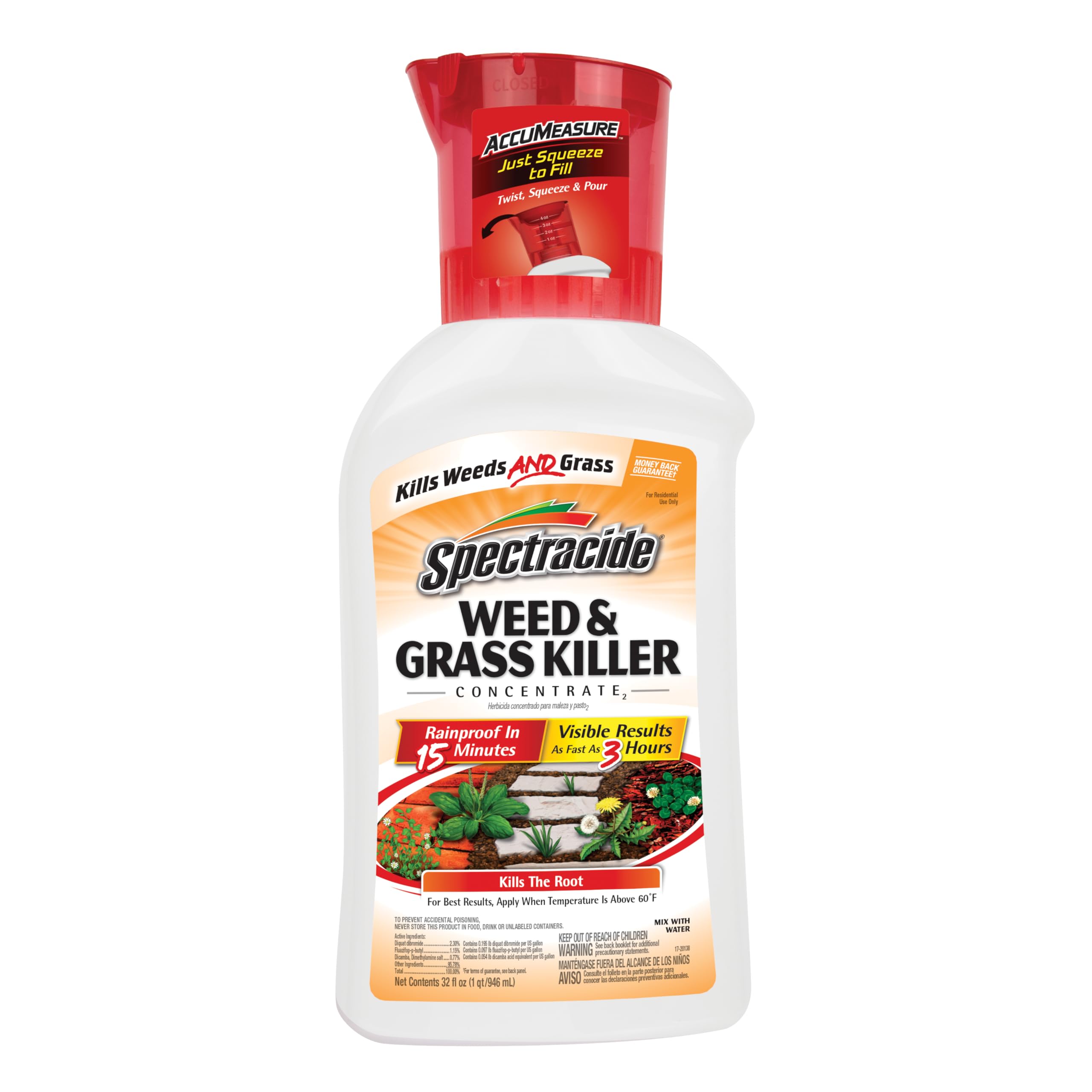
A built-in measuring cap that turns the messy part of mixing into a twist and a squeeze.
Spectracide wins on the measuring side. The Accumeasure cap lets you twist, squeeze, and pour the concentrate straight into your sprayer, so you skip a separate measuring cup. Buyers praise how effectively it kills most, with ease of use close behind. Visible results show in as fast as 3 hours, and rain or watering 15 minutes after application will not wash it away.
It kills broadleaf weeds and grasses down to the root, for use on driveways, walkways, patios, and around fences, trees, flower beds, and shrubs, and it lists 1,350 sq. ft. of coverage from a 32-ounce bottle. The active ingredient is diquat dibromide. Mixed into a reusable 1-gallon sprayer, buyers report weeds along the curb dying within a day.
Two honest frictions come with this bottle, and both are small. The Accumeasure cap divides opinion — some love the self-measuring pour and others find it fussy, so if you already own a graduated cup, that feature is neither here nor there. And leakage is a recurring gripe, so store it upright and check the cap seal before it rides around in a shed. This bottle weighs 2.5 pounds, making it 25% heavier than the Image bottle at 2 pounds — noticeable if you are hauling it up a slope.
The case for the Accumeasure bottle
- Results in as fast as 3 hours and rainfast in 15 minutes
- Twist-and-pour cap removes the need for a separate measuring cup
- 1,350 sq. ft. per 32-ounce bottle at a mid-range outlay
- Works in a standard reusable 1-gallon sprayer
Small frictions to accept
- The self-measuring cap is a love-it-or-not feature
- Some units leak, so store it upright with the cap checked
- At 2.5 pounds it is heavier to carry than the Image bottle
Choose this when: you are mixing batch after batch for a big driveway and want to skip the measuring cup routine.
Skip the upgrade if: you prefer pouring from a plain bottle and want zero risk of a leaky cap.
5. Compare-N-Save 75324 Herbicide, 1-gallon, white
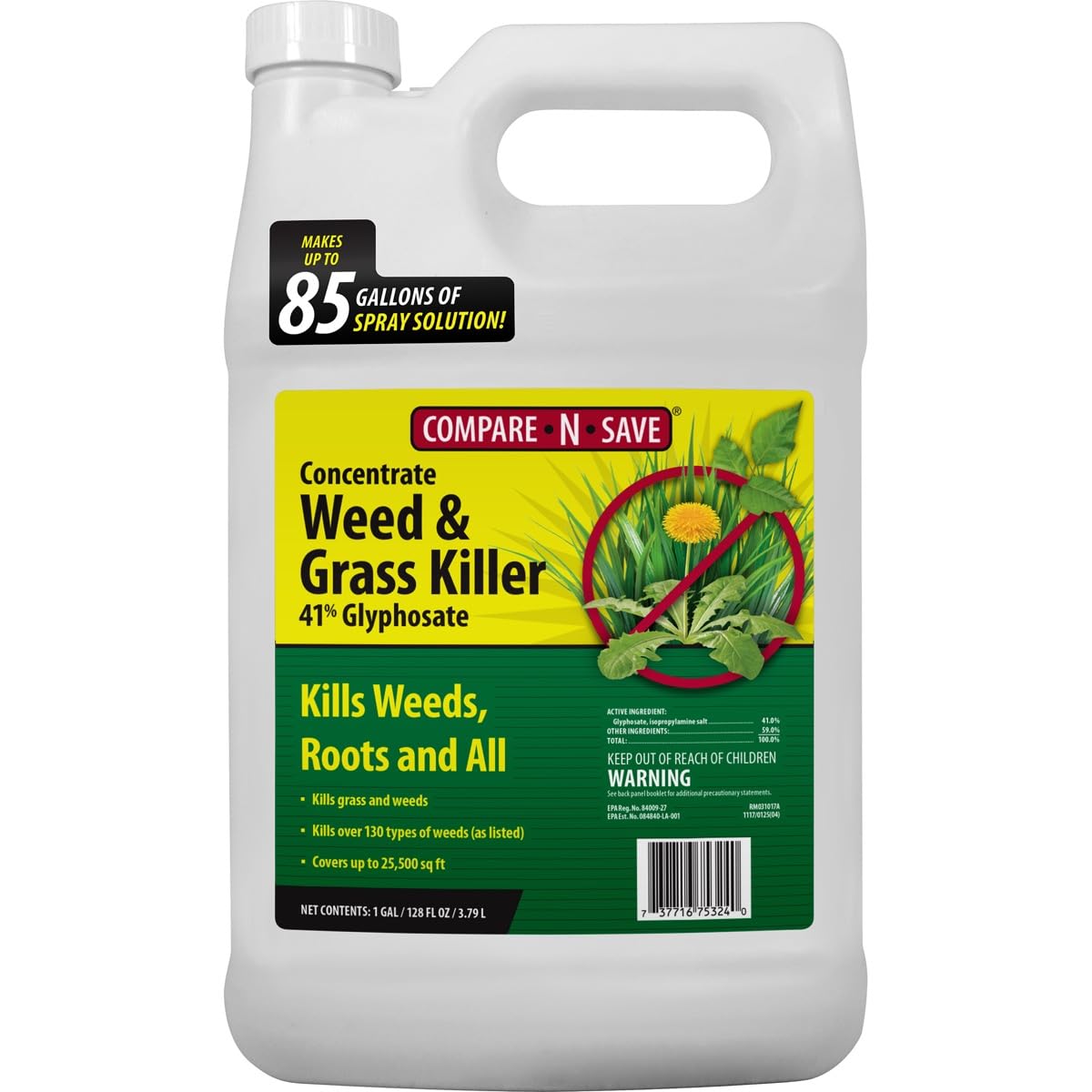
One gallon that mixes into a season of spraying, if you can wait a few days for the payoff.
Compare-N-Save is the coverage math winner by an enormous margin. A single 1-gallon jug covers over 25,000 square feet and makes up to 85 gallons of ready-to-use spray, which is why the value per gallon is the thing buyers talk about most. It contains 41-percent glyphosate, is rainproof in 2 hours, and shows visible results in as little as 2 to 4 days.
The trade-off is speed, and it is worth saying plainly: this is not the bottle for someone who wants brown leaves by dinner. Buyers describe it as slow but thorough — several days before you see it start, weeds dead inside two weeks. The mix ratio is about 3 tablespoons per gallon of water, which is where that 85-gallon yield comes from. Some buyers speed it up with a stronger mix and a surfactant, and one common observation is that patience is required but the kill holds.
Two practical notes before you commit. It is rainproof in 2 hours, so it needs a longer dry window than the 15-minute picks above. And at 9.7 pounds, the jug is a load to carry to a far corner of the property, so plan to mix near where you spray. For a large lot, a fence line of morning glory, or a field edge, this bottle is the low-cost workhorse that keeps giving.
The coverage argument: 25,000 sq. ft. and up to 85 gallons of mix from one jug, with 41-percent glyphosate and a 2-hour rainfast window — hard to match on area treated.
The patience clause: visible results in as little as 2 to 4 days mean you will not see instant browning, and the 9.7-pound jug is heavy to haul far from where you mix.
Reach for this if: you have a large property to clear and want the lowest cost per square foot of ground treated.
Pass on it if: you need same-day visible results or you are only treating a small crack or two.
Know the Specs
Coverage in Square Feet
Coverage is the area a bottle treats after you dilute it, so it is the fairest way to compare cost. A larger number means fewer bottles over a season. Read the label rate alongside it, because a stronger mix than the base rate will shrink the area covered.
Rainfast Timing
Rainfast is how long the spray needs to sit before rain will no longer wash it off. A 15-minute window gives you the most flexibility; a 2-hour window demands more planning. A 15-minute window gives you the most flexibility; a 2-hour window demands more planning.
Active Ingredient
The active ingredient decides how the plant dies. Glyphosate and imazaquin move through the plant toward the root, so they are slower but more thorough. Diquat dibromide is a contact killer (it only burns what it touches) that browns leaves fast but does not travel to the root the same way. Pick diquat dibromide for fast leaf burn, glyphosate or imazaquin for a slower root kill.
Mix Ratio and Sprayer
Concentrates are mixed with water in a tank sprayer at a ratio printed on the label. The ratio controls both strength and how far the bottle goes. Measure carefully — a stronger mix can be more effective on tough growth, but it uses concentrate faster.
Common Questions
Will a grass and weed killer work on morning glory vines?
How long before I see the weeds die?
What does rainfast mean for my spray?
Can I replant flowers after using a weed killer?
Should I spray morning glory leaves or the root base?
Why did my spray only kill half the weeds?
How much area will one bottle treat?
What temperature should I spray in?
Is a concentrate better than a ready-to-spray bottle?
Can I use these around trees and shrubs?
The Bottom Line
For most people fighting morning glory and weeds around the yard, the best morning glory herbicide is the Roundup Dual Action Plus 4 Month Preventer. It gives you a 4-month prevention layer, a 30-minute rainfast window (rain after 30 minutes won’t wash it off), and visible results in as fast as 6 hours. That makes it the most balanced bottle for gravel, cracks, and fence lines. If the vines are the whole problem and other sprays keep letting them return, the Image Brush & Vine Killer is the specialist. It covers 4,000 sq. ft. and kills to the root on blackberry and poison ivy. For a large property where cost per square foot drives the decision, the Compare-N-Save 75324 covers over 25,000 square feet from one gallon. Just give it a few days to work.
How we choose
We do not accept paid placement. Every pick is matched to a real buyer and a real use-case; we do not hands-on test units.
Sources
Specifications: manufacturer listings and product documentation. Review insights: verified customer reviews, as of October 2026. Pricing: not shown on this page (it changes often); check the current price via the retailer link.
As an Amazon Associate, Aappliancez earns from qualifying purchases. This does not affect which products we feature.