Disclosure: Some links in this post are affiliate links. As an Amazon Associate I earn from qualifying purchases, at no extra cost to you. Learn more
Specs are compiled from manufacturer listings and verified buyer reviews and can change over time — please confirm the key details on the product page before buying.
If you are staring at a dark stain on a wall and wondering whether it is paint or something wet growing behind it, a pinless moisture meter (a handheld tool that senses water through the wall surface without poking holes) gives you an answer in seconds. The Klein Tools ET140 is the one to start with. It reads through the wall without drilling a single hole, so you get an answer instead of a repair bill. Below are seven tools: some scan walls for hidden water, and some grow a sample of what is actually floating in your air. Knowing if you need a wall scanner or an air culture kit is half the battle.
This guide is built by comparing the manufacturers’ published specifications and the patterns across verified customer reviews, so you get each pick’s real strengths and trade-offs instead of marketing spin.
Mold needs moisture before it needs anything else, which is why nearly every pick here finds the water first. The other two kits culture what is already airborne so you can see it with your own eyes. Either way, the right tool turns a vague worry about your home into a plain yes or no, and this guide to the mold detector device will help you pick the one that fits your situation.
Top Picks

How To Choose The Best Mold Detector Device
Mold itself does not show up on a meter screen. What the meter sees is the water that feeds it. That is the single most important thing to understand before you buy a moisture meter: you are really shopping for a water finder. The mold question follows from how much moisture is sitting inside your drywall, your ceiling, or your subfloor.
First decide which job you actually have
If a pipe burst, a roof leaked, or a stain appeared after heavy rain, you need a scanning meter. It reads through the surface and shows you where the wet zone begins and ends. If instead the house smells musty and you cannot find the source, a culture kit lets you grow a sample from the air or from a swabbed surface and see whether anything develops. They solve different problems, and a few buyers end up wanting both.
Why pinless beats pins for finished walls
A pinless meter presses a flat sensor pad against the wall and sends an electromagnetic field (an invisible signal that reacts to water) a short distance into the material. Nothing pierces your paint, so you can check the same spot every day while it dries. Pin meters push two metal probes into the material — more precise in raw lumber, but every reading leaves a small hole.
How deep you can read matters
Depth of detection tells you how far behind the surface the tool can sense moisture. Shallow readers catch surface damp; a deeper reader finds water sitting inside the wall cavity. One pick here reads as deep as 3/4 inch, and another reaches 0.79 inch (20 mm). For checking a wall after a leak, deeper is generally more useful.
Material settings change the number
Wood, drywall, and masonry hold water differently, so a good meter lets you tell it what you are scanning. Use the drywall setting on painted walls, the masonry setting on brick or concrete, and pick hardwood or softwood for lumber. Choose the wrong setting and the reading can drift by several points. Press the sensor flat and firm — a gap under the pad throws the number off.
Side-by-Side Comparison
| Model | Best For | Type | Detection Depth | Weight | Amazon |
|---|---|---|---|---|---|
| Klein Tools ET140★ Best Overall | Overall wall scanning | Pinless scanner | Up to 3/4 inch | 7 ounces | Amazon |
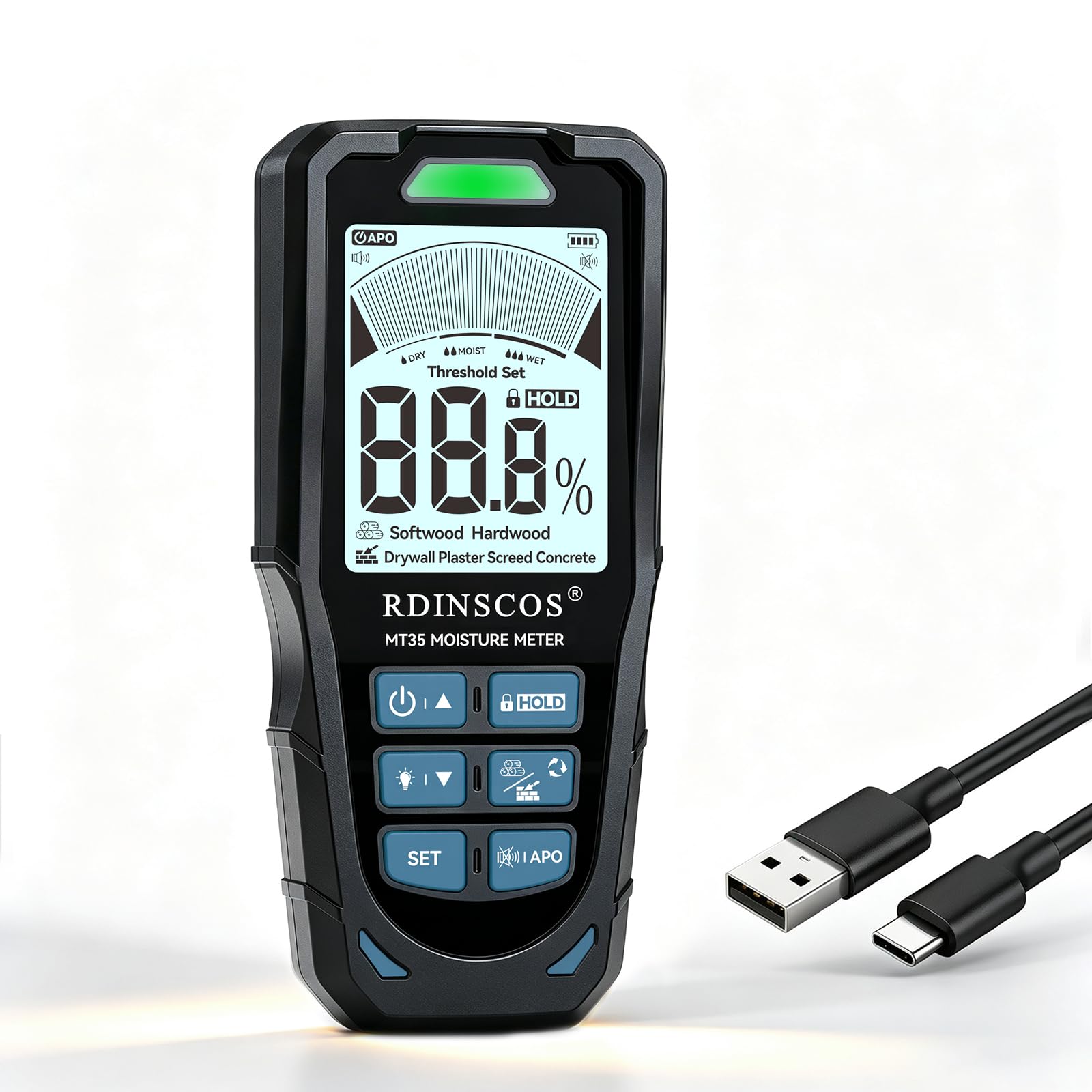
| RDINSCOS Rechargeable PinlessMost Versatile | Everyday home checks | Pinless scanner | 19 mm | 9.1 ounces | Amazon |
| AWT-380 | Tech-forward leak hunting | Pinless scanner | 0.79 inch (20 mm) | 9.9 ounces | Amazon |
| RDINSCOS Drywall & Concrete | Dark crawl spaces | Pinless scanner | — | 0.17 kg | Amazon |
| Evviva Sciences Kit | Air and surface testing | 10-dish culture kit | — | 15 ounces | Amazon |
| General Tools MM8 | High-mounted leak checks | Pinless scanner | — | 5.44 ounces | Amazon |
| Hearcozy Mold Testing Kit | Spot-checking many rooms | 10-plate culture kit | — | 0.48 kg | Amazon |
Detailed Reviews
1. Klein Tools ET140 Pinless Moisture Meter
Our pick — 4.5+★ from 6,000+ verified ratings; the strongest balance of quality and price.
Reads moisture three-quarters of an inch behind the wall and never touches your paint with a pin.
The ET140 presses a flat sensor pad to the surface and reads the electromagnetic field (an invisible signal that reacts to water) before a single hole is made. That depth — up to 3/4 inch — is the figure that matters after a leak, because the water is usually sitting deeper than the paint you can see. It works on drywall, masonry, hardwood, and softwood, and it is calibrated for those materials. Press it against a stain and you get a moisture reading on a reverse-contrast display plus nine LED bars that show the wetness range at a glance. A 9V battery, a hold button, a low-battery alert, and an auto-power-off round out a tool that has earned 4.5+ stars across 6,000+ ratings.
This pick shines when you are on the trail of an actual leak. Point it at the wall, then walk the sensor outward and watch the reading fall as you move away from the wet spot — that boundary tells you how far the water travelled. Owners who have mapped a leak this way describe the readings as consistent and repeatable, which is exactly what you want when you are checking whether a repair finally worked. It is not a lab instrument and nobody claims it is. The honest read from the review pages is that it is accurate enough for home and maintenance work, with the softwood setting more reliable than the hardwood one for some owners.
What wins people over is plain functionality — a long way ahead of any other single praise point — and the build backs it up on the job site. The catch is battery life and power reliability, which draw more negative comments than anything else about this model, so keep a spare 9V on hand and use the auto-power-off. The cycling order through masonry, drywall, and wood settings feels clumsy if you switch materials often. For a tool that costs less than many single-service callouts, that is a fair trade.
What earns its keep
- Reads up to 3/4 inch deep through drywall, masonry, and both wood types — no holes, no patching.
- Reverse-contrast display plus nine LED bars makes a wet spot obvious at a glance.
- Hold, low-battery alert, and auto-power-off are all built in.
- 2m drop protection, so an accidental knock off a ladder is survivable.
Where you feel the limit
- Battery life is the most common friction point — carry a fresh 9V.
- Hardwood readings can come in a few points off compared with a pin meter; softwood is the more trustworthy setting.
- Cycling through material modes to reach the one you want takes patience.
Reach for this if: you have a leak stain, a wet ceiling, or a basement wall that needs checking and you want the answer without cutting drywall.
Look elsewhere if: you are measuring raw lumber for a furniture build where a pin meter’s exactness matters more than a wall-safe reading.
2. RDINSCOS Rechargeable Pinless Moisture Meter
A rechargeable wall scanner tuned to find the slight damp that low-density drywall hides.
Nineteen millimeters of scanning depth — the RDINSCOS measures about 19mm into the material — puts it within a hair of the deeper-reading tools here while staying completely non-destructive. Its real edge is sensitivity. The sensing is tuned for low-density drywall and gypsum, the surfaces where cheaper pinless meters can read flat and tell you nothing. Run it over a painted ceiling after roof work and it will pick up subtle variation before the paint bubbles. A built-in lithium-polymer battery charges over USB-C, so you stop hunting for disposable cells before every inspection. It ships with a charging cable and manual.
For the price of a couple of takeaway meals, this is a practical tool for homeowners and renters alike. Owners describe it as easy to operate, and the fact that it is non-invasive means you can keep checking the same patch of drywall every day until it dries without leaving a mark. After a flood or a burst pipe, this is exactly the tool you want in hand to watch a dehumidifier do its work. It reads painted walls, ceilings, flooring, and most building materials.
What people praise most is the overall build quality, which edges out ease of use as the top praise point. Where it needs practice is consistency: hold the sensor flat and at a steady angle or the reading drifts, and a few owners find the numbers less than exact. If you want to read a spot near the ceiling you will need a ladder, since you have to place the pad directly on the surface rather than aiming from a distance. None of that is a flaw in the design — it is just how pinless sensing works, and a steady hand fixes it.
The rechargeable advantage: going USB-C removes the single most frustrating thing about moisture meters — a dead battery mid-inspection. Charge it off the same cable as your phone and it is ready when you are.
Sizing up the real trade-off: at 9.1 ounces it sits comfortably in one hand and is lighter than the AWT-380’s 9.9 ounces, but neither is heavy enough to tire you out on a full house walk-through. The only true limit is that it needs to physically touch everything it measures.
The sensible everyday pick: a renter or new homeowner who wants a rechargeable scanner for wall checks after storms and slow leaks.
Not for you if: you need to read high ceilings without a ladder — that is the one job a flat-pad meter cannot do.
3. AWT-380 Rechargeable Pinless Moisture Meter
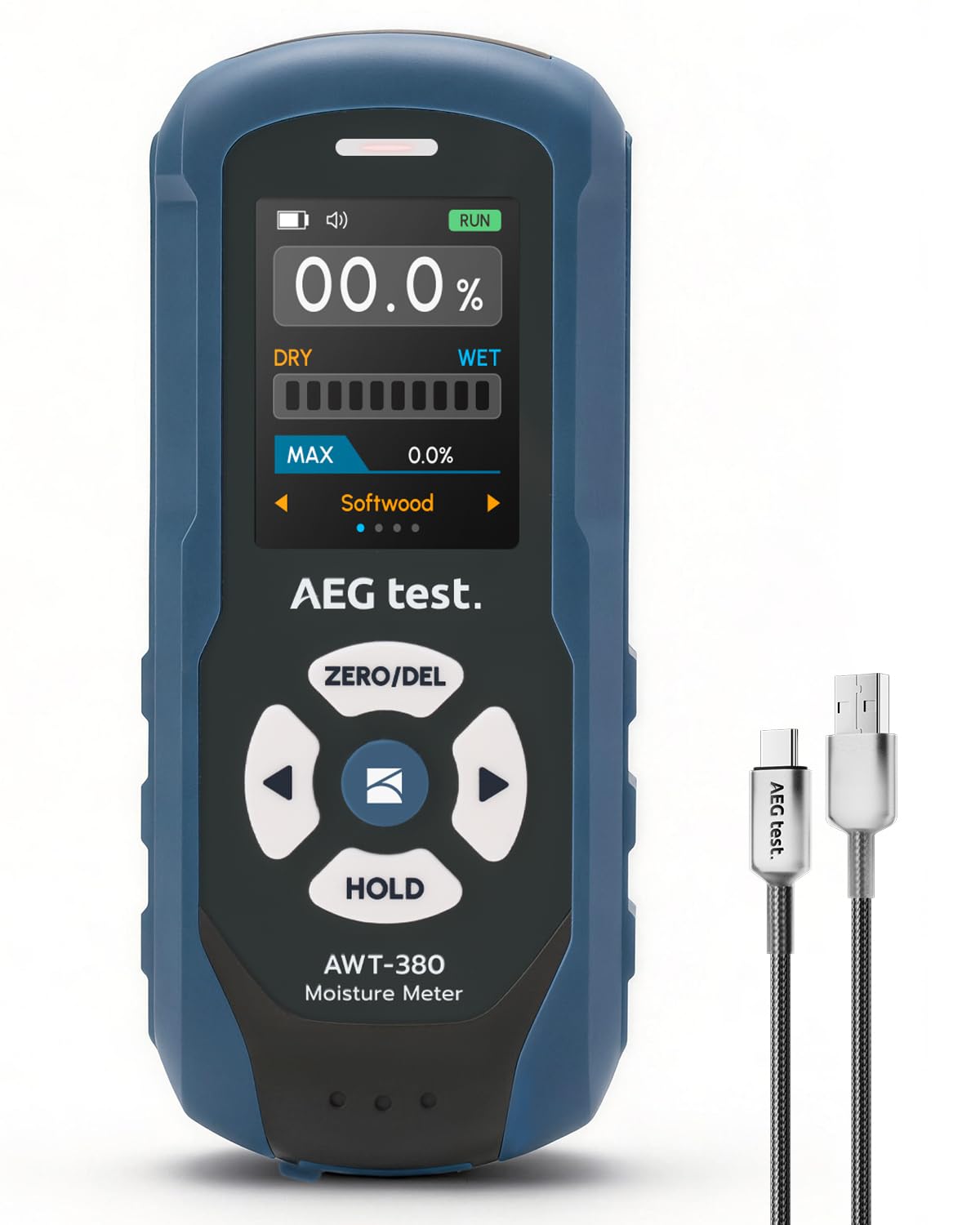
Beeps at you the moment moisture crosses a threshold you set yourself.
Here is the spec that separates this tool from the pack: an adjustable visual and audible alarm that fires when the moisture percentage crosses your own preset limit. That turns a meter into an early-warning system. Walk a wall and the beep tells you where the damp problem starts without staring at the screen. A color display shows the reading, battery status, and alarm state, and max-hold plus data storage let you lock in a number and compare spots later. Readings land within 1 second at two scans per second, and the measuring depth reaches 0.79 inch (20 mm) — slightly deeper than the RDINSCOS’s 19mm and the same ballpark as the Klein’s 3/4 inch.
Running on a rechargeable lithium-ion cell with USB-C charging means no 9V shopping trip. In the field it has proven itself in real emergencies — after a burst pipe followed by three days of dehumidifier running, it gave a clear read on what was still damp and what had dried. RV owners have used it to trace water intrusion through the shell and into cabinetry, and it handles that job cleanly because it never punctures a finished surface.
The one consistent gripe is fit, not function: people with large hands find the power button close enough to the sensor that they can accidentally trigger it while powering on, and the manual is decent but not thorough. Accuracy draws the strongest mixed feedback of anything about this model, so get in the habit of holding the sensor flat and comparing readings across the same spot a couple of times. That said, when a wall was checked after a hidden leak, it registered 30% moisture against a 5% baseline, and 15% in areas that were not visible — that kind of gap is what a homeowner needs to know before deciding whether to call a pro.
The alarm is the feature: an adjustable visual and audible alert means the meter tells you where to stop, rather than you squinting at small digits in a dim basement.
The honest caveat: two owners have had poor experiences with accuracy and a unit that arrived used, so verify the tool works out of the pouch. The 36-month after-sale service backs this one better than most.
The tinkerer’s choice: you want a color screen, a settable beep, and stored readings for walking a whole house room by room.
skip it if: you want a one-button tool with no menus — the alarm and storage settings add steps to every check.
4. RDINSCOS Drywall Concrete Moisture Meter (MT68)
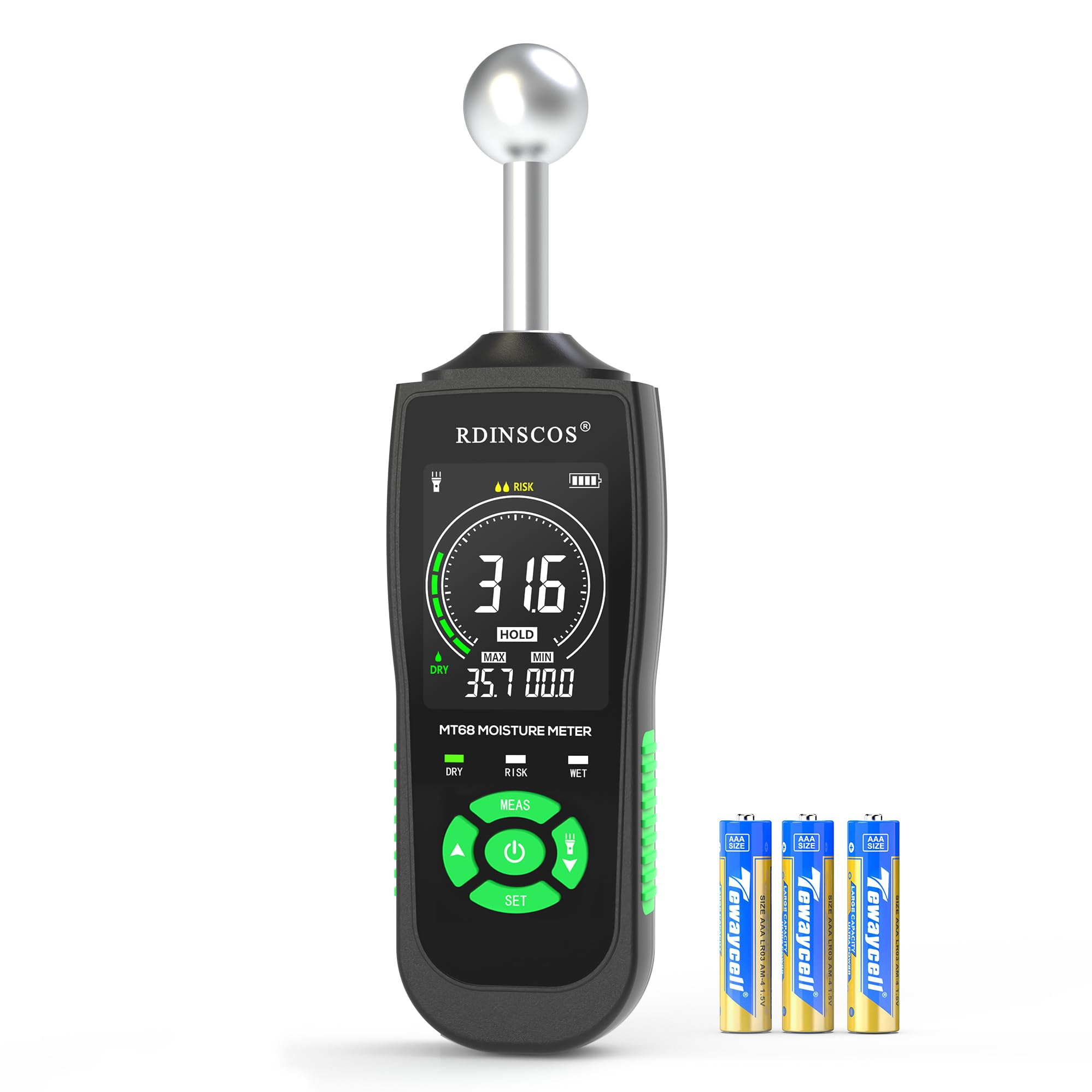
Puts a light where the leak hides — crawl spaces, attics, and the dark behind cabinets.
An integrated LED flashlight is a small thing that saves big effort when the water damage is exactly where the light does not reach. This RDINSCOS model adds one, so you can check behind cabinets, inside crawl spaces, or up in an attic without juggling a phone torch. The non-destructive sensor reads through wood, drywall, masonry, and concrete without drilling or pinholes, which makes it genuinely friendly to finished surfaces. It runs on three AAA batteries and ships with a storage bag and manual.
It has a strong following among people doing their own home repairs and inspections — functionality and build quality are the two things owners praise most. One wall-reading after a roof repair showed a ceiling reaching a reading of 20, then dropping to zero a week after the fix despite heavy rain. That is exactly the kind of before-and-after confirmation a homeowner wants before deciding the job is done. It is quick to power up, quick to read, and the rubber side grips help you hold it correctly against a surface.
The trade-off is consistency on rougher material. Accuracy draws the most mixed response of anything about this tool, and readings can vary between smooth, rough, and end-cut surfaces — plus it can occasionally flag a dry spot as wet. Keep it clear of metal objects, which interfere with the reading, and double-check any spot that seems wet before you tear anything apart. If you want clear guidance on exactly where to place the sensor for the most reliable number, the manual is thin on that detail, so test the same spot twice.
Why it works for inspections
- Built-in LED flashlight for crawl spaces, attics, and cabinets.
- Pinless sensor works on wood, drywall, masonry, and concrete — nothing to patch afterward.
- Fast reads and a clear value for budget-conscious inspections.
What to know before you buy
- Readings change with surface texture; take more than one sample.
- Metal nearby throws the sensor off — keep it back from pipes and trim.
- Instructions are light on measurement technique.
Its natural home: a homeowner with a dark basement or crawl space who wants a single tool to chase leaks in places a phone torch struggles to reach.
The real limitation: inconsistent readings on rough or end-cut material mean you should trust it most on flat painted drywall.
5. Evviva Sciences Mold Test Kit for Home

Grows what is actually floating in your air — then hands you the option of a lab report.
Ten separate tests is the number that defines this kit. You get ten agar petri dishes, ten cotton-tipped swabs, and a downloadable mold information guide, so you can sample ten different spots — room air, the HVAC system, the shower, the sink, the car. That is a real advantage over a single-dish kit, because mold problems rarely sit in just one room. The optional lab analysis, for an additional fee per dish, uses an AIHA certified laboratory and returns a detailed identification report on the types of mold present. The results start showing in as little as 2-4 days.
Owners who have used this against a landlord dispute describe the result as the leverage they needed — a positive dish plus a report is hard for anyone to dismiss. Others use it as a pre-check before shelling out for a full professional inspection, and it is honest about what it is: a tool that helps you decide whether to escalate, not a definitive diagnosis. The test is straightforward to run even for someone who has never handled agar before. A guided sample-and-swab approach covers both what is floating in the air and what is sitting on a surface.
The honest catch is that the optional lab analysis is not included and the fees add up fast if you send several dishes. The guide shows pictures of common molds, but it also notes that actual identification typically needs the lab, and photos alone can leave you comparing fuzzy samples yourself. The results can take longer than expected — one owner waited seven days rather than the shorter window they had in mind. Treat this as the first half of the process, and budget for analysis if you want the answer that matters.
Where it shines: sweeping a whole property at once — ten dishes means ten chances to catch the problem room, which is more than a one-shot kit can do.
What sets the honest limit: the optional lab analysis is a separate fee, and this kit only tells you mold is present and growing — the lab confirms the actual type.
Reach for this if: the house smells off and you want to know which room to take seriously before you commit to an expensive professional inspection.
Be ready for this: the lab report is an extra fee and takes time to arrive — so plan the test early if you need the result in a hurry.
6. General Tools MM8 Pinless Moisture Meter

Two-inch backlit digits and a beep that cuts through any argument about whether a wall is wet.
When you are up a ladder in a dim attic, a 2-inch (50mm) backlit white LCD is not a luxury — it is the difference between reading the number and guessing at it. That display, plus a 3-color LED bar graph that runs green to red and an audible alert, makes a wet spot impossible to miss. The device auto-calibrates and carries separate settings for drywall, masonry, softwood, and hardwood, and the non-marring sensing protects the surface you are testing. An out-of-range alarm and a low 9V battery alert are both built in.
The design itself is a differentiator. An ergonomic handle lets you reach ceilings and high walls without a ladder for every check, and the shape conforms to your hand so you can hold it steady. That handle is the reason long-time owners of this tool keep reaching for it on high work — you can stretch to the top of a shower wall and still see the reading clearly. The white-and-console build feels substantial in the hand despite its lightweight 5.44 ounces.
The honest limits: durability, and corners. The handle helps reach but the unit is vulnerable to drops and shocks — treat it like the precision tool it is rather than tossing it into a toolbox. It can also give false readings along wall corners and edges, probably because of the metal drywall trim hidden inside, so keep your readings a hand’s width away from a corner. The instructions include a recalibration step, and the support team walked one owner through it in about a minute when the sensitivity folded — worth knowing before you assume the tool is finished. What people praise most is the ease of reading and using it, and it is priced to reflect that mid-range build.
Made for people who read numbers in bad light: anyone checking ceilings, attics, or high shower walls where a small screen would be a problem.
The catch that comes with it: the plastic housing will not survive a hard drop, so its long-term life depends on careful handling.
7. Hearcozy Mold Testing Kit with 10 Individual Tests

Ten plates and thirty swabs in one box — the scattergun for a house you cannot quite trust.
The count is the appeal: 10 agar plates and 30 swabs in a single kit, which is three swabs per plate for a surface sample and then a repeat if you need one. That is more testing than almost anyone needs in one sitting, and it is the reason this is a sensible pick when you are not sure where the problem is hiding. The design is deliberately simple — straightforward printed instructions mean first-time users can run it without a professional’s help. The kit carries its own mold identification guide, so you can start interpreting what grows instead of staring at a fuzzy dish.
Reliability is the thing most owners call out, and it makes sense: this kit’s true job is to prove whether there is a mold problem at all. One owner ran it twice for a non-visible mold smell after a roof leak and shower steam — the first test led them to professional verification and mitigation, the second confirmed the self-cleaning had worked. That is exactly the two-step use this kit belongs in: test to find the problem, fix it, then test again to verify the fix.
The recurring caveat, and it is a fair one, is that a kit like this grows whatever is in the container — even breath or contact — within a few days, which is why the value question gets mixed reactions. A dish that shows growth is a reason to look more closely, not a diagnosis, and analysis can cost extra. Some owners also note the plates have a limited window in which they are usable, so plan your tests and use them promptly. It is a tool for narrowing the search, not a substitute for a professional air test.
The value read: 10 plates and 30 swabs cover a full house walk-through and leave spares for a recheck after remediation — practical for anyone on a tight budget.
The right way to think about it: treat a positive dish as “something is growing here” and a professional air test as the confirmation step.
Best entry point: a renter or new owner who wants to test several rooms at once and confirm a musty smell is worth chasing.
Know this upfront: plates do not keep forever, so use them within their window and treat any growth as a prompt to investigate rather than a final verdict.
Know the Specs
Detection depth (how far the meter sees)
Detection depth is how far behind the surface a pinless meter can sense moisture, usually listed in inches or millimeters. The Klein ET140 reaches 3/4 inch, the AWT-380 reaches 0.79 inch (20 mm), and the RDINSCOS rechargeable model measures about 19mm. Deeper readings mean you can find water sitting inside the wall cavity rather than damp paint on the surface. For a leak that started days ago, deeper is generally better.
Moisture percentage (what the number means)
A meter shows how much water the material holds, often as a percentage of its dry weight. A drywall reading of 5% is a normal baseline; jump to 30% and you have a real leak. Around 20% is often treated as the point where mold risk becomes serious, so watch for a drywall reading that climbs past it and stays there. The LED bar graph and color scale on many meters give you the same information in an instant, no number-crunching needed.
Pinless versus pin technology
Pinless meters use an electromagnetic field to read through the surface, leaving no hole and no mark — the reason every scanner here is pinless. Pin meters push metal probes into the material for a more precise reading in raw lumber, at the cost of small holes. For painted walls, finished ceilings, and tile, pinless is the only sensible choice.
Material settings and calibration
Wood, drywall, and masonry absorb water differently, so a good meter lets you tell it what you are testing. The General Tools MM8 offers separate drywall, masonry, softwood, and hardwood modes, and the Klein is calibrated specifically for drywall, masonry, hardwood, and softwood. If you scan without the right setting, the reading can drift by several points — so flip the mode, hold the sensor flat, and press firmly.
Common Questions
Will a pinless moisture meter find hidden mold behind paint?
Is a moisture meter or a mold test kit the better first purchase?
What moisture percentage means I should worry about mold?
Do I need a lab test to identify the mold in my home?
How long does an air culture test take to show results?
Can I use a pinless meter on concrete or masonry?
Why does my meter give a false reading near corners or metal?
Can I use a mold detector device on my HVAC system or vents?
Will a moisture meter survive being dropped off a ladder?
How do I know my leak repair actually worked?
The Bottom Line
The standout tool for most homes is the Klein Tools ET140 because it reads up to 3/4 inch through drywall and masonry without a single pin hole. That means you can find a leak, map how far it spread, and then watch it dry — all without cutting or patching your walls. If your worry is not a leak but a musty smell, head to the Evviva Sciences kit first and let ten dishes tell you which room is actually the problem. And for finishing work in dark corners and behind cabinets, the RDINSCOS MT68 with its built-in flashlight is the one to reach for.
Whatever you choose, remember the order that matters: scan for the water, dry it out, then re-scan to confirm the fix. A meter that reads three-quarters of an inch deep and a set of dishes that show whether mold is still growing are the two facts that turn a worrying house into a known quantity.
How we choose
We do not accept paid placement. Every pick is matched to a real buyer and a real use-case; we do not hands-on test units.
Sources
Specifications: manufacturer listings and product documentation. Review insights: verified customer reviews, as of October 2026. Pricing: not shown on this page (it changes often); check the current price via the retailer link.
As an Amazon Associate, Aappliancez earns from qualifying purchases. This does not affect which products we feature.