Disclosure: Some links in this post are affiliate links. As an Amazon Associate I earn from qualifying purchases, at no extra cost to you. Learn more
Specs are compiled from manufacturer listings and verified buyer reviews and can change over time — please confirm the key details on the product page before buying.
You write a deadline on a page, then realize it belongs three sections back. A modular notebook lets you lift that page out and clip it where it actually belongs — no glue, no torn holes, no starting a fresh book. That page-moving freedom is what separates a modular notebook from a fixed journal.
This guide is built by comparing the manufacturers’ published specifications and the patterns across verified customer reviews, so you get each pick’s real strengths and trade-offs instead of marketing spin.
The picks below sort by how they actually get used: a traveler’s cover for daily carry, discbound letter and junior systems for meeting-heavy work, and one washable A5 organizer for notes you scan and wipe away. Here are the seven covers worth your money in a modular notebook system.
Top Picks


How To Choose The Best Modular Notebook System
Two families dominate this shelf, and picking the wrong one is the mistake beginners make most often. A discbound book holds pages on a row of removable discs, so a sheet lifts out and presses back in on its own. A traveler’s cover wraps a stack of slim refills around elastic bands, so you swap whole booklets rather than single pages. Neither is better — they solve different problems.
Discs or bands: pick your page-moving style
If you rewrite and reorder notes all day, discs win. A letter-size book on eleven discs and a junior book on eight discs both let you pull one page and reinsert it, which is why heavy meeting schedules and planner rebuilding suit them. If you carry several separate booklets — a diary, a project log, a sketch pad — bands win, because you slide a whole refill out and drop another in.
The paper decides whether your pen betrays you
Thin paper lets a fountain pen bleed through to the reverse side, and that ruins the whole back of a sheet. Look for thicker stock — one Oat-cover journal ships with 100 GSM inserts, and owners of the TUL letter book report paper that takes markers, pencil and hard erasing without warping. If you write with a wet pen, paper weight matters more than the cover’s looks.
Pockets and pen loops are the hidden sorting tool
A loose receipt, a boarding pass, a business card you were handed mid-meeting — they clutter a notebook’s pages unless the cover has somewhere to put them. Card slots, side pockets and a rear pocket turn the cover itself into a filing layer, which is why they show up across the traveler’s covers here. Check the pocket layout before you fall for the leather color.
Side-by-Side Comparison
| Model | Best For | System | Size | Pages Included | Amazon |
|---|---|---|---|---|---|
| WANDERINGS Regular Size Travelers Notebook★ Best Overall | Daily carry and travel | Elastic traveler’s cover | 4.5″ x 8.5″ | 3 blank inserts, 180 sheets | Amazon |
| TUL Discbound Notebook, Letter, LeatherMeeting Machine | Meetings and planner rebuilding | Discbound, 11 discs | 8-1/2-x-11-inch | 60 narrow ruled sheets | Amazon |
| TUL Discbound Notebook, Junior, Leather | Purse-sized work notes | Discbound, 8 discs | Junior size | 60 narrow ruled sheets | Amazon |
| TUL Discbound Notebook, Letter, Brown Leather | Five-year daily journaling | Discbound | Letter size | — | Amazon |
| MODUBOOQ Modular Reusable Organizer | Scanning and wiping notes | Discbound reusable | A5 | 40 duratech3 pages | Amazon |
| Moterm Companion Traveler’s Notebook Cover | Holding multiple booklets at once | Elastic traveler’s cover | Standard size | 3 refills: unlined, lined, grid | Amazon |
| Traveler’s Notebook, Regular Size, Blue | Leather that ages and darkens | Elastic traveler’s cover | 8.7″ x 4.7″ | 1 refill, 64 unruled pages | Amazon |
Detailed Reviews
1. WANDERINGS Regular Size Travelers Notebook with Pockets
Our pick — 4.5+★ from 950+ verified ratings; the strongest balance of quality and price.
Three hand-sewn inserts and a pebbled-leather cover that resists scratches — the do-everything starter.
This cover arrives ready to write in, not ready to shop for. You get three blank notebook inserts totalling 180 sheets, all sewn rather than stapled, so the book is usable the moment it lands. The pages are 100 GSM stock — that is grams per square metre, a measure of paper weight — and dense enough that a fountain pen does not bleed straight through. Buyers report the pack of three inserts means no separate refill order before you start.
The pebbled leather resists scratches and hand-oil marks, so the cover still looks sharp after months in a bag. The pebbled surface resists scratches and hand-oil marks, and the seams sit even with the pockets squared up. Owners of other covers call that detail the difference between a workshop build and a mass-market one. One buyer reports the pebbled cover still looks new after three years of daily carry.
The honest catch is sizing and finish expectations. Slim inserts fill this cover faster than a discbound spine does, so a heavy writer will buy refills sooner. And the color can mislead on screen — the red reads as a matte brick rust rather than a bright cheerful red, so order a neutral like the Oat cover if you want exactly what the photo suggests.
What earns its keep
- Three hand-sewn blank inserts and 180 sheets included, so you write the day it arrives.
- 100 GSM paper that holds a fountain pen without bleed-through.
- Pebbled leather that resists scratches and hand-oil marks in daily carry.
- Interior pockets give you a place for loose paper, cards and receipts.
Where it asks for care
- Slim inserts fill quickly for a heavy daily writer, so refills come around often.
- The red finish reads as a sombre brick rust, not the bold red the listing photo suggests.
- Refill size ties you to this cover’s insert format.
Reach for this if: you want one cover, three booklets and real leather on day one without buying refills separately.
Think twice if: you reorder single pages constantly — the discbound books below move pages, this one moves whole booklets.
2. TUL Discbound Notebook Letter Size
Eleven discs, sixty ruled sheets, and a spine you reorder instead of rewriting.
Here is the difference eleven discs make: the letter-size TUL holds more pages on its spine than the junior version’s eight discs, so the sheet count sits higher before a page starts to pull loose. The book ships with 60 narrow ruled sheets on 8-1/2-x-11-inch paper. When a meeting ends, you lift the sheets out, reshuffle them by topic, and press them back in. No fresh notebook, no copied notes.
That reshuffle is the whole point for anyone whose day is wall-to-wall meetings. Notes taken in the order people spoke can be sorted into the order the project actually runs, and pages you never needed come straight out. Owners say it beats a fixed sewn book because pages reorder without rewriting. The leather cover looks professional enough to carry into a boardroom, and it opens fully to lie flat, which makes longhand easier on the wrist.
The trade-off sits in the binding over time. The first page has a habit of working loose, especially if you flip through the book often or switch disc sizes. Refill discs are sold separately, and a larger disc set can take weeks to reach you. Treat the binding gently and this cover earns its keep — buyers count on it for years of daily use.
The spine math: 11 discs against the junior’s 8 — more discs mean more pages held and fewer sheets slipping out mid-week.
The honest wrinkle: the opening page is the one that loosens first, so keep your most-flipped section away from the front.
Built for: the meeting-heavy note-taker who rewrites and re-sorts after the fact.
Less ideal for: anyone who needs the spine to survive constant disc swapping — those discs are sold separately and slow to ship.
3. TUL Discbound Notebook Junior Size
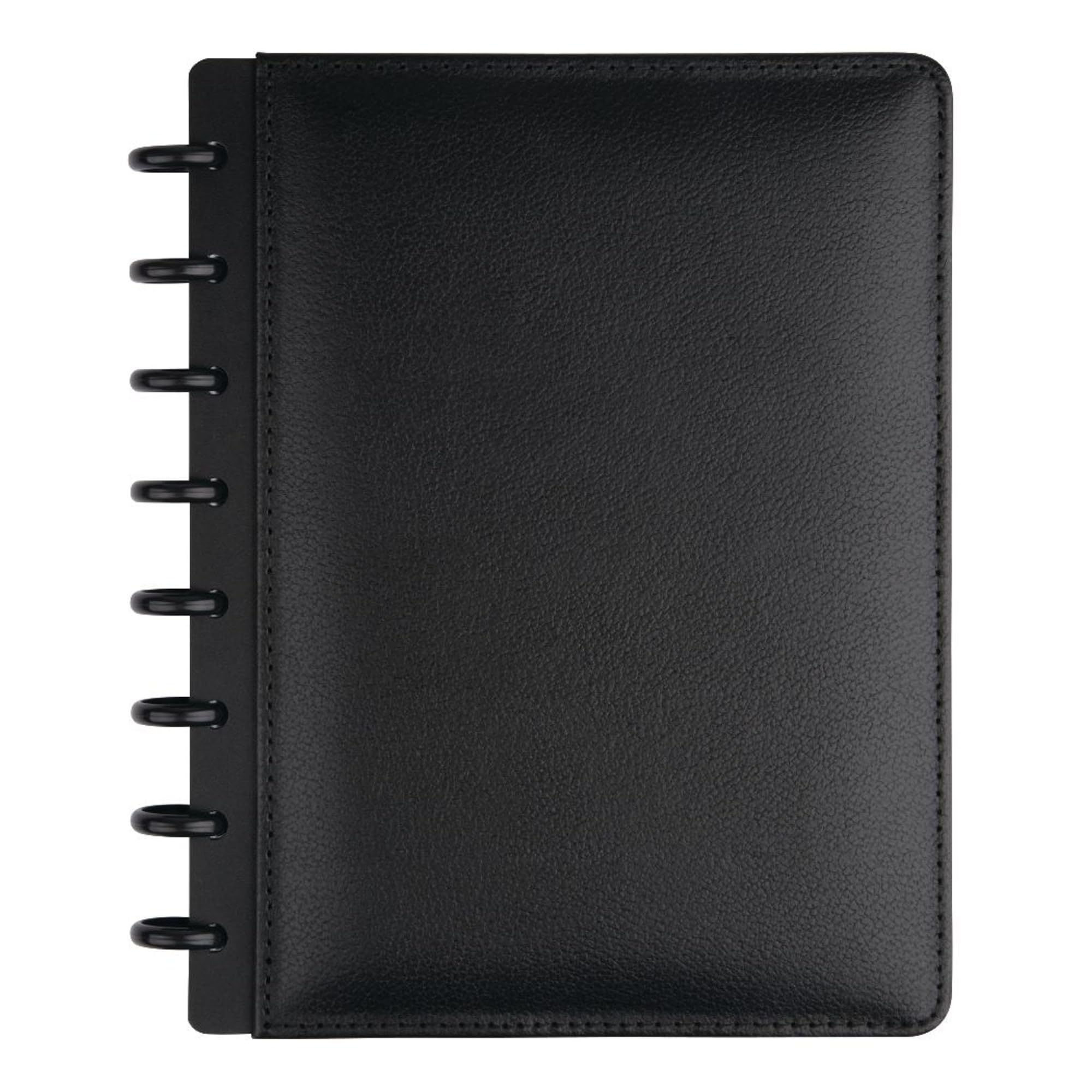
The slim black leather book that slips into a purse and still holds sixty sheets.
If the letter-size TUL is the desk book, this is the one that leaves the house. The junior cover runs 9.75 inches long by 7.35 inches wide, which is small enough to sit in a handbag without swallowing it. Eight discs hold the 60 narrow ruled sheets, and the paper is thick enough that it does not tear easily or bleed through when you write hard. Add and remove pages without damage, then archive the ones you are done with.
What buyers value most is how clean the system looks in use. It passes as a professional notebook in a client meeting, yet the pages rearrange on demand, so one cover serves as a running to-do list, a meeting log and a bullet journal in the same week. The elastic pen loop and interior pockets keep the pen and loose cards off the floor of your bag. Fountain-pen writers find the paper behaves well — minimal ghosting and feathering — which is rare on a notebook this compact.
Where it asks for thought is refill cost. The junior format is a pricey refill cycle, and one route around it is punching your own 32lb paper with a discbound hole punch instead of buying pre-punched sheets. Owners also price-shop this size against other retailers, so it pays to check before committing to the refill pattern.
Why it travels well
- Purse-sized footprint at 9.75″ x 7.35″ with a professional leather finish.
- Pages remove and reinsert without damage, so archived notes leave clean holes.
- Thick paper that resists tearing and bleed-through with a fountain pen.
- Elastic pen loop and interior pockets keep small items contained.
What to weigh first
- Refills for the junior format add up, and punching your own paper needs a separate hole punch.
- The smaller page size crowds longer meeting notes.
Best match: commuters and client-facing work where the notebook rides in a bag all day.
Not the one if: you write pages at a stretch — the junior sheet fills fast, and letter size serves that habit better.
4. TUL Discbound Notebook Letter Size Brown Leather
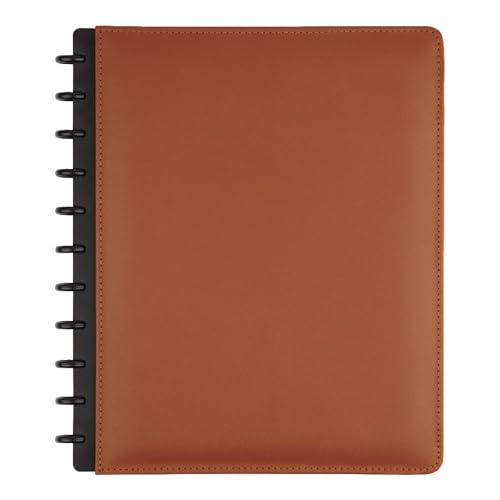
Five years of daily use and the brown leather still draws compliments across the table.
This is the same discbound letter format as the black TUL above, dressed in brown leather and built for the long haul. The page format suits planners and note-takers alike, and the cover is sturdy enough that it survives being thrown into a work bag. One owner reports five years of daily use with the brown leather cover still intact. The disc system lets you slot in calendar pages, dividers or a different paper ruling whenever the job changes.
You can add pages from other systems — printed, punched or third-party — and the book adapts, so one notebook holds your calendar, lined notes and to-do lists at once. That replaces three separate books fighting for desk space. Owners mention this flexibility is why they keep buying it new after the first one wears out.
The friction point is page reinsertion. Sliding a sheet back onto the discs after you pull it takes a bit of patience, and if the rings are too small for your page count, you will want bigger discs to hold the extra bulk. Neither is a deal-breaker; it is a kit you assemble over time rather than a finished product.
The hook: a leather spine that takes five years of daily handling — this is a build-once book, not a replace-every-year one.
The one snag: pages go back on the discs reluctantly, so budget a moment each time you reorder.
Suits you if: you want one letter-size cover that carries calendar, notes and lists and can grow with accessories.
Step away if: you expect pages to slide back on instantly — reinsertion takes care on any discbound spine.
5. MODUBOOQ Modular Reusable Smart Notebook A5 Organizer

Forty pages you write on, scan, rinse under the tap and use again.
The concept is the draw here. This A5 book packs 40 duratech3 pages — 20 double-sided sheets — plus separate colorful tabs: 16 lined, 10 dotted, 2 to-do list pages, and both weekly and monthly spreads. The pages have a matte, paper-like texture so a pen glides the way it does on a normal notebook, yet the ink dries almost instantly. When you are done, the ink wipes off with a damp cloth, or you rinse the pages under a running tap.
You also get a 0.6mm pen, a cloth and an empty spray bottle to fill with water, and the whole thing arrives unassembled so you learn the ring system by putting it together. Scan your pages with a free Android or iOS app and the notes land in your cloud drive in seconds, which is what owners like most about the modular setup. Travelers and remote workers use it as a single all-in-one organizer that covers planning, notes and ideas without a shelf of sewn books.
The honest limits are specific and worth hearing before you buy. It only takes non-permanent pens — a standard permanent marker stays put, and it is not built for the heat-erasing pens some planners use. Erasing is water-only, so there is no spot-fixing one word without wetting the page. It only comes in A5, and the front cover is thinner than the back. If your handwriting is messy, the scan app’s text recognition struggles with it.
What makes it different
- 40 duratech3 pages that write like paper and wipe clean with water.
- Scan-and-upload to cloud storage through free Android and iOS apps.
- Modular rings let you rebuild the order page by page.
- Includes a 0.6mm pen, cloth and refillable spray bottle.
Before you commit
- Non-permanent pens only — standard permanent ink does not wipe off cleanly.
- Water-only erasing rules out quick spot corrections.
- Front cover is thinner than the back, and A5 is the only size offered.
Worth it for: remote workers and visual thinkers who scan their notes and want the same pages back tomorrow.
Look past it if: you write with permanent ink or want a stiff, finished cover — this one is soft and arrives in pieces.
6. Moterm Companion Traveler’s Notebook Cover, Standard Size

A pebbled leather cover that swallows six booklets and still snaps shut.
If you like to carry several booklets at once, this is the cover that lets you. Inside the top-grain leather shell you get many card slots, a side pocket on each side and a large rear pocket for receipts, tickets and loose paper. It ships with three refills — unlined, lined and grid — plus an elastic band. Load it with a diary, a project log and a sketch pad and it takes the lot.
The top-grain leather is what buyers praise most. It is buttery soft in the hand and stays looking new after months of use. A student planning through grad school fits two included notebooks plus a clear photo-and-sticker insert and a compact planner with room to spare — not bulky, nothing hanging over the edge. It also works as a full-size wallet, with card, cash and zippered holders for the odds and ends that otherwise end up loose in a bag.
Two things to weigh. The elastic closure snaps rather than ties, which changes how quickly you can get in and out of it, and a heavy load makes the whole thing chunky — fine in a tote, tight in a small purse. Notebooks inside are stapled, not sewn, which is worth knowing if you prefer a sewn binding for a fountain-pen habit.
Why people switch: top-grain pebbled leather that still looks brand new, plus a card-slot-and-pocket layout built to double as a wallet.
One expectation to set: load it full and it turns bulky — that capacity is real, but so is the thickness.
Made for: the multi-booklet carrier who wants one cover for planner, notes and wallet combined.
Not your fit if: you need a slim profile for a small handbag — this cover grows with every booklet you add.
7. Traveler’s Notebook, Regular Size, Blue

Raw cowhide that arrives scuffed and turns glossy the longer you carry it.
This is the purist’s choice, and the leather is why. The body is cowhide, deliberately left under-treated, so it scratches easily at first and then darkens, shines and softens into its own character with handling. The cover body weighs about 94 grams — light enough to forget in a jacket pocket — and runs 8.7 inches by 4.7 inches by 0.4 inches. A cotton case, a 64-page unruled refill and a spare rubber band come in the box.
Owners talk about the cowhide quality most, and it holds up over years of handling. One buyer reports no wear marks after years of use, and the cowhide darkens and glosses as hand oil soaks in. If scratches bother you early on, a little mink oil darkens the leather and hides them. The insert system is fully modular — swap in line, grid, blank or calendar refills, add bookmarks and extra elastics, and make the book exactly what you need this month.
The honest catch: it does not lay flat the way a sewn notebook does, which some writers find annoying. The paper is thin and fountain-pen-friendly, but it is thin — heavy inkers may see faint show-through. And the cover arrives with a normal dust of white powder from tanning, so give it a wipe before your first page.
What the leather does
- Cowhide that scratches at first, then darkens and glosses with daily handling.
- Slim footprint at 8.7″ x 4.7″ x 0.4″ with a cover body around 94 grams.
- Insert system swaps between line, grid, blank and calendar refills.
- Comes with a cotton case, one 64-page refill and a spare rubber band.
What to expect
- Does not lie flat like a sewn binding, so longhand takes a hand to hold it open.
- Thin paper and a fresh leather scent that fades but is strong at first.
- Arrives with a white tanning dust that needs a wipe-down.
Go for it if: you want leather that records where it has been and grows a patina you cannot fake.
Pass if: a flat-laying page is a must — this one asks you to hold it open.
Know the Specs
Discs versus elastic bands
Discs are a row of small plastic or metal loops down the spine, and each sheet hooks onto them through punched holes. Press a page on and it grips; pull it off and it comes away clean. That is the whole mechanism behind every discbound book here, and it is what lets you reorder pages instead of rewriting them. Elastic bands work the other way: they hold whole slim refills against the cover, so you swap a booklet rather than a sheet.
Paper weight in GSM
GSM stands for grams per square metre — how heavy and dense a sheet is. Thicker paper resists bleed-through, so a fountain pen or a marker does not soak to the back side and spoil the reverse of a page. A 100 GSM insert is a solid, everyday weight. If you write with wet ink or markers, higher GSM is the number to chase before you fall for the cover.
Page count and refill economy
The page count you start with tells you how soon you will buy more. Sixty narrow ruled sheets is a common starting amount, and forty reusable duratech3 pages last far longer because you erase and reuse them. Either way, ask what a refill costs and whether you can punch your own paper instead — some owners sidestep pre-punched refills entirely with a discbound hole punch.
Erasable page technology
Reusable pages are a coated surface, not standard paper. The coating lets non-permanent ink sit on top, so a damp cloth or a rinse lifts it clean. The catch: permanent markers and heat-erasing pens do not belong on them, and a wet surface means no quick spot-fixes. Scanned notes from these pages can be digitized with a free scanning app and pushed straight to cloud storage.
Common Questions
Can I move a single page from one of these notebooks to another without tearing it?
What does 100 GSM paper mean for a fountain pen?
How many discs does a letter-size discbound notebook need?
Can I use any pen on reusable duratech3 pages?
Do traveler’s notebook refills fit every cover on this list?
Can I punch my own pages for a discbound notebook instead of buying refills?
Will the leather on these covers scratch or need conditioning?
How do I scan notes from a reusable notebook to my phone?
Is a discbound book better than a traveler’s notebook for daily work?
Do these notebooks sit flat when open for writing?
The Bottom Line
For most people, the winning modular notebook system is the WANDERINGS Regular Size Travelers Notebook, because it lands with three sewn inserts, 180 sheets and pebbled leather you can carry every day without babying it. If you need to reorder pages mid-week, the TUL Discbound Notebook in Letter Size is the one — 11 discs, 60 ruled sheets and a spine you rebuild. And for notes you scan and wipe away, reach for the MODUBOOQ A5 organizer and its 40 reusable duratech3 pages. Start with the traveler’s cover, add a discbound desk book when the reshuffling starts, and you cover every way you actually write.
How we choose
We do not accept paid placement. Every pick is matched to a real buyer and a real use-case; we do not hands-on test units.
Sources
Specifications: manufacturer listings and product documentation. Review insights: verified customer reviews, as of October 2026. Pricing: not shown on this page (it changes often); check the current price via the retailer link.
As an Amazon Associate, Aappliancez earns from qualifying purchases. This does not affect which products we feature.