Disclosure: Some links in this post are affiliate links. As an Amazon Associate I earn from qualifying purchases, at no extra cost to you. Learn more
Specs are compiled from manufacturer listings and verified buyer reviews and can change over time — please confirm the key details on the product page before buying.
If your last pro-style pad died of stick drift or a loose USB-C port, you already know the real question isn’t which modded controller has the most buttons — it’s which one still works after a year of ranked nights. That’s the filter used here. Every pick below earns its place on drift-resistant stick tech, back buttons that don’t fight your grip, and connections that hold through a full match. The crowd favorite going in is the PlayStation DualSense Edge, sitting at 4.5+ stars across 6,000+ owners.
This guide is built by comparing the manufacturers’ published specifications and the patterns across verified customer reviews, so you get each pick’s real strengths and trade-offs instead of marketing spin.
You’ll see where Hall Effect and TMR sticks (magnetic sensors that read movement without the physical wear that causes drift) actually deliver, and where a clicky trigger is worth the trade. The goal is simple: buy the right modded controllers once, not three times.
Top Picks


How To Choose The Best Modded Controllers
A modded controller lives or dies on two things: whether the sticks stay accurate and whether the back buttons feel natural in your hands. Lighting, faceplates, and carrying cases don’t change how it plays. Start with the stick technology, then work outward to triggers, paddles, and connection.
Stick technology comes first
Standard analog sticks use physical contact that wears down over time, which is what produces drift — the cursor creeping when you’re not touching anything. Hall Effect and TMR sticks (magnetic sensor designs that read stick position without physical contact) are the fix, and they’re the single biggest reason to buy a modded pad at all. Look for either term in the listing; both address wear-based drift.
Count the paddles you’ll actually press
Four back buttons sound better than two until you realize your ring and pinky fingers have to learn them. Paddle layout matters as much as paddle count. Some pads place them where a loose grip reaches naturally; others sit closer to the center and invite accidental presses. Expect a learning period either way — several days, not several minutes.
Trigger stops change shot timing
A trigger stop physically shortens how far the trigger travels before it registers. In a shooter that’s a faster shot; in a racing game it’s a loss of throttle feel. The best pads let you toggle between the two rather than locking you into one. Mechanical switch triggers feel like a mouse click; analog triggers give you a smooth pull.
Side-by-Side Comparison
| Model | Best For | Stick Tech | Back Buttons | Platform | Amazon |
|---|---|---|---|---|---|
| PlayStation DualSense Edge★ Best Overall | PS5 players who want first-party feel | Swappable stick modules | 2 (two styles) | PS5 | Amazon |
| SCUF VALOR PROBest Value | Xbox and PC players on a tighter budget | Hall Effect thumbsticks | 4 embedded paddles | Xbox / PC | Amazon |
| GameSir G7 Pro 8KFastest Response | PC players chasing the lowest input delay | Gen 2 TMR sticks | 2 lockable + 2 mini bumpers | PC / Switch | Amazon |
| GameSir G7 Pro Xbox Edition | Xbox owners wanting wireless freedom | TMR sticks | 4 (2 back, 2 bumper) | Xbox / PC / Android | Amazon |
| Razer Wolverine V3 Pro 8K | Competitive PC players who travel | TMR with swappable caps | 4 back + 2 claw bumpers | Windows PC only | Amazon |
| Nacon Revolution 5 Pro | Large-handed PS5 and PC players | Hall Effect joysticks | 4 Omron paddles | PS5 / PS4 / PC | Amazon |
| Razer Raiju V3 Pro | PS5 tournament players | TMR thumbsticks | 4 back + 2 claw bumpers | PS5 / PC | Amazon |
| HEXGAMING PHANTOM | PS5 players who want maximum tuning | Hall Effect joysticks | 4 remappable | PS5 / PC | Amazon |
| Victrix Pro FS-12 | Fighting game players | Sanwa Denshi leverless | Lockable control bar | PS5 / PS4 / PC | Amazon |
Detailed Reviews
1. PlayStation DualSense Edge Wireless Controller
Our pick — 4.5+★ from 6,500+ verified ratings; the strongest balance of quality and price.
The one pro pad that carries a first-party badge and still lets you wrench on it.
Sony’s answer to the modded market does the thing no third-party brand can: it plugs into everything the PS5 does natively, including the PS5’s own digital trigger and stick adjustment menus. Rather than chasing firmware workarounds, you tune sensitivity and dead zones inside the console itself. Two swappable sets of back buttons can be mapped to any other button input, so your slide, melee, or crouch sits exactly where your fingers rest.
Adjustable trigger lengths are the quiet star here. Manually set how far the left and right triggers travel, then shorten it for FPS shooting or lengthen it for precise throttle control in a racing game. The design leans on replaceable stick modules rather than magnetic Hall Effect sensors — pull a worn module and slot in a fresh one instead of buying a whole new pad. That approach is also why it’s the highest-rated pick on this list at 4.5+ stars across 6,000+ owners. What wins people over most is build quality, by a wide margin. The recurring question is purely about cost, which is why buyers split sharply on whether it justifies its premium-tier position.
Buyers who made the jump from a string of third-party modded pads describe it as the pad that finally stayed put — including hands large enough to want the extra width. Its 4-button count is the honest trade: two back buttons instead of the four some rivals mount, and you’ll want to decide upfront whether that matters for your game.
What earns the crown
- Swappable stick modules mean a worn stick is a cheap part swap, not a new controller
- Adjustable trigger travel lengths to the game in front of you
- Native PS5 integration — no workaround app for sensitivity or dead zones
- Two swappable back-button sets and three changeable stick caps in the box
- Quick-swap control profiles switch mid-session
Where it asks you to compromise
- Two back buttons rather than four
- The heaviest pad in this lineup at 2.6 pounds
- Valued on a replaceable-module model, not magnetic drift-proof sticks
- The premium-tier ask is the split opinion in the reviews
Reach for this if: you’re on PS5 and want pro features without a third-party app or a compatibility gamble.
Look elsewhere if: you need four paddles under your fingers or you’d rather have magnetic sticks than replaceable modules.
2. SCUF VALOR PRO Wired Performance Xbox Controller
Four paddles, Hall Effect sticks, and a price that doesn’t make you wince.
If you play shooters on Xbox and want paddles without spending pro-tier money, this is the value play. Four embedded rear paddles can each be configured across 16 functions, and the Instant Triggers cut trigger pull to shave time off your reaction. The performance grip is built from 13 years of the company’s controller work and carries a non-slip texture, with new wraparound bumpers that give your fingers more surface area on the way to the trigger.
Button count is where this pad separates itself from the DualSense Edge — 24 buttons versus 4 — and its footprint is genuinely smaller too, at 6.02 x 4.21 x 2.52 inches against the Edge’s 8 x 8 x 4.5 inches. That compactness is why it lands in bags and laps so easily at 9.12 ounces. On the stick front, Hall Effect thumbsticks address wear-based drift, and owners who burned through a controller a year on worn stick covers report the paddles taking a few sessions to feel natural and then disappearing from their awareness.
The honest catch is the connection. The USB-C port draws the most divided feedback of any spec on this pad, with reports of disconnects developing after roughly six months of normal use — and once the port goes, headset audio crackles with it. A replacement cable doesn’t cure it because the fault sits in the port. Treat the plug gently, and treat that as the reason this pad costs what it does rather than costing more. Audio controls on the controller and three saved remapping configurations round it out.
The long-run risk: a wired pad is only as good as its port. This one carries a documented failure window at around six months of regular play — buyers who kink cables or yank the plug will find it sooner.
Who it fits: Xbox and PC players who want four paddles and magnetic sticks now, and are willing to baby the connector to get it.
Best matched to: budget-conscious shooter players on Xbox Series X|S or Windows PC who want paddle count over polish.
Think twice if: you’re hard on cables — the recessed USB-C is the weak link, and a wireless pad sidesteps it.
3. GameSir G7 Pro 8K PC Wireless Gaming Controller
The PC-first pad that treats input delay as a solvable problem.
An 8000Hz polling rate is the headline — it means the controller reports its position to your PC up to 8000 times a second, versus the 1000Hz of the Xbox-edition GameSir below it. In practice that’s a near-instant response over both wired and 2.4GHz wireless connections. Whether you feel the difference depends on your display and your reflexes, and plenty of buyers happily run it at a lower setting. The hardware underneath is the part that earns its keep: Gen-2 TMR sticks combine analog precision with the anti-drift durability of magnetic sensing.
There are four programmable macro buttons here — two lockable back buttons and two mini bumpers — each able to record a 32-step macro. Optical micro-switch ABXY buttons fire crisp and fast, matched to a mechanical micro-switch D-pad. Dual-mode trigger stops let you switch between Hall Effect analog triggers for racing and clicky micro-switch stops for shooters with a physical toggle. A charging dock with a built-in battery comes in the box, and a 6-axis gyroscope can be mapped to sticks or mouse input for motion aiming.
Here’s the friction point: the companion software has a history of update problems, including a version that dropped this exact model from the app’s home screen entirely. That’s a genuinely frustrating afternoon if it hits you. The other recurring note is that the thumbsticks would suit players wanting a larger diameter with a deeper concave dish. What sells it is the feel — premium in hand, responsive on press, and priced below the pro-tier pads it gets compared to.
Spec that matters: dual-mode trigger stops with a physical toggle cover both FPS and racing from one pad, no compromise locked in at purchase.
The app caveat: the software layer is the soft spot — expect to spend some time in it, and expect the occasional version hiccup.
Pick this one for: PC players who want the fastest reporting rate available alongside magnetic sticks and a dock.
Don’t pick it for: Xbox play — it’s built for PC and Switch, not Microsoft’s console.
4. GameSir G7 Pro Wireless Controller for Xbox, PC & Android
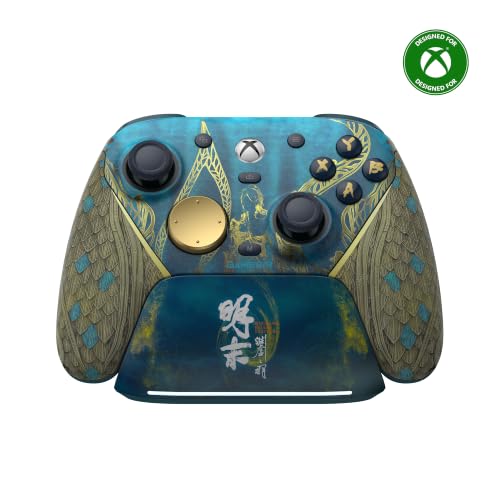
Wireless on Xbox without a dongle dance — plus a dock that wakes the console.
This is GameSir’s first wireless controller built for Xbox, and the practical win is one-press wake-up: lift it off the charging station and the console comes on with it. Connectivity runs three ways — 2.4G wireless and wired for Xbox and PC, Bluetooth 5.3 for Android — all switched with a physical mode selector. The 1200mAh battery sits inside, and the smart auto start-stop charging station tops it up whenever you set it down. A receiver storage compartment hides in the station’s base.
TMR sticks and Hall Effect analog triggers carry the control side. Trigger stops give you a clicky micro-switch pull, and holding the M+LT/RT buttons engages Hair Trigger Mode for an even shorter actuation. Polling runs at 1000Hz on PC over both wired and 2.4G. There are four extra inputs across the back and bumpers, and the face buttons use mouse-click switches. Pick it up and the 272 g weight sits mid-pack — planted without being heavy.
Two gripes repeat. The menu and list buttons sit close to the top edge, which makes them an awkward stretch mid-game. The bumpers also don’t share the clicky feel of the face buttons, triggers, and D-pad. Neither is a dealbreaker; both fade from notice after about a week. Ergonomics are the strongest praise it draws — the shape settles into your hands rather than fighting them.
Reasons it earns a spot
- Lift-to-wake returns the console from sleep automatically
- 2.4G, wired, and Bluetooth 5.3 cover Xbox, PC, and Android from one pad
- 1200mAh battery with an auto start-stop dock
- Hall Effect triggers plus a Hair Trigger Mode on the M+LT/RT combo
- Comfortable grip shape that suits long sessions
Small things that niggle
- Menu and list buttons crowd the top edge
- Bumpers don’t match the clicky face buttons
- Four extra inputs instead of the six some rivals mount
Go here if: you want a wireless Xbox pad with magnetic sticks, a dock, and no cable to worry about.
Skip past if: you’re hunting for six rear inputs or crave a fully clicky button set top to bottom.
5. Razer Wolverine V3 Pro 8K PC Wireless Gaming Controller

Zero rumble, zero RGB, and the lightest esports frame in this lineup.
Razer strips the rumble motors and the lighting out and spends the savings on weight and buttons. The result is the lightest wireless esports controller the company makes at 0.58 kg, built with feedback from top esports players. Six remappable controls line the body: four mouse-click back buttons hidden in the rubberized handles plus two claw-grip bumpers tucked by the triggers. For a padder who wants mouse-click speed without leaving the controller, that’s the whole pitch.
The 8000Hz HyperPolling runs in both wired and wireless mode, and the TMR thumbsticks are anti-drift magnetic units with swappable caps in the box. Pro HyperTriggers toggle per trigger between mouse-click actuation and full analog pull. The action buttons use Mecha-Tactile PBT doubleshot construction with hybrid microswitches, paired with an 8-way floating D-pad. Four onboard profiles save your mappings, and any keyboard key can be mapped to one of the six programmable buttons. A carrying case and a 2 m braided cable ship with it.
Two things to square before buying. This is a Windows 11 PC-only controller — no Xbox, no PlayStation, no macOS, no mobile. And the low weight is a deliberate trade: the frame reads as light and small in hand, which some players love and others find insubstantial. What buyers agree on is the performance side. Extreme responsiveness, no perceptible input lag, and sticks that stay smooth. There’s no stick tension adjustment, which is the one feature named as missing.
Standout spec: 8000Hz polling over wireless, not just wired — most pads reserve their top rate for a cable.
The catch: no rumble and no RGB by design, and the body feels light enough that players who like heft will notice.
Built for: competitive PC shooter players on Windows 11 who want the lightest six-button layout they can find.
Wrong fit if: you play on console, want vibration feedback, or prefer a controller with real weight in your hands.
6. Nacon Revolution 5 Pro Controller
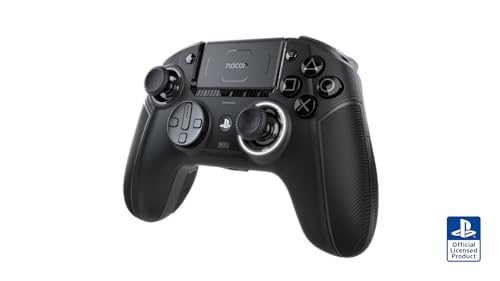
The pad that finally gives big hands somewhere to rest.
Talk to anyone with large hands about the DualSense and you’ll hear the same thing — it’s a touch narrow. The Revolution 5 Pro answers that directly. Extra width and a taller stick profile give your fingers room, and it’s easily the most-repeated compliment in its owner feedback. Hall Effect magnetic sensors run through both the joysticks and the triggers, so neither one wears into drift with use. Four Omron micro-switch back paddles sit under your fingers, and trigger blockers let you pick long or short pulls per game.
The customization goes deep. Interchangeable weights let you tune the heft, thumbstick sizes and heads swap out from a storage case, and the D-pad can be changed between a specialized design built with fighting game pro Mister Crimson and a traditional cross. Bluetooth game audio lets you pair earbuds or a headset straight to the controller in PS4 or PS5 mode, with a 3.5mm port as backup. Battery runs up to 10 hours wireless through the USB-A adapter, and a 3-meter USB-C to USB-A cable switches you to wired for competitive play.
Now the part you need to know. The recessed USB-C port on the bottom is cut deep enough that standard cables don’t seat properly — you’ll want the brand’s own cable or a slim connector. Wireless also needs the bundled dongle; the controller can’t wake the console on its own. And the vibration sits among the more divided specs, so treat built-in haptics as a bonus rather than a reason to buy. The PC-only features and dedicated app don’t extend to console.
Where it shines: Hall Effect in both sticks and triggers means two separate drift sources are handled by design, not by replacement parts.
What to plan around: a proprietary-style recessed port, dongle-dependent wireless, and a footprint that suits larger hands far better than smaller ones.
Look at this one if: standard Sony pads cramp your grip and you want magnetic sticks and triggers in one package.
Not the one if: you have smaller hands or you refuse to carry a dongle just to play wirelessly.
7. Razer Raiju V3 Pro Wireless Esports Controller
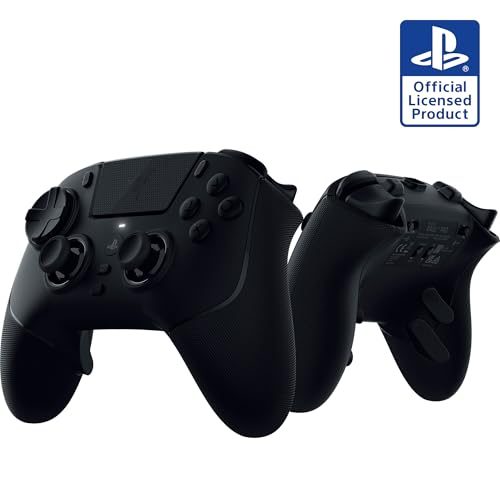
Symmetrical sticks and six mappable inputs, built for the tournament floor.
This one is officially licensed for PS5 and PC, and it keeps the symmetrical stick layout PlayStation players grew up on rather than shifting to offset sticks. Six remappable controls carry the load: four removable mouse-click back buttons plus two claw-grip bumpers. Symmetrical magnetic TMR thumbsticks with swappable caps handle the aim, tuned for consistent micro-adjustments in FPS tracking and flick shots. Razer’s Pro HyperTriggers switch each trigger between rapid mouse-click actuation and full analog pull, and that’s per-trigger, not both at once.
Mecha-Tactile PBT action buttons pair with an 8-way floating D-pad, and the PBT doubleshot construction is built to hold up under heavy use. HyperSpeed Wireless runs over a 2.4 GHz dongle on PS5, while PC players get a 2000Hz wired polling rate for tournaments. Four onboard profiles save your mappings, calibratable triggers and thumbstick sensitivity are tunable, and remapping happens through the Razer Mobile App or Razer Synapse 4. A carrying case, 2 m USB-C to USB-A cable, spare stick caps, and a back-button removal tool come in the box.
The friction here is real but specific. All licensed third-party PS controllers — this one included — skip rumble, so don’t expect vibration. The PS button also can’t power the console, a limitation of the license rather than the pad. Rear buttons require app mapping before they do anything, which is easy to miss on day one. And the layout rewards a grip that rests on the triggers; players who constantly travel from R2 to R1 in action games report finger fatigue. Shooters are where it feels most at home.
Why competitive players lean in
- Six remappable controls, including four removable mouse-click back buttons
- Symmetrical TMR sticks with swappable caps in the box
- Per-trigger HyperTrigger switching between clicky and analog
- 2000Hz wired polling rate for PC tournament play
- Carrying case and toolkit included for travel
Where it asks for patience
- No rumble, as with all licensed third-party PS pads
- PS button can’t wake the console
- Back buttons need app mapping before first use
- Trigger-heavy layouts can fatigue fingers over long combos
Right call for: PS5 shooter players who want symmetrical sticks, six inputs, and a licensed build they can carry to a tournament.
Not the call for: players who need rumble or who spend most of their time in trigger-heavy action games.
8. HEXGAMING PHANTOM Wireless Controller for PS5

Eight thumbstick options, six profiles, and a trigger toggle for FPS or racing.
Nothing else here lets you rearrange the sticks this much. Eight interchangeable textured thumbsticks come in the box — concave, domed, and extended shapes — so you can rebuild the feel of the controller to your hands instead of adapting your hands to it. Six swappable profiles switch layouts on the fly mid-session. Four tactile back buttons sit at ergonomic points underneath, and the whole thing is built on the original official controller shape with soft rubber grips for long sessions.
Trigger mode switches toggle instantly between adaptive and digital. Digital mode gives you a 1.5 to 2mm short trip range with a mouse-click feel for shooters; adaptive mode restores the analog pull for throttle control in racing. Hall Effect joysticks handle the aim with no physical wear and tear, and adjustable centering points plus outer range calibration let you dial out hand fatigue over long play. The pad weighs 330 g. What buyers praise most is the button feel — the mouse-click triggers and back buttons are the reason most people pick it up.
Durability is the honest question mark. Reports of failed triggers and back buttons exist inside the first year, and the back buttons sit soft enough to trigger accidentally if you grip loosely. There’s also no cable or case in the box — just the controller, the eight sticks, and an adjustment tool. If you want a PS5 pad with genuine drift-proof sticks and more tuning than anything else on this list, this is where the flexibility lives.
The tuning angle: eight stick shapes and six profiles mean you can rebuild the pad around your grip rather than the other way round.
What to watch: soft back buttons invite accidental presses, and the box ships without a cable or case.
Best fit for: PS5 players who love to tinker and want magnetic sticks plus a full trigger toggle.
Pass on it if: you grip loosely around the back buttons or you want a case and cable included.
9. Victrix Pro FS-12 Fight Stick Arcade Controller

A leverless fight stick carved from one piece of aircraft-grade aluminum.
This isn’t a gamepad with paddles bolted on — it’s a different tool entirely, aimed at the fighting game crowd. The body is cut from a single piece of aircraft-grade aluminum, made to take the bumps and drops of tournament travel. Pro-grade 24mm and 30mm Sanwa Denshi buttons sit under your fingers alongside a control bar with a PS touchpad. An integrated 6.28° wrist slope and built-in foam lap pad handle the comfort side, because you’ll be resting your wrists on this for hours.
A mode switch moves between PS5, PS4, and PC. Open the quick-access back panel and the wiring sits cleanly laid out for mods and updates with the included Allen wrench. Tournament Mode locks out the control bar buttons so you don’t get disqualified by an accidental press. Carrying handles and cable organizers make transport practical despite 7.8 pounds of aluminum. It’s tuned for Mortal Kombat, Street Fighter, Tekken, Soul Calibur, and Dragon Ball-style fighters.
The stock Sanwa buttons are the honest weak point for anyone who’s picky — they come across as firm and hollow, and swapping in aftermarket buttons is a common first move. Interior space is tight for screw-in buttons, so snap-on replacements are the safer route. This also isn’t a sensible first stick; leverless takes real adaptation time, and the premium-tier price stings for a first experiment. What it does reward is precise directional input. Directional inputs land exactly where you intend once your hands learn the layout.
Build you can feel: a one-piece aluminum chassis at 7.8 pounds gives this stick a planted, immovable feel that plastic fight sticks can’t match.
Know going in: the stock buttons are the upgrade path, and leverless control is a skill you’ll spend weeks learning.
Worth it for: tournament-minded fighting game players who want an aluminum body they can mod and travel with.
Not worth it for: anyone new to fighting games or unwilling to swap the stock buttons.
Know the Specs
Hall Effect vs TMR Sticks
Both use magnetic sensing instead of physical contact to read stick position, which is why neither wears into drift the way a standard analog stick does. TMR (tunnel magnetoresistance) is the newer version and tends to be described as more sensitive and more power-efficient. In practice, either term in a listing means the stick is protected against wear-based drift — the failure that kills most standard controllers. What neither fixes is a bent stick or a cracked housing, so treat the physical stick with the same care as any other.
Polling Rate in Plain Terms
Polling rate measures how many times per second the controller tells your device where its sticks and buttons are. 1000Hz means a report every millisecond; 8000Hz means up to eight reports in that same millisecond. On a high-refresh monitor with a fast PC, that reduces the gap between your input and what you see. On a 60Hz display, the gain is much smaller. If your PC struggles with the 8k setting, drop it down — several buyers report running lower rates with minimal perceived difference.
Trigger Stops and Hair Triggers
A trigger stop is a physical limiter that cuts how far the trigger travels before it registers. A hair trigger is the shorter version of the same idea, and some pads engage it with a button combo. Neither adds a new input — they just shorten the pull. In shooters that means the shot fires earlier in your finger’s motion. In racing games you generally want the full analog travel back, which is why toggleable trigger stops are worth seeking out over fixed ones.
Back Buttons vs Paddles vs Bumpers
Back buttons sit under the controller where your middle and ring fingers rest. Paddles are the same idea in a longer lever shape. Claw-grip bumpers sit higher, near the triggers, for players who curl a finger over the top of the pad. Every extra input needs mapping before it does anything, usually through a companion app or an onboard button combo. Placement matters more than count — four buttons in the wrong spots get in the way more than two in the right ones.
Common Questions
Do Hall Effect sticks actually stop drift for good?
Will a PS5 modded controller work on a PC?
Is 8000Hz polling rate worth it over 1000Hz?
Why do licensed third-party PS5 controllers have no rumble?
Can I use a modded Xbox controller on a PlayStation 5?
How long does the battery last on these controllers?
Do back buttons need software to work?
Is a fight stick better than a gamepad for fighting games?
What is the difference between stick caps and stick modules?
Can I use a modded controller in official tournaments?
The Bottom Line
For most people shopping for modded controllers, the DualSense Edge is the one to beat. It keeps first-party PS5 integration, gives you adjustable trigger travel, and solves a worn stick with a cheap module swap instead of a whole new pad. If your hands are large enough that standard Sony pads cramp you, the Nacon Revolution 5 Pro puts Hall Effect in both sticks and triggers and gives your fingers somewhere to rest. And if you play fighters, the Victrix Pro FS-12 is the aluminum-bodied tool built for the tournament floor.
For Xbox and PC players on a tighter budget, the SCUF Valor Pro delivers four paddles and Hall Effect sticks, with the caveat that its USB-C port is the part to protect. Competitive PC players who want the lowest input delay should look at the GameSir G7 Pro 8K, while Xbox owners who want wireless freedom will find more to like in the GameSir G7 Pro Xbox edition. If you already know you want drift-proof sticks and a long list of tuning options, the crowd of buyers behind the Edge has already done the sorting for you — 6,000+ owners and a 4.5+ star score is a fair place to start your shortlist.
How we choose
We do not accept paid placement. Every pick is matched to a real buyer and a real use-case; we do not hands-on test units.
Sources
Specifications: manufacturer listings and product documentation. Review insights: verified customer reviews, as of October 2026. Pricing: not shown on this page (it changes often); check the current price via the retailer link.
As an Amazon Associate, Aappliancez earns from qualifying purchases. This does not affect which products we feature.