Disclosure: Some links in this post are affiliate links. As an Amazon Associate I earn from qualifying purchases, at no extra cost to you. Learn more
Specs are compiled from manufacturer listings and verified buyer reviews and can change over time — please confirm the key details on the product page before buying.
You already know the frustration: you key the mic from the driver’s seat and the other station hears engine whine, a weak signal, or nothing at all. This guide sorts out which mobile transceivers actually punch a clean signal down the road, which ones want a phone app to program, and which ones are really base-station rigs that happen to fit in a car. The top pick for most people is the Yaesu FT-2980R — a simple, fan-free 80-watt 2-meter rig that owners trust to hold a repeater where a handheld gives up.
This guide is built by comparing the manufacturers’ published specifications and the patterns across verified customer reviews, so you get each pick’s real strengths and trade-offs instead of marketing spin.
Some rigs here are single-band, some cover HF through UHF, and a few need a license you probably already hold. Read on for the full breakdown of every mobile hf radio worth mounting in your vehicle.
Top Picks


How To Choose The Best Mobile HF Radio
The first real decision is which bands you actually need. A 2-meter-only rig like the FT-2980R is simple and strong for local repeater work. A full HF rig like the FT-891 or FT-991A opens worldwide contacts but asks more of your antenna, your power wiring, and your patience. Decide that before you shop, because it drives everything else.
Watts versus antenna and tuning
Power output gets the headlines, but a well-tuned 20-watt signal can beat a poorly matched higher-wattage one. That is why radios with a built-in automatic antenna tuner — a circuit that matches the radio to whatever antenna you bolt on — matter so much in a vehicle. The Xiegu G90 and FT-710AESS both carry one; the FT-891 does not, so budget for an external tuner.
Mounting and the control head
Where the radio body lives and where you actually operate it are two different problems. Detachable or remote heads, like the FT-991A’s touch panel, the Xiegu G90’s detachable display, and the Icom IC-2730A’s optional remote kit, let you hide the bulky body and keep controls within reach. Several radios here ship without a mounting bracket, so check what is in the box.
Power draw and vehicle wiring
A 100-watt HF rig pulls serious current on transmit, and a lighter socket can struggle with that. Plan for proper fused cable run to the battery. The FT-891 draws around 1A on receive in owner reports, which matters less; the transmit surge is the part that punishes thin wiring.
Side-by-Side Comparison
| Model | Best For | Bands | Max Output | Antenna Tuner | Amazon |
|---|---|---|---|---|---|
| Yaesu FT-2980R★ Best Overall | Simple 2m repeater work | 144 MHz (2m) | 80 W | No | Amazon |
| BTECH UV-50PROMost Connected | App programming plus APRS/GPS | VHF/UHF | 50 W | — | Amazon |
| Icom IC-2730ATop Performer | Dual-band dual-watch clarity | VHF/UHF | 50 W | — | Amazon |
| Midland MXT500 | GMRS fleet and trail talk | GMRS UHF | 50 W | — | Amazon |
| Xiegu G90 | Portable HF on a tight budget | HF | 20 W | Yes (built-in) | Amazon |
| Xiegu X6200 | Battery-powered field HF | HF/50 MHz | — | Yes (built-in) | Amazon |
| Yaesu FT-891 | Compact 100W HF mobile | HF/50 MHz | 100 W | No (external) | Amazon |
| Icom IC-7100 | HF-to-70cm with D-STAR | HF/50/144/440 MHz | 100 W HF, 35 W VHF/UHF | — | Amazon |
| Yaesu FT-710AESS | Serious HF/6m receiver | HF/50 MHz | 100 W | Yes (built-in) | Amazon |
| Yaesu FT-991A | Shack-in-a-box all-mode | HF/50/144/430 MHz | 100 W HF, 50 W 2m/70cm | Yes (built-in) | Amazon |
| FT-991A with Quick Reference Card | All-mode rig plus quick guide | HF/50/144/430 MHz | 100 W HF | Yes (built-in) | Amazon |
Detailed Reviews
1. Yaesu FT-2980R 144 MHz Single Band Mobile Transceiver
Our pick — 4.5+★ from 250+ verified ratings; the strongest balance of quality and price.
The fan-free 80-watt bruiser that holds a repeater where handhelds go quiet.
The number that defines this rig is 80 watts of RF output on the 2-meter band, and you can dial it down to 30, 10, or 5 watts when you want to be polite. Those higher settings are why an owner who ran an 8-watt handheld into a repeater roughly 16 miles away through mountains and woods — barely there, mostly static — now reaches the same net loud and clear at 30 watts. That 80-watt ceiling is also the biggest power gap in this whole list: the BTECH UV-50PRO maxes at 50 W, so the FT-2980R leads on raw output.
Cooling is the other quiet win. A massive heatsink means it sheds that 80 watts of heat with no cooling fan at all, so there is no whirring fan noise under the dash and one less part to fail. Round the back it’s a VHF-only radio rated to a talking range maximum of 160 miles, with 200 memory channels, 6-digit backlit LCD, and 3 watts of audio output for a noisy cab. It carries a 3-year manufacturer warranty and a 4.5+ star reputation across 200+ ratings.
The honest catch is the band count. This is 2 meters only — no 70cm, which is the one thing long-term owners wish it had. If your local repeaters live on UHF, or you want both bands in one box, the Icom IC-2730A or FT-991A is the better fit. For pure single-band punch and a near-bulletproof build, though, the FT-2980R is the one that keeps coming back.
Why it earns the top slot
- 80 W output — the highest single-band power in this lineup
- Fan-free massive heatsink, so less noise and fewer moving parts
- 200 memories and a 3-year Yaesu warranty
What you give up
- 2 meters only — no 70cm coverage
- No built-in HF, so it’s local and repeater work only
Reach for it if: you want a tough, simple, high-power 2m mobile for repeater and local nets.
Look elsewhere if: your traffic lives on 70cm or you need HF reach.
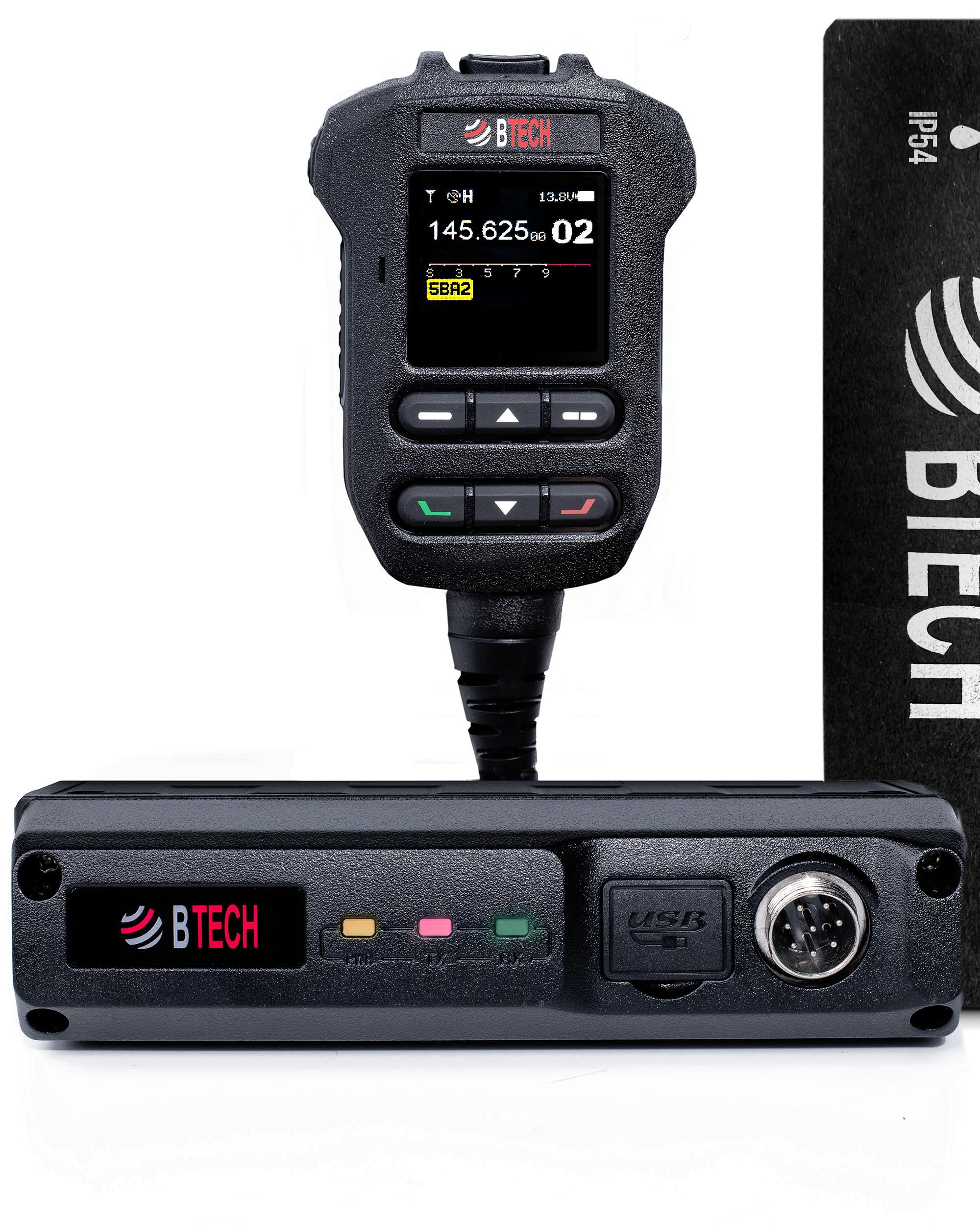
2. BTECH UV-50PRO Dual Band Mobile Ham Radio
A dual-band mobile built around your phone, not a cable and a laptop.
Here is the defining feature: you program this radio from the BTECH UV Programmer app over Bluetooth, editing channels, tones, offsets, and zones from your phone. It is rated to a talking range maximum of 35 miles, a good bit shorter than the FT-2980R’s 160-mile figure, but it talks back to your phone in a way the Yaesu cannot. Output is selectable at 5, 25, or 50 watts, and one data-focused owner closed a line-of-sight link at 40 miles with noisy signals where a Yaesu needed near-full quieting — its real power shows on weak-data paths.
What wins people over most is the sound. The speaker and mic clarity draw the loudest praise, with ease of programing and its reasonably slim size close behind. There is built-in GPS with APRS location tools, smart beaconing, and Mic-E support for tracking and coordination in the field. AI Noise Reduction cuts wind and engine rumble on both transmit and receive. Satellite tracking, NOAA alerts, and FM broadcast round out the extras, and at 11 ounces it mounts without much fuss.
The recurring gripe is the documentation, not the hardware. The manual is thin, the app takes patience, and there is no PC programming or CHIRP — you need the phone app or a CSV workaround. A few experienced operators spent hours getting APRS features configured. Set aside an evening for setup and the payoff is a very connected dual-band rig.
Where it shines: APRS, GPS, and Bluetooth app programming in one compact dual-band package.
Set-up reality: budget real time for the app and manual; the plan is better than the paperwork.
Best for the connected operator: you want APRS, GPS, and phone-based setup in a dual-band mobile.
Pause if: you refuse to work without a PC cable and CHIRP-style tooling.
3. Icom IC-2730A Dual Band VHF/UHF 50W Mobile Radio
Dual-band clarity with the kind of receiver that pulls a signal out of the noise.
Fifty watts on both VHF and UHF, plus simultaneous receive on VHF/VHF or UHF/UHF, is the heart of this rig. That dual-watch means you can listen to two frequencies at once — the everyday win here — and channel switching lives right on the mic. The 1,052-channel memory makes room for your whole repeater map. In owner reports this unit has hit repeaters 40-plus miles out on a good mobile antenna, and one driver with a decade of VHF/UHF experience got 18 miles on flat ground before the signal degraded.
Build and functionality are the things this radio is praised for most: a solid, sensitive unit with accurate frequency control and a large, readable white-backlit LCD. There is an optional VS-3 Bluetooth headset and an optional MBF-1 remote-mount kit so you can put the face where it belongs.
The honest trade-off is accessories. The faceplate-to-body adapter, flat-surface adapter, and mounting bracket are sold separately, so plan on buying the mounting kit you actually need. A cross-repeat feature has to be enabled to work, and it isn’t spelled out in the manual — study the menu or watch a walkthrough. Worth every bit for the receiver, but factor the add-ons into the decision.
What makes it click: true dual-watch receive and a receiver that reads clean on two bands at once.
The asterisk: remote-mount and faceplate adapters are extra, not included.
Pick this one for: dual-band dual-watch operation with strong audio and a huge memory bank.
Think twice if: you want everything in the box — the mounting kit is a separate buy.
4. Midland MXT500 50W IP66 MicroMobile GMRS Two-Way Radio
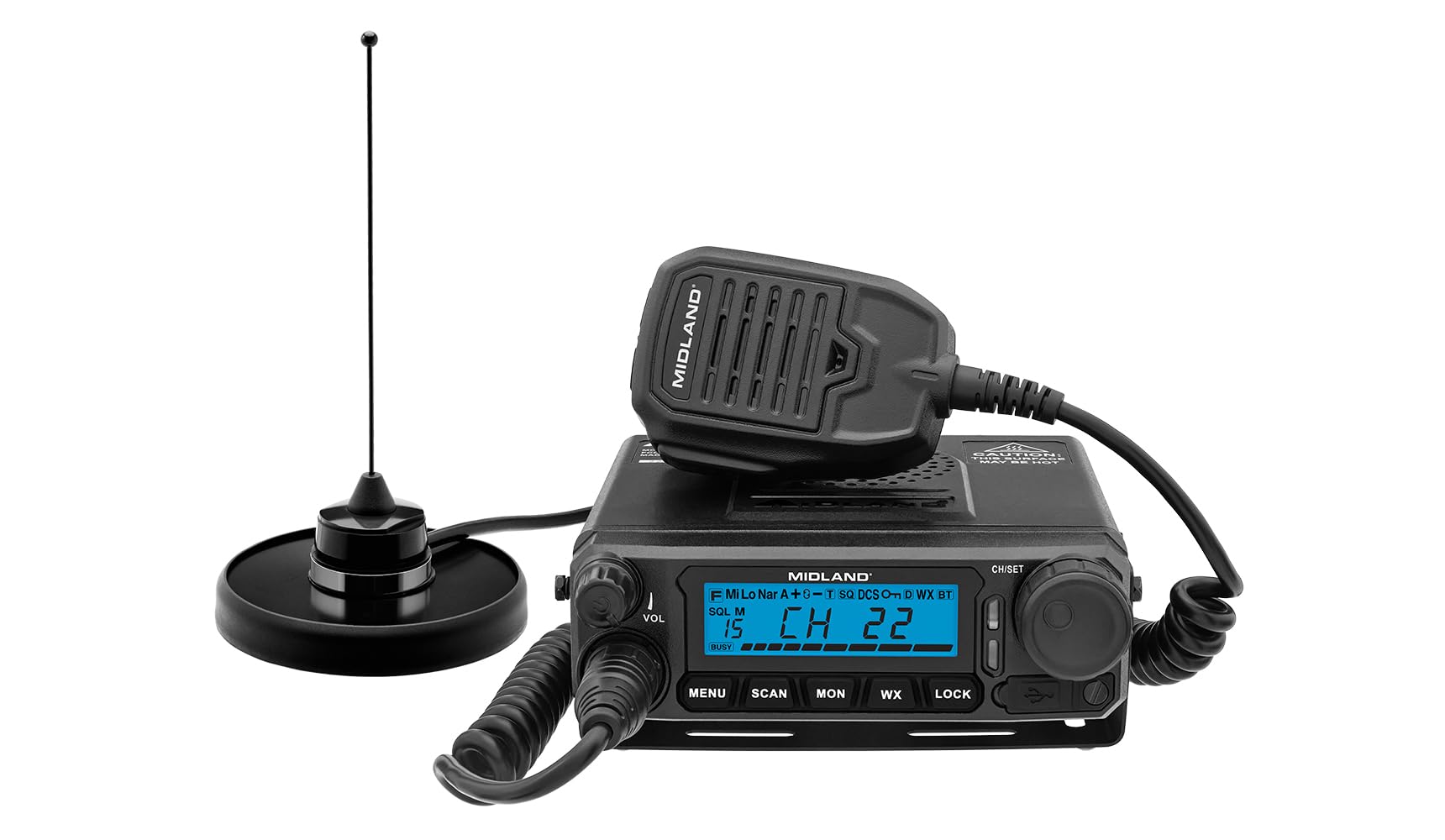
Fifty watts of GMRS that shrugs off dust and water on the trail.
This is not an amateur rig — it runs GMRS, which means a license that covers your family, not a ham ticket. Fifty watts over UHF, 128 channels, 8 repeater channels, and 142 privacy codes give you a lot of coordination room. The IP66 rating is the real trail story: it is built to tolerate dust and water spray, so a side-by-side mount doesn’t scare it. Buyers report it hitting repeaters up to 85 miles away, and range with a good antenna is a recurring theme.
Where it wins people over is sound and signal — clear reception and a loud, clear mic are what buyers talk about most, and the thing is fast to set up: plug in, connect the antenna, and go. NOAA weather scan and alert keep you ahead of storms in the mountains where people actually ride. It is also repeater-capable and programmable for private channels without much fuss.
The catch is two-fold. The built-in speaker is on the weak side, so many add an external speaker for full sound. And it sits on the pricier end for GMRS, which is the complaint you’ll encounter most. If you want the cleanest trail signal and don’t mind paying for it, this is the GMRS pick to beat.
Trail-ready strengths
- 50 W GMRS with 128 channels and 8 repeater channels
- IP66 rating built for dust and water spray
- Fast plug-in, antenna, done setup
Worth knowing
- Internal speaker is quiet; many add an external one
- Premium GMRS pricing — not the budget route
Go here for: family GMRS, off-road groups, and mountains where range and ruggedness matter.
Skip the upsell if: you already have a clean external speaker — the stock one is the weak link.
5. Xiegu G90 HF Radio Transceiver 20W SSB/CW/AM/FM SDR

The backpack HF rig that tunes almost any wire and works the world on twenty watts.
What makes this the value pick of the HF crowd is the wide-range internal automatic antenna tuner. Unlike most low-power (QRP) radios, it will load up your favorite field antenna without an external box, and it includes a built-in mediumwave high-pass filter and an onboard antenna analyzer. Output is 20 watts, and one owner talking single sideband from North Carolina to Slovenia — 4,691 miles — on 15 watts shows the efficiency makes up for the lower power. A 48 kHz spectrum display with waterfall tells you what’s happening around you.
Owners praise its quality above all else, then the value it delivers. It is 3.53 pounds with a detachable display unit you can place remotely, and a color LCD readable in daylight. The menu-driven SDR interface is a real learning curve, and the small screen takes getting used to. But the community support and a responsive VFO make it a favorite for parks-on-the-air and travel work.
Be warned: this is not a first HF rig. Twenty watts rewards a good antenna and punishes a poor one, and the menu depth can frustrate a beginner. It shines for those already comfortable with digital modes or CW. The detachable head and the tune-anything tuner are why it earns this slot.
The standout: a wide-range auto tuner and antenna analyzer in a 3.53-pound carry rig.
The learning tax: menu-driven operation and modest power reward a prepared operator.
Your pick if: you want portable HF for field days and travel without an external tuner.
Not the start if: this is your first HF radio — build antenna skills first.
6. Xiegu X6200 HF/50MHz Portable Transceiver

A self-contained HF rig with its own battery, screen, and tuner for field days.
The headline here is self-sufficiency: a replaceable 3,200mAh battery built into the radio, rated for 4-5 hours of operation on a charge. That means you can run HF in a park without hauling a power supply, and the battery is replaceable when it ages. It covers HF through 50 MHz plus WFM and airband with a precision RF direct-sampling design, and handles SSB, CW, AM, NFM, DIGI, and WFM. A 4-inch color screen shows a spectrum with waterfall. An internal automatic antenna tuner is built in.
Owners reach worldwide stations on just 5 watts into a simple end-fed wire antenna, and the build quality is what they rate highest, with versatility close behind. The 18-month warranty backs it. This is the radio for a go-kit that travels — one buyer built TSA-friendly kits around it.
Here is the honest part: the functionality gets mixed reviews, with some owners reporting features that need firmware attention, and battery life and connectivity are points to watch. The screen is sharp but not touch. Some rate it below the value of the G90 for pure reliability. It is a flexible field companion if you accept the menu learning curve and firmware quirks.
Field-first design: self-contained 3,200mAh battery, built-in tuner, and wide band coverage.
The reality: firmware and battery reports are mixed — buy knowing it’s a work-in-progress platform.
Made for: field operators who want one box, its own battery, and a built-in tuner.
Hold off if: you want polished, bug-free firmware on day one.
7. Yaesu FT-891 HF/50 MHz All Mode Transceiver

Full 100-watt HF muscle in a body small enough to hide under a seat.
One hundred watts across 160 through 6 meters is the whole point of this rig — genuine HF reach in a compact 8.4-pound chassis. That is a big step up from the Xiegu G90’s 20 watts, and it runs all-mode: AM, FM, USB, LSB, CW. It’s compatible with the ATAS-120A automatic tune antenna. Quality is what it’s praised for most, and it makes 99-channel memories go a long way. Through pileups and winter field days, owners mention it works stations easily and runs fine on Bioenno batteries.
What to know before you buy: there is no internal tuner. You will need an external one, which many pair with an FC-50, or a tuned antenna like the ATAS series. A few owners note some hiss on the rear audio jack and fan noise at full 100 watts. It is menu-heavy, and voltage shows only at startup. None of that stops it being a favorite — one long-time Yaesu owner calls it his preferred model, liking the one-button CW zero-beat for mobile work. The 3-year warranty is the reassurance.
Why HF drivers like it
- Full 100 W across 160-6m in a compact body
- All-mode operation with a 3-year warranty
- ATAS-120A compatible for mobile use
The fine print
- No internal tuner — you must add one
- Menu-heavy interface with fan noise at full power
Ideal for: a compact 100 W HF mobile or base setup where you’ll pair a tuner.
Factor in: an external tuner is mandatory, not optional.
8. Icom IC-7100 HF/50/144/440 MHz Mobile Transceiver

An all-band go-box rig with D-STAR digital and a touch panel that faces you.
This is a genuine HF-to-70cm radio in one small, easy-to-rack box, with a touch-screen control head angled toward the operator. The frequency coverage runs the amateur HF bands through 50, 144, and 430 MHz, and it handles D-STAR digital voice plus low-speed data with DR-mode routing. It packs 505 memory channels and dual 32-bit DSP chips for filtering and processing across all bands. One owner reports Seattle-to-Maryland signal reports using a CHA MIL whip, and 35 watts on VHF/UHF reaches plenty of repeaters.
The go-box appeal is real: it breaks down small enough to fit in an ammo can, and a built-in soundcard and USB make digital modes easier to set up. Built-in SD card slot handles voice storage and data cloning. D-STAR is available from the start.
The fair caveat is its age and documentation. It’s an older model that rewards reading the manual and getting hands-on demos first, and it lacks a built-in GPS. Rated 3.5+ stars, it’s a niche pick rather than a crowd favorite. For a compact multi-band field or mobile rig with digital built in, it earns its spot.
The draw: HF through 70cm plus D-STAR in a small, transportable chassis.
The caveat: an older design that asks you to read the manual and has no built-in GPS.
Choose it for: a compact all-band D-STAR rig for go-box and mobile builds.
Consider the newer option if: you want current menu polish from the start.
9. Yaesu FT-710AESS 100W SDR DSP HF and 6M Transceiver

A receiver so clean owners compare it to far pricier big-box radios.
One hundred watts on HF and 6 meters, a built-in high-speed automatic antenna tuner, and a dual-core 32-bit DSP are the engine of this radio. It ships with a high-speed 4.3-inch TFT color touch panel, two USB ports, an SD card slot, and the SP-40 external deluxe speaker for true hi-fi audio. The receiver is the standout: owners rate it a better receiver than the Icom IC-7300 and only slightly behind a Kenwood 2000, and it pulls weak signals out of the noise with effective DNR filtering.
SSB and CW performance are strong, the internal tuner matches nearly anything you hang on it, and the menu is easy to reach. It mounts in a truck with almost no static coupling from the engine, so mobile use is viable. Quality is where it earns top marks, and the 4.5+ star rating reflects a very satisfied crowd — this is one of the highest-scored rigs in the entire list.
The one thing it won’t do: decode CW without buying an add-on or waiting for software. There is a learning curve, and you’ll want to set TX audio vs. the Icom. But if you want a premium SDR receiver with a big bright screen, this is a top contender.
Receiver-first highlights
- 100 W HF/6m with built-in auto tuner
- 4.3″ touch TFT and dual-core 32-bit DSP
- Deluxe SP-40 speaker and hi-fi audio included
Trade-offs to weigh
- No CW decoding built in
- Learning curve and TX audio setup required
Best for the operator who: wants the strongest receiver available without jumping to big-box pricing.
But note: CW decode and a setup session aren’t included freely.
10. Yaesu FT-991A HF/50/144/430 MHz All Mode Transceiver
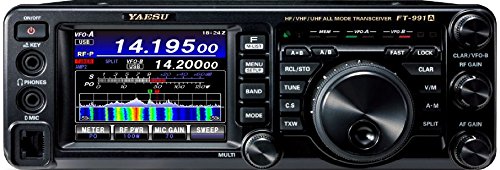
One box that covers 160 meters through 70 centimeters, all modes included.
Coverage is the headline: 160 meters through 70 centimeters, running SSB, CW, FM, C4FM digital, and AM, with 100 watts on HF and 50 watts on 2m/70cm. That is a whole shack in a single chassis — no separate VHF/UHF radio to add. A dynamic real-time spectrum scope and multi-color waterfall keep you oriented, and the 3.5-inch TFT full-color touch panel handles the controls. Functionality is what owners praise most, and the built-in antenna tuner allows flexibility across bands. At 12.99 pounds it’s a substantial but manageable base or mobile unit.
For owners stepping up from Chinese handheld brands, this is the “real” radio — one owner calls it a shack in a box and notes it’s worth the spend, while warning not to skimp on feed lines, antennas, and a proper power supply. Signal quality gets mixed reports, and some find it tricky to program at first. The 3-year warranty covers the long haul.
The fair caveat: a unit can arrive with a transmit fault, so test it promptly and lean on Yaesu support if needed. Get a good one and it covers 160 meters through 70 centimeters in a single chassis.
Do-it-all coverage: HF through 70cm in one all-mode box with built-in tuner.
Program carefully: it rewards proper setup and a good antenna more than a cheap one.
Best for the one-radio shack: you want HF, VHF, and UHF all in one transceiver.
Check it first: verify transmit on arrival, then enjoy the coverage.
11. Yaesu FT-991A Bundle with Ham Guides Quick Reference Card
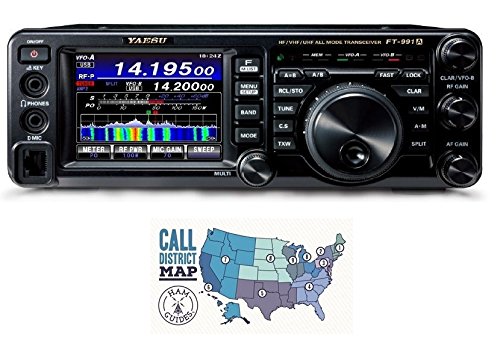
The same all-band FT-991A, now with a quick-reference card for the menu maze.
This bundle pairs the FT-991A — 100 watts on HF, 50 watts on 144 and 440 MHz, covering 160 through 6 meters plus 2m and 70cm — with a Ham Guides quick reference card. If the menu-heavy FT-991A was ever the sticking point, the card is designed to shorten the learning curve. It handles all modes with a built-in antenna tuner and over 100 memory channels, and one owner notes easy USB connectivity to a computer. It’s the same proven platform, bundled with orientation help.
The FT-991A covers the all-mode spread, and buyers here love that an all-in-one with 100 watts exists in one box. The quick reference card is a nice bonus for the exact audience this rig frustrates: people spinning through menus looking for the one setting that matters. At 13.5 pounds it’s a solid base or mobile premium option.
The one quirk worth knowing is the auto tuner: it does not work on VHF bands, by design, and that surprises new owners who assume it does. A common reaction is thinking the tuner is broken, then finding the manual confirms it is VHF-exempt. Read up before assuming a fault, and the card in this bundle helps.
Why the bundle works
- All-band 100 W HF plus 2m/70cm coverage
- Quick reference card shortens the menu learning curve
- Built-in tuner, USB, 100+ memories
Know before you buy
- Auto tuner is intentionally VHF-exempt
- Menu depth demands the manual or the card
Worth it if: you want the do-everything FT-991A plus help with its menus from day one.
Remember: the tuner skips VHF by design — that is not a defect.
Know the Specs
Power output in watts
Watts measure how hard the radio pushes its signal. More watts mean a better chance of cutting through, but a well-tuned antenna with 20 watts can beat a mismatched higher-wattage rig. That is why a built-in auto tuner matters as much as the wattage number.
Built-in automatic antenna tuner
A tuner matches the radio to whatever antenna you connect, dialing the impedance into range. In a vehicle, an antenna rarely presents the ideal load, so a built-in tuner like the ones on the FT-710AESS, FT-991A, and Xiegu rigs saves you an extra box and a lot of fiddling.
Bands and coverage
HF bands get you long-distance contacts; 2 meters and 70cm get you local repeater and short-range work. A single-band 2m rig is simpler and cheaper to run. An all-band rig covers everything in one chassis but asks more of your antenna setup and vehicle wiring.
Transmit current draw
High-power HF radios pull serious current on transmit, and a lighter socket may not keep up. Plan a fused cable to the battery. Owners of compact HF rigs note that wiring and fusing matter as much as the radio itself.
Common Questions
Do I need a license to run a mobile HF radio?
Will a mobile HF radio fit under my car seat?
Do I need an external antenna tuner for the FT-891?
How much current does a 100-watt HF rig draw?
Can I program these radios from my phone or computer?
What is the real-world range of a mobile VHF/UHF radio?
What bands do I need for local repeater work?
Why doesn’t my auto tuner work on VHF bands?
Do these mobile radios need a separate power supply?
Is a detachable or remote control head worth it in a vehicle?
Which pick is best if I want HF, VHF, and UHF in one radio?
The Bottom Line
The mobile hf radio choice for most drivers is the Yaesu FT-2980R because its fan-free 80-watt 2-meter output and near-bulletproof build hold the repeaters that the crowd favorite keeps coming back to. If you want HF reach in a compact, mounted body, grab the Yaesu FT-891 and pair it with an external tuner. And for one box that covers 160 meters through 70 centimeters with a built-in tuner, the Yaesu FT-991A is the one to reach for. Pick the band count your driving actually needs, then mount it properly.
How we choose
We do not accept paid placement. Every pick is matched to a real buyer and a real use-case; we do not hands-on test units.
Sources
Specifications: manufacturer listings and product documentation. Review insights: verified customer reviews, as of October 2026. Pricing: not shown on this page (it changes often); check the current price via the retailer link.
As an Amazon Associate, Aappliancez earns from qualifying purchases. This does not affect which products we feature.