Disclosure: Some links in this post are affiliate links. As an Amazon Associate I earn from qualifying purchases, at no extra cost to you. Learn more
Specs are compiled from manufacturer listings and verified buyer reviews and can change over time — please confirm the key details on the product page before buying.
Your sourdough bulks up faster than you expect, and the wrong bowl turns a wet, stretchy dough into a slippery mess on your counter. What you need is a bowl deep enough to hold a doubling dough, wide enough to stretch and fold without sloshing, and stable enough to stay put while you work it. This shortlist covers picks from a nesting stoneware pair to a glass bowl with a fitted lid, so you can match the bowl to how you actually bake.
This guide is built by comparing the manufacturers’ published specifications and the patterns across verified customer reviews, so you get each pick’s real strengths and trade-offs instead of marketing spin.
A bowl that is too shallow lets your dough climb the sides and spill; one that is too heavy tires your arm before the first fold. Below you’ll find the best mixing bowl for sourdough to keep your dough contained and your proofing on track.
Top Picks


How To Choose The Best Mixing Bowl for Sourdough
A sourdough bowl has to do one thing above all: hold a wet, lively dough while it grows. The mistake most bakers make is buying for looks or for salad duty and ending up with a vessel that is too shallow for a doubled batch. Here is what actually decides whether a bowl earns its spot on your counter.
Capacity has to match your batch, not your recipe card
Your dough expands, so buy for the risen size rather than the rested size. A 2.5-quart bowl suits a single loaf with room to fold; a 4.7-quart or 6-quart bowl handles double batches and big bulk ferments. Glass bowls like the Ajrwiiy at 4.7 quarts and the NUTRIUPS at 6 quarts give you that headroom, and the clear walls let you judge the rise by eye instead of by timer.
Depth keeps wet dough inside the bowl
A deep, straight-sided bowl contains a slack, high-hydration dough during stretch and fold. Shallow serving bowls let it creep up and over the rim mid-fold. Look at the height as a signal — the Pyrex sits at a 3.75″H wall, which is workable for a single loaf but tighter for a big double batch.
Material decides heat, weight, and how you clean it
Ceramic stoneware holds warmth and stays stable on the counter but adds weight; the Mora set runs 4.2 pounds for the pair. Tempered glass and borosilicate glass are lighter, let you see fermentation, and wipe clean easily. Both ceramic and glass are typically dishwasher-safe, but ceramic demands a bit more care to keep its glaze free of metal marks.
Side-by-Side Comparison
| Model | Best For | Capacity | Material | Weight | Amazon |
|---|---|---|---|---|---|
| Mora Ceramic Large Mixing Bowls (Set of 2)★ Best Overall | Warm, stable bulk ferment | 2.5 & 1.6 quarts | Ceramic stoneware | 4.2 lb (set) | Amazon |
| Pyrex 325 (2.5Qt) Glass Mixing BowlWatch It Rise | Watch a single loaf rise | 2.5 quarts | Tempered glass | 2.4 lb | Amazon |
| Ajrwiiy 4.7 Quart Glass Bowl with Lid | Cold proofing with a cover | 4.7 quarts | Glass | — | Amazon |
| Cuiselect 5pc Glass Mixing Bowls Set | Prep alongside baking | 0.85 to 4.65 quarts | Borosilicate glass | — | Amazon |
| NUTRIUPS 6 QT Large Glass Mixing Bowl | Double batches of dough | 6 quarts | Borosilicate glass | — | Amazon |
Detailed Reviews
1. Mora Ceramic Large Mixing Bowls – Set of 2 Nesting Bowls
Our pick — 4.5+★ from 750+ verified ratings; the strongest balance of quality and price.
Two nesting stoneware bowls that hold steady while your wet dough fights back.
You get a pair here — a 2.5-quart and a 1.6-quart stoneware bowl — and the big one is genuinely built for a single sourdough loaf. The deeper of the two is where the bulk ferment lives, while the smaller one keeps your levain or a poolish out of the way. Owners happily keep the big bowl busy for salads, popcorn, and marinating in between bakes, so it is not a one-job vessel.
What wins people over is the build. The stoneware is fired to hold heat and rated by the manufacturer to over 500 degrees F, so a warmed bowl keeps dough from chilling in a cool kitchen. The crystallized glaze resists scratches from forks and whisks, and both bowls are dishwasher safe. One honest note: the matte finish is slick when it is wet and soapy, so grip it firmly at the sink. A metal dough whisk can leave faint grey marks that are cosmetic and come off with a little polish.
The rim is worth calling out for sourdough specifically — it makes a clean seal under plastic wrap, which is how you lock in moisture for a long bulk ferment or an overnight poolish. The weight that makes these feel premium is also the trade-off: this is not a bowl you toss around one-handed, and the stoneware would rather you set it down than balance it on a scale. For a baker who wants warmth, stability, and two sizes that nest away cleanly, it delivers.
What earns the counter spot
- Matte stoneware pair in 2.5 and 1.6 quarts, so bulk ferment and preferment both have a home
- Strong heat retention keeps dough warmer through cooler room temps
- Scratch-resistant glaze and dishwasher-safe cleanup
- Nests compactly for storage
Where it asks for care
- Heavy at 4.2 pounds for the set compared with a lighter glass bowl
- Slippery surface when wet and soapy
- Metal whisks leave light grey cosmetic marks
Grab this set if: you want warm, stable stoneware that holds a single loaf through a long ferment and doubles as a serving bowl.
Keep looking if: a lighter bowl you can lift one-handed across the kitchen matters more to you than heat retention.
2. Pyrex 325 (2.5Qt) Glass Mixing Bowl – Made in USA
The clear winner for bakers who read the dough through the side of the bowl.
If you are baking one loaf at a time, this 2.5-quart tempered glass bowl gives you exactly what glass is good at: you watch the bubbles and the dome form without lifting a cover. As owners put it, “Love this bowl for making my sourdough! Just the right size and I can see the fermentation, that’s why I bought this.” That visibility is the whole reason a glass proofing bowl earns a place next to stoneware. At 2.4 pounds it lifts easily with one hand, and unlike the heavier ceramic pair above, you can carry a loaded dough to the fridge without bracing your whole arm.
The tempered glass resists stains and odors and is microwave, freezer, and refrigerator safe, so it moves from a warm rise to the cold retard without a second dish. The non-porous surface wipes clean and it is dishwasher safe. Being a single 2.5-quart bowl rather than a nesting set, it is the right pick when you know your batch size and want one dependable vessel.
Here is the honest part a glass bowl always carries: it can shatter, and glass of any kind rewards you for not knocking it against the tap or stacking it carelessly. Treat it with respect and it is a workhorse. There is also no lid, so you cover it with a plate, a damp towel, or plastic wrap during a ferment. For a simple, clear, easy-to-clean single-batch bowl, that trade is fair.
The glass advantage: a 2.5-quart tempered glass bowl at 2.4 pounds gives you the clearest read on fermentation you can get, and it is safe from microwave to freezer.
The trade: no lid and a breakable body mean you provide the cover and handle it gently at the sink.
Reach for this if: you bake one loaf at a time and want to see the rise through clear glass.
Look elsewhere if: you need a lid for cold proofing or a larger bowl for double batches.
3. Ajrwiiy Large Glass Bowl 4.7 Quart
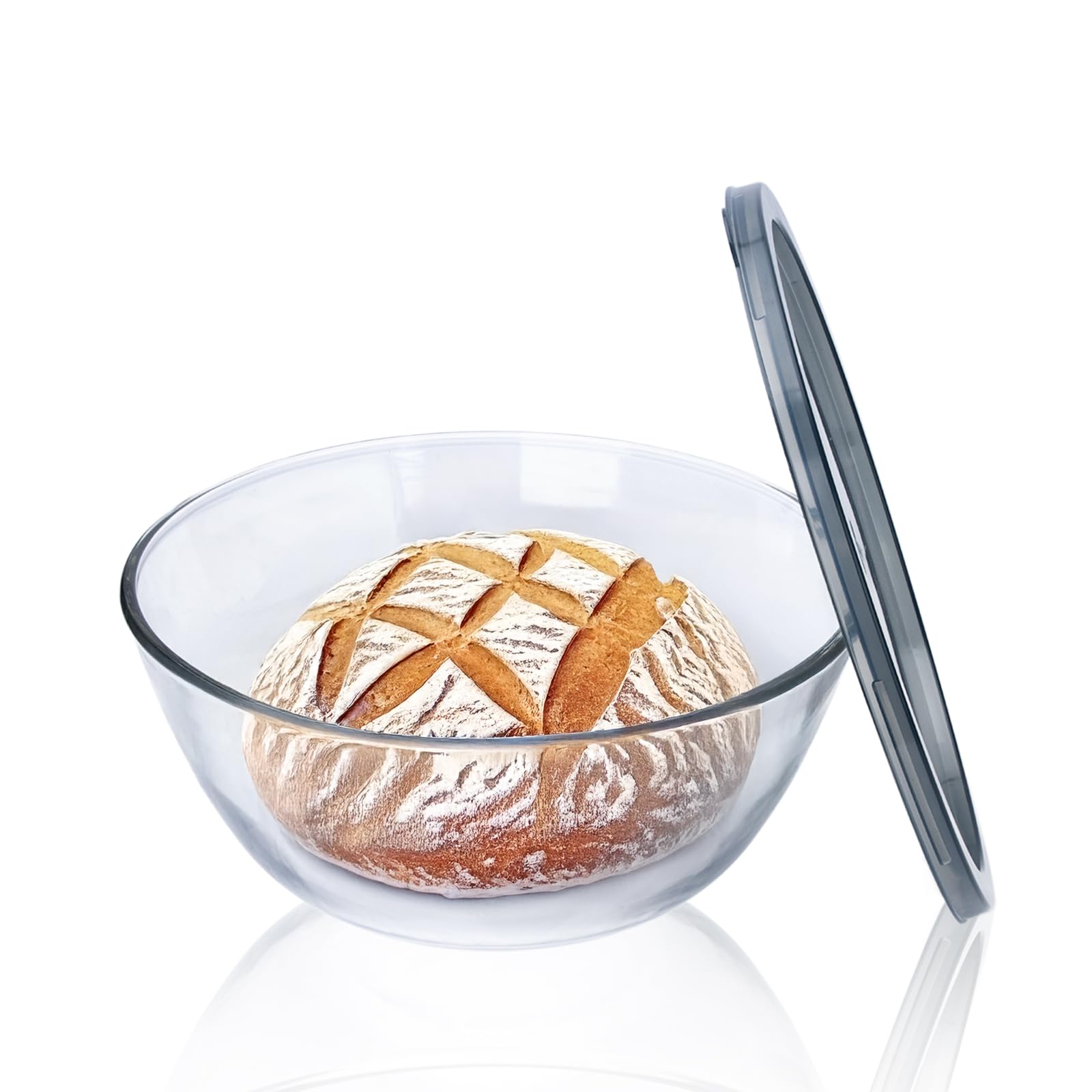
A big glass bowl with a lid that lets cold dough proof while you sleep.
Size is the headline: 4.7 quarts, 88% more capacity than the 2.5-quart Mora, which gives a rising dough generous headroom. The bowl is heat and freeze resistant, so it moves straight from a warm ferment to the cold retard, and the clear glass keeps fermentation visible throughout. If you bake in larger batches or want your dough to proof overnight without a towel to fuss over, this capacity is the reason to look here.
The lid is the feature that shapes how you use it. Owners like that it seals with a firmness that is just right — not so tight you fight it, not so loose it slides — and one buyer described it as easy for cold proofing dough. Being clear, the bowl lets you watch a sponge or a levain build without lifting the cover and letting the warmth escape. It is microwave safe and the smooth interior rinses clean after a messy batch.
Two things to weigh. The lid is a clear plastic cover, not a hard seal, so it holds for a fridge session but is not airtight for long-term storage. And glass demands care — this is a big bowl to lift with hands wet from dough, and a knock against the counter is always possible with a wide 10.43″W body. Neither is a deal for a baker who values capacity and a fitted cover, but they are the honest edges of the design.
Why bakers keep it out: the 4.7-quart glass body holds a large batch, and the fitted lid turns cold proofing into a hands-off overnight step.
The catch to know: the plastic lid seals well for proofing but is not airtight, and the wide glass bowl is heavy to handle with slippery hands.
Pick this one if: a large capacity and a lid that makes overnight cold proofing easy are what you have been missing.
Skip the lid if: you prefer a plain uncovered bowl and never proof in the fridge.
4. Cuiselect 5pc Glass Mixing Bowls Sets
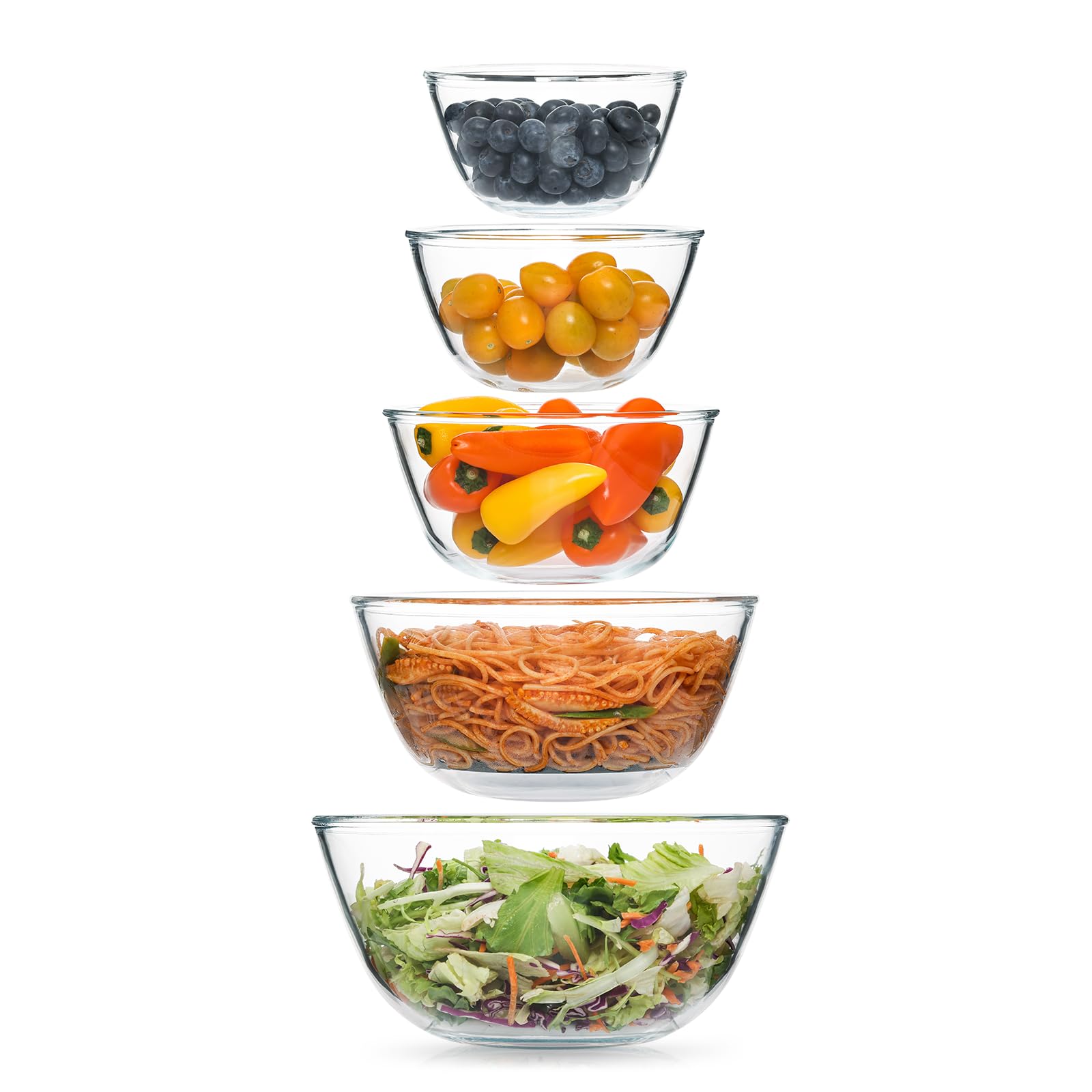
Five graduated glass bowls that keep every stage of your bake separate and tidy.
This is the set for the baker who wants one bowl for the dough and another for the levain, the flour, the seed soak, and the discard all at once. Five sizes run from a 4.65-quart main bowl down to a 0.85-quart small one, so the largest holds a full batch while the little ones catch aromatics and pre-measured flour. The borosilicate glass is built for temperature swings, and the transparent body lets you see contents from the side. Where the Ajrwiiy above adds a lid, this set trades the cover for breadth — you get a whole prep station instead of one proofing bowl.
The wide anti-slip rim and deepened base are aimed at the kneading and stirring you do with sourdough, keeping the bowl planted when you mix a stiff dough. Depth matters for whipping and folding, and the graduated bowl shape helps the smaller ones mix cleanly. The glass is free of BPA, lead, and cadmium, and it is dishwasher, microwave, and freezer safe. Nesting the five together saves serious cabinet room when the bake is over.
The honest limit is that the largest bowl is 4.65 quarts with a fairly shallow 3.5″H wall, so a hugely risen double batch may crowd the top. There is also no lid in the set — a plus if you like keeping storage lean, a gap if you want a covered cold proof. That height and the 6.3″W footprint of the small bowls are worth a look if you proof big.
Best when you bake and prep together
- Five borosilicate bowls from 4.65 down to 0.85 quarts cover every stage of a bake
- Anti-slip rim and deepened base steady the bowl while you knead
- Microwave, freezer, and dishwasher safe
- Nests into one compact stack in the cabinet
Where it gives up ground
- No lid, so cold proofing needs your own cover
- Largest bowl at 4.65 quarts is tighter for a big double batch
- A shallower wall than a dedicated deep proofing bowl
The right call for: bakers who want a full set of glass bowls for mise en place and mixing, not a single proofing vessel.
Not the one if: a lid and a deep wall for big ferments are your priorities.
5. NUTRIUPS 6 QT Large Glass Mixing Bowl

Six quarts of clear glass for bakers who bulk ferment two loaves at once.
Look at the capacity first: 6 quarts, which is the roomiest bowl here and beats the 4.7-quart Ajrwiiy on sheer space. Buyers report it holds two fully bulk-fermented sourdough loaves with room to spare, and one says a third would fit with space left at the top. For anyone doubling a recipe or baking for a crowd, that headroom is the entire point, and it makes stretch and fold comfortable instead of cramped.
The body is high borosilicate glass, chosen for sturdiness and heat resistance, so it handles a hot bake or a frozen retard without cracking. The wide, thick lip gives you a solid grip on a big, heavy dough, and the clear walls let you watch the bulk rise build without lifting anything. It is oven and microwave safe and cleans up easily — baked-on bits rinse and wipe away on the smooth surface.
The trade is plain: this bowl is big and heavy when it is full, so you had better have a good grip on it, and it does not nest with another bowl like the sets above. It also has no lid, which matters if you want a covered cold proof. A wide 6-quart glass bowl also needs real cupboard room when it is empty. Size this bowl for your biggest batch, not your smallest, and it rewards you.
Taken with size in mind: the 6-quart capacity makes double-batch sourdough and big potluck salads easy in one clear bowl.
Two honest limits: it is heavy and bulky when full, and there is no lid for cold proofing or storage.
Know the Specs
Capacity in quarts
Quart capacity tells you how much risen dough a bowl will hold. A single artisan loaf commonly needs the room a 2.5-quart bowl offers; double it and you want 5 or 6 quarts, which is why the NUTRIUPS lists 6 quarts while the Cuiselect tops out at 4.65 quarts. Buy for the size your dough grows INTO, not the amount you start with.
Glass vs ceramic
Glass — whether tempered (heat-strengthened) like the Pyrex or borosilicate (a low-thermal-expansion glass) like the Cuiselect and NUTRIUPS — is clear, lighter, and lets you read fermentation through the side, but it can crack if knocked. Ceramic stoneware like the Mora holds warmth and feels stable and heavy on the counter, but it weighs more and its glaze asks for gentler handling at the sink. Your pick depends on whether you value visibility or heat and heft.
Depth and rim shape
A deeper wall keeps a slack, high-hydration dough from climbing out during folding. An anti-slip or rolled rim, like the sealed edge on the NUTRIUPS and the anti-slip rim on the Cuiselect, helps you keep a grip and keeps the bowl planted. A clean rim also makes plastic wrap seal tightly for a poolish or bulk ferment.
Lids and covers
A fitted lid, like the one on the Ajrwiiy, turns cold proofing into a hands-off overnight step and keeps a sponge from drying out. Most uncovered bowls here expect you to supply plastic wrap or a damp towel. If you proof in the fridge often, count a lid as a real convenience rather than an extra.
Common Questions
How big should a sourdough mixing bowl be?
Is glass or ceramic better for proofing sourdough?
Can I use a glass mixing bowl for a cold proof in the fridge?
Will a metal dough whisk scratch a ceramic bowl?
Does a bowl need a lid for sourdough?
Are these mixing bowls dishwasher safe?
Can I knead or mix stiff dough directly in a glass bowl?
Can a big 6-quart bowl fit in a normal cabinet?
Is borosilicate glass better than regular tempered glass for baking?
Why does dough climb the sides of my mixing bowl?
The Bottom Line
For most bakers chasing the best mixing bowl for sourdough, the Mora Ceramic Large Mixing Bowls win on warmth, stability, and a two-bowl pair in 2.5 and 1.6 quarts — the standout here, and a set that keeps its place on the counter through a long ferment. If seeing the rise through clear glass is your priority, the Pyrex 325 gives you that for a single loaf. For an overnight cold proof with a lid, reach for the Ajrwiiy 4.7 Quart, and if you bake two loaves at once, the NUTRIUPS 6 QT has the room you need.
How we choose
We do not accept paid placement. Every pick is matched to a real buyer and a real use-case; we do not hands-on test units.
Sources
Specifications: manufacturer listings and product documentation. Review insights: verified customer reviews, as of October 2026. Pricing: not shown on this page (it changes often); check the current price via the retailer link.
As an Amazon Associate, Aappliancez earns from qualifying purchases. This does not affect which products we feature.