Disclosure: Some links in this post are affiliate links. As an Amazon Associate I earn from qualifying purchases, at no extra cost to you. Learn more
Specs are compiled from manufacturer listings and verified buyer reviews and can change over time — please confirm the key details on the product page before buying.
If bouncing on a mini trampoline makes your knees ache on landing or the springs send a clang through the floor for the neighbours below, you are looking at the wrong kind of rebounder. Buy a bungee-cord model, not a spring one, and you get a soft landing and near-silent bouncing in the same cheap package. The only real question left is how big you want the mat and how much support you want from a handlebar.
This guide is built by comparing the manufacturers’ published specifications and the patterns across verified customer reviews, so you get each pick’s real strengths and trade-offs instead of marketing spin.
You do not need a handlebar to bounce, but you do need the right frame size for your ceiling and your storage space. Below, seven tested-in-the-wild options are ranked by how they actually behave underfoot, plus the specs that matter when you shop for the mini trampoline for exercise.
Quick Picks
- JumpSport 350 PRO 39 Inch Fitness Trampoline
- KOKSRY Rebounder Trampoline for Adults, 40″ — Budget Champion
- JUMPZYLLA Mini Rebounder Trampoline with Bar — Best With A Bar
- ANCHEER 40″ Foldable Mini Trampoline — Most Compact When Stored
- Newan 48″ Fitness Trampoline — Biggest Mat
- BCAN BT3 51″ Octagonal Rebounder Trampoline — Most Roomy
- Leaps and Rebounds Fitness Trampoline — Firmest Bounce
How To Choose The Best Mini Trampoline for Exercise
Every mini trampoline for exercise does the same one thing: it takes the hard landing out of a jump and replaces it with a slow give. Where they differ is how that give is created, how much room your feet get, and whether the thing wobbles when you go fast. Get those three right and you will bounce daily; get one wrong and the trampoline ends up under the bed.
Bungee cords versus steel springs
The bounce surface on the quieter rebounders is held by elastic bungee cords instead of the coiled steel springs you remember from old garden trampolines. A bungee passes over the rim in a loop and gives a soft, damped return, so your knee absorbs far less force on each landing. Bungees also remove the pinch risk of a spring gap and the clanging noise that goes with it. The trade-off is tension: a bungee under heavy load takes real arm strength to stretch onto its hook, which is why several of these picks arrive partly or fully assembled.
Match the frame size to your room and ceiling
A 39-inch round frame takes up a corner; a 48-inch or 51-inch frame needs a clear patch of floor and enough headroom that your head does not meet a light fixture on a high bounce. Bigger mats give you room for more than a straight-up bounce — side-to-side skating moves and guided routines in a YouTube workout video need that width. Check your folded storage size too, because a rebounder you cannot tuck away is a rebounder you will not use.
Weight capacity and the first week
The weight rating is the frame’s maximum, so pick one that sits comfortably above your own body weight rather than right at the edge. Buyers rarely treat a rebounder like a gym bike — most sessions are five to thirty minutes — so a higher rating mostly buys you a stiffer frame and less wobble. A foam-padded handlebar is worth having if you are new to rebounding or coming back from a joint injury, since it gives your hands something to steady against while you learn the balance.
Side-by-Side Comparison
| Model | Best For | Frame Size | Max Weight | Bounce Type | Amazon |
|---|---|---|---|---|---|
| JumpSport 350 PRO | Best Overall | 39 inches | 330 pounds | 36 EnduroLast cords | Amazon |
| KOKSRY Rebounder | Budget pick | 40 inches | 450 pounds | 32 reinforced springs | Amazon |
| JUMPZYLLA | Best with handlebar | 40 inches | 450 pounds | High-tensile bungees | Amazon |
| ANCHEER 40″ | Easiest to store | 40 inches | 400 pounds | 32 bungee cords | Amazon |
| Newan 48″ | Biggest bounce surface | 48 inches | 330 pounds | 40 bungee ropes | Amazon |
| BCAN BT3 51″ | Best for roomy routines | 51 inches | 450 pounds | 8 mm bungees | Amazon |
| Leaps and Rebounds | Best firm bounce | 48 inches | 270 pounds | Premium latex bungees | Amazon |
Detailed Reviews
1. JumpSport 350 PRO 39 Inch Fitness Trampoline
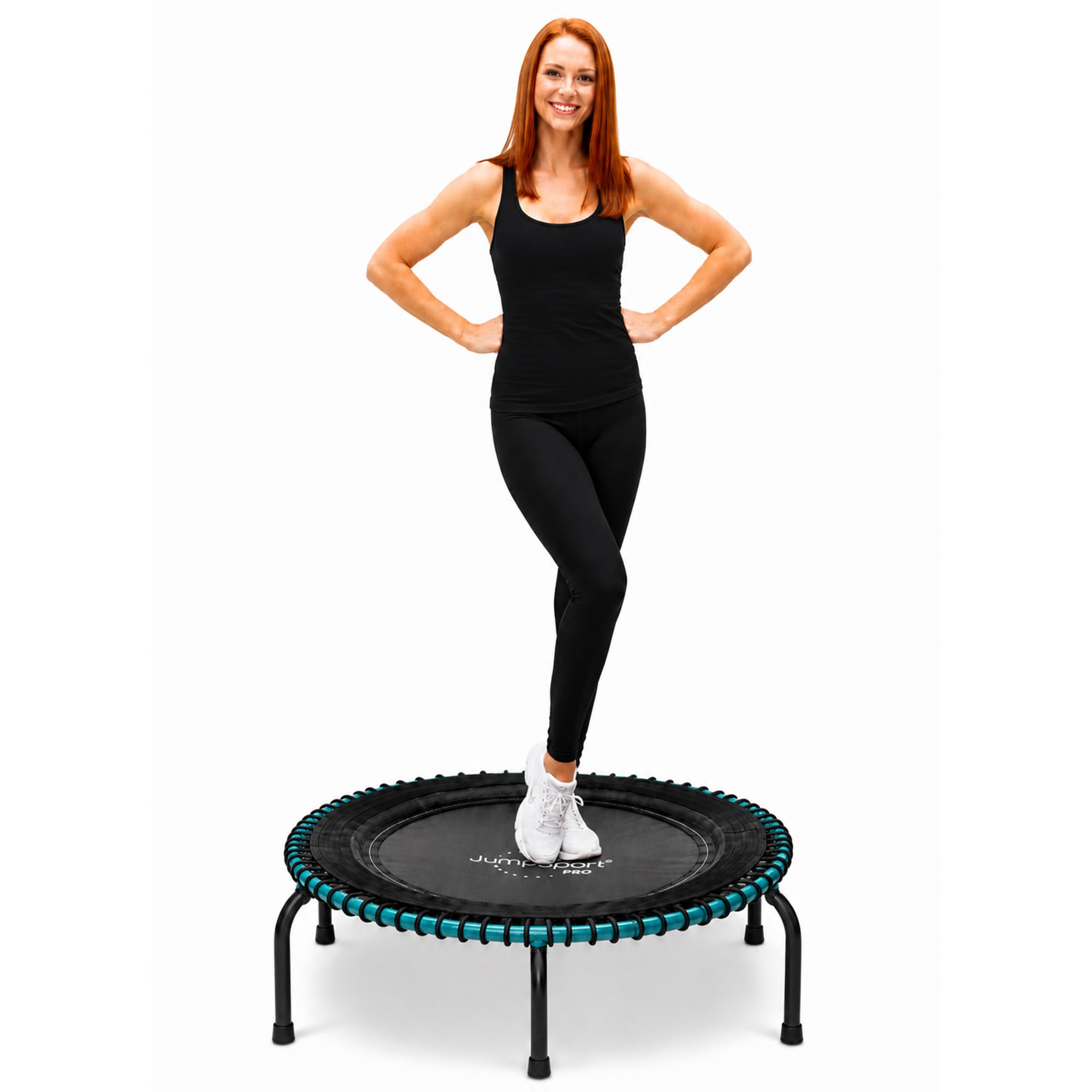
The adjustable-tension rebounder that lets you dial in how firm the floor under your feet feels.
What makes the 350 PRO the pick for most people is not one number but the combination of a 39-inch frame that fits a corner and 36 EnduroLast elastic cords you can tighten from firm to extra firm. That adjustability is the difference between a shared rebounder everybody can live with and one that only suits one body. A 39-inch frame gives you 35 inches of lay-flat mat to land on — enough room for cardio dancing and sculpting moves without leapfrogging off the edge.
You get a trampoline that stays put while you bounce, thanks to arch-shaped legs that resist tipping. The frame is 16-gauge steel (a thick, sturdy grade of steel) with a multilayer powder coating and a 300-pound rating, so it holds up to heavy daily use. If a cheap round trampoline has ever walked itself into a wall on a fast session, this design fixes that exact annoyance. At 39″L x 39″W x 3″H, it sits low enough to step onto without a jump. The whole unit tips up on its side for storage instead of folding.
Owners praise build quality most in this model’s reviews, with sturdiness a close second. A 66-year-old buyer with worn knees bounces daily and calls the cord surface gentle on joints. Another owner reports stronger legs and abs after two months of four to five sessions a week. The catch is what that quietness costs: you pay for a premium cord-and-frame package, and the 39-inch mat is smaller than a 48-inch or 51-inch alternative.
What earns the crown
- Adjustable tension from firm to extra firm, so one rebounder suits different bodies and moods
- 36 EnduroLast elastic cords hold the mat comfortably for a 300-pound rating
- Tip-resistant arched legs keep it planted instead of drifting across the room
- Lay-flat mat gives 35 inches of jumping space in a compact 39-inch frame
Worth knowing before you buy
- Premium pricing puts it at the top of the pick list
- 39-inch frame is roomier than a kids’ trampoline but tighter than the 48-inch and 51-inch picks above
The short answer: this is the one for a home that wants the quietest, most adjustable bounce and does not need a giant mat.
Look at a bigger frame if: your workout routine needs side-to-side skating width that a 39-inch mat cannot give.
2. KOKSRY Rebounder Trampoline for Adults, 40″
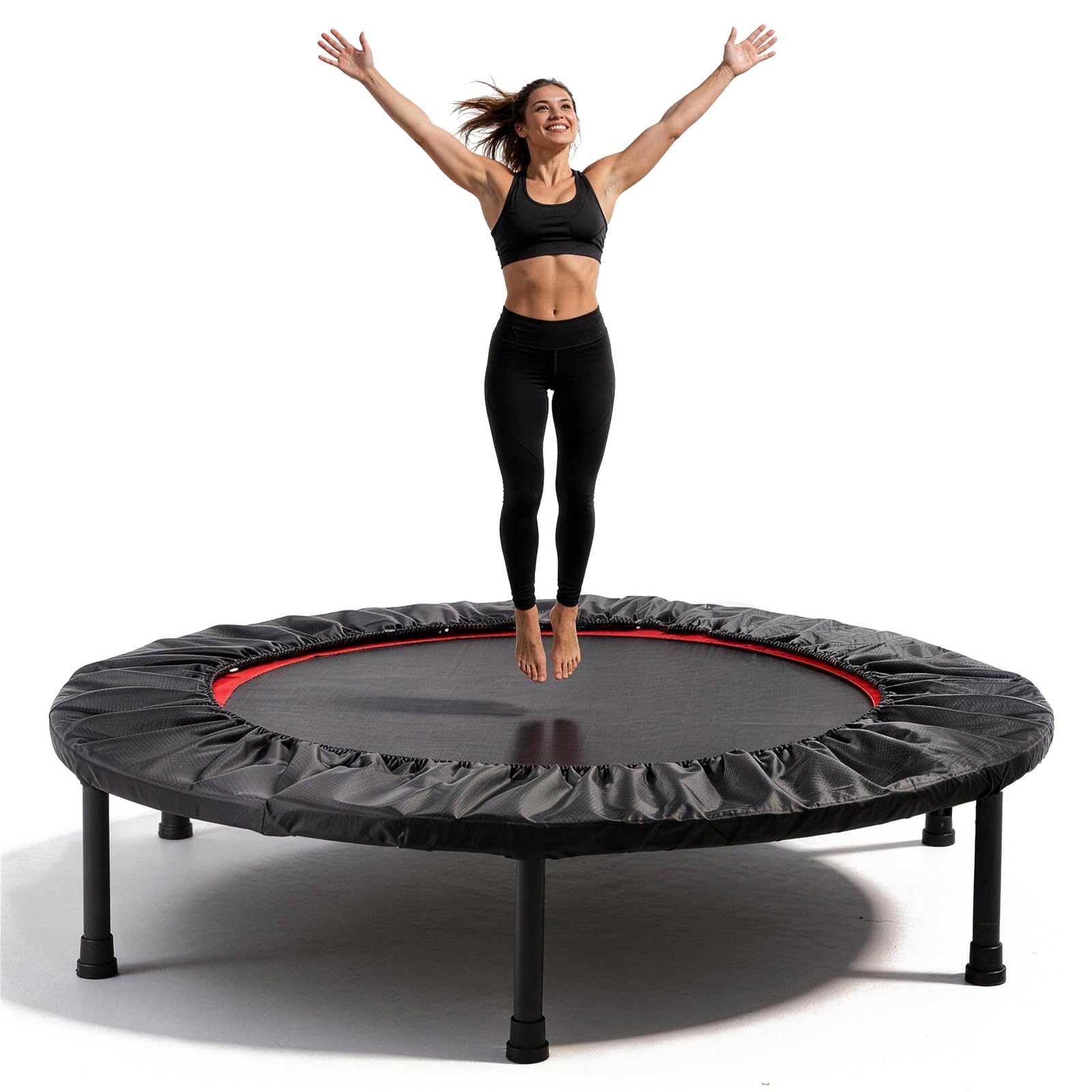
The foldable budget rebounder that promises a 450-pound weight rating for the price of a family dinner.
If you want to try rebounding without committing a big chunk of money, this 40-inch KOKSRY is the low-risk entry point. The item measures 40″L x 40″W x 8.7″H, and the whole thing collapses into a compact package for under-bed or closet storage.
Two things stand out in its owner experience. First, it is quieter than you would expect from springs, because the noise-reduced base and full-wrap spring guards take the edge off each landing. Second, assembly is genuinely beginner-friendly; it arrives nearly fully assembled, so you are mostly opening it flat rather than threading cords. Some buyers report the spring cover tore quickly and the springs underneath were not cushioned enough, which is the honest trade-off of going spring-based at this level — the cover does the mild work the springs do not.
The fit verdict: if you weigh closer to the rated limit or you want something you can fold away between sessions, this is a sensible first purchase. If you have bone-on-bone knees or are recovering from a joint issue, the softer cord-based bounce on the other picks is the kinder surface. It is not the rebounder to buy if you need a handlebar — this one does not include one.
The real value here: a 450-pound rating and compact storage for a fraction of the premium picks, with a spring-based bounce that is firmer underfoot than cord models.
The fit caveat: if you want cushioned landings and a handlebar to steady against, a bungee rebounder is the better first step.
Reach for this if: you want to test-drive rebounding cheaply and your storage is limited.
Spend up instead if: your knees need the softer give of an elastic-cord surface.
3. JUMPZYLLA Mini Rebounder Trampoline with Bar
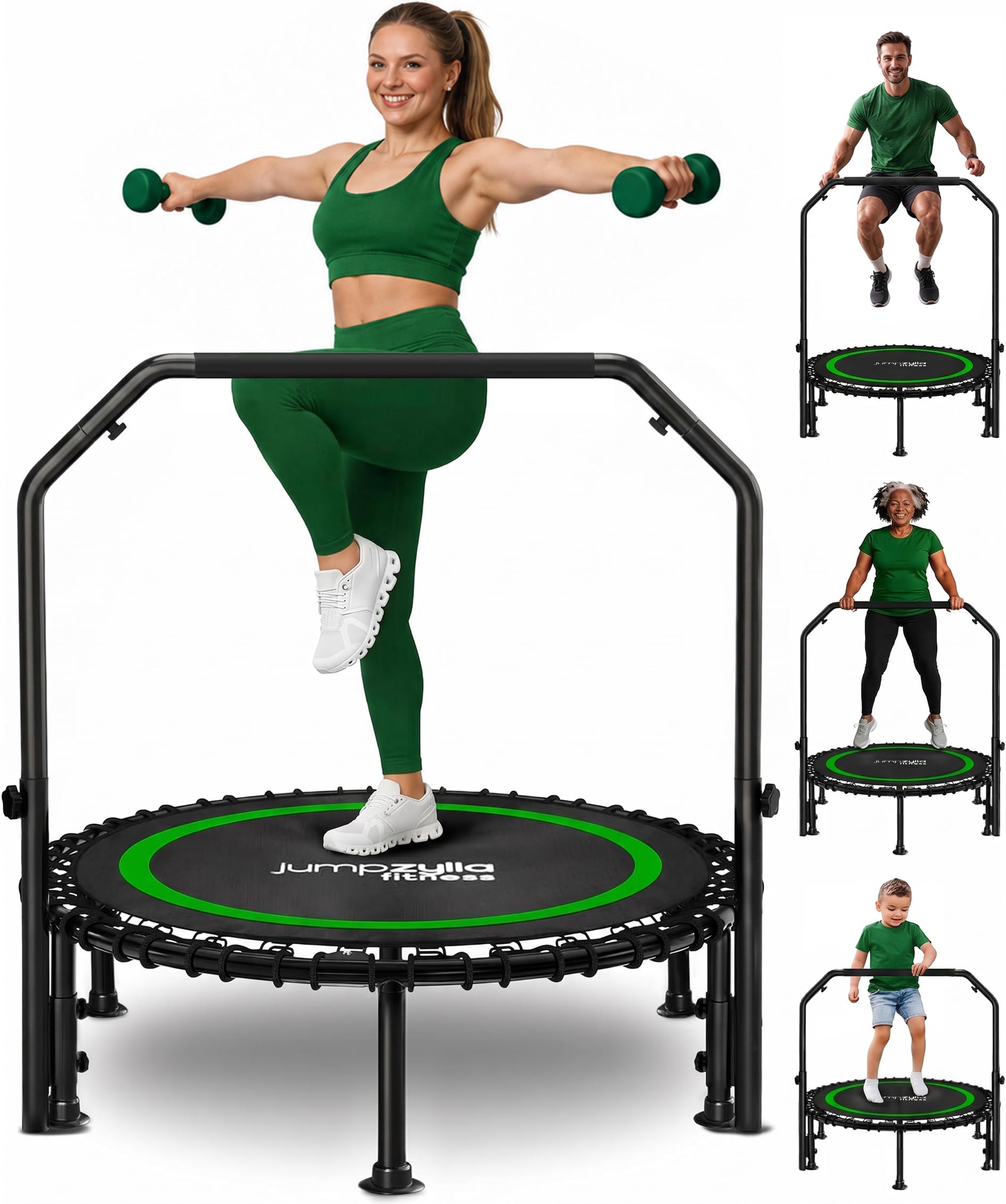
The build-it-once rebounder with a foam handlebar that turns a wobbly first bounce into a steady one.
Buyers who want something to hold onto while they learn should start here. The JUMPZYLLA ships with a four-level adjustable foam-padded handlebar, so you can steady yourself at the height that suits you and let go once your balance catches up. It is bungee-based rather than spring-based, which keeps the bounce gentle on joints and the noise down. The frame is a 40-inch galvanized stainless steel model with a 450-pound rating, and the mat is breathable polypropylene that wipes clean.
Reviewers are won over by quiet, well-made construction. A 67-year-old owner calls the bounce fun and the setup easy. A buyer whose 90-year-old relative uses it daily says the frame stays sturdy enough to bounce while watching TV. The most recent owner adds that the tension straps double as arm-exercise gear. Assembly is a task, though: one solo buyer had to remove and reattach about a third of the bungees to get the frame to unfold, and seating a stiff bungee properly takes real practice.
Compared with the KOKSRY above, you are swapping the spring surface for bungees and adding the handlebar, both upgrades that matter if balance is your sticking point. The handlebar also makes it a shared-family rebounder — kids and adults can all find a safe setting. What you give up is the near-instant setup of a spring model; count on a small amount of elbow grease on day one.
The no-spin zone: a four-level foam handlebar and tight bungees make this the easiest pick to get steady on, with a 450-pound frame rating supporting that confidence.
The first-day friction: it is not foldable between sessions, and the bungee tension can be a two-person job to get started.
Who this is for: anyone who wants a hand to hold while they find their balance, or a family rebounder everyone can adjust.
Who it is not for: buyers who expect to unfold and bounce in under ten minutes with no help.
4. ANCHEER 40″ Foldable Mini Trampoline
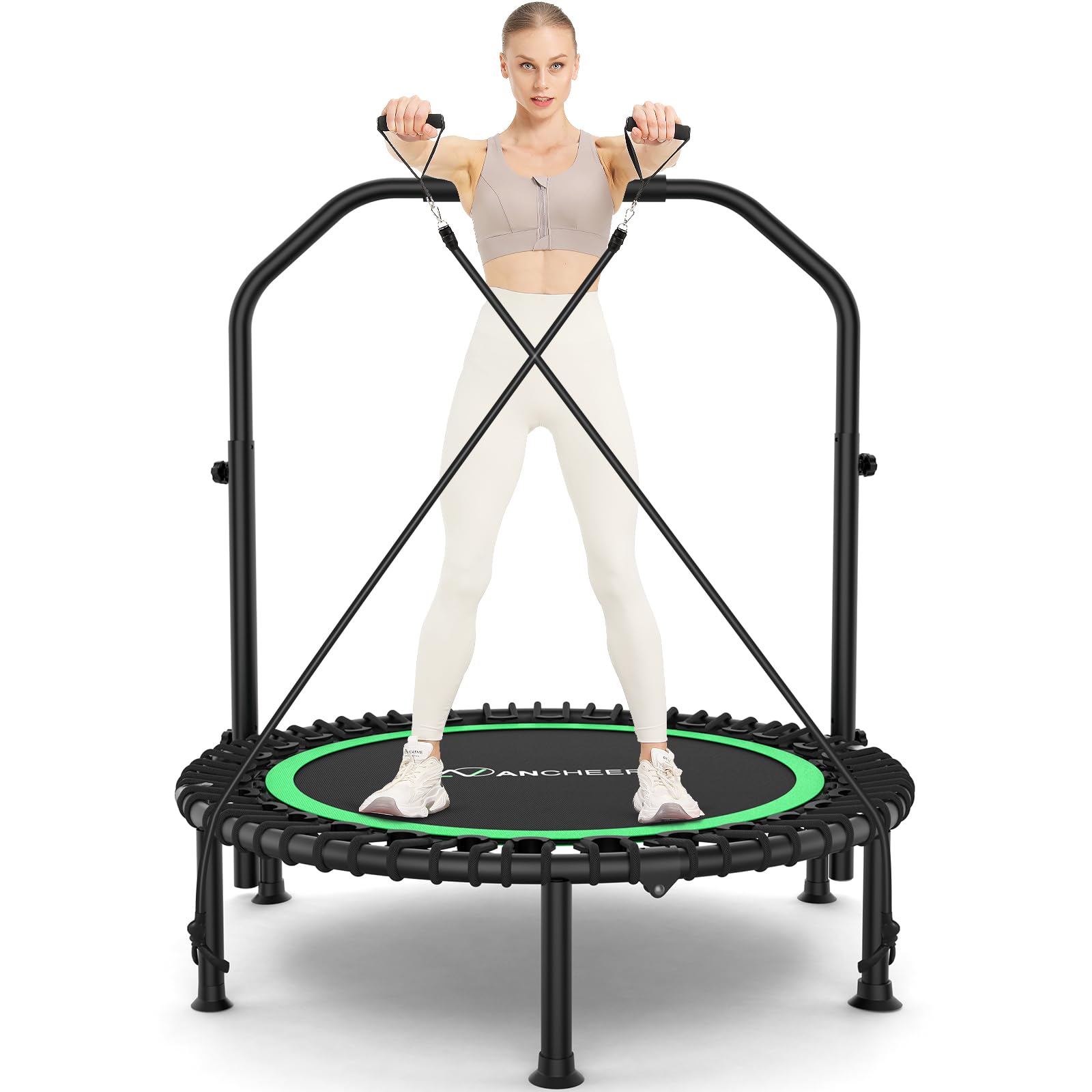
The travel-friendly rebounder that folds twice down to a footprint you can slide under a bed.
I have saved the folding champions for the small-apartment crowd, and the ANCHEER leads that group. It folds twice into a 15-inch by 30-inch package, which is small enough to tuck under a sofa, slide into a closet, or drop into a car trunk for a gym trip. The 40-inch frame runs on 32 elastic cords at 1.2 mm in diameter, backed by 3 mm thickened steel plates and six thickened support tubes rated to 400 pounds. That split between cord count and steel reinforcement is what separates it from a flimsy folding toy.
You trade a firm bounce for that portability. The surface is bungee rather than sprung or latex, so landings feel more forgiving. Rubber suction-cup feet keep the frame steady on hardwood, and owners mention it is quieter than metal springs, though not completely silent. A four-level foam handle adjusts from 2’6″ to 3’5″ above the mat, so adults and kids can each set their own height.
Durability is the honest sticking point here, and it shows in how owners treat it. The folding mechanism is laborious, so much so that most buyers leave it unfolded between sessions, which undercuts the compact design slightly. One buyer found assembly needed two people and the fabric skirt has to be oriented correctly or it misfits. If you plan to move it weekly, this is the pick to own; if you will leave it in a corner, a fixed-frame rebounder is sturdier.
Where it shines
- Folds twice to 15 inches by 30 inches — genuinely storable under furniture
- 32 cords at 1.2 mm and six support tubes hold a 400-pound rating
- Four-level handlebar adjusts from 2’6″ to 3’5″ for mixed-age households
- Rubber suction feet grip the floor and cut noise
Where it asks patience
- Folding and unfolding is slow enough that most owners leave it set up
- Bungee tension calls for two people or real effort on first assembly
- No spare cords included in the box
The right match: renters or small-space owners who genuinely need to stow the rebounder between sessions.
Not the right match: anyone who wants to set it up once and forget about it — a fixed frame beats this on fold-free living.
5. Newan 48″ Fitness Trampoline
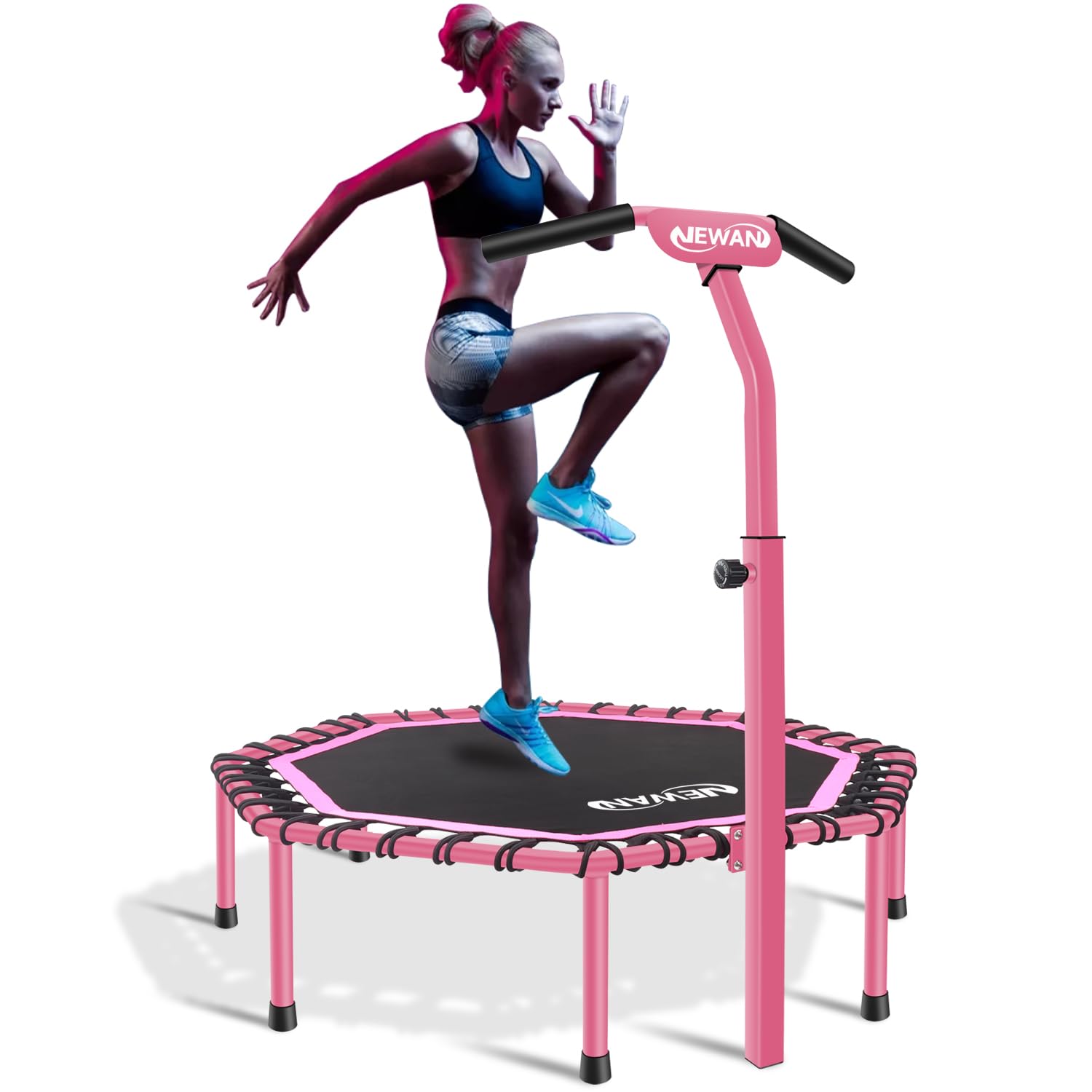
Forty bungee ropes and a 48-inch surface, built for people who want room to move rather than just bounce.
The Newan is the pick for a workout that goes beyond straight up and down. Its 48-inch frame gives you the biggest bounce area in this crew besides the BCAN, and the 40 bungee ropes at 8 mm in diameter run through an oval tube frame with eight legs. That leg count matters — more legs mean more contact with the floor and less roll when you shift your weight. The whole frame is rated to 330 pounds.
Bungee-rope suspension is the reason this one is kind to joints and quiet underfoot, and owners often describe the bounce as firm rather than springy. The T-shaped foam handle adjusts to five different heights, so it is comfortable whether you are tall or short. At 30.6 pounds it is heavier than the 39-inch and 40-inch picks, which is part of why it feels planted rather than portable. The surface is a hexagonal anti-wear polypropylene mesh, not a circle, so your footwork has defined edges to push off.
Assembly is the catch. Stretching 40 thick bungees onto the frame takes two people and real arm strength, even with the included hook tool. One fit 40-year-old buyer quit the 40-bungee stretch after two hours and handed it to her husband. Get past that first session and it earns its keep: A 59-year-old owner assembled it solo in about 30 minutes with the maker’s video and still bounces daily. Size is the trade you accept, since this takes a real patch of floor, so measure before you buy.
The case for the bigger mat: 40 rope-suspended bungees over a 48-inch hexagonal surface gives you more room for varied moves than the compact picks, at a 330-pound rating.
The assembly tax: it arrives flattened and the bungees are tight, so plan on a second pair of hands and some patience before your first jump.
This one rewards: rebounders who have a clear floor space and want a broad surface for choreographed routines.
It punishes: buyers with cramped rooms or nobody around to help stretch the cords on day one.
6. BCAN BT3 51″ Octagonal Rebounder Trampoline

A 51-inch octagon that leaves room for full skating-style side-to-side moves and a 450-pound rating.
Want more room than the Newan offers? The BCAN BT3 is the roomiest frame in the list at 51 inches across. Its 450-pound recommendation makes the Newan’s 330-pound figure look conservative, a full 120-pound gap in the mat’s load rating even though both are bungee rebounders. The octagonal shape gives your feet a slightly different geometry to work against. It uses 8 mm thickened bungees for a bounce that keeps noise to a minimum.
Assembly is the surprise here. About half of the elastic ropes arrive pre-attached, and after unfolding, it takes an estimated 10 minutes to finish with the included tool. That is a different experience from the bungee-heavy Newan, and it matters if you dread first-day setup. The 51″L x 51″W x 7.5″H frame also folds down to a 15-inch by 30-inch footprint for storage, and it weighs 12.5 kg, so it is portable enough to shift room to room.
A 65-year-old former hockey player used it for leg-atrophy rehab and reported no ankle soreness on the 51-inch surface. Durability is the lightest knock in its review record, and the bungees are the wear item over time; the fix is simply proactive replacement, not a new trampoline. Buyers who want a big surface and do not want to wrestle with cord stretching will find this the friendliest big frame to own.
Why the big footprint pays off
- 51-inch octagonal surface with a 450-pound rating for roomy, high-motion sessions
- Half the bungees arrive pre-installed, with an estimated 10-minute finish
- Folds to 15 inches by 30 inches for stow-away storage
- 8 mm bungees keep bounce quiet and joints cushioned
What to keep an eye on
- Bungees are the eventual wear part and will need replacing over time
- The handlebar is fiddly to attach and remove, so pick a spot and stay there
The clear winner for: high-energy rebounders who want a big stage and a quick first-day setup.
Think twice if: your room is tight — at 51 inches across, this needs elbow room in every direction.
7. Leaps and Rebounds Fitness Trampoline
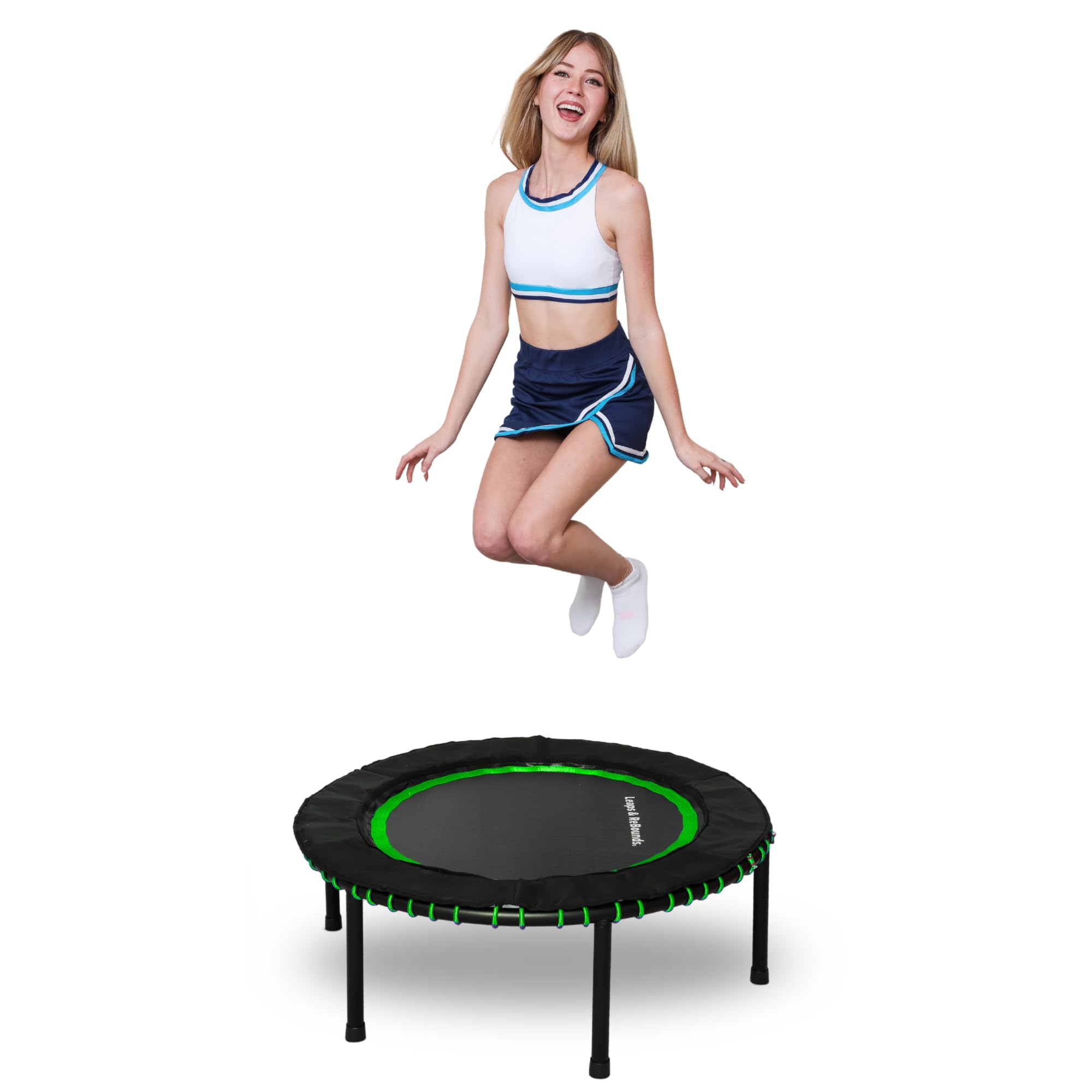
The deep, firm bounce that makes cheap rebounders feel like a workout with a pillow strapped to your feet.
Leaps and Rebounds is the pick for the rebounder who wants a crisp, responsive bounce rather than a soft mush. Its latex bungees and UV-resistant basket-woven polypropylene mat are designed to reduce stretch, which is why owners describe the feel as firm and predictable underfoot. The 48-inch round frame is built from carbon steel with straight screw-in legs that push the center of gravity low, so high jumps feel stable rather than tippy. The mat has a full-size bungee cover that protects your ankles and adds usable space.
Leaps and Rebounds backs the frame with a lifetime manufacturer’s warranty and offers a 30-day risk-free trial, which is a stronger support promise than any other pick on this list. The 16-pound unit assembles in under 30 minutes with four click-together frame bars, six screw-in legs, and an included bungee tool. It is also the lightest big-frame pick here, which is why owners find it easy to move around.
The honest limits are capacity and storage. It is rated to 270 pounds, the lowest of the full-size frames, so heavier users should look at the BCAN or Newan. The legs do not fold, so it is not a stow-away, and one tall owner found it uncomfortable under average ceilings. Customers note years of service from the carbon steel frame; if you weigh under 270 pounds, the rest of the spec sheet falls into place.
What you get for the money
- Deep, firm latex-bungee bounce that feels responsive rather than springy
- Lifetime frame warranty and a 30-day risk-free trial behind it
- Straight screw-in legs give a stable, low center of gravity for high jumps
- Carbon steel frame and basket-woven mat resist stretching over time
Where it asks a trade
- 270-pound rating is the lowest here, so heavier users need to look elsewhere
- Legs do not fold, so it takes dedicated floor space
Buy this one if: you want a firm, low-impact surface and the confidence of a lifetime frame warranty.
Go with a different pick if: you weigh near 270 pounds or need a rebounder that folds away.
Know the Specs
Bungee count and diameter
More cords spread the load and let each one move less on a landing, which usually reads as a softer, quieter bounce. A thicker bungee — like the 8 mm ropes on the Newan and BCAN — gives more support per cord than a thinner one. The practical result is a mat that feels firm but forgiving, so your knees do not absorb a slap every time your feet come down.
Maximum weight recommendation
This figure is the frame’s ceiling, not a target. Choose a rebounder rated well above your own weight and you get a stiffer frame, less flex, and less wobble. Weighing in near the limit is not automatically unsafe, but the frame takes more of the strain — so if the top number is close to your body weight, look for a higher-rated model.
Frame size and ceiling clearance
A 39-inch frame is compact enough for a corner; a 48-inch or 51-inch frame needs a real patch of floor and enough headroom for a bouncing head. Check your room’s ceiling before you commit to a big mat, especially if you are tall. Also note the folded size: a frame that folds to a thin package can live in a closet, while a fixed-leg design will not.
Handlebar and mat material
A foam-padded handlebar gives new rebounders something to brace against, and its height adjustment lets tall and short users share the frame. The mat material matters too: polypropylene weaves resist wear and wipe clean, while latex bungees deliver a more responsive bounce. Together these two choices determine how easy the trampoline is to get on and how long the surface lasts.
Common Questions
Is a bungee trampoline better than a spring trampoline for my knees?
Will a mini trampoline damage my floor?
How much ceiling height do I need to bounce safely?
Do I need a handlebar on a rebounder?
How long does a bungee trampoline last before the cords wear?
Is a mini trampoline loud enough to bother downstairs neighbours?
Can heavier adults use a mini trampoline?
Do I need help to assemble a rebounder?
Can I use a mini trampoline outdoors?
How do I store a mini trampoline in a small apartment?
The Bottom Line
For most people, the mini trampoline for exercise winner is the JumpSport 350 PRO because it pairs adjustable cord tension with tip-resistant legs in a 39-inch frame that does not need a spare room. If you want the biggest surface and the easiest first-day setup, grab the BCAN BT3 51″. And for a firm, responsive bounce backed by a lifetime frame warranty, the Leaps and Rebounds is the one to reach for.
How we choose
We do not accept paid placement. Every pick is matched to a real buyer and a real use-case; we do not hands-on test units.
Sources
Specifications: manufacturer listings and product documentation. Review insights: verified customer reviews, as of October 2026. Pricing: not shown on this page (it changes often); check the current price via the retailer link.
As an Amazon Associate, Aappliancez earns from qualifying purchases. This does not affect which products we feature.