Disclosure: Some links in this post are affiliate links. As an Amazon Associate I earn from qualifying purchases, at no extra cost to you. Learn more
Specs are compiled from manufacturer listings and verified buyer reviews and can change over time — please confirm the key details on the product page before buying.
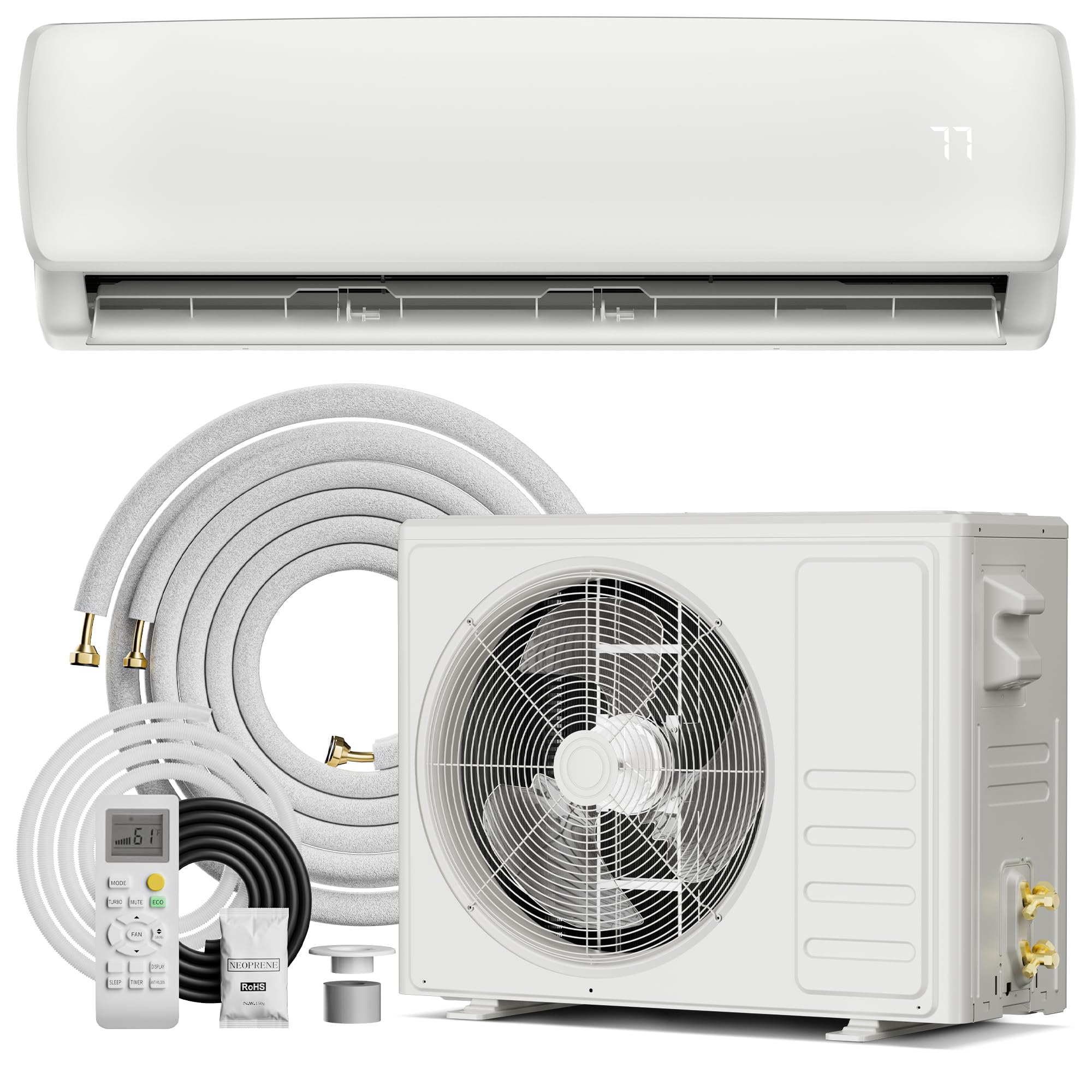
If you only need cold air, buying a ductless system with a heat pump you will never use is a waste of money. The good news: every unit here is a ductless mini split built for serious cooling, and several also heat, so a cooling-only buyer gives up nothing. The one number to check first is the floor-area rating — a 550 sq. ft. unit in a 1,000 sq. ft. garage will run itself ragged, while an 18,000 BTU system in the same space barely works up a sweat. Match the rated square-footage coverage to your room and the sizing question is settled.
This guide is built by comparing the manufacturers’ published specifications and the patterns across verified customer reviews, so you get each pick’s real strengths and trade-offs instead of marketing spin.
In the pages below, each pick is matched to a real room size, a real SEER2 efficiency level, and the install reality a licensed tech or a determined do-it-yourselfer will face on the day. Every pick below is matched to a specific room size, SEER2 level, and install path.
Top Picks

How to Choose the Right Cooling-Only Mini Split
Choosing a ductless cooling system looks like a spec-sheet contest, but three numbers decide whether you are comfortable or miserable. Nail the BTU rating, the SEER2 rating, and the install type, and the rest is detail. Get any of the three wrong, and you will either overspend on a system that cools too much or burn electricity on one that never catches up.
Match BTU Output to Your Actual Room Size
BTU (British thermal units) is the raw cooling power number, and it has to match the space. An 18,000 BTU unit is rated for rooms as large as 1,250 square feet in the case of the Mountman, while the Cooper & Hunter 6,000 BTU unit is a half-ton system built for small bedrooms or workshops. Oversizing is not just wasteful — a unit that cycles on and off too quickly dehumidifies poorly, leaving the room cool but clammy. Undersizing means the fan never stops running and the room never quite gets there on a 95°F afternoon.
Understand SEER2 Before You Compare Prices
SEER2 is the efficiency score for a cooling system — a higher number means it pulls less electricity to deliver the same cold air. A 21 SEER2 system like the DELLA Vario uses meaningfully less power than an 18 SEER2 unit on the same job. If you run the unit eight hours a day all summer, the higher SEER2 pays back. For a weekend-only workshop, the SEER2 gap barely shows up on the bill.
DIY Quick-Connect vs. Professional Install
The biggest hidden cost on a mini split is the installation. Some systems ship with pre-charged line sets that click together with quick-connect fittings, making a genuine do-it-yourself job possible with a few basic tools. Others require a licensed HVAC technician to evacuate the lines with a vacuum pump, pressure-test the system, and charge the refrigerant. That is not a DIY job. Before you pick, decide honestly which path you are on — pro installation on a system that ships without a pre-charged condenser is not something you can shortcut.
Consider Inverter Compressors for Efficiency
An inverter compressor is the engine that lets a mini split throttle up and down smoothly instead of slamming on and off like a traditional window unit. That smooth throttle is why ductless units run quieter and draw less power over a season. Almost every pick here uses inverter technology, and the difference is real: you get steadier temperatures, less electrical draw on startup, and a compressor that tends to last longer because it is not constantly cycling.
Side-by-Side Comparison
| Model | Best For | BTU Output | Floor Coverage | SEER2 / Efficiency | Amazon |
|---|---|---|---|---|---|
| Mountman 18000 BTU Mini Split★ Best Overall | Best Overall | 18,000 BTU | 1,250 sq. ft. | 19 SEER2 | Amazon |
| Senville LETO 18000 BTUBest Voice Control | Best Voice Control | 18,000 BTU | 1,000 sq. ft. | AHRI Certified | Amazon |
| YITAHOME 21 SEER2 18000 BTUBest Budget Efficiency | Best Budget Efficiency | 18,000 BTU | 1,250 sq. ft. | 21 SEER2 | Amazon |
| ROVSUN 18000 BTU WiFi | Best for Garages | 18,000 BTU | 1,000 sq. ft. | 20 SEER2 | Amazon |
| Cooper & Hunter 6,000 BTU | Best Compact Pick | 6,000 BTU | Small rooms | 21.5 SEER2 | Amazon |
| DELLA Motto 18000 BTU | Best for Small Homes | 18,000 BTU | 1,000 sq. ft. | 19 SEER2 | Amazon |
| DELLA Vario 18000 BTU | Top Performer | 18,000 BTU | 1,000 sq. ft. | 21 SEER2 | Amazon |
| Daikin 12,000 BTU Entra | Premium Pick | 12,000 BTU | 550 sq. ft. | 18 SEER2 | Amazon |
| MRCOOL Easy Pro 12000 BTU | Best DIY Install | 12,000 BTU | 550 sq. ft. | — | Amazon |
| MRCOOL DIY 4th Gen 12000 BTU | Best Smart Kit | 12,000 BTU | 550 sq. ft. | High Efficiency | Amazon |
| Senville AURA 33000 BTU | Best for Large Spaces | 33,000 BTU | Large garages / commercial | Energy Star | Amazon |
Detailed Reviews
1. Mountman 18000 BTU Mini Split AC/Heating System, 19 SEER2
Our pick — 4.5+★ from 350+ verified ratings; the strongest balance of quality and price.
The 18,000 BTU workhorse that covers 1,250 square feet and still whispers at 26 dB.
This is the largest coverage area in the entire lineup. The Mountman is rated for 1,250 square feet, which is 25% more floor area than the Senville LETO at the same 18,000 BTU rating — a meaningful gap if you are sizing for a wide open living space, a converted garage, or a great room. The inverter compressor and pre-charged R32 condenser handle the heavy lifting, and the whole system ships with an installation kit, so the plumbing pieces are accounted for before the technician arrives.
The quiet side is what really holds up in daily use. Sleep Mode drops the indoor unit to 26 dB — a faint hum you will notice more from its absence than its presence — and the remote display switches itself off after 10 seconds so nothing glows at you in the dark. There are four fan speeds, four operating modes, and an ECO mode that the maker measures at up to 30% energy savings. A washable anti-dust filter rinses clean with a monthly pass under the tap, and the self-cleaning cycle runs the indoor coil dry to keep it from getting musty.
The honest catch is the instruction manual. The translated text is the weak link in an otherwise solid package, and the install details — charging pressures in particular — are thin. Buyers report: “Cools 450 sq ft garage in N. Texas (95°F/70°F humidity) to mid-upper 70s at 80°F setpoint, barely working, near-silent unless fan high.” That pattern holds: the hardware stands up, the paperwork does not, so plan to lean on videos and a good technician rather than the paper guide. For the money, the Mountman is the widest-coverage unit in this group, and it earns the top spot on that combined strength of coverage, silence, and included kit.
What Earns It First Place
- 1,250 sq. ft. rated coverage — 25% more floor area than the Senville LETO at the same 18,000 BTU
- 26 dB Sleep Mode is genuinely quiet for overnight use
- ECO mode measured by the maker at up to 30% energy savings
- Pre-charged R32 condenser and installation kit included
- Self-cleaning cycle and washable anti-dust filter keep maintenance simple
Where It Wants Help
- Instruction manual is poorly translated and light on charging pressures
- Email support was slow to respond for one owner
- Professional installation is still the smart call for a system this size
Go for this if: you have a wide open room or a garage above 1,000 square feet and want the most coverage per unit in this lineup.
Plan around: the manual — line up a knowledgeable installer or a good video walkthrough, because the paperwork will not carry you.
2. Senville LETO 18000 BTU Mini Split
A 4-in-1 inverter system that speaks Alexa and backs it with a 5-year parts and compressor warranty.
For a cooling-first buyer who also wants a heat pump on standby, the LETO is the most well-rounded package in this group. It is rated for 1,000 square feet, runs on a DC Inverter that is UL Listed and AHRI Certified, and combines air conditioning, heat pump operation down to 5°F, dehumidifier, fan, and turbo function in one wall unit. The installation package includes a 16 ft. line set and communication wire, and the system arrives pre-loaded with refrigerant for up to 25 ft. of lines — so a shorter run does not need a top-up.
What wins people over is the day-to-day usability. Alexa and app control let you set routines and adjust temperature from anywhere, and the turbo function brings a room down fast. Owners mention: “Senville mini split cools a 60 sq ft home office to 75°F in 6 minutes using Turbo mode, saving ~/month vs. central AC; both indoor and outdoor units are extremely quiet; Alexa works but requires a separate USB kit (not included).” That USB kit detail is worth knowing before you buy — the voice control is real, but you will need the adapter to enable it. The 5-year parts and 5-year compressor warranty is the strongest coverage promise on this list, and the company has a track record of reimbursing install-side problems quickly.
The trade-off is the install path. This is a professional-install system, not a quick-connect kit, so the labor cost has to be part of your budget math. And while the 1,000 sq. ft. rating is generous, it falls short of the Mountman’s 1,250 — so if your room is genuinely large, size up. For most homes with a home office, a bedroom suite, or a small commercial space, though, the LETO is the safest bet in this lineup.
Warranty Confidence: Five years on parts and five on the compressor is the longest written coverage here, and the company responded to a flare-fitting leak by reimbursing the service receipt within a day.
Install Reality: Pre-charged for up to 25 ft. of line set, but skip the DIY fantasy — this one wants a licensed tech and a vacuum pump on the day.
Reach for it when: you want a name-brand inverter system with voice control, a real heat pump on standby, and the coverage to match.
Look elsewhere if: you need the largest possible floor-area rating — the Mountman covers 1,250 sq. ft. to this unit’s 1,000.
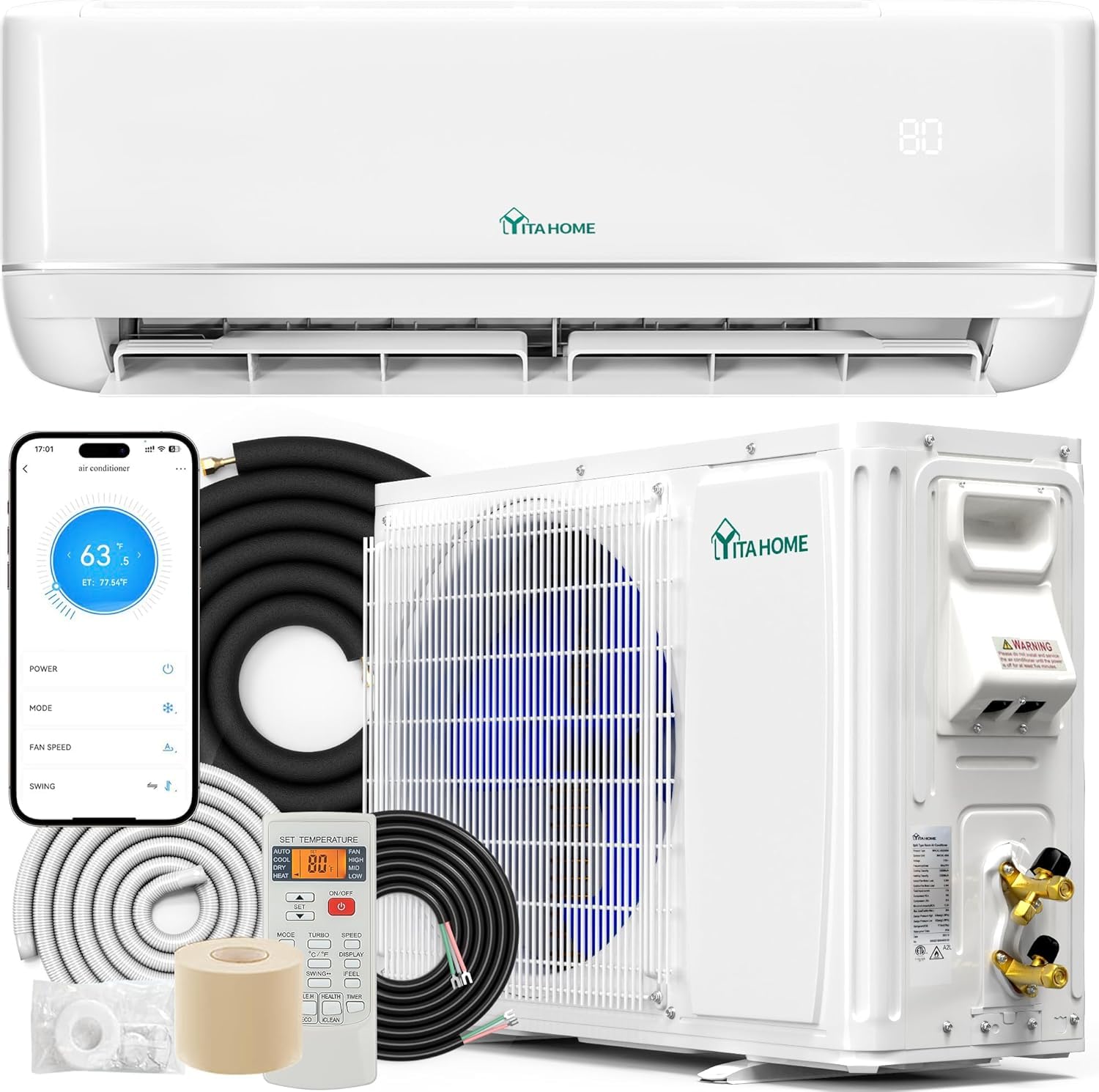
3. YITAHOME 21 SEER2 18000 BTU Mini Split
A 21 SEER2 inverter that covers 1,250 square feet and asks for less electricity doing it.
The headline here is efficiency at a value-tier price. The 21 SEER2 rating sits at the top of this lineup alongside the DELLA Vario, and the maker measures the inverter tech at up to 25% energy savings versus baseline, and up to 50% versus older 14 SEER2 models. For a cooling-only buyer, that is the whole point: less power per hour of cold air. It covers 1,250 square feet — same as the Mountman — and runs at under 49 dB, with a quiet fan setting and the option to kill the display at night.
The feature list is unusually deep for the money. Five modes (Auto, Cooling, Drying, Heating, Fan), four fan speeds including Turbo, remote and WiFi and Alexa compatibility, auto defrost, self-diagnosis, a 135°F self-cleaning cycle, an iFEEL sensor that reads temperature at the remote, a 0-24h timer, and separate healthy modes for negative ion and PM2.5 removal. It also handles a wide outdoor window, from 5°F to 118°F, and the airflow is rated to reach 50 ft. with 4D circulation — a genuine asset in a long shop or a lofted living room.
The honest catch is that this is the lowest-rated system in the top half of this list, and the owner feedback reflects real distribution-world friction. One buyer had a compressor and fan fail overnight and found the warranty hard to claim; others note a buggy app that took many tries to connect and an auto mode that is fixed at 77°F cooling and 68°F heating with no adjustment. Those are the kinds of trade-offs a low price buys, and for a buyer who wants max efficiency per dollar in a garage or a shop, they may be acceptable. For a whole-home primary system, pay for a brand with deeper support.
Efficiency Per Dollar: A 21 SEER2 rating at a value-tier price is the standout — this is the most electrically frugal 18,000 BTU unit in the group.
What To Know Before You Buy: The app is fiddly and the warranty process has been slow for some buyers — this is a pick for a confident DIYer, not a hands-off homeowner.
Best fit for: a shop, garage, or rental where efficiency and raw features matter more than a luxury ownership experience.
Think twice if: you want a brand with a phone number that picks up, or an auto mode you can actually reprogram.
4. ROVSUN 18000 BTU Mini Split

A workshop-first inverter with a 61°F–88°F range and a 32 dB whisper mode for tight spaces.
The ROVSUN is built around a 20 SEER2 inverter and an 18,000 BTU output rated for up to 1,000 square feet, with a temperature band of 61°F to 88°F. The broad band matters in a garage or a shed where you want cool, not refrigerated — set it to 79°F and it will hold a working temperature without blasting cold air at your desk. Mute mode drops the indoor unit to 32 dB, and the 4-way swing spreads the airflow evenly enough that a full bay does not get a cold spot and a warm spot side by side.
What wins people over is how it handles real garage life. Customers note: “18k BTU cools fully insulated 960 sq ft garage all summer at 79°F with no noticeable power bill increase.” Another described a 2-car garage where the unit was blowing 42°F air even before the vacuum and insulation work was finished. It also pairs with Alexa and Google Assistant through the app, and the installation kit ships with a 16.4 ft. copper line and signal cord — though a separate power cord is needed and the system requires two boxes to arrive, so schedule installation after both are in hand. The maker measures the energy saving at up to 35% with the intelligent frequency adjustment.
The caveat is the smallest review base in this group, and a small base means a single failure carries weight. That said, the reviews that are there describe long, uneventful service in tough climates. Keep the unit upright for 24 hours before installation, plan for a licensed tech, and this is a solid workshop cooling choice.
Made for: an insulated garage, workshop, or shed where the goal is a livable working temperature, not freezing it out.
Watch for: the power cord is sold separately and the two boxes may arrive on different days — plan the install window after both land.
5. Cooper & Hunter 6,000 BTU Mini Split Heat Pump

A half-ton wall unit with the highest efficiency score here, built for one small room.
There is no bigger mismatch in this category than putting an 18,000 BTU system in a 120-square-foot room. The Cooper & Hunter is the answer to that problem: a 6,000 BTU half-ton system with a 21.5 SEER2 rating, the highest efficiency number in this whole comparison. For a bedroom, a sleeping porch, a shed office, or a storage room that just needs steady cool air, this is the right-sized tool — and it comes as a full kit with a 16 ft. pre-flared insulated copper line set, communication wire, drainage extension, smart port adapter, and accessories.
The build quality is what gets mentioned most. The unit is quiet, the copper core is solid, and once installed it holds a steady temperature through hot or cold weather. It is 115V, so it can run on a standard household circuit rather than a 230V run — a real advantage in a shed or a small office where adding a dedicated 230V circuit is a hassle. Variable fan speeds let you dial down the noise when you are sleeping or working. The heat pump is on board for year-round use, though the primary reason most people buy this one is small-room cooling.
Two things to know. The factory flares have been called out as thin and worth having a technician re-flare before the lines are connected — a low-cost step that saves a refrigerant leak later. And the WiFi adapter is a separate purchase; the app control is excellent once the dongle is in, but the system does not ship with it inside the box. For the right small space, this compact unit is the most efficient way to cool it.
Why Small Rooms Win Here
- 21.5 SEER2 is the highest efficiency rating in this entire comparison
- 115V operation runs on a standard circuit — no dedicated 230V run needed
- Full install kit included with 16 ft. line set and wire
- Whisper-quiet at low fan speeds, with a solid copper core
Steps To Plan For
- Factory flares are thin — have a tech re-flare them before connecting
- WiFi adapter is sold separately
- 6,000 BTU is for one small room only; do not oversize this pick
This is your unit if: you are cooling a single small room and want the highest efficiency you can get in a compact 115V package.
Not the right pick for: an open-plan living space or a garage — this half-ton system is built for one room and one room only.
6. DELLA Motto Series 18000 BTU 19 SEER2 230V Mini Split AC
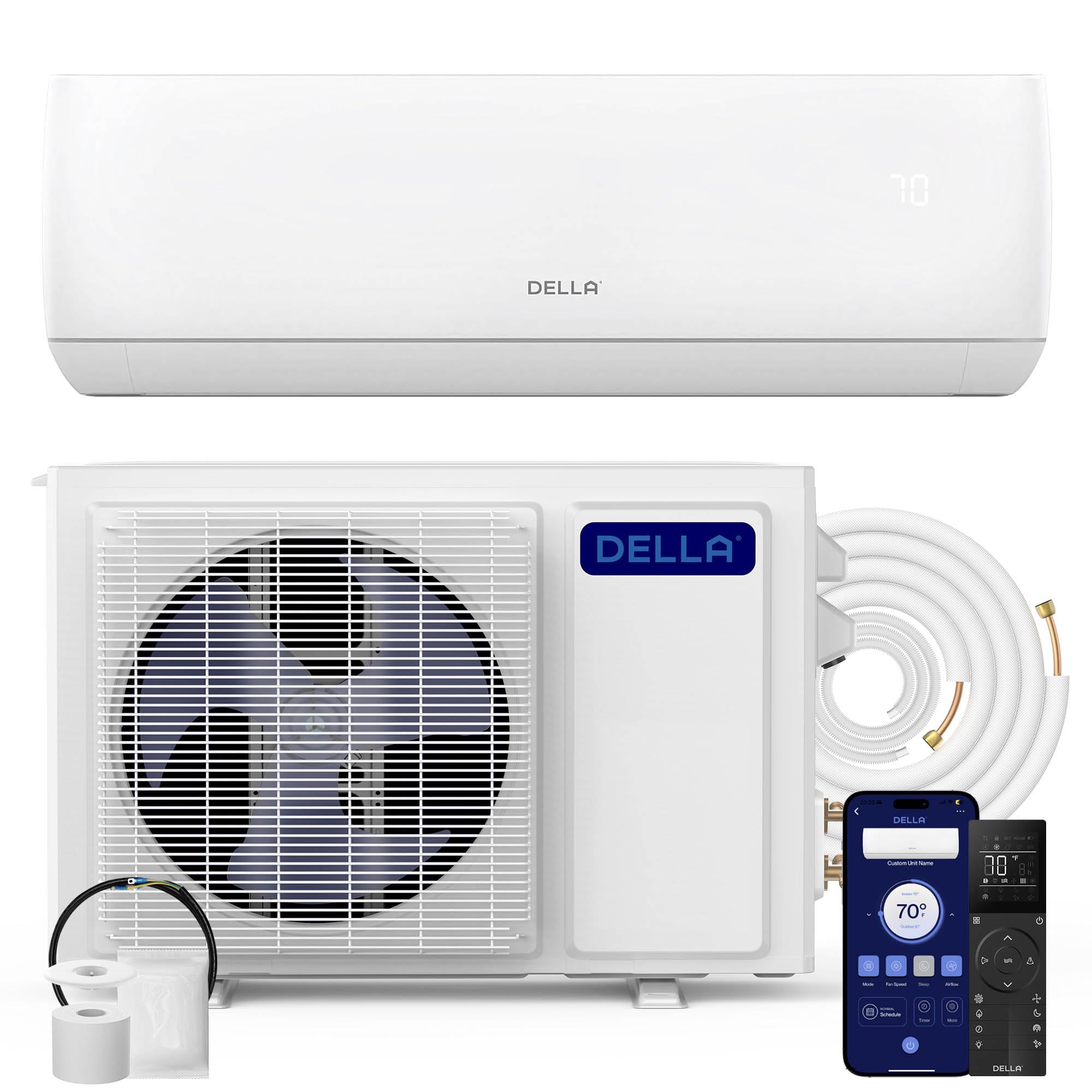
A 19 SEER2 inverter rated for 1,000 square feet, silent at 29 dBa across the whole room.
This is a 1.5-ton system with 18,000 BTU per hour of cooling power and a 19 SEER2 rating, rated for up to 1,000 square feet. The R-32 refrigerant and DC inverter are the modern standard, and the maker measures the resulting power savings at up to 30%. Add in 4D airflow — up-down and left-right together — and the whole room gets an even wash of cool air instead of a cold cone aimed at the sofa. The 9,000 BTU-h higher heating capacity picks up the slack when summer ends and winter starts.
The quiet side is what sells this unit to tiny-house owners and studio dwellers. At 29 dBa in silent mode, the indoor head is quieter than a refrigerator hum, which is why the system is a natural fit for a 400-square-foot living space where the AC shares a wall with the couch. The iFEEL sensor reads temperature at the remote instead of at the wall unit, so the unit cools to the spot where you actually sit. Alexa and WiFi control are built in, filters pull from the top for easy cleaning, and the 24-hour timer and eco mode round out the package.
What to know before you commit: this unit mandates professional installation and requires line-set vacuuming, so a licensed tech is in your budget. It also has a minimum setpoint of 60°F, which is fine for comfort but not for a server closet or a wine room. And a small number of long-term owners describe units that failed after 18 months and were replaced without warranty coverage, so register the warranty immediately on arrival. For the right small home, the Motto is a genuinely comfortable daily driver.
The Tiny-House Fit: 29 dBa silent mode and 4D airflow make this a natural for a one-room home where the AC is eight feet from the bed.
Register On Day One: The warranty terms matter here — a handful of long-term owners needed it early, so get the paperwork in before you start running the unit.
Pick this one if: you live in a small home, a cabin, or an ADU where a 1,000 sq. ft. unit covers the whole space and noise matters.
The honest limit: 60°F minimum setpoint and a mandatory pro install — not a unit for a cold room or a DIY-only budget.
7. DELLA Vario Series 18000 BTU WiFi Mini Split AC, 21 SEER2

The 21 SEER2 inverter that keeps a room at 71°F when the outside hits 90°F.
This is the premium cooling pick in this lineup. The Vario is a 1.5-ton, 18,000 BTU system with a 21 SEER2 rating — matching the best in this group — and a 19,000 BTU-h heating capacity that pushes through to -4°F on the heat pump side. The 4D airflow, iFEEL sensor, and 24-hour timer are all on board, and the 32 dBa quiet mode keeps the indoor head nearly silent. For the most efficient cooling in a standard 1,000-square-foot layout, this is the pick.
What wins people over is the steady comfort in real summer heat. Owners put it simply: it holds 71°F indoors when the outside is hitting 90°F, and it cools and heats fast enough that the room is comfortable before the coffee is done. The DC inverter throttles smoothly, the R-32 refrigerant runs clean, and the max fuse size is 20A — a meaningful detail for the electrician doing the connections. Both indoor and outdoor units are rated quiet, and the included kit ships with 1/4″ and 3/8″ copper lines plus drain pipe. For a small commercial space or a large living area, the performance is top of the class.
Two honest limits. The system mandates professional installation, and Della’s lifetime parts warranty is void if the unit is not registered within 100 days of purchase — so put a reminder on the calendar. And the alloy fins are not self-cleaning, so plan on an annual mold wash on the blade assembly; it is a fifteen-minute job, not a service call. Those are the trade-offs for the efficiency and quiet that make the Vario the best-performing cooling-only choice in this group for a mid-sized room.
Why It Performs
- 21 SEER2 efficiency — matches the top of this lineup
- Holds 71°F indoors against 90°F outdoor heat
- 32 dBa quiet mode with 4D airflow and iFEEL sensing
- Heat pump pushes to -4°F for year-round use
- 20A max fuse size, 1/4″ and 3/8″ lines and drain pipe included
What To Budget For
- Professional install required — this is not a DIY system
- Lifetime parts warranty void without registration in 100 days
- Fins need an annual cleaning pass to stay at peak
Choose the Vario if: you want the most efficient, quietest cooling for a 1,000 sq. ft. living area and you have a licensed tech lined up.
The one catch: register the unit within 100 days or the lifetime parts warranty goes away — the single easiest thing to forget on a busy install day.
8. Daikin Entra R32 12,000 BTU Mini Split

The recognized brand name in the room: a 12,000 BTU Entra that covers 550 square feet.
This is a 1-ton, 12,000 BTU wall-mounted system with an 18 SEER2 rating, 9 HSPF2, 8.5 EER2, and a 3.30 COP — the most detailed efficiency readout in this comparison. The cooling window runs from 50°F to 115°F, the heating side from 5°F to 65°F, and the coverage is rated at up to 550 square feet. It uses R-32 refrigerant, ships with a 15 ft. 1/4 x 3/8 line set and interconnecting cables, and comes with a Maxwell wall bracket. For a sunroom, a basement, an attic conversion, or a garage workroom, the Daikin is the pro-grade name that installers know.
What owners like is the combination of quiet operation and simple controls. The unit runs near-silent, the filter pulls out for easy cleaning, and the programmable on/off timer keeps it on your schedule. It carries the Titanium Apatite photocatalytic air purifying filter, Blue Fin Protection on the outdoor coil, and an ECO+ mode for energy trimming. A licensed HVAC contractor who reviewed it called it out as a brand with good price and quality for the trade, and for a pro-installed system that reputation matters when you need a service call three years out.
The two honest limits are installation and the factory flares. This is not a DIY-friendly unit — instructions are hard to parse and the electrical hookup wants an electrician. And the factory flares should be cut off and re-flared with O-rings before you connect, because a known leak issue lives there and a leak after the fact nearly doubles the cost with recharge and service. For a buyer who wants a name-brand system with a service network behind it, the Entra is the safe premium pick.
The Pro-Grade Argument: A real brand with an R-32 condenser, 18 SEER2 efficiency, and a service network an HVAC contractor will recognize — the peace-of-mind play.
The Install Warning: Factory flares have a known leak issue and the manual is thin — have a licensed tech cut and re-flare the connections before charging the system.
Best for: a sunroom, basement, or workshop up to 550 sq. ft. where you want a name-brand system and a service network behind it.
Not for: the DIY crowd — this one wants a licensed installer and an electrician on the same day.
9. MRCOOL Easy Pro 12000 BTU Mini Split
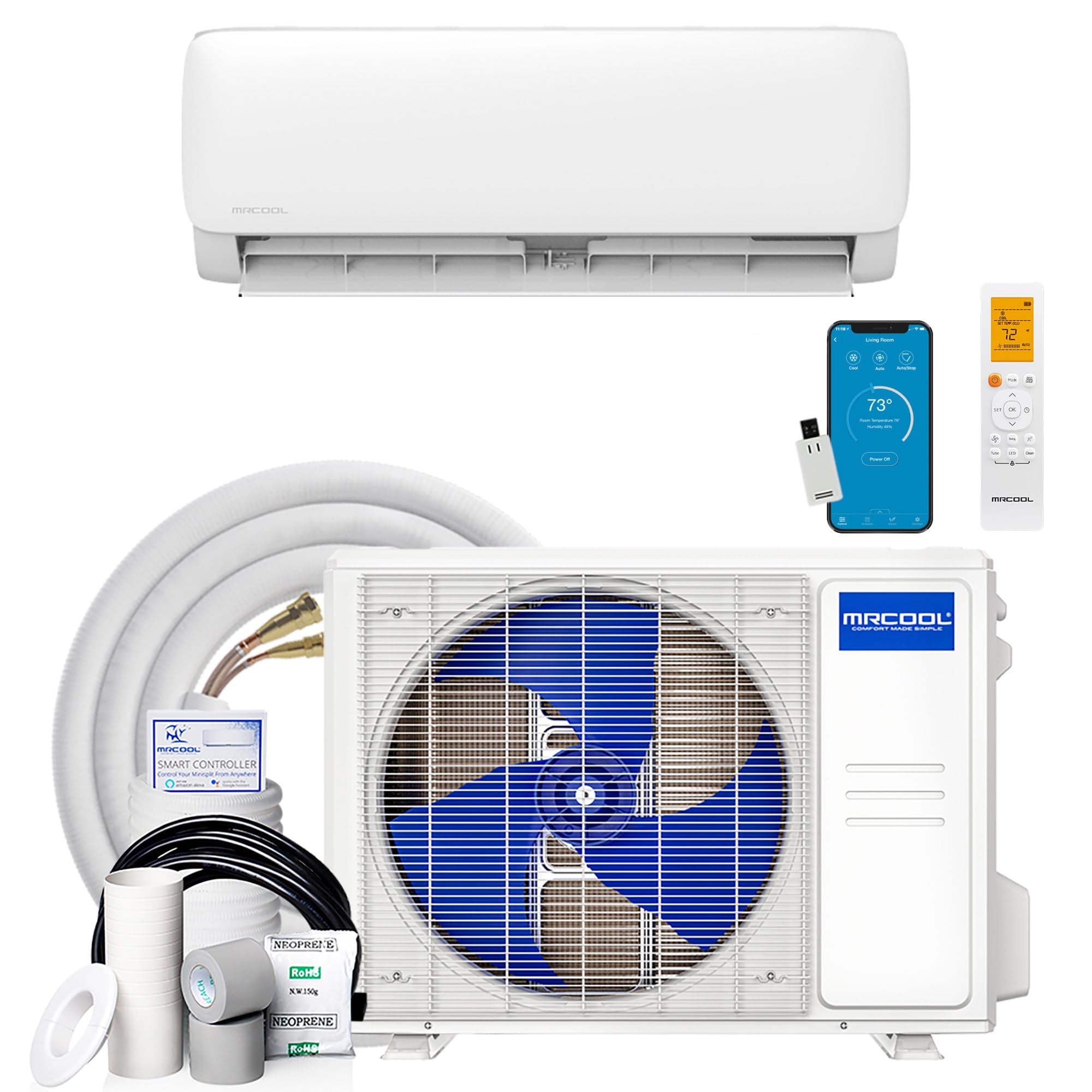
The 115V quick-connect kit that lets a careful homeowner install a 12,000 BTU system themselves.
If avoiding a four-figure installation bill is the whole reason you are considering a mini split, the MRCOOL Easy Pro is the pick. It is a 12,000 BTU, 550-square-foot, 115V system designed to be installed with no special tools, equipment, or training, because it arrives with a pre-charged lineset that tightens with a wrench and does not need a vacuum pump on the day. Systems like this are how people who would never touch a refrigerant line end up with a ductless system for a fraction of a pro-install cost, and the Easy Pro is the cleanest expression of that idea in this lineup.
The cooling performance holds up. What gets mentioned most is how effective it is for the room size — a 12,000 BTU unit will chill a 550-square-foot bedroom, living room, or small office without breaking a sweat, and the indoor and outdoor units are both described as extremely quiet. Sleep mode trims the temperature overnight, the washable filters rinse clean under the tap, and Google Assistant and Amazon Alexa voice control let you adjust it without hunting for the remote. For a first-time ductless buyer, the Easy Pro is the most approachable path in the group.
The honest caveat is twofold. Durability is the one mixed aspect in this product’s own feedback: most reviewers point out it runs beautifully, but a small number describe a line that broke at a weld point with minimal stress, and warranty coverage was contested in that case. And the electrical hookup is the one step that is not truly DIY — you will want a licensed electrician to make the final 115V connection. Price the electrical work before you commit so the savings math is honest.
This is the one for: a confident homeowner with a 550 sq. ft. room and a healthy appetite for DIY who wants to skip the pro-install bill.
The honest footnotes: budget for a licensed electrician for the final hookup, and inspect the copper lines carefully before you tighten them down.
10. MRCOOL 4th Generation 12,000 BTU Mini Split

The 4th-gen quick-connect that adds a low-refrigerant alarm and a WiFi smart controller.
This is the step-up version of the MRCOOL DIY idea, and the extra smart features are the reason to pay the difference. It is a 12,000 BTU, 550-square-foot, inverter-driven ductless system with Quick Connect pre-charged linesets — the install completes in a few hours with no special tools or training, which is the whole selling point. On top of that, the 4th generation adds a low-refrigerant alarm that warns you before a small leak becomes a costly repair, plus air filter cleaning and replacement alerts so you know when the system wants attention. The Smart HVAC controller module turns the unit into a WiFi-connected machine you can tune from your phone.
What gets mentioned most is the installation experience, and owners describe it as genuinely easy — clear instructions, good videos, and a working unit when the power comes on. The rest of the feedback supports the performance: it cools and heats well in both hot and cold conditions, runs quiet indoors and out, and the auto restart feature brings it back to your last settings after a power blip. The low ambient cooling means it can run in cooling mode from as low as 5°F — useful for a server room, a greenhouse, or a year-round equipment closet that needs cold air in February.
The caveats are normal for a DIY system. The lineset and wires are too long to cut, so on a short run you coil the excess and it looks a little less polished on the wall. And while the DIY installation is genuinely approachable, the electrical needs a proper 30A circuit, which means an electrician for that part. If reliability over the long haul matters more than any of that, keep in mind that a small number of owners describe units that failed within a few years with a bad control board, and MRCOOL support has been slow to respond in those cases. For a buyer who wants smart features and genuine self-install, this is the most complete kit here.
The Smart-Kit Advantages
- 4th-gen low-refrigerant alarm warns you before a small leak turns into a big bill
- Quick Connect pre-charged linesets make self-install genuinely possible
- Smart HVAC WiFi module with app and Alexa control
- Cools down to 5°F ambient for server rooms and greenhouses
- Auto restart after outages returns to your last settings
Plan Around These
- Lineset cannot be shortened — excess coils on the wall
- Electrical hookup needs a 30A circuit from an electrician
- A small number of owners needed control-board service within a few years
Go with the 4th gen if: you want the easiest self-install plus the low-refrigerant sensor and smart controls, and you can accept a coiled lineset for the trade.
Stay with the Easy Pro instead if: you want to save a little onthe upfront cost and the smart alerts don’t matter for a workshop.
11. Senville AURA 33000 BTU Mini Split

A 33,000 BTU powerhouse for a big garage or commercial space, with heating down to -22°F.
The AURA sits at the top of the capacity ladder in this group. It is a 33,000 BTU, 2.75-ton wall-mount system with a scroll compressor, an Energy Star Certified rating, and a 208-230V DC inverter. That means it moves far more cold air than any 18,000 BTU unit here — roughly double the raw cooling power — and it is built for a large garage, a warehouse floor, a restaurant, or an oversized open living space. The maker bills it as a year-round system, and the heating side is rated to work in extreme conditions down to -22°F. It also arrives complete with an indoor air handler, outdoor condenser, and a 16 ft. line set and wire.
Voice control is part of the package. Alexa and app control let you set routines and temperatures from anywhere, which is genuinely useful in a commercial space where you arrive before the thermostat does. The Silver Ion anti-microbial filter is on the indoor head, the unit runs quiet for its size, and owners describe it cooling a large three-car garage easily. The overall feedback centers on reliable performance and a straightforward install for anyone on the professional path — this is a licensed-install system, not a DIY kit.
The honest trade-off is the scale of what you are buying. At 33,000 BTU this is more cooling than most homes need, and putting it into a small space would be overkill in both cost and comfort. The one repeated criticism concerns the app: WiFi pairing has been a common frustration, with the signal not broadcasting and connections failing on the first several tries, so plan to use Alexa pairing as the fallback. For a genuinely large space that smaller units cannot touch, the AURA is the biggest hammer in the group.
Raw Power, Real Coverage
- 33,000 BTU and 2.75 tons — the largest cooling capacity here
- Heats down to -22°F for extreme-climate year-round use
- Energy Star Certified with a 208-230V DC inverter and scroll compressor
- Alexa and app control for remote routines and scheduling
- Silver Ion anti-microbial filter on the indoor head
Know Before You Install
- Professional installation required — not a DIY system
- WiFi pairing is a known frustration; use the Alexa app as a fallback
- Overkill for a small room — match this to a genuinely large space
This is your system if: you need to move serious cooling volume into a large garage, warehouse, or commercial floor that 18,000 BTU units cannot keep up with.
Not the right tool for: a bedroom or small office — this is a big-room machine with a big-room install requirement.
Know the Specs
BTU Output and Sizing
BTU stands for British thermal units and measures how much heat the unit can remove from a room in an hour. In this category, the number runs from 6,000 BTU for a single small room up to 33,000 BTU for a large garage or commercial floor. The trick is matching the rating to the space: an 18,000 BTU unit rated at 1,250 square feet is right for a large open area, while a 12,000 BTU unit rated at 550 square feet is right for a room that size. Oversize the unit and it decides the room is already cool, cycles off, and leaves humidity behind — cool but clammy. Undersize it and the fan never stops running on a hot day.
SEER2 Efficiency Rating
SEER2 is the efficiency score for a cooling system — a higher number means less electricity per hour of cold air. In this group you will see ratings from 18 SEER2 up to 21.5 SEER2, with the highest numbers sitting on the most efficient units. The maker figures attached to specific units translate to real savings: a jump from 14 SEER2 to a 21 SEER2 unit is measured at up to 40% lower energy draw in some cases, and an inverter upgrade is measured at up to 30% savings. If the unit runs eight hours a day through summer, the higher rating pays back over the life of the machine. If it runs on weekends only, the difference shrinks.
Inverter Compressor vs. Traditional
An inverter compressor is a variable-speed engine that throttles up and down smoothly to hold a temperature, instead of slamming on and off like a window unit. In practice that means steadier room temperature, quieter operation, and less electrical draw on startup. It is also a durability argument: a compressor that does not cycle hard tends to last longer. Every mini split worth considering in this category uses inverter technology, and the units here that rank highest on efficiency are all inverter-driven.
Pre-Charged Line Sets and Installation
A line set is the pair of insulated copper tubes that carry refrigerant between the indoor head and the outdoor condenser. “Pre-charged” means the outdoor unit arrives with refrigerant already inside, so a short run does not need a top-up from a technician’s tank. Some systems ship with quick-connect fittings that tighten with a wrench and no vacuum pump — the MRCOOL DIY kits are the clearest examples — while most of the systems here need a licensed tech to vacuum the lines and pressure-test them before the refrigerant is released. That single difference is often the largest hidden cost in a mini split purchase.
Common Questions
What size mini split do I need for a garage or a large living room?
Can I install a mini split myself or do I need a licensed HVAC tech?
What does SEER2 actually mean and does a higher number save me money?
Do I need a heat pump if I only want cooling?
How quiet is a mini split compared with a window unit?
What is a pre-charged condenser and why does it matter for installation?
How do I maintain a mini split so it lasts?
Will a mini split work on a standard household electrical circuit?
Is an 18,000 BTU mini split too much for a 400 square foot room?
Will a cooling-only setup handle humidity, or do I need a separate dehumidifier?
The Bottom Line
For most cooling-first buyers, the mini split ac cooling only winner is the Mountman 18000 BTU because it covers the largest floor area in this lineup at 1,250 square feet, runs at 26 dB in Sleep Mode, and ships with the installation kit and pre-charged R32 condenser. If you want the most efficient and quietest cooling for a mid-sized room, grab the DELLA Vario at 21 SEER2. And for a genuine self-install on a smaller space, the MRCOOL Easy Pro is the one to reach for, with its 12,000 BTU quick-connect kit and 550 square foot coverage.
One last note: the Senville LETO carries the strongest written warranty coverage of the group at five years on parts and five on the compressor, so if long-term confidence outweighs the largest floor area per unit, it is a fair runner-up. Whatever you pick, match the BTU rating to your room before anything else — that single number decides whether the system keeps you comfortable or runs itself ragged.
How we choose
We do not accept paid placement. Every pick is matched to a real buyer and a real use-case; we do not hands-on test units.
Sources
Specifications: manufacturer listings and product documentation. Review insights: verified customer reviews, as of October 2026. Pricing: not shown on this page (it changes often); check the current price via the retailer link.
As an Amazon Associate, Aappliancez earns from qualifying purchases. This does not affect which products we feature.