Disclosure: Some links in this post are affiliate links. As an Amazon Associate I earn from qualifying purchases, at no extra cost to you. Learn more
Specs are compiled from manufacturer listings and verified buyer reviews and can change over time — please confirm the key details on the product page before buying.
Your jeans hems are fine — your machine never will be, so buy the one built for the fabric you actually sew. Mini and portable sewing machines split into two worlds: a compact beginner machine that mends and hems thin cotton, and a full-size combo that handles embroidery and multiple layers at once. The models below cover both, with the exact specs that decide whether your machine stalls on denim or glides through a quilt sandwich.
This guide is built by comparing the manufacturers’ published specifications and the patterns across verified customer reviews, so you get each pick’s real strengths and trade-offs instead of marketing spin.
You will see which machines come ready to thread, which ones need trial and error, and where a motor genuinely falls short. Every detail points back to the same question: how do the best mini sewing machines perform after the first week?
Top Picks


How To Choose The Best Mini Sewing Machines
A mini sewing machine is a compact, portable unit designed for home mending, simple hems, craft projects and beginner practice — not for sewing through heavy denim or upholstery. If you expect a small machine to handle thick layers like a professional machine, you will be disappointed. Match the machine’s real capability to the fabric you sew most often. The guide below explains the four factors that separate a machine you will keep using from one that sits in a closet.
Weekly Use or Occasional Mending
Where you plan to use the machine determines which features matter. A machine you set up on a desk once a month only needs basic function. One you teach with, either to a child or in a classroom, needs safety guards and reversible parts. Most compact machines stay between 4 and 6 pounds, so portability is rarely the problem — the real question is whether the footer pedal and speed settings give you enough control when you reach a seam end.
Bobbin Access and Threading Clarity
Threading is the moment most beginners quit. A top drop-in bobbin with a transparent cover lets you see the thread feeding and check it without taking the machine apart. If the model has the threading path printed on the casing, follow those printed arrows exactly. Buying a machine with a visible bobbin window and clear threading marks reduces the most common frustration far more than any stitch count upgrade.
Stitch Count Versus Stitch Quality
A machine advertising 12 or 16 or even 32 built-in stitches gives you variety, but variety means nothing if the stitch length setting slips or the machine jams on a straight seam. Start with a machine that does a clean straight stitch and a secure zigzag, then add decorative stitches as you gain confidence. Check whether the machine includes a reverse function — a reverse stitch locks your seams so they don’t unravel.
Match Fabric to Motor
Light cotton, linen and thin knits are within reach for nearly any beginner machine. Denim, canvas and multiple thick layers demand more motor and material handling, and many compact models explicitly warn against these fabrics. If you know you will sew thick materials, review the product’s own guidance on fabric weight and layer limits before buying. A machine that jams and heats up on a hem is not saving you time.
Side-by-Side Comparison
| Model | Best For | Stitches | Weight | Power Source | Amazon |
|---|---|---|---|---|---|
| Brother SE700★ Best Overall | Sewing plus embroidery in one unit | 103 stitches / 135 embroidery designs | 15.6 pounds | 120 volts / wireless LAN | Amazon |
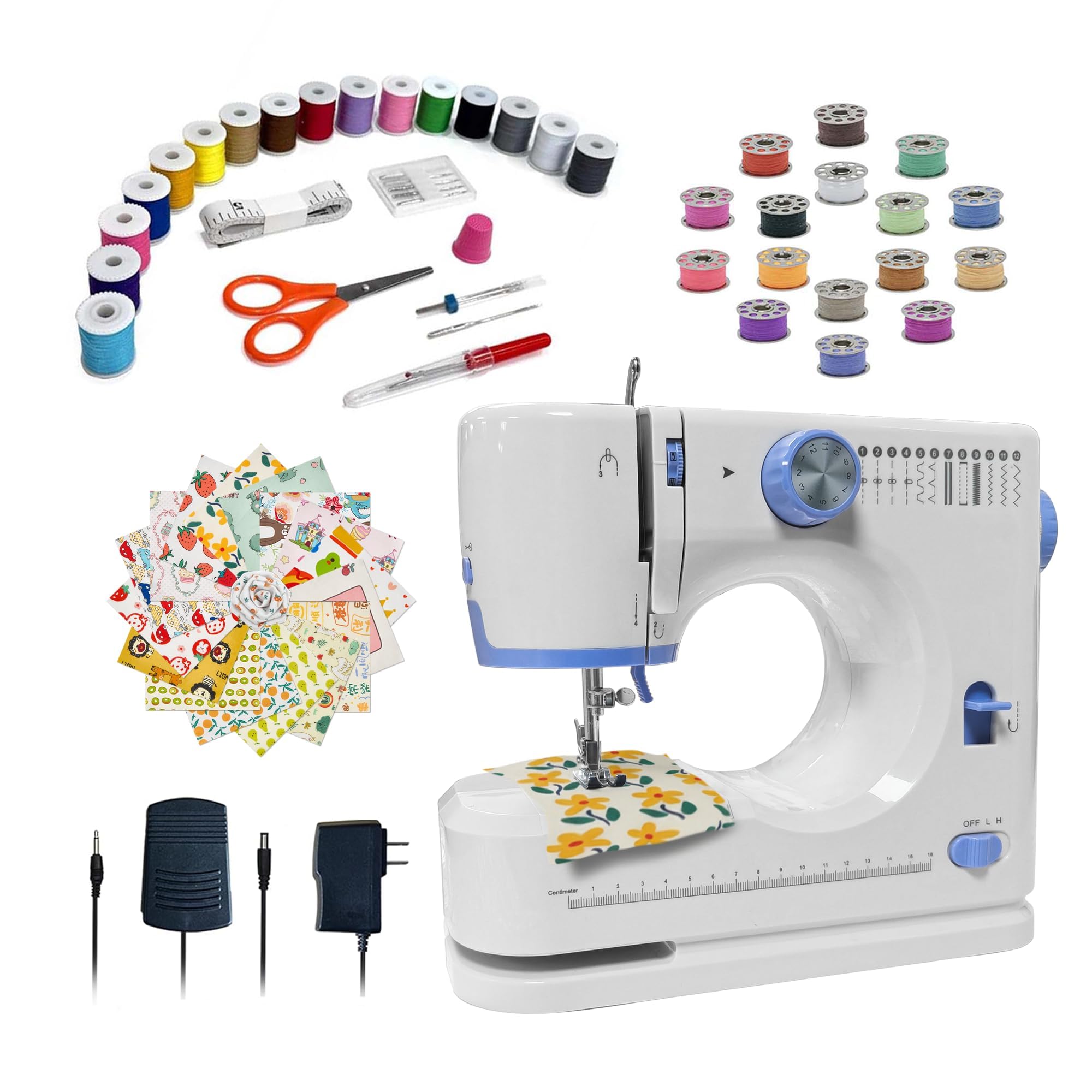
| Stoigeld SM-725Best Value | Ready-to-sew beginner kit | 12 built-in stitches | 5 pounds | ac_dc | Amazon |
| Pllieay S-007WBest for Quilting | Beginner quilting and crafts | 12 stitch patterns | 6.2 pounds | ac_dc | Amazon |
| Lastempa 505 | Small-space quick repairs | 12 stitch patterns | 3.2 ounces | AC adapter or 4 AA batteries | Amazon |
| sangzm 520A | Quiet apartment sewing | 16 built-in stitches | 4.4 pounds | ac_dc | Amazon |
| SINGER M1000 | Mending hems, cuffs and sleeves | 32 stitch applications | 5.5 pounds | AC/DC | Amazon |
| Royalsellpro Mini-201 | Kids supervised sewing | Dual speed, finger guard | — | DC (battery or plug-in) | Amazon |
| Ninonly NinUS-frj505A | Travel and dorm sewing | 12 stitches / 2 speeds | 4.4 pounds | Battery or corded electric | Amazon |
| Hearth & Harbor HH-MINISWNGSET | Gift-ready starter kit for kids | Dual speed, 48-piece set | 2 pounds | Electric | Amazon |
| Nexgenz FY-520 | Sewing on the go | 12 stitch patterns | 4.2 pounds | 6 volts. AC | Amazon |
| Dechow 728 | Children and absolute beginners | 14 built-in stitches | 5.1 pounds | — | Amazon |
Detailed Reviews
1. Brother SE700 Sewing and Embroidery Machine
Our pick — 4.5+★ from 1,000+ verified ratings; the strongest balance of quality and price.
A sewing machine and embroidery unit in one cabinet, built for the beginner who wants both from day one.
This is the pick for someone who wants to embroider a name on a baby blanket and hem pants on the same afternoon. It runs on 120 volts and takes up a real but manageable footprint, weighing 15.6 pounds with a 3.7-inch color touchscreen built into the top. The screen lets you preview an embroidery design before the needle ever touches fabric, which saves you from wasting thread on a misplaced pattern.
The auto needle threader pushes thread through the eye for you, and the jam-resistant drop-in top bobbin keeps the bobbin area calm during long sessions. The 4″ x 4″ embroidery field (a 4-inch by 4-inch area for embroidered designs) with an included hoop handles monograms and small motifs. You get 135 built-in designs, 10 embroidery lettering fonts and 103 built-in sewing stitches, including 10 styles of one-step auto-size buttonholes (buttonholes that size themselves to the button in one step).
Compare this to the Stoigeld SM-725, which offers 12 stitches and no embroidery, and the gap is obvious: 103 stitches to 12, and a 4″ x 4″ hoop the Stoigeld simply doesn’t have. The wireless LAN (a built-in Wi-Fi connection) and the free Design Database Transfer software mean you can send embroidery files from your PC without a cable, and the Artspira mobile app lets you draw custom patterns on your phone and send them over the air. If you already own embroidery files, the USB port takes those too.
What makes it the anchor pick
- Combines 103 sewing stitches with a 4″ x 4″ embroidery field and an included hoop, arm and 8 feet.
- Auto needle threader and jam-resistant drop-in top bobbin cut the two biggest beginner slowdowns.
- Wireless file transfer plus USB covers both the app route and existing PES files.
Where it asks for your patience
- At 15.6 pounds it stays on the table — this is not a toss-in-a-bag model like the 4.2-pound Nexgenz FY-520.
- Needle breakage shows up often enough in buyer feedback that you should keep spare needles on hand.
- Owners frequently wish they had gone larger, so plan your embroidery ambitions before you commit.
Buy it if: you want one machine for both sewing projects and personalized embroidery, and the auto threader and cutter sound like relief rather than extras.
Thinks twice if: your only goal is hemming curtains — a lighter 12-stitch machine will do that and leave you more shelf space.
2. Stoigeld Sewing Machine
Ships with the thread and the practice fabric already in the box, so your first project starts the day it lands.
Few beginner machines acknowledge the obvious: you cannot sew the day it arrives unless someone also sold you thread and scrap cloth. Stoigeld puts 32 spools of thread and 20 pieces of fabric in the kit alongside bobbins, needles, a threader, a foot pedal and the power cord. The machine itself weighs 5 pounds and offers 12 built-in stitches, a 4-step buttonhole and a reverse function.
The maker states fabric limits directly: thin cotton, linen and light wovens up to 4-6 layers, denim or thick multi-layer material only at 2-4 layers. It is a home and school machine, not a commercial one, and the small drawer for needles keeps your extras from vanishing into a drawer somewhere.
Where it loses ground to the Pllieay S-007W is capacity — the Stoigeld includes 32 thread spools against the Pllieay’s fabric-heavy kit, and the Pllieay handles quilting layers that the Stoigeld wants you to keep thin. What the Stoigeld does better is get you running faster, because the thread colors are already sorted and ready. Stick to cotton and linen and it stitches cleanly and predictably; push into a heavy denim hem and the machine will strain, heat up, and start jamming until you learn to re-thread patiently.
The fabric rule to respect: treat the 4-6 layer guidance as a hard ceiling rather than a suggestion. Single-layer cotton and simple hems are where this machine feels smooth, and that is what most beginner households actually sew.
The honest catch: long runs make it hot enough to smell, which is your signal to stop for a minute rather than push on. Short sessions keep it happy.
Reach for this if: you want everything — thread, fabric, pedal, bobbins — in one box and you are sewing thin woven fabric.
Look elsewhere if: denim patches and multi-layer bags are on your list, since this one is explicitly built for lighter work.
3. Pllieay Sewing Machine
Fifty pre-cut squares of cotton and a machine that layers them without flinching.
Quilters need a machine that stacks fabric plus batting and keeps the straight stitch true, and this Pllieay kit is built around exactly that. It arrives with 50 pieces of 10″ x 10″ cotton fabric, a storage bag, a sewing tool kit and 8-inch scissors. The machine weighs 6.2 pounds and runs on an AC adapter or 4 AA batteries, so a power outlet is optional.
The double thread design is the detail that separates it from a single-thread toy — stronger stitching that holds up when you sew through multiple layers and batting. You get 12 stitch patterns including straight and zigzag, and the machine lets you preset stitch widths and lengths so the next seam matches the last one. Speed control runs through a button or the foot pedal, so you can pick the control style that feels natural.
Against the Hearth & Harbor 48-piece set, the Pllieay brings heavier fabric prep and a bigger tool bundle, but the two differ in intent — Hearth & Harbor is a kids’ starter, Pllieay is a quilting and crafts machine that happens to be beginner-friendly. The maker rates it for delicate silks and sturdy denim, but it lacks the power for the heaviest work. Small squares and layered quilt blocks are the balance.
Best paired with batting: multiple layers and batting feed through cleanly and produce the straight stitches quilters depend on. Off-grid sewers will appreciate that it runs on AA batteries as well as household power.
Trim your expectations on thickness: this is not a heavy-duty machine. Thick canvas and stacked denim will test it, so keep the layers moderate.
Pick this one when: your projects are quilts, crafts, and fabric squares, and you want a starter kit that includes the cutting tools.
Consider a bigger machine when: your work leans on heavy materials, because this one tops out well before the toughest fabrics.
4. Lastempa Portable Tabletop Beginner Mini Sewing Machine

Small enough to store without rearranging the room, and ready to mend the moment something splits.
If your sewing list is hems, ripped seams and clothes your kids outgrow overnight, this is the shape of machine that fits that life. The Lastempa is a tabletop model with 12 versatile stitch patterns — straight stitch through to zigzag, overlock and buttonhole — selected with a single dial. Automatic bobbin winding and reverse stitching come built in, and the LED light and visible bobbin window make threading easier to follow than most compact machines.
Power comes from an AC adapter or 4 AA batteries, and the complete kit adds 24 colorful thread spools, needles, a thimble, threader, seam ripper, scissors, a tape measure and an instruction guide with video tutorials. One parent taking in oversized children’s clothes found it handled jeans fine; mending and hemming are where it earns its place. A full bobbin and usable notions in the box means most people start sewing the same day.
Sewing denim on it takes finesse rather than force — the bobbin holder can slip out of calibration on thick fabric, and the fix is a thicker needle and a bit of tuning. That is a setup detail, not a build failure. Cottons and light knits run smoothly, and the noise is normal for the class. It is not meant for heavy-duty work, so treat the thick-fabric jobs as occasional rather than routine.
Why beginners keep it on the table
- 12 stitch patterns with dial selection, so switching between a straight seam and an overlock edge takes seconds.
- AC adapter or 4 AA batteries means it works at a desk, on a kitchen counter, or wherever the mending pile sits.
- The kit includes 24 thread spools plus scissors, a seam ripper and a tape measure, so nothing extra is required on day one.
The honest trade-offs
- The built-in light is dim in a dark room — work near a lamp for accuracy.
- Denim tends to knock the bobbin holder out of alignment; re-seat it and swap to a heavier needle.
- Two separate controls for stopping — the foot pedal and the hand switch — make halting exactly at a seam end feel fiddly at first.
Ideal for: households that want a compact mending station with thread, tools and both power options already included.
Not the one for: regular heavy denim or thick upholstery work, where the bobbin assembly wants lighter fabric.
5. sangzm Small Sewing Machine
Noise reduction built in, so late-night hems don’t wake the apartment next door.
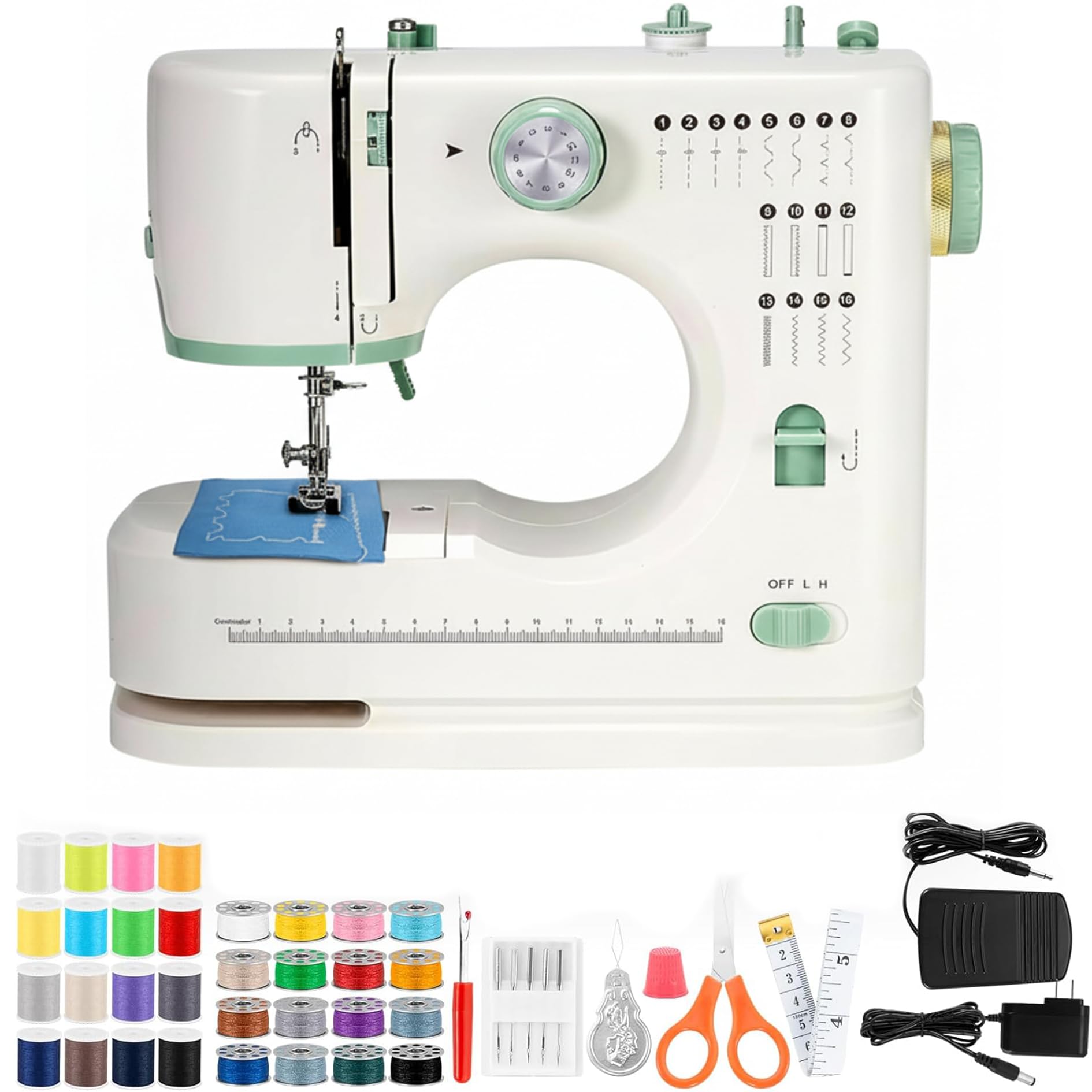
Some buyers sew at midnight in a small flat, and this sangzm machine is designed around that problem. It uses noise reduction technology to keep the motor quiet, which makes it friendlier for apartments and evening projects than the average compact machine. The 4.4-pound body fits on a shelf, and the plastic ABS housing keeps the whole package easy to move.
For a machine this size, the features are generous: 16 built-in stitch patterns cover everything from straight seams to decorative work, and the foot pedal runs two speed modes — light pressure gives slow, controlled stitches while learning, firm pressure speeds things up. A bright LED light handles dark corners, one-touch reverse stitching locks seams, and automatic thread cutting saves you hunting for scissors. The 42-piece accessory kit and twin needles come in the box, so nothing extra is needed to begin.
The maker claims it punches through 6 layers of denim, well beyond what the other 12-stitch compacts here attempt. Treat that as the upper edge rather than the everyday target — regular cotton work is where the machine feels consistent, and the quiet motor is the standout trait. With the twin needles and 16-stitch range, it sits above the Ninonly NinUS-frj505A in stitch variety but asks for a little more care with heavy fabric.
The apartment argument: reduced motor noise plus a bright LED and auto thread cutting add up to a machine you can use after everyone else has gone to bed.
Where to start: use light pressure on the pedal until your straight stitch is even, then increase speed. Slow control is the fastest route to clean seams.
This is your machine if: you sew in a flat or dorm and want 16 stitches, twin needles and quiet operation from a compact body.
Check your ambitions first: if your work is mostly heavy denim, a full-size machine will serve you better than any compact.
6. SINGER M1000 Portable Mending Machine

The free arm reaches inside cuffs and sleeves, which is exactly where mending jobs live.
Hems, cuffs and sleeve repairs are awkward on a flat table machine, and the SINGER M1000 answers that with built-in free arm functionality. Slide the sleeve over the arm and you can sew tubular or hard-to-reach fabric without wrestling the whole garment. The machine weighs 5.5 pounds and offers 4 stitches that deliver 32 stitch applications — straight, zigzag, blind hem and more — with a dial for quick selection and preset width and length.
Thread monitoring is a strong point here. The transparent Class 15 bobbin sits behind a see-through cover, so you can check the bobbin without taking the machine apart, and the manual threader plus an all-purpose foot and an extra needle come included. Adjustable thread tension lets you tune the stitch to the fabric and thread, and the reverse stitch lever reinforces seams at the start and end so your hems hold. The FREE Creativate app stores your manual, quick-start guide, tutorials and troubleshooting tips for your model number.
Thick clothing is where it taps out — light to medium-weight fabrics are the stated range, and heavy material will bog the motor down. Bobbin life is not guaranteed either: the bobbin area has given out on some units after extended use. Feed it cotton, saree fabrics and standard garments, and it sews reliably and quietly with a standard setup that most people find easy to work out.
The mending advantage: free arm access plus a transparent bobbin window and adjustable tension make this the most repair-focused machine of the group.
Keep the workload light to medium: thick fabrics slow the motor, so treat upholstery and heavy denim as out of scope.
Fits you best when: your sewing is garment repair — hems, cuffs, sleeves — and you want reach plus visible bobbin monitoring.
Consider other options when: you need heavy-fabric capability or you expect to run long sessions without checking the bobbin.
7. Royalsellpro Mini Sewing Machine
A finger guard and dual speed settings turn a beginner machine into something a supervised child can operate.
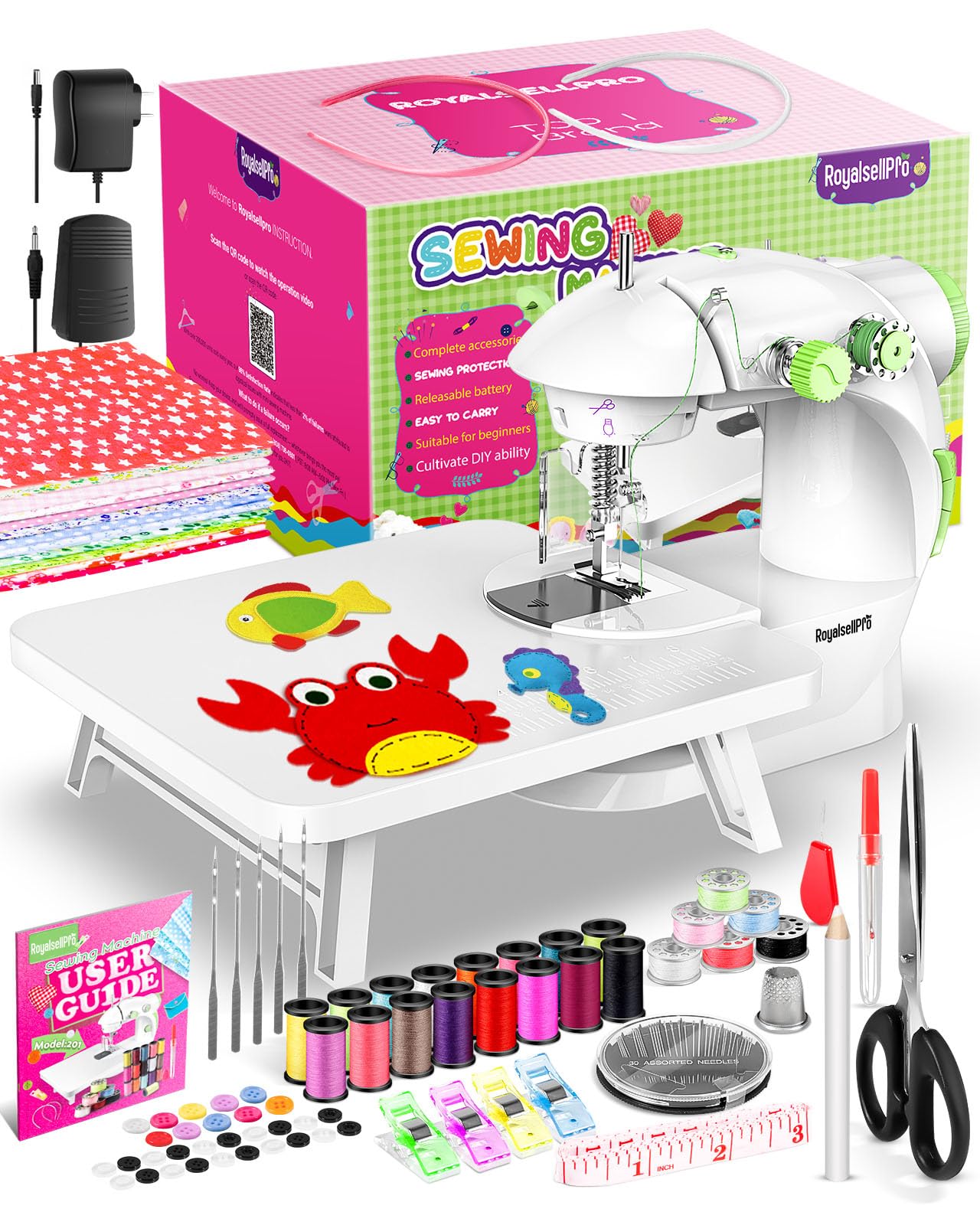
Safety matters more than stitch count here — a built-in finger guard sits between little hands and the needle, and the adjustable high and low speed settings let you match the machine to the skill level at the table. It is built for beginners and teens, with dual power options so it runs from a wall plug or batteries, and a built-in light keeps the fabric visible in a dim room.
What arrives in the box is substantial: 16 colored threads, 5 needles, scissors, a measuring tape, an extension table and a sewing tutorial eBook with 12 projects from aprons to dolls to shopping bags. Kids in the 6 to 10 range use it with supervision to make doll blankets and placemats, and the compact body stays space-saving. Battery or corded power means it can sit on the floor or the table, whichever the child prefers.
The one rough edge is bobbin threading, which some buyers find genuinely difficult and can eat an afternoon before the machine ever makes a stitch. Test it immediately after unboxing so a return is still possible if the bobbin defeats you. Run it as intended — thin fabric, small projects, adult nearby — and the finger guard, extension table and low-speed setting make it the safest of these kits for a young beginner.
Safety first, then speed: the finger guard plus high/low settings mean you can slow everything down for a first project, then step up as confidence grows.
Before you give it: thread the bobbin yourself once to confirm it behaves. It is the one task that trips up first-time users.
Buy it for: a supervised child or teen learning to sew, where the finger guard and dual speed matter more than stitch variety.
Not for: an adult tackling full-size sewing projects, since the compact body and small work surface limit larger garments.
8. Ninonly Mini Sewing Machine

The threading route is printed right on the housing, so you can see where the thread goes without a manual.
A built-in handle, a lightweight body and two power modes — AC adapter or batteries — make this the machine you take with you. It runs on batteries or a cord, so it works in a dorm room, an RV or a hotel room where an outlet is not guaranteed. The threading path printed directly on the casing, plus arrows to follow and two installation videos, removes the guesswork that stops most beginners cold.
The functional spread is 12 stitches with two speed settings, covering straight stitches for hemming, zigzag for finishing edges and decorative stitches for scrunchies, pouches and coin purses. The foot pedal gives hands-free control and a built-in light keeps stitches visible in low light. The kit bundles bobbins, needles, colorful threads, a measuring tape, scissors and the pedal, so you can start without another order.
The clear limit is thick fabric. Denim stalls the machine immediately, and the included needles have snapped under light pressure on some units, so swap in stronger needles for anything dense and keep the machine to soft and medium-weight fabric. It runs a little rough and sews slowly according to several owners, but for simple DIY, small spaces and quick repairs it holds up and does the job it promises.
Built for small spaces and travel: batteries or cord, a carry handle and a compact footprint let you sew away from a fixed desk.
Stay in the light-fabric lane: denim stalls it and the stock needles are not up to dense material, so upgrade needles and keep layers thin.
Worth it for: tents, RVs, dorms and apartments where you need a portable machine that runs off batteries and prints its own threading guide.
Pass on it if: jeans and canvas are regular projects — the motor and the stock needles are not built for that.
9. Hearth & Harbor Mini Sewing Machine

A 2-pound starter machine with 48 pieces in the box and a projects book to give a first-timer direction.
Buying a sewing machine as a gift is easier when the box does the teaching, and this set arrives with a built-in light, a foot pedal, adjustable speed, an expandable table, an AC/DC adapter, and an easy user guide. The 48-piece kit covers 16 threaded bobbins, 4 spare bobbins, 5 machine needles, 16 thread spools, a thimble, needle threader, seam ripper, scissors, a tape measure and a guide book. The illustrated book walks through 10 sewn projects, so a young beginner has something concrete to make on day one.
At 2 pounds, this is the lightest machine on the list — noticeably lighter than the 15.6-pound Brother SE700 and the 6.2-pound Pllieay, and light enough that a child can move it to the table alone. That same lightness is why the machine needs the extension table for stability and why it only handles basic hems and thin cotton. Small projects with thin material go fine; it is not a sturdy machine for anything more ambitious.
A selectable dual speed plus reverse stitching and decent stitch quality round out the feature set, and the size makes it approachable for kids and adults who find a standard machine intimidating. Keep it to cotton and small crafts, and the kit covers everything you need to start. Push it toward denim and it will not manage — there is not enough clearance between needle and base for thick fabric, and thread tension can drift enough to snap the thread.
The ideal first gift: 48 pieces, a light body and an illustrated book mean the new sewer can begin without a trip to the store.
Sized for simple work: thin cotton and basic hems are the target, and heavier material will frustrate the machine and the sewer.
Delightful gift for: a child or adult beginner who wants a light machine and every accessory included in one box.
Not the best fit for: anyone whose projects involve thick fabric or need a machine that stays planted during fast sewing.
10. Nexgenz Portable Sewing Machine

Built for sewing away from home, with practice fabric and thread already packed in the case.
This one targets travel and off-site work directly. At 4.2 pounds it is among the lightest machines here, and the kit includes a 20-piece set of 7″ x 7″ practice fabrics in random colorful patterns plus a 32-piece thread kit. The 6-volt machine runs from an AC source and can be operated manually with a foot switch or with a push-button switch, so you can choose whichever control suits your position at the table.
The stitching range is 12 patterns, including the classic straight stitch and decorative options, with reverse sewing built in to lock seams at the ends. It arrives threaded with a full bobbin and the on-machine threading hints plus clear directions make setup quick. The control scheme is worth understanding: the “off” setting hands control to the foot pedal, while “on” auto-starts the machine, and foot control gives the most precision at seam ends.
A lightweight kit at this size will always have boundaries, and the honest one is quality control — an occasional unit arrives with transit damage or a missing part, so inspect the contents on arrival and confirm the machine stitches before the return window closes. Keep it to practice fabric and light repairs and it does the job it was built for: portable, not industrial.
The travel setup: fabric and thread are already in the box, the machine comes threaded with a full bobbin, and the foot pedal offers the control the auto-start mode does not.
Inspect on arrival: since some units arrive damaged or short a piece, check the kit contents and run a test seam straight away.
Goes with you if: you want a light machine for classes, off-site work or travel, with practice fabric and thread already included.
skip it if: you prefer tabletop stability or you plan to sew heavy materials on a regular basis.
11. Dechow Sewing Machine for Beginners

Fourteen built-in stitches at a pickup-friendly size, aimed squarely at beginners and kids.
The biggest draw is straightforward: 14 built-in stitches — basic, decorative and stretch — at a small overall size that makes the machine less intimidating for a first-timer. Its new-generation motor is claimed to give greater piercing power for thicker fabric. A removable extension table, a foldable storage bag, fabric and 12 thread colors come in the set, so a beginner can try the machine without buying anything else first.
Reverse sewing is included to secure stitches at the start and end of a seam, which is one of the few things that separates a professional-looking hem from one that starts unraveling after a wash. The machine measures 10.8 inches by 4.7 inches by 10.2 inches and weighs 5.1 pounds, small enough to store away between uses. Parents of young children report it as a manageable introduction to sewing, and it is offered as a gift option for birthdays and holidays.
The catch is real and worth weighing: the machine needs a gentle touch on thin material. Heavy denim will stop it, and the instruction book is confusing enough that some people struggle at the start. Multiple users described it as a soft-fabric-only machine, so buy it knowing its lane is light cotton and simple beginner projects — which, for a first machine, is exactly what most people need.
Where it shines: 14 stitches, a removable extension table and a foldable bag make it a compact first machine for children and new sewers.
Stick to soft fabric: denim and thick material stall the motor, and the manual order can be confusing, so allow extra time for the first setup.
Great starter for: a child or adult beginner sewing light cotton projects, who wants a small machine with a generous stitch count and a carry bag.
Not for: jeans, heavy repairs or anyone needing clear, well-ordered instructions from the start.
Know the Specs
Stitch Count
Stitch count is the number of built-in patterns the machine can produce, from a basic straight stitch to zigzag, decorative and stretch options. A higher count like the Brother SE700’s 103 stitches or the sangzm’s 16 built-in stitches gives you more variety, but a machine with fewer stitches can still sew beautifully if the straight seam is clean and even. For most beginners, the reliable basics matter more than the full list.
Motor and Fabric Limits
Motor power decides how many layers the machine will push the needle through. Many compact models are built specifically for light cotton, linen and thin woven fabric, and the maker often states an explicit layer guideline. Pushing a light-fabric machine into denim or heavy multi-layer work causes the motor to stall, heat up and jam. If you sew thick material regularly, choose a full-size machine rather than a compact one.
Bobbin and Threading Type
A drop-in top bobbin behind a transparent cover is the easiest setup to monitor, since you can see how much thread remains without removing a part. A visible bobbin window and threading arrows printed on the casing make first-time threading far simpler. This is the step that trips up most new sewers, so prioritize understandable threading over a bigger stitch count.
Power Options
Sewing machines typically take a wall outlet, but many compact models accept batteries as an alternative. Battery power is convenient for travel, dorm rooms and sewing away from a desk, while a corded supply gives more consistent power for longer projects. Some machines allow one mode or the other but not both at once, so check the operating instructions before you start.
Common Questions
Can a mini sewing machine sew denim?
Do mini sewing machines use standard needles and bobbins?
How much does a beginner mini sewing machine weigh?
Can children use these sewing machines safely?
What stitch count should a beginner start with?
Do these machines run on batteries or a power cord?
Is a mini sewing machine better than a full-size machine?
Why does my mini sewing machine jam on thick fabric?
How do I thread a mini sewing machine without frustration?
Can a mini sewing machine handle quilting layers?
Do these machines come with everything I need to start?
The Bottom Line
For most buyers, the best mini sewing machines winner is the Brother SE700 because it does both sewing and embroidery in one machine, with 103 built-in stitches, 135 built-in designs and a 4″ x 4″ hoop. If you want a machine that ships ready to sew, thread and fabric included, grab the Stoigeld SM-725, which brings 12 stitches plus 32 thread spools and 20 pieces of practice fabric in the box. And for garment mending — hems, cuffs and sleeves — the SINGER M1000 is the one to reach for, thanks to its built-in free arm and 32 stitch applications.
Before you choose, answer one question honestly: which fabric will you actually sew? If it is thin cotton, linen and simple repairs, the light, portable machines here will do everything you ask. If it is denim, canvas or quilt layers, step up to a heavier machine rather than fighting a compact one. Match the machine to the fabric and you will keep sewing long after the first project.
How we choose
We do not accept paid placement. Every pick is matched to a real buyer and a real use-case; we do not hands-on test units.
Sources
Specifications: manufacturer listings and product documentation. Review insights: verified customer reviews, as of October 2026. Pricing: not shown on this page (it changes often); check the current price via the retailer link.
As an Amazon Associate, Aappliancez earns from qualifying purchases. This does not affect which products we feature.