Disclosure: Some links in this post are affiliate links. As an Amazon Associate I earn from qualifying purchases, at no extra cost to you. Learn more
Specs are compiled from manufacturer listings and verified buyer reviews and can change over time — please confirm the key details on the product page before buying.
If you want a small machine that actually cuts metal instead of scratching it, the short answer is this: spend your attention on spindle power and frame rigidity before anything else. The desktop mills and routers below range from a 20,000 rpm micro mill to a 550W lathe, and each one suits a different buyer. Match the machine to the material you really plan to cut — wood, aluminum, or round stock — and most of the frustration disappears.
This guide is built by comparing the manufacturers’ published specifications and the patterns across verified customer reviews, so you get each pick’s real strengths and trade-offs instead of marketing spin.
Most first-time buyers overestimate spindle speed and underestimate frame rigidity, so the picks below are grouped by what they actually cut well. Here is what separates a hobby mill from a machine that holds tolerance, and how to tell each type apart before you commit to a bench. That is the real job behind choosing the right mini milling machine.
Top Picks


How To Choose The Best Mini Milling Machine
Start with the material on your bench, not the machine’s marketing. A router that carves wood in one pass will chatter on aluminum. A lathe cuts round work; a mill cuts flat work. Decide which one your projects need before you compare a single spec.
Match spindle and speed to the material
Spindle speed, measured in rpm (revolutions per minute — how fast the cutting bit spins), decides how clean a small bit bites. Higher rpm keeps a tiny cutter from stalling in a corner. Wattage, meanwhile, is the muscle behind a deeper pass. A 60W hobby spindle is fine for shallow woodwork, while a 300W or 550W spindle takes heavier cuts.
Check the working area against your largest part
Working area is the box your workpiece has to fit inside, listed as three numbers like 400 x 400 x 60mm. The last number is Z travel, the height you can raise the spindle. If your stock or clamp sits taller than that, the machine cannot reach it no matter how powerful the motor is.
Rigidity beats raw power
A stiff frame stops the bit from bouncing, which is what keeps a cut accurate on the second and third pass. Look for lead screws and steel linear rails if you plan on aluminum. Belt drives and v-slot wheels flex more, and that shows up as chatter on harder metals.
Plan for setup and cleanup time
Most of these arrive coated in shipping grease and need deburring, squaring, and lubrication before the first real job. Factor a spare afternoon, plus a set of correct-sized tools, into your first weekend. The machines that reward that prep with repeatable cuts are the ones you keep for years.
Side-by-Side Comparison
| Model | Best For | Spindle Speed | Working Area | Machine Weight | Amazon |
|---|---|---|---|---|---|
| Milwaukee 2892-22CT M18 Combo Kit★ Best Overall | Drilling and driving alongside the mill | 3000 rpm | — | 16 ounces | Amazon |
| Proxxon Micromot MF 70Micro Precision | Micro milling of tiny parts | 20000 rpm | 11.02″W x 9.45″H | 7 kg | Amazon |
| VEVOR 5Inch 3 Jaw Dividing HeadIndexing Workhorse | Indexing and gear cutting | — | 5-inch swing, 5.5″/140 mm | 49 pounds | Amazon |
| Twotrees TTC450 Pro | Large-format wood and sign routing | 80W spindle | 460 x 460 x 80mm | 20.5 kg | Amazon |
| FoxAlien Masuter Pro | Beginner workbench routing | 10000 rpm | 400 x 400 x 60mm | 13 kg | Amazon |
| Genmitsu PROVerXL 4030 | Rigid frame for metal work | 12000 rpm | 400 x 300 x 110mm | 31 kg | Amazon |
| VEVOR 7″x14″ Metal Lathe | Round work and threading | 50 to 2500 rpm | 180mm swing x 350mm | 103 pounds | Amazon |
| Genmitsu 4040-PRO | Big flat work on a desktop | — | 435 x 400 x 80mm | 20.84 kg | Amazon |
| JET JWL-1221VS Lathe | Variable-speed wood turning | 60 to 3600 rpm | 12″ x 21″ turning | 121 pounds | Amazon |
Detailed Reviews
1. Milwaukee 2892-22CT M18 Compact Brushless 2-Tool Combo Kit
Our pick — 4.5+★ from 1,000+ verified ratings; the strongest balance of quality and price.
The supporting act that every bench machinist reaches for first
Before a mill runs a single pass, somebody has to clamp the plate, drill the pilot hole, and drive the mounting bolts. This kit is the honest answer to that job. It brings a 1/2-inch drill/driver and a 1/4-inch impact driver, both on Milwaukee’s brushless motor, with two 2.0 REDLITHIUM battery packs and a multi-voltage charger in one case.
On paper it runs up to 3000 rpm, next to the Proxxon mill’s 20000 rpm spindle. That gap is exactly why the two do different jobs: the mill cuts, while this drives and drills the fixture holding your workpiece. The 500 in-lb torque rating is what lets the impact driver crack loose a stubborn bench bolt without rounding it.
The batteries here belong to Milwaukee’s M18 system, which the maker lists as more than 175 compatible tools. That means every battery you buy for this kit works in your future drills, lights, and saws. Buyers praise the power and performance in the same breath, and it holds 4.5+ stars across a thousand-plus owners on Amazon. Two batteries also means one charges while the other works, so the bench never stops for a power cord.
What the workbench gains
- Two cordless tools cover drilling, driving, and bolt-busting in one case
- M18 platform compatibility across 175-plus tools
- Two battery packs keep one charged while the other runs
Where the constraint sits
- Battery health draws mixed feedback — a few buyers report a pack that stops holding a charge
- No cutting spindle, so this is a partner to your mill, not a replacement
Bench partner: Buy this if you already have a mill and want a cordless drill and impact driver that keep your clamps tight and your mounts moving.
Not a milling tool: It cannot cut metal on its own, so pair it with a machine that does.
2. Proxxon Micromot MF 70 Milling Machine
Twenty thousand revs for parts the size of a fingernail
Where a full-size mill overwhelms a clock gear or a model engine part, this one is built for the micro scale. The spindle spins up to 20000 rpm — the fastest on this list — so a tiny end mill stays in its cut instead of chattering. That is the defining reason to choose it, and buyers confirm it: “Better and faster than the ones you find at Harbor freight.”
Against the Milwaukee kit’s 3000 rpm, this spins roughly 6.7 times faster, which is the whole point when your bit is a fraction of a millimeter across. The aluminum body keeps the unit steady at that speed, and the fixed base gives you a stable reference surface for the work. At 7 kg, it stays planted without swallowing your bench.
The honest limit is scale: the work envelope and bits are sized for millimeter parts, not furniture panels or heavy plate stock. This is a micro mill that suits delicate workmanship, not a machine for furniture panels or heavy plate stock. If your parts are measured in millimeters and your bits are fine, this is the tool that fits your hands. It earns 4.5+ stars from a smaller pool of owners who are doing exactly that kind of work.
What it does best: Turns a bench into a precision station for tiny parts, with the highest spindle speed on this list at 20000 rpm.
The trade-off: Small work envelope and micro-scale bits mean it will not handle large stock or heavy cuts, so size your projects to match it.
Reach for this if: Your work is small, fine, and measured in millimeters rather than inches.
Look elsewhere if: You need to cut large panels or take deep cuts in thick stock.
3. VEVOR 5Inch 3 Jaw Chuck Dividing Head Set
The accessory that turns a plain mill into a gear-cutting station
This is not a machine on its own — it is the dividing head you clamp to your mill’s table, and it is the difference between cutting a gear and cutting a guess. It swings 5.5 inches (140 mm) and tilts from 10° below horizontal all the way to 90° vertical. Set the angle, lock it, and you can handle round or square work at the same station.
The indexing plates are the point of the whole thing. You get a direct plate on the head plus two interchangeable plates with different hole counts, and those plates set the exact spacing between cuts. For gears, flanges, and any work that needs evenly spaced features, that accuracy is what lets you stamp out repeated parts. Buyers cut clock gears on it and call it a good buy.
The machining itself wins people over, and reviewers describe the body as well made. The catch is that it is sold as a kit in spirit. Plan on a deburring and cleanup session before the first dial-in, and expect the adjustability to feel gritty until you have cleaned and greased the moving parts. It rates 4.0+ stars and is a strong value for anyone cutting indexed features rather than single holes.
Why machinists buy it: The interchangeable hole plates let you set precise spacing for gears and other repeated cuts, with a tilt range from 10° below horizontal to 90° vertical.
What you’ll have to accept: The movements arrive gritty and the fit varies, so budget cleanup time and be ready to shim or smooth parts before you trust a cut.
Good fit for: Gear cutting, clock work, and any job that needs evenly spaced features on a mill table.
Skip the plunge if: You want a plug-and-play accessory with zero dial-in — this one asks for setup time.
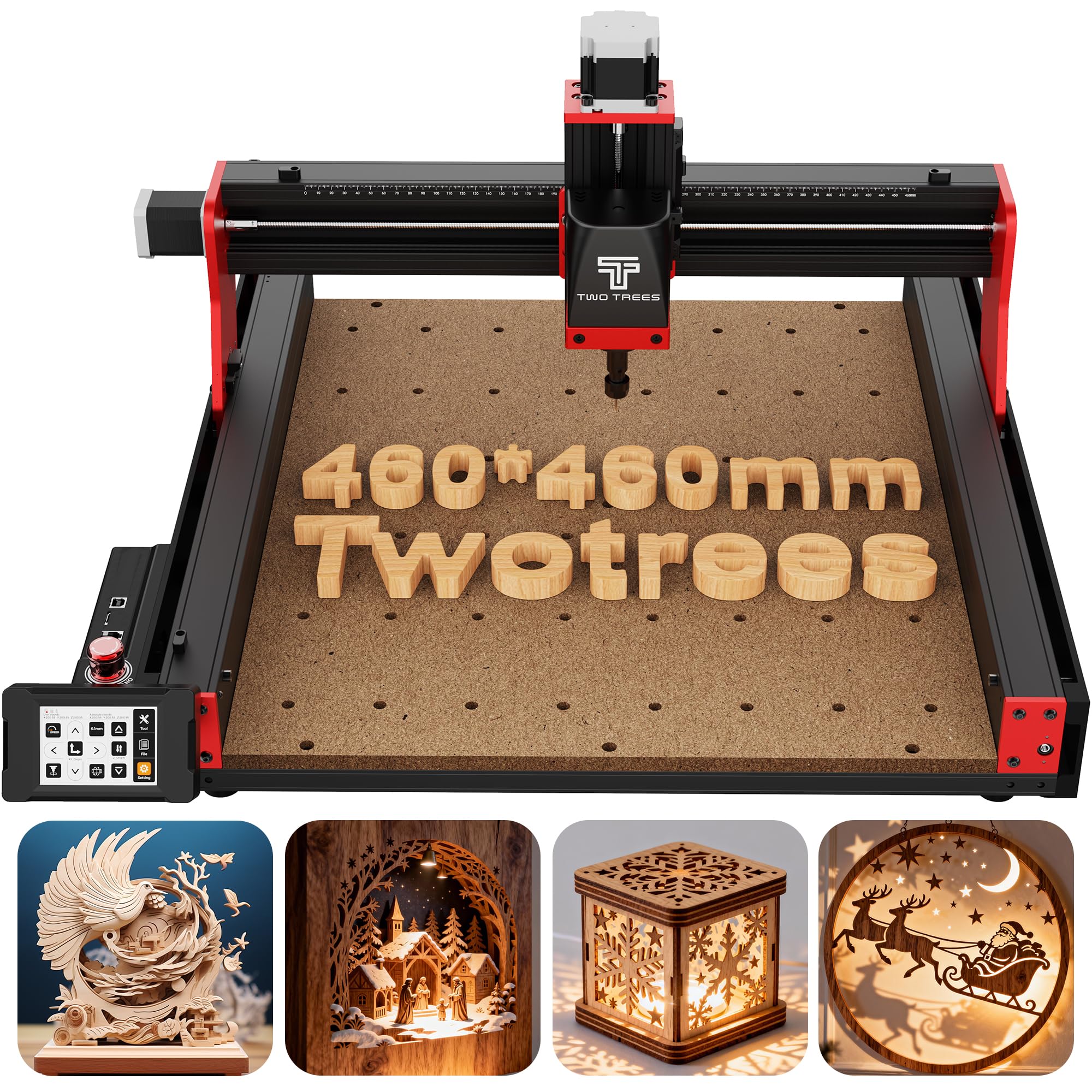
4. Twotrees TTC450 Pro All-Metal CNC Router Machine
A square meter of bench that handles signage and batch work
The working area sets the tone here: 18.1 inches across (460 x 460 x 80 mm) means this machine can swallow furniture panels and large signage rather than nibbling at coasters. That is a materially bigger footprint than the Genmitsu 4040-PRO’s 435 x 400 mm, so if your parts are board-sized, this is the one that fits them.
Under the hood, the Z-axis is driven by a 57 stepper motor with positioning accuracy listed up to 0.0025 mm — on real stock, that translates to consistent depth across a multi-layer relief. The control box carries dedicated ports for a 4th axis, a laser module, and a 500W spindle speed controller, so the machine can grow as your projects do. The NEMA 57 motor here is a different breed from the tiny pancake steppers on the 4040-PRO.
The 3.5-inch IPS capacitive touch screen makes the operation feel more like a modern gadget than a workshop tool. The build is aluminum and stainless steel, and the quality control is what draws the most praise among buyers — the stepper hardware in particular gets singled out. On the practical side, the supplied spindle works for hardwood logos once you square the machine, and using a better USB cable fixed connection freezes for one owner. Windows 11 buyers need the CH341 driver from the WCH site, not the CH340.
Where it pulls ahead
- 460 x 460 x 80mm working area takes on panel-sized parts
- Touch screen and expansion ports for laser, 4th axis, and spindle control
- Quality control on the stepper hardware is the standout praise
Where it bites back
- Some owners hit accuracy trouble on basic tests, and a few units arrive with missed or faulty screws
- The 80W spindle is light for real 1/4-inch pocketing until you upgrade
- Windows 11 setup needs the CH341 driver instead of the CH340
Big-board bet: Choose this if your projects are signage-sized and you want expansion ports ready for a laser or 4th axis.
Weigh this first: Expect to fight connection and accuracy gremlins occasionally, and plan on a stronger spindle for heavy cuts.
5. FoxAlien Masuter Pro 3-Axis CNC Router Machine

The first router that does not make you dread assembly day
The pitch here is speed to first cut. Main parts arrive pre-assembled with the wiring already run to the controller, and the maker lists setup at 10-15 minutes. The all-aluminum frame and linear rail on the Z-axis give it a rigid feel you would not expect from a starter machine, and the 400 x 400 x 60mm work area handles a solid workbench project.
Two spindle clamps (52mm and 65mm) cover 60W and 300W spindles, with a path up to a 65mm trim router or a 1.5KW spindle for deeper carving. That upgrade path matters, because the stock 60W spindle is light for anything beyond shallow passes. The dust-resistant controller box carries an accessible emergency stop and home button, so the controls stay clean under sawdust.
Build quality and ease of assembly are what buyers mention most, and the support line follows through with parts when things arrive damaged. The honest caveat is the 60W spindle: it is fine for learning and detailed engraving, but heavier wood or aluminum cuts want more muscle. It rates 4.0+ stars, and the machine makes the most sense if you are honestly new to CNC and want to learn the workflow.
The draw: Pre-wired modules and a 10-15 minute setup get you cutting on day one, with dual spindle clamps for future upgrades.
The honest caveat: The stock 60W spindle runs out of steam on heavy or deep cuts, so budget for an upgraded router down the line.
Beginner fit: Buy this if you want to learn CNC routing on a rigid, upgradable frame without a weekend of wiring.
Step back if: You need to hog out real wood or aluminum cuts right away.
6. Genmitsu PROVerXL 4030 CNC Router Machine

Leadscrews, C-beam frame, and a 300W spindle to match
Rigidity is the whole story with this one. Where the FoxAlien is stamped aluminum and belt-driven, this router uses a leadscrew drive on the Y-axis (dual screws) and an optical axis on the Z, mounted on a C-beam frame. Translate that into real work: less flex means the bit holds a line when you push into aluminum, MDF, and plastics.
The spindle runs up to 12000 rpm with 300W behind it, and the kit includes an adapter to drop in a DeWalt DWP611 router for more headroom. Limit switches on all three axes, an emergency stop, a speed control, and a Z-probe are already in the box, which saves you the parts-hunting that usually follows a cheap kit. The 400 x 300 x 110mm work area gives you more Z clearance than most at this size.
Quality and value are the recurring themes in the buyer feedback — reviewers upgrading from the small 3018-style frames find the difference night and day. One rough edge worth knowing: assembly runs a few hours for some, and the supplied hex wrench can strip the stepper set screws, so use a thread locker. The construction rates 4.0+ stars and the support story is generally strong when a loose screw or damaged lead shows up.
Frame and motion strength
- Leadscrew drive and C-beam frame keep cuts stable in wood, plastic, and aluminum
- 300W spindle with an adapter for a DeWalt DWP611 upgrade
- Ships with limit switches, emergency stop, Z-probe, and speed control
Setup friction to expect
- Assembly runs a couple of hours for some builders
- The stock 1/8-inch collet flexes under heavy 1/4-inch cuts without the router upgrade
- Occasional lead or switch issues show up after shipping
Fits the metal-friendly buyer: This is the router for you if you want to cut aluminum and thicker stock on a rigid frame.
Trade-off to plan for: Expect an afternoon of assembly and a later router upgrade to open up the frame’s full strength.
7. VEVOR 7″x14″ Metal Lathe with Digital Display

Turn round stock in aluminum or brass without a full-size machine
This is the different kind of cutting tool: a lathe spins the workpiece and cuts round features, where a mill spins the bit and cuts flat ones. It swings 7.09 inches (180 mm) over the bed with 13.78 inches (350 mm) between centers, powered by a 550W motor that runs from 50 to 2500 rpm. For bushings, spacers, and threaded parts, that range gives you control at both extremes.
The upgraded build moves from nylon gears to metal gears and an aluminum handwheel for longer life, and adds an LED lamp for dim corners and an automatic power-off switch for safety. A 4-inch 3-jaw chuck handles square and round stock, and the 4-way quick-change tool post holds four standard tools at once. Threading and accuracy work are what this machine is aimed at.
Quality feedback is genuinely split here, and that is worth saying plainly. Some owners dial in the lathe and cut parts that match their Smithy, while others report misaligned headstocks or a switch that fails. The setup is the equalizer: it needs many hours of prep and cleanup before it cuts truly, and the stock cutting tools are weak. It rates 4.0+ stars and pays back that prep if you are willing to do it.
Why a lathe buyer picks it: A 550W motor, 50 to 2500 rpm, and a digital display give you repeatable speed control for round work and threading.
What you must accept: Count on hours of disassembly, cleaning, and gib adjustment, and buy better tool holders — the included tools and manual are not ready for serious cuts.
Best for: Buyers who want to turn round parts in aluminum, brass, and steel at a bench-friendly size.
Think twice if: You are not ready to disassemble, clean, and tune a lathe before its first good cut.
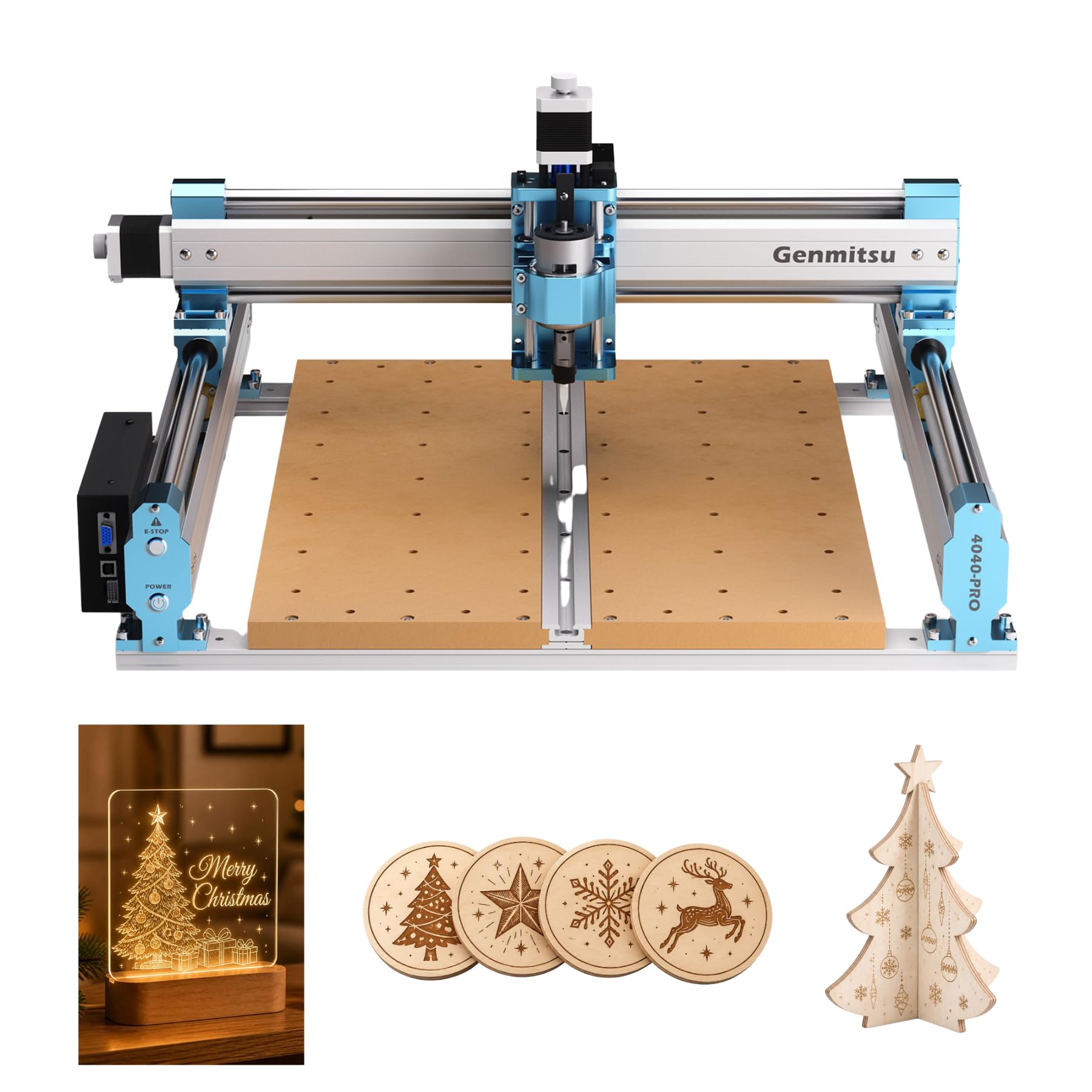
8. Genmitsu 4040-PRO CNC Router Machine
A flatter bed and quieter drivers for sign-sized projects
The upgrade that matters here is under the workpiece: a reinforced hybrid spoilboard with a center aluminum support bar that resists sagging. On a large sign or a relief, a flat bed is what keeps the cut depth even from edge to edge. The 435 x 400 x 80mm work area is slightly smaller than the Twotrees TTC450 Pro’s 460 x 460mm, so if you need the largest board go that way — but for most bench projects this is plenty.
Rigidity comes from dual 16mm steel tubes on each axis and a leadscrew drive, and the 32-bit controller with silent Toshiba drivers keeps the machine quiet while you cut. That muted operation is a real bench-side comfort for a machine running detailed carving for hours. Pre-assembled modules get assembly done in about 15 minutes, and GRBL control keeps the workflow familiar.
Quality and assembly are the highlights in buyer feedback, and most owners are cutting fine detail on the first job. The mixed signals come from precision and reliability — a few report the machine losing vector orientation or fighting alignment, and the bundled Candle software feels thin next to G-sender. The stock spindle is modest, so deep pockets and heavy 1/4-inch cuts want an upgraded router. It sits at 4.0+ stars and answers best to a hobbyist who values a quiet, flat, well-built frame.
What earns the place
- Reinforced spoilboard with a center support bar keeps cuts level across large work
- 32-bit controller with silent Toshiba drivers keeps the machine quiet
- Pre-assembled modules get you to a first cut in about 15 minutes
Where it asks patience
- A few units arrive losing vector orientation or fighting alignment
- The stock spindle is light for deep pockets and 1/4-inch shank bits
- Bundled Candle software is basic; most users move to G-sender
Quiet bench pick: Choose the 4040-PRO if flat, consistent cuts across board-sized projects matter more than the widest bed.
Look past it if: You need the largest reachable area or heavy stock removal on day one.
9. JET 12″ x 21″ Variable-Speed Woodworking Lathe (JWL-1221VS)

Three speed ranges and a ratchet belt that makes changing them easy
For wood turning, the speed range is the spec that decides how a blank behaves. This lathe offers three ranges — 60-900, 110-1800, and 220-3600 rpm — so you can run a rough log slow and a finished pen blank fast. The 1 HP motor and 12 x 21-inch turning capacity handle bowls and spindles alike, with a smooth forward-to-reverse transition and a spring-loaded spindle lock for setup.
Its ratchet-style belt tension system is listed as patent pending, and in practice it takes the fight out of moving the belt between pulleys. The redesigned controls add a larger DRO (a digital readout that shows the current speed) and a recessed power switch, plus 24 integrated indexing positions for evenly spaced work. The tailstock uses Acme thread for steadier travel.
What buyers keep coming back to is build quality and the ease of speed control, and the machine runs surprisingly quiet for its size. It is also heavy, which is a good and a bad thing: good because a heavy bed resists wobble on big blanks, less good because you will want help in the shop when it arrives. A 5-year warranty covers hobby use. The 4.0+ stars reflect a machine owners trust for years of turning.
The standout: Three speed ranges from 60 to 3600 rpm and a ratchet belt system deliver smooth speed changes across roughing and finishing.
What to expect: The machine is heavy and wants its headstock bolts checked, and a few owners mention wobble that tuning can usually settle.
Turner’s pick: Buy this if you turn bowls or spindles and want variable speed, reverse, and indexing on a solid bed.
Skip the leap if: Your bench is small and you cannot move 121 pounds of cast iron into place.
Know the Specs
Spindle Speed and Wattage
Spindle speed in rpm sets how fast the cutting bit spins, and higher rpm keeps small bits from stalling in a cut. Wattage is the motor’s muscle for taking deeper passes. A 20000 rpm micro mill and a 300W router spindle answer very different jobs, so match both numbers to the material you cut most.
Working Area and Z Travel
Working area is the size of the box your workpiece must fit inside, listed as width x depth x height. The height figure, Z travel, is the reach you can raise the spindle — a part taller than that will not clear the bit no matter how wide the bed is. Measure your largest stock before you compare.
Lead Screws versus Belts
Lead screws (a threaded shaft that moves the carriage) hold a position firmly, while belts and v-slot wheels flex more under load. If you cut aluminum, rigid motion hardware reduces chatter and keeps the second pass accurate. For soft wood and shallow engraving, a belt-driven hobby machine can work fine.
Indexing and Dividing Heads
A dividing head clamps to a mill’s table and rotates the workpiece by precise increments. That lets you space gear teeth, bolt holes, and flutes evenly around a round part. The interchangeable hole plates on a dividing head set the exact spacing, which is why machinists reach for one when a single hole is not the job.
Common Questions
Will a mini mill cut aluminum or only wood?
What does the working area number tell me?
Do these machines come ready to cut from the start?
What is a dividing head used for on a mill?
Is a lathe or a mill better for metal parts?
How loud are these machines in a home shop?
What GRBL control means for a beginner?
Can I upgrade the spindle on a hobby router?
How much setup does the VEVOR metal lathe need?
What is a digital readout worth on a lathe?
The Bottom Line
The right mini milling machine depends on what you plan to cut, and the picks above split by material: micro parts, aluminum, or round stock. For the fastest spindle on a micro scale, the Proxxon Micromot MF 70 spins at 20000 rpm and suits tiny precision parts. If you need a rigid frame that handles aluminum and thicker stock, the Genmitsu PROVerXL 4030 earns its place with a leadscrew drive and a 300W spindle. And for round work and threading, the VEVOR 7″x14″ Metal Lathe turns bushings and spacers that a mill simply cannot.
One honest nudge: any machine here rewards the prep you put in. If you want the widest bed for board-sized projects, the Twotrees TTC450 Pro is the one to reach for. And if you want a partner to keep your clamps and fixtures tight, the Milwaukee M18 combo kit earns its place on the bench. Match the machine to your material, do the setup right, and your first real cut will confirm the choice.
How we choose
We do not accept paid placement. Every pick is matched to a real buyer and a real use-case; we do not hands-on test units.
Sources
Specifications: manufacturer listings and product documentation. Review insights: verified customer reviews, as of October 2026. Pricing: not shown on this page (it changes often); check the current price via the retailer link.
As an Amazon Associate, Aappliancez earns from qualifying purchases. This does not affect which products we feature.