Disclosure: Some links in this post are affiliate links. As an Amazon Associate I earn from qualifying purchases, at no extra cost to you. Learn more
Specs are compiled from manufacturer listings and verified buyer reviews and can change over time — please confirm the key details on the product page before buying.
If you want one salt that tastes clean, dissolves fast, and keeps the minerals intact, the Baja Gold Signature Mineral Sea Salt is the one to start with — it is the crowd favorite at 4.5+ stars across 11,000+ owners. The confusing part about mineral salt is not the price, it is the dampness, the grain size, and whether the “82 minerals” label means anything at all. This guide sorts the five strongest options by the things that actually change how your food tastes.
This guide is built by comparing the manufacturers’ published specifications and the patterns across verified customer reviews, so you get each pick’s real strengths and trade-offs instead of marketing spin.
You will learn the difference between fine and coarse grain, why unrefined salt feels damp, and which jar belongs in your grinder versus your baking bowl. Every pick below is a mineral salt worth owning, and this walkthrough of the best mineral salt makes the choice between them a quick one.
Top Picks

How To Choose The Best Mineral Salt
Most people buy mineral salt expecting a health upgrade and then get surprised by the texture. The bag arrives damp, the grains clump, and suddenly the salt feels broken. It is not broken — the moisture is part of how unrefined salt keeps its minerals. Pick the grain size and the packaging first, and the rest usually sorts itself out.
Grain size decides where the salt lives in your kitchen
A fine grind behaves like flour — it dissolves fast and disappears into dough, sauces, and dry rubs. A coarse flake sits on top of food and gives you a crunch, which is why it belongs in a grinder or a finishing bowl. Match the grain to the job and you stop fighting your salt.
Fine grind versus coarse flake
Fine salt is the safer everyday choice because a pinch spreads evenly and a little goes a long way. Coarse salt gives you control and texture, but it needs a grinder to reach a table-friendly size. If you bake often, fine wins. If you grill and finish salads, coarse wins.
Why unrefined salt feels damp
Refined table salt is dried hard and treated with anti-caking agents so it pours freely forever. Unrefined sea salt keeps a small amount of natural moisture so the trace minerals stay put. That dampness can cause clumping in a shaker, but a sealed bag and a decent grinder solve it.
Check the packaging before you commit
A resealable bag keeps a large amount fresh for a long stretch of cooking. A grinder jar is convenient but locks you into one texture. If you cook daily, buy the big resealable bag and refill a small shaker on the counter.
Side-by-Side Comparison
| Model | Best For | Grain | Pack Size | Stated Minerals | Amazon |
|---|---|---|---|---|---|
| Baja Gold Signature Mineral Sea Salt★ Best Overall | Everyday cooking and baking | Fine (flour-like) | 1 lb resealable bag | Over 80 trace minerals | Amazon |
| MAYi Natural Spring Coarse SaltPurity Pick | Grinder, pickling, and brining | Coarse | 1.1 lb | 82 trace minerals | Amazon |
| Napoleon’s Celtic Salt | Finishing roasts and salads | Coarse, naturally moist | 1 lb | 82 essential minerals | Amazon |
| Pure Mineral Grinder Salt from Lake Deborah | Grinder-first households | Grinder salt | 400 g | Calcium, magnesium, potassium | Amazon |
| Redmond Real Salt Fine Sea Salt | Bulk cooking and canning | Fine | 10 lb bag | Trace minerals, no additives | Amazon |
Detailed Reviews
1. Baja Gold Fine 1 lb
Our pick — 4.5+★ from 11,500+ verified ratings; the strongest balance of quality and price.
The flour-fine salt that vanishes into dough and never leaves a bitter edge.
The first thing to know is the grain. Baja Gold is milled to a flour-like texture — the finest grind in this lineup — so it dissolves almost instantly instead of sitting in visible specks on top of your food. That makes it the default pick for baking, sautéing, and everyday seasoning, where you want salt to disappear into the dish rather than announce itself.
The flavor is where this salt earns its place. It is unrefined and tastes clean and full-bodied, without the bitter chemical edge some people notice in ordinary table salt. Its mineral profile lists magnesium and potassium, and it carries less sodium than table salt. Taste is what wins people over here by a wide margin, and the mineral content sits right behind it. Buyers report needing less of this fine salt than regular kosher coarse salt to hit the same saltiness, so the 1 lb bag stretches further than its weight suggests.
Then there is the honest catch, and it is moisture. Natural sea salt arrives damp, because the water is what holds the minerals in place, and a fine grain is more prone to clumping than a coarse one. Keep the resealable bag sealed, store it dry, and break up any clumps with your fingers. If you want a pour-and-forget shaker that never clumps, this is the wrong format — but if you cook daily, the trade is worth it.
Why It Sells Itself
- Flour-like fine grind dissolves fast in baking and brining
- Unrefined with over 80 trace minerals, including magnesium and potassium
- A little goes a long way, so the 1 lb bag lasts
- Resealable packaging keeps a large bag fresh for repeat cooking
Where It Asks Patience
- Arrives damp from natural seawater moisture and can clump
- Fine grain is not a finishing texture — it disappears rather than crunches
Go for this if: you bake, roast, and season daily and want one unrefined salt that dissolves cleanly into everything.
Skip the shaker: the fine grain clumps in humid air, so store it sealed and dry.
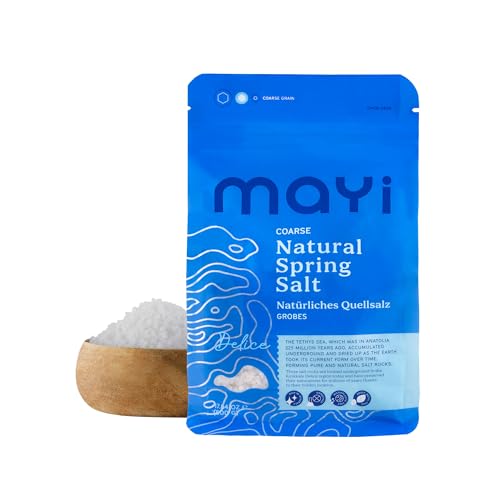
2. MAYi Coarse Salt 1.1 lb
It comes with the one piece of paper most salt bags never bother to include.
That paper is the lab result. MAYi states its coarse salt was independently verified by certified laboratories to contain zero microplastics — a claim most salts on the market have never been tested for at all. If you have been reading about what turns up in sea salt and want the tested version, this is the pick that answers that question directly. At 1.1 pounds it is a touch heavier than Napoleon’s Celtic Salt at 1 pound, so you get slightly more in the bag.
The grain is a proper coarse one, hand-harvested from ancient natural springs with no mechanical processing and no anti-caking agents. That texture is built for a grinder, not a shaker. It performs well as a grinder salt, and the amount needed to hit a given saltiness is modest — owners mention needing less of this coarse salt than regular kosher coarse salt to reach the same saltiness. Salt quality is the thing people praise, with taste close behind.
Be honest with yourself about the value question, because it is the one place this bag gets mixed feedback. The grain runs on the expensive side for the weight, and 1 lb is less than some people expect when the bag arrives. If you want a big, cheap pantry staple, look further down this list. If purity is the whole reason you are shopping, the lab-tested claim is the reason to pay up.
The tested-purity angle: independent lab verification for zero microplastics is the standout here, and it is paired with a coarse, hand-harvested grain that works well in a salt grinder.
The value trade: the grain is priced on the high side for the weight, and the bag holds 1.1 pounds — enough for grinding, not for filling a bulk jar.
The right buyer: someone who wants a lab-tested, additive-free coarse salt and already owns a grinder.
The wrong buyer: anyone hunting a cheap bulk bag — the value feedback here is mixed.
3. Napoleon’s Celtic Salt 1.0lb

Raked by hand from French marshes, this is the salt you pinch over a finished plate.
Celtic salt is defined by how it is dried, and Napoleon’s keeps that method deliberate. Ordinary coarse sea salt is dried to under one percent humidity, which strips out most of its minerals along with the water. This one stays deliberately moist so the flake retains 82 different essential minerals instead of losing them. The moisture you feel is the point, not a flaw.
Texture and taste are why it holds the top quality marks in this lineup. It stays moist, grinds well, and still carries its own water content — as customers note, “Napoleon’s Celtic Salt has a very nice taste and texture. Grinds well and still holds it’s moisture.” It lifts soups, salads, and holiday roasts, and it is organic, gluten free, vegan, and kosher, which makes it easy to keep on the table for a range of diets.
Now the grain-size caveat, which is the most-discussed friction point. Some bags run too coarse for the grinder — one buyer put it plainly: “Tastes great, not coarse enough to work in a grinder unfortunately, but otherwise positive.” The fix is simple: grind it, or use it as a finishing salt and let the flakes show. Do not expect a table-shaker pour. If you want salt to vanish into a recipe, reach for the Baja Gold above; if you want a flake that crunches on a roasted vegetable, this is the pick.
The French-marsh difference: hand-raked, deliberately moist flakes that keep 82 essential minerals instead of drying them out.
What to plan around: grind consistency varies by bag, and the flake runs coarse enough that some grinders struggle. Pair it with a capable grinder or use it as a finisher.
Reach for this if: you finish plates and want an organic, mineral-rich flake with real texture.
Leave it if: your routine needs a fine, shaker-ready grain every single day.
4. Lake Deborah Grinder Salt 400g
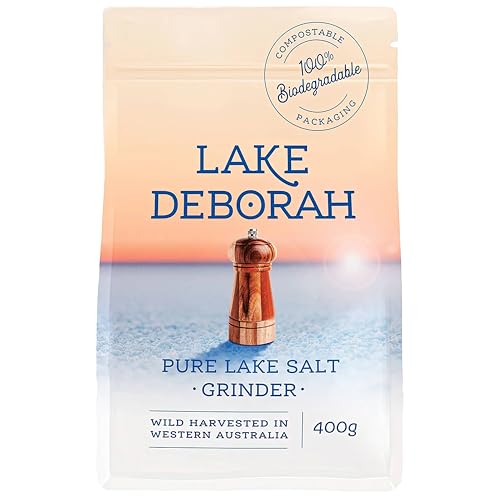
Australian lake salt that comes with a purity test and packaging you can compost.
Lake Deborah is the pick for the shopper who reads labels carefully. It is independently tested to be free from heavy metals, microplastics, and modern pollutants, and it contains no anti-caking agents or added iodine. Salt quality is what stands out most, with the heavy-metal-free testing a close second. For a family that wants a clean, tested mineral salt from a known source, that combination is the whole pitch.
It is also the only option here packaged in 100% compostable, biodegradable material. That is a real difference if you care about what goes in the bin alongside what goes on your food. The taste lands on the subtle side, and reviewers point out it is not too salty or overpowering — a good sign it will not flatten a delicate dish.
The honest limit is size and cost. It is also priced as a premium grinder jar, and a few people call it expensive for the weight. If you want volume, this is not your bag. If you want a pure, tested grinder salt and value the compostable package, it earns the spot.
The purity story: tested free of heavy metals and microplastics, with no anti-caking agents or added iodine, and 100% compostable packaging.
Grain and size: a grinder-friendly texture at 400 grams — enough for a season of finishing, not for a bulk kitchen.
Made for: households that want tested purity, no additives, and packaging that breaks down.
Not for: anyone who needs a big bag to fill a commercial-style kitchen.
5. Redmond Real Salt 10 Lb
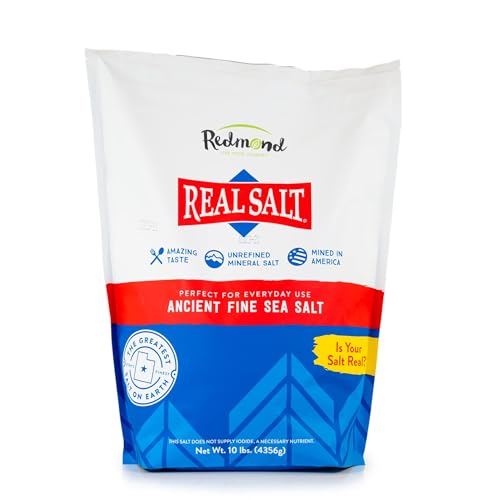
Ten pounds of fine salt from an ancient Utah seabed, mined since 1958.
If you cook by the potful, this is the one that stops you rebuying salt every month. The 10 lb bag carries fine-grain unrefined sea salt with trace minerals and no additives — nothing added, nothing removed. Redmond mines it in Utah from an ancient seabed that has been protected from modern pollution since 1958, which is the reason it is a known, traceable source rather than a mystery bag.
Taste is its strongest suit. It reads subtly sweet rather than bitter, and it is less aggressively salty than regular table salt, so it is easier to build flavor with. That trait makes it versatile — buyers use it for everything from canning and cooking to table and finishing. The fine grind matches the texture of table salt, so it goes into a shaker or a pound cake batter without a fight.
Two honest notes before you order. It is fine salt, so if you want a finishing flake on a salad, this is not that. And the natural moisture concentrates in a large bag of fine grain, so the texture can clump — a few people find that frustrating. Neither is a defect; it is the reality of a 10 lb unrefined bag. Keep it sealed and dry, and the bag lasts through a long stretch of cooking.
The Bulk Advantage
- 10 lb bag means one purchase covers months of daily cooking
- Unrefined with trace minerals, no additives and nothing removed
- Fine grind matches table salt texture, so it works in shakers and baking
- Mined in Utah from a protected ancient seabed
The Everyday Trade
- Fine grain is not a finishing flake, so it does not crunch on a plate
- Natural moisture can cause clumping in a large bag of fine salt
Best suited to: high-volume cooks, canners, and bakers who want one fine, unrefined salt in a big bag.
Look past it if: you want a flake for finishing, or you prefer a small jar on the counter.
Know the Specs
Grain Size: Fine Versus Coarse
Grain size is the spec that changes how you cook more than any mineral claim on the label. A fine, flour-like grind dissolves into dough and brine, which is why the Baja Gold and the Redmond bag are kitchen workhorses. A coarse flake like Napoleon’s or the MAYi bag sits on top and gives crunch, so it belongs in a grinder or a finishing bowl. Buy for the job, not the label.
Trace Minerals and Natural Moisture
Unrefined salt keeps its minerals because it is not dried hard. Where ordinary coarse sea salt is dried to under one percent humidity and loses most of its minerals, Napoleon’s deliberately keeps a little moisture in the flake. That moisture is why the bag feels damp and why clumps form. Store it sealed and dry, and a grinder handles the rest.
Common Questions
Why does my mineral salt arrive wet or damp?
Is fine grind better than coarse for everyday cooking?
What does “82 trace minerals” actually mean on a salt bag?
Can I use a coarse Celtic salt in a regular salt grinder?
Is microplastic-free salt worth paying more for?
How long does a 1 lb bag of mineral salt last?
Does unrefined salt need to be stored differently from table salt?
Which mineral salt is best for canning and pickling?
Can I put mineral salt in a bath or use it for body care?
The Bottom Line
The shortlist lands in one place: the Baja Gold Signature Mineral Sea Salt is the strongest all-round mineral salt for most kitchens. Its flour-like fine grind dissolves into baking and cooking, it keeps over 80 trace minerals, and the crowd backs it — the review pages put it well past 11,000+ owners at 4.5+ stars. If you want tested purity and a coarse grind, the MAYi Natural Spring Coarse Salt is the lab-verified pick. And if volume is the whole point, the Redmond Real Salt 10 lb bag is the one to reach for.
How we choose
We do not accept paid placement. Every pick is matched to a real buyer and a real use-case; we do not hands-on test units.
Sources
Specifications: manufacturer listings and product documentation. Review insights: verified customer reviews, as of October 2026. Pricing: not shown on this page (it changes often); check the current price via the retailer link.
As an Amazon Associate, Aappliancez earns from qualifying purchases. This does not affect which products we feature.