Disclosure: Some links in this post are affiliate links. As an Amazon Associate I earn from qualifying purchases, at no extra cost to you. Learn more
Specs are compiled from manufacturer listings and verified buyer reviews and can change over time — please confirm the key details on the product page before buying.
If vocals sound buried and guitars turn to mush, the problem is usually the speaker, not your ears. A good midrange speaker reproduces the human voice, guitar, and piano band faithfully — the part of the music your ear locks onto first. Below you get nine real options, sorted by what they actually do well: serious bookshelf pairs for a listening room, a slim passive set for tight shelves, a car dash drop-in, and powered boxes you plug straight into a turntable or PC.
This guide is built by comparing the manufacturers’ published specifications and the patterns across verified customer reviews, so you get each pick’s real strengths and trade-offs instead of marketing spin.
Some of these are wired pairs that need an amplifier, and some carry their own amp so they play the moment you plug them in. Match the amplifier type and the woofer size to your room before you click buy. That is exactly what this comparison of the best midrange speaker options is built to settle.
Top Picks


How To Choose The Best Midrange Speaker
The most common first-time mistake is buying a speaker without checking whether it fits the room or the amplifier you own. A midrange speaker that fits a car dash will not fill a living room, and a pair built for a big room can sound thin on a desk. Decide where it lives first, then match the specs to that space.
Woofer size decides how much air you move
A bigger cone pushes more air, which means fuller low frequencies and more headroom before the sound distorts. The Polk ES20 uses a 6.5-inch driver. The Kenwood dash pair runs 2.5-inch drivers — that is fine for fitting a factory opening, but it is a completely different job.
Smaller woofers can still surprise you when the enclosure is designed well. The Micca OoO squeezes two 3-inch square-frame woofers into a slim cabinet and reaches usable bass extension down to 60Hz. Just go in knowing the limits of the size.
Powered or passive: the amplifier question
A passive speaker is a box with drivers and terminals, nothing else. It needs an amplifier or AV receiver to make any sound. The Polk ES20 pair, the Micca OoO, the Klipsch R-40M, the Sony SS-CS5M2 and the ELAC Debut 3.0 are all passive — budget for the amp.
A powered speaker has its own amplifier built in, so a turntable or a PC plugs straight in. The MEVOSTO 5-inch pair carries a built-in 36W RMS amp, and the Klipsch R-40PM is a self-powered set that needs no receiver at all.
Impedance and sensitivity: will your amp drive it?
Impedance is the electrical load a speaker presents to your amplifier, measured in ohms. Lower numbers pull more current. The Polk ES20 is rated for both 4- and 8-ohm compatibility, so it works with most receivers and amps.
Sensitivity tells you how loud the speaker gets for a given amount of power, in decibels (dB). The Kenwood dash pair is rated at 85 dB — fine here because it runs off a head unit, but the figure is note when you are matching a small amp to a speaker.
Where the bass port sits
A bass reflex enclosure uses a hole — the port — to reinforce low frequencies. Crucially, where that port points decides whether you can push the speaker against a wall. The Micca OoO’s ported enclosure helps it reach lower, and the Sony SS-CS5M2 uses a rear port that needs clearance from the wall behind it.
The Klipsch R-40M also has a rear bass port, and that means it cannot sit flush against a wall without colouring the bass. Plan your stands or shelves with that in mind.
Side-by-Side Comparison
| Model | Best For | Woofer Size | Powered or Passive | Low-End Reach | Amazon |
|---|---|---|---|---|---|
| Polk Signature Elite ES20★ Best Overall | The centerpiece of a music and movie room | 6.5 inches | Passive | Power Port bass, 4- and 8-Ohm capable | Amazon |
| Marshall Stanmore IIIRoom Filler | Plug-and-play room filler with character | 5 inches | Powered | Bass Boost feature | Amazon |
| ELAC Debut 3.0 DB63Deepest Bass | Serious two-channel listening on a stand | 6.5 inches | Passive | 42Hz to 38KHz | Amazon |
| Klipsch Reference R-40PM | Turntable and TV sound without a receiver | 4 inches | Powered | Subwoofer output for extra bass | Amazon |
| Klipsch Reference R-40M | Compact home theater with a horn tweeter | 4 inches | Passive | Rear bass port | Amazon |
| Sony SS-CS5M2 | A three-way set for a desk or small office | 5.12 inches | Passive | 53Hz to 50,000Hz | Amazon |
| Micca OoO | Slim shelves and a desktop center channel | Two 3-inch square-frame woofers | Passive | 60Hz usable extension | Amazon |
| MEVOSTO 5-Inch Powered Pair | A PC, turntable, or console in one box | 5 inches | Powered | Bass and treble knobs | Amazon |
| Kenwood eXcelon KFC-X2C | Replacing factory dash speakers in the car | 2.5 inches | Car head-unit driven | 800-20,000 Hz response | Amazon |
Detailed Reviews
1. Polk Audio Signature Elite ES20 Bookshelf Speaker Pair
Our pick — 4.5+★ from 800+ verified ratings; the strongest balance of quality and price.
The 6.5-inch woofer that turns a bookshelf pair into a small tower.
The Polk ES20 is a pair of passive bookshelf speakers built around a 6.5-inch woofer and a 1-inch Terylene tweeter. That dome is a soft fabric design — the goal is a smooth, non-fatiguing top end rather than a sizzling one. Polk calls the driver layout a Dynamically Balanced Acoustic Array with precision crossovers, which in plain terms means the tweeter and woofer hand off to each other cleanly at the frequencies where your ear is most sensitive.
Bass is where this one pulls ahead. Polk’s Power Port technology pipes the port airflow along a shaped surface instead of dumping it straight out of a hole. Polk claims the Power Port delivers 3dB more bass output than a conventional port while reducing the port turbulence that muddies detail. In practice owners describe a warm, non-clinical tone that suits acoustic, vocal, and movie dialogue. As buyers report: “Layman review: loud with clarity, no distortion at 25% volume.”
What wins people over is the soundstage — the sense of where each instrument sits in the room. It is the quality that comes up most in owner feedback, and the driver size is the reason: a 6.5-inch woofer here against 2.5 inches on the Kenwood dash pair, a 2.6x gap in cone area that lets the Polk move real air in a room. It is also rated for both 4- and 8-Ohm loads (the electrical resistance an amp must drive), so most AV receivers and stereo amps will run it, including the Dolby Atmos and DTS:X models Polk names. Expect it to respond to a few hours of break-in (a settling-in period for new drivers) before the treble settles.
Where the Polk earns its spot
- A 6.5-inch woofer and 1-inch Terylene tweeter produce a wide, lifelike stage for movies and music alike.
- Power Port bass keeps low frequencies clear instead of boomy, so you can hold off on a sub for a while.
- 4- and 8-Ohm compatibility means it plays nicely with most receivers and stereo amplifiers.
- Timbre-matched to the rest of the Signature Elite line, so it grows into a 5.1 setup later.
What to plan around
- It is a big, deep cabinet — surface-mounting on a wall is not as simple as the listing suggests, so budget for stands or deep shelves.
- The faux-wood finish reads a little cheap under close inspection.
- It needs an amplifier, and a subwoofer helps for the deepest movie effects.
Built for: anyone assembling a real two-channel or surround system around a receiver and a room to fill.
Think twice if: you wanted something you can hang on a wall — the depth works against you there.
2. Marshall Stanmore III Bluetooth Home Speaker
A single powered box that plugs in, pairs, and fills the room — no receiver in sight.
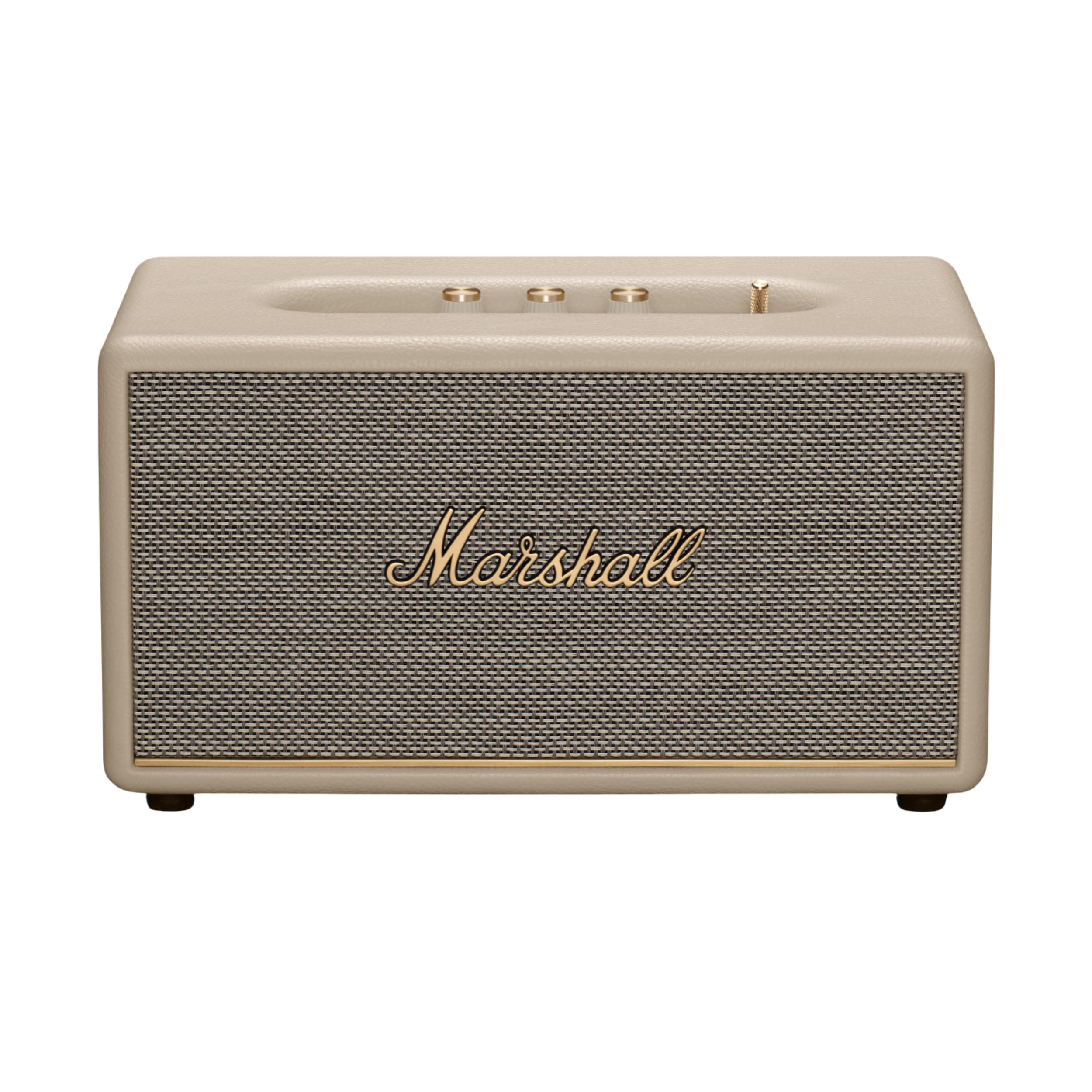
The Stanmore III is a tabletop speaker with a 5-inch driver and its own amplifier, so there is no separate box to buy. Bluetooth range is listed at 33 feet, and you can also feed it through auxiliary and RCA connections. Physical knobs handle volume, bass, and treble, and the companion app lets you adjust the bass and treble curves if you want to fine-tune.
The cream wrap and amp-style control panel make it a piece of furniture rather than a black box on a shelf. The cream wrap and the amp-style control panel make it look like it belongs in a room rather than hidden on a shelf, and the build uses 70% recycled plastic in a PVC-free cabinet. Owners describe it filling a large open space with detail, and the low end is genuinely present for a box this size — a bass-heavy track has body to it that a thin bookshelf set will not give you.
The catch is the architecture. It is a single speaker enclosure, so you get a wide stereo image rather than true left-right separation, and the deepest rumble is not its job. A few units have been reported arriving faulty, which is the honest risk with any powered electronics. For a turntable, a TV, or phone streaming in a bedroom or den, it removes an entire amplifier from your shopping list — which is exactly why it sits this high.
What it does best: one cable, one pairing press, and music in the room. One cable and one pairing press is a routine you repeat every day, and it never gets old.
The honest trade: no true stereo spread and no subwoofer-grade rumble. Add a sub-out only if you accept this is a lifestyle speaker, not a two-channel rig.
Reach for this if: you want a turntable or TV to sound good without learning what an AV receiver does.
Look elsewhere if: you listen critically in a fixed chair and want instruments pinned to a left and right position.
3. ELAC Debut 3.0 DB63-BK Bookshelf Speakers
A 42Hz floor and a woven cone that stays composed when you turn it up.
Read the spec sheet on the DB63 and the number that jumps out is the frequency response: 42Hz to 38KHz. The low end of that figure is what tells you this passive pair reaches down into genuine bass territory before you add a subwoofer. The 6.5-inch woofer is woven aramid fiber, a cone material chosen for stiffness and damping, and the 1-inch aluminum dome tweeter sits behind a wave-guide and phase-plug that widen where the highs are aimed.
Inside the cabinet there is internal bracing, and that is not a marketing flourish — it stops the box itself from vibrating and muddying the sound coming off the drivers. ELAC also notes the speakers are easy to drive, needing less amplifier power to hit a given volume. Owners consistently describe controlled, punchy bass and accurate mids with no breakup when pushed, and the imaging is a recurring strength. As the maker puts it in the listing, this is a series built to prove that style and serious sound are not reserved for the top tier.
Compared with the Polk ES20, the ELAC reaches lower on paper — 42Hz (a low bass note) versus a port-enhanced figure — but it is a smaller-company tuning, and one honest note from the room is a slightly thin, hollow quality at moderate levels before break-in smooths it out. Give it hours of playing time and stands that put the tweeter (the small high-frequency driver) near ear height.
The spec that matters: that 42Hz bottom note means kick drums and bass lines arrive with weight, so an EDM or hip-hop library does not immediately demand a sub.
Set-up note: a passive pair needs a capable amplifier, and it rewards proper stands more than a shelf shoved against a wall.
Best for: the listener who wants the lowest clean notes without adding a subwoofer on day one.
Not for: anyone hoping to skip the amplifier — this is a wired passive pair.
4. Klipsch Reference R-40PM Powered Bookshelf Speakers
Horn-loaded highs and a phono input, with the amplifier already inside the box.
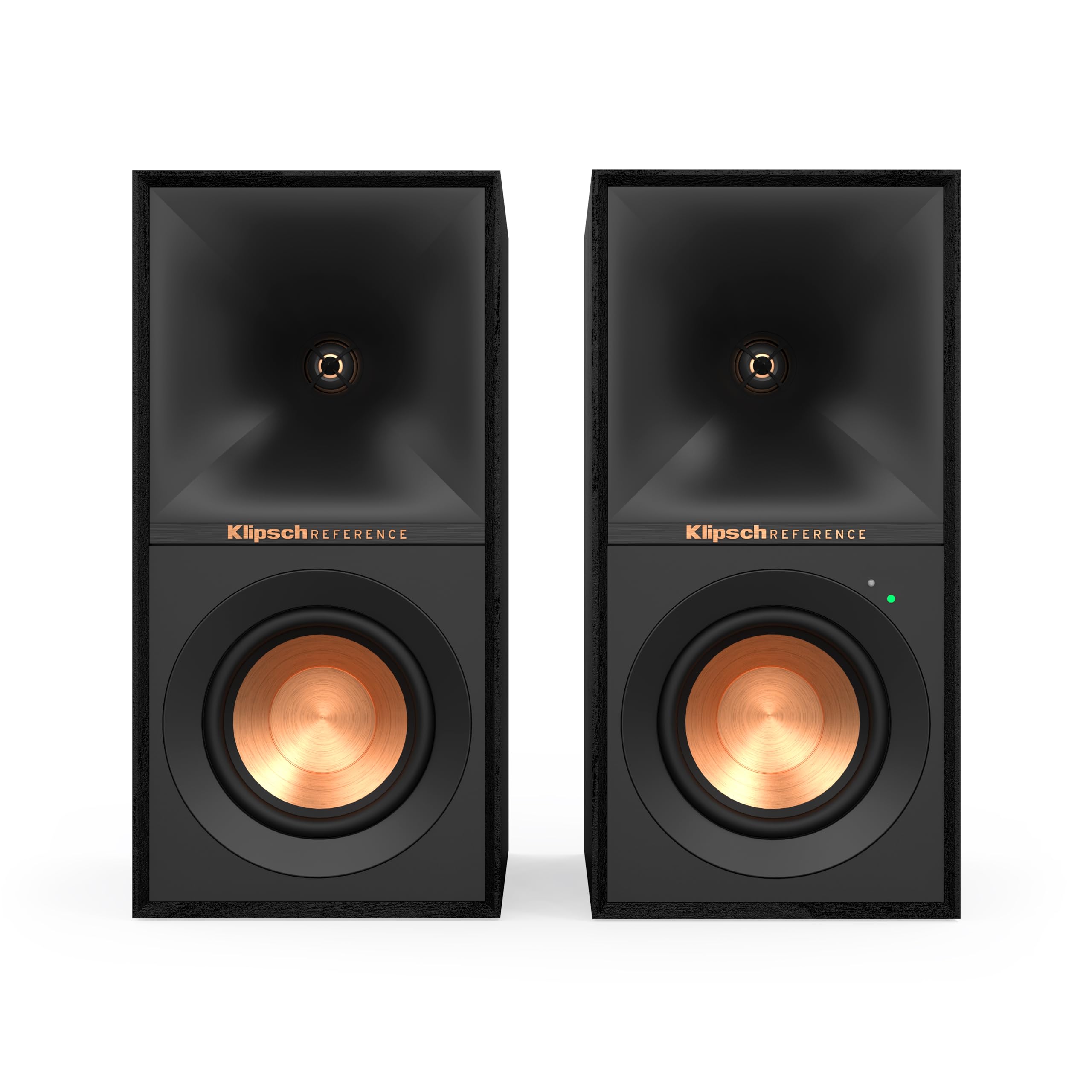
The R-40PM takes the Klipsch horn formula and builds the amp in, so no receiver is required. The horn is a 90-degree by 90-degree Tractrix design — think of it as a shaped flare that spreads the high frequencies evenly across your room rather than firing them in a narrow beam. Behind it sits a 1-inch LTS aluminum tweeter, and the 4-inch woofer is spun-copper thermoformed crystalline polymer.
For a turntable owner this is a neat package: there is a phono input with a ground screw terminal, plus Bluetooth for streaming and digital and analog inputs. Owners describe the sound as full and rich for a small room, and the remote lets you switch inputs and change volume without leaving your chair. The high-frequency separation the horn produces is the standout trait — cymbals and strings stay distinct instead of blurring together.
Be clear about the limits. A 4-inch woofer gives you punch, not depth, so for movie rumble you will want a subwoofer, and the R-40PM has an output for one. Bluetooth pairing can also take longer than you would like on the first attempt. Reliability has drawn mixed feedback — most units run flawlessly, but some owners mention speakers stopping and connection trouble, so buy from a seller with a straightforward return path.
Why it earns a spot
- Built-in amplification kills the receiver purchase entirely.
- A phono input with a ground terminal means a turntable plugs straight in.
- The 90° x 90° horn spreads highs widely, so the balance is not razor-narrow.
- Subwoofer output lets you add low end later.
Go in knowing
- 4-inch woofers need a sub for real low frequencies.
- First-time Bluetooth pairing can be slow.
- Most units are solid, but a faulty one is a real possibility — check the return window.
Who it suits: the vinyl and streaming listener who wants one pair of speakers and no separates.
Who should pass: anyone chasing subwoofer-deep bass from the speakers alone.
5. Klipsch Reference R-40M Horn-Loaded Bookshelf Speakers

The passive sibling of the R-40PM — same horn, amplifier sold separately.
This is the wired version of the horn formula. The R-40M uses the same 90-degree by 90-degree Tractrix horn and 1-inch LTS aluminum tweeter, with a 4-inch spun-copper TCP woofer carrying trickle-down design from Klipsch’s Reference Premiere line. It is passive, which means it needs an amplifier or AV receiver to run. The cabinet is MDF with a scratch-resistant textured wood-grain vinyl and hidden fasteners for a clean front face.
What it brings to a home theater is attack. Horn-loaded highs are assertive, so effects and dialogue cut through a soundtrack, and owners note a punchy, dynamic character that wakes up at higher volume — around 60% on the dial is where it comes alive. The compact cabinet fits tighter spaces that a 6.5-inch pair will not. Owners also describe a broader tweeter focus than the Polk speakers they replaced, which suits off-axis seating in a living room.
Two things to plan for. There is a rear bass port, so the speaker needs breathing room behind it and cannot press flat against a wall. Owners also report that the threaded insert for mounting stands is hard to find in the aftermarket, so sort your stand choice before the speakers arrive. If you are building a 5.1 setup on a receiver you already own, this is the value play in the Klipsch line.
What owners respond to: the horn gives easy dynamic headroom, and the small cabinet disappears into a room without eating shelf space.
The one snag: a rear port rules out wall-flush placement, and the stand-mount threads are an odd size. Measure before you buy.
The right buyer: a home theater builder with a receiver already in the rack who wants compact, punchy surrounds or fronts.
Wrong turn: if you have no amplifier, this pair makes no sound — take the R-40PM instead.
6. Sony SS-CS5M2 Bookshelf Speakers

Three drivers splitting the work — a 5.12-inch woofer, a tweeter, and a super tweeter above it.
Most budget pairs are two-way: one woofer, one tweeter. The SS-CS5M2 splits the job three ways, adding a wide-dispersion super tweeter above the main high-precision tweeter to push the top end out to a 53-50,000 Hz frequency response. Hi-Res Audio certification is the label for that extended range. The 5.12-inch woofer handles the low end, and the reinforced cellular cone is built to stay controlled when volume climbs.
The three-way layout pays off in the mids and highs. Vocal detail and cymbal shimmer sit forward, and the wide dispersion throws a bigger stage than the cabinet size suggests — useful when you are not sitting dead center. Owners describe clear, crisp sound with a reasonable bottom end, and several note these outperform speakers costing considerably more. For a desk or a small office wall-mounted near the computer, that combination is hard to argue with.
The bass is honest but finite: a rear port helps, and that port needs clearance, so pushing the cabinet against a wall dulls the low end. Sony’s own spec stops its response at 53Hz, which means a subwoofer is the sensible next purchase if you want the deepest notes. Give the port room and consider isolation feet rather than flat rubber pads to keep the bass tight on a shelf.
The standout: a true three-way crossover at this price tier is uncommon, and the super tweeter is why voices and strings feel open rather than closed-in.
Honest limit: 53Hz is where the low end begins, not where it thumps — plan on a sub for movies.
Pick this if: you want detail-forward sound for a desk or small room and already own an amplifier.
Skip this if: deep bass without a subwoofer is non-negotiable.
7. Micca OoO Slim Passive Bookshelf Speakers

A cabinet slim enough to slip under a monitor, still reaching down to 60Hz.
Space is the problem this speaker solves. The OoO is narrow enough to sit horizontally as a center channel under a monitor, stand vertically as a bookshelf pair, or go on optional wall brackets as surrounds. Each speaker packs two 3-inch square-frame woofers into a ported enclosure, and the combination reaches usable bass extension down to 60Hz. The tweeter is based on Micca’s 0.75-inch silk dome design, with a neodymium magnet and a small bezel to keep the drivers close together.
Keeping the tweeter near the woofers helps the sound arrive as one coherent wavefront rather than smearing across the crossover point, which is why owners describe warm mids and a surprisingly room-filling stage from such a thin box. The crossover itself is split: a 6dB/octave low-pass on the woofers and a 12dB/octave high-pass with level matching on the tweeter. Customers note a stage that fills a room far beyond what the slim cabinet suggests.
The trade-off is ceiling. With 3-inch drivers you get a clean, present midrange and modest bass, but a home theater with explosions needs a subwoofer behind it. The highs are also less refined than the larger pairs here — this is a value-first speaker, not the last word in detail. For a desktop 5.1 system or a tight shelf where nothing else fits, it earns its place.
The reasons it works
- A slim, narrow cabinet that fits where normal bookshelf speakers cannot go.
- Two 3-inch woofers and a ported enclosure reach 60Hz of usable bass.
- The 0.75-inch silk dome tweeter and tight driver spacing give warm, coherent mids.
- Triples as a center channel, a bookshelf pair, or wall surrounds.
Set expectations here
- 3-inch woofers run out of steam on deep movie bass — a sub is the natural partner.
- The treble is not as detailed as the larger pairs in this guide.
- Passive design, so an amplifier is required.
Made for: a desk or shelf with strict width limits, or a center-channel slot under a monitor.
Not the one: if you have floor space and want full-range sound, a bigger cabinet serves you better.
8. MEVOSTO 5-Inch Powered Bookshelf Speakers

Dual 5-inch woofers and a built-in amplifier that accepts almost anything you own.
Two 5-inch woofers, two 1-inch silk-dome tweeters, and a built-in 36W RMS amplifier add up to stereo sound with no separate receiver. Inputs cover USB digital audio, Bluetooth 5.4, and RCA/AUX, so a vinyl turntable with a phono preamp, a desktop PC, a TV, or a games console all have a path in. Physical knobs on the speaker handle bass and treble, and the included remote adds volume and input switching from your seat. Bluetooth range is listed at 15 meters.
Five inputs on one pair is the reason owners keep recommending it. There are five connection options, and the USB mode auto-switches when you plug a computer in — several people replaced a far more expensive desktop set with this pair. The 5-inch woofers deliver real bass for the cabinet size, though an owner notes it can overwhelm at halfway on the knob, so dial it back. The walnut wood-grain finish looks more considered than the price suggests.
The honest notes: there is no subwoofer output, so the amp is the ceiling on bass, and the included DC adapter is a bulky block that eats space on a surge protector. Bluetooth carries a slight lip-sync delay on video, which is why USB is the better route for a PC or TV. Console users should confirm their USB port supports audio output first, and Dolby Audio is not supported.
Why it stands out: five ways in, one box out. Very few powered pairs at this tier let a turntable, a PC, and a phone share the same speakers this cleanly.
The catch to weigh: no subwoofer out and no Dolby support — this is a stereo pair doing a lot of jobs, not a surround hub.
The match for: a small desk or den where one pair of speakers must serve the PC, the turntable, and the phone.
Look past it if: you need a subwoofer output or Dolby decoding for a movie room.
9. Kenwood eXcelon KFC-X2C Car Speakers

A 2.5-inch factory-fit speaker built to replace the muffled drivers in your dash.
This is a different animal from everything above. The KFC-X2C is a 2.5-inch midrange driver sized to slip into the factory dash opening of many Chevrolet, Chrysler, Dodge, Toyota, Jeep, and Ford vehicles. It handles 50 watts RMS with 120 watts of peak power, runs at 4 ohms, and covers 800-20,000 Hz at 85 dB sensitivity. Mounting depth is 1-5/16 inches, and grilles are included. The cone is an acrylic carbon hybrid, chosen to reproduce natural sound with a smooth high-frequency response.
Where a stock dash speaker turns voices into a dull smear, this one adds clarity and lift. As reviewers point out, “Fits 2018 Chevy Colorado Z71 crew cab with Bose despite Crutchfield saying no; clearer, accurate mids/highs vs stock 3.35-ohm speakers with same presence.” The recurring theme across installs is that it drops into places the fitment guides say it will not, and the front stage gets noticeably brighter off the factory head unit. Owners swapping Subaru dash speakers describe it as a night-and-day change.
Know what you are buying. It is a midrange driver at 2.5 inches, so it handles mids and highs, not bass. Plan on reusing or splicing the factory connector, and on older vehicles the factory plastic speaker cages can crumble the moment you pry the grille off — the 30-year-old plastic is the risk, not the speaker. With a 2-year manufacturer warranty behind it, though, this is the upgrade that delivers the most change for the least work.
The result owners notice: the soundstage lifts out of the footwells and vocals stop sounding like they are under a blanket.
The install reality: no aftermarket wiring connector is supplied, so expect to splice into the factory harness, and treat brittle trim gently on older cars.
Buy it for: replacing tired factory dash speakers in a supported vehicle without cutting the dash apart.
Don’t expect: bass or a full-range upgrade — this is the mid-and-highs layer of a car system.
Know the Specs
Woofer size and where the speaker belongs
The diameter of the low-frequency driver decides how much air the speaker can move, and that sets its natural home. A 6.5-inch woofer like the Polk ES20 or the ELAC DB63 fills a living room. A 2.5-inch dash driver like the Kenwood is sized to fit a car opening, not a room. Match the size to the space and you avoid both a thin sound and a cabinet that will not fit.
Impedance: the load your amplifier sees
Impedance is measured in ohms and describes how hard a speaker pulls on your amplifier. Lower numbers draw more current. A pair rated for both 4 and 8 ohms, like the Polk ES20, gives you more freedom with receivers. Check your amp’s rated range before pairing it with a low-impedance set, especially if you like to play loud.
Frequency response and the subwoofer question
The frequency response figure tells you the range of notes a speaker can produce. Read the low number first: 42Hz on the ELAC DB63 reaches deeper than 53Hz on the Sony SS-CS5M2, and 60Hz on the Micca OoO stops higher still. Lower is better for fullness, but a dedicated subwoofer still does the deepest work in a movie system.
Sensitivity in decibels and amplifier headroom
Sensitivity, in dB, tells you how loud a speaker plays for a set amount of amplifier power. A 4-ohm, 85 dB car driver like the Kenwood works because a head unit feeds it directly. For a passive pair in a room, a higher sensitivity figure means your amplifier has an easier time and you hit your listening volume with less strain.
Common Questions
Do I need an amplifier with all of these speakers?
Will the Kenwood KFC-X2C fit my car if a fitment guide says no?
Can I use a bookshelf speaker pair without a subwoofer?
What does a rear bass port mean for where I can put the speaker?
Is a horn-loaded tweeter better than a dome tweeter?
Will the MEVOSTO pair work with my turntable?
How much power does the Kenwood dash speaker handle?
What is Hi-Res Audio on the Sony SS-CS5M2?
Can the Klipsch R-40PM connect to a TV and a phone at once?
Do I need a special stand for the Klipsch R-40M?
The Bottom Line
If you own an amplifier and a room to fill, the Polk Signature Elite ES20 is the pick — the 6.5-inch woofer and Power Port bass give you full, lifelike sound without a subwoofer on day one, and it grows into surround when you are ready.
Want the lowest clean notes from a passive pair? The ELAC Debut 3.0 DB63 reaches 42Hz and stays composed when pushed. Need a turntable and streaming with no receiver in the mix? The Klipsch R-40PM builds the amp right in. And for the car, the Kenwood eXcelco KFC-X2C drops into more dashes than the fitment charts admit.
Decide where the speakers will live and whether you are buying an amplifier, and the right midrange speaker narrows to one or two options fast.
How we choose
We do not accept paid placement. Every pick is matched to a real buyer and a real use-case; we do not hands-on test units.
Sources
Specifications: manufacturer listings and product documentation. Review insights: verified customer reviews, as of October 2026. Pricing: not shown on this page (it changes often); check the current price via the retailer link.
As an Amazon Associate, Aappliancez earns from qualifying purchases. This does not affect which products we feature.