Disclosure: Some links in this post are affiliate links. As an Amazon Associate I earn from qualifying purchases, at no extra cost to you. Learn more
Specs are compiled from manufacturer listings and verified buyer reviews and can change over time — please confirm the key details on the product page before buying.
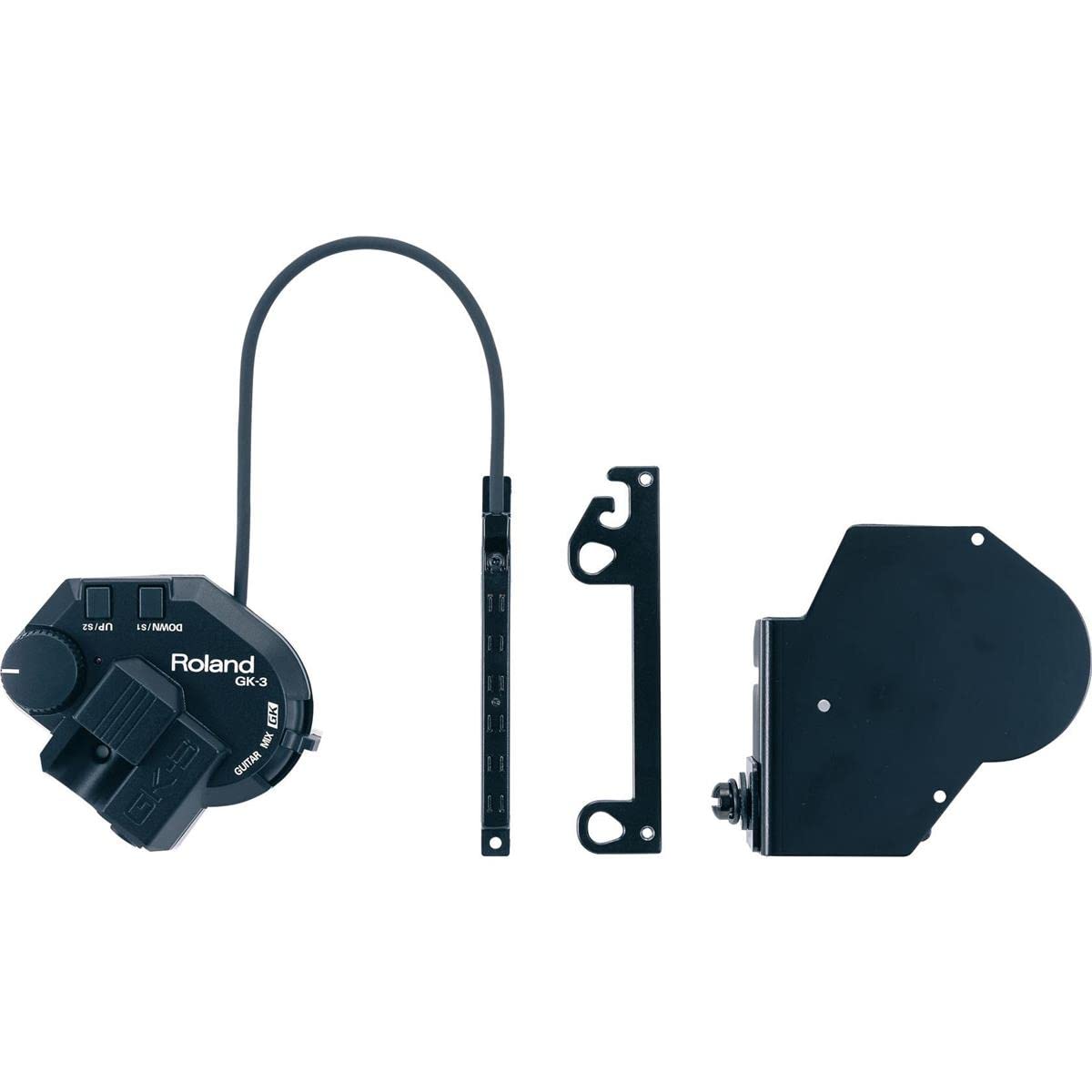
If you want your guitar to trigger synths, samplers, and soft-synths in your DAW, the thing that actually decides whether you will love or hate the setup is pitch tracking — how fast and how cleanly the unit turns a plucked string into a MIDI note. The Roland GK-3 Guitar Divided Pickup takes the top spot here because it is the pickup that most players bolt onto a guitar they already own. Its installation is straightforward, it works with guitar synthesizers by design, and the pickup itself has built a long reputation for reliability — 4.7 stars across 360+ ratings.
This guide is built by comparing the manufacturers’ published specifications and the patterns across verified customer reviews, so you get each pick’s real strengths and trade-offs instead of marketing spin.
Some options are pickups you mount on an existing guitar, some are standalone pedals that add synth tones through a normal cable, and some are full guitar-shaped controllers that need no guitar at all. This breakdown of the midi guitar category sorts them by how you actually play and where the setup friction really sits.
Top Picks

How To Choose The Best MIDI Guitar
The first fork in the road is not brand or budget — it is if you want to keep playing the guitar you already own. If you do, you are shopping for a divided pickup and a synth or interface to feed it. If you would rather skip the hardware entirely, a standalone pedal that adds synth tones through a regular instrument cable is the simpler path. The rest of this section walks through the handful of specs that decide whether the thing works on your rig.
Pickup or pedal — pick your path first
A divided pickup (also called a hex pickup) reads each of your six strings on its own separate channel. That per-string reading is what makes chords, bends, and slides translate into clean MIDI notes instead of a scrambled mess. A pedal like the BOSS SY-200 uses your normal guitar signal instead, so there is nothing to mount and nothing to wire under the strings. Pedals trade some tracking precision for a much faster setup.
String-to-pickup gap and saddle distance
Once you go the pickup route, mounting position stops being a detail and becomes the whole ballgame. Buyers working with the Roland GK-3 report that a 1mm string-to-pickup gap and 20mm saddle distance are the numbers to hit, and that tracking gets noticeably sloppier when those drift. Measure before you stick anything down.
Latency and connection type
Latency is the delay between your pick hitting the string and the synth note sounding. Anything you can feel under your fingers will throw off your timing, so the connection method matters: 5-pin MIDI and USB Type-C show up across these picks, and the Aeroband controller lists latency as low as 9ms over Type-C. Wired connections also sidestep the Wi-Fi hiccups that show up in some wireless setups.
Side-by-Side Comparison
| Model | Best For | Type | Connection | MIDI / Memory | Amazon |
|---|---|---|---|---|---|
| Roland GK-3 Guitar Divided Pickup★ Best Overall | Mounting on the electric you already own | Divided pickup | GK 13-pin, 1/4″ jack | Feeds external synth/MIDI I/O | Amazon |
| AEROBAND Black Full-Size Guitar-Shaped MIDI ControllerMost Versatile | Guitarists who want zero setup and no tuning | Guitar-shaped controller | USB Type-C | Latency as low as 9ms, universal MIDI | Amazon |
| Arturia KeyLab Essential mk3 49Top Performer | Producers who need keys, pads, and faders in one | 49-key USB keyboard controller | USB | 2000 presets, 6 user banks | Amazon |
| BOSS SY-200 Synthesizer Effects Pedal | Pedalboard players who want synth tones with no pickup | Standalone synth pedal | Micro USB, full MIDI I/O | 128 memories, 171 sounds | Amazon |
| PAINTAUDIO MIDI Captain Foot Controller | Hands-free control of DAWs, plugins, and synths | 10-switch foot controller | USB | 10 presets, PC/CC/Note messages | Amazon |
| Fishman TriplePlay Wireless MIDI Pickup | Wireless pickup-to-DAW players | Wireless divided pickup | USB, wireless MIDI | Class-compliant MIDI to software | Amazon |
| HeadRush Core Electric Guitar and Vocal Multi-Effects Pedal | Guitar-and-vocal rigs with amp cloning | Multi-effects processor | USB, Wi-Fi, Bluetooth, 5-pin MIDI | 350+ IRs, 1024/2048 sample lengths | Amazon |
| HOTONE Ampero II Stage | Deep amp modeling and IR loading on a budget stage rig | Multi-effects processor | USB, Bluetooth, MIDI I/O | 460+ effects, 12 effect modules | Amazon |
| Sheeran Looper X Multi Track Looper Workstation | Standalone multi-track looping with MIDI I/O | Looper workstation | USB, 5-Pin MIDI I/O/THRU | 99 layers per track, 7 hrs loop storage | Amazon |
Detailed Reviews
1. Roland GK-3 Guitar Divided Pickup
Our pick — over 4.5★ from 350+ verified ratings; the strongest balance of quality and price.
The pickup that turns the guitar already hanging on your wall into a synth controller.
Most players who go the MIDI guitar route want to keep playing the instrument they already love, not learn a new one. That is exactly what the GK-3 is built for: it mounts on any steel-stringed electric without damaging the finish, using an adhesive attachment plate rather than screws into your body. It ships with a dedicated plate for Les Paul-type guitars, so the angled top on that shape is covered from the start.
What earns it the top spot is the thing you cannot fake — reliability. Installation is the second most-discussed topic, and it is genuinely friendly: a buyer who had owned two earlier GK2A pickups described the newer mounting plate as a finish-friendly upgrade, and another who runs the GK-3 on a Les Paul noted how easy the install was. Buyers running Telecasters into a GR-09 synth have routed MIDI out to a DAW and made the guitar function as a full MIDI controller.
Here is the honest part. The GK-3 is not a standalone solution — you still need a Roland synth module (a “brain box”) and a separate MIDI interface to reach your computer. Budget for the pickup plus a synth module and MIDI interface — there is no shortcut around that spend. Tracking is also setup-dependent, and the plastic housing and 13-pin jack draw fair criticism for feeling less solid than the price implies. Get the mounting geometry right and it tracks cleanly — buyers working with this pickup report the 1mm string-to-pickup gap and 20mm saddle distance as the numbers to dial in before tracking smooths out.
Where it wins
- Mounts on any steel-stringed electric without damaging the guitar
- Adjustable curve design plus a Les Paul-type attachment plate included
- The most consistently praised pickup tracking in this group
- Easy install — buyers report finish-safe adhesive mounting
Where it asks patience
- Needs a separate synth module and MIDI interface to reach a DAW
- Won’t work on nylon-string guitars
- Plastic body and a 13-pin jack that isn’t rock solid
- Tracking accuracy depends on careful pickup-height setup
Grab this if: you already own an electric guitar you love and want it to speak MIDI without swapping instruments.
Don’t grab it for: a nylon-string classical guitar — this pickup is not compatible with that construction.
2. AEROBAND Black Full-Size Guitar-Shaped MIDI Controller
Full-size, no tuning, no drivers — it feels like plugging in a guitar that just happens to be a controller.
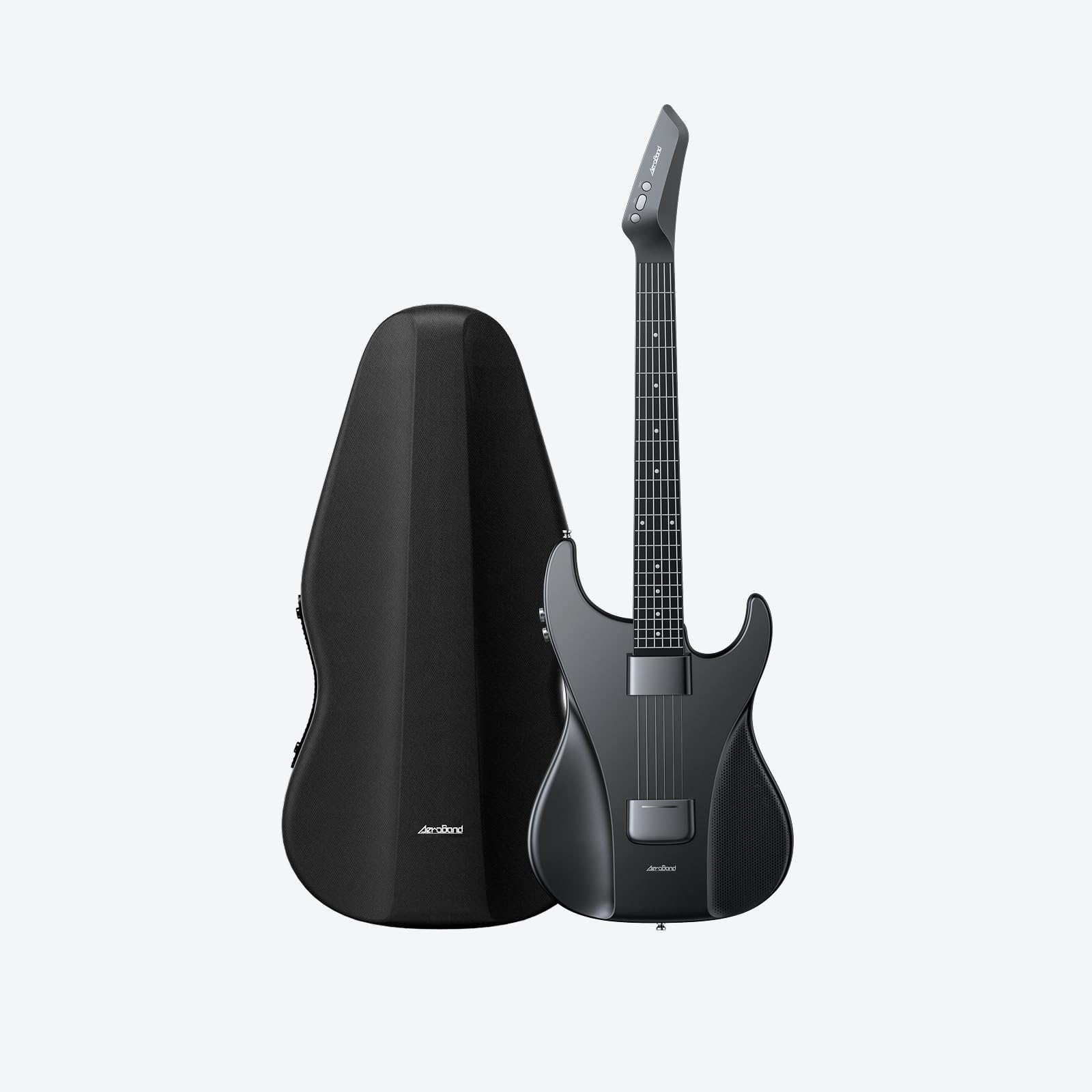
If you want zero setup, the Aeroband is the shortest path in this group. It plugs and plays, requires no tuning and no drivers, and works on both Windows and Mac from the start. Tracking runs on six-channel piezoelectric ceramic recognition — that is the pickup system reading each string individually — and the controller uses a full-size body under 40 inches long, so it hangs on your frame the way a real guitar does. The connection is USB Type-C, and the spec sheet lists latency as low as 9ms, which is the part that matters most for live feel.
Compatibility is broad, spanning mainstay DAWs including Logic, Cubase, and Studio One. The package includes a bag, which makes it easy to carry to a session. Owners describe it as fun and easy to play, and there’s more range here than the budget-controller tag might suggest. It’s also note that the controller shouldn’t be confused with the wireless pickup crowd — it does not need a brain box or a separate MIDI interface, unlike the pickup systems above.
The catch is that this is not a real guitar, and some buyers come in expecting one. The body and fretboard are ABS plastic, and one buyer called it an overpriced toy compared to a proper instrument with richer acoustic character. If you want acoustic guitar feel and tone, this controller won’t deliver it. If you want a controller that works the moment power is on, with no wiring under the strings, it earns its place.
Who it’s actually for: guitarists and producers who want MIDI notes from a guitar-shaped surface without the wiring and tuning ritual.
What to know going in: the ABS body is a controller, not an acoustic instrument — expect controller behavior, not instrument resonance.
Built for: anyone who wants a guitar-shaped controller they can unbox and play within minutes.
Look elsewhere if: you want natural guitar tone as well as MIDI output — the all-plastic build delivers controller output, not acoustic sound.
3. Arturia KeyLab Essential mk3 49 Key USB MIDI Keyboard Controller
The keyboard controller that gives you keys, pads, faders, and software in one box — and skips the guitar entirely.
You don’t need a guitar to make guitar-adjacent music, and the KeyLab Essential mk3 makes that case cleanly for players who want hands on a keyboard. The 49-key version carries 9 faders, 9 encoders, and 8 velocity- and pressure-sensitive pads, plus a bright 2.5-inch LCD for real-time feedback. Custom scripts run deep into Ableton Live, Logic Pro X, FL Studio, and more, so the hardware stays synced with whatever DAW you’ve already committed to.
Quality is the dominant note in owner feedback across hundreds of buyers, and it shows up in the mechanical feel — buyers describe the keybed as sturdy and the knobs and sliders as smooth and solid. The bundled Analog Lab V package includes 2000 presets that stretch well past vintage sounds into modern synths, orchestral voices, and hybrids. Six user programmable banks sit on top of two read-only banks, giving you plenty of room for custom configurations. Buyers routing into Akai Force, MPC One, and Roland MC 707 report it works as advertised once MIDI Learn is dialed in.
Worth knowing: this is a controller, not a synth, and it needs a computer or USB-MIDI host to make sound. Some buyers hit setup friction getting it talking to non-USB MIDI gear, and the keybed is non-weighted with no polyphonic aftertouch. It can’t stand alone as an instrument, but as a studio control surface for the money, few options at this level come close.
What earns it a slot
- 6 user programmable banks plus 2 read-only banks for presets
- 8 velocity- and pressure-sensitive pads handle drums and chord stabs
- 2.5″ LCD gives real-time feedback while you play
- Includes Analog Lab V with 2000 presets and two full pianos
Fair trade-offs
- Controller only — no built-in sounds without a DAW or host
- Non-weighted keybed, no polyphonic aftertouch
- Compatibility with some third-party host setups takes patience
Reach for this if: you want a single unit covering keys, pads, faders, and deep DAW control.
Look elsewhere if: you need a guitar-shaped instrument or a standalone sound source.
4. BOSS SY-200 Synthesizer Effects Pedal

Synth tones from a standard guitar cable — no hex pickup, no synth box, no wiring.
The SY-200 does something the pickup system above cannot do without extra gear: it triggers synth sounds using your regular guitar or bass signal. That means the pedal drops onto a board between your guitar and your amp, and you’re making notes almost immediately. Latency-free performance is the headline spec, and it holds up because the pedal isn’t translating your playing into MIDI — it processes the audio directly. Two onboard footswitches give real-time control, and the large display makes sound editing fast.
Sound quality is the runaway winner in owner feedback across 140+ ratings, with 24 counted notes — the biggest single thread by a wide margin. Ease of use is second, and buyers describe being able to play it right from the start without cracking the manual. The expanded sound set holds 171 sounds, drawn from 12 analog-style synth categories, with three adjustable parameters per sound for shaping. 128 memories let you store your favorites for stage use. BOSS also supports firmware updates over micro USB to keep the pedal current.
The honest note: the factory instructions are famously thin. Owners mention that the real variation lives inside each category — Customers note that the 171 sounds across 12 categories multiply into thousands of variations, but the manual never spells that out. Pair it with an external footswitch or expression pedal and you open up more live control, but the pedal itself is the source of the synth engine — no MIDI pickup required. If you already own a MIDI foot controller like the PAINTAUDIO below, the 5-pin MIDI I/O makes them a natural pair.
Tone without the hardware: 171 sounds across 12 analog-style synth categories, all triggered by a normal instrument cable.
Reading between the lines: the manual undersells the pedal’s real range — expect to learn the deeper options by ear and by foot.
Suits: pedalboard players who want classic synth character in their normal signal chain.
Less ideal if: you need full MIDI note-from-string translation — that’s the pickup crowd’s job, not this pedal’s.
5. PAINTAUDIO MIDI Captain Foot Controller

Ten programmable footswitches that put your whole rig — DAW, plugins, synths — under your feet.
A MIDI guitar setup still needs a way to fire commands without leaving the strings, and the MIDI Captain handles that with 10 footswitches, each fully customizable for PC, CC, and Note messages. The built-in Time Engine is the stand-out feature for live use: save a series of key actions once, and the controller replays them whenever you press again. If your setlist involves stacked effects changes, that’s a huge reduction in what your brain has to track mid-song.
Performance draws the most owner attention by a wide margin, with build quality close behind — the all-metal chassis and pedal-style footswitches come up repeatedly as the reason this holds up on a gigging board. There are 10 preset modes including JamUP, Bias, and AxFx, and PaintAudio has supported the platform with firmware updates, including a “Geek Mode” that open up 6 simultaneous PC/CC/Note codes per press or release, 16 banks, and on-device editing. Six user programmable banks cover Ableton Live, Headrush LooperBoard, and MX-5 rigs, and users say the controller is recognized instantly by most hosts.
Programming is the honest friction point. The text-file setup is genuinely daunting at first, and set up work in Geek Mode took several hours for one buyer working through five separate reviews’ worth of complexity. Windows users in particular report security-software conflicts during install, and a small number hit firmware update issues. Standard MIDI ports are also spaced too wide for common wireless adapters, so a cable gets stretched — a real annoyance but not a dealbreaker. Once configured, buyers consistently describe it as rock-solid.
What stands out
- 10 fully customizable footswitches for PC, CC, and Note messages
- Time Engine replays multi-action sequences from a single press
- All-metal build and pedal-style switches hold up gigging
- 16 banks in Geek Mode with on-device editing
What to brace for
- Text-based programming has a real learning curve
- Some Windows setups hit security-software conflicts during install
- MIDI port spacing can stretch cables with wireless adapters
- No internal battery — needs 9V, USB, or AA power options
For hands-free players: guitarists who want their whole rig underfoot and are willing to learn the programming once.
Not the pick if: you want a controller that works from the start with zero setup time.
6. Fishman TriplePlay Wireless MIDI Pickup
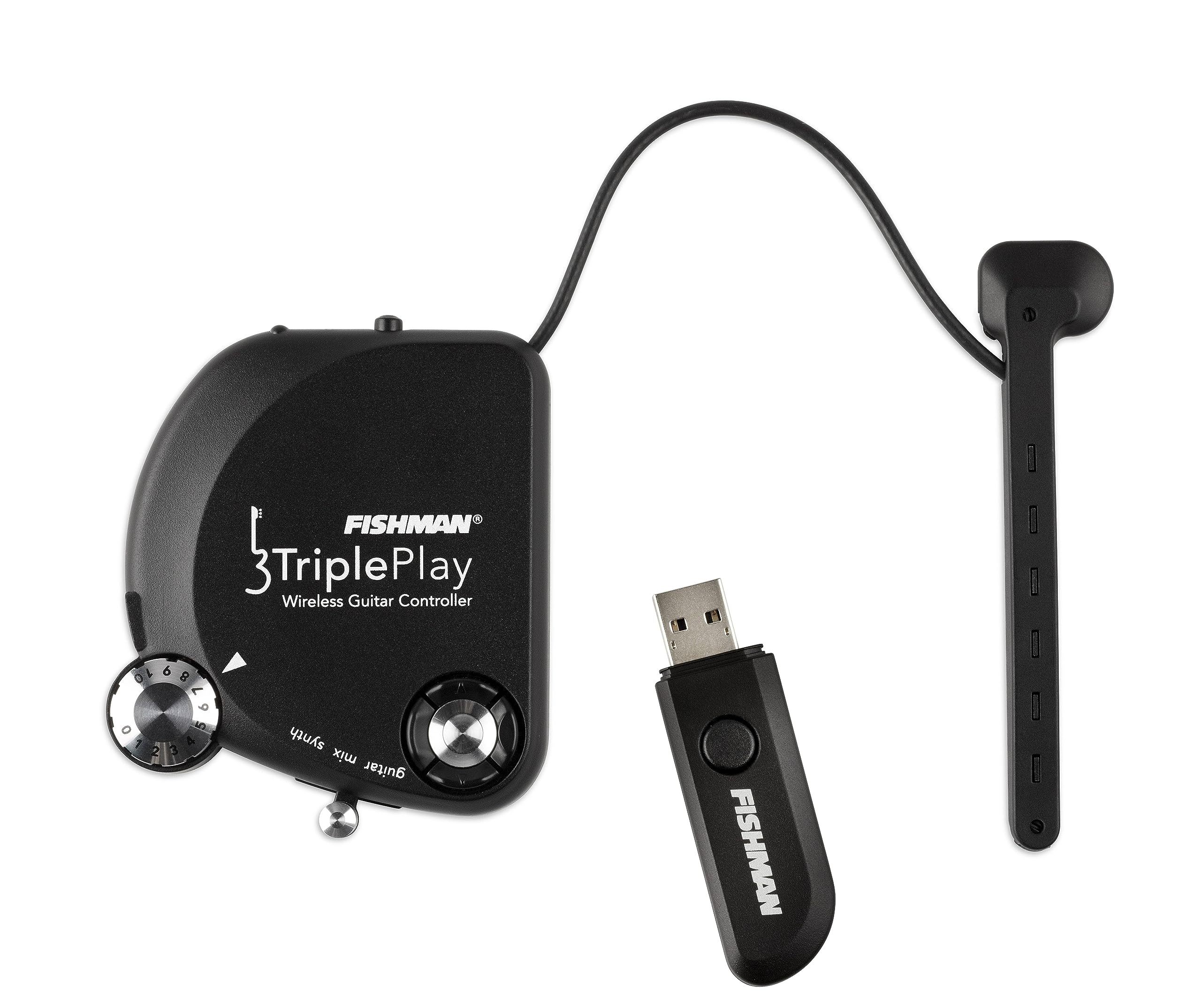
The pickup that skips the wire entirely — no hex cable under the strings, MIDI straight to your software.
Where the Roland option above tethers you to a synth box, the Fishman TriplePlay cuts that cable. It mounts on most 6-string guitars and sends MIDI wirelessly to your computer or mobile device, with a hand-position technology the manufacturer says eliminates ghost notes. Tracking gets the strongest owner response in this group by a wide margin — it’s the aspect buyers praise most — and several describe it as outperforming Roland’s GR series on speed. Chords, leads, and arpeggios land cleanly once the pickup is dialed in.
Compatibility is broad: it works with Logic, Cubase, Digital Performer, GarageBand, Ableton Live, and anything else accepting class-compliant MIDI. It fits a Fender strat-style Showmaster body, but reviewers point out it won’t fit a PRS Custom 24, a Gibson ES-335, or various Jackson models — check your bridge and body shape before ordering. Once the pickup height is tuned, buyers describe the tracking as spot-on, and the included software suite gives you immediate integration with existing plugins.
Where it draws fire is the software side. Installation is by far the most-discussed topic in owner feedback, and much of it is negative: the installer forces the system drive, help links in the GUI are broken, and the ASIO driver can disable other devices on Windows. A small number of shoppers say severe lag on certain Windows hosts and chord detection that misfires as random notes. This is a specialist tool — if you’re willing to invest the setup time and your rig matches the fitment, the wireless tracking payoff is real. If you want something that installs cleanly in under an hour, look at pedal or controller options instead.
The wireless breakthrough: no hex cable, no brain box, MIDI straight to your DAW from the guitar itself.
What buyers keep flagging: installation and software setup, which dominate the review pages — the hardware is easy, the software is not.
Get this if: you’re comfortable with software setup and want the cleanest physical install of any pickup in this group.
skip it if: your guitar is a PRS Custom 24, Gibson ES-335, or Jackson — the pickup may not fit that body shape.
7. HeadRush Core Electric Guitar and Vocal Multi-Effects Pedal
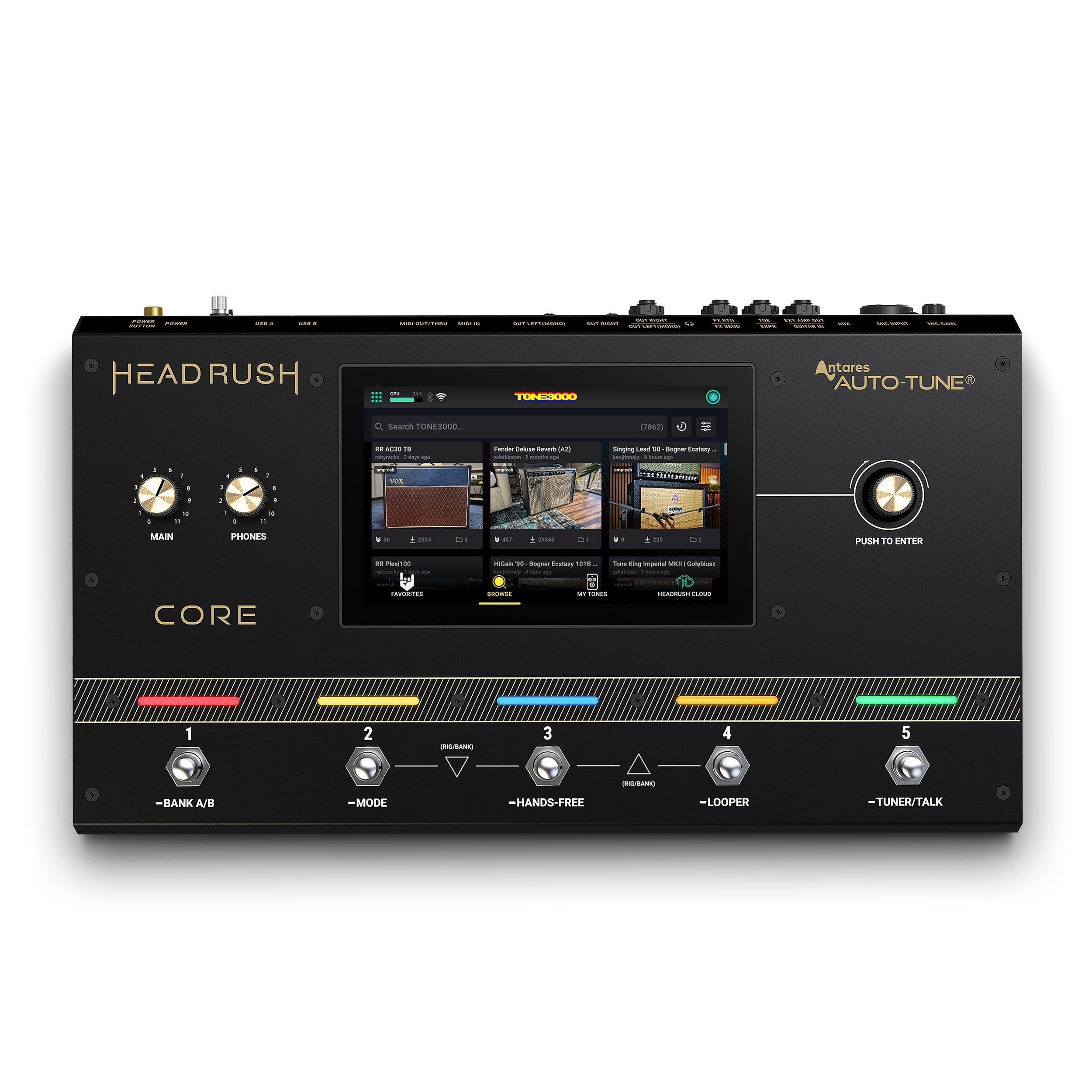
The kitchen-sink rig: amp cloner, vocal processor, drum machine, and looper in a single steel-chassis unit.
This is the deepest single-box rig on the list. The HeadRush Core runs a 7-inch hi-res touchscreen over a multi-core processor, and the trick that separates it from most modelers is the onboard Smart Amp Cloner — capture the dynamic response of your favorite amps, pre-amps, or drive pedals and store the clone on the device, sharing it through the HeadRush Cloud over Wi-Fi. Add 350+ factory IRs (impulse responses, the speaker-cab profiles that shape tone) plus support for your own third-party IRs at 1024 and 2048 sample lengths, and you have more tonal shaping than most rigs ever touch.
Vocal processing is where this earns the price for many buyers, thanks to integration with Antares Auto-Tune for live pitch correction. Guitar and vocal process on the same unit, with 5 customizable footswitches handling both. A built-in drum machine offers 16 kits and 134 patterns by Alesis Drums/BFD, with MIDI sync over 5-pin I/O to lock to your DAW. Quality ranks highest in owner feedback across 570+ ratings, with sound quality second — buyers describe realistic amp and cab models with deep, intuitive tone-shaping, and the response to playing dynamics gets repeated praise.
Two things to plan for: it’s not plug-and-play, and the initial setup takes a manual read. Wi-Fi has been reported as occasionally finicky, with some buyers preferring a phone hotspot connection. The occasional rig-switching delay also comes up. Neither is a fatal flaw — this is pro-level gear for the money, and 3-year extended warranty coverage is a recommended add-on given the amp-cloning workflow and extensive feature set. It’s also note that unlike the Fishman pickup above, this pedal has nothing to do with guitar-to-MIDI-note translation; it processes audio and drives MIDI out.
What makes it deep
- Smart Amp Cloner captures and shares real-rig tones via HeadRush Cloud
- Antares Auto-Tune for vocals, on the same unit as guitar FX
- 350+ IRs plus support for 1024 and 2048 sample lengths
- 16 drum kits, 134 patterns, 5-pin MIDI I/O for sync
Setup notes
- Not plug-and-play — expect to read the manual before the first session
- Wi-Fi has been reported as occasionally finicky
- Rig-switching delay observed by some buyers
Singers and players in one box: 5 customizable footswitches manage both vocal processing and guitar effects on the same board.
Sits right with: gigging guitarists who also sing and want amp cloning, vocal tuning, drums, and a looper in one case.
Best passed on if: you want to string-to-MIDI-note translate — that’s a pickup job, and this pedal handles audio processing, not note tracking.
8. HOTONE Multi-Effects Pedal Ampero II Stage

Twelve effect modules running at once, plus amp modeling and IR loading, in a unit that sounds bigger than its price tag.
The Ampero II Stage runs a triple-core digital platform with ESS Sabre AD/DA converters (the chips that convert analog sound into digital and back) and 24-bit signal processing with up to 127dB of dynamic range. The effects library lands at 460+ effects across 12 simultaneous effect modules per patch. 20 classic Celestion speaker IRs come loaded, and support for 2048 IR sampling points means third-party cab captures load at high resolution. The brand-new Scene feature lets each patch hold up to five scenes with smooth sound transitions during a song.
Sound quality is the most praised aspect in owner feedback, with modulation quality a close second — buyers who’ve gigged it alongside Neural DSP Quad Cortex describe it as comparable in quality and sound, if less DSP horsepower from its triple-core vs the Quad Cortex’s four-core. Ease of use earns top marks too: patch creation is fast, Bluetooth handles band-automation, and the desktop editor gets the job done. A 5-inch dynamic touchscreen with the new system UI keeps navigation simple, and 10 additional footswitch toppers ship in the box for quick visual indexing under stage lights.
Two real snags. Windows PC installation requires special security software and an app for loading custom IRs, and the process conflicts with some PC security suites — Mac is the friendlier install. A few buyers also find the unit noisy in certain rigs and lean on the built-in noise filters to clean it up. The Stage has no built-in expression pedal, though it supports an external one; that’s the trade-off for the 1.5 kg footprint.
The packaging story: 12 effect modules per patch, 460+ effects, and 20 Celestion IRs come standard — an embarrassment of low-end depth for a stage pedal this size.
Smart pairing: MIDI I/O over USB plus Bluetooth means this works alongside a dedicated foot controller like the MIDI Captain for hands-free control of a full rig.
Reach for it if: you want deep amp modeling and IR loading without paying flagship-rig prices.
pass on it if: you’re on Windows and don’t want to deal with the security-software install path — Mac users have the smoother ride.
9. Sheeran Looper X Multi Track Looper Workstation

A standalone 4-track looping workstation with real MIDI control — no computer needed to build a full arrangement.
The Looper X earns its place here because it is a MIDI-controllable workstation, not just an effects loop. It accepts incoming MIDI CC (control change messages, which trigger parameter changes from an external controller) or MIDI Note messages over USB-A or the 5-pin MIDI in, so a foot controller like the MIDI Captain above can drive it while your hands stay on the strings. It also can’t be missed that the unit ships with 8 stadium-grade die-cast aluminum pedals — the same construction language that lives on Ed Sheeran’s touring rig — with an RGB LED system for stage visibility.
Inside, the Looper X holds 5 looping modes (Multi, Sync, Song, Band, Free), up to 4 tracks per loop, 99 layers per track with unlimited loop lengths, and over 7 hours of loop storage that you can save, load, and drag-and-drop without extra software. The 7-inch multi-touch display drives the SHEERAN LOOPER workflow, and 26 individual FX plus 9 Multi-FX racks powered by HeadRush give the loops somewhere to go. It also functions as a 2-in/2-out 24-bit audio interface over USB, so recording straight to a DAW or streaming via USB takes no extra hardware.
One reviewer noted the touchscreen failing after barely using the unit, and another flagged that it doesn’t MIDI-sync with some other loopers — worth verifying before you commit if sync is a workflow requirement. Buyers describe it as the best on the market for build quality and ease of use, and its feature set puts it in a different class from a small loop pedal.
What you get onstage
- 5 looping modes and up to 4 tracks per loop with 99 layers each
- 7 hours of onboard loop storage plus drag-and-drop loop transfer
- External MIDI CC or Note control via 5-pin MIDI or USB-A
- Doubles as a 2-in/2-out 24-bit USB audio interface
Weigh this first
- 7.3 kg — desktop or studio piece, not a grab-and-go pedal
- Touchscreen reliability has drawn reports in the review pages
- MIDI sync with other loopers is not universal — check before planning around it
- 7″ workflow has a learning curve if you’re new to multi-track looping
Pairs with: solo artists and loopers who want a workstation that drives via MIDI CC from an external foot controller.
Think twice if: you need guaranteed MIDI sync to a second looper — this unit’s sync behavior with other loopers is inconsistent in reports.
Know the Specs
Pickup type — divided vs single-coil
A divided pickup, also called a hex pickup, reads each string on its own separate channel. That per-string reading is what makes chords, bends, and slides land as clean MIDI notes instead of a scrambled mess. Single-coil designs read the whole six-string signal at once, which is fine for audio but loses the per-note precision MIDI needs. Solutions like the Roland GK-3 use a hex design; solutions like the BOSS SY-200 sidestep MIDI translation entirely by processing audio directly.
Latency and connection type
Latency is the delay between your pick hitting the string and the synth note sounding. Under 10ms is imperceptible for most players, and the Aeroband controller lists latency as low as 9ms over USB Type-C. Wired connections — 13-pin GK on the Roland, USB on the PaintAudio, 5-pin MIDI across the pedals — tend to be more stable than wireless. The Fishman TriplePlay’s wireless MIDI is the trade-off: it skips the hex cable, but setup on the software side has to be earned.
String-to-pickup gap and mounting
Once a hex pickup is on your guitar, the distance from each string to the pickup element becomes the whole ballgame. Buyers working with the Roland GK-3 report that a 1mm string-to-pickup gap and 20mm saddle distance are the numbers to hit, and that tracking gets noticeably sloppier when those drift. Measure before you stick anything down, and check that your bridge and body shape can accommodate the pickup before ordering.
MIDI I/O and memory
For live use, how many sounds you can store and recall without a laptop matters more than the size of the raw sound count. The BOSS SY-200 holds 128 memories and 171 sounds; the HeadRush Core ships with 350+ IRs; the HOTONE Ampero II Stage carries 460+ effects. MIDI connections vary too — 5-pin MIDI (standard round connector) shows up on the Fishman, the HeadRush, the looper, and the HOTONE, while the PaintAudio runs PC/CC/Note messages over USB. Match the I/O to your rig before you buy.
Common Questions
What is the difference between a MIDI pickup and a MIDI guitar controller?
Will the Roland GK-3 work on an acoustic or nylon-string guitar?
Do I need a separate synth module to use a MIDI pickup?
What string-to-pickup gap should I set for accurate MIDI tracking?
Is wireless MIDI tracking as good as a wired pickup system?
Can the Aeroband MIDI Guitar replace a real guitar?
How much setup time should I budget for a MIDI guitar rig?
Do I need a computer to use a MIDI guitar?
What is the fastest way to get synth sounds from a guitar without a synth module?
Can I control a DAW like Ableton or Logic with these MIDI devices?
The Bottom Line
For most players, the midi guitar winner is the Roland GK-3 Guitar Divided Pickup because it mounts on the guitar you already play without damaging it, and it does the one thing that matters most in this category — turn string movement into clean note data. Pickups feel the guitar you already love; controllers skip the setup ritual entirely. If you want synth tones through a regular instrument cable with no wiring at all, the BOSS SY-200 is the one to reach for. For hands-free foot control of your whole rig, the PAINTAUDIO MIDI Captain puts it under your feet. And if you want a keyboard, pads, and deep DAW integration in one piece, the Arturia KeyLab Essential mk3 49 covers more surface than anything else here.
How we choose
We do not accept paid placement. Every pick is matched to a real buyer and a real use-case; we do not hands-on test units.
Sources
Specifications: manufacturer listings and product documentation. Review insights: verified customer reviews, as of October 2026. Pricing: not shown on this page (it changes often); check the current price via the retailer link.
As an Amazon Associate, Aappliancez earns from qualifying purchases. This does not affect which products we feature.