Disclosure: Some links in this post are affiliate links. As an Amazon Associate I earn from qualifying purchases, at no extra cost to you. Learn more
Specs are compiled from manufacturer listings and verified buyer reviews and can change over time — please confirm the key details on the product page before buying.
A mid level AV receiver is the box that decides whether your speakers sound expensive or cheap. Buy the wrong one and your movie nights stay flat, your 4K TV downscales, and your turntable sits silent. Buy the right one and your 7.2-channel Atmos layout plays clean at reference volume.
This guide is built by comparing the manufacturers’ published specifications and the patterns across verified customer reviews, so you get each pick’s real strengths and trade-offs instead of marketing spin.
Channels, watts per channel, and HDMI version are the three numbers that matter most. Get those right and the rest falls into place, which is exactly what this breakdown of the mid level av receiver category is built to help you do.
Top Picks

How To Choose The Best Mid Level AV Receiver
The biggest mistake buyers make in this category is shopping by brand name instead of by channel count and HDMI version. A receiver with the right logo and the wrong ports will leave your new console stuck at a lower frame rate.
Start with channels, not watts
Channels tell you how many speakers and subwoofers the receiver can drive at once. A 5.2 receiver runs five speakers and two subwoofers. A 7.2 receiver runs seven speakers. A 9.2 receiver steps up again for larger Atmos layouts with ceiling speakers.
If you have four speakers and one subwoofer today but plan to add height speakers for Dolby Atmos later, a 7.2 receiver gives you the room to grow. Buying 5.2 and then wanting Atmos means buying again.
Understand what watts per channel means for your speakers
Watts per channel (W/ch) tells you how much power the amplifier sends to each speaker. More watts usually means more headroom — the ability to play loud without distortion or clipping. The number is quoted at a stated impedance (the electrical load the speaker presents) and distortion level, so compare like for like: a figure measured at 8 ohms across the full 20 Hz to 20 kHz range is stricter than one measured at 1 kHz.
Pair high-watt receivers with speakers that can handle the power, and low-watt designs with efficient speakers. A 50 W/ch receiver driving sensitive bookshelf speakers can sound fuller than a 150 W/ch receiver pushing hard into demanding floorstanders.
Match HDMI to your TV and console
HDMI 2.1 with 8K/60Hz and 4K/120Hz passthrough matters if you own a PlayStation 5, Xbox Series X, or a new 8K TV. Older HDMI 2.0 ports cap the signal and can cause black screens when you push refresh rates. eARC (enhanced Audio Return Channel) sends high-quality audio back from your TV to the receiver on a single cable, so check the output supports it.
Room calibration separates good from great
Calibration systems like Audyssey, Dirac Live, and YPAO measure your room with a microphone and apply EQ filters so the sound fits your space. Audyssey, Dirac Live, and YPAO measure your room with a microphone and apply EQ filters, which typically changes dialogue clarity and bass control more than swapping speakers does. Include a calibration microphone in your shortlist criteria — every pick below ships with one.
Side-by-Side Comparison
| Model | Best For | Channels | Power Per Channel | HDMI Inputs | Amazon |
|---|---|---|---|---|---|
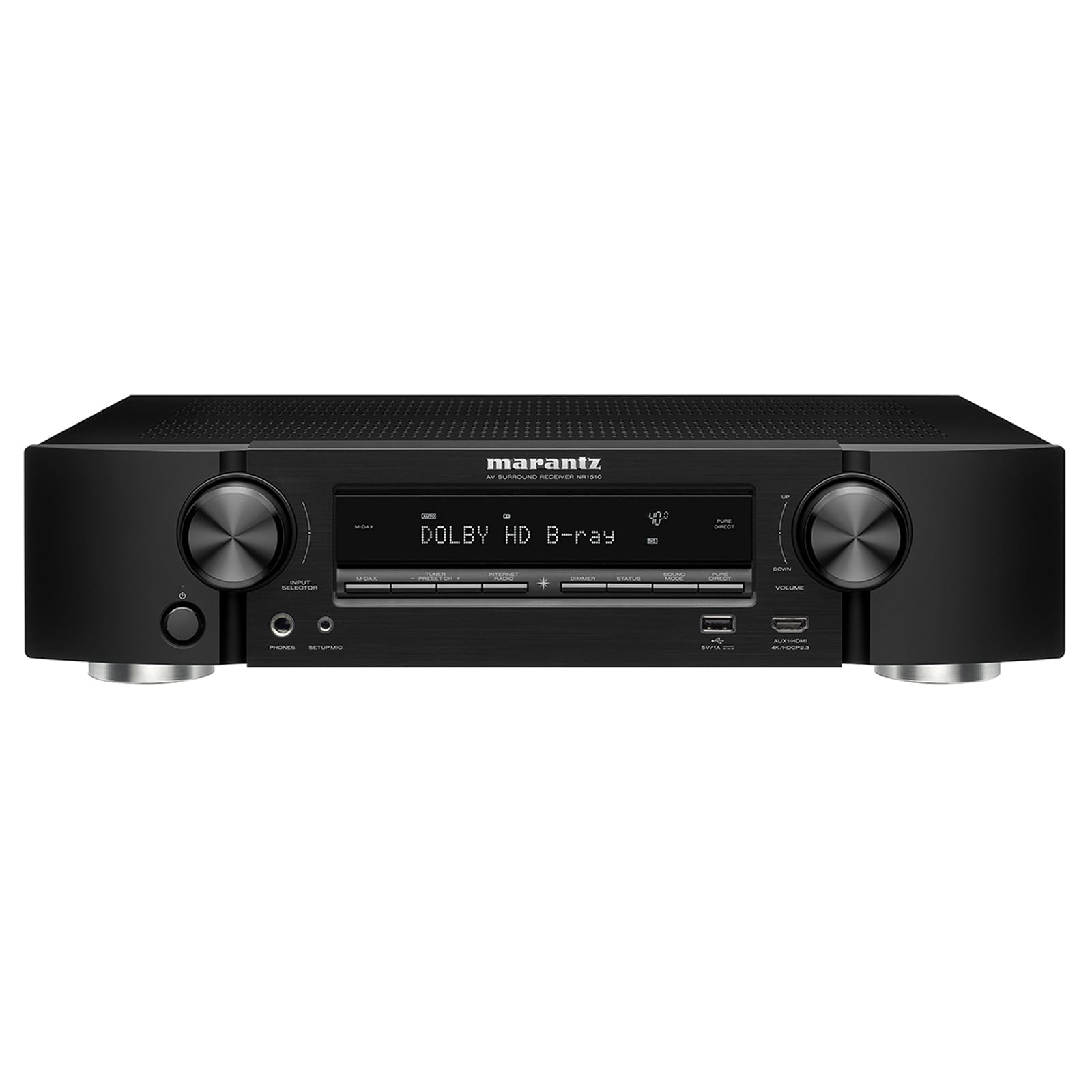
| Marantz NR1510★ Best Overall | Small spaces and music-first setups | 5.2 | 50 W | 6 | Amazon |
| JBL MA310Budget Champion | Budget home theater starters | 5.2 | 60 W x 5 | 4 | Amazon |
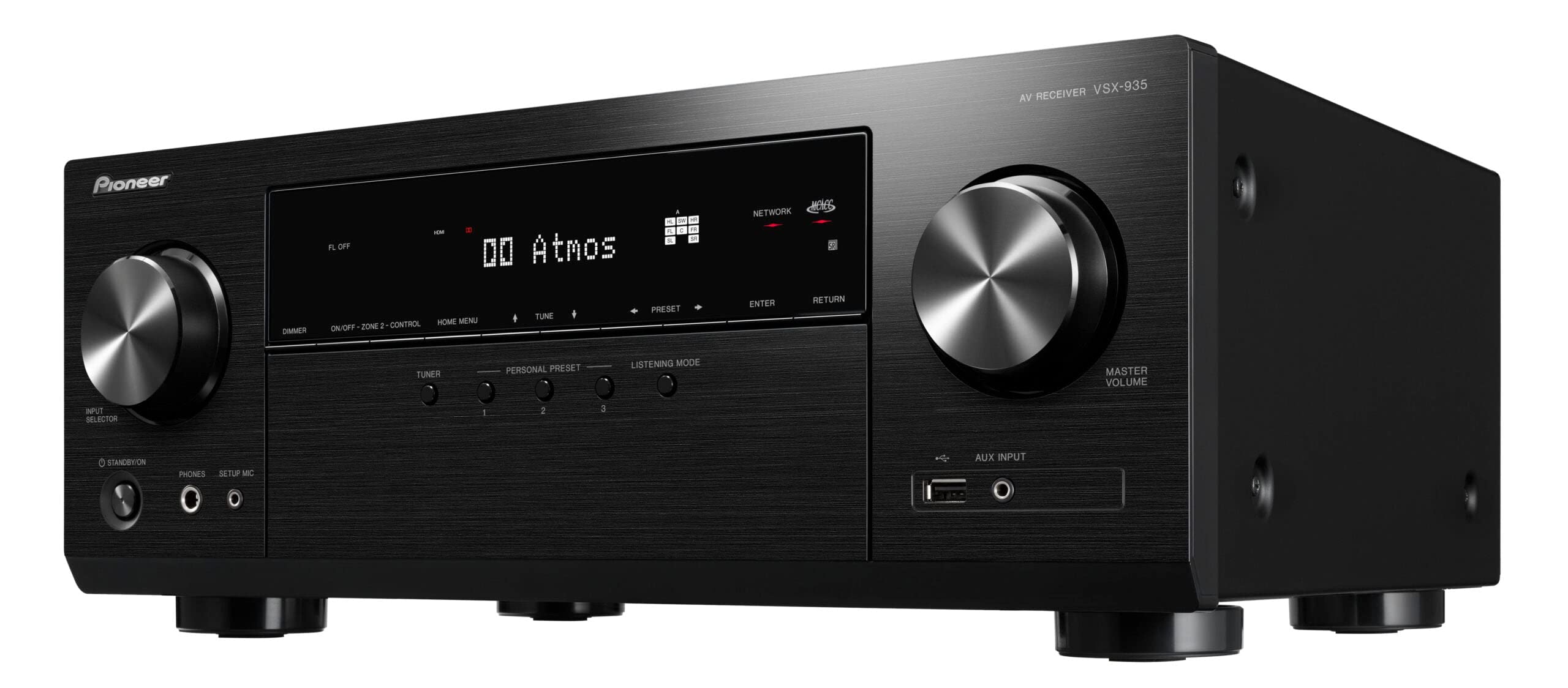
| Pioneer VSX935Top Performer | Loud room-filling cinema sound | 7.2 | 170 W | — | Amazon |
| Denon AVR-S770H | 8K-ready flexibility | 7.2 | 75 W x 7 | — | Amazon |
| Onkyo TX-NR6100 | THX cinema certification | 7.2 | 210 W/Ch | — | Amazon |
| Yamaha RX-V6A | Multi-room MusicCast homes | 7.2 | — | 7 | Amazon |
| JBL MA710 | Slim footprint, big sound | 7.2 | 110 W x 7 | 6 | Amazon |
| Onkyo TX-NR7100 | rich 9.2 Atmos rigs | 9.2 | — | — | Amazon |
| Denon AVR-S970H | Mid-size rooms with 8K | 7.2 | 90 W x 7 | 6 In / 2 Out | Amazon |
| Yamaha RX-A2A | Premium build, Zone 2 flexibility | 7.2 | — | 7 | Amazon |
| Sony STR-AN1000 | 360 Spatial Sound Mapping fans | 7.2 | 165 W | 6 In / 2 Out | Amazon |
Detailed Reviews
1. Marantz NR1510 Slimline AV Receiver
Our pick — 4.0+★ from 300+ verified ratings; the strongest balance of quality and price.
Half-height chassis, full-size character — the receiver for shelves where nothing else fits.
Space is the problem this receiver solves. At 14.5″D x 17.3″W x 4.1″H it stands roughly half as tall as a traditional AV receiver, so it slides into a cramped media console that full-size models cannot enter. That slim body still carries a high-current discrete amplifier rated at 50 watts per channel across all five channels, feeding a 5.2 speaker layout with two subwoofer outputs.
The sound is the draw here. Marantz tunes this model by ear as much as by measurement, and the warm, musical character comes through whether you are spinning vinyl through the phono input or streaming Spotify, TIDAL, and Amazon Music HD over HEOS. Audyssey MultEQ measures your room and applies per-channel filters so the dialogue stays centered and the bass stays controlled.
What wins people over most is how much receiver this is for the footprint — the software experience earns the strongest praise of any aspect, with sound quality close behind. As owners put it, this is “a great receiver in a compact size with all the bells and whistles.” Setup is straightforward once HDMI ARC is connected, and the auto speaker calibration takes the guesswork out of levels. Two honest notes: it runs warm and wants breathing room around it, and the on-screen setup menus require a connected TV or monitor — you cannot configure it blind.
What earns it the top spot
- Half-height chassis fits shelves that reject full-size receivers
- Six HDMI inputs — two more than the JBL MA310
- HEOS streaming plus a phono input for vinyl setups
- Audyssey MultEQ room calibration included
Where it asks something of you
- 50 W per channel is the lowest power figure here — efficient speakers matter
- Runs warm and wants ventilation around the chassis
- Needs a TV or monitor connected for setup
Built for: compact living rooms, apartments, and music-first listeners who stream more than they game.
Worth knowing: five channels means no ceiling-speaker Atmos expansion later — if that is the plan, look at the Onkyo TX-NR7100.
2. JBL MA310 5.2 Channel (60 Watt x 5) 4K AV Receiver (Black)
The warm-sounding entry ticket that makes a first surround setup sound deliberate.
For a first step into real surround sound, this is the one that keeps the damage low without sounding like a compromise. The amplifier is rated at 60 watts across five channels, running a 5.2 layout with two subwoofer outputs.
Owners describe the tone as warm and round, closer to an old-school amplifier than a clinical digital box, and mention hearing the digital upscaling working on lower-resolution sources. Bluetooth v5.1 streams wirelessly from your phone, and the app includes an EQ so you can tune the sound to your room without a separate calibration microphone.
The one catch is documentation and future-proofing. There is very little online support material, and the HDMI ports are 4K60Hz only — if you push a next-gen console to higher refresh rates, you may see black screens. The setup also has a learning curve: all the meaningful tweaks live in your TV’s menu rather than the receiver’s own display. That said, the build quality and crisp sound are what get noticed most here, and most buyers land on it as excellent value for a first AV receiver.
Sound character: warm and full-bodied rather than sharp — reviewers compare it to the smooth house sound of older amplifiers.
Trade-off to accept: 4K60Hz HDMI caps the ceiling. If you own a PS5 or Series X and want 120Hz, the Denon AVR-S770H or Yamaha RX-V6A are the better-matched picks.
Reach for this if: you are building a first 5.2 system with mid-price speakers and want a low-risk entry.
Look elsewhere if: your TV and console both demand HDMI 2.1 at 4K/120.
3. Pioneer VSX935 7.2 Channel Network AV Receiver
When you want the loudest, most speaker-hungry 7.2 receiver on the shortlist.
If raw power per channel is your priority, this one wins outright. Pioneer rates the VSX935 at 170 watts per channel, and the next-highest wattage on this list — the Marantz NR1510 — sits at 50 W. That is a 3.4x gap in rated power, and it shows up when you run large floorstanding speakers at loud volumes without the amp running out of steam.
Channel count is 7.2, versus 5.2 on the Marantz and JBL MA310. That extra pair of channels lets you run a full Atmos layout with height speakers or an extra stereo zone in a neighbouring room. The height virtualization feature fakes overhead sound when you cannot install ceiling speakers, and the receiver supports Dolby Atmos, DTS:X, and Dolby Surround Upmixer for turning stereo tracks into surround.
The audio itself is the hero, but the install is the weak link. Speaker wire connectors are placed awkwardly, and the auto room correction leaves something to be desired from the start — manual calibration is what brings the best out of it. Bluetooth is the other sore spot; a handful of owners find two-way Bluetooth flaky and buried in menus. Most buyers still land happy, praising the sound output and the easy hookup for a first-time amplifier swap.
Headline spec: 170 W per channel delivers headroom that keeps loud passages clean in a large room.
Do not skip: budget time for manual speaker setup. Auto calibration is a starting point, not the finish line here.
Best fit: big rooms, inefficient floorstanding speakers, and buyers who want volume without strain.
Think twice if: you rely on Bluetooth streaming and want zero menu-diving to use it.
4. Denon AVR-S770H Home Theater Receiver

The future-proof pick for anyone buying a receiver alongside a new 8K TV.
Here is the receiver you buy when the TV is newer than the receiver. It passes 8K/60Hz and 4K/120, supports VRR, ALLM, and QFT for frame-tear-free gaming, and handles every modern HDR format including HDR10+, Dolby Vision, and Dynamic HDR. The 75W x 7 amplifier drives a 7.2 layout or a 5.2.2 Atmos arrangement if you want ceiling effects.
Room correction comes courtesy of Audyssey with a bundled microphone and cardboard stand. Virtualization gives you overhead-style sound in a plain 7.1, 5.1, or even 2.1 setup without installing height speakers — a real benefit for renters. HEOS streaming plus Bluetooth and Wi-Fi push music to other rooms, and voice control via Alexa keeps the remote in your lap.
You will need patience with the menus. Buyers describe the advanced menus as overwhelming at first, and the remote layout takes time to learn. On the plus side, buyers praise the sound quality, setup process, and number of inputs — one buyer called it “rich surround sound effects.” The recurring gripe is HEOS (the built-in music streaming system) channel switching from the remote occasionally dropping audio. If you want room to grow, this receiver gives you that.
Why buyers reach for it
- 8K/60Hz and 4K/120 passthrough keeps a new TV happy
- VRR, ALLM, and QFT for lag-free console gaming
- Audyssey room correction with microphone included
- Dolby Height Virtualization adds overhead effects in plain setups
Adjust your expectations on
- Advanced menu system runs long — plan an evening for setup
- Remote layout takes learning
- Occasional HEOS remote-control audio dropout
Right for: new-8K-TV owners who want the receiver to match the display for years.
Not ideal if: you prefer simple menus and one-button operation over deep configuration.
5. Onkyo TX-NR6100 AV Receiver
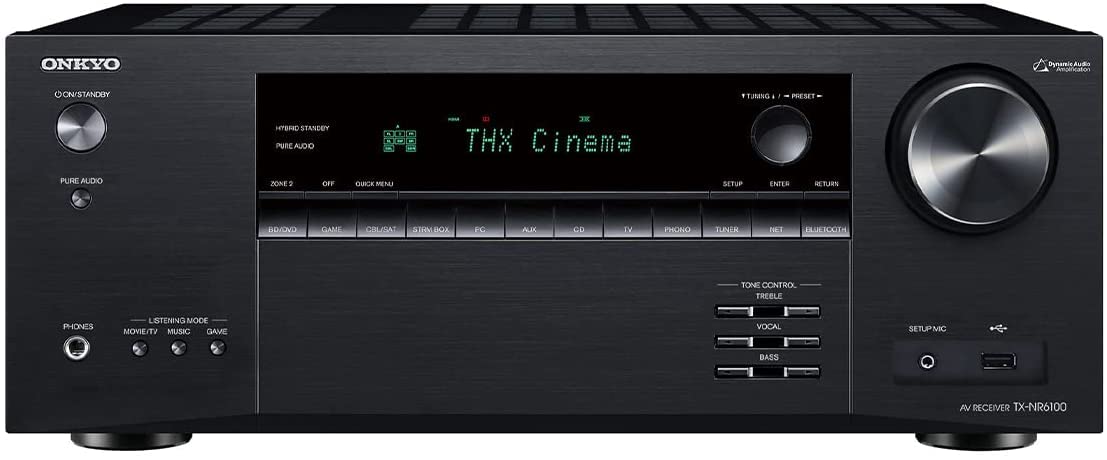
THX Select certified, with 210 W/Ch of Dynamic Audio Amplification for large floorstanding speakers.
THX Select certification is not just a sticker — it means the amplifier was tested against a reference standard for cinema-level output in rooms of a certain size. Onkyo pairs that with 210 W/Ch of Dynamic Audio Amplification and a 5.2.2-channel Dolby Atmos and DTS:X playback layout. Eight HDMI ports let you connect practically everything you own, and 8K passes through HDMI 2.1 at 40Gbps on three dedicated inputs.
The AccuEQ room calibration is the detail that wins the most praise — it is a fast, accurate way to get your speakers working together without a long setup session. The surround processing handles Atmos and DTS:X with well-placed effects, and the discrete Zone 2 audio and video output lets you push a second source to another room.
Two things to plan around. The amp delivers clean, neutral power, but it is honest rather than generous about the bass — some buyers report it feels underpowered for larger speakers, and a few software bugs (hangs that need a hard reset) have shown up. The upside: the sound is accurate and the setup menu is straightforward, which is why it is one of the best value picks in this category.
Biggest strength: THX-certified amp and outstanding room calibration in a single box.
Worth knowing: several owners mention the power is honest rather than abundant — if you drive inefficient speakers at reference levels, step up to the TX-NR7100.
Choose this if: THX validation matters and you want the calibration done with a few button presses.
Consider the step up if: your speakers are big, inefficient beasts that demand power in reserve.
6. YAMAHA RX-V6A 7.2-Channel AV Receiver with MusicCast

MusicCast puts every room in the house under one streaming app.
If you want one app controlling music in every room, MusicCast is the reason to shortlist this receiver. It pairs seven HDMI inputs (three of which handle 8K60 or 4K120) with a 7.2-channel amplifier, two subwoofer outputs, and Wi-Fi, Bluetooth, AirPlay 2, Spotify Connect, and voice control with Alexa, Google Assistant, or Siri. Dolby Atmos, DTS:X, Dolby Vision, HDR10+, and Hybrid-Log Gamma round out the format support.
YPAO R.S.C. multipoint room calibration (a system that measures sound at several seats, not just one) balances audio across a whole couch instead of a single balance. In a living room, that means everyone hears the same quality, not just the person in the middle.
What gets praised most is the build quality and the sound — buyers describe it as magnificent and reliably musical across movies and multi-room audio. The catch is the setup experience. Connection for Bluetooth and internet radio leans heavily on the app, and the built-in display is not helpful for deep menu work. Several owners have noted a need for current firmware and occasional Bluetooth dropouts, and unlike some competing receivers it does not auto power-on via eARC, though the TV remote will still control volume once it is running.
Streaming ecosystem: MusicCast spans the house, with Spotify, TIDAL, Qobuz, and Amazon Music HD on tap.
App dependency: count on the phone app for wireless setup and internet radio — this receiver likes to be managed remotely.
Ideal for: households that want one streaming system across the living room, kitchen, and patio.
Skip if: you prefer a physical remote and front-panel display over a phone app for everyday use.
7. JBL MA710 7.2 Channel (110 Watt x 7) 8K AV Receiver (Black)

Big-channel power in a chassis slim enough for a tight media shelf.
Seven channels, 110 watts per channel, and a shallow 4.3-inch-tall body — the JBL MA710 crams serious amplification into a footprint that many AV receivers cannot match. Six HDMI inputs plus one output with eARC feed a smart TV, a console, and several streaming devices without a switch box. Dolby Atmos and DTS:X processing supports up to 7.1 or 5.1.2 layouts, and a moving-magnet phono input lets a turntable plug straight in.
Wireless streaming covers Bluetooth plus Apple AirPlay 2 and Google Chromecast, so music gets to the receiver from nearly any phone. Buyers describe the sound as crisp and clear with sharp styling to match, and the white finish turns heads in a visible rack.
The honest caveat is reliability history compared with the rest of this list. A small number of early units have failed within months, and firmware updates have fixed several niggles — screen blanking on certain source switches has been reported. Menus are simple and the footprint is genuinely small, but if long-term confidence matters most, the Denon AVR-S970H or Yamaha RX-A2A have longer track records in this tier.
What makes it compelling
- 110 W x 7 channels in a slim 4.3-inch-tall chassis
- Phono input for vinyl without an external preamp
- AirPlay 2 and Chromecast plus Bluetooth
- Two Wi-Fi antennas for stable wireless streaming
What to weigh up
- Reliability track record is shorter than competing brands
- Firmware updates have been needed to tidy glitches
- Occasional blank screen when switching some sources
Great match for: buyers who need maximum channels in a shallow shelf space.
Look at rivals first if: you want the longest possible service life from a long-term unit.
8. Onkyo TX-NR7100 9.2-Channel THX Certified AV Receiver
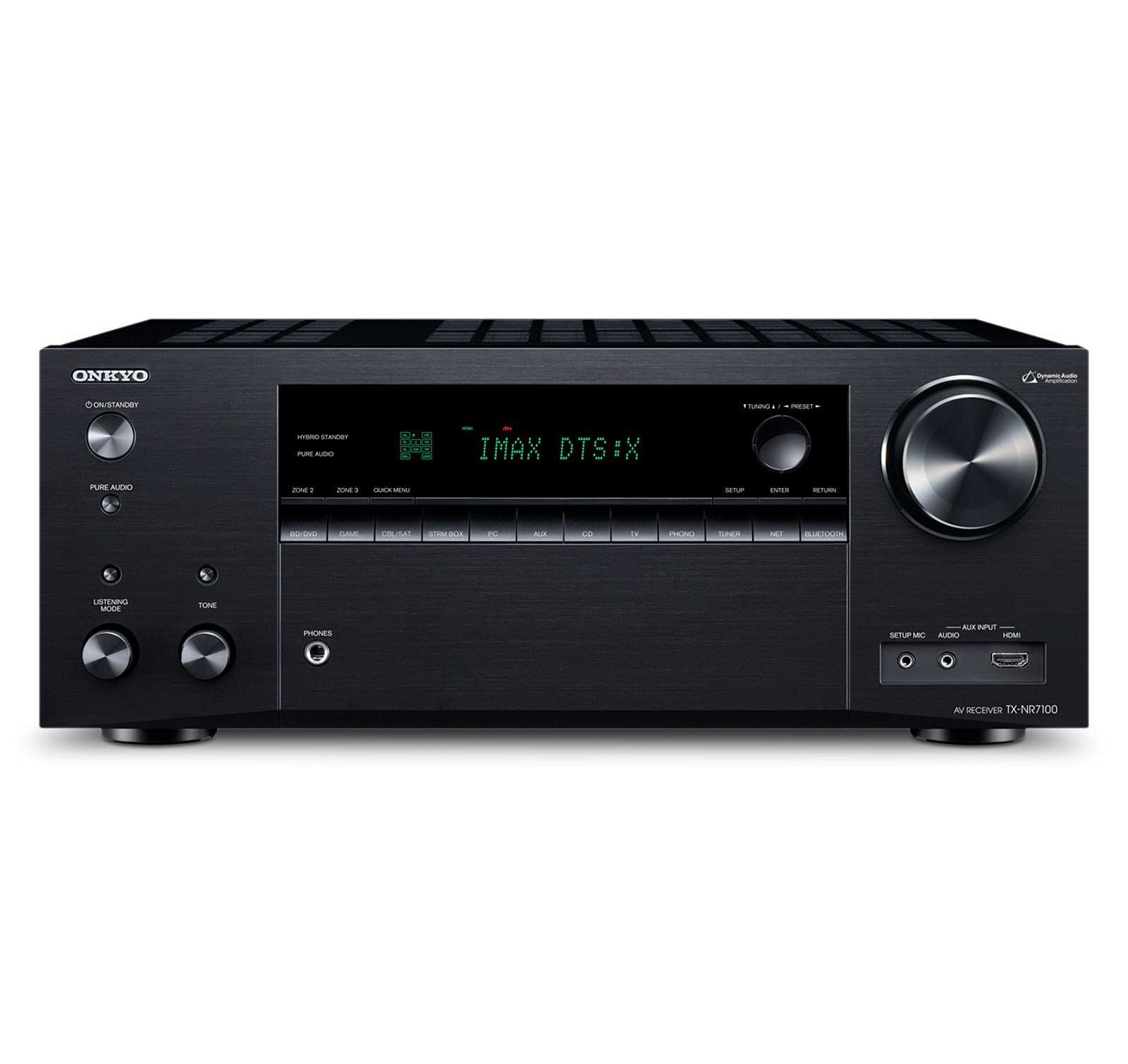
Nine channels of amplification for a full-height Atmos array with ceiling and height speakers.
Nine channels turns ordinary surround sound into an rich dome. The TX-NR7100 stands at 9.2 channels, the highest count on this list, so you can power a full Atmos (Dolby’s overhead sound format) array with ceiling and height speakers in a large room. THX certification (a guarantee the receiver meets strict cinema sound standards) is included with four listening modes — cinema, gaming, music, and surround EX — and IMAX Enhanced decoding open up the same sharp 4K HDR picture the filmmaker signed off on.
On the streaming side, the receiver works with Sonos, Chromecast, AirPlay 2, and DTS Play-Fi, plus Spotify, Amazon Music HD, TIDAL, and TuneIn. Bi-directional Bluetooth means you can stream in from your phone or push audio out to wireless headphones. Dirac Live room correction ships in the box, and buyers who use it report that it transforms home theater systems that sounded flat before calibration.
The catch is software. Dirac (a room-correction system) can be finicky to set up — a handful of customers note repeated failed attempts before switching to manual calibration — and there is a known audio drop of roughly one second every time the content changes. Buyers praise its performance and sound most, but come ready to spend an evening with the manual, and pick a source chain you trust.
Why nine channels matters: full-height Atmos layouts are possible without compromise, and Dirac Live delivers calibration depth that rivals far more expensive processors.
Setup reality: budget a full evening for Dirac and standby for HDMI chain sequencing. Dirac Live delivers the deepest calibration on this list, but budget an evening for setup.
Reach for this if: you have the room for nine speakers and want the calibration software to do the heavy lifting.
Look at the TX-NR6100 instead if: your room only supports seven channels and you want a simpler install.
9. Denon AVR-S970H AV Receiver

The step up from the S770H that puts more ports and more power in the same family.
Two upgrades earn the S970H a spot above the S770H. Power jumps from 75W x 7 to 90W x 7 across seven channels, which matters when your speakers are inefficient and you want headroom at high volume. And the HDMI count rises to eight ports — six in and two out including three 8K inputs — which opens up a second-room TV without an external splitter.
The format list is broad: 8K/60Hz passthrough, Dolby Atmos in 7.2 or 5.2.2, HDR10+, Dolby Vision, VRR, QFT, and ALLM. HEOS handles multi-room streaming, and a phono input covers vinyl. Buyers get a strong impression from the performance and sound quality that comes out of their existing speakers — one described the improvement to a Pioneer speaker system as making it sound amazing.
The honest note here is long-term reliability. A minority of reviewers point out units that stop working after a year, and Bluetooth connectivity gets mixed feedback — dropping out periodically. Neither pattern affects the majority, and the setup experience is one of the sharpest on this list thanks to a well-designed wizard and the bundled Audyssey microphone. Fresh buyers who want a plug-and-play Denon with a large port count land happy.
Port count matters: eight HDMI ports across two outputs cover a second TV or projector without a switcher.
Bluetooth watch-out: a portion of buyers see intermittent Bluetooth drops — if you stream from a phone often, keep a wired or HEOS fallback.
Ideal for: mid-size media rooms where two displays or a projector need to share one receiver.
Not the pick if: you want the simplest Bluetooth experience without any hiccups.
10. Yamaha RX-A2A AVENTAGE AV Receiver

The AVENTAGE line’s entry point — premium build you can feel through the chassis.
Yamaha reserves the AVENTAGE badge for its top-tier receivers, and the difference is real. The RX-A2A weighs 25.4 pounds, packing a rigid chassis with a fifth foot for vibration control that cheaper receivers do not include. Seven HDMI inputs, one output with HDCP 2.3 and eARC, and three inputs that handle 8K60 or 4K120 handle next-gen gaming alongside a normal living-room setup. VRR and ALLM keep the console side lag-free, and Dolby Vision, HDR10+, and BT.2020 cover modern video formats.
Surround:AI is the standout feature — it automates the surround field in real time, adjusting effects based on what is playing. YPAO R.S.C. with multipoint measurement analyzes several seating positions, and MusicCast ties the receiver into a whole-home streaming system with Spotify, TIDAL, Qobuz, Amazon Music HD, and SiriusXM. A phono input handles vinyl, and Works with Sonos makes this one easy to slot into an existing Sonos household.
The strongest praise among buyers lands on the sound quality and the build, both described as a noticeable step up from budget receivers. The gripes are the smaller display, less flashy menus, and a well-documented intermittent no-signal issue that shows up on some TVs until you power cycle. Network firmware updates have been finicky for a handful of owners, though USB updates work around it.
Where the AVENTAGE badge earns its keep
- Fifth-foot rigid chassis for vibration control
- Surround:AI adjusts effects in real time
- YPAO R.S.C. multipoint room calibration
- MusicCast multi-room plus Works with Sonos
Smaller annoyances worth knowing
- Intermittent no-signal issue on some TVs, fixed by power cycle
- Network firmware update has been unreliable for some buyers
- Display size and menu design feel understated
For the buyer who wants: a 25.4-pound AVENTAGE chassis with a fifth foot for vibration control, plus MusicCast streaming to every room.
Skip if: you need the biggest, showiest front display, or want the simplest possible firmware-update path.
11. Sony STR-AN1000 7.2ch Home Theater 8K A/V Bluetooth Receiver

360 Spatial Sound Mapping builds an rich field around your seat, not just one balance.
Sony’s standout feature is 360 Spatial Sound Mapping, which uses Digital Cinema Auto Calibration IX (an automatic setup that measures your room) to build an rich field that moves around your listening position instead of pinpointing one balance. The amplifier is rated at 165 W (6 ohms, 1 kHz, 1ch THD 0.9%) — enough power for most rooms. Six HDMI in and two HDMI out ports include HDMI 2.1 for 8K and 4K/120, so a modern console runs at full speed.
Format support is complete: Dolby Atmos and DTS:X for object-based sound, plus Dolby Vision, HDR10, Hybrid Log Gamma, and IMAX Enhanced for the video side. Zone 2 and Zone 3 let you run audio to two additional rooms independently. Chromecast built-in, Spotify Connect, AirPlay, Bluetooth, and Google Assistant cover every way you might want to send music to the receiver.
Buyers consistently flag the sound quality as impressive — particularly the 360 spatial audio — and mention the upscaling engine doing a good job with 4K HDR content. The setup walks you through on screen step by step, which softens the learning curve for first-time AV buyers. What it does not do is second-guess your speakers on the calibration side the way Dirac or Audyssey can; the spatial processing is the star rather than deep room correction.
Signature feature: 360 Spatial Sound Mapping delivers rich audio to a wider seating area than a traditional sweet-spot calibration.
Worth noting: 165 W per channel paired with HDMI 2.1 ports makes this the amp to pick when gaming refresh rates and Atmos share one setup.
Right for: rooms where the couch is off-center and you want every seat to sound like the front row.
Rethink if: you want fine-grained room EQ as the primary feature — the Yamaha RX-A2A leans harder into calibration.
Know the Specs
Channels — the speaker count your receiver supports
Channels are the number of speakers (and, when marked.2, subwoofers) a receiver can drive. A 5.2 receiver handles five speakers and two subs; a 7.2 or 9.2 adds more. If you plan to add Dolby Atmos height speakers later, start at 7.2 so you have somewhere to plug them in. The Pioneer VSX935, Denon AVR-S770H, Onkyo TX-NR6100, Yamaha RX-V6A, JBL MA710, Denon AVR-S970H, Yamaha RX-A2A, and Sony STR-AN1000 all offer 7.2; the Onkyo TX-NR7100 is the only 9.2 on this list.
Watts per channel — how loud and how clean
Watts per channel (W/ch) measures amplifier output to each speaker; more watts generally means more headroom before distortion sets in. The number is only meaningful alongside the conditions it was measured at — 6 ohms at 1 kHz is a looser measurement than 8 ohms across 20 Hz to 20 kHz. On this list, the Pioneer VSX935 leads at 170 W, followed by the Sony STR-AN1000 at 165 W, the Onkyo TX-NR6100 at 210 W/Ch quoted under its own conditions, and the Denon AVR-S970H at 90 W x 7. Match mid-tier watts to efficient speakers; pair low-watt designs like the Marantz NR1510’s 50 W with easy-to-drive speakers.
Common Questions
What is the difference between a 5.2 and 7.2 AV receiver?
Do I need 8K passthrough on a mid level AV receiver?
Will a mid level AV receiver drive my existing 8-ohm speakers?
Is Dirac Live better than Audyssey room calibration?
How many HDMI inputs do I actually need?
Will my new AV receiver work with my Sonos system?
Can a mid level AV receiver power ceiling speakers for Dolby Atmos?
Why does my receiver run hot during films?
Is 170 W per channel overkill for a normal living room?
Do I need an amplifier-friendly turntable input?
The Bottom Line
For most homes, the mid level av receiver that fits the widest range of spaces is the Marantz NR1510, because its slim chassis fits shelves a full-size receiver cannot reach while still carrying six HDMI inputs and Audyssey calibration (a system that tunes sound to your room). If your speakers demand raw channel power, grab the Pioneer VSX935 with its 170 watts per channel. And for the biggest, most rich Atmos setup — up to 9.2 channels with Dirac Live on board — the Onkyo TX-NR7100 is the one to reach for. Whichever you choose, make sure your speakers can handle the load before the package arrives.
How we choose
We do not accept paid placement. Every pick is matched to a real buyer and a real use-case; we do not hands-on test units.
Sources
Specifications: manufacturer listings and product documentation. Review insights: verified customer reviews, as of October 2026. Pricing: not shown on this page (it changes often); check the current price via the retailer link.
As an Amazon Associate, Aappliancez earns from qualifying purchases. This does not affect which products we feature.