Disclosure: Some links in this post are affiliate links. As an Amazon Associate I earn from qualifying purchases, at no extra cost to you. Learn more
Specs are compiled from manufacturer listings and verified buyer reviews and can change over time — please confirm the key details on the product page before buying.
Most people buy a microwave by the sticker on the box, then spend three years annoyed by a cold center in their leftovers. The fix is simpler than it looks: match the wattage to what you actually heat, then match the cavity size to the plates you actually own. The crowd favorite in this lineup, the Farberware 1.1 cu. ft. red countertop, holds 4.5+ stars across 5,000+ ratings — and it is not the most powerful or the most expensive pick here.
This guide is built by comparing the manufacturers’ published specifications and the patterns across verified customer reviews, so you get each pick’s real strengths and trade-offs instead of marketing spin.
Below you will find 15 countertop, over-the-range, and drawer models split by what they genuinely do well — from a 700-watt dorm unit to a 1200-watt inverter oven. Every pick is here to help you choose from the microwaves to buy in 2026 shortlist with your eyes open about wattage, cavity size, and door hardware.
Top Picks


How To Choose The Best Microwaves to Buy in 2026
Start with the honest question: what do you actually put in a microwave? A single person reheating coffee and a frozen dinner needs a very different machine from a family warming four plates at once. Get that answer right and the rest of the spec sheet sorts itself out.
Wattage decides your cook time, not your menu
A 700-watt oven takes longer to bring food to temperature than a 1000-watt or 1200-watt model. That gap is plain when you compare the Farberware at 1000 watts against the Panasonic NN-SN686S at 1200 watts — the Panasonic’s 1200 watts is 20% more output than the Farberware’s 1000. Higher wattage means fewer minutes standing at the counter, but it also means less forgiving if you walk away.
Cavity size in cubic feet is really about plate diameter
A 0.7 cu. ft. cavity (compact) handles mugs, bowls, and small plates. A 1.1 or 1.2 cu. ft. cavity fits a full dinner plate flat, which matters more than any preset. The Panasonic’s 1.2 cubic feet is 71% more interior than the Nostalgia Retro’s 0.7. If you routinely reheat plated leftovers, that difference is the whole ballgame.
Inverter versus standard microwave power
An inverter (a power supply that delivers steady low-level heat instead of pulsing full blast on and off) is what lets a microwave gently defrost without cooking the edges. Standard microwaves cycle on and off at full power to simulate lower settings. If you defrost meat regularly, inverter models like the Panasonic earn their keep; if you mainly reheat, a standard unit is fine.
Door hardware is the part that fails first
Push-button release, pull handle, and one-touch drawer all work — but the mechanism is where most long-term complaints land. A handle gives you leverage; a push button is one less protruding part to catch on a cabinet. Whichever you pick, plan for it to be the first thing that needs attention after several years of daily use.
Match the install type to your kitchen
Countertop models plug in and sit anywhere. Over-the-range units replace your hood and need cabinet clearance plus venting. Drawer models mount into cabinetry and open outward at counter height. Pick the install type first, then narrow by wattage and size — that order saves you from falling for a model that will not physically fit.
Side-by-Side Comparison
| Model | Best For | Wattage | Capacity | Install Type | Amazon |
|---|---|---|---|---|---|
| Farberware 1.1 cu. ft. Red★ Best Overall | Everyday countertop reheating | 1000W | 1.1 cu. ft. | Countertop | Amazon |
| Panasonic NN-SN686SInverter Pick | Inverter defrosting and even cooking | 1200W | 1.2 cu. ft. | Countertop / Built-in | Amazon |
| Toshiba 1.2 cu. ft. StainlessBest Capacity | Big-cavity family cooking | 1000W | 1.2 cu. ft. | Countertop | Amazon |
| BLACK+DECKER 5-in-1 Air Fry | Replacing a toaster oven and air fryer | 900W | 0.9 cu. ft. | Countertop | Amazon |
| Breville Compact Wave | Quiet kitchens and shared spaces | 900W | 0.9 cu. ft. | Countertop | Amazon |
| COSMO 24 in. Over the Range | RV and tight over-range fits | 1000W | 1.34 cu. ft. | Over-the-Range | Amazon |
| Midea Over the Range | Smart-home voice control | 1000W | 1.2 cu. ft. | Over-the-Range | Amazon |
| KoolMore 24 in. Drawer | Cabinet-mount counter-height access | 1000W | 1.2 cu. ft. | Built-in Drawer | Amazon |
| GE 4-in-1 Air Fry | Convection and broil in one box | 1050W | 1.0 cu. ft. | Countertop | Amazon |
| Sharp SMC1161KW | Simple high-power white countertop | 1000W | 1.1 cu. ft. | Countertop | Amazon |
| Kenmore 0.9 cu. ft. | Apartment and dorm counters | 900W | 0.9 cu. ft. | Countertop | Amazon |
| Chefman 0.7 cu. ft. | Mute button and quiet reheating | 700W | 0.7 cu. ft. | Countertop | Amazon |
| COMFEE’ 0.7 cu. ft. White | Under-cabinet small spaces | 700W | 0.7 cu. ft. | Countertop | Amazon |
| Nostalgia Retro Aqua | Retro-look kitchen accents | 700W | 0.7 cu. ft. | Countertop | Amazon |
| Frigidaire 0.7 cu. ft. Black | Budget small-kitchen backup | 700W | 0.7 cu. ft. | Countertop | Amazon |
Detailed Reviews
1. Farberware 1.1 cu. ft. Microwave
Our pick — 4.5+★ from 5,000+ verified ratings; the strongest balance of quality and price.
The candy-apple red that turns a countertop appliance into the thing guests comment on.
This is the safest bet in the lineup for one reason: it does the boring things well and does not charge a premium for them. You get 1000 watts of output power through a 1.1 cubic foot cavity — enough to reheat a full dinner plate without tilting it, and enough power to get water boiling before your patience runs out. The color is metallic red, and the grey interior finish is what people keep mentioning when they describe how it looks in a real kitchen.
What wins people over is build quality and reliability, not novelty. The control scheme is six one-touch options (popcorn, potato, pizza, and more) plus ten power levels with multi-stage cooking, so you can set a defrost stage and a cook stage in one run. Defrost works by weight or by time, which matters when you pull a frozen brick of ground beef out at 6 p.m. and want it usable by 6:30. The LED display carries both a kitchen timer and a clock, and the interior light is bright enough to watch things bubble without opening the door.
The recurring gripe is the door — the close makes a loud “ker-chunk,” and the keypad layout is not exactly intuitive when you are half-asleep. Some long-term owners also report the clock drifting out of accuracy. Neither is a reason to walk away; treat the door gently and you will get years out of it. Compare it to the Panasonic NN-SN686S at 1200 watts and 1.2 cubic feet: the Farberware gives up 200 watts and a tenth of a cubic foot, and in exchange you get a simpler machine at a friendlier tier.
What earns its keep
- 1000 watts through a 1.1 cu. ft. cavity fits a full plate flat and heats fast.
- Six presets plus ten power levels with multi-stage cooking cover real weeknight meals.
- Bright interior light and clear LED display mean less door-opening guesswork.
- Child safety lock built in for households with small hands.
Where it asks for patience
- Door close is loud enough to hear from the next room.
- Keypad grouping takes a few days to learn by touch.
- Some units show clock drift over long ownership.
Best for: anyone who wants a 1000-watt countertop that fits a real dinner plate and does not need a manual.
Think twice if: you regularly defrost thick frozen meat — the inverter-equipped Panasonic handles that gentler.
2. Panasonic NN-SN686S Microwave
1200 watts that never cycle on and off — the defrost machine for people who actually cook.
Inverter technology is the whole pitch here, and it is a real difference rather than a label. A conventional microwave fakes lower power by switching full blast on and off; the Panasonic generates a steady stream of power at any level, so a 30% defrost setting is genuinely 30% heat. Practical result: frozen chicken thaws without the edges turning to rubber.
The Genius Sensor is the other half of the story. It reads moisture coming off the food and adjusts time and power automatically, and there are 14 preset menu items on top of that. The Keep Warm feature holds soups, gravies, or desserts at temperature until you are ready, which is the small thing that makes a difference when dinner runs late. A quick-minute timer, delay start, and child safety lock round out the controls. One reviewer’s earlier Panasonic Inverter ran 15 years and was still working when gifted on.
The catch is the sensor logic itself: it wants uncovered food and can underheat when a lid is on, so some owners skip it and just set time manually. The control panel is also dim and the child lock ships enabled, which means a few extra button presses before your first cook. It is the most expensive countertop pick in the mid-range here, and the value question is legitimately mixed. Buy it for the inverter, not for the badge.
The verdict: if defrosting and even reheating are your daily reality, the steadier inverter power here is worth the step up.
The trade-off: the steam sensor needs uncovered food to behave, and the panel is dim in a bright kitchen.
3. TOSHIBA 1.2 Cu. Ft. Microwave
A 12.4-inch turntable inside a midsize footprint — dinner plates and Pyrex bowls both fit.
Family cooking needs cavity, and this Toshiba delivers 1.2 cubic feet with a 12.4-inch glass turntable — the same interior volume class as the Panasonic NN-SN686S but with a standard 1000-watt magnetron rather than an inverter. Six preset menus handle pizza, veggies, and sensor reheat, and ten power levels let you drop down for softening butter or boiling liquid. The humidity sensor adjusts cook time on its own based on the moisture coming off the food.
You get a stainless appliance look instead of a plastic box, and it fits a lot inside. A real door handle (not a push button) is easier on your hand, and the mute function silences the beeps — rare at this tier and a favorite with anyone in an open-plan kitchen or with a sleeping baby. Defrost by weight or time is simple, one-touch start runs from 1 to 6 minutes, and a real clock timer rounds out the panel.
The honest caveat is durability at the door and hinge after several years, which is the most-complained-about area in its own review data. An occasional unit arrives with a dimmer interior light than expected. It is a solid appliance for the tier, not a lifetime purchase. Get the white LED and the handle and you will be happy; expect to treat that door with some care.
Where it earns the spot: the combination of 1.2 cu. ft. cavity, 12.4-inch turntable, true door handle, and a mute function is hard to assemble anywhere else at this price tier.
Where to set expectations: the hinge is the part that eventually needs attention — a fair trade for a handle that gives you real leverage day to day.
Pick it if: you reheat for a household and want the biggest cavity that still fits on a normal counter.
Consider the Panasonic instead if: even defrosting matters more to you than raw interior volume.
4. BLACK+DECKER 5-in-1 Microwave

Five appliances in one 0.9-cubic-foot box — microwave, air fryer, grill, bake, and roast.
The pitch is counter space: instead of a microwave plus a toaster oven plus an air fryer, you get one 0.9 cu. ft. unit that runs microwave, air fryer, combi (grill plus convection), bake, and roast. The microwave side is 900 watts with 7 auto menus (beverage, fresh and frozen vegetables, oatmeal, potato, popcorn, frozen pizza). The air fry side adds 11 presets, including frozen French fries, steak fries, squid rings, chicken nuggets, wings, legs, fish sticks, fish fillets, cheese sticks, vegetables, and spring rolls. It ships with a bake tray and two grill racks.
This is the pick for someone who wants the toaster oven off the counter without giving up crispy food. Even heating and simple controls are what hold up over time; the direct-start button cooks at 100% for 30 seconds and takes another press for a second 30. The child lock engages by pressing stop for three seconds — keep the manual on top of the unit, because that is where the instructions live and you will want them for a week.
The real catch is the child lock, which engages automatically after every cook cycle on some units and has to be dismissed before the door opens. Owners flag that as an annoyance and occasionally worse if you do not know the sequence. Interior space at 0.9 cu. ft. is tight — a dinner plate plus a splatter cover just fits, with no hand room at the sides. If you want one appliance to do everything and you cook for one or two, this does it; if you cook large plates daily, look at the Toshiba above.
Why it lands here: getting air fry, convection, and microwave functions in a single counter footprint is a real space win, and the 11 fry presets cover most frozen food.
Where it asks for patience: the auto-engaging child lock and 0.9 cu. ft. interior mean it is not a big-plate machine.
Best for: small kitchens, RVs, and anyone replacing three countertop appliances with one.
Skip if: you routinely heat full-size dinner plates — the 0.9 cu. ft. cavity is genuinely tight.
5. Breville BMO650SIL Microwave

An 80% quieter soft-close door and a mute button — built for open-plan kitchens.
Breville treats the noise problem as the feature. Breville rates the soft-close door 80% quieter than a standard clap-close and the oven 50% quieter overall. The Breville Sound Suite with a mute button silences the beeps entirely, which is the single most-mentioned thing in the review pages. At 900 watts and 0.9 cubic feet (25 liters), it is fundamentally a compact reheater — but the continuous time dial gives you proportional control that button-only units cannot match.
The control layout is the part people actually love once they use it. One touch buttons for Reheat, Defrost, Popcorn, and Beverage, plus a Food Menu for pizza, vegetables, and potatoes. The continuous dial lets arthritic hands adjust the time in seconds rather than punching keypad entries. Defrost is genuinely gentle — the function steps down power so edges do not dry out. Reheat uses lower power levels so a plate of pasta does not emerge with a concrete rim.
The cost is real: this is the most premium-priced countertop in the mid-range tier, and reliability data in its own review block is mixed. A subset of units fail early, and the soft-close mechanism has arrived broken in rare cases (Breville has replaced those). Buy it for the quiet and the dial, not for long-term durability expectations at the wrong end of the bell curve.
What it nails: silence, a soft-close door that actually prevents slamming, and a dial that works without looking — the combination is rare in this category.
What to go in knowing: early-failure reports exist within the review pages, so register the one-year limited warranty the day it lands.
Reach for this if: you live in a studio, a loft, or a home where the microwave noise carries — the mute and soft close are worth the premium.
Look elsewhere if: you want maximum cavity for the money — this is a 0.9 cu. ft. compact, not a family-cooking box.
6. COSMO 24 in. Over the Range Microwave

The 24-inch over-the-range that fits an RV cabinet — 1.34 cu. ft. with a strong blower.
Most over-the-range microwaves assume a 30-inch slot; this COSMO is built for the narrower 24-inch gap that RVs and compact kitchens actually have. The cavity is 1.34 cubic feet — the largest in this whole lineup — with a 13.6-inch turntable inside. Output is 1000 watts across ten power levels, and the integrated range hood handles smoke, odor, and moisture with a blower that owners describe as strong.
Installation is where this one stands out. The box includes the glass tray, turntable ring, exhaust adapter, grease filters, installation kit, and both manuals, and reviewers repeatedly call it an easy install — one RV owner who swapped out an old microwave found this one about 20 pounds lighter. The LED downlight has multiple brightness settings and looks like it belongs with the stove. Sensor reheat and cook detect when the food is done and turn the unit off automatically, and touch presets cover melting, softening, defrosting, and popcorn.
Check your cabinet depth before ordering: some 24-inch over-range models are shallower than the units they replace, causing a setback that needs wall shims to fix. The LED downlights are fixed bright white and cannot be dimmed to warm — one owner solved it with colored filters. The door is oversized and heavy, so give it side clearance to open. Do that prep work and this is a strong RV or compact-kitchen answer.
The standout: 1.34 cu. ft. of interior inside a 24-inch footprint is unusual, and the included installation hardware makes a swap genuinely doable in an afternoon.
The fit note: measure cabinet depth first — a shallow replacement can sit several inches back from the old unit and need shims.
Suits: RV owners and anyone with a 24-inch over-range opening who needs a real vent fan and full cavity.
Not for: standard 30-inch range slots — this is purpose-built narrow and will look undersized in a wide opening.
7. Midea Over the Range Microwave
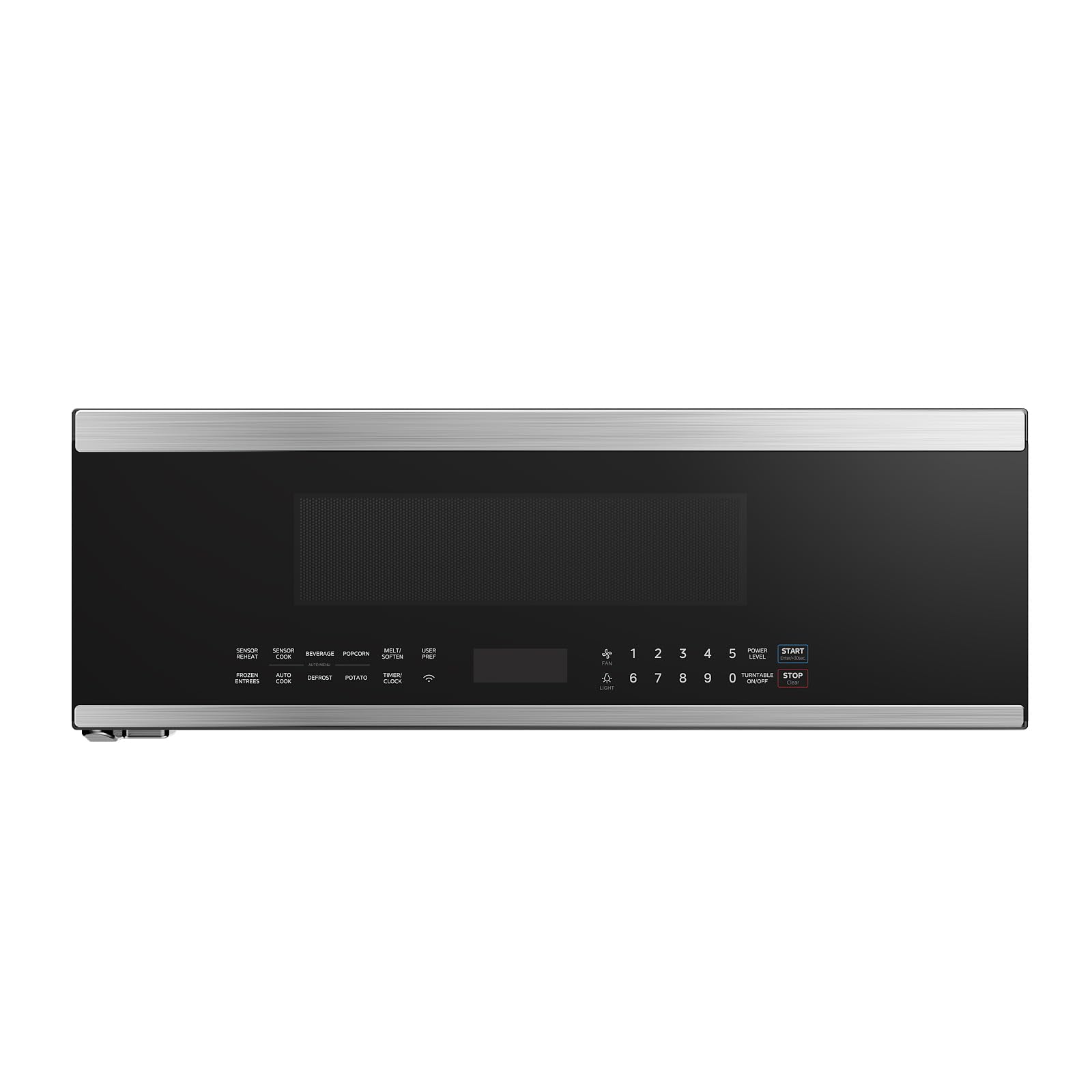
Slim enough to free overhead space, smart enough to take a voice command.
This Midea earns its spot with a slim body that fits the regulation height above a stove without eating your upper cabinets, while 1.2 cubic feet of cavity still holds a full dinner plate. It puts out 1000 watts, and the vent fan is rated 400 CFM (cubic feet per minute of air pulled out of the kitchen) — enough to clear steam from the stovetop. Sensor cook and sensor reheat read steam coming off the food to pick time and power, so you do not set them yourself. The SmartHome app and voice control let you start cooking or change the fan without walking over to the panel.
What users latch onto is the convenience layer: notifications when cooking finishes, voice commands for ventilation, and an auto-cook menu for one-touch meals. Setup is straightforward if you are already in a smart-home ecosystem. It performs well as a normal over-the-range microwave too — heats food quickly, looks modern, and the stainless finish matches other appliances.
The honest limits are real. The capacitive buttons need firm pressure, and on some units the interior light and task light flicker unless the unit is connected to WiFi — a design quirk that has appeared on replacements as well. The task LEDs run blue-white, not warm. Midea’s support has been slow in some cases, though a later free replacement did happen for at least one owner. It is the right pick if you want smart control; if you mainly want a straight down-the-middle over-range, the COSMO above is simpler and cheaper.
Why it earns the spot: voice control plus 400 CFM venting is a genuinely useful combination, and the slim profile matters for kitchens with low overhead cabinets.
What to go in knowing: the light-flicker-without-WiFi quirk is unusual enough to note, and the capacitive panel needs deliberate presses.
Best for: smart-home households who want voice control and a slim over-range that does not dominate the wall.
Think twice if: you keep your kitchen off WiFi — the light flicker is reported to return when disconnected.
8. KoolMore 24 Inch Microwave Drawer

Opens outward at counter height — the microwave you can reach without lifting a plate above your shoulder.
A drawer microwave is a different answer to the same question. Instead of a door that swings toward you at chest height, this KoolMore mounts into cabinetry or a wall and pulls out horizontally, so a full plate slides in at counter level. The cavity is 1.2 cubic feet with a flat bottom (no turntable), which means a rectangular casserole dish sits flat and stable. Output is 1000 watts across 10 power levels, and there is a memory function and timer on the control panel.
Where the design pays off is accessibility. The KoolMore sits at counter height, which owners note makes it markedly easier for shorter users, wheelchair users, and kids — one reviewer’s 7-year-old opens and runs it without help. The one-touch open and slow-close door work smoothly, the stainless finish looks at home in modern or farmhouse kitchens, and the halogen light plus wide labelled buttons make it easy to read at a glance. Installation is straightforward but needs precise measurements and (for cabinetry installs) extra support underneath.
The catch list is short but real. This is the heaviest pick in the lineup by a clear margin — plan on two people to move it into place, and know that repositioning after unboxing is a chore. The exhaust fan runs notably loud, and there is no standalone air-fry setting despite the multi-function expectations some buyers bring. It is the most expensive microwave here, but still a real step below flagship drawer brands, which is exactly why it earns the premium slot.
What it does that nothing else here does: flat-bottom drawer access at counter height is genuinely more usable for a whole range of people, from kids to wheelchair users.
The honest weight: it is heavy, and the vent fan is louder than a countertop unit — this is a considered install, not a plug-and-go.
The right buyer: anyone renovating a kitchen island or wall cabinet and wanting a microwave at an accessible height.
The wrong buyer: renters and anyone who moves frequently — the built-in install and heavy weight make relocation genuinely painful.
9. GE 4-in-1 Air Fry Microwave

Microwave, air fry, convection, and broil — four modes and a crisper pan in one 1.0-cubic-foot box.
The GE runs four cooking modes through a 1.0 cu. ft. cavity and 1,050 watts: standard microwave, air fry (with a stainless steel crisper pan included), convection (with a wire rack to circulate hot air), and broil (with a tall wire rack for searing and caramelizing). The controls add convenience presets for pizza and popcorn, and the child lock is easily disabled when you do not need it. This is the pick for people who want to bake or crisp in the same box that heats leftovers.
What wins people over is the do-more-in-less-space math. The microwave side heats food quickly and quietly, and the convection mode produces consistent browning on smaller baked goods. Air fry handles crispy food without a second appliance. Quiet operation makes it a reasonable dorm or home-office fit, where noise carries. GE has been building kitchen appliances for generations, and the physical build quality here is solid.
The honest limits are significant enough to note. Air-frying here is slower than a dedicated air fryer for most foods, so if crispy food is your main goal, plan on a second appliance for the hard cases. Moisture buildup and internal rust after six months appear in a subset of owner reports. The control panel labels are small white inset text without illumination, so reading functions in a dim kitchen is genuinely difficult. At 3.5+ stars, it is the lowest-scored pick in this lineup — buy it for the convection and broil range, not for air-frying alone.
Where the four modes pay off
- 1,050 watts heats fast and the microwave side runs quiet.
- Air fry, convection, and broil in one 1.0 cu. ft. countertop footprint replaces three appliances.
- Includes the crisper pan and both wire racks, so you can cook from day one.
- Child lock easy to disable when a household has no small children.
What to know before you buy
- Air-frying is slower than a standalone fryer for most foods.
- Control labels are unlit and small — hard to read in a dim kitchen.
- Moisture and rust complaints show up after several months of use in a minority of units.
The honest verdict: the air fry mode disappoints; the convection and broil modes earn the space.
Who it suits: bakers and roasters who want a compact convention oven with a microwave built in, and can live with small unlit labels.
10. Sharp SMC1161KW Microwave

A full-size 12.4-inch turntable inside 1.1 cubic feet, with power that actually boils water.
What this Sharp gets right is the boring stuff: 1000 watts, a 1.1 cubic foot cavity, a 12.4-inch carousel turntable that fits dinner plates without tilting, and ten power levels with two-stage cooking. It ships with weight and time defrost, a +30 seconds key for instant start, and Express Cook up to 6 minutes on a single press. The white finish and gray interior read as clean rather than cheap, and the LED interior lighting is genuinely bright enough to watch food bubble.
Performance is the story here. Owners who replaced older 1000-watt units describe this one as faster, quieter, and stronger in the carousel spin. Even heating across the plate, perfect popcorn, and intuitive one-touch controls build the case for it. The push-button door is one less protrusion to catch on cabinets. The 12.4-inch turntable is removable, so cleaning is a wipe rather than a wobble.
The honest catches are small. The child lock ships enabled and requires the disable sequence — 7, 9, hold 0 for 3 seconds — printed on the door card. The interior LED task lighting is on the dim side compared to the main display. And this thing is heavy; the feet need a full 13 inches of counter depth even though the chassis is 11.8 inches tall. Measure the counter before you commit, because that extra inch matters.
Why it earns its slot: 1000 watts through a 1.1 cu. ft. cavity with a 12.4-inch turntable is the size-and-power combo most people actually need.
The one thing to check: the feet need 13 inches of counter depth, not 12 — measure before you place the order.
Reach for this if: you want a straight white countertop that fits a dinner plate and heats in about half the time of an old 800-watt unit.
Look elsewhere if: counter depth is tight — the feet need 13 inches of clearance.
11. Kenmore 0.9 Cu. Ft. Microwave

Kenmore’s no-nonsense 0.9-cubic-foot box for apartments, dorms, and offices.
This is the sensible countertop for someone who wants a microwave that works without needing a manual. 900 watts through a 0.9 cubic foot cavity, six preset menus (Popcorn, Potato, Pizza, Frozen Dinner, Beverage, Reheat), one-touch start for 30 seconds and 1 through 6 minutes, defrost by weight or time, clock, and kitchen timer. The control panel is genuinely logical — not the maze of unused presets you find on cheaper units.
What earns praise from long-time owners is the straightforward approach. Owners who have run Kenmore appliances since the early ’80s describe this one as a counter fixture that simply keeps working. The frame is stainless steel, and it looks tidy next to other appliances. The single-touch number keys start cooking without needing a separate start button, and the defrost is quick andaccurate. At 19.00″ W x 13.56″ D x 10.75″ H, it fits a real countertop without needing side clearance for an oversized door.
The honest friction is the child lock and the size. The childproof feature ships engaged and has to be open up with a button press every single time — a daily annoyance, not a safety problem, and one you can disable via the manual. The cavity is also smaller than the spec suggests for some owners; Tupperware Stack Cookers and dinner plates fit, but a full roasting dish does not. It earned its spot as a small-kitchen workhorse, not a family-cooking machine.
Why it fits the small-kitchen slot: 900 watts in a 0.9 cu. ft. frame, a logical panel, and a price tier that keeps it accessible.
The daily friction: the child-lock sequence has to be repeated before every cook on units that ship with it engaged.
Best for: apartment and dorm kitchens where counter space is tight and a manual takes up a drawer you do not have.
Think twice if: you routinely cook for a family — the 0.9 cu. ft. cavity limits plate size and depth.
12. Chefman 0.7 Cu. Ft. Microwave
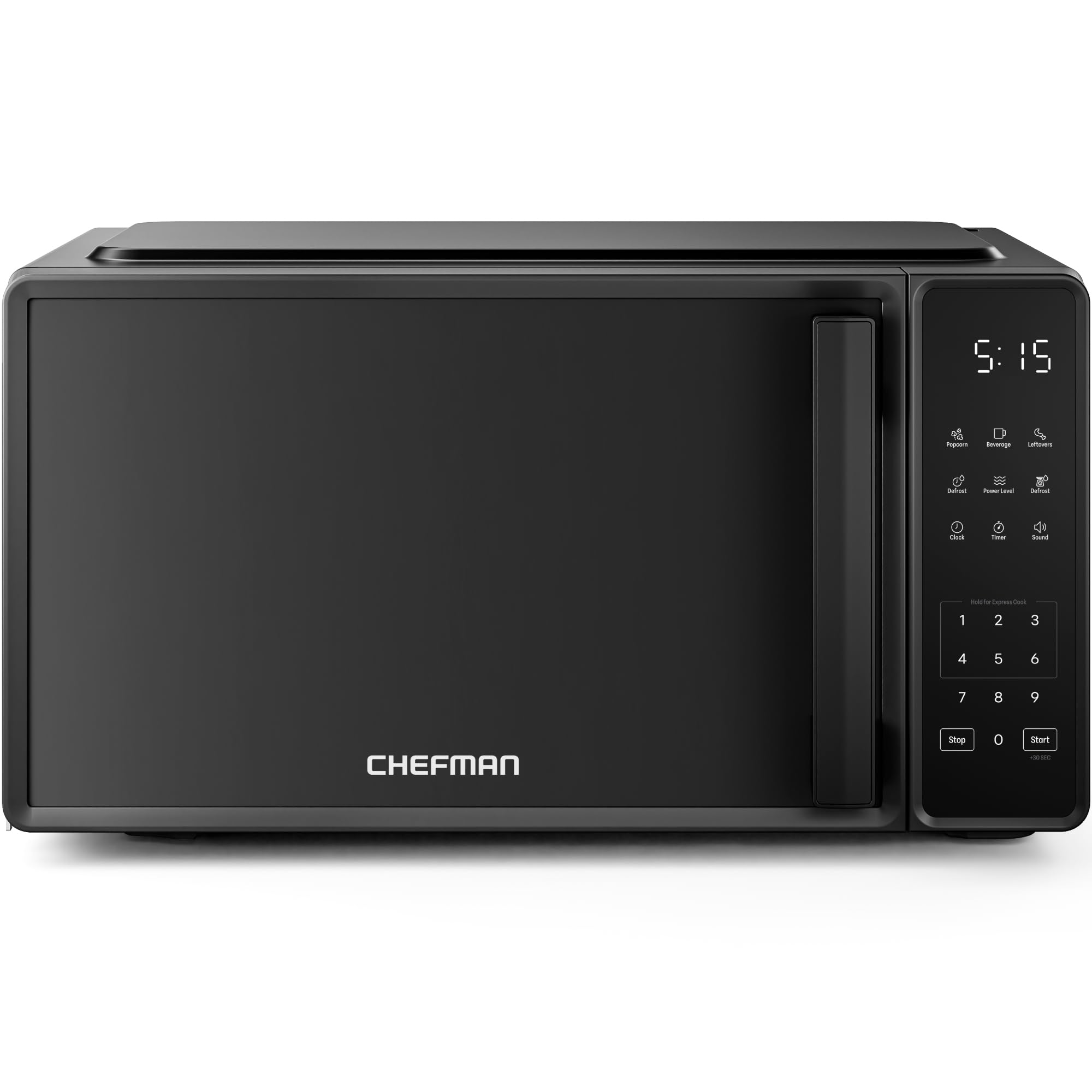
A silent beeper and a child lock that actually opens in one step — rare at 700 watts.
The mute is what sets this one apart: press the Audio Button and the beeps go away, which you only appreciate when reheating a bottle at 6 a.m. or staying quiet in a shared office. The oven is a 700-watt, 0.7 cubic foot compact with six one-touch presets (popcorn, pizza, beverages, veggies, potatoes, leftovers). Ten power levels run from a low melt-butter setting to full blast, and a +30 seconds button adds time mid-cook.
What earns the pick its place in this lineup is the child lock design. On most compact units the child lock is a burden; here you pull upward on the top edge of the handle and the door opens — one step, no open up sequence on a keypad. Owners describe the door as the least frustrating child lock they have used. The kitchen-friendly build continues with a dishwasher-safe glass turntable (top-rack) and a black exterior that wipes clean with a damp towel. cETL approved with a 1-year assurance from Chefman.
The honest catches are real. The keypad needs a firm press and the hold-to-start for longer cooks is impractical — owners work around it with 4-0-0-start rather than holding start down. Some units arrive with what looks like cracking plastic over the controls, which turns out to be peelable film in most cases, but you will spend an hour worrying about it. And at 700 watts, this is genuinely slower than a 1000-watt unit for thick frozen food. Buy it for quiet and the door, not for speed.
Pick it if: silence matters — shared office, sleeping kids, or a partner on shift — and you cook for one or two.
Consider the Toshiba instead if: you want mute at higher wattage and a bigger cavity; the Toshiba offers both at a higher tier.
13. COMFEE’ 0.7 Cu. Ft. Microwave

Small enough to mount under a cabinet and still fit a 10-inch turntable inside.
Eleven power levels on a 700-watt compact is what sets this COMFEE’ apart — most 0.7 cu. ft. units stop at ten. That extra notch rarely matters for boiling water, but it matters when you want a low setting for melting chocolate or softening butter without scorching. The internal cavity is 12 x 11.9 x 8 inches, and the glass turntable is 10 inches in diameter — big enough for a dinner plate. A bright digital display, interior light, and a two-step child lock that follows the newer safety standard keep small hands out of the door.
The practical win is the footprint. It is small enough to mount under a cabinet when counter space is precious, and it heats food evenly — including a stovetop-fast cup of tea at 1:20 and coffee in 20 to 30 seconds. The auto-cook functions cover popcorn, potato, pizza, frozen vegetable, beverage, and reheat, and the one-touch express cooking does 1 through 6 minutes plus +30 seconds. Two defrost settings (by weight or by time) handle frozen food without guesswork.
The recurring gripe is moisture. Buyers report water collecting on the inside of the door, top, and floor of the cavity after every use — harmless, but requiring a wipe before the popcorn preset will pop reliably. A second unit reportedly showed the same pattern, so this is a design trait rather than a one-off defect. Treat the wipe-down as part of the routine and you have a well-sized small-counter microwave.
The small-space case: 0.7 cu. ft. with a 10-inch turntable that fits under a cabinet — the size math works for studios and offices.
The routine cost: a wipe-down after every cook prevents the moisture-related popcorn misfire.
Best for: very tight counters, offices, and kitchenettes where a bigger unit just will not fit.
Skip if: you want to reheat dinner plates — 0.7 cu. ft. means small plates and bowls only.
14. Nostalgia Retro 700W Microwave
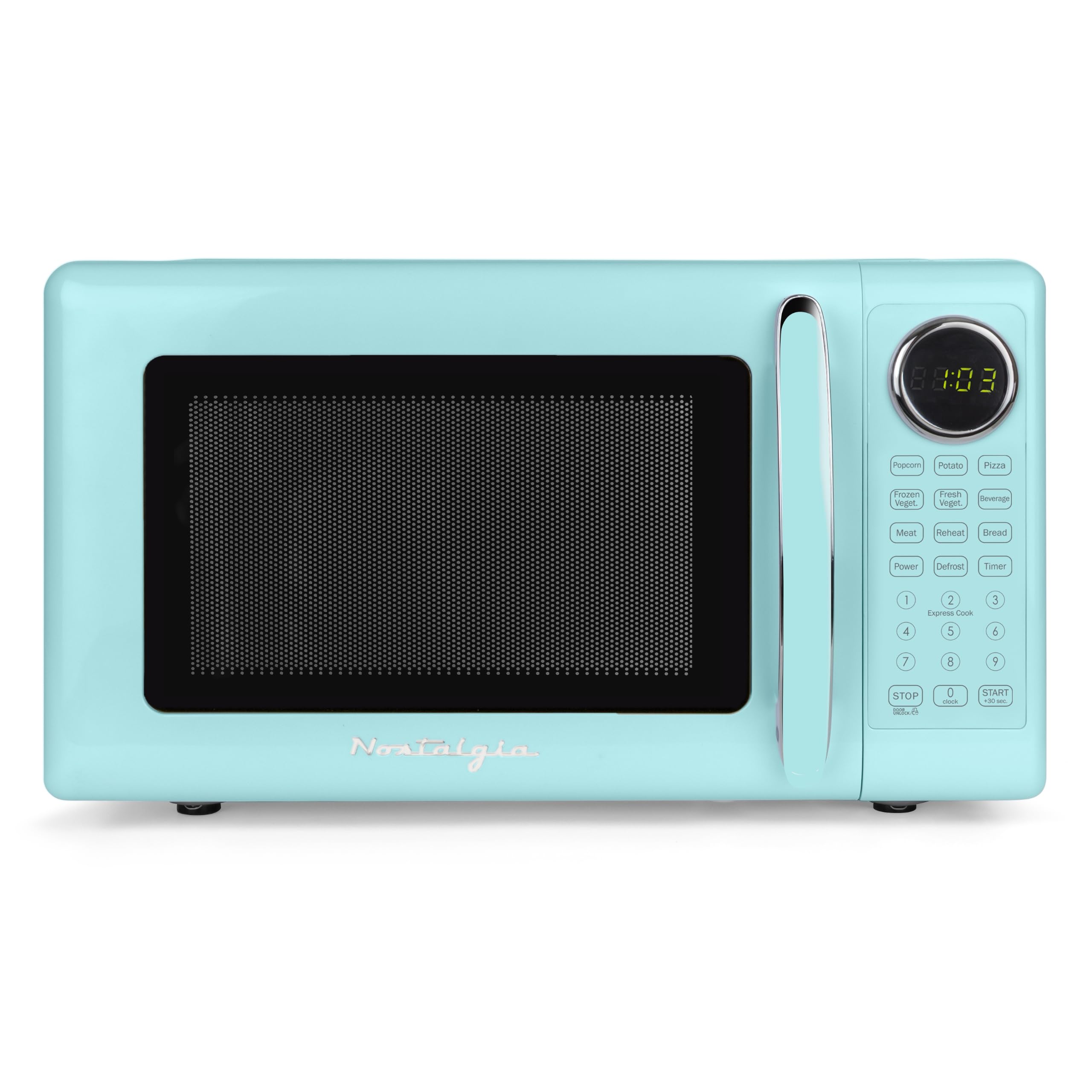
The appliance that doubles as a kitchen accent — aqua finish, square window, 700 watts underneath.
Nostalgia’s design language is unmistakable: a square window, a rounded top edge, and an aqua finish that reads as decor rather than appliance. Underneath the styling is a competent 0.7 cubic foot oven — 700 watts, ten power levels from melt-butter low to full cook, an 8-preset auto-cook menu, and a rotating glass carousel that heats food evenly. The child safety lock is included, and there is an express cooking function for a fast blast.
What lands with buyers is the look, and owning it. The aqua color hits the retro-theme kitchen perfectly; one owner sits it on top of a mini fridge, the small-space spot this 0.7 cu. ft. oven targets. A 21.3 pound body means it is light enough to move by yourself if you need to. The controls are simple buttons, and the featured presets (popcorn, potato, pizza, beverage) cover the snacks most people actually cook.
The honest downside is durability. The door is the physically weakest part, and a handful of units have reported door breakage after only a couple of uses — a real risk if you open it roughly or if shipping lands wrong. Register the warranty on day one and inspect the hinge from the start. If you want retro style and small-space reheating, this is the one; if it needs to survive the long haul, look at the Toshiba.
Pick it if: the retro look is the point, and you need a light 0.7 cu. ft. oven for a mini fridge, dorm, or themed kitchen.
Go bigger if: you have real cooking to do — the 700-watt output is slow for frozen meals and the door wants gentle handling.
15. Frigidaire 0.7 Cu Ft Microwave

The cheapest way to get a Frigidaire badge on your counter — and the trade-offs show.
This Frigidaire plays in the smallest tier of the lineup at 0.7 cubic feet and 700 watts, yet the control set is surprisingly complete for the money. You get six preprogrammed settings (popcorn, pizza, beverages, frozen dinners, and more) and ten power levels. Auto defrost calculates time and power for thawing, express cooking starts with a single touch, and a bright LED display shows a digital timer and clock. A removable glass turntable and the smart sensor auto cook function are included.
What earns its spot is value. This is the most affordable fully equipped microwave in the list, and for a dorm room, a rental kitchen, or a garage setup, the math works — buttons respond, the door locks properly, and food reheats. One owner’s 5-star note says the microwave “works beautifully has a child safety lock on it and a perfect size,” which is the use case this unit is built for.
The limits are real. Cook time runs longer than higher-wattage units, and the door needs a stop/reset press before it opens (one owner calls that a good safety feature). The door hardware is the weak point — a subset of units separate plastic from metal at the door on first use. Review data rates value for money and size strongly, but durability and door functionality poorly. For a short-term or light-duty setup, it delivers.
The budget case: 700 watts, six one-touch menus, auto defrost, express cooking, LED display — the feature list is complete for a small-kitchen backup.
The trade-off: door hardware is the physical weak point and cook time is longer than the higher-wattage picks.
Best for: a garage, dorm, or vacation rental where the microwave will not see daily heavy use.
Go up a tier if: you need durability — the door hardware is the part that fails and a higher-wattage model with a stronger hinge is the safer long-term choice.
Know the Specs
Wattage: what the number actually buys you
Microwave output power, measured in watts, is how fast the oven heats food. A 700-watt unit is a small-space reheater — good for coffee, popcorn, and single servings, but slow on frozen dinners. A 900-watt unit is the sensible middle for apartments and dorms. A 1000-watt unit is the everyday standard for households. A 1200-watt unit boils water and reheats fast, and is the one to pick if you actually cook rather than reheat. The difference is real: at 1000W a mug of water comes to boil noticeably faster than at 700W, and frozen meals finish sooner. The trade-off is that higher-wattage units are less forgiving if you walk away from something.
Cavity size in cubic feet: what actually fits
The cubic-foot rating on a microwave (0.7, 0.9, 1.1, 1.2, 1.34) tells you interior volume. The practical translation: 0.7 cu. ft. fits mugs, bowls, and small plates; 0.9 cu. ft. fits most dinner plates but not a full roasting dish; 1.1 cu. ft. and up fits a dinner plate flat with room for a splatter cover. The turntable diameter matters as much as the volume — a 12.4-inch carousel fits a full plate, a 10-inch carousel does not. If you routinely reheat plated leftovers, size the cavity by the plate you own, not by the cubic feet figure on the box.
Inverter vs conventional microwave power
A conventional microwave creates low power by cycling full blast on and off — a 30% power setting is really full power run 30% of the time. An inverter generates a steady stream of power at any level, so a low setting is genuinely gentle. The practical effect is on defrosting: an inverter thaws frozen chicken without cooking the edges, and reheats a plate of pasta without a hot rim and a cold center. Inverter models tend to command a higher price tier. If you mostly reheat coffee and popcorn, a conventional unit does the job; if you cook or defrost from frozen regularly, the inverter earns its place.
Door type: push button vs handle vs drawer
A push-button release is one less protruding part to catch on a cabinet, and it is mechanically simpler. A pull handle gives you leverage and is easier on arthritic hands. A drawer opens outward at counter height and is the most accessible option for shorter users, wheelchair users, and kids — but it is the heaviest to install and the loudest at the vent fan. Every door style is a valid choice; the failure point is always the mechanism. Gently closing any style extends the life of the latch.
Sensor cook and auto menus: what they actually automate
A moisture sensor reads steam coming off the food and adjusts time and power automatically. It works well for uncovered food (vegetables, rice, leftovers) and poorly for anything covered, because the steam cannot escape to reach the sensor. Auto-cook menus are just preset time-and-power combinations — handy for popcorn and baked potatoes, unused for everything else. Neither replaces knowing how long your food needs; they just remove one button press.
Venting and airflow for over-the-range units
Over-the-range microwaves pull smoke, odor, and moisture out of the kitchen with a vent fan rated in CFM — cubic feet per minute of air moved. Higher CFM moves more air. Most over-range units also need clearance from cabinets and a rear vent route. Installation matters as much as the spec sheet: measure your cabinet depth, check the height above the stove, and confirm the vent path before you commit. A powerful unit installed in the wrong slot is worse than a modest one installed correctly.
Common Questions
Is a 700-watt microwave enough for everyday cooking?
Will a dinner plate fit in a 0.7 cubic foot microwave?
What does inverter technology actually change in daily use?
How long do countertop microwaves typically last?
Is a convection or air-fry microwave worth it over a plain countertop?
Can I put a countertop microwave in a cabinet or built-in enclosure?
How does the child safety lock work, and can I turn it off?
What is the difference between an over-the-range and a countertop microwave?
Does higher wattage always mean better cooking?
Can I use metal in these microwaves? What about the air fry and convection modes?
The Bottom Line
For most people buying from the microwaves to buy in 2026 shortlist, the answer is the Farberware 1.1 cu. ft. Red. It is 1000 watts through a 1.1 cubic foot cavity, fits a dinner plate flat, and it holds the highest rating in the whole lineup — 4.5+ stars, with the biggest review base in the mid-range tier. The Panasonic NN-SN686S has more raw power at 1200 watts and the inverter edge on the Farberware, but the Farberware’s simpler machine and friendlier tier earn it the top slot.
If you want the defrost machine, grab the Panasonic NN-SN686S — the 1200-watt inverter and Genius Sensor are worth the step up. And for anyone who has an over-range opening, the COSMO 24 in. squeezes a full 1.34 cu. ft. cavity and a strong vent fan into a narrow footprint, which is the rarest combination in the entire category.
How we choose
We do not accept paid placement. Every pick is matched to a real buyer and a real use-case; we do not hands-on test units.
Sources
Specifications: manufacturer listings and product documentation. Review insights: verified customer reviews, as of October 2026. Pricing: not shown on this page (it changes often); check the current price via the retailer link.
As an Amazon Associate, Aappliancez earns from qualifying purchases. This does not affect which products we feature.