Disclosure: Some links in this post are affiliate links. As an Amazon Associate I earn from qualifying purchases, at no extra cost to you. Learn more
Specs are compiled from manufacturer listings and verified buyer reviews and can change over time — please confirm the key details on the product page before buying.
If your toes go numb two miles into a rocky descent, the shoe is the problem — not your feet. Men’s wide trail running shoes fix that by giving your toes room to spread while still gripping loose dirt and wet rock. Below are nine real options, sorted by who they actually fit, and the Brooks Divide 5 leads the list as the crowd favorite at 4.5+ stars across 400+ ratings.
This guide is built by comparing the manufacturers’ published specifications and the patterns across verified customer reviews, so you get each pick’s real strengths and trade-offs instead of marketing spin.
You will see which uppers snag, which soles run short, and which lugs hold on wet rock. Every pick here is a wide or wide-friendly option for men’s wide trail running shoes that you can actually order in a wide size.
Top Picks

How To Choose The Best Men’s Wide Trail Running Shoes
Most men buy a trail shoe one size up and hope the width sorts itself out. That is the wrong lever. Width comes from the last — the foot-shaped mold the shoe is built on — and you can only get more of it by picking a shoe built wide or ordering an explicit wide size. Get the width right first, then worry about grip.
Start with the toe box, not the size number
A roomy toe box lets your toes splay when you land, which keeps your big toe from pressing the front wall on long descents. Some shoes here are built around an anatomical last that is wide by design. Others come in dedicated wide and extra-wide widths. Know which one you are buying, because sizing up to gain width also adds length you do not want.
Match lug depth to the ground you actually run
Deep lugs dig into mud and loose dirt but feel vague on smooth wet rock. Shallow, flatter lugs feel planted on hardpack and pavement but slip in slop. If your weekly loop is a mix of dirt road and rocky singletrack, a mid-depth lug with a sticky rubber compound is the safer all-rounder.
Decide how much rock protection you need
A rock plate is a thin stiff layer under the forefoot that spreads the point of a sharp stone. It adds protection but can mute ground feel. Runners on sharp scree want one. Runners who want to feel the trail underfoot often skip it and rely on a thicker midsole instead.
Check heel drop before you commit
Drop is the height difference between heel and toe, measured in millimeters. A low drop puts you closer to a flat, natural stance and asks more of your calves. A higher drop feels more familiar if you are coming from road shoes. Neither is better — but a sudden switch to zero drop is a common cause of sore Achilles tendons.
Side-by-Side Comparison
| Model | Best For | Weight | Heel Drop | Outsole | Amazon |
|---|---|---|---|---|---|
| Brooks Divide 5★ Best Overall | Road-to-trail crossover | — | — | — | Amazon |
| Saucony Peregrine 15Trail Specialist | Aggressive mixed terrain | — | — | 5mm lugs | Amazon |
| New Balance Fresh Foam X Garoé V2Cushion King | All-day cushion | — | — | AT Tread | Amazon |
| Merrell Speed Strike 2 | Hybrid hike and run | 1.5 lb | — | Sticky trail outsole | Amazon |
| Topo Athletic Terraventure 4 | Rocky technical trails | 12.0 oz (M9) | 3 mm | Vibram | Amazon |
| The North Face Altamesa 300 | First-time trail runners | — | — | Surface Control rubber | Amazon |
| New Balance Fresh Foam X Hierro V9 | Wet and muddy grip | 2.1 lb | — | Vibram Megagrip, 6mm lugs | Amazon |
| Altra Lone Peak 9 | Widest toe box available | 11.15 oz / 316 g | 0 mm | MaxTrac | Amazon |
| Brooks Cascadia 18 | Long mountain days | 1.5 lb | — | — | Amazon |
Detailed Reviews
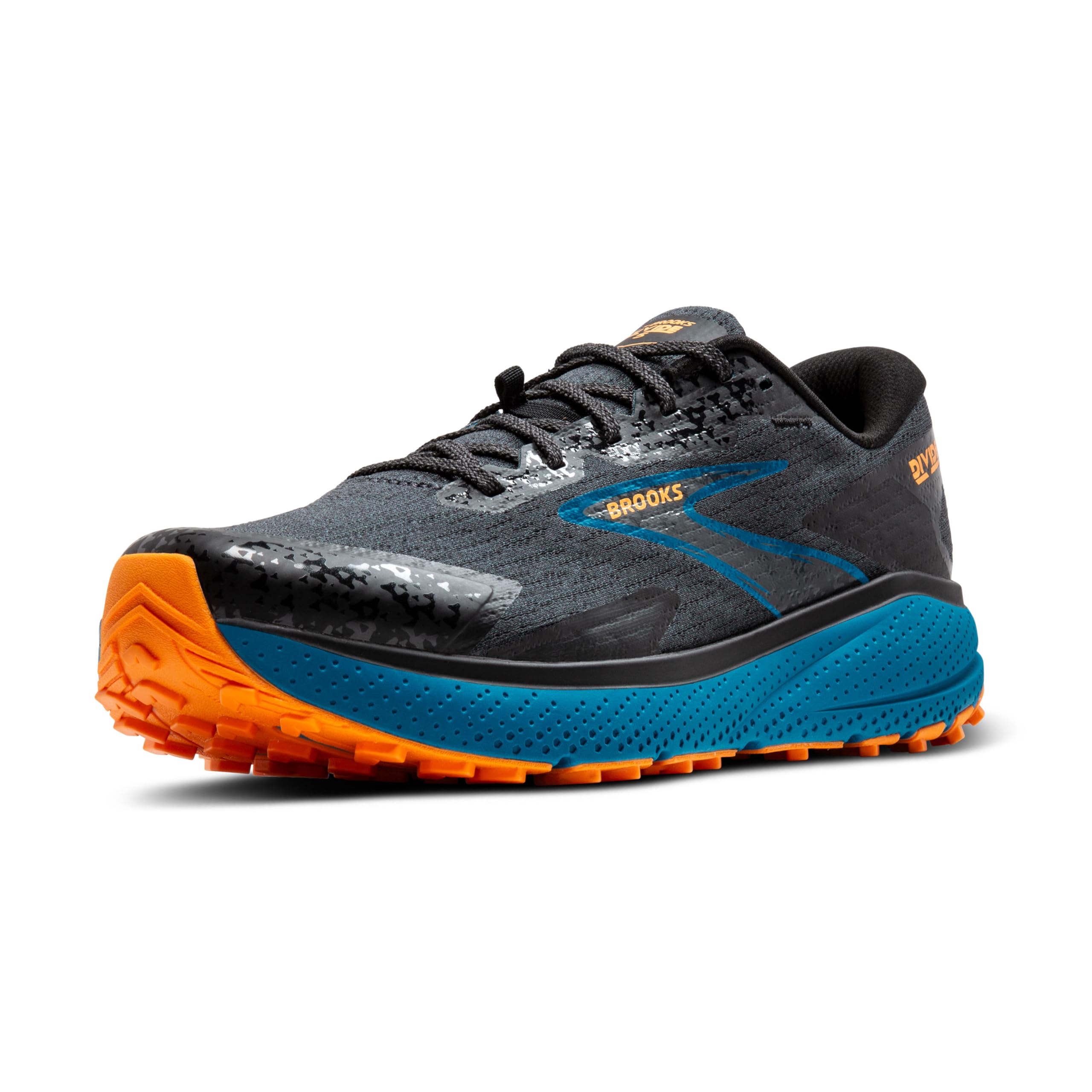
1. Brooks Men’s Divide 5 Trail Shoes
Our pick — 4.5+★ from 450+ verified ratings; the strongest balance of quality and price.
The shoe that treats the sidewalk between your door and the trailhead as part of the run.
Most trail shoes punish you for the pavement miles it takes to reach the dirt. The Divide 5 takes the opposite approach: Brooks built it around a familiar road-shoe fit, then added grippy traction underneath. If your route is a mile of sidewalk, three miles of packed dirt, and a rocky climb at the end, this is the shoe that does not fight you on any of it.
The toe box is where wide-footed runners get their relief. Reviews keep circling back to the same thing — the fit is generous up front, with enough room for toes to spread without the shoe feeling sloppy through the midfoot. Support holds up too; the arch support has drawn steady praise from buyers, including men managing old ankle injuries who needed something that would not roll under them.
The bigger surprise is how long they hang on. Durability is not the first thing most people mention about a crossover trail shoe, but here it is one of the things owners bring up unprompted — the consensus is that these outlast expectations for the category. The honest trade-off: this is not a technical-terrain specialist. Deep mud and wet, angled rock are jobs for the Peregrine 15 or the Hierro V9 below. The Divide 5 is the shoe for mixed ground where the trail is only part of the route.
What buyers actually say
- Generous toe box that keeps wide feet from pinching on descents — the single most repeated point in the reviews.
- Arch support solid enough that buyers with past ankle fractures still wear them for daily running.
- Build quality wins the most praise of any trait, and durability ranks high right behind it.
- Smooth on pavement, so the run to the trailhead does not feel like a chore.
Where it runs out of road
- Traction is praised, but this is not a lug-heavy shoe for wet root or slick rock.
- If you want a dedicated technical-terrain runner, look further down this list.
Made for: runners whose loop mixes asphalt, gravel, and light singletrack, and wide-footed men who want the toe room without going to an extra-wide last.
Think twice if: your local trail is steep, wet, and rock-strewn most of the year — you want deeper lugs than this.
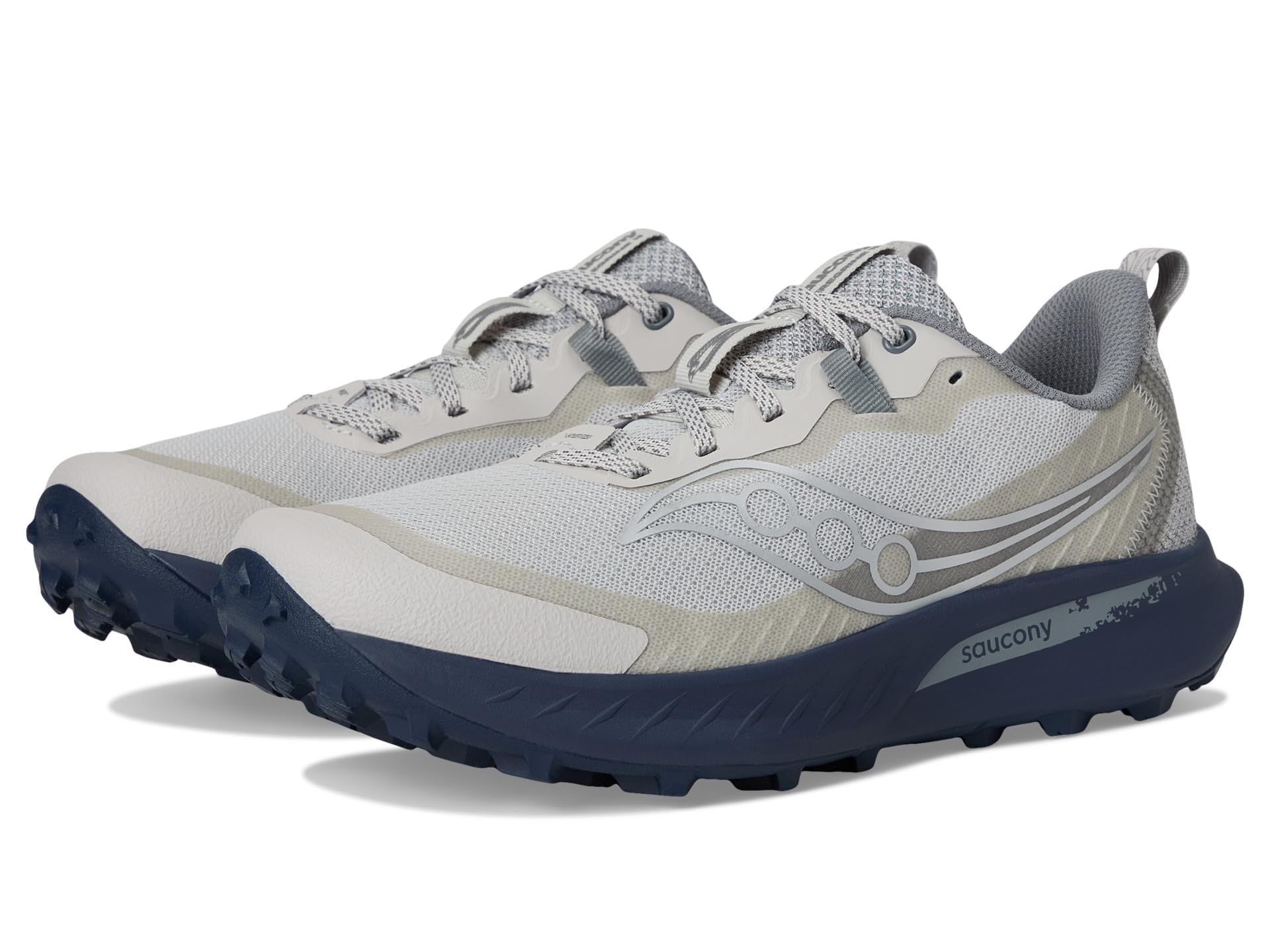
2. Saucony Peregrine 15
Five-millimeter lugs and a low-profile build for runners who want the ground talking back.
Here is the number that sets the Peregrine 15 apart from the crossover shoes above: 5mm lugs. Lugs are the rubber teeth under the sole, and 5mm is deep enough to bite into loose dirt and mud where flatter outsoles skate. Saucony pairs that with a PWRRUN cushioning system — a foam layer tuned to absorb impact without ballooning — and a low-profile shape that keeps you close to the trail.
What wins people over is comfort over distance. Owners talk about long efforts without blisters, and the cushioning earns its own steady praise for being enough without feeling bloated. Traction on dry hardpack comes up again and again as the reason people keep re-buying. The shoe also crosses over to pavement better than a lug this deep has any right to.
Fit is the catch. The upper runs voluminous (roomy), and sizing gets strange at the extremes — one detailed breakdown found a size 12 too roomy and an 11.5 too short, with heel rub on steep climbs until the shoe broke in. Wet rock is the other weak spot; the deep lugs are built for dirt, not slick stone. Buyers put it plainly: “Run 50 miles in a single go in these. No blisters. Durable. Hard working.” That is the shoe in one line.
Grip where it counts: you get bite on dry hardpack, technical trail, and soft ground from aggressive 5mm lugs (the raised rubber teeth under the shoe) covering the full outsole — so loose dirt and gravel hold instead of sliding. Owners call out grip most after comfort, with trail performance ranking right behind it.
The fit caveat: try before you commit to a size, especially if you are between sizes or have a narrow heel — the upper runs roomy and the heel can rub on steep climbs until broken in.
Worth it for: the runner who spends most of the week on dirt and wants lugs that actually dig in.
Look elsewhere if: your trails are wet rock slabs more often than loose dirt.
3. New Balance Men’s Fresh Foam X Garoé V2 Trail Running Shoe
A soft, bouncy ride for men who are on their feet all day and still want trail grip.
Plenty of trail shoes assume you are running intervals. The Garoé V2 assumes you might be standing for eight hours and then walking the dog. The Fresh Foam X midsole — a lightweight, ultra-soft foam layer — is the heart of it, and the AT Tread outsole underneath keeps grip on dirt without turning the shoe into a hiking boot.
Owners with hard-on-the-feet jobs are the ones who sound most grateful. A grocery worker who stands all shift said they stayed comfortable from clock-in to clock-out. Another buyer put 700+ miles on a pair over 15+ months of daily wear before the upper showed real damage. That is the kind of longevity that makes a soft shoe worth the money — and value is genuinely one of the things reviewers bring up on their own.
Two things to weigh honestly. The shoe is neutral, and the arch support is not built for everyone — buyers who need real arch lift ended up adding inserts. The lace loops have also been reported breaking early on a small number of pairs. Neither is a reason to rule it out; both are reasons to know what you are buying. Fit runs true to standard US sizing, which New Balance buyers tend to appreciate.
The all-day angle: a soft, bouncy Fresh Foam X midsole plus an AT Tread outsole makes this the pick for men who spend more time standing than sprinting.
Know before you buy: it is a neutral shoe with modest arch support, and a handful of buyers found the lace loops fragile.
The right call if: you want trail-ready grip wrapped around a genuinely plush everyday ride.
Not your shoe if: you need built-in arch support without adding an aftermarket insert.
4. Merrell Men’s Speed Strike 2

A running shoe crossed with a day hiker, for men who split the difference on purpose.
Merrell calls this an athletic hybrid hiker, and that label is accurate: durable outdoor mesh uppers over a sticky trail outsole. It sits in the middle of the trail spectrum — more support than a stripped-down runner, less bulk than a boot. At 1.5 pounds it is light enough to jog in and sturdy enough to trust on a rocky day hike.
The proof is in the mileage. One buyer logged 700+ miles over 13 months across walks, bogs, creeks, trails, and cobblestones before the soles wore through — and planned to buy again. Another wide-footed buyer wore them through a Glacier National Park trip and reported a perfect fit. This is a shoe that earns its keep through repetition rather than a single heroic outing.
The honest limit: the top mesh is basic netting on this pair, and at least one buyer found it snags and hooks too easily for rough trail use. Fit also splits opinion — a foot that sits toward the edge of the sole has left a couple of wearers constantly repositioning. Neither problem is universal, but if your local trail is full of brush and sharp branches, factor the upper into your thinking.
Where it earns its keep
- Comfort ranks second only to build quality in how often it comes up — this is an easy shoe to spend a long day in.
- Wide-footed buyers report a clean fit; one hiker wore his through a full national park trip without complaint.
- Light enough to run in, supportive enough to hike in, and priced as a mid-range option.
What to weigh
- The upper mesh is basic — a buyer who took it into rough brush found it snagged easily.
- Some wearers feel their foot slip toward the sole edge and need to reposition.
- Not waterproof.
Fits your week if: you want one pair for a Saturday trail run and a Sunday hike without buying two shoes.
Reconsider if: your trails are dense with snagging brush — the upper is the weak link.
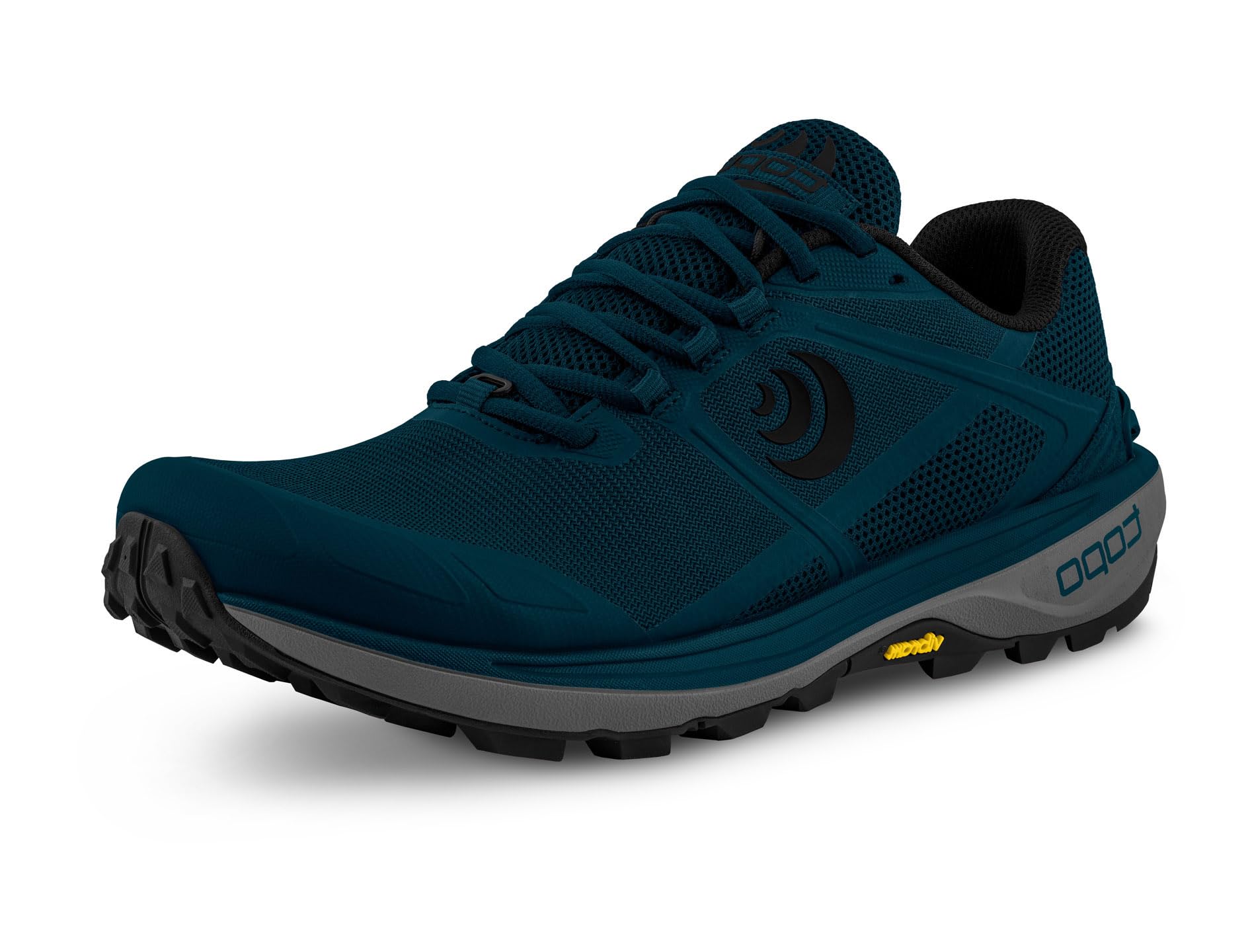
5. Topo Athletic Men’s Terraventure 4
A rock plate underfoot and a wide, anatomical toe box — the technical-trail package for men with broad feet.
Sharp stone under a thin sole is the thing that ends a trail run early. The Terraventure 4 answers that with a flexible ESS rock plate — a stiff layer under the forefoot that spreads the point of a rock — so a jagged stone pushes across the plate instead of into your foot. It pairs that with a Vibram outsole (a sticky rubber sole made by Vibram) for grip and a 3mm heel drop (heel sits 3mm above the toe) that keeps you close to the ground. The roomy toe box is built on an anatomical last (a foot-shaped mold), so your toes spread naturally instead of stacking.
Men with wide feet are the ones who sound happiest. The toe box is the trait buyers single out most after overall quality and comfort, and they praise it in exactly the terms you would hope — enough width to feel natural, not so much that the shoe feels loose. Grip and light weight round out the picture. At 12.0 oz in a men’s 9, it is a substantial shoe, but the weight is not what owners complain about.
What they do complain about, sometimes, is how long it lasts. Durability is the mixed note in this block, with some pairs developing holes after a few months of hard use. Value opinions split along the same line. If you want a shoe for rocky, technical ground and you accept that a rock plate and Vibram come with a weight and lifespan trade-off, this is a strong pick.
The technical case: an ESS rock plate, Vibram outsole, and anatomical toe box make this the most purpose-built rocky-terrain shoe on the list for wide feet.
The honest trade: durability is the mixed signal here, and at 12.0 oz it carries more weight than most runners on this page.
Pick this one if: your trails are rocky and technical, and your toes need genuine width without a sloppy fit.
Pass if: you log high mileage annually and want a shoe that clearly outlasts it.
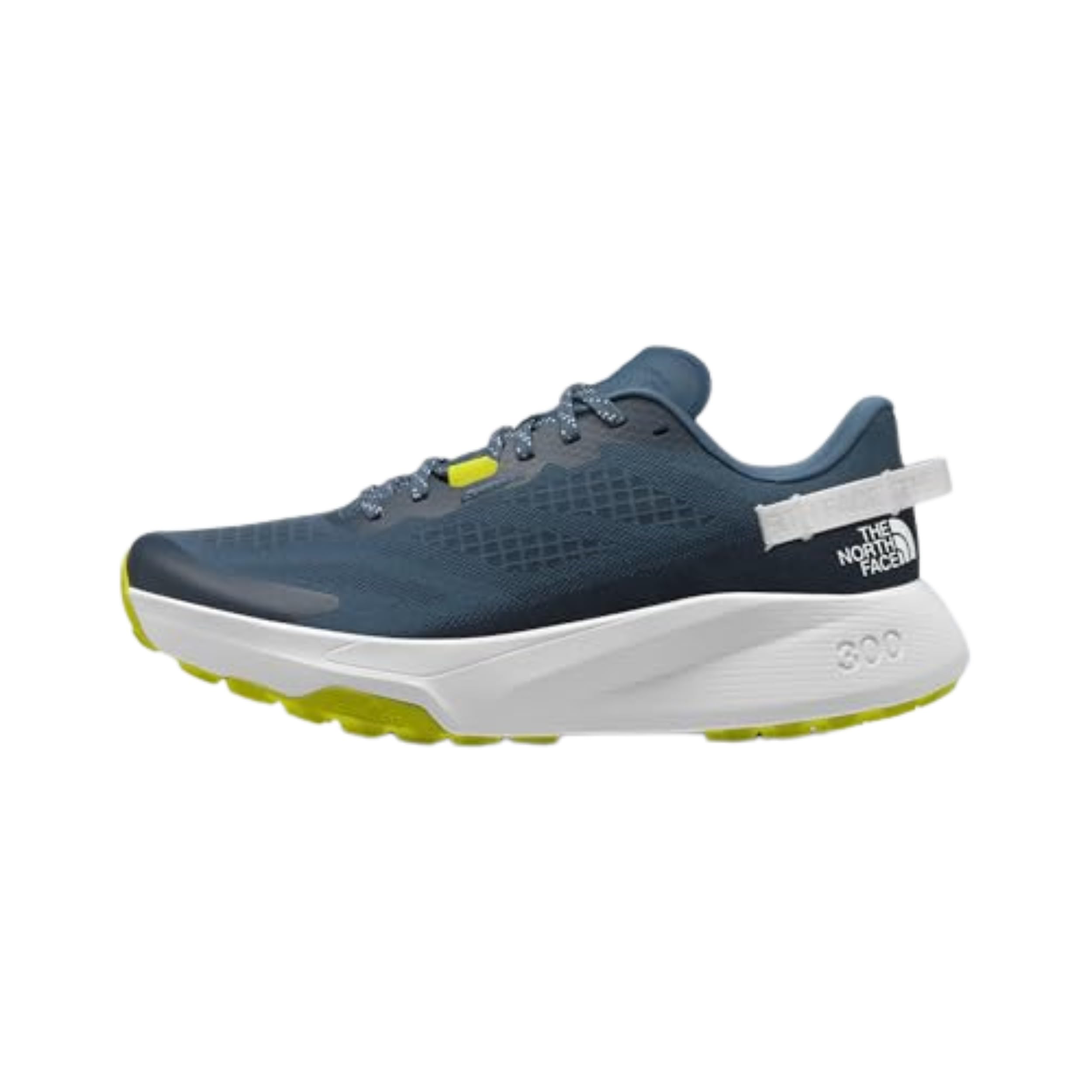
6. THE NORTH FACE Men’s Altamesa 300 Trail Running Shoe
Built for the runner stepping off pavement for the first time, with a roomy toe box and plush foam.
The Altamesa 300 is designed with beginners in mind, and the spec sheet reflects it. A DREAM foam midsole — a responsive foam layer tuned for rebound — sits over a rock plate for protection, so roots and stones do not jab through on your first trail miles. A Surface Control rubber outsole handles grip across mixed terrain. Lightweight breathable uppers with smooth overlays (smooth panels that cut rubbing) are there to reduce fatigue over the miles.
What wins people over is comfort and quality in roughly equal measure, and the fit runs true to size, which removes the sizing guesswork that trips up first-time trail buyers. Owners describe them as a “Swiss Army knife” shoe — functional across walking, hiking, and casual wear. Men who spend all day on their feet at work have called them the most comfortable shoes they own.
Style and long-term durability are the two softer spots. The look divides opinion — one reviewer noted being turned away from a Berlin bar in white sneakers — and a few wearers question how long the shoe will hold up under hard running. Fit runs true, so if you are a wide-footer, order the wide width. For a first trail shoe with a roomy toe box and forgiving cushion, it does the job.
What works
- DREAM foam and a rock plate give you plush cushioning without letting rocks poke through.
- True-to-size fit saves you the trial and error of ordering a half size up.
- Comfort and build quality are the two most-praised traits — the shoe holds up as an everyday wearer too.
What gives
- The look splits opinion — functional, not stylish.
- A few wearers are unsure about how long the shoe lasts under serious running mileage.
Start here if: this is your first trail shoe and you want cushion, a roomy toe box, and true-to-size fit.
Keep looking if: style matters as much as function, or you need a dedicated technical-terrain runner.
7. New Balance Men’s Fresh Foam X Hierro V9
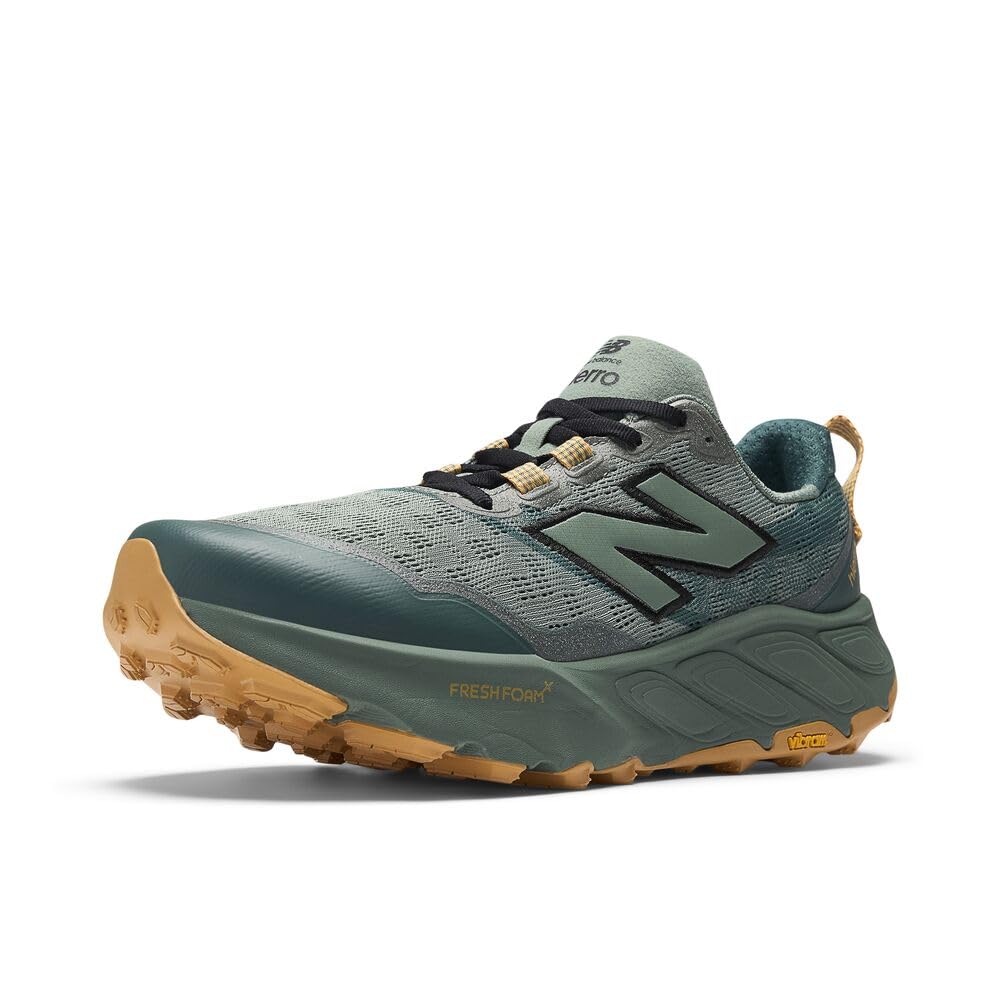
Six-millimeter lugs on a Vibram Megagrip sole — the wet-rock answer on this list.
If wet roots and slick rock are your problem, the Hierro V9 is the shoe that addresses it head-on. It uses a Vibram Megagrip outsole — a sticky rubber compound designed for grip on wet and dry surfaces — with deeper 6mm lugs and a revamped tread pattern. A dual-density Fresh Foam X midsole adds plush comfort on top of a more stable underfoot feel. Toe Protect shielding and a gusseted tongue keep rocks and debris out.
Owners describe the grip in concrete terms. One hiker wore it up a 14,000-foot Colorado mountain and credited the outsole with holding its grip on angled rock and pebbles. Another wore a pair for a week in Zion and reported zero slips. Cushioning comes up as comfortable for 10-12 mile runs, and the look earns praise of its own.
Sizing is the recurring pain point. Multiple owners mention the Hierro V9 runs short — some had to size up a full size, and at least one wide-footed runner sized up into a 4E width to get the same fit as past models. The shoe also runs warm, with limited breathability on hot days. Read the sizing notes before you order and you will sidestep the main complaint.
Grip that earns the label: a Vibram Megagrip outsole with 6mm lugs is the most aggressive wet-terrain setup here — deeper than the Peregrine’s 5mm lugs, and buyers trust it on slick rock and steep descents.
The sizing snag: this shoe runs short, so plan on at least a half size up and consider a full size if you are between sizes or wear thick socks.
For you if: you run wet, muddy, or rocky terrain and grip is the spec you care about most.
skip it if: you want a shoe that runs true to size from the start, or you run hot and need maximum breathability.
8. ALTRA Men’s Lone Peak 9 Trail Running Shoe
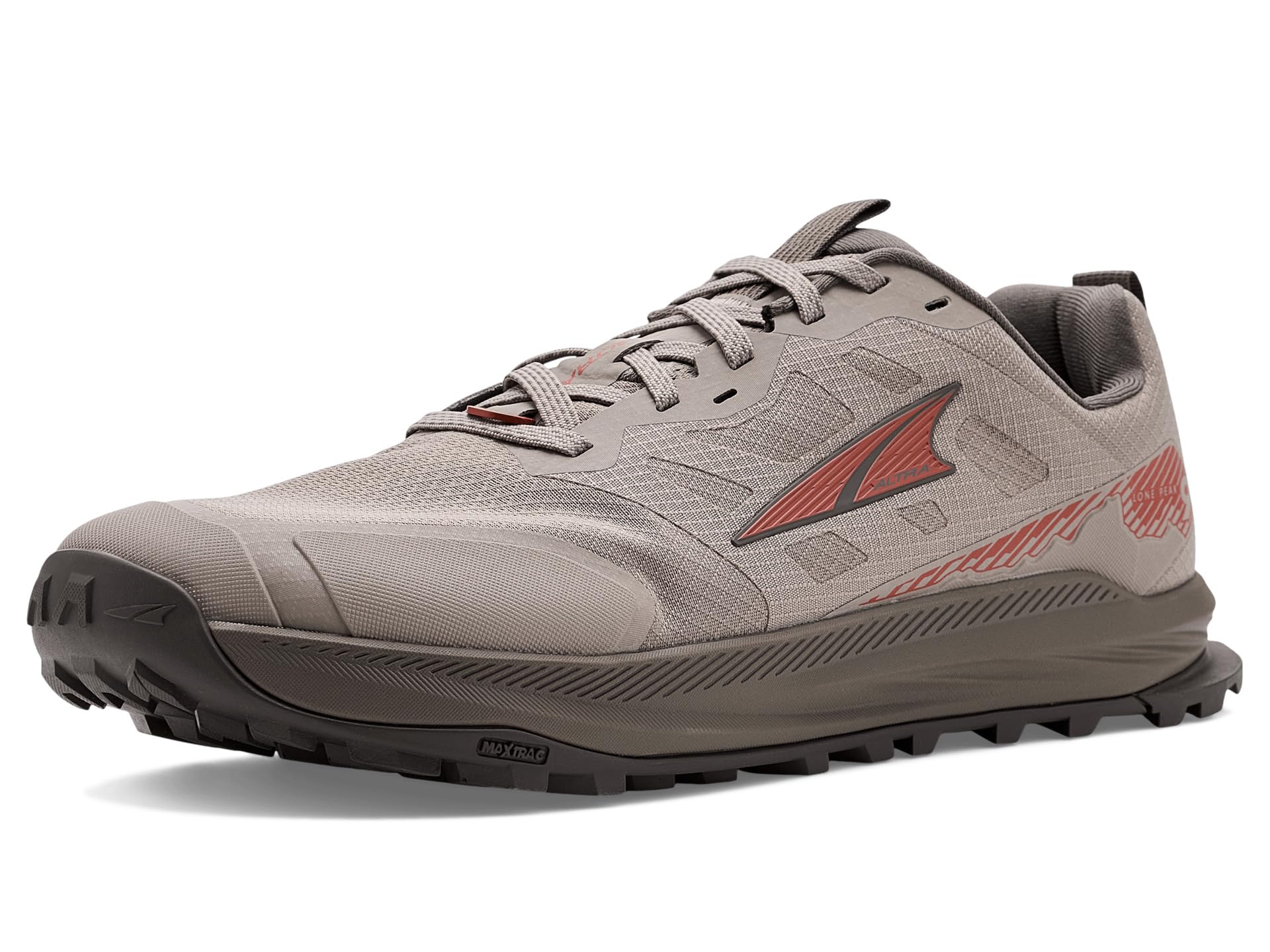
Altra’s roomiest toe box on a zero-drop platform — the widest-feeling shoe on this list.
If every other wide shoe has still left your toes pinched, the Lone Peak 9 is where you end up. Altra built it around the brand’s roomiest toe box and a zero-drop platform — meaning heel and toe sit at the same height, so your foot sits flat instead of tilted forward. A Stoneguard insert underfoot handles rocks and debris, and a MaxTrac outsole provides grip, traction, and durability across terrain types. At 316 g (11.15 oz) in a men’s size, it stays reasonably light for the protection it offers.
The toe box is the headline for a reason: owners say it is comically large, and a buyer who normally wears a 12 W found it wider than a Merrell 12W. Men with bunions, wide forefeet, and years of squeeze now report a shoe that lets the foot work naturally. Grip on mud, gravel, and rock gets steady praise as well.
Two things a new buyer should know. Zero drop takes adjustment — if you have only run in conventional trail shoes with a higher heel, ease into it slowly rather than switching overnight. And the cushion is on the moderate side; it is not a road-running shoe. A couple of buyers also questioned long-term durability, with seams coming apart on some pairs. The price point is higher than many picks here, and value opinions split along that line.
The width argument: the roomiest toe box Altra makes, plus MaxTrac grip and a Stoneguard insert, makes this the pick for genuinely wide forefeet and men with bunions.
Two adjustments: zero drop asks for a gradual transition, and cushion is moderate — this is a trail shoe, not a road runner.
Made for: men whose forefeet have never fit a standard wide, and runners willing to give zero drop an honest try.
Not the pick if: you want soft, high-stack cushioning or need to transition from a high-drop shoe immediately.
9. Brooks Men’s Cascadia 18 Mountain Trail Running Shoe
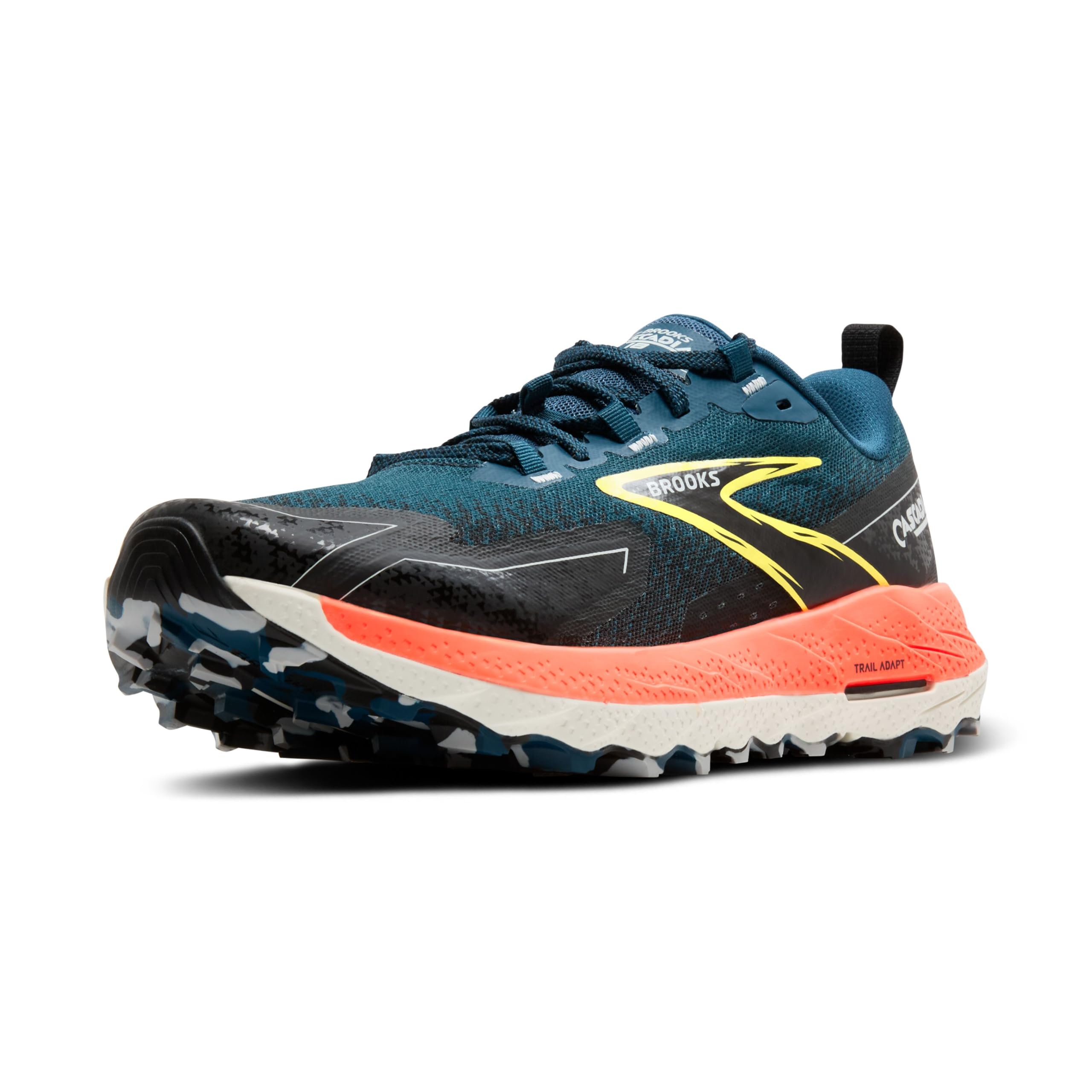
The mountain-day shoe for men who want stability and toe room over several hours of moving.
The Cascadia 18 is the more protective Brooks trail shoe, built for long days on mixed terrain. Customers note stability and comfort as the two reasons they wear it, with traction for grip across ground types running close behind. The toe box is roomy, cushion is generous, and the sole is rugged enough that wet, dry, muddy, and mossy ground all get handled without drama.
One buyer covered a 28-mile Sequoia loop with no discomfort even over pebbles, citing the roomy toe box and rugged sole. Another took a pair into Alaska and reported no blisters even when wet. If you are shopping for a long-mileage mountain shoe that fits like a Brooks, this is the pick.
Two things to know. The shoe runs narrow relative to most men’s wide options — a wide-footed buyer may want to size up in width or try the wide fit before committing. Cushion is soft enough that long-term durability on hard pavement is worth watching if you mix road miles into your routine. Otherwise the Cascadia is one of the more reliable long-day options on this page.
The long-day case
- Quality and comfort are the two most-praised traits by a wide margin — this is a shoe built for hours, not minutes.
- Roomy toe box, reinforced toe cap, and water-resistant upper handle mud, slush, and rocky ground.
- Stable on steep, rutted, rocky terrain, with grip praised across wet and dry surfaces.
What swings the decision
- Runs narrow for a wide shoe — try the wide width or size up if your forefoot is broad.
- Soft sole may wear faster on concrete and asphalt than on dirt.
- Slightly heavier than the lightest options here — a fair trade for the protection.
Go for this if: your trail days run long and you want stability, toe room, and protection from rocks and debris.
Try another width if: standard widths pinch — this shoe runs narrow, even in the wide fit.
Know the Specs
Toe Box and Width
Toe box is the space in front of the laces where your toes sit. A roomy toe box lets toes spread when you land, which reduces pressure on the big toe. Two kinds of shoes deliver it here: shoes built on an anatomical last (wide by design) and shoes offered in explicit wide and extra-wide widths. Know which one the listing is selling.
Lug Depth
Lugs are the rubber teeth on the outsole. Deeper lugs — like the 5mm on the Peregrine 15 or 6mm on the Hierro V9 — dig into mud and loose dirt. Shallow lugs feel planted on hardpack and pavement. Match the depth to the terrain you actually run on, not the terrain in the product photo.
Heel Drop
Drop is the height difference between heel and toe in millimeters. A low drop like the 3mm on the Terraventure 4 or the 0mm on the Lone Peak 9 puts you closer to a flat stance and asks more of your calves and Achilles. A higher drop feels more familiar if you are coming from road shoes.
Rock Plate
A rock plate is a thin stiff layer under the forefoot that spreads the point of a sharp stone. The Terraventure 4 uses a flexible ESS rock plate; the Lone Peak 9 uses a Stoneguard insert; the Altamesa 300 pairs one with DREAM foam. A rock plate adds protection but mutes ground feel, so choose based on how much protection you want versus how much you want to feel the trail.
Common Questions
How do I know if a trail shoe is truly wide enough for my foot?
Do wide trail running shoes need a period of break-in?
How do I stop my toes from jamming into the front of the shoe on descents?
Is zero drop better for wide feet on trails?
Can I run on pavement in a trail shoe?
Where should I start if I am switching from road running to trail?
Does a rock plate make a trail shoe feel stiff?
How long should a pair of trail running shoes last?
Do I need a wide fit or an extra-wide fit for trail running?
Will a trail shoe for wide feet handle wet rock?
The Bottom Line
For most runners shopping for the men’s wide trail running shoes category, the Brooks Divide 5 earns the top spot because it handles the whole route — pavement, gravel, and light singletrack — without punishing wide feet, and its durability has held up over serious mileage. If you run wet, muddy, rocky terrain and want the most aggressive grip on this list, grab the New Balance Hierro V9. And for men whose forefeet have never truly fit any shoe, the Altra Lone Peak 9 is the pick that finally gives your toes room — just plan for a slow transition to zero drop (a level heel-to-toe height).
How we choose
We do not accept paid placement. Every pick is matched to a real buyer and a real use-case; we do not hands-on test units.
Sources
Specifications: manufacturer listings and product documentation. Review insights: verified customer reviews, as of October 2026. Pricing: not shown on this page (it changes often); check the current price via the retailer link.
As an Amazon Associate, Aappliancez earns from qualifying purchases. This does not affect which products we feature.