Disclosure: Some links in this post are affiliate links. As an Amazon Associate I earn from qualifying purchases, at no extra cost to you. Learn more
Specs are compiled from manufacturer listings and verified buyer reviews and can change over time — please confirm the key details on the product page before buying.
If your calves ache by mid-afternoon or your ankles puff up after a long flight, the right pair of men’s compression socks can keep your legs feeling fresh instead of heavy. The catch is that “compression” gets stamped on everything from genuine graduated medical knitwear to plain crew socks with a tight cuff. This guide separates genuine graduated support from plain tight cuffs, so you buy the pair that matches your day.
This guide is built by comparing the manufacturers’ published specifications and the patterns across verified customer reviews, so you get each pick’s real strengths and trade-offs instead of marketing spin.
The five pairs below range from everyday crew socks to true graduated knee-highs made in Italy, and each one fits a different kind of day on your feet. Read on for a buyer’s breakdown of men’s compression socks, from mmHg ratings to knee-high versus crew length.
Top Picks

How To Choose The Best Men’s Compression Socks
Compression socks live or die on one number: the pressure rating in mmHg (millimetres of mercury — a measure of how firmly the sock squeezes your leg). Everything else — the fabric, the length, the cuff — exists to deliver that pressure where you need it. Pick the right number for your day and the sock feels like support; pick the wrong one and it feels like a tourniquet.
Match the mmHg to your actual day
Mild pressure around 15-20 mmHg is the everyday zone: comfortable enough to wear all day at a desk, on a plane, or through a shift, and easy to pull on. Firmer 20-30 mmHg is a stronger squeeze aimed at real recovery and heavier support, so it suits sore legs, swelling, or long recovery days — but expect a firmer fight getting it over your heel.
Graduated versus flat compression
Genuine compression socks taper their pressure: strongest at the ankle, lighter as they climb toward the calf. That ankle-to-calf taper is what pushes blood upward and helps with swelling. A plain tight crew sock squeezes evenly, which does little for circulation and can feel restrictive at the top. Look for the words “graduated compression” if you want the real thing.
Length, cuff and sizing
Knee-high socks cover more of the calf and give more graduated support, but the cuff is what keeps them up — and a cuff that is too narrow can dig in. Crew-length sits lower and hides under normal trousers. Whichever you choose, size by calf and foot measurement, not shoe size alone, because a good compression sock must grip without bunching.
Side-by-Side Comparison
| Model | Best For | Compression | Length | Fabric | Amazon |
|---|---|---|---|---|---|
| Dickies Dri-tech Crew★ Best Overall | All-day work and moisture control | Arch compression | Crew | Moisture-wicking blend | Amazon |
| Merino Wool Compression SocksBest for Travel | Flying and chilly-day warmth | 15-20 mmHg | Over the knee | Merino wool mix | Amazon |
| NEENCA Professional | Swelling and injury recovery | 20-30 mmHg | Ankle-length | 65% nylon, 20% spandex | Amazon |
| Physix Gear 20-30 mmHg | Nurses and long shifts on feet | 20-30 mmHg | Knee-high | High-quality blend | Amazon |
| Zensah Tech+ | Runners and travel | Graduated compression | Knee-high | 82% polyamide, 18% elastane | Amazon |
Detailed Reviews
1. Dickies Men’s Dri-tech Original Moisture Control Crew Socks
Our pick — 4.5+★ from 218,500+ verified ratings; the strongest balance of quality and price.
The everyday workhorse that keeps feet dry and socks standing up through a full shift.
If your feet just need to stay dry and comfortable through long days rather than medical-grade squeeze, this is the pair to start with. The defining feature is the moisture-management fiber with built-in ventilation channels (small knitted airways) that move sweat away and let air circulate, so your feet do not stew inside a boot by lunchtime. Arch compression hugs the foot and holds the sock in place, giving a little in-step support instead of a loose tube that slides down.
You get reinforcement where it matters: a reciprocated heel and toe (knitted to follow the curve of your foot) plus full cushioning across the sole. It comes as 6, 12, or 18 pairs, so you can stock the drawer in one go. As buyers with a 12-13 foot report, “XL is perfect a fit for size 12-13 feet.” Sizing runs M through XXL, and one point worth knowing — a 12 in a Large fits snug without restriction, while plenty of wearers find the large toe box keeps toes from feeling cramped.
The honest trade-off sits in the thickness and warmth: the cushioning that makes these comfortable in a work boot can feel a touch warm in high summer, and the sock is built for support rather than firm medical pressure. It gives arch support, not a mmHg rating (a measure of compression pressure) — so it is not the pick for serious swelling or recovery. The build holds its shape and elasticity wash after wash, which is why this is the pair most people keep reordering.
What keeps feet happy
- Ventilation channels and moisture-wicking fibers keep feet dry through long workdays
- Arch compression holds the sock in place with in-step support
- Reciprocated heel and toe plus full cushioning for a snug, supported fit
- Holds shape and elasticity through repeated washing
- Available in 6, 12, or 18-pair packs for stocking up
Where it settles short
- Cushioned build can run warm in hot weather
- Arch support only — no full graduated mmHg pressure
Reach for this if: you want a durable everyday crew sock that keeps feet dry and supported on long shifts.
Think twice if: you need firm, doctor-style graduated pressure for swelling or recovery.
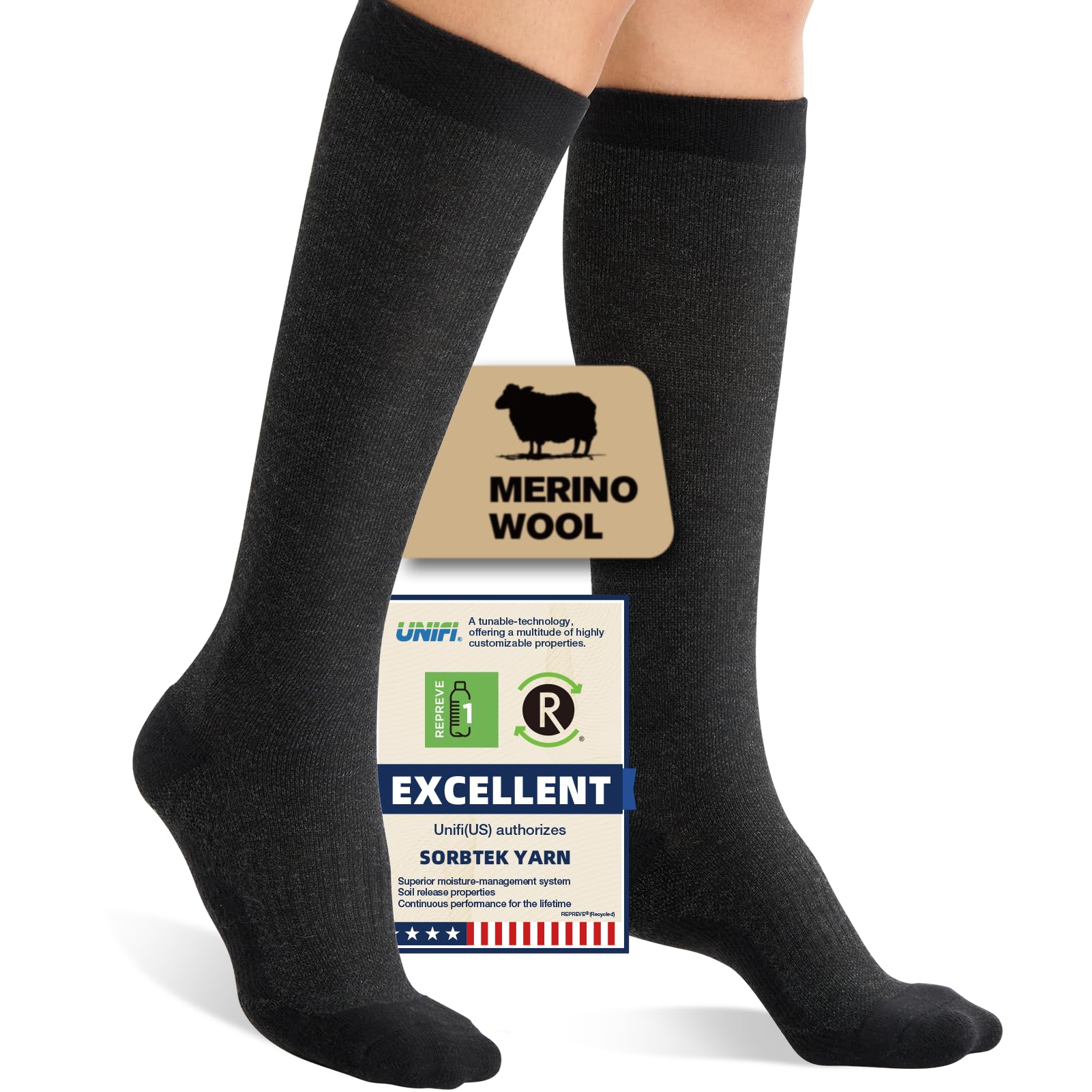
2. Merino Wool Compression Socks for Women Men 15-20 mmHg
A gentle 15-20 mmHg squeeze wrapped in merino warmth, built for long flights and cold mornings.
This is the pair that goes over the knee and delivers mild 15-20 mmHg pressure — the everyday zone that is easy to tolerate for hours. That gentler rating is the point: it is firm enough to support your legs on a flight without the fight of a medical-grade sock. The merino wool mix brings real warmth, which makes it a favourite for chilly morning runs and winter travel rather than summer shorts weather.
The fabric blend is smooth against the skin with definite, not-too-tight compression, and it pulls on and off without a wrestling match. Buyers report the supportive fit still leaves room for the toes, and the sock is odour-resistant enough for repeat wear across a multi-day trip. Word on sizing: “The small-medium size is perfect for 7 1/2 size foot.”
What wins people over is the warmth and the comfortable all-day hold — a supportive fit that does not bunch above the knee. The catch to know about is the material: the fabric is a merino mix rather than 100% wool, and sensitive skin can find the very top of the cuff itchy. That is a fit-personal note, not a reason to pass on the pair — for most travellers it is a comfortable, easy option that earns repeat buys.
Travel-ready warmth: The 15-20 mmHg rating is gentle enough for a long-haul flight, and the over-the-knee length keeps the whole calf supported.
Fabric caveat: It is a merino wool mix, not pure wool, and the cuff top can prickle on sensitive skin.
The flight-day pick: gentle 15-20 mmHg support with merino warmth for travel and cold-weather wear.
Skip if: you need the firmer 20-30 mmHg recovery squeeze or pure-wool material.
3. NEENCA Professional Compression Socks 20-30 mmHg

Firmer 20-30 mmHg ankle-focused support that targets swelling where it starts.
Here the number to fix on is 20-30 mmHg — the firmer recovery zone, and noticeably stronger than the 15-20 mmHg merino pair above. NEENCA concentrates that pressure at the ankle with six compression rings knitted into the ankle area, an arch reinforced with stretched elastics, and a sole built from six layers of thicker loops for shock absorption. The result is targeted ankle-and-foot support rather than an even squeeze up the whole leg.
The fabric is 65% nylon, 20% spandex, 8% polyester and 7% cotton — stretchy enough to pull on, breathable enough to wear day or night. This is a shorter ankle-length sock, not a knee-high, so it suits wearers who want firm support without fabric climbing their calf. What owners mention most is how it handles swelling: “Kept swelling down while my broken foot was healing.”
The real trade-off is length and fit. At ankle height it tops out only about 4 inches above the heel, so if you want the full calf covered, this is not the pair. A few wearers with broader ankles also find the 20-30 mmHg squeeze too tight right at the joint. For feet and ankles that need genuine firm pressure, though, the quality and compression hold up well and reward the higher spend.
Built for ankles: Six compression rings and a reinforced arch put firm 20-30 mmHg support right where swelling collects.
The honest limit: It is ankle-length, not a knee-high, and the firm squeeze can feel tight on wider ankles.
Best for swollen ankles: firm 20-30 mmHg ankle-focused support for recovery days.
Not the one if: you want fabric covering the full calf.
4. Physix Gear Compression Socks 20-30 mmHg

The knee-high that stays put below the knee, favoured by nurses and long-shift workers.
For anyone on their feet all day — nurses, warehouse staff, construction crews — this 20-30 mmHg knee-high is the standout. It reaches just below the knee and holds there without sagging, which is the whole game with a longer compression sock. The compression is firm and targeted at the arches and heels, and the fabric has a sturdy, textured feel that grips rather than slips.
The real-world proof is in the long-haul wear. Nurses wearing compression socks for years describe less ankle swelling against cheaper socks and no visible wear after around 20 washes. Older wearers doing construction work wear these daily and reorder. Pulling them on takes a little practice the first time, but the knee-high run stays put once it is seated — a good sign it is doing its job rather than bunching at the ankle.
Now the honest part: the striped material above the heel is the weak point, and daily wearers report it tearing within a couple of months while the solid heel and toe hold up fine. Compression also softens over roughly two years of hard use, so these are a replace-over-time pair rather than a forever sock. Air-drying instead of tumble-drying is the simple habit that keeps the elasticity longer.
Why shift-workers rate it
- Firm 20-30 mmHg knee-high that sits just below the knee and stays up
- Less ankle swelling than cheaper socks for all-day standing
- Sturdy, textured fabric that holds up through repeated washes
- No visible wear after around 20 washes for regular wearers
The gripes worth knowing
- Striped material above the heel can tear within a couple of months of daily use
- Compression softens over roughly two years of hard wear
- Takes some practice to pull on the first few times
The long-shift standard: a firm, stay-put 20-30 mmHg knee-high built for nurses, crews and anyone standing all day.
Look elsewhere if: you want a single pair to last for years — plan to replace as the compression fades.
5. Zensah Tech+ Compression Socks — Made in Italy
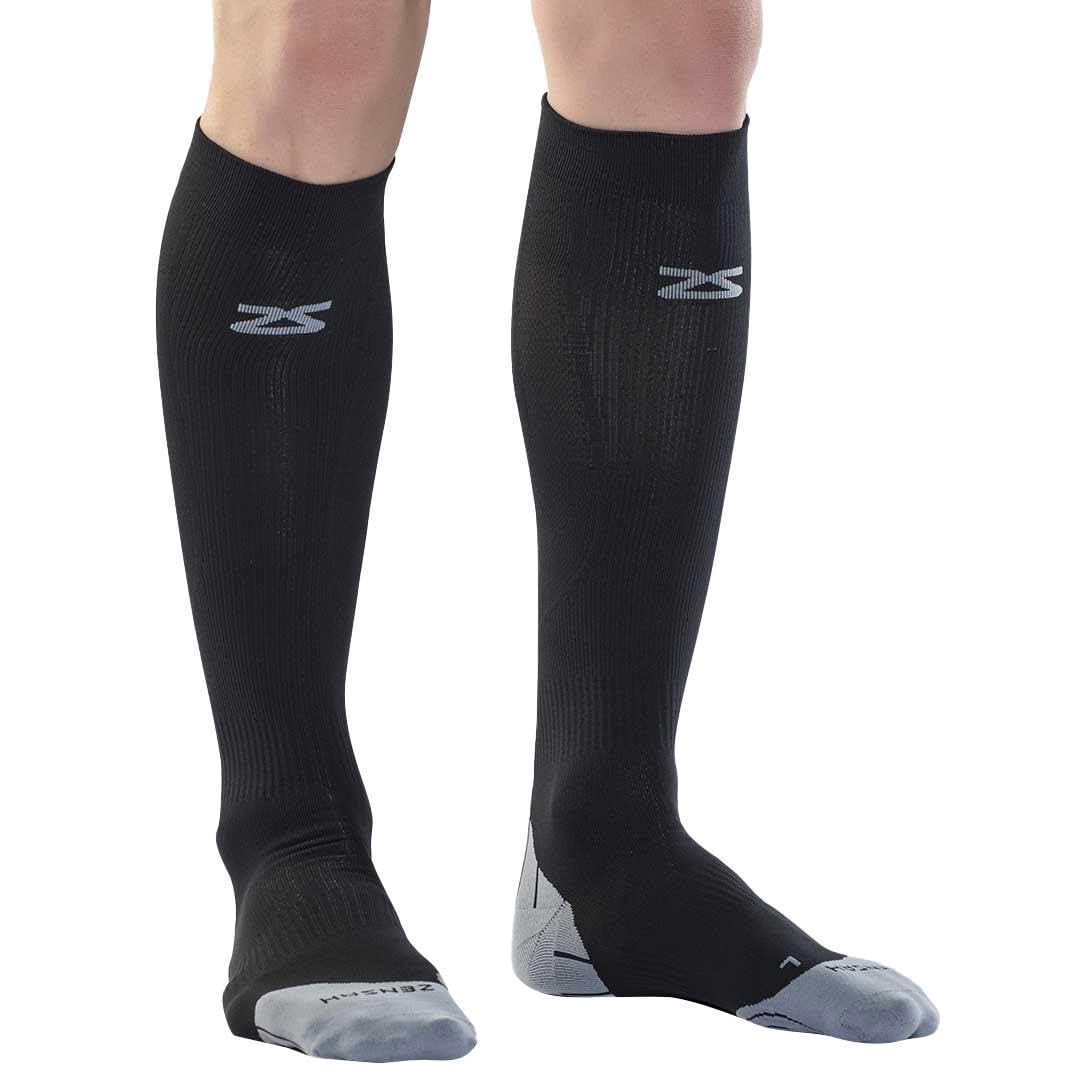
The Italian-made runner’s sock that pairs true graduated compression with an anatomical left-right fit.
This is the premium end of the lineup, and the detailing shows why. It is made in Italy from 82% polyamide and 18% elastane and knitted on a 200-needle-count construction — a finer, denser knit that produces a more durable sock with compression exactly where you need it. The key feature is true graduated compression: firmest at the ankle and lighter toward the calf, which is the direction that helps move blood back up the leg.
The comfort thinking is everywhere — a smooth toe to prevent chafing and blisters, an anatomical fit shaped for the left and right foot separately, and an elastic band around the arch for support. Runners wear them over 5-mile-plus runs and through cold mornings down to 7°F, and they are versatile enough for cycling, hiking, and long flights. For anyone chasing a faster recovery, the graduated knit (tighter at the ankle, looser up the leg) is meaningfully more advanced than the evenly-squeezed budget options.
What everyone raves about is the feel of the knit — soft, thick and durable, with a padded footbed and a top band that stays up all day. The catch is getting them on: they are intentionally tight, and the first few attempts take technique (turn them inside out, seat the heel, roll them up). Some also find the cuff band narrower than older versions and want a wider top. Neither spoils the pair — this is simply the most refined compression sock here, and it asks for a little patience in exchange.
The Italian craft difference: A 200-needle-count knit and anatomical left-right fit give a denser, more supportive sock than the evenly-knit options.
The snug reality: They are tight by design and tricky to pull on at first, and the cuff runs on the narrow side.
The runner’s upgrade: true graduated compression with an anatomical fit for athletes, travellers and recovery chasers.
Pass if: you want a sock that slips on without a bit of technique.
Know the Specs
mmHg (Compression Rating)
The mmHg figure tells you how firmly a sock squeezes your leg — higher means more pressure. Mild 15-20 mmHg is easy to wear all day, while 20-30 mmHg is a firmer recovery-level squeeze. Match this number to your reason for buying before anything else.
Graduated Compression
Graduated compression means the pressure is strongest at the ankle and weaker higher up, which helps push blood back toward your heart. An evenly tight sock squeezes the same way all around and does far less for circulation, so look for the word “graduated” on the label.
Common Questions
What is the difference between 15-20 mmHg and 20-30 mmHg compression socks?
How do I know what size compression sock to buy?
Are knee-high compression socks better than ankle-length ones?
Why are my compression socks so hard to put on?
Can I wear compression socks on a long flight?
How long do compression socks last before the pressure fades?
Do compression socks help with swollen ankles?
What are compression socks actually made of?
Can women wear these men’s compression socks?
The Bottom Line
For most people, the strongest pair of men’s compression socks here is the Dickies Dri-tech crew — it keeps feet dry, holds its shape and gives arch support through the longest workdays. If you are hunting warmer, gentler support for flying, the Merino Wool 15-20 mmHg pair is the travel-ready one. And when you need firm, graduated recovery squeeze for swelling or running, reach for the Zensah Tech+ or the knee-high Physix Gear 20-30 mmHg. Pick the mmHg that matches your day and the rest follows.
How we choose
We do not accept paid placement. Every pick is matched to a real buyer and a real use-case; we do not hands-on test units.
Sources
Specifications: manufacturer listings and product documentation. Review insights: verified customer reviews, as of October 2026. Pricing: not shown on this page (it changes often); check the current price via the retailer link.
As an Amazon Associate, Aappliancez earns from qualifying purchases. This does not affect which products we feature.