Disclosure: Some links in this post are affiliate links. As an Amazon Associate I earn from qualifying purchases, at no extra cost to you. Learn more
Specs are compiled from manufacturer listings and verified buyer reviews and can change over time — please confirm the key details on the product page before buying.
If your throat feels like sandpaper every time you swallow and the cough keeps you (and everyone in earshot) awake, the fix depends on one real choice: a numbing lozenge that hits fast, or a syrup that coats and soothes over hours. A drop that only tastes like honey will not quiet a cough. The picks below are built around what actually works — a measurable active ingredient, a format you will genuinely use, and a taste your household will not fight you on.
This guide is built by comparing the manufacturers’ published specifications and the patterns across verified customer reviews, so you get each pick’s real strengths and trade-offs instead of marketing spin.
From infant-safe daytime-and-nighttime syrups to numbing extra-strength lozenges, each option below earns its spot for a different kind of throat. The best medicine for itchy throat and cough is the one that matches who is sick and how bad it feels.
Top Picks

How To Choose The Best Medicine for Itchy Throat and Cough
Two jobs need doing when a cough and a scratchy throat hit at once: quiet the cough, and take the sting off swallowing. Most single products lean toward one job, so the smart move is to decide which one is wrecking your day before you buy anything. Here is what separates a remedy that helps from one that just sits in the cabinet.
Read the active ingredient, not the flavor
The flavor is candy; the active ingredient is the medicine. Menthol is the cooling agent in many lozenges — in the Ricola drops it is 4.8 mg per drop, enough for a steady cooling tingle as the lozenge dissolves. Benzocaine is a numbing agent, and it is what makes the extra-strength Cepacol lozenges dull a raw, throbbing throat. Dextromethorphan is the cough-suppressant side of that same lozenge, working on the cough reflex itself rather than just the surface. A syrup like Zarbee’s instead uses agave and zinc, aimed at gentle soothing for little ones rather than numbing.
Match the format to where you are
A lozenge lives in your pocket and works while you talk, drive, or sit at a desk. A syrup lives at home and works best when you can sit still for a while after taking it. If your cough spikes at night, a syrup with a nighttime version is easier than trying to hold a lozenge in your mouth half-asleep. If you are out in the world with a tickle that will not quit, a sealed lozenge is the more practical tool. Neither format is better — they answer different moments.
Check who it is for before you buy
Age rules are not fine print here. One pick is built specifically for infants six months and older up to age three, with a daytime bottle and a nighttime bottle. Others carry a clear rule of ages six and older. Getting this wrong means either a product you cannot safely give or one that is too mild to do anything. Read the label for the person who is actually sick, not the person doing the shopping.
Side-by-Side Comparison
| Model | Best For | Format | Key Active / Base | Age Range | Amazon |
|---|---|---|---|---|---|
| Zarbee’s Baby Daytime & Nighttime Cough Syrup with Agave★ Best Overall | Babies and toddlers, day and night | Syrup combo (2 bottles) | Organic agave and zinc | 6 months to 3 years | Amazon |
| Ricola Honey Herb Herbal Cough Suppressant Throat DropsBest Value | All-day tickle at a desk or on the road | Individually wrapped lozenges | 4.8 mg menthol | Ages 6 and older | Amazon |
| Father John’s Cough Medicine Plus | Old-school cold and allergy relief | Liquid | Non-narcotic blend | Follow label | Amazon |
| Nin Jiom Pei Pa Koa | Restoring your voice when it has gone | Herbal syrup | Honey and loquat | Follow label | Amazon |
| Cepacol Extra Strength Sore Throat & Cough Relief Lozenges | Raw, painful swallowing you need numbed fast | Lozenges | Benzocaine and dextromethorphan | Ages 6 and older | Amazon |
Detailed Reviews
1. Zarbee’s Baby Daytime & Nighttime Cough Syrup
Our pick — over 4.5★ from 1,000+ verified ratings; the strongest balance of quality and price.
Two bottles, one job: a calmer baby through the day and a sleepier one at night.
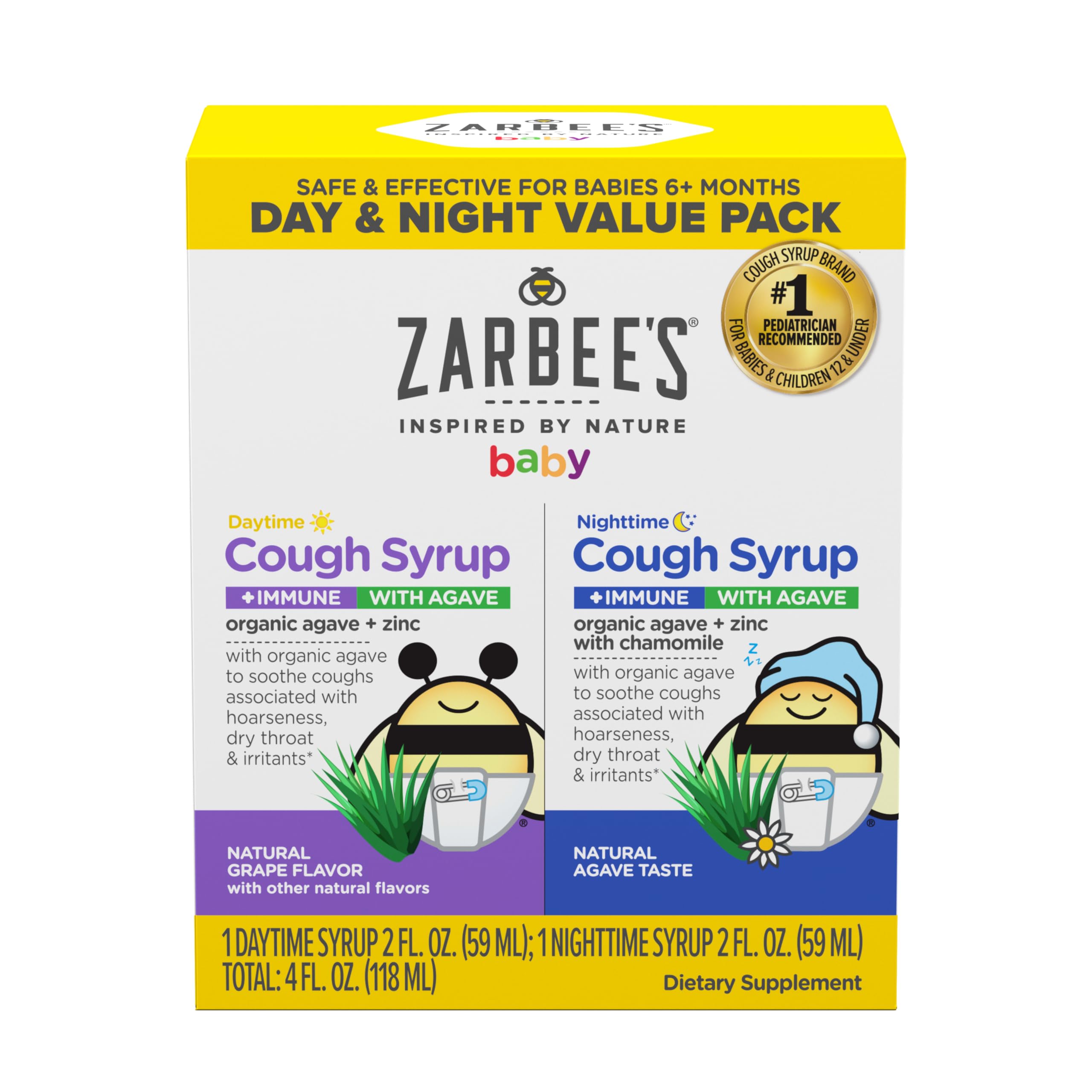
This is the pick for the parent of a coughing infant, and the format tells you why. You get two separate bottles — a daytime cough syrup and a nighttime version — so you are not choosing between soothing a cough and helping a baby settle at bedtime. Both are built on organic agave and zinc, with no drugs, no artificial colors, artificial sweeteners, or gluten. The daytime bottle targets coughs tied to hoarseness, dry throat, and irritants, in a natural grape flavor. The nighttime bottle keeps the same gentle ingredients and adds chamomile.
The label draws a firm line: infants six months and older, up through children age three. That narrow window is exactly why this earns the top spot in a list like this — most cough remedies on the shelf start at age six and leave you with nothing for a baby. If you have a three-year-old and a six-year-old, this bottle only covers one of them.
What wins people over here is whether it actually does anything, and that is far and away the most-praised trait of this product — parents report it does. The review pages sum it up: “This was a total lifesaver when my baby was struggling with a pesky cough. It worked quickly and gave our little one (and us!) much-needed comfort and rest.” The grape flavor gets credit too, because a baby who likes the taste is a baby you can actually dose. Parents of bigger kids note the trade-off sideways: many move up to a honey-based version once the child ages out.
What parents keep coming back for
- Nighttime bottle adds chamomile, so bedtime and cough relief are not competing.
- No drugs, artificial colors, artificial sweeteners, or gluten — easier to feel good about dosing a baby.
- Grape flavor makes the spoon go down without a fight.
- Infant-friendly at six months and up, when most syrups will not touch this age group.
Where it stops helping
- Covers only ages six months to three years — older kids need something else entirely.
- It soothes; it is not a numbing agent, so a raw, painful throat still hurts.
- Four total fluid ounces between two bottles goes fast in a bad week.
The house call for: a household with a coughing baby or toddler who needs both a daytime soother and a bedtime settle.
Not your bottle: if your sick one is past age three, the age window rules this out.
2. Ricola Honey Herb Throat Drops 24ct
The pocket-sized fix for a tickle that shows up mid-sentence.
Start with the number that does the work: 4.8 mg of menthol per drop. That is the cooling agent that takes the tingle off a scratchy throat, delivered slowly because the lozenge is square and dissolves gradually instead of vanishing in a minute. The herb side comes from a ten-herb blend sourced from Swiss mountain regions, dried and mixed for consistency. The honey is the flavor bridge that keeps the herbal notes from tasting like a medicine cabinet.
Buying this pack of three nets you 72 drops in three 24-count bags, and each lozenge is individually wrapped. Ricola draws the line at ages six and older, and the bags are sized for a desk drawer, a purse, or a travel kit.
This is the fun-size of the group — 4.8 mg per drop versus the extra-strength Cepacol’s harder numbing hit. Ricola cools and soothes. Cepacol dulls. For steady desk-side relief rather than a knockout, Ricola leads on all-day usability. Buyers report the drops work “great for cough and good taste,” and the flavor balance is the subtle win: not too sweet, not too mentholated, so the fifteenth drop of the day still goes down easy. A smoker in the house will happily use them for a dry mouth too.
Where the value sits: three sealed bags mean one for home, one for the car, one for the office — the dispersal is the deal.
The honest catch: gradual dissolution is also the downside if you want relief now — a slow square lozenge asks for patience a fast-numbing drop does not.
Reach for this if: your throat tickles all day long and you want something you can carry anywhere and ration out by the drop.
Look elsewhere if: you need deep numbing for a throat that hurts to swallow — that is a different tool.
3. Father John’s Cough Medicine Plus, 4 Ounces

The bottle your grandmother kept in the cabinet, still earning reorders.
Father John’s Plus goes after the whole cold rather than just the throat. The label lists temporary relief for cough, colds, and allergy symptoms, including nasal congestion and runny nose. It is non-narcotic, which is the detail that keeps it in the medicine cabinet for people who refuse to spend a sick day in a haze. The maker, Oakhurst, has been shipping old-time remedies across four generations, with some formulas tracing back to 1841.
That compact footprint, 3 x 3 x 6 inches, is about the size of a single can of soda stood upright.
The habit that makes it work is timing. The bottle rewards you for starting the day the first sniffle appears rather than waiting until the cough has settled in. Tastes have shifted over the decades — the flavor now reads like a flat root beer to some longtime users, where older bottles were closer to unpleasant — but the loyalty has not. One buyer reports it “knocked the cold out in 2 days,” and the reviews show a pattern of nostalgia that turns into a reorder. A rare note: some users found it pulled from local pharmacy shelves and had to look online to restock.
Best in class at: heading off a cold at the very first sniffle, which is what most of its fans actually use it for.
Dosing note: as a liquid, it needs a spoon or a measure and a moment to sit with — no taking it in line at the store the way you can a lozenge.
Suits you if: you want a drowse-free classic that targets the cold and the cough together and tastes like something you remember.
Skip it when: the only symptom bothering you is a raw, painful throat — this one treats the cold, not the sting.
4. Nin Jiom Pei Pa Koa 300ml

Thick as molasses, and the reason singers reach for it when the voice disappears.
Pei Pa Koa is a honey-and-loquat herbal syrup with a texture you feel before you taste it. It pours heavy — noticeably thicker than the pours of the remedies above — and that weight is exactly why it coats a raw throat instead of running straight down. The bottle holds 300ml, about 10 oz, so a single bottle is a real supply rather than a two-day sample.
When your voice has gone and you need it back for a meeting or a show, the Nin Jiom Pei Pa Koa is the thick coat that does it. What people rave about most is the soothing, and it shows up strongest when the throat has been pushed to its limit — a long night of talking, a performance, a stretch of coughing that has stripped your voice. It does not claim to cure a cold; it quiets the scratch and brings the voice back. Users describe taking it at the very first sign of a scratchy throat and keeping the sickness from getting worse. One buyer reports it left “throat normal in 2 days; shortened cold duration,” and calls it a staple they will keep around.
The trade-off is real and worth naming up front. The syrup is messy to pour, the bottle can be hard to open, and the price-per-bottle feels high next to the lozenge multipacks here. There is also a taste split in the house: adults tolerate the thick, sweet, minty flavor fine, but a child in the family tends to dislike it. If you are buying this for a fussy kid, that is the wrong bottle.
What you are buying: a voice-restoring coating in liquid form, thick enough to actually linger on the throat instead of sliding past it.
Mess warning: the pour and the sticky bottle cap are the two things owners mention most often as the price of the effect — keep a napkin nearby.
Made for: anyone whose voice has cracked or gone and wants a coating thick enough to bring it back, especially after heavy talking or singing.
Think twice if: you are dosing a child who turns up their nose at the flavor, or you want fast numbing rather than a slow coat.
5. Cepacol Extra Strength Lozenges 16 Count

Two actives in one lozenge — numbs the pain, then quiets the cough behind it.
Most drops pick a lane. This one runs both. The lozenge carries benzocaine, the numbing agent, alongside dextromethorphan, the cough suppressant. In plain terms: the first one deadens a raw, painful throat so swallowing stops being an event; the second goes after the cough reflex itself. That is why it gets slotted against the everyday itch relief of the Ricola drops — Cepacol is the harder hit, meant for a throat that hurts, not just tickles.
The package is a four-pack of 16-count, so you are stocking a drawer, not buying a single bag, and the mixed berry flavor is far easier to take than a medicated menthol spray. Dosing is specific and worth reading twice: take two lozenges, one immediately after the other, every four hours, and it is labeled for ages six and older. Follow that and the coverage stretches out to roughly a four-hour window per round.
If your throat hurts to swallow and you want real numbing with a cough suppressant behind it, the Cepacol Extra Strength Lozenges are the ones to reach for. The proof is in how quickly the itch gets calmed — the numbing effect is the headline, and people trading up from ordinary cough drops notice it fast. The words buyers keep reaching for are “stops cough” and “excellent at numbing the throat.” One detail worth knowing before you stock up: these are strong, so some people split a lozenge in half and stretch a pack further. If you have no cough, you are not missing anything — the numbing still does its job on the throat alone.
The core advantage: benzocaine plus dextromethorphan means one lozenge covers the pain and the cough, which is why it is the one to keep when the throat genuinely hurts.
Watch the cost-per-pack: the four-pack is the way to buy it, but the individual lozenges are the priciest per-unit hit here — a fair trade only if you want real numbing, not a candy to finish.
Click for this if: every swallow smarts and you want a lozenge that numbs the pain and attacks the cough at once, with a four-hour window per dose.
Better off without it if: you just have a light tickle and want an everyday drop — this is more medicine than that moment needs.
Know the Specs
Active Ingredient: Menthol vs Benzocaine vs Dextromethorphan
Menthol is the cooling agent — 4.8 mg per drop in the Ricola lozenges — and it creates a cooling tingle that takes the edge off a scratchy throat as the lozenge dissolves. Benzocaine, found in the extra-strength Cepacol lozenge, is a numbing agent: it deadens the surface so a painful swallow hurts less. Dextromethorphan, also in that Cepacol lozenge, targets the cough reflex itself rather than the throat surface. A cooling lozenge and a numbing lozenge are not the same tool — one soothes, the other deadens.
Format: Syrup vs Lozenge
Lozenges are portable and work hands-free while you are talking, driving, or working — sealed wrappers make them easy to carry and share. Syrups need a spoon and a quiet moment but coat a wider stretch of the throat and can be made in daytime and nighttime versions, as Zarbee’s does with its two-bottle pack. Thicker syrups, like the honey-and-loquat Pei Pa Koa, cling longer but pour messier. Age rules follow the format: the Zarbee’s syrup is built for six months and up, while the lozenges here are labeled for ages six and older.
Common Questions
Will a numbing lozenge work if I only have an itchy throat and no cough?
How long does the relief from these throat lozenges last?
Is the Zarbee’s baby cough syrup safe for a child older than three?
What is the difference between menthol drops and benzocaine lozenges?
Can I take a syrup and a lozenge on the same day?
Does the Nin Jiom Pei Pa Koa actually bring your voice back?
How many drops are in a pack of the Ricola throat drops?
Is the Father John’s cough medicine going to make me drowsy?
What age can use the extra-strength Cepacol lozenges?
Which of these is best for a cough that hits hardest at night?
The Bottom Line
For most households, the medicine for itchy throat and cough that covers the most ground is the Zarbee’s Baby Daytime & Nighttime Cough Syrup, because it answers the hardest case — a coughing infant who needs soothing by day and a calmer bedtime by night, ages six months to three years, with no drugs or artificial sweeteners. If your throat hurts to swallow and you want real numbing with a cough suppressant behind it, the Cepacol Extra Strength Lozenges are the ones to reach for. And when your voice has gone and you need it back for a meeting or a show, the Nin Jiom Pei Pa Koa is the thick coat that does it. One honest nudge: with a 4.8-star rating and over a thousand owners weighing in, the Zarbee’s pack is the safest first thing to keep in the cabinet before the next cough shows up.
How we choose
We do not accept paid placement. Every pick is matched to a real buyer and a real use-case; we do not hands-on test units.
Sources
Specifications: manufacturer listings and product documentation. Review insights: verified customer reviews, as of October 2026. Pricing: not shown on this page (it changes often); check the current price via the retailer link.
As an Amazon Associate, Aappliancez earns from qualifying purchases. This does not affect which products we feature.