Disclosure: Some links in this post are affiliate links. As an Amazon Associate I earn from qualifying purchases, at no extra cost to you. Learn more
Specs are compiled from manufacturer listings and verified buyer reviews and can change over time — please confirm the key details on the product page before buying.
If you only buy one pair of medical scissors, buy a 7.5-inch pair with a blunt tip and a non-stick blade coating. That combination is what separates a tool you trust in a real emergency from a drawer ornament. The shorter 5.5-inch bandage scissors are fine for tape and gauze at a dressing change. But they run out of leverage the moment denim, leather, or a seatbelt gets in the way. Below are eleven real options, so you can match the shear to how you actually cut.
This guide is built by comparing the manufacturers’ published specifications and the patterns across verified customer reviews, so you get each pick’s real strengths and trade-offs instead of marketing spin.
You will see which blade length and coating matter for your kit, which handles survive a 290°F autoclave cycle, and where a compact pocket pair beats a full-size trauma shear. The short answer on the medical scissors question is that blade length and tip shape decide almost everything.
Top Picks


How To Choose The Best Medical Scissors
Blade length: 7.5 inches versus 5.5 inches
Longer blades give you more cutting leverage per squeeze. A 7.5-inch shear opens wider and slices more material in one motion, which is why field medics favor it for clothing removal. A 5.5-inch bandage scissor is lighter and easier to steer around a small dressing, but it will not clear a thick hem in one pass. Think about the widest material you might realistically face, then buy for that width.
Coatings that stop tape sticking to the blade
A fluoride or titanium coating is a slick bonded layer on the steel. Its job is to stop adhesive tape, hydrocolloid dressings, and gauze residue bonding to the blade while you cut. Bare stainless steel grabs at tape and drags it instead of slicing it. If you do a lot of dressing changes, the coating is the single feature you will notice every single shift.
Tip shape and the safety question
A blunt tip has a rounded end with no sharp point, so you can slide it under a bandage against skin without stabbing the patient. A clothing-lift lip raises the material slightly ahead of the blade for the same reason. Both describe the same goal: cutting close to a body without cutting the body.
Handles, hand size, and sterilization
Some shears sit comfortably in larger hands thanks to a wide thumb hole; others shave the frame down to fit a scrub pocket. Neither is wrong, but a poor fit costs you control. Check the handle material too — alloy steel, polypropylene, and thermoplastic handles all behave differently, and only some shears are rated for an autoclave cycle at 290°F.
Side-by-Side Comparison
| Model | Best For | Blade Length | Blade Material | Hand Orientation | Amazon |
|---|---|---|---|---|---|
| Madison Supply 7.5″ Trauma Shears★ Best Overall | All-round field and clinic use | 7.5 inches | Stainless Steel | Ambidextrous | Amazon |
| Ever Ready First Aid Titanium Bonded ShearsBudget Champion | First aid kits on a tight budget | 7 1/4 inches | Titanium | Ambidextrous | Amazon |
| Utopia Care Bandage Scissors 5.5″Compact Pick | Dressing changes and tape at home | 5.5 inches | Stainless Steel | Ambidextrous | Amazon |
| MEUUT 2-Pack Trauma Shears | Shared kits and left/right handed users | 2.2 inches | Stainless Steel 440 | Ambidextrous | Amazon |
| OK TAPE Bandage Shears | Compact first aid storage | — | Stainless Steel | — | Amazon |
| MABIS Lister Bandage Scissors | Light, compact dressing work | 5.5 inches | Stainless Steel | Ambidextrous | Amazon |
| Nursing Tools Hummingbird 4-in-1 | Pocket carry with built-in extras | — | Japanese 420J2 Stainless Steel | — | Amazon |
| Prestige Medical Fluoride Scissor | Heavy-duty utility cutting | 7 1/2 inches | 420 Stainless Steel | — | Amazon |
| North American Rescue Trauma Shear | Tactical and IFAK kits | 7 1/4 inches | Stainless Steel | Ambidextrous | Amazon |
| Rockland Guard 7.5″ Trauma Shears 2-Pack | Keeping a spare in every bag | 7.5 inches | Stainless Steel | — | Amazon |
| XSHEAR 7.5″ Extreme Duty Trauma Shears | Daily EMS and rescue work | 7.5 inches | Stainless Steel | Ambidextrous | Amazon |
Detailed Reviews
1. Madison Supply Stainless Steel Trauma Shears
Our pick — 4.5+★ from 28,000+ verified ratings; the strongest balance of quality and price.
The 7.5-inch workhorse that field medics replace because they lose it, not because it died.
Start with the number that earns this pair its place: 7.5 inches of serrated stainless steel blade. That extra length gives you the leverage to cut through denim, rope, and plastic in one steady squeeze instead of a dozen nibbles. It also measures a full 2 inches more blade than the 5.5-inch Utopia Care bandage scissors further down this list, which is the difference between clearing a trouser leg and struggling with a gauze pad.
The blades carry a fluoride coating — a slick bonded surface that keeps adhesive tape and dressings from grabbing the steel while you cut. The tip is blunt for sliding under bandages without nicking skin, and the design is rated autoclavable up to 290 degrees F, so it can go through hospital-grade steam sterilization between uses. Cutting is what owners rave about most, and it is easy to see why when you combine deep serrations with a handle built for bigger hands.
Duplication rather than replacement tells the story best. As buyers put it: “I have had 4 pair of these. This is because I keep leaving them at my patients houses, however, I will keep buying them.” That is a home-health nurse who trusts the same shear enough to rebuy it four times. The honest catch is the black-on-black finish, which makes the shear easy to misplace in a dark bag or at night — the tiny trade-off for a coated blade that stays clean-looking.
What carries this pair
- 7.5-inch serrated blade clears bandages, clothing, and rope in one pass
- Fluoride coating stops tape and adhesive sticking to the blade
- Autoclavable up to 290 degrees F for real sterilization
- Ambidextrous handle that fits left and right hands equally
Where it asks a little care
- All-black finish disappears into a dark bag or night shift
- Large thumb hole suits bigger hands better than small ones
Reach for this if: you want one coated, autoclavable shear that handles clinic duty, home visits, and a car kit without complaint.
Look elsewhere if: you have small hands and want a pocket-sized shear — the compact Hummingbird below fits a scrub pocket far better.
2. Ever Ready First Aid Titanium Bonded Bandage Shears
A bent-handle shear that slides flat under a bandage and cuts through the whole roll.
The bent handle is the practical star here. It lets the shear lie flat against a surface while the blade slides underneath tape and gauze. So you cut the dressing, not the skin beneath it. Add a bonded titanium blade (titanium fused onto the steel for a harder cutting edge) and a 7 1/4-inch size. Now you have a shear that handles multiple layers of gauze and tape without separating them first.
Heat resistance reaches 290°F for a full sterilization cycle, and the fluoride coating keeps the edge working longer by resisting wear. Weight is worth knowing: owners describe an 8 oz shear with enough tension in the arms to bite into a bandage. That heft is the point — thin, floppy shears skate across tape; this one grips and slices. It earned its keep in ER and ICU work for years before landing in home kits.
Break-in is the one thing to expect. The hinge starts stiff and can leave your hand a little sore for the first few sessions, then settles into smooth action. It is also a dedicated shear, not a paper scissor — keep it for medical and heavy material, not crafts.
Why it earns a slot: titanium-bonded edge, 290°F sterilization, and a flat-cutting bent handle in an entry-level package make it the easy first-aid-kit pick.
Plan for the break-in: give the hinge a week or two of use before judging the tension — most of the stiffness works itself out.
Best for: outfitting several first aid kits or vehicles at once without overspending.
Hold off if: you need a pocket-carry shear — this one lives in a bag.
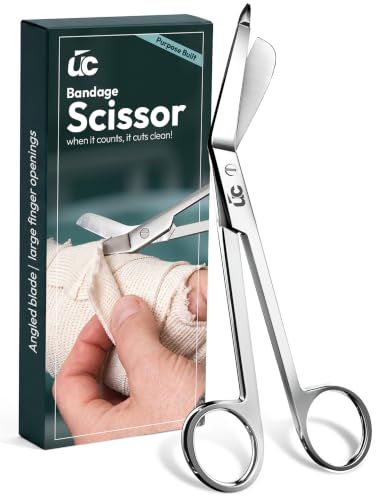
3. Utopia Care Bandage Scissors
The dressing-change specialist: short, light, and built for tape rather than denim.
At 5.5 inches with a 1.76 oz weight, this is the shear you keep beside the gauze for the twice-daily bandage change. It is ice-tempered stainless steel — steel heat-treated for hardness — so it stays sturdy despite the light frame. The non-stick surface on the surgical blade helps it keep its sharpness and stops tape dragging across the edge. Fits adult hands comfortably, which is the one fit note that keeps recurring in a good way.
Where this pair earns trust is the everyday dressing routine. It cuts gauze cleanly, glides along a finger ring grip for steady control, and matches the length most home wound kits expect. If your cutting life is tape, gauze, and bandages, the short blade steers more precisely than the long trauma shears above.
Now the honest part. Sharpness and cutting performance are the mixed notes in this pair’s record — the shorter bevel edge is not the brute-force cutter a 7.5-inch serrated shear is. Owners who cut heavy clothing or leather will want more blade. For bandages, though, the compact size and the clean cuts keep this a first-aid-kit staple.
Fit note: buy it for dressings, tape, and gauze, and it does exactly the job it was made for.
skip it if: your cutting reaches denim or seatbelts — that is a 7.5-inch job.
Good pick for: the home wound kit and anyone changing bandages regularly.
Not ideal for: heavy fabric or first-responder duty use.
4. MEUUT 2-Pack Medical Scissors Trauma Shears for Nurses
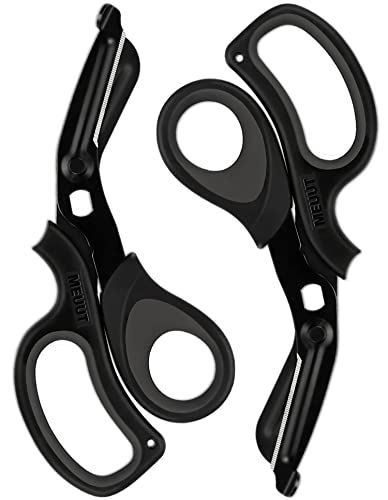
A built-in oxygen wrench and a carabiner clip turn one shear into three tools.
The 2-pack is the first practical argument: one pair for your primary kit, one for a belt or car door. One pair runs in your primary kit while the backup rides a belt or car door, so you are never caught short when a shear walks off. Each shear measures 7.8 inches long from a 440 high-hardness stainless steel blade given triple heat treatment — a hardening process that holds the edge through seatbelts and denim. The blade itself runs 2.2 inches, short enough for precise dressing work, with a blunt tip keeping it off skin.
The extra tool is an oxygen tank wrench built into the handle. That wrench lets a responder open an O2 cylinder valve mid-call without hunting for a separate tool. The non-stick fluoride coating keeps adhesive tape off the blade, so you are not scraping gunk between cuts. The symmetrical TPE and PP soft grips (a rubbery cushion over a rigid plastic core) suit both left- and right-handed users and reduce hand fatigue on long shifts. The carabiner clip is the other favorite detail. It hangs the shear where you can grab it.
The 2-pack does not arrive with two identical sizes in mind, so check which shear you are reaching for. Size draws some mixed comments because the 7.8-inch frame is generous in smaller hands. For most work — ER, home care, a car kit — that length is exactly what you want when clothing needs to come off fast.
What lands in your hand
- 440 high-hardness stainless steel with triple heat treatment
- Oxygen tank wrench built into the handle
- Carabiner clip for belt or bag carry
- Symmetrical soft grips work for left and right hands
The honest trade-offs
- 7.8-inch frame feels large in smaller hands
- Two shears means deciding which lives where
Choose this if: you want two dependable shears and appreciate the oxygen wrench on the handle.
Pass if: you want a single, compact shear for pocket carry.
5. OK TAPE Shears Non-Stick Bandage Scissors
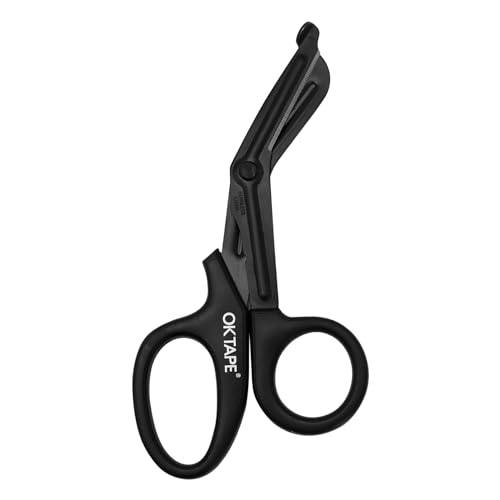
Milled serrations grip slippery material, and a 290°F rating keeps it clean between uses.
The milled serration pattern is the cutting story here. Those fine grooves on the blade grip material instead of letting it slide, so gauze and slick tape stay put while the edge bites in. A Teflon coating on the stainless steel keeps the blade non-stick and resists rust, and the high-strength ABS handle (a tough rigid plastic) is shaped for a comfortable, controlled hold. At 3.2 oz it is light enough to slip into a first aid kit without adding bulk.
The curved tip and blunt edge are built for fast, safe cutting close to skin, and the shear is rated to withstand 290F/143C autoclave treatment — real steam sterilization, not a wipe-down. That makes it the tool to reach for when cleanliness between patients matters more than brute cutting power.
The catch is sharpness. Some buyers find it super sharp and others find it does not cut well, so treat this as a shear for gauze, tape, and KT tape rather than leather or heavy straps. If you want an inexpensive, sterilizable shear for light clinical use, it delivers.
Strongest feature: the milled serrations and 290F/143C autoclave rating make it the cleanest lightweight option here.
Where to size expectations: it is a fine-material shear, so leave the heavy denim to a 7.5-inch pair.
Pick this for: a sterilizable shear that lives in a compact first aid kit.
Think twice if: you need heavy-duty cutting on tough fabric.
6. MABIS Medical Scissors, Lister Bandage Scissors, 5.5 Inch

A true Lister bandage scissor for careful tape and dressing work up close.
Lister bandage scissors carry an angled blade and a blunt tip so you can run the shear along a bandage without catching skin. This one is 5.5 inches of stainless steel, brushed to a standard finish, and it resists the stickiness of tape and glue on the blade — the specific job a bandage scissor exists for. At 13.61 g the frame is genuinely light, so long dressing sessions do not wear out your hand.
What this shear does well is precise, controlled cutting at close range: sizing a dressing, trimming a tape edge, getting through a bandage without pulling at the wound. Owners who keep one in a wound kit find it comes in handy for exactly this kind of everyday task, and the fit is described as easy to hold with minimal force to open and close.
Size is where buyers split. Some call the 5.5-inch length nice and compact, others find it smaller than expected — so measure what your cutting habits actually demand before buying. Sharpness and blade length also draw mixed comments, and there is no sheath in the box. For lighter dressing work up close, it is a tidy little tool.
Made for: careful dressing changes where a compact, light Lister scissor keeps your hand fresh.
Look elsewhere if: you need to cut wide tape in one pass or want a sheath included.
7. Nursing Tools Hummingbird 4-in-1 Medical Scissors

A tiny 1.44 oz four-tool shear that fits a scrub pocket and still cuts a code.
Four tools in one small frame is the headline. The Hummingbird packs an oxygen key, an IV clamp, and a screwdriver alongside the shear blade, all in a shear that weighs 1.44 ounces and is TSA approved for carry. The blades are high-grade Japanese 420J2 stainless steel — a fine-grained steel that takes a keen edge — coated in durable titanium gold. They will not fade or rub off, and the whole thing slips into a scrub pocket without a bulge.
The small size is a deliberate fit, not a shortfall. It is built for smaller hands and for pocket carry, which is why nurses describe it as the shear they actually keep on them instead of in a locker. It cuts through thick dressings and a shirt if needed; the oxygen key and magnet earn their keep at the bedside. The 4-in-1 design saves a reach for a separate oxygen key or clamp when your hands are full.
Know the limits. This is not the shear for leather, paracord, or a busy trauma bay — heavier duty pairs exist for that. The IV remover is described as mediocre by at least one veteran, and the small frame suits a pocket better than a trauma kit. For bedside nursing, though, it is the tool that rides with you.
Why nurses keep it handy
- 1.44 oz with a 4-in-1 setup: shear, oxygen key, IV clamp, screwdriver
- Japanese 420J2 steel with titanium gold coating
- TSA approved for carry
- Small frame that fits a scrub pocket
Where it tops out
- Not built for leather, paracord, or trauma-bay duty
- IV remover draws modest reviews
For the nurse who carries a shear every shift: the Hummingbird earns a pocket spot.
Not the one for: a trauma kit or heavy material cutting.
8. Prestige Medical Fluoride Scissor, Black, 7 1/2 Inch

A 7 1/2-inch utility shear paramedics keep calling the best they own.
The blade here is 420 stainless steel at 7 1/2 inches, and it is a utility shear that punches above its light frame. The 420 stainless steel blade holds its edge through years of hard use, cutting jeans, double layers, and belts without losing its bite. The fluoride coating is the same non-stick idea the Madison Supply uses: tape and bandages slide off instead of sticking and dragging.
Where this shear separates itself is long-haul dependability. Paramedics and ER residents who have handled drug-rep freebies, supply-store shears, and titanium versions describe this as the smoothest and best they have used, with no drop in performance across a year of level-one trauma work. Owners notice the fluoride coating keeping ortho-glass and tape from clinging, and the all-black finish holding its look over time. A small needle cutout helps pull a needle off a bone injection gun, a detail field medics notice.
The catch is stiffness from the start and the higher cost of the all-black build. The blade is also not a metal slicer — it will not chew through a penny past a thin edge. For cloth, tape, leather, and belts, it is the smoothest cutter in this lineup.
Standout: a 420 stainless steel 7 1/2-inch utility blade that medics call their best over a year of trauma work.
Worth knowing: it starts stiff and is not a metal cutter — keep it for fabric, tape, and leather.
Go here if: you want a proven, smooth-cutting utility shear for serious field use.
Look elsewhere if: you need a pocket-carry size or a lower-cost spare.
9. North American Rescue Trauma Shear, 7 1/4 Inch

NAR’s tactical shear: blunt tip, clothing-lift lip, and an O2 wrench built in.
Safety features lead here. The clothing-lift lip raises fabric slightly ahead of the blade, and the rounded tip keeps a point off skin — two things that make it easier to cut a garment without catching the patient. The enhanced serrated lower edge is built to cut the toughest materials, and the soft-grip non-slip contoured handles keep control even when wet. A 7 1/4-inch length and built-in O2 wrench round out the tactical setup.
What makes this a medic favorite is the fit. It drops into an IFAK, a molle webbing loop, a pocket, or a glove compartment without getting in the way. Owners describe it cutting thick and thin without breaking easily, and the all-over black finish suits low-light tactical use.
The 7 1/4-inch length is the one fit question. Some buyers call it perfect, others find it small — so measure against the kit it will live in before buying. Black also hides the shear in a dark bag, and one small fix is worth knowing: thread bright tape or a lanyard through the thumb hole so you can find it fast.
Reach for this if: you build IFAK or tactical kits and want a well-made black shear with an O2 wrench.
Look elsewhere if: you need a bigger shear for large hands or heavy kit duty.
10. Rockland Guard 7.5″ Premium Medical Trauma Shears (2-Pack)

Two 7.5-inch serrated shears built to slice denim, leather boots, and seatbelts.
The 7.5-inch frame with a precision-milled serrated lower edge is designed for the material nobody wants to cut gracefully — dense denim, thick leather motorcycle boots, heavy winter outerwear, rigid seatbelts. The steel is high-density, rust-resistant stainless to hold up to that load. The stealth-black fluoride bonded surface keeps tape, hydrocolloid dressings, and bio-matter from sticking so the pivot stays smooth through wound care.
The 2-pack is the practical buy: one shear for the trauma bag, one for a vehicle IFAK or a partner. Keep one in your trauma bag and one holstered or in a vehicle IFAK, share with a partner, or replace a dirty pair without waiting on shipping. The high-impact thermoplastic handles are contoured to spread force evenly, including under gloved hands, and the elongated clothing-lift lip and blunt safety tip protect the patient while you expose an injury. Fully autoclavable up to 290°F, it meets a real sterilization cycle.
The straightforward caveat is size and weight — this is a substantial 4.16 oz shear, not a pocket tool. If you want a single compact shear, a 2-pack of heavy shears is more tool than you need. For anyone stocking a bag and its backup, it fits.
What you get: two 7.5-inch autoclavable shears with a serrated edge and a non-stick fluoride coating for the price of stocking both kit and backup.
Size check: at 4.16 oz it is a full-size shear — great for a bag, wrong for a pocket.
Good fit for: stocking a primary kit and a spare in a vehicle or duplicate bag.
pass on it if: you want one pocket-sized shear instead of a heavyweight pair.
11. XSHEAR 7.5” Extreme Duty Trauma Shears

Blades twice as thick as most shears, with a center bolt that refuses to flex.
This is the shear built for the hard stuff. The hardened stainless steel blades are made twice as thick as most shears, and a specially designed heavy-duty center bolt keeps the pivot from loosening or flexing under load. The patented blunt tip and curved design keep a gentle edge near skin while you cut, and the soft-touch inner handles give a slip-resistant grip under gloves. It is a full 7.5-inch, 4 oz shear for the paramedic, EMT, or emergency physician who cuts clothing daily.
The cutting reputation is built on material toughness. It cuts jeans ankle to waist, a thick leather belt, and fiberglass casts, and holds its edge through a year of daily emergency use. A tree-climbing and SCUBA instructor who carries it reports clean, precise cuts through climbing rope and webbing where a knife would be slower or riskier. As one buyer sums it up: “Absolutely my favorite shears! These last me a year despite cutting through fiberglass casts all day!”
The catch is carry, not cutting. It is a premium shear with a premium frame, so it does not slide into every EMS pants pocket — plan on a cargo pocket or a proper holster. It also starts stiff from the start, so give the bolt a few sessions to settle. For the provider who wants the toughest blade on the market, it earns the spot.
Built for the rough end
- Hardened steel blades twice as thick as most shears
- Heavy-duty center bolt resists flex and loosening
- Blunt tip and curved design protect the patient
- Soft-touch inner handles for gloved grip
Plan around it
- Premium frame will not slide into every EMS pocket
- Stiff action until the bolt breaks in
For the daily cutter: the XSHEAR is the one provider who faces the toughest material should reach for.
Not for you if: you want a small pocket shear or a light spare for the car.
Know the Specs
Blade length and leverage
Blade length is the first number to check because it decides how much material you clear per squeeze. A 7.5-inch trauma shear opens wider and cuts denim or a seatbelt in one motion, while a 5.5-inch bandage scissor steers more precisely around a small dressing. Longer doesn’t mean always better — it means more leverage for heavy material. Short means more control for tape and gauze up close.
Non-stick coatings
A fluoride or titanium blade coating is a slick bonded layer that stops adhesive tape and dressings from sticking to the steel while you cut. Bare blades grab at tape and drag it instead of slicing cleanly. If you do frequent dressing changes, the coating is the feature you will feel on every shift. Some coatings, like titanium bonding, also add wear resistance to the cutting edge.
Autoclave ratings
An autoclave is a steam sterilizer, and a rating of 290°F means the shear is built to survive that cycle. Not every shear here carries that rating, so check it if cleanliness between uses matters to you. A full autoclave rating makes a shear suitable for a clinical setting. A wipe-down bandage shear is fine for home first aid but not for sterile protocols.
Blunt tips and safety lips
A blunt tip has a rounded end with no sharp point — you can slide it under a bandage against skin without stabbing. A clothing-lift lip raises fabric slightly ahead of the blade for the same reason. Both describe one goal: cutting close to a body without cutting the body. Look for both on any shear you intend to use on patients or people you care for.
Common Questions
Are 7.5-inch trauma shears better than 5.5-inch bandage scissors?
Can I sterilize medical scissors in an autoclave at home?
What does a fluoride or titanium blade coating actually do?
Will a blunt-tip shear still cut through thick clothing?
Can I carry medical scissors through airport security?
How long should a pair of medical scissors stay sharp?
Are these shears ambidextrous for left-handed users?
What is the difference between trauma shears and bandage scissors?
Do medical scissors come with an oxygen wrench?
How do I stop my black trauma shears from getting lost?
Should I buy a two-pack or a single pair of medical scissors?
The Bottom Line
For most buyers, the medical scissors winner is the Madison Supply 7.5-Inch Trauma Shears. It pairs a 7.5-inch serrated stainless blade with a fluoride coating and a 290-degree F autoclave rating (safe for high-heat sterilization), all in a shear that fits both hands. If you want the toughest blade here for daily field cutting, grab the XSHEAR 7.5-Inch Extreme Duty Trauma Shears. And for pocket carry at the bedside, the Nursing Tools Hummingbird 4-in-1 is the one to reach for. The coated, autoclavable build of the top pick is the reason it is the safe first purchase.
How we choose
We do not accept paid placement. Every pick is matched to a real buyer and a real use-case; we do not hands-on test units.
Sources
Specifications: manufacturer listings and product documentation. Review insights: verified customer reviews, as of October 2026. Pricing: not shown on this page (it changes often); check the current price via the retailer link.
As an Amazon Associate, Aappliancez earns from qualifying purchases. This does not affect which products we feature.