Disclosure: Some links in this post are affiliate links. As an Amazon Associate I earn from qualifying purchases, at no extra cost to you. Learn more
Specs are compiled from manufacturer listings and verified buyer reviews and can change over time — please confirm the key details on the product page before buying.
If you’re shopping for someone who spends most of the day in bed, the short answer is this: you want a surface that moves pressure around instead of letting it sit in one spot. A regular mattress, even a good one, keeps the same weight on the same skin for hours. With a spinal cord injury, that unrelieved load is the core risk. This guide covers nine beds and mattress systems, matches each to a level of need, and translates every spec into plain English.
This guide is built by comparing the manufacturers’ published specifications and the patterns across verified customer reviews, so you get each pick’s real strengths and trade-offs instead of marketing spin.
You’ll see the difference between static foam support and powered air cells, plus which sizes fit a standard hospital frame. Here is a straight read on the best mattress for spinal cord injury.
Top Picks


How To Choose The Best Mattress For Spinal Cord Injury
Your first decision is simple: do you need a powered air system or a well-built foam mattress? The answer depends on how long the person stays in bed and how much help they have with turning, not on the brand name. That single choice drives every spec that follows.
Powered air versus static foam
A powered air mattress runs an air pump that shifts pressure between cells on a timer — often a 10-minute cycle — so the same patch of skin isn’t bearing weight for long stretches. That continuous movement matters most for someone who cannot reposition themselves independently. A foam mattress relies on its density and a pressure-relieving top layer to spread load. It’s quieter, needs no electricity, and is simpler to set up, but it doesn’t change the pressure on its own. If you want the full picture of how air and foam systems differ, the reviews below show both in real homes.
The specs that actually change daily life
Weight capacity tells you who the bed is built for and whether it will stay stable over years. Cell height matters too: 10-inch cells on a bariatric system give more room to sink in gently than a shallower air layer. Cover material decides how easy cleaning is — a fluid-resistant, low-shear cover wipes down and reduces the pull that damages skin when someone slides. Finally, check the pump’s cycle options and whether it auto-returns to alternating mode after being left static.
Fitting your frame and your room
A standard hospital mattress is 80 inches long by 36 inches wide. Measure your frame before buying, because a 42-inch bariatric width won’t settle into a 36-inch deck, and a 5-inch hybrid sits lower than a 10-inch air system. If you’re buying a full bed rather than a mattress, the frame’s height range and caster size decide how easy transfers are for a caregiver.
Side-by-Side Comparison
| Model | Best For | Type | Weight Capacity | Height | Amazon |
|---|---|---|---|---|---|
| Armonyo Medical Grade Dual-Layer Foam★ Best Overall | Static foam support for 24/7 bed rest | Dual-layer foam | 450 lbs | 5 in | Amazon |
| Point A PAM-3H Full Electric BedComplete Bed System | A complete powered bed with LINAK motors | Full electric bed with hybrid air mattress | 550 lbs | 5.9 in mattress | Amazon |
| ProHeal Low Air Loss Alternating PressureLow Air Loss Specialist | Low air loss with cell-on-cell backup | Powered air, 20 cells | — | 8 in | Amazon |
| MedVance Alternating Air Mattress | Quiet pump and digital control | Powered air, cell-on-cell | 450 lbs | 8 in | Amazon |
| ESHINE Adjustable Bed Set | Adjustable frame plus waterproof mattress | Adjustable bed with 6″ foam mattress | 750 lbs | 6 in mattress | Amazon |
| Drive Med Aire Plus Bariatric | Bariatric sizing with deep 10″ cells | Powered air, 20 bladders | 600 lbs | 10 in | Amazon |
| Drive Med-Aire Low Air Loss 84″ | Longer 84″ deck with 4-way stretch cover | Powered air, 20 cells | 450 lbs | 8 in | Amazon |
| ELENKER Full Electric 5-Function Bed | Full ICU-style positioning with IV pole | Electric bed with 5″ mattress | 530 lbs | 5 in mattress | Amazon |
| Restisland Electric 5-Function Bed | Trendelenburg positioning at lower cost | Electric bed with 4″ foam mattress | 530 lbs | 4 in mattress | Amazon |
Detailed Reviews
1. Hospital Bed Mattress, Medical Grade Dual-Layer Foam
Our pick — 4.5+★ from 50+ verified ratings; the strongest balance of quality and price.
The foam layer that keeps its shape when someone can’t turn themselves.
For a spinal cord injury where the person is in bed nearly all day, this is the simplest strong answer: a static dual-layer foam mattress you don’t have to plug in. What it does better than most foam beds is stay honest about its density. The base is 2.1 lb foam for firm, stable support that resists bottoming out, and the top is a 1.9 lb layer that spreads pressure rather than letting it pool. Those two numbers are the reason this one holds up when a lighter, cheaper foam would flatten.
It’s built to support up to 450 lbs across an 80″ x 36″ x 5″ deck, which is the standard twin XL hospital size. Four reinforced handles let a caregiver reposition it, and a low-slip bottom keeps it from drifting on the frame. For someone who spends nearly every hour in bed, the cover matters as much as the foam. The 70D nylon waterproof top is non-butyl backed, which the maker says reduces heat buildup so the surface stays cooler — worth knowing if sweating and skin moisture are already a concern. As owners put it: “Comfortable, supportive mattress; wife with MS uses it 24/7.”
What earns the most praise is the overall build quality, followed closely by comfort, and the medium-firm feel is what makes that work. It’s supportive without the stiff, board-like feel that pushes people toward adding a topper. Cleaning is simple — the waterproof cover zips off and wipes down. The trade-offs are honest ones. At 19 lbs it’s movable by one person, but this is a static surface, so it doesn’t shift pressure on its own the way a powered air system does; it suits someone who still gets regular repositioning help. It’s also a mattress only, so you’ll need a hospital or adjustable frame to put it on.
What holds up over months
- 2.1 lb base plus 1.9 lb top foam resists bottoming out under a 450 lb limit
- 70D nylon waterproof cover zips off for quick cleanup
- Medium-firm surface that stays comfortable for near-constant bed rest
- Four handles make solo repositioning realistic at 19 lbs
Where it asks more of you
- No powered pressure cycling — repositioning help is still needed
- Sold as a mattress only, so a frame is a separate buy
Reach for this if: you want dependable static support with a cooler, easy-clean cover and no pump to maintain.
Look elsewhere if: the person needs an air surface that moves pressure automatically through the night.
2. Point A PAM‑3H Premium Full Electric Hospital Bed
A whole bed, motor and mattress, that arrives with nothing to assemble.
If you’re setting up a room from scratch rather than replacing a mattress, this is the whole package in one crate. It arrives fully assembled, moves on 6″ aluminum casters with a central locking system, and adjusts height from 17.5″ to 27″ so a caregiver can work at a comfortable level. The head, foot, and knee sections each move independently.
You get quiet, smooth adjustment from Danish-engineered LINAK actuators (the motors that move the bed) — the same class you’d expect in a facility bed, not the jerky clunk of a budget frame. The numbers separate it clearly: this bed supports up to 550 lbs, while the Armonyo foam mattress above tops out at 450 lbs. The included hybrid air mattress measures 78″ x 35″ x 5.9″ with a waterproof surface, so spills wipe clean. The whole setup is backed by a 2-year limited parts and labor warranty, with full coverage in year one and replacement parts in year two.
Where it asks more of you: this is a substantial piece of equipment at roughly 287 lbs for the bed, and the shipping crate alone is 86″ long. That’s a delivery-day logistics question — where it lands and who helps move it — not a reason to rule it out. It’s also a full bed, so it needs the floor space a home-care room can give it.
The math on capacity: 550 lbs on this frame versus 450 lbs on the Armonyo mattress is a meaningful gap if the person you’re caring for is heavier — it’s the reason this one sits in premium territory.
What you’re really buying: a bed that goes from delivery to usable without a toolbox, plus powered positioning that saves a caregiver’s back on every transfer.
The confident call: a complete, no-assembly electric bed for anyone furnishing a home-care room and wanting LINAK motor quality from day one.
The one caveat: at roughly 287 lbs with a 410 lb crate, plan the delivery path and a second pair of hands before it shows up.
3. Low Air Loss Alternating Pressure Mattress
Twenty air cells that trade pressure back and forth, with moisture venting built in.
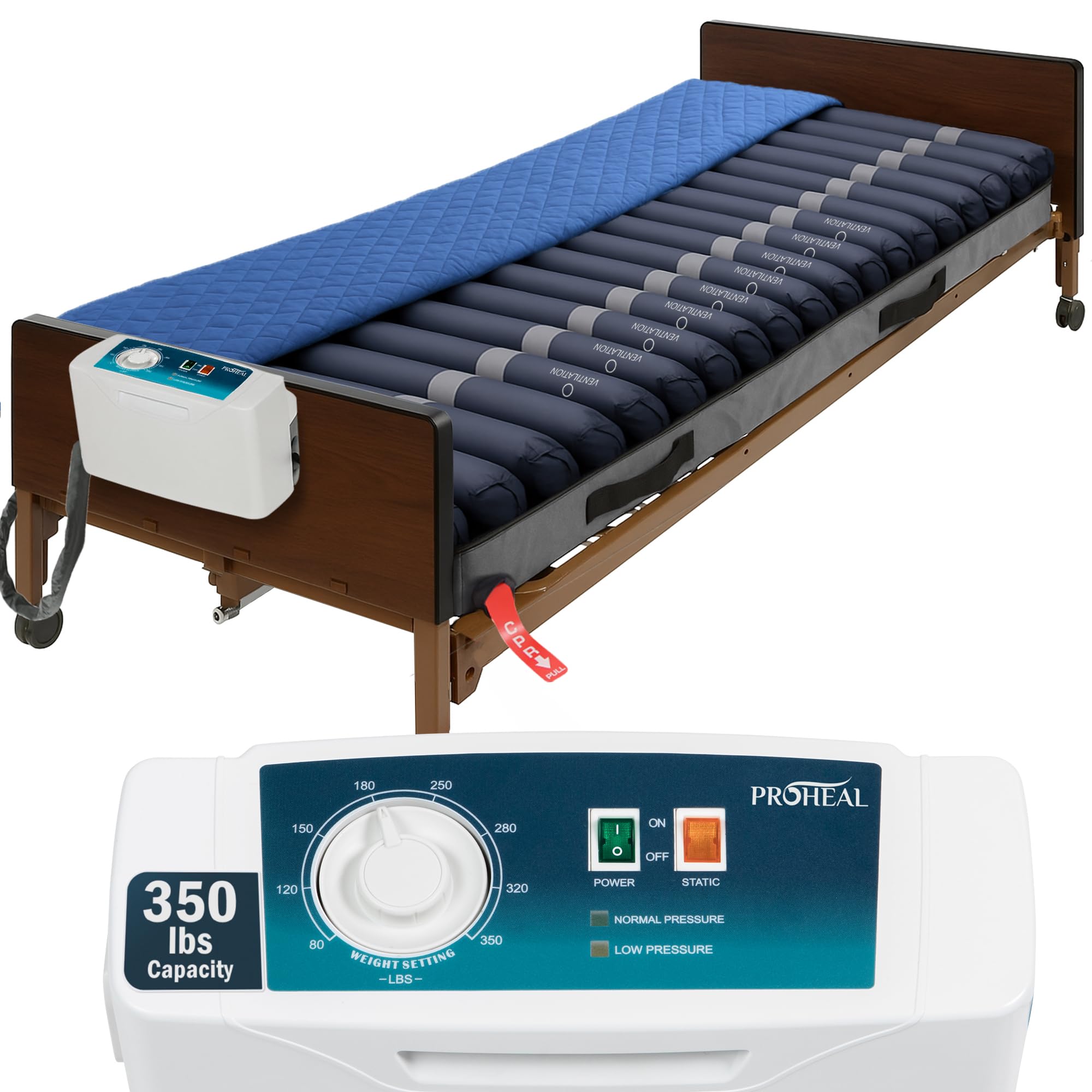
Here’s the design that matters for someone stuck in one position: 20 individual cell-on-cell bladders run an airflow cycle every 10 minutes, so body weight alternates and the skin under it gets a break. The cell-on-cell layout keeps air in the lower 4″ even if the power cuts out, which is the difference between a flat mattress and a supported one during an outage.
The second job is moisture. Bedbound skin collects sweat and moisture, which softens tissue and speeds sore formation. This one has 18 laser-size holes feeding low air loss ventilation across the surface — a small microclimate under the body rather than a sealed, damp pocket. Rated for pressure ulcers stages I-III, it adds a CPR valve for fast emergency deflation and a whisper-quiet pump with a visual low-pressure alarm.
The honest catch is consistency. The 36″ x 80″ x 8″ sizing fits a standard frame and the fluid-resistant cover wipes clean, but one owner found that after several months the airflow stopped fluctuating and stayed static — worth watching the pump readout. A quiet night is the norm here, not the exception: one buyer sleeping next to it reports hearing only faint inflation adjustments. If you want a system with a longer track record and a digital display, the MedVance below is worth a look.
Where it shines: the combination of alternating pressure and low air loss in one pad, plus a 10-minute cycle and cell-on-cell backup that keeps the lower 4″ inflated in a power failure.
What to watch: pump reliability over the long haul — keep an eye on whether the cells keep alternating rather than sitting static.
Choose it when: moisture control and pressure cycling both matter, and you want low air loss at a mid-range point.
Think twice if: you need proven long-term pump reliability above all else — the track record here is shorter than the Drive options.
4. MedVance Alternating Air Mattress

A digital air bed quiet enough to sleep beside, with a remote for the caregiver.
What wins people over here is the pump. It runs at under 20 dB — roughly a whisper — with dual pump cores for strong output and a digital screen showing weight and pressure. The practical payoff is the remote: a caregiver can drop the mattress to change sheets or hit the max-firm setting to make a wheelchair transfer easier, all from the bedside. The 8″ cell-on-cell design prevents bottoming out and holds up to 24 hours of power-outage protection, with a pillow function that keeps the head cells inflated in static mode.
For scale, this is 28 lbs against the ProHeal’s 25.8 lbs above — close enough that weight isn’t the deciding factor; the digital control and the longer track record are. It fits standard hospital beds at 80″ x 36″ x 8″, handles up to 450 lbs, and the quilted poly PU cover is water resistant with an anti-slip coating and adjustable straps. There’s a CPR red tag to deflate in a second. This is the pick for a paraplegic user who wants independent control of their own surface.
The pattern in the reviews is comfort and sleep quality, with the recurring gripe being the wireless infrared remote — it needs a clear line to the pump, which can be awkward to aim from lying down. A few units have stopped working over time, so treat the pump as the part to watch. Otherwise this is the most controllable system at its level.
Why it earns its spot
- Under-20 dB dual-core pump keeps the room quiet overnight
- Digital LED screen shows weight and pressure at a glance
- Max-firm button simplifies wheelchair transfers
- 24-hour outage protection from the cell-on-cell build
Where it tests your patience
- Infrared remote needs to face the pump to respond
- A handful of pumps have failed over long use
Best match for: a user who wants to control their own pressure settings and needs the room to stay silent.
Less ideal if: you’d rather have a wired control that never misses an aim.
5. ESHINE Adjustable Bed Frame
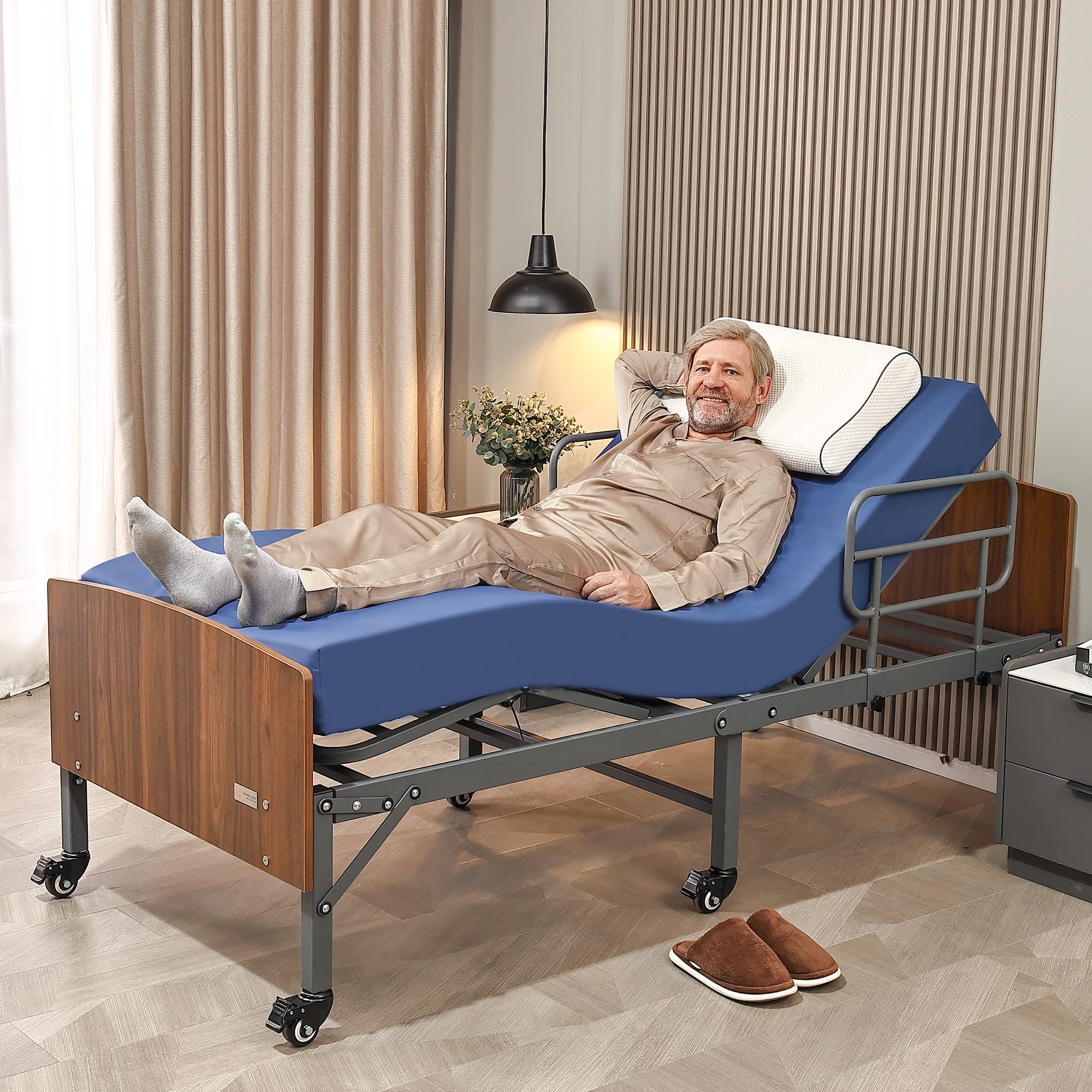
A grab-rail adjustable bed that tilts the sleeper upright without a full hospital frame.
This one solves a different problem: getting someone comfortable and upright in a room that isn’t a hospital. The head section inclines up to 70° and the foot up to 30°, controlled by a 9-button wireless remote, so a caregiver can shift the angle for eating, reading, or breathing comfort without physically lifting. The 750 lb capacity on the frame is the highest here, and the 6″ hospital-grade mattress uses high-density foam with medical-grade fabric for pressure redistribution.
Details that matter day to day: grab rails on the frame for support during transfers, an under-bed night light for 2AM checks, and 2.5″ wheels to roll it into position. Assembly is listed at about 10 minutes with instructions included. It’s a complete set — frame and mattress together — which is the reason it’s the practical middle ground between a bare mattress and a full electric hospital bed like the Point A above. For a senior managing balance issues or arthritis, the rails and the incline do most of the work.
The catch worth knowing: the mattress is 6″ of high-density foam, and a couple of buyers added a topper for extra padding. If deep pressure relief is the top priority, pair it with a dedicated surface or set expectations for a firmer feel. The frame itself is described as heavy and solid, and the adjustable positions run smoothly. As buyers report: “Just perfect for my new assisted living home. Easy to operate. Easy to get in and out of.”
The real value: one purchase covers the powered frame, the mattress, the rails, and the light — no hunting for parts that fit each other.
The honest limit: 6″ of foam is firm, so plan a topper if the sleeper needs softer pressure relief.
Worth it for: a home setting that wants one adjust-at-the-touch-of-a-button bed with grab rails and no medical-room look.
Not the pick for: skin that needs automatic pressure cycling rather than a static foam surface.
6. Drive Medical Med Aire Plus Bariatric Low Air Loss Mattress

Deeper cells and wider deck for a heavier body that needs pressure off every point.
When the person you’re caring for is larger, shallow air cells give way under the weight and stop doing their job. This one is built for that: 10″ deep air cells across a 42-inch width, 20 bladders in all, with a 600 lb capacity. The cell-on-cell design keeps it from bottoming out and holds pressure for up to 24 hours during an outage. Each bladder can be pulled and replaced on its own rather than scrapping the whole mattress.
The pump is where it earns trust for long-term care. It runs alternating pressure with diagnostic alarms, four cycle times (10, 15, 20, and 25 minutes), and it auto-returns to alternating mode if someone leaves it on static for more than 2 hours. A pillow function keeps the three head cells inflated in static mode. The maker rates it for pressure ulcers up to Stage IV. Airflow is 12 LPM.
The honest caveat is the cover. It’s slick, so a heavier user can slide when sitting up — releasing air first makes repositioning easier, which is the standard workaround. The mattress also stands as tall as the side rails, which complicates moving a patient across. If deep pressure relief for a bariatric user is the goal, this is the system designed for it.
Built for a heavier user
- 10″ cells and a 42″ wide deck support up to 600 lbs
- 20 individually replaceable bladders extend the system’s life
- Pump auto-returns to alternating mode after 2 hours static
- Cell-on-cell design holds 24 hours of outage protection
What to plan around
- Slick cover lets the user slide when sitting up
- Stands as tall as the side rails, complicating transfers
Go with it for: a bariatric user whose weight demands deeper cells and a wider deck than a standard 36-inch air mattress.
The trade-off: the slick cover needs a release of air before repositioning to keep the user from sliding.
7. Drive Medical Med-Aire Low Air Loss Mattress System

An extra four inches of length for a taller user, with a cover built to cut friction.
Most hospital mattresses stop at 80 inches. This one runs 84 inches by 36 inches by 8 inches, so a tall person’s heels stay supported instead of hanging off the end. That extra length alone separates it from the standard-size systems here. Measure your frame before you commit.
Under the surface it does two jobs at once: alternating pressure and low air loss, the combination that both shifts weight and draws moisture away from the skin. There are 20 individual air cells for immersion and envelopment, a pillow feature for head stability, and a digital pump with diagnostic alarms that auto-returns if left static for more than 2 hours. You get four cycle times and adjustable comfort weight settings. The removable 4-way stretch PU cover is fluid resistant, low shear, and vapor permeable — a cover designed to slide rather than drag at the skin. Capacity is 450 lbs, and pump airflow is 8 LPM.
The thing to weigh honestly is durability at the edges. The quality and bed-sore protection are what people praise most, but there are reports of air channels losing pressure under the tailbone and a mattress sagging at one end after months of use. The pump can also wear out over years. Treated well, this is a serious long-term surface; expect to watch the cells and the pump over time.
The standout spec: 84 inches of length — four more than the standard 80 — for a taller sleeper who needs the heels supported.
The long-game caution: air retention at the tailbone and a sagging foot end are the failure points to monitor, and the pump is a wear item.
Pick this one if: length is your sticking point and you want low air loss plus a friction-reducing stretch cover.
Look at the bariatric Drive instead if: you need a wider, heavier-duty surface with 10″ cells rather than extra length.
8. ELENKER Full Electric Hospital Bed, 5-Function ICU Bed
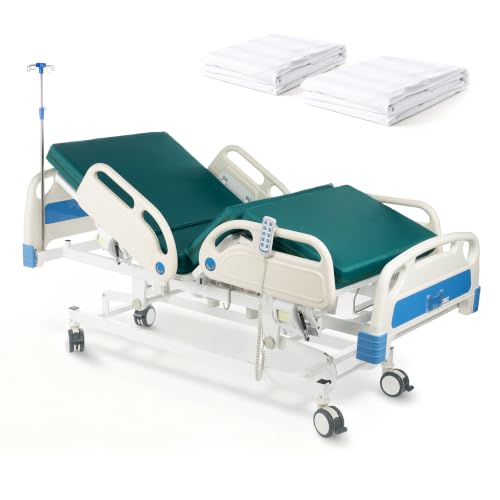
Five powered positions, including the tilt functions a caregiver leans on most.
If you’re caring for someone who needs to be angled, raised, and turned in bed, the feature list here is the reason to look. It runs five powered functions: trendelenburg and reverse trendelenburg at 0° to 12°, full elevation from 17.5″ to 30.1″, a backrest that goes to 80°, and legs to 45°. All of it moves by remote, on quiet electric actuators, so a caregiver isn’t cranking a handle.
The frame sits on 5-inch lockable casters that roll across carpet, wood, and tile, and it has a 530 lb operating limit. It arrives mostly put together — only the headboards and footboards need attaching — with instructions and a video to guide the rest. That makes it a realistic home setup, and the height range means a tall caregiver can work at a level that spares their back. What people praise most is the overall quality, and the money-to-bed comparison holds up: buyers describe it as close to a hospital bed without the hospital price.
The two things to weigh before buying. The included mattress is firm with little cushion, so many owners add an air cushion or inflatable layer on top — budget for a better surface if pressure relief is the goal. And the frame needs a bolt check: one owner had a nut work loose after four months and a support bolt later on, so a periodic tighten of all bolts is real maintenance. It’s the trade-off for a motorized bed at this level.
The motors and range do the work
- Five powered functions including Trendelenburg and reverse
- Elevation from 17.5″ to 30.1″ spares a tall caregiver’s back
- Mostly assembled on arrival — only head and foot boards to fit
- 530 lb limit on lockable 5″ casters
What you’ll want to add
- Included mattress is firm with little cushion
- Bolts need periodic checking and tightening
The fit: a caregiver who needs full positioning range and wants a bed that’s nearly ready on delivery.
Add to the plan: a pressure-relief topper and a quarterly bolt check to keep it solid.
9. Restisland Hospital Bed Electric 5 Function
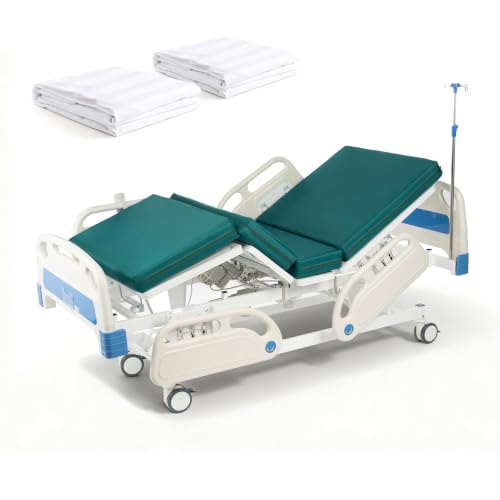
The trendelenburg functions, IV pole, and quiet motors for a fraction of the luxury-bed price.
Here’s the value read: a powered 5-function bed with trendelenburg and reverse trendelenburg, quiet motors, and an IV pole, without the premium markup of the Point A above. The side rails raise and lower and lock securely, the 5-inch casters roll smoothly with brakes that hold, and the 530 lb limit covers most home-care users. Elevation runs 17.5″ to 30.1″ on an 85.2″ x 39.1″ frame.
What people single out is quality — the build is described as stable and sturdy, with motors that are smooth and responsive. Caregivers compare it favorably to field beds. It comes as a full package: the bed, a 4-inch foam mattress, an IV pole, and two sets of sheets. Assembly is limited to fitting the head and footboards, guided by instructions and a video.
Two honest limits. The 4-inch mattress is thin, and the common fix is adding a topper — one buyer solved it with a 3-inch layer and called it perfect after that. And there’s a height discrepancy worth checking: the listing advertises a 19-inch floor height, but one buyer measured only 24 inches, which mattered for walking rehab. If a specific floor height is critical for getting feet on the ground, measure carefully on arrival. Frame welds are the other long-term item to watch over the years.
The value case: full 5-function positioning, trendelenburg included, plus an IV pole and sheets, on a stable frame with quality cited as the top strength.
The fit check: a 4-inch mattress that usually needs a topper, and a floor height that may not match the listing — verify it for rehab use.
Choose it if: you want powered tilt and a full bed package without paying premium prices, and can add a topper.
Check first if: exact floor height matters for someone relearning to stand and walk.
Know the Specs
Alternating pressure and low air loss
Alternating pressure means the air cells fill and deflate in a cycle — often around 10 minutes — so the weight on any one patch of skin keeps shifting. Low air loss is the smaller stream of air vented through tiny holes in the surface, which draws moisture away and keeps the skin drier. Together they tackle the two drivers of breakdown: unrelieved pressure and trapped moisture. A cell-on-cell design, where each column has a second layer beneath it, keeps the lower air inflated during a power outage so the body is never left on a flat, hard surface.
Foam density, weight capacity, and cover material
Foam density is given in pounds per cubic foot, and higher numbers mean the foam resists flattening longer — a 2.1 lb base is denser and firmer than a light foam that collapses under a heavier body. Weight capacity tells you the load the whole surface is rated for, so match it to the user with room to spare. Cover material decides cleaning and skin safety: a waterproof nylon or poly cover wipes down, and a low-shear, 4-way stretch cover lets the body slide instead of dragging. A quilted top adds comfort; a slick surface makes repositioning harder unless you release some air first.
Bed height, casters, and positioning functions
On a full electric bed, the height range matters for the caregiver — a taller frame spares the back during transfers. Casters are the wheels: 5-inch lockable casters roll across carpet and tile and lock in place for safety. The positioning functions, including backrest angle, leg angle, and trendelenburg (a gentle tilt that raises the foot end relative to the head), let a caregiver shift the person without lifting them. Check the stated floor height against your real-world need, since that’s what determines whether feet reach the ground for standing practice.
Matched sizing for frames and sheets
A standard hospital mattress is 80 inches long and 36 inches wide; bariatric systems widen to 42 inches, and some run longer at 84 inches. Confirm the deck size of your frame before buying, because a wider or longer mattress won’t seat properly. Thickness ranges from 4 to 10 inches depending on the system, and that affects how high the surface sits relative to the side rails. Standard twin sheets fit the 36-inch width on many of these air systems, though a bariatric deck may need larger bedding.
Common Questions
Do I need a powered air mattress or is foam enough for a spinal cord injury?
What does cell-on-cell mean and why does it matter?
Will a 42-inch bariatric mattress fit my standard hospital frame?
Why do so many people add a topper to the included mattress?
Can I put a hospital mattress on a regular adjustable bed frame?
How loud are the air pumps overnight?
What is the trendelenburg function for on a hospital bed?
Do these mattresses fit standard sheets?
How do alternating pressure mattresses handle a power outage?
Is a full electric bed worth it over just a pressure-relief mattress?
The Bottom Line
For most people setting up a bed for a spinal cord injury, the mattress for spinal cord injury that balances support, easy cleaning, and no power requirement is the Armonyo Medical Grade Dual-Layer Foam — its 2.1 lb base and 1.9 lb top keep it firm without flattening, and the waterproof cover wipes clean. If you want automatic pressure cycling (the mattress shifts pressure on its own) and a quiet digital pump, reach for the MedVance Alternating Air Mattress. And if you’re furnishing a whole home-care room, the Restisland 5-Function Bed brings powered tilt and an IV pole into the mix as a complete package. Whichever way you lean, match the surface to how much turning help the person gets — that one decision drives every other spec.
How we choose
We do not accept paid placement. Every pick is matched to a real buyer and a real use-case; we do not hands-on test units.
Sources
Specifications: manufacturer listings and product documentation. Review insights: verified customer reviews, as of October 2026. Pricing: not shown on this page (it changes often); check the current price via the retailer link.
As an Amazon Associate, Aappliancez earns from qualifying purchases. This does not affect which products we feature.