Disclosure: Some links in this post are affiliate links. As an Amazon Associate I earn from qualifying purchases, at no extra cost to you. Learn more
Specs are compiled from manufacturer listings and verified buyer reviews and can change over time — please confirm the key details on the product page before buying.
If your stomach acts up after meals and you want a spoon of something natural instead of another pill, Manuka honey is worth a serious look — but only the right jar. Most “Manuka” honey on Amazon is a blend, or carries an MGO number (the potency rating for methylglyoxal, the compound that gives real Manuka its strength) that sits low on the scale. This guide cuts straight to the seven jars that hold up, explains in plain words what each number on the label means for your daily routine, and tells you which one to buy for your stomach.
This guide is built by comparing the manufacturers’ published specifications and the patterns across verified customer reviews, so you get each pick’s real strengths and trade-offs instead of marketing spin.
Most people do best with a certified monofloral jar rated MGO 200 or above. That one line covers the manuka honey for digestive problems question for the average buyer. Below you will see which jars are monofloral (made from the nectar of one flower, the Manuka bush) versus blended. You will also learn what an MGO or UMF rating tells you about strength, and how long a jar lasts at a daily spoon.
Top Picks
How To Choose The Best Manuka Honey for Digestive Problems
Three label facts decide whether a jar is worth your money: is it monofloral, what is the MGO (or UMF) rating, and is it raw. Get those three right and the jar does what it says. Get them wrong and you have paid Manuka money for a sweetener that happens to have the word on the front.
Monofloral Or Blend: The First Thing To Check
Monofloral means the bees fed on the Manuka bush itself, so the honey carries its signature compounds. A blend mixes Manuka with other honey, which lightens the flavor and lowers the strength. For a daily stomach routine, look for the word monofloral or a UMF certification on the jar — that certification comes from the UMF Honey Association, which tests potency and authenticity independently.
The MGO And UMF Number, In Plain Terms
MGO stands for methylglyoxal, the compound that makes Manuka different from ordinary honey. A higher MGO number means more of it in the jar. UMF is a rating that measures three compounds together, including methylglyoxal, and it maps to an MGO figure — UMF 15+, for example, corresponds to a minimum of MGO 514+. Entry jars sit low on the scale; daily-strength jars climb higher; the strongest are usually kept for short-term use, not every morning.
Raw And Unpasteurized: Why Heat Matters
Raw and unpasteurized mean the honey was never heated to high temperatures, so its natural enzymes survive. That is also why you should stir it into warm — not boiling — tea or water. A spoon straight from the jar, or stirred into a drink you can comfortably sip, keeps more of what you paid for intact.
Side-by-Side Comparison
| Model | Best For | MGO Rating | Jar Size | Monofloral | Amazon |
|---|---|---|---|---|---|
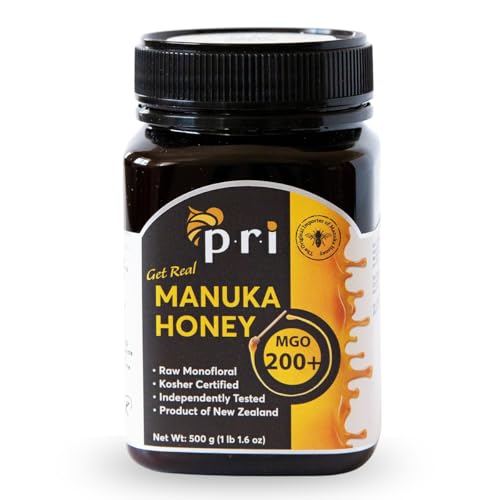
| P.R.I Manuka Honey MGO 200+★ Best Overall | Everyday stomach routine | MGO 200+ | 500g / 17.64 oz | Yes | Amazon |
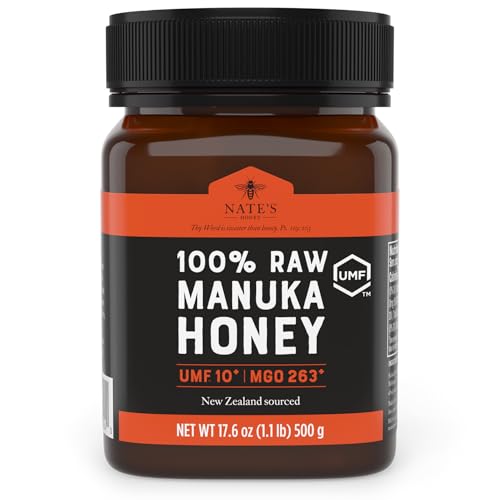
| Nate’s Manuka HoneyBest for Tea | Tea and yogurt sweetener | UMF certified (three MGO strengths offered) | 17.6 oz | Yes | Amazon |
| 100% Pure New Zealand Manuka Honey MGO 70+ | First-time Manuka buyers | MGO 70+ | 17.6 oz | Yes | Amazon |
| Me Today Manuka Honey UMF 20+ | Short bursts of high-strength use | UMF 20+ / MGO 826+ | 8.8 oz | Yes | Amazon |
| New Zealand Manuka Honey UMF 15+ | Daily immune support tier | UMF 15+ / MGO 514+ | 8.8 oz / 250g | Yes | Amazon |
| HONEY FEAST Propolis Infused | Big jar, low cost per spoon | MGO182 | 6 lb | Blend with wildflower honey | Amazon |
| Bees & Trees Manuka Honey 550+ | Highest strength, richest flavor | MGO 550+ | 380g / 13.4 oz | Yes | Amazon |
Detailed Reviews
1. P.R.I Manuka Honey MGO 200+ (500g/1.1lb)
Our pick — 4.5+★ from 700+ verified ratings; the strongest balance of quality and price.
The 500-gram jar that does the everyday job — certified monofloral, lab-tested MGO 200+, no guessing.
What earns this jar the top spot is the proven potency inside a mid-strength bottle: MGO 200+, independently lab tested per batch, from 100% monofloral New Zealand Manuka. That MGO number is above the entry-level jars and honest enough for a daily spoon — the maker has been selling Manuka into the US since 1987, so the supply chain is well-worn. Reviewers praise the honey’s taste and texture more than any other feature of this jar.
The everyday details are well thought out. The jar is 2.75 x 2.75 x 4.5 inches, which sits comfortably in a kitchen cupboard next to your tea tin. There is a QR code on the lid that links to batch-specific test results, so you can trace the jar back to its hive. And the honey is raw and cool-processed — no high heat — so the natural enzymes survive the trip. Keep it out of boiling water; warm is fine, scalding is not.
Two honest caveats come up in buyer feedback. A fraction of buyers find the flavour divisive, because Manuka is a stronger, earthier taste than the clover honey most people grew up on. A small group also question the cost against a supermarket jar. Both are fit notes, not defects. If you want a mild, sweet honey to drizzle over porridge, this is not the jar; if you want to taste the Manuka, it is.
What Owners Prize
- Certified monofloral with MGO 200+ verified per batch — the mid-strength balance for daily use.
- QR code on the lid traces each jar to its batch test results, so you can check authenticity yourself.
- Smooth, creamy texture that dissolves cleanly in warm tea and coffee.
- 500g / 17.64 oz jar — a generous size that holds its value per spoon.
Where It Stings
- The earthy Manuka flavour is not for everyone — some find it stronger than expected.
- Stir it into warm drinks only; heat destroys the raw enzymes you are paying for.
- 17.64 oz is slightly more than the 17.6 oz Nate’s jar — the difference is negligible.
Grab this if: you want a trusted, monofloral daily jar with verifiable MGO 200+ and enough of it to last a few weeks of morning spoons.
Pass if: you need a very mild flavour — Manuka’s earthy tang is the point, not a bug.
2. Nate’s Manuka Honey – 17.6 oz Jar
The mildest Manuka on this list — the one that slides into tea and yogurt without taking over.
What sets Nate’s apart is the taste: milder and less assertive than the P.R.I jar above, which makes it easier to fold into a daily drink if you are building a stomach-friendly morning routine. The jar is UMF certified through the UMFHA (the association that independently verifies Manuka potency, authenticity, freshness and purity), so you are not guessing whether it is the real thing. It comes in 17.6 oz — 0.04 oz smaller than the P.R.I jar — which is close enough to call it a draw on size.
The convenience is the second quiet win: customers single it out as easy to use, especially the squeeze bottle for measuring out a spoon. Consistency is thick and solid straight from the jar, so you will want to melt it in warm liquid. That is the trade-off if you like a runny honey — Nate’s demands a little warmth before it cooperates.
The verdict is straightforward. If you have tried a stronger Manuka and found the flavour too medicinal, Nate’s is the gentler on-ramp. Order it once and ease in.
Fit for daily drinkers: Runners, toast-toppers and tea-sippers will find this the easiest jar to reach for — the flavour is mild, the squeeze bottle is neat, and the UMF certification does the authenticity work for you.
Know this before you buy: the consistency is very thick, so it needs warm tea or a warm spoon to loosen. If you want to eat it straight off a cold spoon, it will fight back.
Reach for Nate’s if: you want a certified Manuka that disappears into your morning cup without a strong aftertaste.
skip it if: you prefer a pourable honey with an assertive bite — this one is thick, gentle and built for warm liquid.
3. 100% Pure New Zealand Manuka Honey MGO 70+
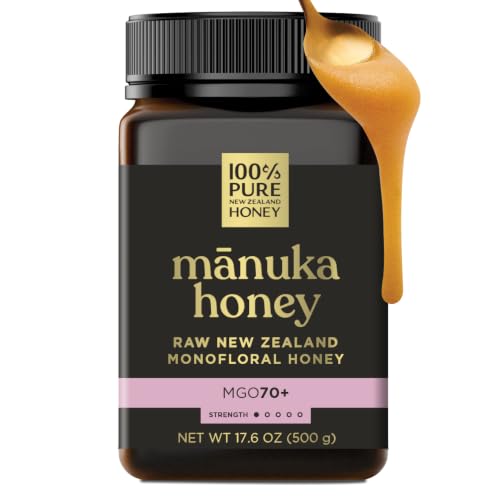
The gentle-starter jar — MGO 70+, a smooth caramel flavour, and a 17.6 oz size that won’t intimidate.
Never had Manuka before? Start here. The MGO 70+ rating puts it at the entry tier — plenty for a first-time daily jar without the premium price of the UMF 20+ bottles. The flavour is billed as rich caramel with the Manuka note present but not shouting. The cream process (a slow stirring technique that makes the honey smooth and spreadable) gives it a texture that works on toast, in smoothies and straight off the spoon. It won Supreme Honey at New Zealand’s national honey awards three years running — 2021, 2022 and 2023.
For everyday wellness, the jar works hard. It is raw, unpasteurised, non-GMO and glyphosate-free, and the size is 17.6 oz — right at the level of the Nate’s jar, so no freshness concerns between the two. The most-discussed aspect of this jar is the taste, and reviewers consistently come back for it.
The honest catch: the lid. Several people find the screw-on top fiddly to re-seat after opening. It comes off cleanly, but one buyer admits they “can’t get the top back on correctly.” It is a small annoyance, not a reason to skip the jar. If you plan to store the jar upside down or pack it for work, decant it into a smaller container.
First-timer’s read: Low MGO makes this the gentlest step onto the Manuka ladder, and the smoothed, creamed texture is easy to like from spoon one.
Small snag: the lid can be fussy to line up. Treat it gently on the first few opens and it behaves.
Try this if: you want to test whether Manuka suits your stomach without committing to the strongest jar on the shelf.
Look higher up the scale if: you already know you need a stronger potency — this is the doorway, not the destination.
4. Me Today Manuka Honey UMF 20+

The heavy hitter — UMF 20+ and MGO 826+ packed into a small 8.8 oz jar for short, high-strength runs.
The number that matters here is 826 — MGO 826+ is one of the strongest ratings in this whole list, independently certified by the UMF Association. That makes it a short-run jar, not a daily-spoon-for-months jar: 8.8 oz, reserved for when your stomach is acting up sharply or you are recovering from a cold. The colour is deep caramel, the texture lightly creamed and toffee-like, and the flavour is described by the maker as distinctively bittersweet with a hint of smoke. It is a Manuka-lover’s Manuka; not the starter jar.
The jar itself is small but well made — 3.31 x 2.32 x 2.28 inches, sized for a bedside table or a handbag. It is BPA-free and made from recycled PET, which fits the brand’s emphasis on ethical harvesting. Several buyers bought it as a gift and kept one for themselves, which tells you how it reads on arrival.
The catch worth flagging: storage. One buyer received a jar that had leaked in transit in 100°F+ heat — the interior safety seal glue likely softened. The lesson is simple: keep this jar below roughly 77°F, in a cool cupboard, and check the seal when it arrives. It is a shipping and storage issue, not a quality issue in the honey itself.
High-potency case: When you want the strongest punch per spoon, MGO 826+ is the number to beat. The creamy texture and deep caramel taste make it pleasant enough to take straight.
Small-jar reality: 8.8 oz will not carry a long daily routine. Expect to reorder if you take it consistently.
Pick Me Today if: you want a small, high-potency jar to keep on hand for flare-ups or cold season.
Keep looking if: you need a jar to spoon every morning — the 8.8 oz size and highest-tier strength are built for short bursts.
5. New Zealand Manuka Honey UMF 15+
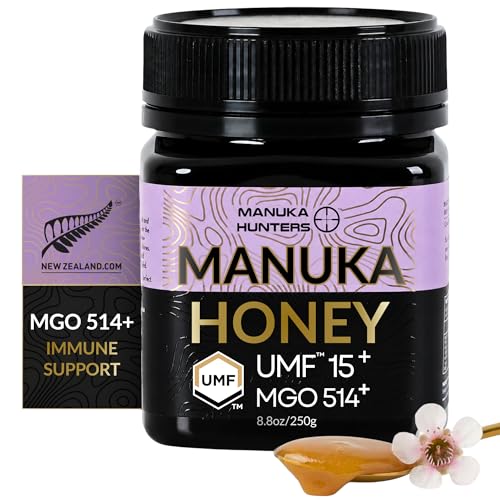
The 50-day jar — UMF 15+ / MGO 514+ strength, sized for a daily spoon and a Subscribe & Save rhythm.
Want a daily jar above the entry tier without the highest-tier premium? This is the pick. UMF 15+ maps to MGO 514+ minimum — noticeably higher than the MGO 200 range of the P.R.I jar. The jar is certified by the UMF Honey Association against all three signature compounds (Leptosperin, DHA and methylglyoxal), not just one. The flavour is described as sweet with more Manuka notes. The 8.8 oz / 250g jar is rated by the maker for 50 days at one teaspoon most days.
The most useful detail here is the daily rhythm: the jar is designed to be replenished on a subscription, so you are not running out mid-week. Six uses are spelled out — tea, coffee, toast, oatmeal, yogurt, smoothies, spoon straight, or stirred into a warm drink — which makes it easy to fit into whatever already sits in your morning routine. Crystallisation can happen; warm the jar in hot water (never microwave) and it softens again.
Buy two at the start if you are testing it against your stomach.
Daily-support logic: At one teaspoon most days, that is nearly two months before a reorder. The flavour is still sweet and approachable, not the intense bitter-leaning taste of the UMF 20+ jar.
What it is not: a bulk jar. Come in expecting a small 8.8 oz jar and plan your reorder cadence around it.
Consider this your daily jar if: you have moved past the entry-level MGO 70 price and want UMF 15+ strength in a size you can finish.
Don’t buy it for the family shelf: 8.8 oz evaporates quickly if more than one person spoons from it every morning.
6. HONEY FEAST Propolis Infused Raw Manuka Honey

The 6-pounder — a wildflower-blended Manuka with propolis, made for people who use a lot of honey.
The jar is the headline: 6 lb is a bulk buy, and it is one of the few Manuka-labeled jars that will last through a whole season of tea, smoothies and toast without a reorder. The formula is a blend — New Zealand Manuka honey cut with wildflower honey, plus a propolis extract (a resin-like substance bees produce, sold here as a wellness add-on) — so the Manuka content is not pure. The makers themselves describe it as a blend, with an MGO rating of 182. If you want a pure monofloral jar for digestive use, look at the top three picks above.
Taste-wise, it is a love-or-leave-it jar. Some buyers find it thin enough to drizzle on salads and desserts, and describe it as delicious enough to be hard to stop eating. Others find it cloying or too sweet. The honesty: it is a sweet blend with a propolis character, not a Manuka-first product. Buy it for the value and the size, not for the highest potency.
A few notes on freshness — the 6 lb jar is heavy, at 5 x 5 x 10 inches, and should be stored away from heat to keep the propolis blend evenly distributed. Scoop from the jar with a dry spoon; if the surface thickens, a warm-water bath restores it.
Value math: If you spoon a lot of honey into tea or use it in cooking, no other jar on this list stretches further per spoon than 6 lb. The wildflower blend softens the Manuka flavour and makes it easier to use as a sweetener.
Honest limit: this is a blend, not a pure monofloral Manuka jar — if you are shopping specifically for MGO 200+ or higher, skip this one and buy the P.R.I, Nate’s or Bees & Trees jar instead.
Reach for the bulk jar if: your household goes through honey fast and you want a Manuka blend with propolis for tea and toast.
Pass it by if: you want a certified monofloral jar for a stomach-specific daily routine — the blend and MGO182 rating put it in a different category.
7. Bees & Trees Manuka Honey 550+ MGO
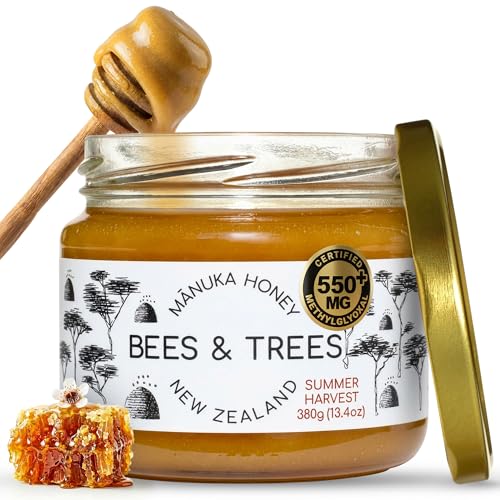
The one that tastes like custard and carries MGO 550+ — a premium jar for people who take their stomach routine seriously.
If your priority is strength plus flavour, this is the top of the list. MGO 550+ sits well above the mid-strength jars here (the P.R.I is MGO 200+, the UMF 15+ jar is MGO 514+), and it is monofloral, harvested in the Taranaki region of New Zealand, raw and unpasteurised. The texture is thick, creamy, and described by owners as soft like custard. The flavour is earthy with mild sweetness, versatile enough for tea, smoothies, oatmeal and straight-from-the-spoon. The taste is the thing owners return for — it is the flavour that anchors this jar’s reputation.
Traceability is unusually thorough. Each jar ships with a Certificate of Analysis documenting the MGO level, and the jars are RFID-tracked from hive to jar (RFID is a small radio tag that logs the batch). That is more transparency than most Manuka brands offer. Note the size: 380g / 13.4 oz, so it is a smaller jar than the 17.6 oz P.R.I and Nate’s jars — but higher potency per spoon.
Two honest trade-offs. The 380g size means reordering faster at daily use, and a small number of people find the cost hard to sustain as a long-term daily habit. If you are starting out, pair this with one of the larger mid-strength jars for the everyday spoon, and keep the Bees & Trees for the days you need the extra strength.
Creamy strength: Thick, custard-soft texture with an earthy flavour most owners come back for. RFID hive tracking and a batch certificate add real trust to the jar.
Size and cost: 380g is on the smaller side of this list, and a few owners find the cost heavy for a habit you take every day. Plan around it.
The premium keep-safe jar for: someone who wants the highest MGO in the house, with real traceability and a texture that genuinely tastes good off the spoon.
The jar to skip if: you need a month-plus supply at a single spoon — 380g will run out faster than the 17.6 oz jars.
Know the Specs
MGO And UMF — What The Numbers Mean
MGO is the short name for methylglyoxal, the compound that gives Manuka honey its distinctive strength. The higher the MGO number, the more of that compound is present. UMF is a rating system that measures three signature compounds together, and it maps to MGO — UMF 15+ corresponds to a minimum of MGO 514+, for example. For a daily stomach routine, jars tend to sit in the MGO 200 to MGO 550 range; the highest-rated jars (UMF 20+/MGO 826+) are often kept for short-run use. Monofloral means the bees fed on the Manuka bush itself, which is why monofloral jars carry a stronger, earthier profile than blends.
Jar Size And Daily Use
Manuka is measured in both grams and ounces, and the two do not always line up neatly — 500g is 17.64 oz, while 380g is 13.4 oz. At a standard teaspoon most days, a 17.6 oz jar runs for weeks, while a 250g or 380g jar runs out faster. That is why pick 5 highlights the 50-day cadence: the size is designed for a subscription reorder. Raw and unpasteurised matter too — heat breaks down the natural enzymes, so stir it into warm drinks, not boiling ones. Store in a cool cupboard; crystallisation is normal and reversible in a warm-water bath.
Common Questions
How much Manuka honey should I take for my stomach each day?
Is Manuka honey better than regular honey for digestion?
What is the difference between MGO and UMF on the label?
How should I store Manuka honey so it stays good?
Can I stir Manuka honey into hot tea or only warm?
How can I tell if my Manuka honey is real?
How long does a jar of Manuka honey last once opened?
Is the strongest MGO always the best for my stomach?
Does Manuka honey work for acid reflux?
Can I cook or bake with Manuka honey?
The Bottom Line
For most people, the best manuka honey for digestive problems is the P.R.I Manuka Honey MGO 200+. It pairs certified monofloral Manuka with a verifiable MGO 200+ rating in a 17.64 oz jar big enough for weeks of daily spoons. If a milder flavour matters more to you than size, the Nate’s Manuka Honey is the jar that disappears into tea. And if you want the highest potency with genuine traceability for a short-run stomach routine, reach for the Bees & Trees 550+ MGO.
How we choose
We do not accept paid placement. Every pick is matched to a real buyer and a real use-case; we do not hands-on test units.
Sources
Specifications: manufacturer listings and product documentation. Review insights: verified customer reviews, as of October 2026. Pricing: not shown on this page (it changes often); check the current price via the retailer link.
As an Amazon Associate, Aappliancez earns from qualifying purchases. This does not affect which products we feature.