Disclosure: Some links in this post are affiliate links. As an Amazon Associate I earn from qualifying purchases, at no extra cost to you. Learn more
Specs are compiled from manufacturer listings and verified buyer reviews and can change over time — please confirm the key details on the product page before buying.
Short answer: Micro Four Thirds (M43) wins when you want a body and lens small enough to carry daily, plus in-body stabilization (a sensor that physically moves to cancel hand shake) that keeps handheld shots sharp. You do not need a huge sensor for great photos — you need the right mount, a lens you will actually keep mounted, and stabilization that holds up in low light. The picks below cover every budget and every job, from a learning body to a flagship travel rig.
This guide is built by comparing the manufacturers’ published specifications and the patterns across verified customer reviews, so you get each pick’s real strengths and trade-offs instead of marketing spin.
Expect a clear read on sensor size, stabilization stops, and autofocus points so you can match a body to how you actually shoot. By the end you will know which camera earns a place in your bag, and this breakdown of the m43 camera field keeps every comparison grounded in real specs.
Top Picks


How To Choose The Best M43 Camera
Start with the mount, not the megapixels. Every camera here uses the Micro Four Thirds mount, so a lens you buy today works on the body you upgrade to later. That shared mount is why so many shooters stay in M43 for years.
Sensor resolution and what it actually buys you
You will see bodies with 16, 20, and 25.2 megapixels. More pixels help when you crop hard into a shot or print large — the 40.2-megapixel Fujifilm X-E5 lets you crop in with the two-step digital teleconverter that gives a 1.4x or 2x zoom. For social media and everyday prints, a 16-megapixel sensor like the LUMIX G85 is plenty.
Stabilization stops, explained in plain terms
In-body image stabilization (IBIS) moves the sensor to cancel out your hand shake. Fujifilm rates the X-E5 at up to seven stops of benefit at the center of the frame. More stops means you can handhold in dim light instead of reaching for a tripod — a real edge for travel and street shooting.
Autofocus systems and moving subjects
Contrast-detection autofocus (which hunts for the sharpest edge) is fine for still subjects. Phase-detection autofocus reads distance directly and locks faster on action — the LUMIX G9II uses 779 phase-detection points, so it tracks a running dog or a dancer far more reliably than a contrast-only body.
Side-by-Side Comparison
| Model | Best For | Sensor | Autofocus Points | Mount | Amazon |
|---|---|---|---|---|---|
| Canon EOS Rebel T7★ Best Overall | First-time learners | 24.1 MP APS-C | 9 | Canon EF | Amazon |
| Panasonic LUMIX G9IITop Performer | Still-and-video hybrid pros | 25.2 MP Live MOS | 779 | Micro Four Thirds | Amazon |
| Panasonic LUMIX G100Best for Vloggers | Vloggers and travel | Micro Four Thirds | 205 | Micro Four Thirds | Amazon |
| OM SYSTEM OM-5 E-M10 Mark IV | Beginners on a budget | 20 MP Live MOS | 121 | Micro Four Thirds | Amazon |
| Panasonic LUMIX G85 | Value video and stills | 16 MP | 49 | Micro Four Thirds | Amazon |
| Sony Alpha a7 III | Low-light full-frame | 24.2 MP full-frame | 693 | Sony FE | Amazon |
| Fujifilm X-E5 | Street and travel style | 40.2 MP X-Trans 5 HR | 142 | Fujifilm X | Amazon |
| Sony Alpha 7 IV | Hybrid pro work | 33 MP full-frame | 693 | Sony E | Amazon |
| OM SYSTEM OM-3 | Retro design, serious tech | 20 MP Stacked BSI | — | Micro Four Thirds | Amazon |
| OM SYSTEM OM-1 Mark II | Rugged flagship | 20 MP Stacked BSI | 1,053 | Micro Four Thirds | Amazon |
| Fujifilm X-H2 | High-resolution video | 40 MP X-Trans CMOS 5 HR | 425 | Fujifilm X | Amazon |
Detailed Reviews
1. Canon EOS Rebel T7 DSLR Camera
Our pick — 4.5+★ from 5,000+ verified ratings; the strongest balance of quality and price.
The classroom workhorse that teaches you aperture, shutter, and ISO without overwhelming the dials.
This is where a lot of people should start. The 24.1-megapixel APS-C sensor (a chip about 22 x 15mm, larger than the M43 Four Thirds chip) gives you headroom to crop and still print big. A 9-point autofocus system is simple, but for a beginner learning composition it locks onto a still subject reliably. The built-in optical viewfinder shows roughly 95% of the frame, so what you see is close to what you get.
The 18-55mm kit lens with image stabilizer covers your standard zoom range, so you have a walk-around lens in the box. Built-in Wi-Fi and NFC let you push photos to your phone, and the EOS Utility Webcam Beta Software turns the body into a webcam on Mac and Windows. In practice: one lens handles portraits, landscapes, and family shots while you learn the craft.
The honest limit is reach. The 18-55mm will not pull in distant wildlife without a telephoto, and night shots without flash take some post-processing recovery. The recurring note across owner experiences is that total beginners sometimes fumble the mode dial at first. Neither is a defect — it is the trade-off of a body that keeps the controls visible instead of burying them in a menu.
What earns it the top spot
- 24.1MP sensor with ISO range 100–6400 (expandable to 12800) for daylight and decent low light.
- Kit image-stabilized 18-55mm lens means one purchase gets you shooting.
- Built-in Wi-Fi and NFC push photos to your phone without a card reader.
- 3 FPS burst and Full HD 1080p video cover the basics.
Where it asks you to adapt
- Only 9 autofocus points — fine for stills, not for fast action.
- No telephoto reach in the box, so distant subjects need another lens.
- APS-C bodies and lenses run larger than an M43 setup.
- The mode dial needs a read-through before total beginners feel at home.
Pick it for: a first DSLR you plan to learn on, with a lens already attached.
Think again if: you want a pocketable travel rig — this is a full DSLR body and lens to carry.
2. Panasonic LUMIX G9II Micro Four Thirds Camera, DC-G9M2BODY
The M43 body that finally removes autofocus doubt — 779 phase points and stabilization that holds a handheld low-light frame.
For anyone who shoots both stills and video, the G9II is the most complete camera here. Its 25.2-megapixel Live MOS sensor delivers rich tonal gradation, and phase-detection autofocus across 779 points tracks subjects in real time with AI-powered recognition. Compare that to the Canon Rebel T7’s 9 autofocus points and the gap is plain: action tracking that stays locked instead of guessing.
Video is equally serious. It records C4K/4K 60p 4:2:2 10-bit footage, and the 100MP Handheld High-Res Mode captures far more detail when the light is good — that means a 100MP frame you can crop into with room to spare. As owners put it: “handheld 100MP high-res mode” and a minimum ISO 50 for finer detail in good light are the reasons they reach for it. The large bright medium-size electronic viewfinder (the little screen you look through) matches the feel of a full-frame body too.
What holds it back is heat. Long continuous video sessions will hit a thermal stop, so plan short clips rather than marathon recordings. And it is a body and lens system to build — without a lens in the box, budget for glass. Neither undercuts the core appeal for a hybrid shooter who values the M43 lens size.
Burst and build: Dual SD card slots, Wi-Fi and Bluetooth, plus a weather-sealed body mean it works in real weather and real deadlines. Dual I.S. 2 combines 5-axis sensor and 2-axis lens stabilization so handheld shots stay sharp.
The catch to size up: ProRes 422 recording and V-Log support are a filmmaker’s tools, but you will want to plan your recording length around a thermal stop on long takes.
Buy it if: you need one body that shoots fast stills and clean 4K without a second camera.
Hold off if: marathon video takes are your whole job — the thermal limit will interrupt you.
3. Panasonic LUMIX G100 4K Mirrorless Camera DC-G100KK
Built for the creator holding the camera one-handed — a tracking mic and a flip screen instead of a bag full of gear.
The G100’s loudest party piece is not the sensor, it is the audio. A built-in microphone with tracking audio auto-adjusts to record clearly inside or outside, in crowds or one-on-ones — so your voice comes through instead of the wind. The 12-32mm zoom lens is small, and the flip screen lets you monitor yourself while you record. 4K video with V-Log L recording gives you room to grade later, and 5-axis hybrid stabilization smooths out handheld walking shots.
Day-to-day, compact portability is what owners rave about — a body light enough for one-handed recording that still beats a phone for video detail. The autofocus uses 205 contrast-detection points and generally locks accurately on stills, though it can occasionally hunt. For vlogging and travel clips, that combination of size, audio, and 4K is exactly what the job asks for.
Battery runs about five hours of continuous filming, and recording auto-stops at 20 minutes — so long livestreams or interviews need a plan and a spare battery. It charges only when off, and the USB cable in the box is short. The build is plasticky enough that a rough handler should treat it gently. These are real limits, but for a creator shooting short clips they rarely bite.
Charm that lands
- Tracking microphone adjusts for crowds or solo shots automatically.
- 12-32mm lens and compact body for one-handed recording.
- 4K video with V-Log L for grading flexibility.
- Flip screen for self-monitoring.
- 5-axis hybrid stabilization smooths handheld shots.
Plan around these
- Recording auto-stops at 20 minutes.
- Charges only when switched off.
- Plastic body rewards careful handling.
- Kit lens is decent, not stellar.
The right call for: vloggers and travelers who want clean 4K and good sound in a small bag.
Look elsewhere if: you need long uninterrupted recording sessions.
4. OM SYSTEM Olympus E-M10 Mark IV with M.Zuiko 14-42mm EZ Kit

A 20MP, 5-axis-stabilized body small enough to live in a jacket pocket — and easy enough to hand a beginner.
The E-M10 Mark IV is the classic first step into M43. The 20-megapixel Live MOS sensor is paired with in-body 5-axis image stabilization rated at 4.5 shutter speed steps of compensation — in real terms, you can shoot handheld in dim light and still get a crisp frame. The 14-42mm power-zoom kit lens collapses down, so the whole package slips into a handbag or jacket pocket. A built-in flash handles dim interiors without extra gear.
Image quality is the thing owners praise most. The 121 contrast-detection autofocus points handle everyday stills, and Bluetooth plus the OI Share app keep a background connection to your phone so photos sync on the go. There are 16 Art Filters (31 types) including an Instant Film look, and the flip-down monitor has a selfie mode that switches on automatically. For someone stepping up from a phone, it delivers sharp macro shots and rich color without menus that punish you.
The catch shows up in a small share of units — some report the camera simply stopped working, which is worth knowing before you treat it as a rough-use body. Charging is also old-school: no external charger in the box and no USB-C port, though spare batteries and chargers are cheap. Neither overshadows a beginner camera that fits in a pocket and shoots this well.
Why beginners keep it: 4.5 stops of stabilization, a selfie mode that turns on when you flip the screen, and 16 Art Filters to play with mean a lot of fun for the money.
Set up early: Order a screen protector with the camera and a spare battery — the touchscreen rear monitor and the non-USB-C charging both reward a little foresight.
Reach for this if: you want a pocketable, stabilized first M43 body with a lens included.
Not your camera if: you demand a modern USB-C charging port from the start.
5. Panasonic LUMIX G85 4K Mirrorless Camera with 12-60mm Lens

Weather sealing, a 24-120mm-equivalent kit lens, and 4K for a modest outlay — the value that keeps people in M43.
The G85 is the bargain of the hybrid set. Its 16-megapixel Micro Four Thirds sensor drops the low-pass filter (a glass layer that softens detail) for a near 10 percent boost in fine-detail resolving power, so stills stay crisp. In-body 5-axis dual stabilization works in both photo and 4K video, which means clear handheld shots even in low light. The 12-60mm Power O.I.S. lens gives you a versatile 24-120mm equivalent range in one go.
Because it is weather-sealed in the body and the kit lens, it survives drizzle, dust, and cold that would sideline a bare consumer body. The 3-inch touch LCD tilts and swivels for vlogging angles, and the 2360K-dot OLED viewfinder stays clear in bright sun. 4K QFHD video at 3840 x 2160 pairs with 4K Photo and Post Focus, letting you record bursts and pick focus points after the fact. Owners consistently call it versatile for both stills and video while staying light.
The real trade-off is resolution and low light: 16 megapixels is plenty for 8×10 prints and social, but noise creeps in above ISO 6400, and the 4K crop forces wider framing. The autofocus is not the fastest for fast motion, so sports shooters should look elsewhere. For a value-first body that shoots both stills and 4K video well, those are fair limits, not flaws.
The core strength: Dual I.S. keeps both stills and 4K footage steady handheld, and the weather-sealed 12-60mm kit lens means you can start shooting with one purchase.
The honest ceiling: 16 megapixels limits heavy cropping, and above ISO 6400 the noise becomes visible — fine for social, less so for large prints.
The one to grab if: you want a sealed, stabilized hybrid body plus a versatile kit lens on a value budget.
skip it if: your priority is high-megapixel detail or state-of-the-art autofocus tracking.
6. Sony Alpha a7 III Mirrorless Camera with 28-70mm Lens

The full-frame alternative for night shoots: a 24.2MP back-illuminated sensor that drinks in low light.
The a7 III sits here as the full-frame contrast to the M43 picks. Its 24.2-megapixel back-illuminated full-frame sensor delivers 15-stop dynamic range and shoots ISO 50 to 204,800, so dim venues and dusk portraits come out cleaner than a smaller sensor allows. Autofocus runs 693 phase-detection and 425 contrast points across 93% of the image — a serious tracking setup for people and animals. Up to 10fps silent or mechanical shutter keeps up with movement.
The 28-70mm kit lens covers a standard zoom, and 4K video looks sharp — though it wants a UHS-II card to record comfortably. Owners consistently praise low-light performance and fast autofocus as its defining strengths. That full-frame depth of field and clean high-ISO output is the exact reason people pay more here: it does things an M43 sensor physically cannot in near-darkness.
The reality check is size and complexity. The body and lenses are larger than any M43 setup, the menus take study, and weather sealing is limited, so it is not the camera for a wet hike. The 4K wants a fast card. Buy it for low light and full-frame look; pick M43 when portability matters more.
Why low-light shooters choose it: ISO to 204,800 and 15-stop dynamic range deliver clean files where a smaller sensor struggles.
What you accept: a bigger body, heavier lenses, complex menus, and limited weather sealing — the full-frame tax in size.
Best for you if: clean high-ISO files and shallow depth of field top your list.
Not for you if: you want a light, sealed kit that fits a jacket pocket.
7. Fujifilm X-E5 Mirrorless Camera, Silver
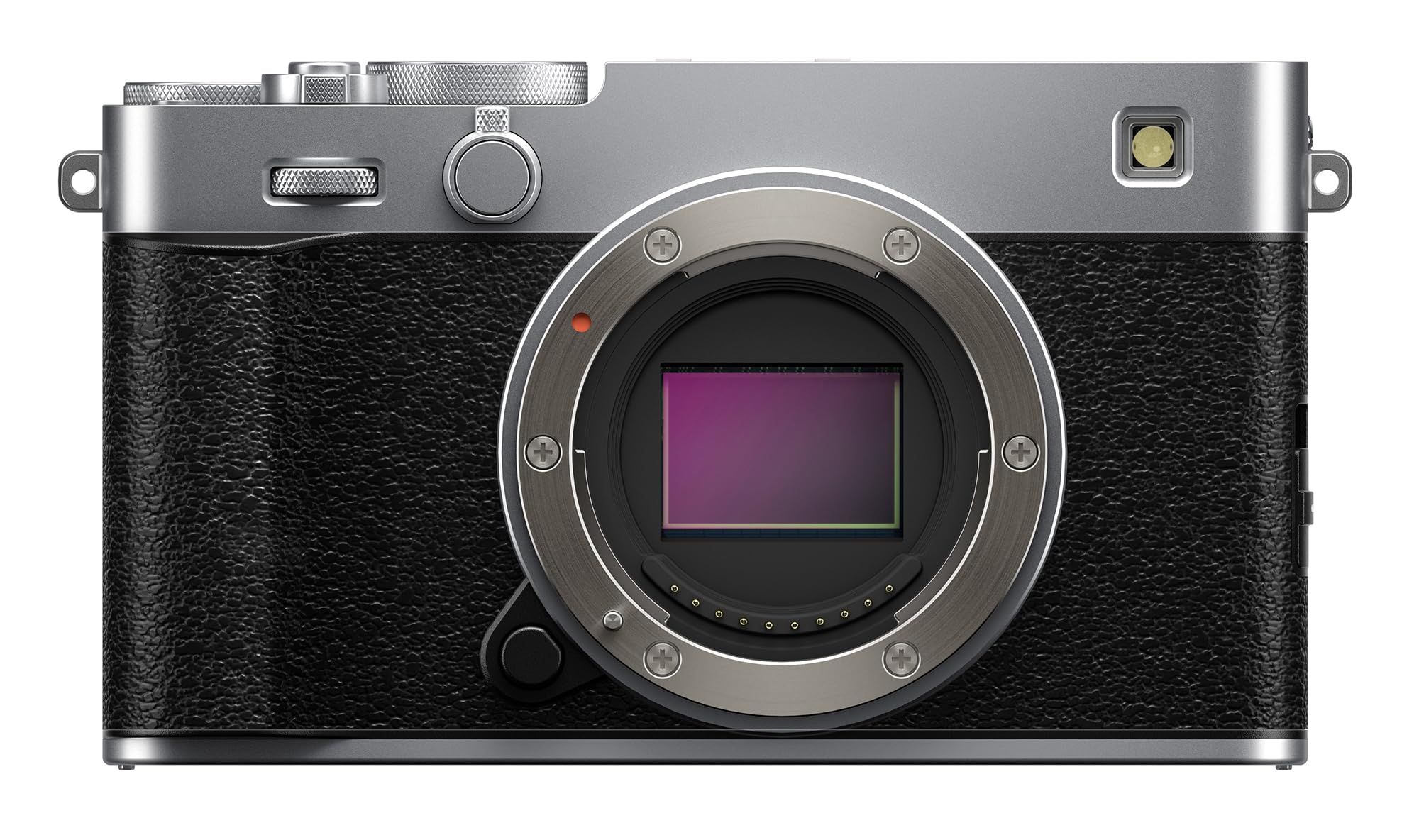
Analog dials on a machined aluminum top plate, with a 40.2MP sensor and stabilization that holds seven stops.
The X-E5 is the camera you buy for the look and the feel as much as the spec sheet. A 40.2-megapixel X-Trans 5 HR sensor pairs with the X-Processor 5 engine for a lower base ISO of 125 and deep-learning AI subject detection. In-body stabilization is rated at up to seven stops at the center of the frame and six at the edges — meaning sharp handheld shots in light that would blur most cameras. The machined aluminum top plate and analog controls give you direct dial access to core functions instead of a menu dive.
What makes it distinct in this list is the customizable Film Simulation dial, sitting under the aluminum top plate with a circular window so you can see your active mode. Three customizable settings save your own recipes for instant recall. It pairs with over 40 X Mount optics, and the two-step digital teleconverter crops for a 1.4x or 2x zoom, so you get extra reach without another lens. For street and travel, the rangefinder-style body stays inconspicuous.
Build and image quality are what win people over, and the recurring note is cost. This is a premium body, and if you are not chasing the analog feel or the 40MP file, you are paying for style. Battery life also runs around 1.5 hours, so carry a spare on long days out. Choose it for the shooting experience; accept the price of entry.
Why it feels special
- 40.2MP X-Trans 5 HR sensor with AI subject-detection AF.
- 7-stop in-body stabilization for handheld low light.
- Customizable Film Simulation dial with three saved recipes.
- Machined aluminum top plate and analog controls.
- Two-step digital teleconverter for 1.4x or 2x crop zoom.
The price of the look
- Premium cost for the analog experience.
- Battery life averages around 1.5 hours.
- Body only — lenses add up.
- External controls take adjustment coming from a menu-driven body.
Choose it when: you want a compact street camera with film-like controls and huge files to crop.
Pass if: value-per-dollar and all-day battery are your deciding factors.
8. Sony Alpha 7 IV Camera

33 megapixels, 4K 60p at 10-bit, and a menu that finally makes sense — a do-everything hybrid for working shooters.
The a7 IV steps up from the a7 III with a 33-megapixel full-frame back-illuminated sensor and the BIONZ XR image processing engine. It records up to 4K 60p at 10-bit 4:2:2 with full pixel readout in every format, plus 7K oversampling for 4K 30p with no pixel binning — so detail stays crisp instead of being merged down. S-Cinetone color gives pleasing straight-out-of-camera footage. Autofocus covers 693 points across contrast and phase detection and, by all accounts, tracks faces and eyes accurately even in tricky light.
What wins people over is the whole package maturing. The menu is a clear improvement over earlier Sony bodies, customization runs deep, and dual card slots with high-ISO noise reduction make it a reliable work camera for both stills and video. A 33MP file gives you cropping room that the M43 bodies cannot match — the direct trade-off for its larger size.
Performance is the split point. Some units run exactly as they should; others overheat, so long takes need monitoring. It is also not the friendliest first camera — expect a learning curve, and the 60-120p modes crop. Spare batteries are wise on long shoot days. Treat it as a professional hybrid, not a point-and-shoot.
Standout spec: 4K 60p 10-bit 4:2:2 with 7K oversampling at 4K 30p gives you clean, gradable footage in one body.
Watch closely: overheating reports exist for long recordings, so build in breaks and carry spare batteries for marathon sessions.
Made for: working hybrid shooters who want 33MP stills and pro video in one body.
Think twice if: you want a simple first camera or shoot very long uninterrupted takes.
9. OM SYSTEM Olympus OM-3 Silver

A vintage-styled metal body with a modern stacked sensor, IP53 sealing, and a pro-grade 12-45mm lens in the kit.
The OM-3 makes a statement. Its premium metal body carries a 20-megapixel stacked BSI Live MOS sensor (a fast-reading chip that reduces noise and improves tracking) with the TruePic X processor. It is rated IP53 for dustproof, splashproof, and freezeproof performance, so rain and cold are weather, not a stop signal. In-body 5-axis stabilization and phase-detection autofocus keep handheld shots sharp and moving subjects locked. A 2.36m-dot OLED electronic viewfinder stays clear in bright light.
The 12-45mm F4.0 PRO lens in the kit is a step above a starter zoom, and the tactile metal dials make direct control a pleasure rather than a chore. Technology is what buyers praise most here — the computational functions and fast, accurate focus make it feel cutting-edge despite the vintage face. As buyers report, it is a joy to carry: light enough to live on a strap all day, sealed enough to keep going when the sky opens.
The honest gap versus the flagship OM-1 Mark II is a second SD card slot and some shutter-speed range, so working pros who need redundancy should look up the line. The price is also consistent across sellers — this is not a budget body. For a travel camera that pairs retro looks with IP53 weatherproofing, those are deliberate trade-offs, not shortcomings.
What the money buys: a stacked 20MP sensor, IP53 dust/splash/freeze sealing, and a 12-45mm PRO kit lens in one retro metal body.
Know before you buy: it gives up a second card slot compared to the OM-1 Mark II — fine for most travel, a compromise for redundant pro work.
The pick for you if: you want a beautiful, sealed daily-carry camera with near-flagship tech.
Step up the line if: dual card slots and fuller shutter range are non-negotiable.
10. OM SYSTEM Olympus OM-1 Mark II

The sealed all-weather flagship: 1,053 cross-type autofocus points and a fast 12-40mm F2.8 PRO II lens in the box.
This is the M43 camera you take where conditions are hostile. Its Cross Quad Pixel AF delivers 1,053 all cross-type points with 100% high-precision focusing, so it locks onto subjects across the whole frame — a clear step beyond the 121 points of the E-M10 Mark IV. The 20-megapixel stacked BSI sensor and TruePic X engine give up to 3x faster processing plus computational modes: Handheld High Res Shot, Live ND, Live GND, Handheld Live Composite, Focus Stacking, and HDR. It is rated IP53, dustproof, splashproof, and freezeproof to -10℃.
The 12-40mm f/2.8 PRO II lens is a constant-aperture zoom that stays bright at every focal length, and in-body stabilization lets you shoot crisp handheld in low light without a tripod. Owners describe top-tier weather sealing proven in rain, snow, and dust, and handheld high-res shots that rival larger sensors. It fits more lenses for the weight because the body is compact, and the sealed build feels solid in the hand.
The catch is deliberate: there is no Auto mode here, so it asks for manual settings knowledge. A 100-400mm attachment can push the total weight up toward 5 lbs, so balance your lens choice. It is also the priciest body on this list. For a weatherproof flagship with computational tools, those are the terms of the deal.
Flagship reasons
- 1,053 all cross-type autofocus points for full-frame precision.
- IP53 dustproof, splashproof, freezeproof to -10℃.
- Computational modes including Handheld High Res and Live ND.
- 12-40mm f/2.8 PRO II constant-aperture kit lens.
Who it asks more of
- No Auto mode — you need manual settings knowledge.
- Long telephoto lenses add significant weight.
- The highest cost among these bodies.
- Overkill for casual point-and-shoot use.
Built for: serious outdoor and documentary shooters who need sealing and fast autofocus in one body.
Not the fit if: you want the camera to pick settings for you.
11. Fujifilm X-H2 Mirrorless Digital Camera XF16-80mm Lens Kit

A 40-megapixel APS-C sensor that records 8K/30p and shoots 160MP Pixel Shift stills — detail as the whole point.
The X-H2 is the detail machine of this group. Its 40-megapixel back-side illuminated X-Trans CMOS 5 HR sensor runs on the X-Processor 5 for 8K/30p video, black-out-free bursts at 15fps, and boosted battery performance. Pixel Shift Multi-Shot records 20 frames and combines them into a single 160-megapixel image — that is the kind of file you want for archival or commercial work where color fidelity and fine detail matter. Autofocus covers 425 points with hybrid AF and AI subject detection.
Video is the marquee. Apple ProRes 10-bit 4:2:2 records internally up to 8K/30p on a CFexpress Type B card, and 12-bit ProRes RAW or Blackmagic RAW goes out over the full-size HDMI Type A port. F-Log2 extends dynamic range to 13+ stops, a one-stop improvement over the previous sensor. In-body stabilization offers seven stops of compensation with an improved algorithm for shake-free panning and handheld video.
The recurring honest note is price — this is a premium body, and casual shooters will not use the 8K or the 160MP mode enough to justify it. Extensive customization also takes study before the dials feel automatic. For advanced users chasing 40MP detail and 8K video flexibility, it delivers; casual snapshooters will never touch those modes and should buy simpler.
Detail above all: 40MP stills and 160MP Pixel Shift captured as a single DNG RAW, plus 8K/30p ProRes internally, make it the highest-resolution option here.
Be realistic about need: the value proposition only lands if you actually shoot 8K or large-format stills — otherwise the price outweighs the features you use.
Right for: detail-obsessed photographers and filmmakers who will use 8K and Pixel Shift.
Overkill if: you shoot casual stills and short social clips.
Know the Specs
Sensor size and the Four Thirds chip
A Four Thirds sensor measures roughly 17 x 13mm — smaller than the full-frame chip in the Sony a7 III, which is 35.6 x 23.8mm. The smaller sensor is why M43 lenses stay compact and light. You trade some shallow depth of field and extreme low-light headroom for a kit you will actually carry, and modern stabilization helps close the low-light gap for handheld work.
In-body image stabilization (IBIS)
IBIS physically moves the sensor to cancel hand shake. Stabilization is rated in “stops” — more stops means slower shutter speeds you can handhold. The Fujifilm X-E5 rates seven stops at the center and six at the edges; the E-M10 Mark IV rates 4.5 steps. That rating is the difference between a sharp handheld night shot and a blurry one.
Phase detection versus contrast AF
Contrast autofocus hunts for the sharpest edge and slows on fast subjects. Phase detection measures distance directly, so it locks quickly — the G9II uses 779 phase points and the OM-1 Mark II uses 1,053 all cross-type points. If you shoot sports, pets, or kids, phase detection is worth prioritizing.
Bit depth and video
Bit depth describes how much color and brightness data each pixel records. A 10-bit file (asin the G9II and G100) gives you more grading headroom than 8-bit. The X-H2 goes further, recording 12-bit ProRes RAW externally. More bits is more flexibility in post, not sharper photos.
Common Questions
Can I use a Micro Four Thirds lens on any camera in this list?
Is a Four Thirds sensor worse than full-frame for low light?
How many stabilization stops do I actually need?
Will an M43 camera work as a webcam for streaming?
What is the difference between phase detection and contrast autofocus for M43?
Do I need a weather-sealed body for outdoor shooting?
How long does the battery last on these cameras?
Which camera is best for a beginner who wants to learn manual settings?
Can M43 cameras shoot professional video?
What is Pixel Shift Multi-Shot and do I need it?
The Bottom Line
For most buyers starting out, the winner is the Canon EOS Rebel T7 because it bundles a stabilized 18-55mm lens, a 24.1MP sensor, and controls that teach you photography instead of hiding it in a menu — it is the crowd favorite at 4.5+ stars across 5,300+ owners. If you shoot both stills and video and want the sharpest autofocus in the M43 system, grab the Panasonic LUMIX G9II with its 779 phase-detection points and weather-sealed body. And for outdoor work in rain, snow, or cold, the OM SYSTEM OM-1 Mark II is the one to reach for, thanks to IP53 sealing and 1,053 all cross-type autofocus points.
Buy for the conditions you actually shoot in: if you carry a camera all day, a compact M43 body leaves the house more often than a bigger one that stays in the drawer.
How we choose
We do not accept paid placement. Every pick is matched to a real buyer and a real use-case; we do not hands-on test units.
Sources
Specifications: manufacturer listings and product documentation. Review insights: verified customer reviews, as of October 2026. Pricing: not shown on this page (it changes often); check the current price via the retailer link.
As an Amazon Associate, Aappliancez earns from qualifying purchases. This does not affect which products we feature.