Disclosure: Some links in this post are affiliate links. As an Amazon Associate I earn from qualifying purchases, at no extra cost to you. Learn more
Specs are compiled from manufacturer listings and verified buyer reviews and can change over time — please confirm the key details on the product page before buying.
Your garage door groans like it is being tortured, and you want the one can that actually shuts it up. The short answer: match the lubricant to the part. Silicone for rubber seals, gaskets and weatherstripping. Lithium grease or a dedicated door spray for hinges, rollers, tracks, chains and the springs themselves. Get that pairing wrong and the noise comes back within weeks.
This guide is built by comparing the manufacturers’ published specifications and the patterns across verified customer reviews, so you get each pick’s real strengths and trade-offs instead of marketing spin.
Below are five proven options ranked by how well they handle real garage-door work, with each formulation and spray tip spelled out so you can match one to your door. A torsion spring that stops groaning is the whole point of a dedicated spring lubricant.
Top Picks

How To Choose The Best Lubricant for Garage Door Springs
A garage door is not one metal surface — it is several, each wanting a different kind of film. Springs, hinges and roller stems are heavy metal-on-metal contact points that want a grease that clings. Weatherstripping and rubber gaskets want something that will not swell them. Picking one can for the whole door means picking the wrong can for half of it.
Know your formulation before you buy
Silicone spray is the safe all-rounder: it lubricates, waterproofs and protects, and it is formulated to be safe on rubber, vinyl and plastic. Lithium grease is the heavier hitter — a grease, not a thin oil — so it stays on a coil instead of running off in a day. Spray-format lithium gives you grease thickness in a can that reaches up into a track.
The spray tip is half the job
A two-way straw lets you flip between a precision stream for one hinge pin and a fan pattern for a run of track. That matters because a spring coil is awkward to reach and easy to over-spray. A squeeze tube gives you direct, dab-it-on control where a spray would mist everything nearby.
Do not lubricate the wrong parts
Lubricating the springs, hinges, rollers and tracks is the aim. Nylon rollers and the door’s weather seal usually want a light touch of silicone, not a coat of grease that collects grit. Think about where the dirt will stick before you spray.
Side-by-Side Comparison
| Model | Best For | Form | Volume | Compatible Materials | Amazon |
|---|---|---|---|---|---|
| WD-40 Specialist Silicone★ Best Overall | Rubber seals and gaskets | Spray | 11 fluid ounces | Metal, rubber, plastic, vinyl | Amazon |
| 3-IN-ONE Garage Door LubricantTop Performer | Full-door moving parts | Spray | 325.31 ml | Metal | Amazon |
| WhiteLith Squeeze Tube | Precise spring and hinge dabs | Grease | 8 fluid ounces | Metal | Amazon |
| STAR BRITE White Lithium | Grease-gun owners and all-weather use | Grease | 14 fluid ounces | Metal, plastic | Amazon |
| B’laster White Lithium Spray | Climbing coverage on tracks and coils | Grease | 11 fluid ounces | Metal | Amazon |
Detailed Reviews
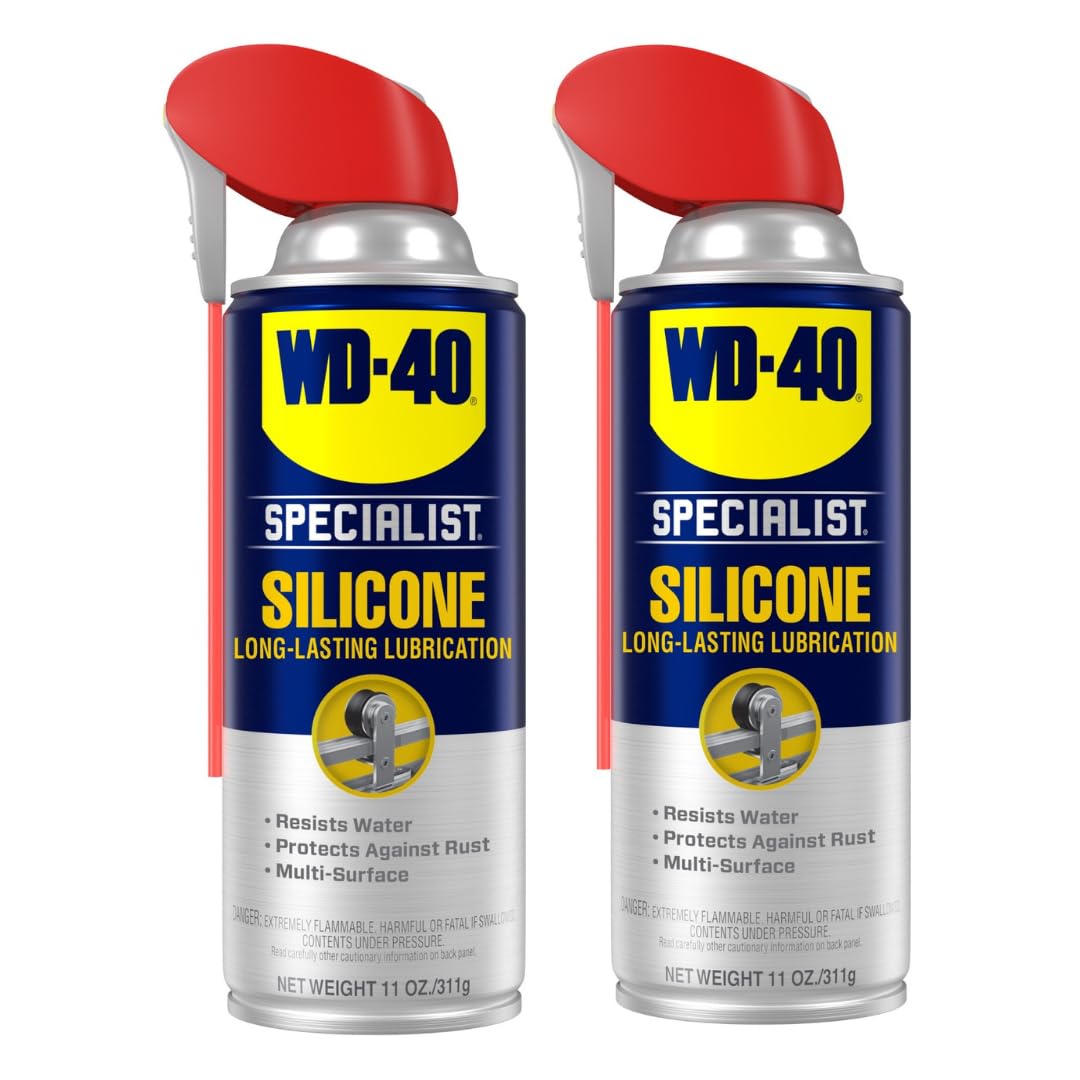
1. WD-40 Specialist Silicone Lubricant Twin-Pack
Our pick — 4.5+★ from 850+ verified ratings; the strongest balance of quality and price.
The can you buy when the noise comes from rubber, not steel.
Two cans of 11 fluid ounces each, and the whole reason this one sits at the top is what it will not damage. The silicone formula is built to be safe on rubber, vinyl and plastic as well as metal — so you can run it down a door’s weather seal and around the gasket line without worrying about swelling or cracking what you just touched. Ordinary petroleum sprays can soften those materials over time; this one is formulated not to.
The Smart Straw sprays two ways, which is the feature you will use every time. Flip it to a thin stream for a hinge pin or the stem of a roller, then swap to the wider fan for a length of track. It dries quickly and leaves no messy residue, so grit has less to grab onto. Owners frequently mention how clean the finish is, and one review from a driver using it on car window channels makes the same point in a different way: friction is what it removes, and windows (or doors) stop fighting back.
On volume: the WhiteLith tube below holds 8 fluid ounces of grease, while these cans hold 11 fluid ounces each — 22 ounces total across the twin-pack. That is a lot of coverage for seals, gaskets, tracks and any rubber contact point. The honest catch is that silicone is a light film, not a heavy grease. On a heavily loaded torsion spring you may find it needs reapplication sooner than a true lithium grease would.
Where it shines: Anything with rubber in it. Gaskets, weather seals and vinyl trim are exactly where a silicone spray earns its keep, because it lubricates without softening the material.
Worth knowing: Thin and fast-drying by design. Treat it as your surface protector and use a grease for the spring coil’s heavy metal contact.
Reach for this if: your door squeals at the seal line or you want one can that is genuinely safe across rubber, vinyl and metal.
Look elsewhere if: you need a thick film that clings to a coil for months — that is a grease job, not a silicone one.
2. 3-IN-ONE Garage Door Lubricant 2-Pack
A formula written specifically for the door, not borrowed from the toolbox.
This is the one that names the job on the label and then covers every part of it: hinges, tracks, chains, pulleys, rollers and more. The formula is quick-drying and non-sticky, which is the detail that matters most over a year of use — a tacky film collects dust, and dust is what turns a quiet door noisy again. Two 11-ounce cans come in the pack, and the intelligent straw flips between a precision stream and a fan spray and cannot be lost or misplaced.
What wins people over is the noise result. The quiet factor is the standout in the feedback — doors that had been groaning get noticeably hushed, and the binding and squeaking go with it. It is easy to apply and takes barely any time on the tracks. One honest note from a buyer who tried a single heavy coat: it took several applications before the noise fully stopped, so plan on a couple of passes rather than one. Wait between them and let the low-viscosity carrier flash off.
Weigh it against the silicone pick above. The WD-40 is the gentler choice on rubber and plastic; this one is metal-only by its own spec, so keep it off the weather seal and aim it at the hinge pins and tracks where it belongs. The commercial-grade claim on the label is aimed at heavier doors, which suits a double-width or older door that needs a bit more film. It is a two-can set, which means you can keep one in the garage and one wherever you keep the rest of your tools.
What earns it the second slot
- Formulated for hinges, tracks, chains, pulleys and rollers by name
- Quick-drying and non-sticky so dirt has less to cling to
- Two-way intelligent straw that will not get lost
- Two 11-ounce cans in the pack
The small print
- Listed as compatible with metal only — do not aim it at rubber seals
- A stubborn squeak may need several applications before it goes quiet
Best fit: anyone with a conventional sectional door who wants one can that covers every metal moving part and quietens fast.
Second thoughts if: your noise is at the gasket or weather stripping — that is a silicone job, which is why the previous pick exists.
3. WhiteLith White Lithium Squeeze Tube, NLGI 2, 8oz
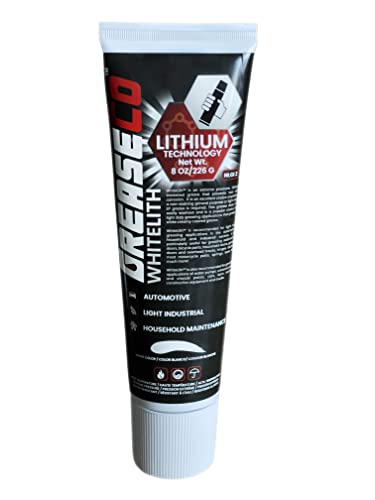
No spray mist, no overspray — just grease exactly on the hinge pin.
An 8-ounce squeeze tube of NLGI 2 white lithium grease. NLGI 2 is a consistency grade — think peanut butter rather than oil — which is exactly what you want on a hinge pin or a roller stem where a liquid runs straight off. Squeeze it into the gap and it stays. It is a lithium-thickened light-duty grease that prevents rust and corrosion, and it is listed for garage doors and overhead tracks alongside automotive doors and household hinges.
The feedback is clean on the basics: effective, easy to use, and a noise-killer on garage doors. Buyers report that a little goes a long way, and that is not an exaggeration here. It is also a no-drip proposition, unlike a liquid oil, so you are not chasing runs down the door frame. Because it is a grease rather than a spray, nothing else in the garage gets misted by accident — a real advantage if your door is close to a car.
Compare it with the B’laster can below: this tube is 8 fluid ounces to the B’laster’s 11, but a dab per hinge pin goes much further than spraying a whole run of track. One caution worth flagging — buyers describe this as greasiness that sticks around, so it is the wrong pick if you want a dry finish on a visible track. Use it on hidden contact points, not on the face of a rail you touch every day.
The tube advantage: You control the dose. A dab on each coil and a smear on the hinge pins keeps everything tidy, and there is nothing to spray by accident.
Sizing it honestly: It is a grease, so it is deliberately clingy. Great on a spring, less so on cosmetic surfaces.
Made for: the spring coil and hinge-pin job where you want a thick film that stays exactly where you put it.
Wrong tool if: you are trying to cover a long track quickly — the spray options do that far faster.
4. STAR BRITE Heavy-Duty White Lithium Grease, 14 oz Cartridge

Grease-gun loading, 14 ounces, and rated for heat a garage will never reach.
If you already own a grease gun, this is the cartridge that loads straight in. It is 14 fluid ounces of NLGI-2 high-performance white lithium grease, described as marine grade, and it is sized to fit a standard pistol grease gun. That format matters on a garage door if your rollers have zerk fittings or if you also look after a trailer, boat or mower — one cartridge covers a lot of ground.
The temperature and water specs are the differentiators. It holds performance up to 350°F, it is water-resistant so it does not wash away in wet conditions, and it forms a corrosion and rust barrier. For a door that faces driving rain or a cold winter, that is the reassurance you actually want from a grease that will sit on a spring for months. The white color is there for inspection — you can see at a glance whether the film is still present. It is listed as compatible with plastic as well as metal, so synthetic roller components are not automatically off-limits.
Set against the WhiteLith tube, this is 14 fluid ounces to that tube’s 8 — noticeably more grease per cartridge, in a water-resistant all-weather formula. The trade-off is the format. There is no precision tip, no spray, no way to reach into a hinge pin with a bead of grease unless you have the gun or a small applicator. If you were hoping for a one-step spray, this is not it. The brand has been making marine and auto care products in the USA, and that heritage shows in how deliberately the temperature and water ratings are specified.
Pick it when: a grease gun is part of your toolkit and you want an all-weather cartridge that shrugs off moisture and high heat.
Skip the format if: you have no gun and no applicator — a spray or squeeze tube will serve you better.
5. B’laster White Lithium Grease Spray, 11oz (Case of 3)

Spray-on grease that climbs a track and clings instead of running away.
This is the can to grab when you need grease thickness delivered by spray. The formulation is designed to stay put and will not run — the film clings to surfaces, which is precisely what you need on hinges, gears and metal-to-metal contact that has to stay lubricated through a lot of motion. It is low-odor and described as a clean formula, and it guards against moisture and oxidation so indoor and outdoor use both work. A case of three 11-ounce cans means you will not run out mid-job.
The feature that makes it genuinely useful on a garage door is the reach. The red straw lets you shoot lithium into the hinge pins, and the spray lets you coat the inside of the tracks and the tension springs. Owners mention exactly that: the door got noticeably quieter once both were done. It is aimed at hinges, bearings, latches, chains, pulleys and rollers by design, and it is 50-state VOC compliant. For anyone who wants grease performance without owning a grease gun, it is the most direct route.
Weigh it against the 3-IN-ONE above: both are 11-ounce sprays, but this one lays down a clinging lithium grease. Both are sprays at 11 ounces per can, but this one is a lithium grease that stays put while the 3-IN-ONE is quick-drying and non-sticky. The honest catch is packing — a few cans have shown up with a broken nozzle or cracked cap from rough shipping. That is a delivery gripe, not a formula problem, and it is worth checking the cans the moment the box arrives.
Why it earns a slot
- Thick lithium film that clings instead of running
- Red straw reaches hinge pins; spray coats tracks and tension springs
- Low-odor formula safe for indoor and outdoor use
- Three 11-ounce cans in the case
Fair caveats
- Occasional cans arrive with a damaged nozzle or cracked cap in shipping
- Listed as compatible with metal only
Choose this if: you want lithium grease in spray form to hit tracks and tension springs without a gun.
Better elsewhere if: you need a grease that is safe on rubber — this one is metal-only, and the silicone pick handles the seals.
Understanding the Specifications
NLGI Grade
NLGI is a consistency rating for grease, and a higher number means a firmer grease. An NLGI 2 grease sits firm, like peanut butter, so it stays on a spring coil instead of running off. That is why a grease is the right call for heavy metal contact points and silicone is better for seals.
Formulation and Compatible Materials
Read the compatible-materials line on the can before you spray. Silicone is safe on rubber, vinyl and plastic as well as metal. Lithium products are typically listed for metal only, so keep them off the weather seal. Matching the formulation to the surface is the difference between a quiet door and a swollen gasket.
Common Questions
What is the best lubricant for garage door springs?
Can I use WD-40 silicone spray on the torsion spring?
Should I lubricate the garage door tracks and rollers?
Is a lithium grease safe on the rubber weather seal?
How often should I lubricate garage door springs and hinges?
Do I need a grease gun for the Star Brite cartridge?
What is the difference between white lithium grease and silicone spray?
Will a spray lubricant get onto rubber parts it shouldn’t touch?
Can I use a lithium grease on nylon or plastic rollers?
Is it safe to lubricate a spring under tension?
The Bottom Line
For most garage doors, the winner in the lubricant for garage door springs lineup is the WD-40 Specialist Silicone — it is the one can that is safe on rubber, vinyl, plastic and metal alike, so it handles the seals that most sprays get wrong. If your goal is the quietest possible door and you will keep the spray off the weather stripping, grab the 3-IN-ONE Garage Door Lubricant, which is purpose-built for hinges and tracks and dries non-sticky. And for heavy spring coils that need a film that clings, the WhiteLith squeeze tube puts grease exactly where you point it with no drips and no overspray.
How we choose
We do not accept paid placement. Every pick is matched to a real buyer and a real use-case; we do not hands-on test units.
Sources
Specifications: manufacturer listings and product documentation. Review insights: verified customer reviews, as of October 2026. Pricing: not shown on this page (it changes often); check the current price via the retailer link.
As an Amazon Associate, Aappliancez earns from qualifying purchases. This does not affect which products we feature.