Disclosure: Some links in this post are affiliate links. As an Amazon Associate I earn from qualifying purchases, at no extra cost to you. Learn more
Specs are compiled from manufacturer listings and verified buyer reviews and can change over time — please confirm the key details on the product page before buying.
Most carbon monoxide alarms stay silent until the gas hits a level that already matters — which is exactly why a low level CO detector earns its place. These three units read the small numbers, not just the emergency ones, so you see a problem building instead of hearing about it after the fact. Below you get the honest differences between them, from what each one can actually measure to the upkeep nobody mentions.
This guide is built by comparing the manufacturers’ published specifications and the patterns across verified customer reviews, so you get each pick’s real strengths and trade-offs instead of marketing spin.
You will see which units read down to single-digit parts per million, which one suits a home with pets or health concerns, and which one is built for a job site. If you want the short version, the low level co detector that reads down to 1 ppm is the one professionals carry.
Top Picks
How To Choose The Best Low Level Co Detector
The number that decides everything here is the lowest concentration a unit can actually read. A standard home alarm is designed to stay quiet during small, slow leaks and only sound once CO reaches a level that demands evacuation. A low level detector shows you the small number instead, so a reading creeping upward is visible long before it becomes an emergency.
Parts Per Million and What Counts as “Low”
CO is measured in ppm, or parts per million — a count of how many gas molecules sit in every million parts of air. Standard alarms typically wait for higher concentrations before they sound. The units on this list work differently: one reads from 1 ppm, another alerts in the 30-70ppm band with a distinct light and sound pattern, and the third shows a digital number as low as 10 PPM. A lower readable floor means you see a slow rise sooner, giving you time to ventilate and trace the source before it escalates.
Who Actually Needs the Extra Sensitivity
Households with infants, older adults, pregnant women, or pets are the group most often steered toward low level detection, because smaller bodies process CO differently. If that describes your home, the value is in the earlier warning, not in a louder horn. For an ordinary household with no particular risk factor, a regular alarm plus a sensible placement near sleeping areas does the core job.
The Upkeep Question Nobody Asks Up Front
Electrochemical sensors are the part that does the measuring, and they age. One unit here spells out a 6-month calibration routine, and calibration kits cost extra. Two of the three run on ordinary batteries you can replace yourself; check what is included in the box before you mount anything, because at least one model has shipped short a cell. A 10-year end-of-life warning, where the data lists it, tells you when the whole unit retires rather than leaving you guessing.
Side-by-Side Comparison
| Model | Best For | Lowest Readable Level | Power | Weight | Amazon |
|---|---|---|---|---|---|
| Inspector CO Monitor★ Best Overall | Job sites and travel | 1 ppm | 1 CR123A (included) | 3.84 ounces | Amazon |
| Kidde COBDL | Everyday home use | 30-70ppm alert band | 2 AA (included) | 5.92 ounces | Amazon |
| Kidde Ultra-Sensitive | Homes with pets or health concerns | 10 PPM display | 3 AA (included) | 8 ounces | Amazon |
Detailed Reviews
1. Inspector CO Monitor Standard Model
Our pick — 4.5+★ from 450+ verified ratings; the strongest balance of quality and price.
The one that reads the tiny numbers, not just the emergency ones.
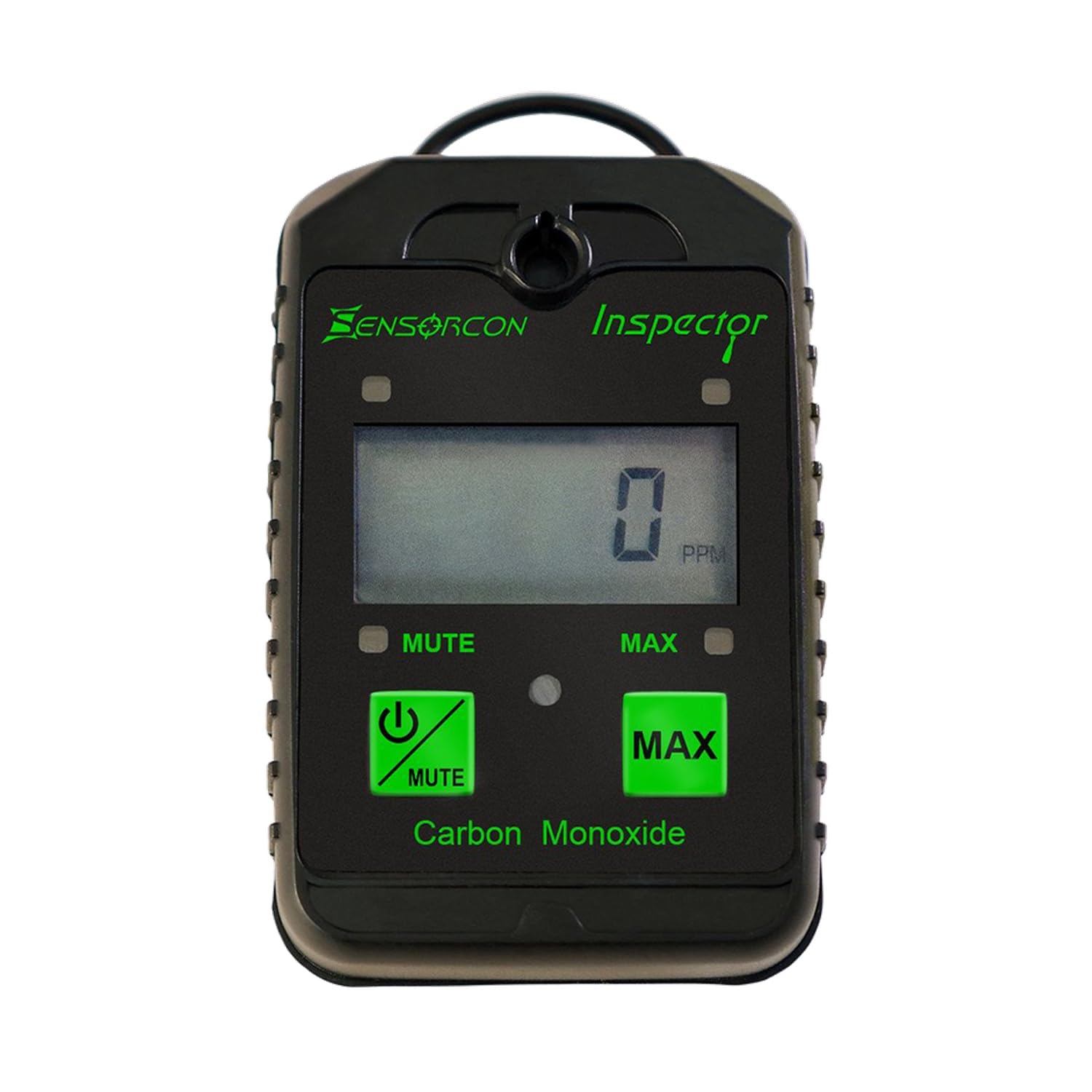
If you have ever wondered whether the faint smell near a propane stove is anything at all, this is the tool that answers the question with a figure. It measures from 1 ppm at ±2ppm accuracy, so a slow leak shows up as a climbing number instead of a silent wait for alarm-level CO. That is the whole reason it sits at the top of this list — no other pick here starts its scale that low.
The build is meant to be carried, not shelved. It weighs 3.84 ounces and clips to a belt with steel hardware and a lanyard loop, and the housing carries an IP67 rating — that is a sealed shell that survives dust and a dunking in water. The CR123A battery comes included, and the gas sensor is replaceable, so a worn sensor does not retire the whole instrument. At 3.84 ounces it is less than half the 8-ounce Kidde Ultra-Sensitive, so it stays unnoticed on a belt all shift. Owner ratings back it up: 4.5+ stars from 400+ buyers.
What wins people over is simply that it functions in the field — the largest share of owner feedback is about it doing its job, with accurate readings close behind. As buyers report: “Measures from 1 ppm (accurate ±2ppm), unlike home alarms or pilot sensors that only read at alarm levels; reliable over years of frequent use.” The honest catch is upkeep. The electrochemical sensor needs calibration roughly every 6 months, and that is a real recurring cost unless you buy the calibration kit, plus the display has no backlight for dark corners. A strong secondary detail: the max-reading lock keeps the highest number it saw while you were away, which is exactly what you want after a shift in a mechanical room.
Where it earns its keep
- Reads from 1 ppm at ±2ppm accuracy, so slow leaks become visible numbers
- IP67 housing shrugs off dust and water on a job site
- Replaceable sensor and CR123A battery keep it out of the bin
- Steel belt clip and lanyard loop for hands-free wear at 3.84 ounces
What you should plan around
- Roughly 6-month calibration is a running cost, and the kit is sold separately
- No backlight, so the readout is hard to check in a dark basement
- Strong solvents can trip it — coffee grounds and exhaust have set it off
Worth it for: HVAC techs, inspectors, and anyone monitoring a garage or cabin where a slow leak would go unnoticed.
Think twice if: you want a set-and-forget wall unit — the calibration routine is part of owning this one.
2. Kidde Carbon Monoxide Detector, AA Battery-Powered, COBDL
Low-level alerts plus a plain room alarm, in a body you can pack for a hotel.
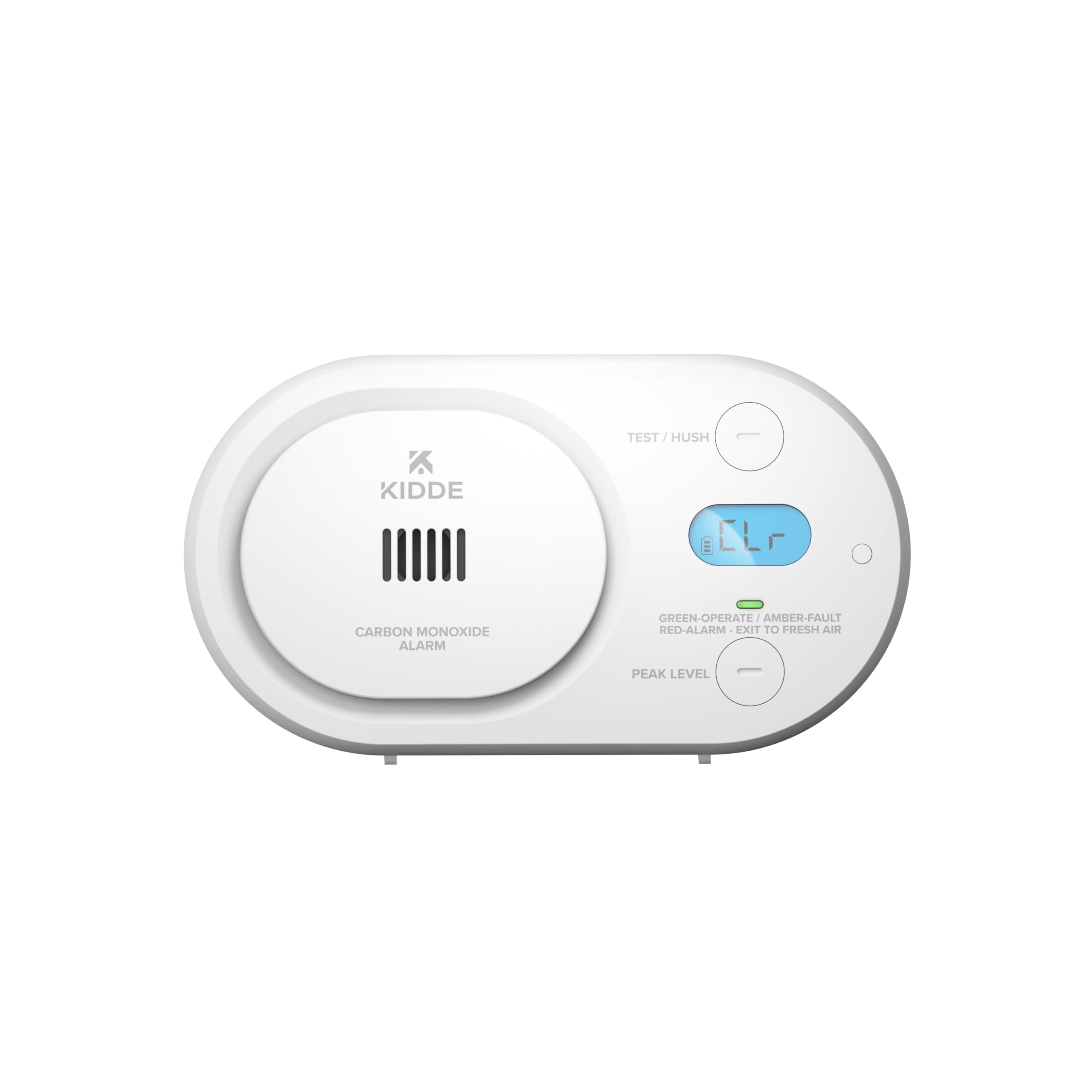
Here is the pick for someone who wants earlier warning without turning into an instrument operator. It alerts at 30-70ppm with a distinct light and sound pattern, which is the band below the level a standard alarm reacts to. At 70ppm a separate alarm pattern kicks in to signal danger for everyone in the building. That two-stage idea is the practical middle ground: some early awareness, none of the calibration ritual.
The everyday numbers are friendly. It runs on two included AA batteries, so it keeps working through an outage and needs no wiring at all. It mounts on a wall with the included screws or simply stands on a table, which makes it easy to drop in a bag for a vacation rental. The horn hits 85 dB, loud enough to wake a household, and a Test/Hush button lets you check it or quiet it briefly. At 5.14 inches wide and 2.83 inches tall it is a small slab on the wall, not a fixture.
Owners consistently describe it as solid and dependable, with quality and reliability the two things that come up again and again. As owners mention: “I like the fact it has a lower alarm threshold.” It is UL 2034 5th Edition tested and ETL Listed, with a 10-year limited warranty on the alarm. The trade-off versus the Inspector above is scale: this one alerts in a band, while that one prints a live number from 1 ppm. It has fewer owner ratings than the Ultra-Sensitive (81 versus 171) but scores higher at 4.5+ stars.
The travel angle: battery power and a tabletop option mean you can set it up in a rented cabin the moment you walk in, no tools required. That single feature is why it appeals to renters as much as homeowners.
Where it stops short: there is no continuous numeric readout of your ambient CO, so you get a warning at a threshold rather than a running figure to watch creep upward.
Reach for this if: you want low-level awareness in a normal home, plus something you can toss in a suitcase.
Look elsewhere if: you need to see the actual ppm figure at all times, not just be told when it crosses a line.
3. Kidde Ultra-Sensitive Carbon Monoxide Detector

A digital readout that shows the number as low as 10 PPM, built for homes with pets or health concerns.
This is the one you put in a bedroom hallway when someone in the house is a baby, an older adult, or a pet. Its electrochemical sensor is designed to pick up CO below 30 PPM, so the small accumulation gets noticed while it is still small. The display shows a figure as low as 10 PPM, which turns an invisible gas into a number you can check at a glance. It is a meaningfully different experience from a unit that only speaks up at a threshold.
Setup is deliberately low-effort. Three included AA batteries, rated for an average of 8,760 hours, keep it monitoring through a power failure. You can wall-mount it or stand it on a table, and its 4.5-inch depth by 2.75-inch height footprint keeps it inconspicuous. The alarm sounds at 85 decibels when CO is present. A 10-year end-of-life warning signals when the whole monitor needs replacing, so you do not have to track the date yourself. It is the larger of the two Kidde units here, sitting at 8 ounces against the COBDL’s 5.92 ounces.
Owner feedback zeroes in on accuracy more than anything else, and that tracks with what the sensor is for. Two things do come up as friction points: a share of buyers find it costly for what it is, and some units arrive short a battery — the box has shipped with two when the unit needs three. That is a battery-pack slip, worth checking before you mount it. And as with any electrochemical sensor, the readings are the whole point and they come at a higher entry than the COBDL. Choose this one because the household profile calls for the extra sensitivity, not because it is the fanciest-looking unit on the shelf.
Why the number matters: a 10 PPM display means you can see a slow drift begin, ventilate, and find the appliance responsible before it becomes a 30ppm event.
The honest downside: durability and battery life appear as mixed points in owner notes, and the price is the highest of the three — so this is a pick for a specific household need, not a default.
This is your pick if: the house has infants, older adults, or pets, and you want the actual ppm figure on a screen.
Skip the upgrade if: a standard low-level alert is enough and you would rather not pay extra for the digital display.
Know the Specs
Parts Per Million and Detection Floor
PPM stands for parts per million — how concentrated the CO is in the air you are breathing. The lower a unit’s detection floor, the earlier it can tell you something is off. One pick here reads from 1 ppm at ±2ppm, one alerts in a 30-70ppm band with a distinct pattern, and one displays figures down to 10 PPM. A lower number is not automatically better for every household; what matters is whether early awareness changes what you would do about it.
Sensor Type and Calibration
An electrochemical sensor is the measuring cell inside these monitors, and it gradually wears as it reacts to gas. Some designs call for periodic calibration to stay honest — one unit here specifies roughly a 6-month interval, and the kit is a separate purchase. Others are sealed and replaced at end of life instead, which is what the 10-year warning on one model signals. Know which kind you are buying before you commit, because the maintenance shapes the true cost of ownership.
Power and Placement
Battery choice decides where a detector can live. Two units here run on AA cells, and one uses a single CR123A lithium battery; all three keep monitoring through a power cut, which matters because heating appliances are exactly what fails when the electricity does. Placement is the other half: wall mount or tabletop, belt clip or lanyard. A unit you can move is a unit you will actually use in a garage, a cabin, or a hotel room.
Alarm Loudness and Display
An 85 dB alarm is roughly the level of a loud household horn — enough to pull you out of sleep in most homes. Two picks here hit that number, and the third uses visual LED plus audible notification in the field. A digital display adds a second layer: you can read the current level instead of waiting for the horn. Backlighting matters more than people expect, because basements and mechanical rooms are dark, and a screen you cannot read at night helps less than it should.
Common Questions
What does low level mean on a carbon monoxide detector?
Is a low level CO detector worth it for a home with pets?
How often does the Inspector CO Monitor need calibration?
Can I take the Kidde COBDL to a hotel or vacation rental?
How loud is the alarm on these carbon monoxide detectors?
Does the Kidde Ultra-Sensitive work during a power outage?
What is the 10-year end of life warning on the Kidde Ultra-Sensitive?
Will the Inspector CO Monitor survive a job site?
What can set off a low level CO detector falsely?
Is the Kidde COBDL easy to mount with no wiring?
The Bottom Line
For most people dealing with a slow, hard-to-pin-down CO question, the Inspector CO Monitor is the pick because it reads from 1 ppm with ±2ppm accuracy — you get an actual figure instead of waiting for a threshold to trip. It is also the only one here with an IP67 sealed housing and replaceable sensor, which is why it lives on belts and lanyards rather than hallway walls.
If the aim is low-level warning across an ordinary house plus something you can pack for a hotel, the Kidde COBDL does that on two AA batteries with a 30-70ppm alert band. And if someone in the home is an infant, an older adult, or a pet, the Kidde Ultra-Sensitive puts the ppm number on a screen down to 10 PPM, which is the most visibility of the three. None of these is a substitute for a standard alarm in a hallway — they are the extra set of eyes for the readings a standard alarm was never designed to show.
How we choose
We do not accept paid placement. Every pick is matched to a real buyer and a real use-case; we do not hands-on test units.
Sources
Specifications: manufacturer listings and product documentation. Review insights: verified customer reviews, as of October 2026. Pricing: not shown on this page (it changes often); check the current price via the retailer link.
As an Amazon Associate, Aappliancez earns from qualifying purchases. This does not affect which products we feature.