Disclosure: Some links in this post are affiliate links. As an Amazon Associate I earn from qualifying purchases, at no extra cost to you. Learn more
Specs are compiled from manufacturer listings and verified buyer reviews and can change over time — please confirm the key details on the product page before buying.
If you want one radio that just works when the cell bars vanish, the Baofeng UV-5G Plus is the safest pick on this list — it holds up in the suburbs, the mountains, and everything between. The rest of this page sorts eleven real long range radios by what they actually do well, so you can match one to your terrain instead of guessing.
This guide is built by comparing the manufacturers’ published specifications and the patterns across verified customer reviews, so you get each pick’s real strengths and trade-offs instead of marketing spin.
Range on these radios depends on terrain, antenna, and whether a repeater is in reach, not on the box claim alone. Everything below is ranked by how each radio handles that reality, and the full breakdown of the long range radios worth your money starts right here.
Top Picks

How To Choose The Best Long Range Radios
The word “range” on a radio box is almost always a best-case number measured over open water or flat desert. In real life you are fighting trees, hills, buildings, and steel, all of which eat signal. The radios below are ranked on how they behave once that terrain gets in the way, because that is the only comparison that matters.
Licensing: GMRS Versus FRS
FRS radios are license-free and limited by law to lower transmit power, so they are the easy pick for family and casual use. GMRS radios can transmit at higher power and reach repeaters, but in the United States they require an FCC GMRS license. That license covers your whole immediate family and, on the models here, is the single biggest factor in how far you can actually talk.
Power Output And Antenna Gain
Output power is measured in watts, and more watts means a stronger signal pushed into the air. But an upgraded antenna often does more for your range than a power bump. Several radios on this list ship with a tall high-gain antenna precisely for that reason, because getting the antenna higher and tuned better beats brute force every time.
Battery Capacity And Standby Time
Battery capacity is measured in mAh, which is simply how much energy the pack can hold. Standby time is how long it lasts when mostly listening, and talk time is how long when you are transmitting constantly. A bigger mAh number paired with USB-C charging means you can top the radio up from a power bank or car charger instead of hunting for a wall outlet.
Durability And Water Ratings
If your radio is going on a hike, a raft, or a job site, look at the IP rating and drop protection. IP67 means it survives dust and temporary immersion, while a lower rating like IP56 handles splashes and snow only. Rubber shells, silicone button covers, and metal belt hardware all matter more than they sound when the radio lives clipped to a pack.
Side-by-Side Comparison
| Model | Best For | Channels | Battery Life | Output Power | Amazon |
|---|---|---|---|---|---|
| Baofeng UV-5G Plus★ Best Overall | All-around GMRS starter pair | 999 | 12 hours | 8W | Amazon |
| Baofeng GM-15 ProBest Value | Budget repeater access | 250 | 24 hours | 8W | Amazon |
| TIDRADIO TD-H3Most Versatile | Bluetooth and app programming | 199 | 48 hours | 5W | Amazon |
| Retevis RB48 | Rough job sites and weather | — | 20 hours | — | Amazon |
| Radioddity DB20-G | Vehicle-mounted mobile reach | 500 | — | 20W | Amazon |
| SAMCOM FPCN30A | Construction and warehouse crews | 20 | 12+ hours standby | 5W | Amazon |
| Radioddity GD-88 | DMR and ham operators | 4000 | — | 7W | Amazon |
| BTECH GMRS-PRO | Motorcyclists and GPS texting | 180 | — | 5W | Amazon |
| Midland GXT3000 | Overlanding and farm coverage | 50 | 27 hours | — | Amazon |
| Retevis RT68 | Teams that need ten handsets | 16 | 14 hours | — | Amazon |
| Rocky Talkie Mountain Radio | Skiers, climbers, and backcountry | 128 | 4 days | 2W | Amazon |
Detailed Reviews
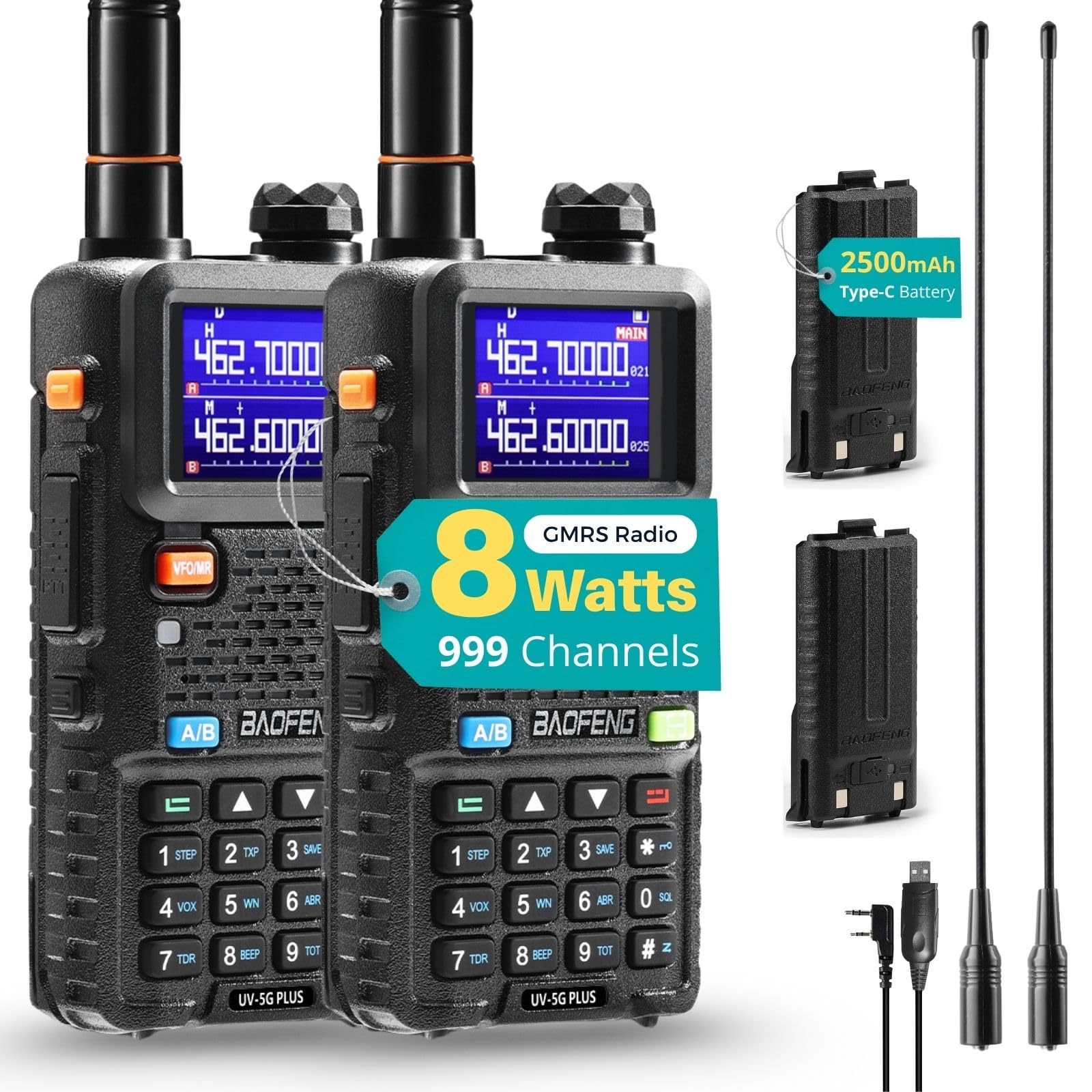
1. BAOFENG UV-5G Plus GMRS Handheld Radio 2 Pack
Our pick — 4.5+★ from 1,000+ verified ratings; the strongest balance of quality and price.
A 999-channel GMRS pair that reaches 12+ miles through suburbs via repeater.
A 999-channel memory is the headline here, and it is not a vanity number. You can pre-load every local repeater, each with its own split tone, and move between cities or towns without ever reprogramming the handset. It is the roomiest channel list of any radio on this page, and for anyone who travels with a radio in the truck, that headroom is the whole point.
Power is listed at up to 8W on channels 15 through 30, which is the GMRS transmit range you actually want when the terrain is unfriendly. The package ships with both an 8-inch and a 15.5-inch high-gain antenna, so you can start compact and switch to the tall whip when you need the extra reach. Charge it from a wall outlet, a power bank, a desktop, or a car charger, because the 2500mAh pack runs through a USB-C port.
What wins people over is the audio — clear transmit and receive is the thing this radio gets right more than anything else. Owners push it well past the box claim: one buyer reports transmitting “12+ miles THROUGH THE SUBURBS successfully with stock antenna!” after hitting a repeater and then reaching another six miles beyond it. The published 12-hour battery rating is the piece to keep an eye on, since a full day of constant chatter will want a top-up partway through.
What earns the top spot
- 999 programmable channels with GMRS, repeater, UHF and VHF slots in one handset
- USB-C charging on a 2500mAh pack, so a power bank or car port works as a charger
- Ships with both 8-inch and 15.5-inch high-gain antennas
- Frequency copy clones settings from one radio to another without a cable
Where it asks a little patience
- The red-on-blue menu is genuinely hard to read in direct sunlight
- Dual-watch stays on and cannot be turned off
- New users face a real learning curve before the deeper menus feel natural
Buy it if: you want one GMRS pair that handles suburbs, trails, and repeater travel without a second purchase.
Look elsewhere if: you want a radio you can hand to a total beginner and never explain — this one rewards a little setup.
2. BAOFENG GM-15 Pro GMRS Radio 2Pack
Half the channels, double the battery — and eight watts pushing through both.
Here is the cleanest trade in this whole roundup: the UV-5G Plus carries a 999-channel memory while this one carries 250, yet the GM-15 Pro lasts 24 hours on a charge against the UV-5G Plus’s 12. If your day is long and your channel list is short, that doubling is the more useful number.
Both radios are rated at 8W output, so you are not giving up transmit muscle to get the stamina. The GM-15 Pro comes pre-loaded with 30 default channels — 22 GMRS and 8 GMRS repeater slots — plus 24 customizable repeater channels and 154 privacy codes made up of 50 CTCSS and 104 DCS codes to keep other voices off your line. An 11-channel NOAA weather receiver is built in for storm warnings.
Owners consistently describe these as working well the moment they come from the start, which matters if you are handing one to a family member who has never touched a GMRS radio. Field reports on range line up with the spec sheet rather than overshooting it, with one buyer putting it plainly: “Tested 4-mile urban range on high power.” Toward the fringe of that distance, the speaker output is merely serviceable — fine for voice traffic, not the loudest you will hear here.
The stamina argument: 24 hours of claimed battery life on an 8W handheld is the reason to pick this over radios with far larger channel lists.
One honest note: a GMRS license is required to transmit on these, so factor that into your first purchase.
Reach for this if: you need a dependable all-day handheld and can live with a smaller channel bank.
Pass it over if: you plan to pre-load dozens of repeaters and want every one of them stored.
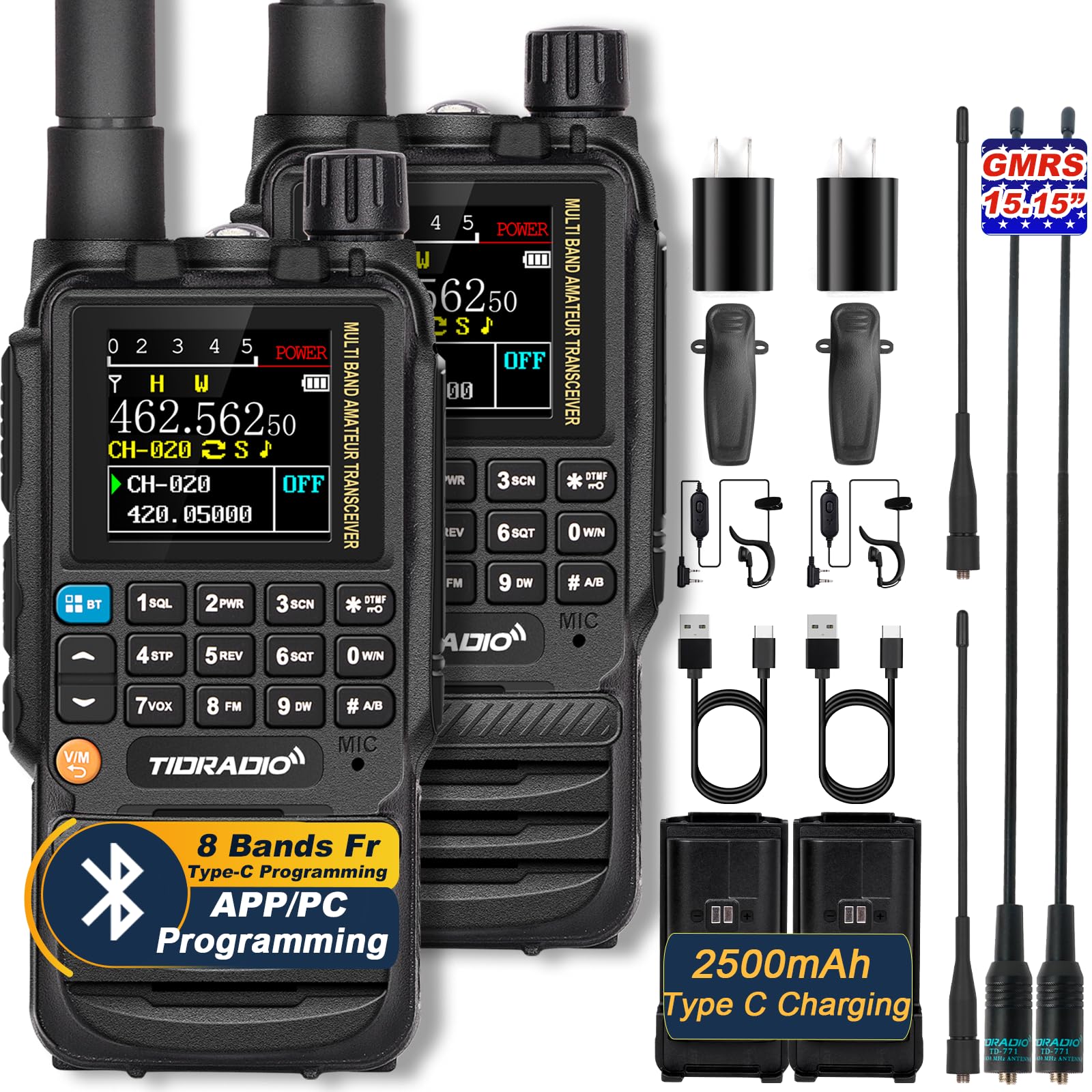
3. TIDRADIO TD-H3 GMRS Radios 2 Pack
Program it from your phone and listen to air traffic while you wait.
The TD-H3 receives across eight frequency bands, including the AM air band that lets you eavesdrop on nearby aviation traffic — a feature nothing else on this list offers. It also runs a 2500mAh battery against the GM-15 Pro’s 1500mAh, giving it meaningfully more stored energy per charge.
Bluetooth programming is the quality-of-life win. You pair the radio with the ODmaster phone app or the web tool and set channels from a screen that is actually pleasant to use, rather than stabbing at menu trees. There is also a USB-C side port for cable programming, a retained two-pin legacy interface, and support for both CHIRP and CPS for anyone who prefers the old way.
The long-range case rests on the bundled 15.15-inch TD-771 antenna and a rated 5W of output. Owners say that pairing with a mountaintop repeater is where the distance really opens up, and the radio holds 36 to 48 hours on light monitoring duty. Do note the trade: at 5W it trails the 8W GM-15 Pro on raw transmit power, so this is a smarter pick for a listener and repeater user than for someone who needs maximum punch into the trees.
Who it beats: if you value antenna gain and band coverage over raw watts, the TD-H3’s tall 771 whip and eight-band receiver are more useful day to day than a power figure.
Suits you if: you want to tune and re-tune your radio from a phone and enjoy scanning beyond GMRS.
skip it if: you want all the transmit power you can legally get in a handheld and no appetite for app pairing.
4. Retevis RB48 FRS Walkie Talkies
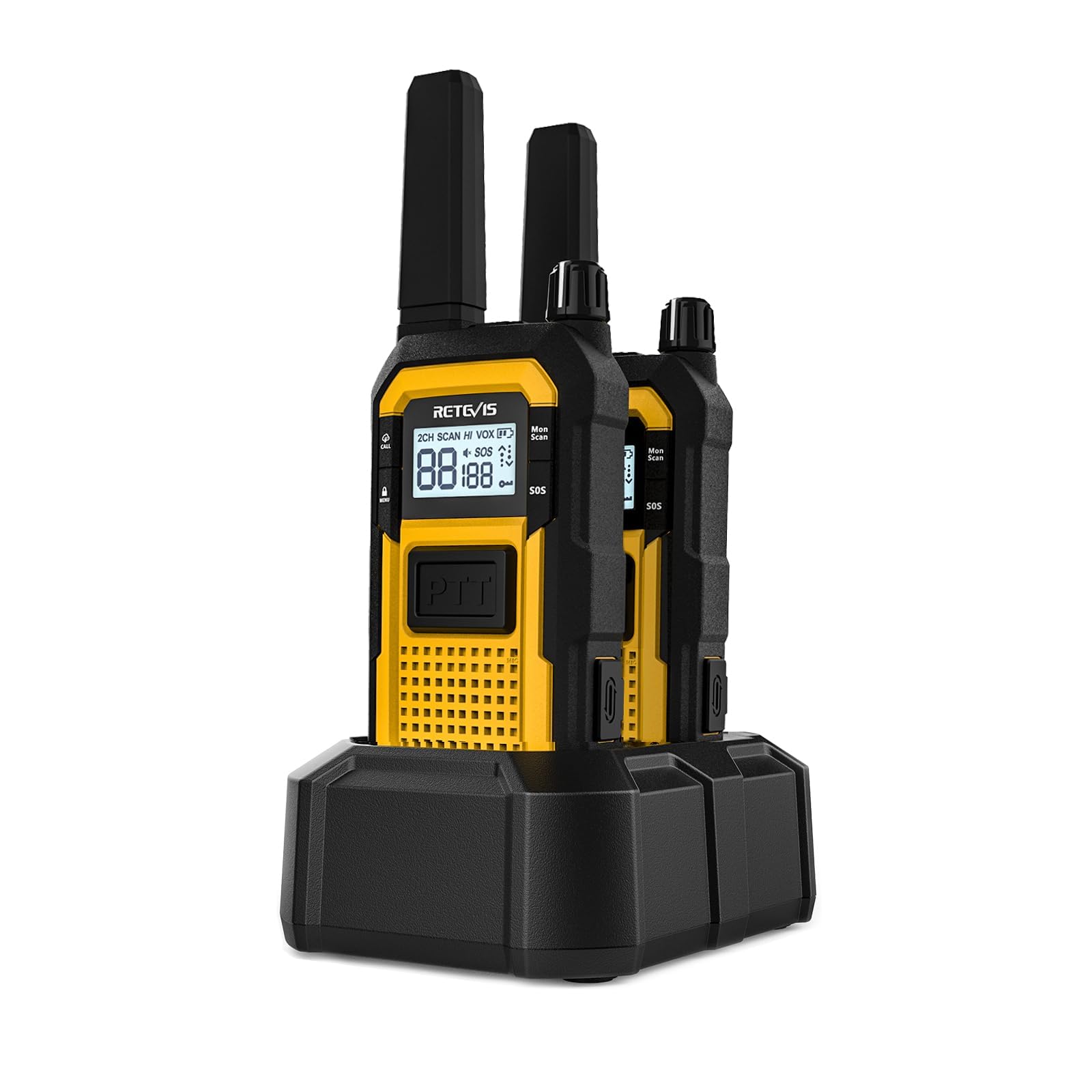
Built to keep talking through rain, drop, mud, and a full working day.
Durability is the entire pitch, and it is tested rather than implied. The RB48 is rated to MIL-STD-810H, the military durability standard covering drops, dust, vibration, heat, and cold, and it carries an IP67 rating for dust and water protection. That includes surviving 1000 drops from 2 meters without breaking, plus a floating body if it goes in the drink.
Since it is an FRS radio, there is no license required and no paperwork before your first transmission — you take it from the start and talk. The 2000mAh battery is rated up to 20 hours, and charge comes through USB-C or the included two-in-one dock. A bright yellow shell makes it easy to spot, silicone button covers help with gloved hands, and an 80 db audible noise figure speaks to the loudness of the alerts.
The honest framing is that this is a short-to-mid-range tool, not a distance machine. Owner testing put clear communication at up to 800 meters between vehicles without line of sight and perfect clarity at 600 meters in heavy traffic, which is exactly what a job-site or car-to-car radio needs. If you were hoping to reach a repeater across the county, this is the wrong tool.
Why the shell matters
- IP67 dust and water protection with a floating body
- MIL-STD-810H tested against drops, dust, vibration, heat, and cold
- License-free FRS operation means zero setup friction
- USB-C and dock charging on a 2000mAh pack rated up to 20 hours
The trade you accept
- FRS power limits keep the reach closer than GMRS options
- Best suited to urban and job-site distances rather than open backcountry
The right tool for: crews, rental fleets, and anyone who drops gear and keeps working.
Not the tool for: crossing valleys where you need repeater access and maximum legal power.
5. Radioddity DB20-G GMRS Mobile Radio

The one you mount in the truck when a handheld cannot cut it.
Twenty watts is the number that separates this from every handheld here — the GM-15 Pro pushes 8W and the TD-H3 pushes 5W, so a properly mounted mobile station simply has more signal to work with. Radioddity rates it to reach up to 20 miles in the open air and 10 miles on a mountain trail, distances a pocket radio cannot touch.
It is also the most driver-friendly design on the page. All the controls live on the microphone handset, so volume and channel changes happen with one hand without taking your eyes off the road, and the display syncs the channel name, frequency, and channel number together. Nine dedicated repeater slots with 1075 privacy codes let you cut interference and stretch your reach through a local repeater.
What buyers talk about most is how this radio sounds — clean audio is the trait owners return to again and again — and its compact footprint suits newer vehicles where dash space is tight. The recurring frustration is the programming software, which is clunky enough that one owner resorted to a specific workaround: separating your frequency files by band and uploading them one band at a time rather than mixing GMRS and VHF together. That is a real learning curve, not a defect.
Where it shines: a 0.45 kg chassis and a microphone that carries every control button make this the easiest radio here to run while driving.
Built for: overlanders, road-trippers, and anyone who wants serious reach from a permanently mounted unit.
Think twice if: you want push-button simplicity — this one expects you to learn its software.
6. SAMCOM FPCN30A Walkie Talkies

Twenty channels so you can split a job site without splitting your attention.
The trick here is organization. With 20 UHF channels you can park crane operators on channel 4, foundation on channel 7, and the site office on channel 12, keeping crews separate when they need to focus on their own work. When everyone does need to hear the same thing, the instant group call function broadcasts to multiple teams even when they are sitting on different channels.
Five watts of output is rated to cover 3 to 5 miles in open areas and more than 300,000 square feet inside buildings, with enough punch to get through concrete and steel. The 1500mAh pack is listed for 12 or more hours of standby and 8 or more hours of continuous use, which covers a full shift with room to spare. Each radio also ships with a 6.7-inch antenna, a K-type earpiece, a dock charger, and a pre-assembled belt clip.
What owners value most is the sheer straightforwardness of these — the performance and build quality are the recurring themes, and the sound lands clear and crisp rather than muddy. The one number to plan around is 55 db of audible noise, which points to a radio that is loud enough for a work site but not a concert. It is built for dust, bumps, and drops, and it keeps going.
The group-call edge: broadcasting across channels is the feature that separates this from a plain handheld pair, and it is why site managers keep coming back to it.
Best matched to: construction, warehouse, and industrial teams that run several crews at once.
Less useful for: solo hikers who want a light pocket radio and never need a group broadcast.
7. Radioddity GD-88 DMR Ham Radio

Two radios in one shell, with the ability to relay between them.
This is a different animal from everything above it. The GD-88 runs two independent VFOs, so it operates on VHF and UHF at the same time, and it moves between analog and digital DMR without a reboot. It carries 4000 channels, supports 300K contacts, and runs a 3000mAh battery.
The rare feature is the cross-band repeater function. Set it up as a base station and it can receive on one band while transmitting on the other, and unlike traditional cross-band repeaters it will bridge analog to digital or digital to analog. There is also a Same Frequency Repeater mode that lets several GD-88 units form a mesh network, so single-VFO radios can still talk to each other through the chain — a real asset where normal infrastructure is missing.
Built-in GPS pairs with APRS to push your position to the network in real time, which is the kind of thing that matters on a backcountry trip. The honest complication is the software: programming reports are mixed, with a buggy CPS that struggles with large contact lists. One owner sidestepped it entirely by switching to CPEditor, praising the dual receive and describing themselves as fully satisfied once the firmware was updated. Budget buyers should note this radio assumes a certain amount of ham-world background.
The mesh-network angle: chaining several GD-88 units into a Same Frequency Repeater setup is a capability none of the simpler handhelds here can match.
Choose it if: you already have a ham license and want DMR, APRS, and cross-band relay in one handset.
Leave it if: you want a set-and-forget GMRS radio and have no interest in programming software.
8. BTECH GMRS-PRO GMRS Radio

The only radio here that texts your position to the rest of the group.
Pair this with the BTECH app and you get channel management, contact syncing, and text messaging from a phone screen instead of a front-panel menu. Built-in GPS and a digital compass show coordinates, heading, speed, and altitude right on the radio, and location sharing lets you see nearby users — genuinely useful when you are off-grid and the group spreads out.
Bluetooth carries audio too, which is where motorcyclists come in. The radio links to a helmet headset for hands-free talk at highway speed with no cables or adapters, and an IP67 rating means rain, splashes, mud, and temporary immersion are part of the plan rather than a risk. The 2600mAh pack charges over USB-C, and 180 channels plus 180 GMRS/FRS backward compatibility round out the setup.
Sound quality is what consistently gets praised, and the feature list is deep enough that owners describe it as having everything standard and advanced GMRS can offer. Two caveats are worth knowing up front. GPS and texting only work with another GMRS-PRO unit, so plan on two if you want those features to do anything. And it is not CHIRP compatible, so all programming happens through the app.
The features that justify it
- GPS location sharing and built-in digital compass for off-grid group coordination
- Bluetooth audio to a helmet headset with a handlebar remote PTT option
- IP67 dust and water protection with USB-C charging on a 2600mAh battery
- Text messaging and contact syncing through the phone app
What to plan around
- GPS and texting require another GMRS-PRO to be useful
- The belt clip takes effort to install and accessories are proprietary
- Programming is app-only since CHIRP is not supported
Made for: motorcyclists, side-by-side riders, and anyone who needs hands-free Bluetooth and position sharing.
Overkill for: a two-person hiking group that just wants simple voice contact.
9. Midland GXT3000 GMRS Two-Way Radios 2 Pack
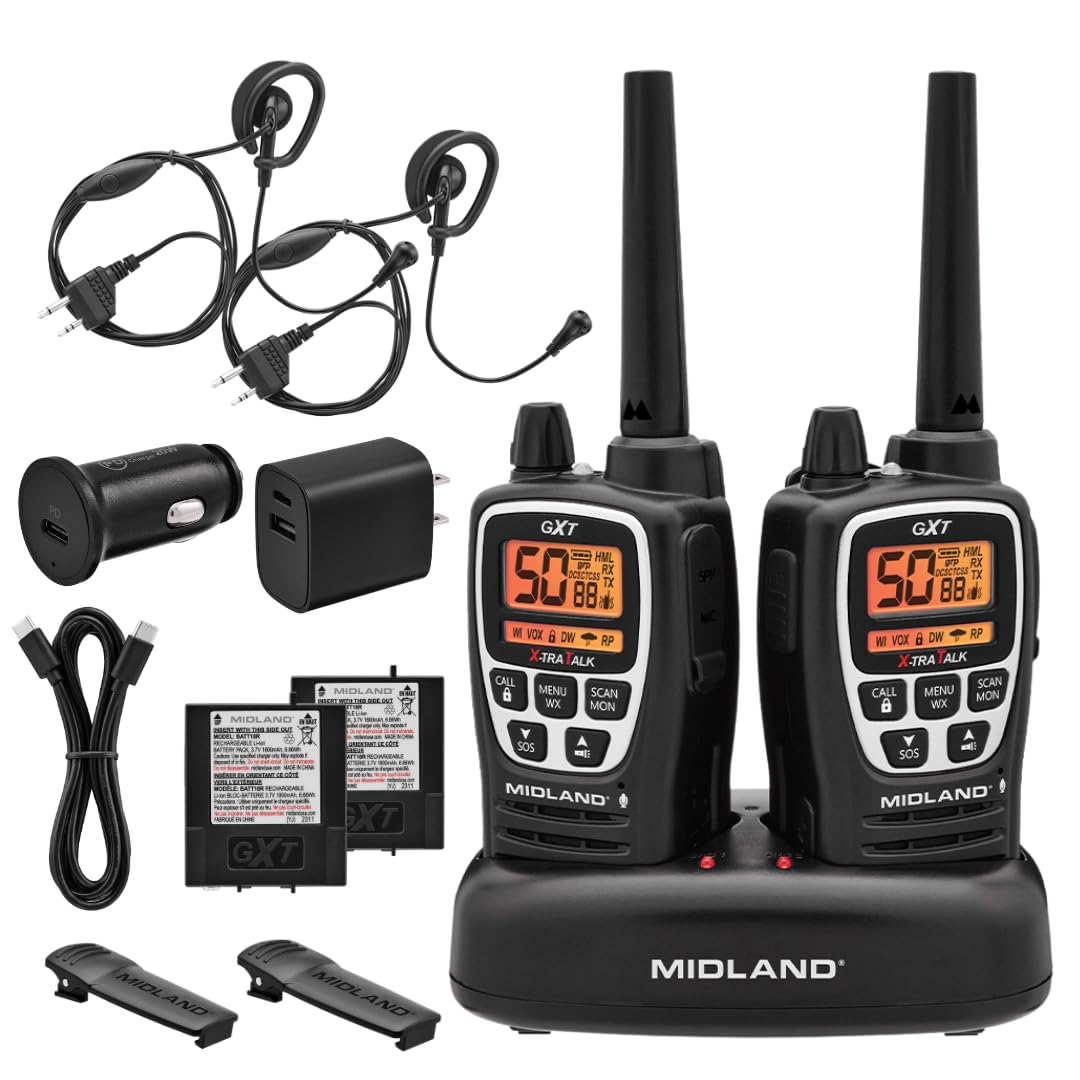
Repeater-linked reach that stretches well past anything line-of-sight allows.
The standout figure is the repeater claim: link through a GMRS repeater and Midland rates these up to 65 miles, far beyond what a handheld can manage on its own. That is the number that matters for overlanders, farm operations, and off-road convoys stretching across wide ground, where a direct radio-to-radio link would fade long before the crew arrives.
Power is handled by a rechargeable lithium-ion pack rated at 27 hours, which is the longest claimed runtime of any handheld pair on this page — the GM-15 Pro sits at 24 hours by comparison. Charging runs over USB-C so a truck outlet or power bank tops it up, and the radios carry 50 channels with 142 privacy codes to hold your line across canyons, timber, and mountain passes where phone bars disappear.
Owners describe these as quality units, and the battery packs are specifically called out for holding their charge over long use. A built-in NOAA monitor scans automatically and alerts your group before bad weather moves in, while a water-resistant body, LED flashlight, SOS siren, and keypad lock round out the field kit. The honest limit is that the 65-mile figure depends entirely on a repeater being in range — take that away and you are back to ordinary handheld distances.
The runtime leader: at 27 claimed hours this has the longest battery rating of any handheld here, a meaningful edge on multi-day trips.
Ideal when: you travel wide terrain and have a GMRS repeater nearby to link through.
Less compelling when: you are working a few hundred feet apart and never plan to touch a repeater.
10. Retevis RT68 FRS Walkie Talkies 10 Pack
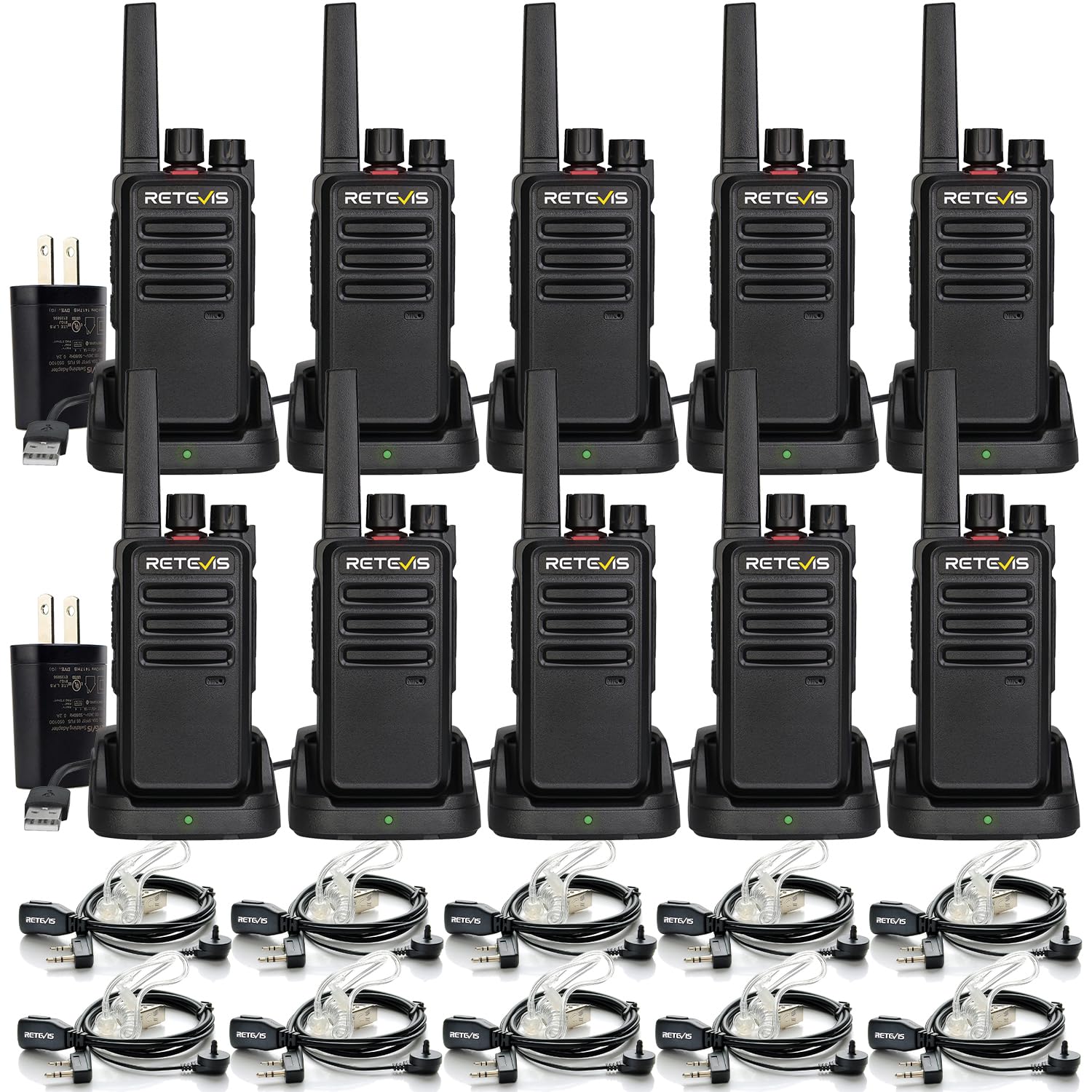
Ten handsets, one channel, and nobody has to read a manual first.
Ten radios in one box is the defining fact here, and it changes the math on outfitting a whole crew at once. The RT68 runs 16 channel combinations with enough signal to get through concrete and steel, which is why it shows up in construction, warehousing, retail, hospitality, and school settings. FRS operation means no license, no paperwork, and no training session before your staff can use them.
Each radio is palm-sized with a single knob and buttons for volume and channel changes, wrapped in a hardened shell that shrugs off normal drops. The VOX function lets you transmit by speaking rather than pressing a button, which keeps hands free during tasks, and a 0-9 level squelch keeps audio clear and loud in noisy places while cutting power drain. The 500mW speaker is built for intelligibility rather than volume alone.
Reliability and sound quality are what owners keep coming back to, with strong performance reported over 12 city blocks and across longer distances in a work context. The battery is rated for 14 hours, and each set includes a charging base, earpiece, belt clip, and lithium-ion pack — where this one is genuinely plain rather than rugged is the same place budget radios always are, and moisture is what it is least forgiving of.
The fleet logic: covering ten people on one purchase is the reason this beats buying five two-packs, especially for schools and job sites.
Best for: teams of eight to ten who need everyone on one channel with zero setup fuss.
Not for: anyone who wants long-distance or repeater work — FRS keeps this close to home.
11. Rocky Talkie Mountain Radio 2 Pack
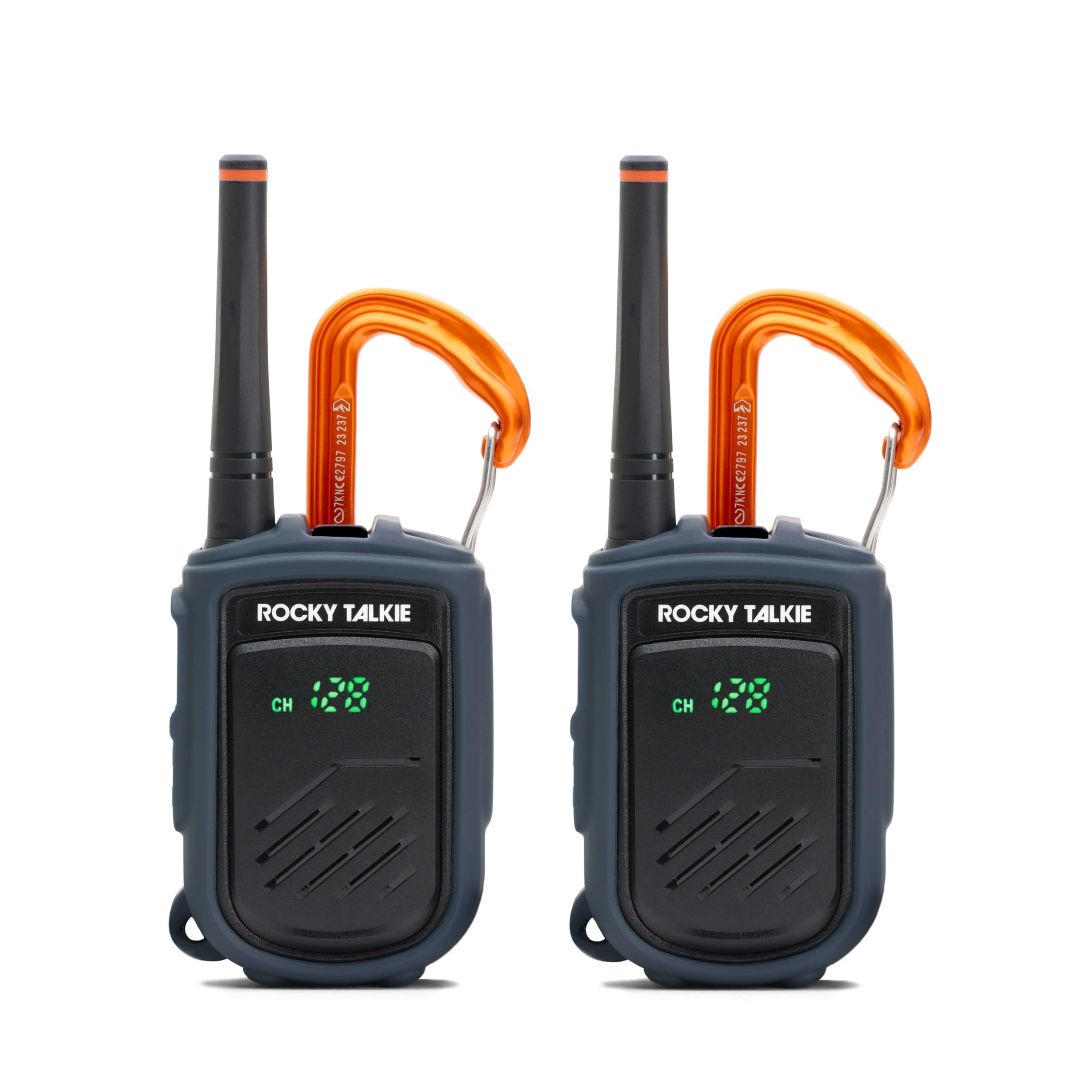
Four days of battery, five buttons, and nothing to configure before you hike.
Battery life is the headline: a specialized rechargeable lithium-ion pack rated for over four days, even in very cold conditions. For ski tours, alpine climbs, and multi-day trips where recharging is not an option, that is the most important figure on the whole page. It charges over USB-C and comes back up fast.
It transmits the maximum power legally allowed without a license at 2 watts, a hard legal ceiling rather than a shortcoming of the design. The stated max range is over 35 miles, but the manufacturer is refreshingly honest that 1 to 5 miles is more typical in backcountry terrain — which is exactly what buyers report, with one group logging solid communication at 3 to 4 miles across the Rockies. Five simple buttons mean zero setup, and a shatterproof LED screen pairs with a thermoplastic protective shell.
Mounting is where it separates from the pack. Instead of the fragile plastic belt clips found elsewhere, it attaches to backpacks and harnesses with an ultra-light climbing-rated carabiner plus a metal-reinforced back-up leash, and it carries 128 channels with IP56 protection against splashes and snow. The one recurring wish is a belt clip option for people who prefer waist carry over a pack attachment.
Why climbers trust it
- Over four days of battery life, rated to hold up in very cold conditions
- Climbing-rated carabiner plus metal-reinforced back-up leash instead of a plastic clip
- No configuration needed — five buttons and 128 channels ready from the start
- IP56 water protection against splashes and snow
The fine print
- 2W output is capped by FRS rules, so raw power is lower than GMRS handhelds
- Typical backcountry range runs 1 to 5 miles despite the 35-mile maximum figure
Right for you if: you ski, climb, or hike with a pack and need a radio that survives the mountain and stays charged for the whole trip.
Wrong for you if: you need maximum legal transmit power and long-distance repeater access.
Know the Specs
Output Power in Watts
Output power measures how much energy the radio pushes into the antenna, measured in watts. More watts generally means a stronger signal and better penetration through trees and buildings. On this list the Radioddity DB20-G leads at 20W as a vehicle-mounted unit, the Baofeng UV-5G Plus and GM-15 Pro sit at 8W, and the Rocky Talkie Mountain Radio is capped at 2W by FRS rules. Power is not the whole story — antenna gain and height often matter more — but it sets the ceiling.
Battery Capacity in mAh
Battery capacity is measured in mAh, which is simply how much energy the pack holds, and average life is expressed in hours. The TIDRADIO TD-H3 carries 2500mAh against the GM-15 Pro’s 1500mAh, and the rated life tells a different part of the story: the GM-15 Pro claims 24 hours while the TD-H3 claims 48. What matters to you is whether charging happens over USB-C, because that determines whether you can refuel from a power bank or car port instead of a wall outlet.
Common Questions
Do I need a license to use these long range radios?
What is the actual range of a handheld radio in the woods?
What is a GMRS repeater and why does it matter for range?
Can a GMRS radio talk to an FRS radio?
How long does the battery actually last on a full day out?
Doesa higher mAh number always mean longer battery life?
Is a twenty watt mobile radio better than a handheld for range?
What does IP67 waterproof actually protect against?
Can I program these radios from my phone instead of a computer?
What is the difference between GMRS and ham radio models here?
Will an upgraded antenna really improve my range?
The Bottom Line
For most people, the long range radios winner is the Baofeng UV-5G Plus because it pairs a 999-channel memory and 8W output with USB-C charging and a rock-solid reputation for audio in the field. If your priority is all-day stamina and you can live with a smaller channel bank, grab the Baofeng GM-15 Pro, which trades channels for a 24-hour battery against the UV-5G Plus’s 12. And for backcountry trips where the radio has to survive the mountain and stay charged for days, the Rocky Talkie Mountain Radio is the one to reach for with its climbing-rated carabiner and over-four-day battery. If you want the safest first pick among a crowd that clearly agrees, the UV-5G Plus earns its spot as the most-followed choice on this list.
How we choose
We do not accept paid placement. Every pick is matched to a real buyer and a real use-case; we do not hands-on test units.
Sources
Specifications: manufacturer listings and product documentation. Review insights: verified customer reviews, as of October 2026. Pricing: not shown on this page (it changes often); check the current price via the retailer link.
As an Amazon Associate, Aappliancez earns from qualifying purchases. This does not affect which products we feature.