Disclosure: Some links in this post are affiliate links. As an Amazon Associate I earn from qualifying purchases, at no extra cost to you. Learn more
Specs are compiled from manufacturer listings and verified buyer reviews and can change over time — please confirm the key details on the product page before buying.
Before you book another hotel room, know this: a listening device detector works best when you match it to the job. Use a radio-frequency sweep (a scan for radio signals) to find an active bug. Use an infrared lens finder (a tool that spots camera lenses by their reflection) to find a hidden camera. Use a magnetic check to find a tracker tucked under a car seat. No single gadget here nails all three at long range. Choose by where you feel exposed: a hotel room calls for an RF and infrared sweep, a car for a magnetic check.
This guide is built by comparing the manufacturers’ published specifications and the patterns across verified customer reviews, so you get each pick’s real strengths and trade-offs instead of marketing spin.
Below you get the real trade-offs on each pick: what it catches, what it misses, and how far away it still works. Every pick was matched to the way people actually sweep a room, a rental, or a car, so you can choose a best listening device detector that fits your own routine.
Top Picks


How To Choose The Best Listening Device Detector
The single mistake most first-time buyers make is treating these gadgets like a police scanner that sees everything. They do not. Each one listens for a different kind of clue: radio waves, an infrared reflection off a lens, or a magnet holding a tracker in place. Buy for the mode you will actually run — RF for a live bug, infrared for a lens, magnetic for a tracker — and every blip on the screen has a meaning.
Start with the frequency ceiling, not the price tag
A detector’s frequency range (the span of radio waves it can hear) tells you what kind of wireless bug it can catch. One pick here reaches 6.5 GHz, which covers Wi-Fi and many modern wireless cameras. A unit that tops out lower will simply miss the higher-frequency transmitters, so match the range to the gear you are worried about.
Infrared lens finding beats guessing
An infrared scanner shines a light and catches the reflection off a camera lens, so you can spot a pinhole camera in a smoke alarm or a clock even when it is powered off. That is the one mode that still works on a camera with no radio signal at all, which is why frequent travelers lean on it.
Sensitivity controls keep the false alarms down
Your own phone, router, and Bluetooth headphones all broadcast, so a raw signal sweep lights up constantly. Adjustable sensitivity levels let you dial down the noise and walk slowly toward a stronger signal. Fewer levels per unit here, more alarms to sort through by hand.
Check the battery and standby before you pack it
A detector is only handy if it is charged when you need it. Standby times run from a couple of hours of active use up to 30 days on standby, and rechargeable batteries differ across picks. A rechargeable unit with auto-shutdown saves you from finding a dead meter in a hotel room.
Side-by-Side Comparison
| Model | Best For | Detection Modes | Frequency / Range | Battery / Power | Amazon |
|---|---|---|---|---|---|
| ERICKHILL EMF Meter RT-100★ Best Overall | Home EMF mapping | Electric field, magnetic field | 1V/m–1999V/m; 0.01–99.99µT | Rechargeable lithium polymer | Amazon |
| Ganods K18 Hidden Camera DetectorBest for Travel | Travel hotels and rentals | Camera, GPS/magnetic, infrared | 6.5 GHz | 3.7V, up to 30-day standby | Amazon |
| Aleanu T01 DetectorLongest Battery Run | Long-battery travel sweeps | RF, IR lens, magnetic, flashlight | 1 MHz–6.5 GHz; 30㎡ area | 25-hour battery | Amazon |
| Abyliee Hidden Camera Detector Pro | Pocket carry | RF, camera, GPS tracker | 100-foot maximum range | Rechargeable, 1 nonstandard battery | Amazon |
| Tadeto Decibel Meter TE017 | Sound-level checking | SPL audio measurement | 30dB–130dB | Battery (user supplied) | Amazon |
| JMDHKK K18 (Black) | All-round bug sweeps | Camera, bug, magnetic | — | USB rechargeable | Amazon |
| JMDHKK K18+ (Silver) | Color choice, same tool | Camera, bug, magnetic | — | 1 Wh rechargeable | Amazon |
| JMDHKK K18+ (Gold) | Color choice, same tool | Camera, bug, magnetic | — | Rechargeable | Amazon |
| JMDHKK M8000 (Silver) | Serious vehicle and room sweeps | Optical, magnetic, bug | 10 meters | Lithium-ion rechargeable | Amazon |
| JMDHKK M8000 (Black) | Serious vehicle and room sweeps | Optical, magnetic, bug | 10 meters | 400 mAh rechargeable | Amazon |
Detailed Reviews
1. ERICKHILL EMF Meter
Our pick — 4.0+★ from 8,500+ verified ratings; the strongest balance of quality and price.
The home meter that turns “is this wall buzzing?” into a real number on a screen.
If your worry is the wiring inside your own four walls — a router, a breaker panel, a plugged-in appliance — this is the pick that gives you a reading instead of a vague hunch. The ERICKHILL RT-100 measures electric fields from 1V/m up to 1999V/m and magnetic fields from 0.01µT to 99.99µT. A microchip inside processes the raw sensor signal and prints the value on an LCD (a small digital display) you can read in a dark room.
What makes it genuinely useful at home is the alarm logic. Cross 40V/m on the electric side or 0.4µT (4mG) on the magnetic side, and the screen turns red, the light flashes, and a buzzer sounds. A mute mode keeps it silent in a bedroom. The data-hold button freezes a reading so you can jot it down, and the unit powers off after 5 minutes idle so the rechargeable battery is not flat when you reach for it. At 8.8 ounces it sits in one hand like a small remote.
Here is the honest limit. This is a low-frequency meter, built for appliances and power lines, not for sniffing out a Wi-Fi bug or a Bluetooth transmitter in a hotel lamp. Magnetic readings can also show 0 if the appliance is switched off, so you have to power the suspect device on and hold the top sensor close. Weigh that against 4.0+ stars from 8,000+ owners and it is easy to see why it still leads: what wins people over is how often it turns a scary unknown into a calm, readable number.
Why it earns the top slot
- Reads both electric (V/m) and magnetic (µT/mG) fields, so one tool covers appliances plus wiring.
- Red-screen, flashing-light and buzzer alarm at 40V/m or 0.4µT — you do not have to interpret the digits to know something is high.
- Rechargeable with auto-shutdown at 5 minutes and a mute mode for quiet rooms.
Where it stops
- Low-frequency only — it will not catch a Wi-Fi or cellular bug, which is the job the K18 and M8000 picks handle.
- You must switch the source on and put the sensor close, or the magnetic reading sits at zero.
Reach for this if: you are mapping your own home for appliance and wiring hotspots and want a clear, alarm-backed reading in one hand.
Look elsewhere if: your real worry is a hidden wireless bug or a covert lens — that needs an RF and infrared sweep instead.
2. Hidden Camera Detectors
Three tools in one pocket-sized shell for the rental you have never slept in before.
The Ganods K18 gives you three separate jobs in one handset. It has a camera detector for wireless and wired hidden cameras, a GPS finder that sniffs the magnetic field a tracker throws off, and an infrared mode for cameras with night-vision lenses. Its frequency band reaches 6.5 GHz (a radio frequency that many modern hidden cameras use), so it can pick up the Wi-Fi and high-band transmitters most covert cameras rely on. Three buttons and a sensitivity dial run the whole thing — no manual needed to start.
Battery is the travel feature that matters, and this one holds its charge for up to 30 days on standby after a top-up. That means you can leave it in a bag between trips and still have power when you check into a strange room. The unit runs at 3.7 volts and a single count ships in the box. Weigh that against 4.0+ stars and a review base in the high hundreds, and it is a sensible first detector for someone who travels often.
The catch is selectivity. The radio-frequency sweep is eager — it picks up nearby phones, Wi-Fi and Bluetooth alongside the thing you are hunting, so you sweep slowly and turn the sensitivity down. Magnetic detection is short-range too. For a hotel, motel or unfamiliar Airbnb where the goal is to check a smoke alarm, mirror and lamp for a camera, that trade is fine. For pinpoint long-range tracking work, step up to the M8000 picks instead.
What it does well: a compact, three-mode sweeper with a 30-day standby that fits in a carry-on and covers camera, GPS and infrared checks in one pass.
The honest caveat: the RF mode is sensitive enough to light up on your own phone and router, so a careful sweep beats a fast one.
Buy it for: frequent travelers who want a small, always-charged tool for a quick rental-room check.
Skip the upgrade if: you expect lab-grade precision — this is a practical first-line sweep, not a professional counter-surveillance rig.
3. Aleanu Hidden Camera Detector
Six sensitivity steps and a 25-hour battery for the traveler who sweeps every room slowly.
The Aleanu T01 is built around four modes — radio-frequency signal detection, infrared camera-lens finding, magnetic field detection and a built-in flashlight for dark corners. Its frequency range runs from 1 MHz up to 6.5 GHz, wide enough to cover 2G, 3G and 4G mobile signals as well as the wireless cameras most people worry about. Six sensitivity levels let you walk a sweep from broad to precise instead of guessing on one fixed setting.
The battery is the standout: a 25-hour run time means it can survive a multi-day trip without hunting for an outlet. It weighs 110 grams, so it disappears into a jacket pocket, and the stated effective detection area is 30㎡ — roughly a standard hotel room. That combination of a long run and a typed-out detection area is what separates it from the smaller pocket sweepers. It is rated 3.5+ stars across a few hundred reviews.
Be ready for a learning curve. The manual is thin, the controls take a first pass to get comfortable, and the short detection range plus crowded-signal false alarms are the recurring gripes. One buyer summed it up: “Use this item on my own cams and it works.” If you want a detector that works perfectly on the first try with no manual reading, the Aleanu’s thin instructions and six sensitivity levels will frustrate you. If you will take five minutes to learn the six levels, it earns its place.
The reason to pick it: 25 hours of battery and six sensitivity levels make it the patient traveler’s sweeper — one charge covers a whole trip.
Know before you buy: the instructions are sparse and the first sweep feels fiddly, so budget a few minutes to learn the modes before you rely on it.
Fits the traveler who: takes privacy seriously and will put in a little practice to master six sensitivity levels and four modes.
Not for the impatient: a first-time buyer who wants instant, manual-free confidence will find the setup period frustrating.
4. Upgraded Hidden Camera Detector
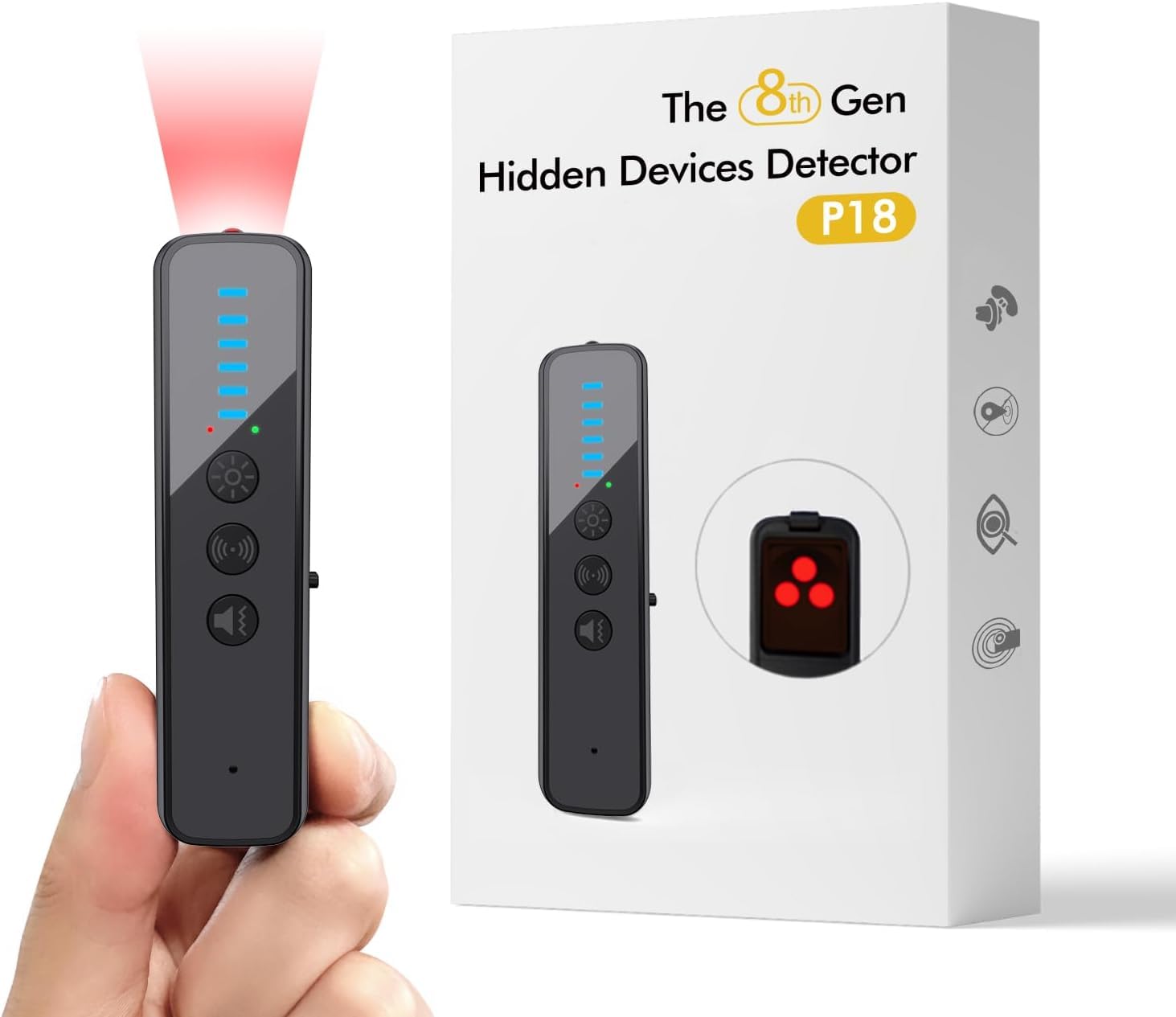
A lighter-sized scanner that lives in your pocket until the moment you need it.
At 27.22 grams, the Abyliee Hidden Camera Detector Pro is the easiest of this group to carry anywhere — a bag, a purse, a jacket pocket. It sweeps for hidden cameras, listening devices and GPS trackers, and flags what it finds with an audible alarm plus LED alerts. A stated maximum range of 100 feet gives you a headline figure to work with, and the rechargeable battery means no coin-cell hunting. The operation is genuinely simple: press a button, sweep, wait for the alert.
One reported strength is the lens finder — it can spot a pinhole lens set into a smoke detector or a clock, which is the classic hiding spot in a rental. Owners also report it can pick out radio-frequency signals without constantly tripping over routers and microwaves. The kit includes the detector, a Type-C charging cable and a manual, and it carries a 2-year manufacturer warranty. It is rated 3.5+ stars across 950+ reviews.
The trade-off is range. The GPS and Wi-Fi detection want you close to the source even at higher power, so this rewards a slow, hands-on sweep rather than a scan from across the room. The manual is also thin — one reviewer noted “it doesn’t really give you instructions on how to use it.” If close-quarters pocket coverage is your need, those are acceptable compromises. If you want long-distance pinpointing, the M8000 pairs better.
What makes it handy
- 27.22 grams — genuinely pocketable, so it goes everywhere with you.
- Audible alarm and LED alerts mean you do not have to stare at a screen.
- 2-year manufacturer warranty and a Type-C cable in the box.
What to watch for
- Detection needs close proximity, so sweep slowly and near suspected spots.
- The manual is minimal — plan to learn the modes by trial.
The pick for: a lightweight, always-with-you scanner for hotel rooms and rental spaces.
The mismatch: anyone expecting to sweep a large room from one spot — this wants you up close.
5. Tadeto Digital Sound Level Meter

Not a bug sweeper — the tool for proving how loud a room, machine or speaker really is.
The Tadeto TE017 measures sound pressure level (how loud the air is vibrating) from 30dB to 130dB, with a stated accuracy of ±1.5 dB. It gives you five adjustable measurement ranges and an A/C weighting switch: A weighting mimics how the human ear hears quieter, everyday noise, while C weighting reads the harsher pressure of loud machinery. If you want to document a noisy neighbor, tune a home theater, or check a workshop, this is the meter that puts a number on it.
Two response settings change how quickly it updates — a fast 0.125-second constant for general environmental reads, and a slow 1-second constant for noise that swings a lot. A backlit LCD keeps the digits readable in low light, MAX/MIN holds the high and low values, and data hold freezes a reading. The physical design is friendly too: a one-hand body, a detachable foam windscreen, standard tripod threads and a zippered bag. It is rated 4.0+ stars across 350+ reviews.
Do not confuse this with a listening device detector — it measures loudness, not hidden transmitters. There is also a known quirk: it powers down after a few minutes to save battery and can forget your A/C and fast/slow settings on restart, so you reset the mode each time you switch it on. For home theater levelling and noise checks, that is a minor step; for catching a hidden bug, it is the wrong tool entirely.
Where it shines: 30dB–130dB range, ±1.5 dB accuracy and A/C weighting make it a proper sound-level meter for tuning and noise documentation.
The quirk to know: it auto-off and resets your A/C and fast/slow choices on the next power-on, so re-select the mode each session.
Made for: home-theater tuning, noise complaints, and workshop checks where you want a real dB reading.
Wrong tool if: your goal is finding a hidden transmitter — this reads loudness, not radio signals.
6. JMDHKK Hidden Camera Detector Black

The all-round sweeper that has been the default choice for years — and it shows.
What makes the JMDHKK K18 the pick most people picture is its three working modes: hidden-camera detection, bug detection and magnetic-field detection. Two buttons switch between them, and an LED signal-strength indicator points you toward a stronger source as you walk. Alerts come as sound or vibration so you can sweep quietly. The disassemblable body packs down for travel, and the kit includes an RF antenna, GS probe, USB cable and manual.
It detects bug signals passively, meaning it listens without broadcasting its own radio signal — the recorder hiding in the meeting room gets no hint you are scanning. The build is ABS plastic with sound and motion alerts, and the whole thing measures under 4 inches across. This is a device that has been through more real-world sweeps than almost anything else on this list.
The fair caveat is expectation. The accuracy reviews split — plenty find it works, and the magnetic side is short-range. The honest read: a strong transmitter close by is easy; a faint, intermittent one takes patience and a slow walk. If you want the sweeper with the longest track record in rental rooms and offices, this is it; if you want a wide detection field from one spot, lower your expectations everywhere.
The strong case: camera, bug and magnetic detection from one two-button unit with LED strength guidance, in a body that packs flat for a bag.
The reality check: magnetic tracking wants you within inches, and a weak or intermittent bug needs a slow, steady sweep.
Go with this for: home, office and hotel checks where you want one proven three-mode tool.
Think twice if: you expect every faint signal to announce itself — this rewards a careful, close-in sweep.
7. JMDHKK Hidden Camera Detector Silver
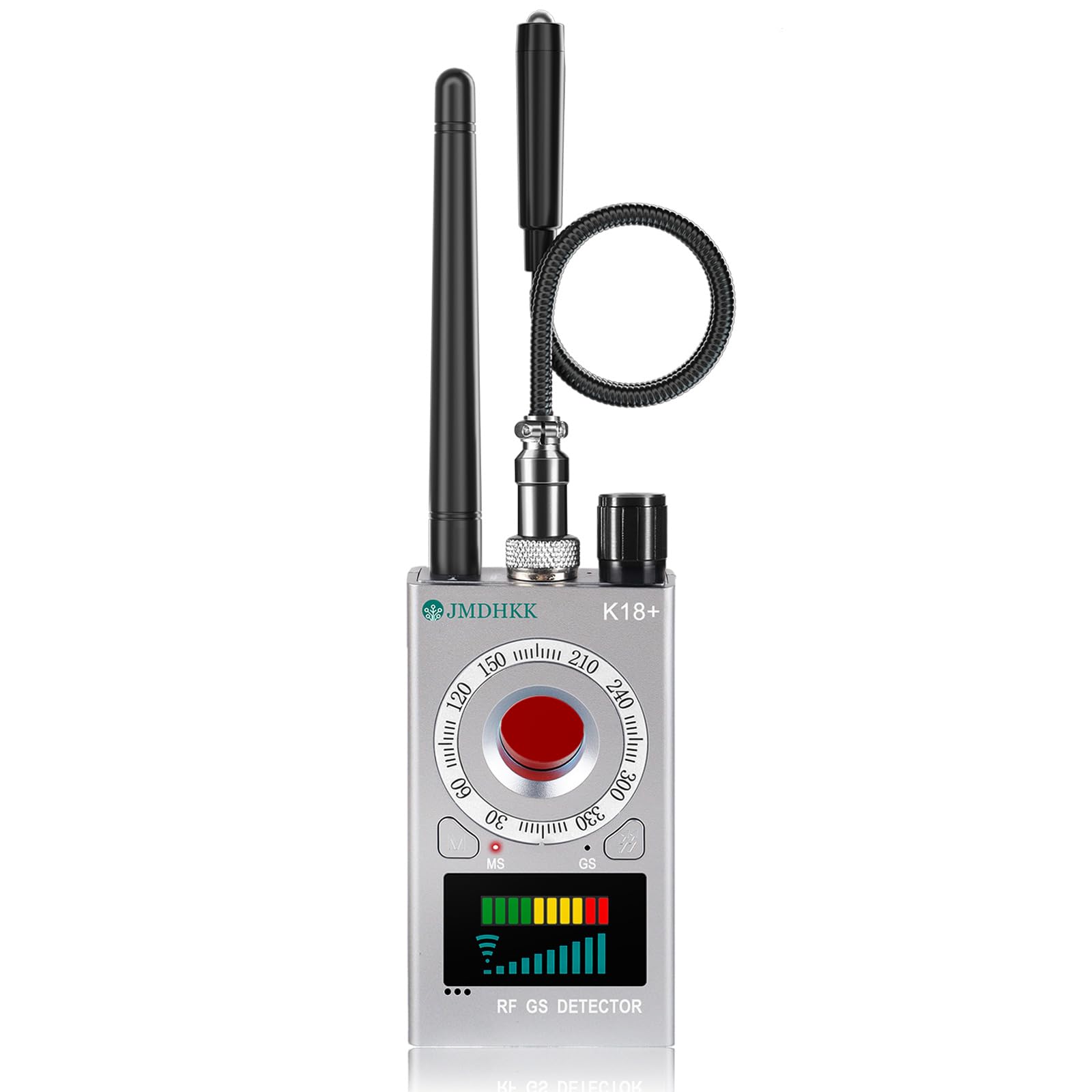
Same proven K18+ engine as the black version, now in a silver shell that suits a desk drawer.
This is the JMDHKK K18+ in silver, and the guts are the ones you already trust: hidden-camera detection, bug detection and magnetic-field detection, switched with two buttons and shown on an LED strength indicator. Alerts run as sound or vibration. A 1 watt-hour rechargeable battery keeps it running, and the box carries an RF antenna, GS probe, charging cable and manual.
What changes is the color and the usage notes. It is indoor and outdoor rated in the listing, so a car-seat or luggage sweep is fair game alongside a hotel room. At 4.8 ounces it is lighter than the black edition’s sibling picks, which matters if you keep it in a coat pocket. If you have already decided the K18+ layout is for you and just prefer a lighter finish, this is the one to order.
The honest question is whether a fresh color earns a separate spot. It does if you want the silver to disappear against a desk or case; it does not if you only care about performance, because the detection modes and short magnetic range are shared with the black model. Expect to sweep close, and expect the magnetic mode to need you within inches of a tracker.
Why pick it: the trusted three-mode K18+ detection set in a 4.8-ounce silver body with an RF antenna and GS probe included.
What stays the same: short-range magnetic tracking and a close-in sweep — the color is the change, not the reach.
The match for: anyone who wants the K18+ mode set and prefers a silver finish for a desk or travel case.
No reason to switch: if color does not matter to you, the black K18+ does the identical job.
8. JMDHKK Hidden Camera Detector Gold

The gold K18+ — the same three-mode privacy sweeper dressed for a glove box or nightstand.
Strip away the finish and this is the JMDHKK K18+ detection engine: hidden-camera finding, bug detection and magnetic-field sensing, all run from two buttons with an LED strength readout. Sound or vibration alerts keep a sweep discreet, and the body folds down for travel. It weighs 6.4 ounces and is built from plastic, so it is light enough to forget about until you need it.
The gold shell is the differentiator if you keep your gear visible — it sits well on a nightstand or in a car console without looking like a piece of surveillance kit. The three modes cover the standard sweep: run the camera scan for a lens, the bug scan for a live transmitter, and the magnetic scan for a tracker. Use it across a hotel room, a vehicle, or an office meeting space and the workflow is the same as the other K18+ versions.
Now the same caveat that applies across this whole family: magnetic detection is short-range, and the radio sweep wants you close and patient. The gold finish is also a pure aesthetic choice — it does nothing for detection that the silver does not do. If you like the gold look and will sweep in close, it delivers the same three modes as the silver; the finish adds no extra detection range.
What it gives you: the proven three-mode K18+ set in a 6.4-ounce gold body with discreet sound or vibration alerts.
Straight talk: the finish is cosmetic — magnetic range and close-in radio sweeping are unchanged from the other colors.
Choose it when: you like the gold look and want the standard three-mode sweep for travel, vehicle and office checks.
Pass when: you want the finish to change how far it detects — it does not.
9. JMDHKK M8000 Hidden Camera Detector Silver

The big step up: optical camera finding, magnetic tracking and a 10-meter reach in one tool.
If you want to sweep a room or a vehicle from across the space rather than nose-to-the-wall, the M8000 is the pick. Its stated maximum range is 10 meters — the widest here — and its optical sensors hunt for hidden cameras, while high-precision magnetic sensors catch a tracker in a bag or a vehicle. A bug-detection mode scans for transmissions from listening devices and wireless microphones for good measure.
The standout feature is what JMDHKK calls AI smart signal detection: the device alerts after detecting six strong wireless signals, which is designed for spies that only transmit intermittently to save power. That matters because a camera that wakes up every few minutes is exactly what a fast sweep misses. It weighs 7.68 ounces, runs on a lithium-ion battery, and ships with a GS probe, RF antenna, USB cable and manual. It carries a 1-year free replacement and 2-year repair warranty, and is rated 3.5+ stars across the high hundreds of reviews.
The honest friction points are the alarm and the knobs. The beeping is loud with no adjustable volume, the RF knobs are sensitive enough to nudge by accident, and the magnetic range is short — about 3 inches for a small magnet — while the manual’s English is rough in places. If you want to sweep a room or a car from up to 10 meters and can live with a loud, non-adjustable beep, the extra reach is worth it. If you want silent operation, look at the simpler K18 picks.
Where it pulls ahead
- 10-meter maximum range — the widest reach in this group, so you can scan from across a room or a vehicle.
- AI smart detection that alerts after six strong signals, built for cameras that transmit intermittently.
- Optical camera, magnetic tracker and bug scanning in one unit, backed by a 1-year replacement and 2-year repair warranty.
What you tolerate
- The alert beep is loud and cannot be turned down, which is awkward in a shared or quiet space.
- The RF knobs are touch-sensitive and easy to bump, and the magnetic mode still wants you within about 3 inches of a small tracker.
Best when: you need real reach — scanning a hotel room or a vehicle from a few paces back — and want optical plus magnetic plus bug modes.
Look past it if: you need silent, discreet alerting or a polished English manual.
10. JMDHKK M8000 Hidden Camera Detector Black
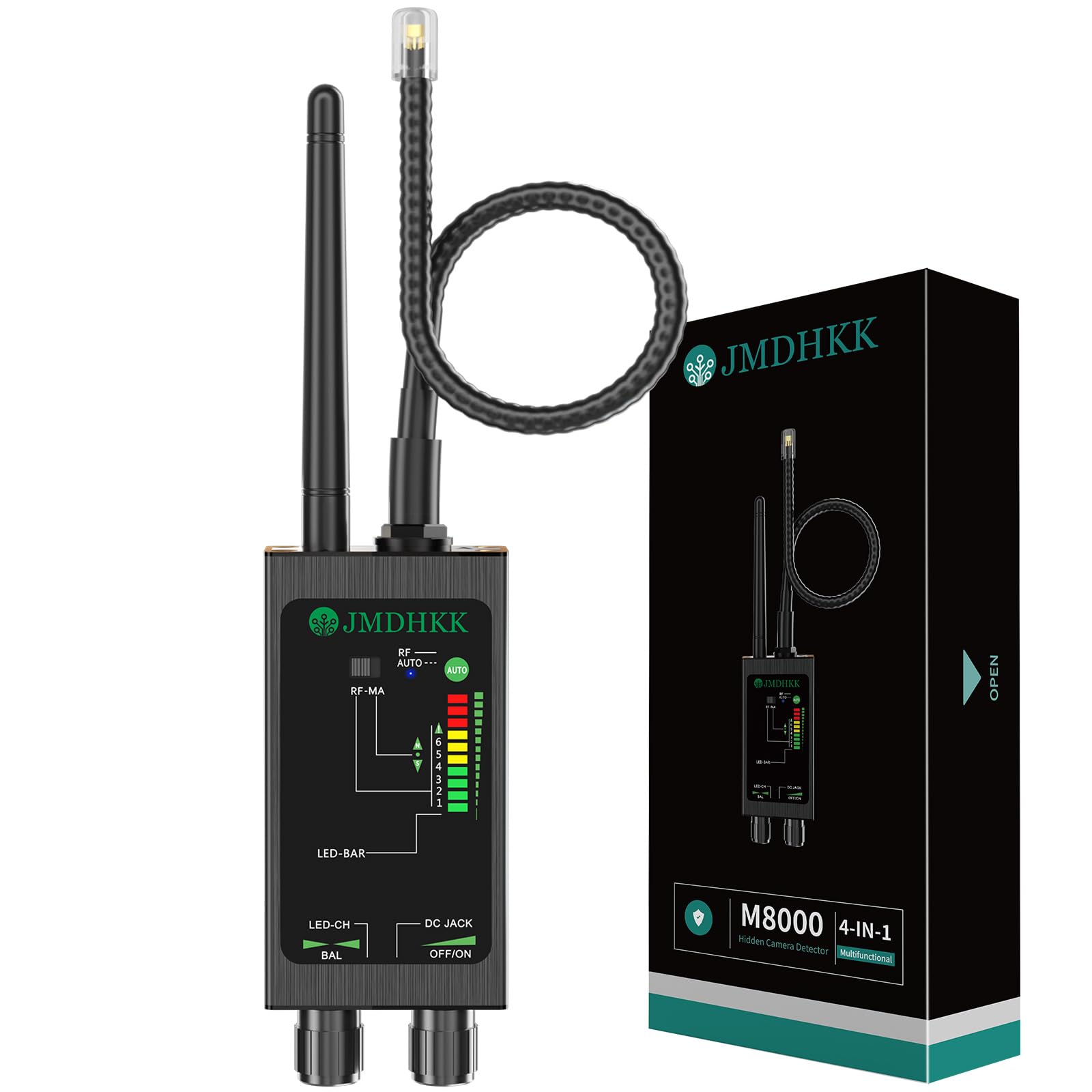
The same long-reach M8000 in black, with a 400 mAh battery and a plain audio alarm.
This is the black M8000, and it brings the same toolkit as the silver: optical scanning for hidden cameras, high-precision magnetic detection for trackers, and a bug-detection mode that scans for wireless signals from listening devices. Its stated maximum range is 10 meters, and the AI smart signal detection triggers an alert after six strong wireless signals — the logic that catches an intermittent, power-saving camera that other sweeps miss.
The differences are small but real. This one runs on a 400 milliamp-hour rechargeable battery (a measure of how much charge it holds) and the listing describes its alert type as audio only, so it beeps rather than vibrates. It handles Wi-Fi-range signals and is set up for indoor and outdoor use, which covers a car or a luggage scan alongside a hotel room. At 3.5+ stars across the high hundreds of reviews, it sits alongside the silver model on performance.
The recurring gripe here is the audio alarm: loud and not adjustable, so it is not your tool for a silent, discreet sweep. The magnetic range is short as well, and the RF knobs are touchy. If you want the 10-meter M8000 reach in a black shell with an audio-only alarm instead of vibration, this is the one. If you value a quiet operation, keep looking.
The core value: 10-meter reach, six-signal AI alerting and three detection modes for camera, bug and magnetic tracking, on a 400 mAh rechargeable battery.
What to expect: audio-only alerting that is loud and fixed, plus short magnetic range — a tool built for thoroughness, not stealth.
Right for: buyers who want the widest-reaching M8000 and do not need a vibration mode.
A poor fit for: quiet, discreet sweeps in a shared office or a sleeping household.
Know the Specs
Frequency range and what it catches
Frequency range (how high up the radio spectrum a detector can hear) tells you whether it can catch a modern wireless bug. A unit rated to 6.5 GHz covers Wi-Fi and many wireless cameras; one that tops out lower simply will not hear those higher transmitters. Match the range to the gear you are worried about, and remember that a magnetic or infrared mode is what covers the devices a radio sweep cannot reach.
Sensitivity levels and false alarms
Sensitivity controls decide how eagerly a detector responds to radio energy. Your phone, router and Bluetooth headphones all broadcast, so a raw sweep lights up constantly. Six-step or adjustable sensitivity lets you dial down the noise and walk slowly toward a stronger source. Fewer steps means more manual sorting of alarms — not a defect, just a different way of working.
Detection range in meters versus magnetic reach
Range is often quoted for the radio scan — one pick here lists 10 meters — but magnetic detection is far shorter, often within inches for a small tracker. Read both numbers separately: the wide range is for sweeping a room, and the short magnetic reach is for confirming a tracker that is close by. Treat a quoted range as the best case, not the normal case.
Battery, standby and charging
Battery life and standby time decide whether the tool is charged when you need it. On this list you will find a 25-hour run time, a 30-day standby, 400 mAh and 1 watt-hour cells, and rechargeable units with auto-shutdown. A rechargeable model that sleeps after a few idle minutes is the easiest to keep ready. Alkaline-cell models mean buying replacements, so factor that into your routine.
Common Questions
Will a listening device detector find a hidden microphone in a hotel room?
What is the difference between a listening device detector and an EMF meter?
Can a hidden camera detector find a camera that is switched off?
Which frequency range do I need to catch a Wi-Fi hidden camera?
How close do I need to be to detect a GPS tracker?
Why does my detector go off near my phone and Wi-Fi router?
Is a magnetic detector enough on its own to find a car tracker?
How long does the battery last on these detectors?
Can these detectors tell me exactly where a hidden camera is?
Is a detector worth it for a short hotel stay?
The Bottom Line
For most people mapping their own home, the listening device detector winner is the ERICKHILL RT-100 because it reads both electric and magnetic fields with a red-screen alarm and earns the top rating of the group — 4.0+ stars from 8,000+ owners, the deepest trust base here. If your worry is a hidden wireless bug or a covert lens in a rental, grab the Ganods K18 for its 6.5 GHz reach and 30-day standby. And for tracking a vehicle or sweeping a room from a few paces back, the JMDHKK M8000 is the one to reach for, with its 10-meter maximum range and six-signal AI alert.
The one honest nudge: an RF sweeper, an infrared lens finder and a magnetic tracker finder each catch a different threat. An EMF meter, a radio sweeper and a magnetic tracker finder solve different jobs, and buying the widest-selling one for the wrong job helps nobody. Buy for the threat you actually face — a wireless bug, a covert lens, or a car tracker — and one detector will outwork a drawer of mismatched ones.
How we choose
We do not accept paid placement. Every pick is matched to a real buyer and a real use-case; we do not hands-on test units.
Sources
Specifications: manufacturer listings and product documentation. Review insights: verified customer reviews, as of October 2026. Pricing: not shown on this page (it changes often); check the current price via the retailer link.
As an Amazon Associate, Aappliancez earns from qualifying purchases. This does not affect which products we feature.