Disclosure: Some links in this post are affiliate links. As an Amazon Associate I earn from qualifying purchases, at no extra cost to you. Learn more
Specs are compiled from manufacturer listings and verified buyer reviews and can change over time — please confirm the key details on the product page before buying.
Sealing a window, door, or sill? The difference between a dry house and a leaky one often depends on one product: a liquid flashing you brush or gun on that cures into a rubbery skin. This guide separates the fast-skinning, no-primer formulas from the fussy ones.
This guide is built by comparing the manufacturers’ published specifications and the patterns across verified customer reviews, so you get each pick’s real strengths and trade-offs instead of marketing spin.
You will see which formulas tack up fast, which ones bridge cracks and odd corners, and which ones demand a primer first. Every pick below is judged on published specs and verified owner reviews.
Top Picks
How To Choose The Best Liquid Flashing
Liquid flashing is a thick, brushable or gun-able rubber coating you apply around windows, doors, sills, and penetrations. It flows into corners and gaps, then cures into a flexible membrane that keeps water and air out. Pick by substrate, climate, and square footage.
Match the formula to your surface
A silane-modified polymer sticks to most common building materials without a primer, which saves a step. An STPE-based fluid-applied flashing handles irregular surfaces and complex shapes well. If your surface is rubber, like an RV roof, an EPDM primer is the correct route because coatings bond better once the rubber is prepped.
Watch your working window
Tack-free time tells you how long the material stays workable before a skin forms. A fast tack means you apply it in small sections, not a big area at once. Cure time then tells you when the seal is fully set and can take weather.
Pick the package for the job
Sausage tubes fit a standard caulk gun for detail work around frames and sills. Cartridges are ready to go and tidy for small repairs. Pails and gallons cover floors, walls, and broad roof areas where a tube would run out fast.
Side-by-Side Comparison
| Model | Best For | Form | Container Size | Surface Prep | Amazon |
|---|---|---|---|---|---|
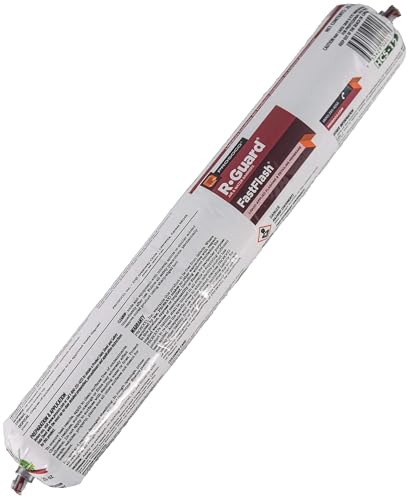
| Prosoco R-Guard FastFlash Liquid Flashing Membrane★ Best Overall | Detail sealing around sills and frames | Paste | 20 oz sausage | No priming needed | Amazon |
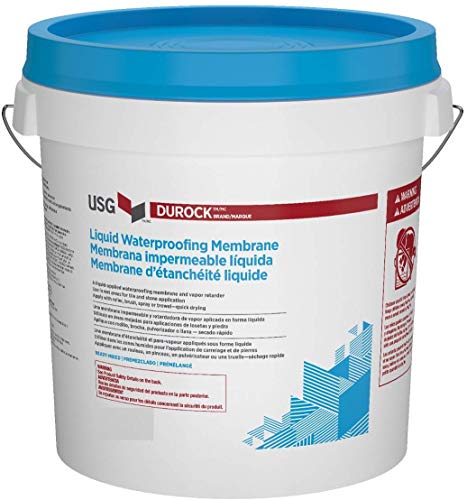
| USG DUROCK Brand Liquid Waterproofing MembranePremium Pick | Shower walls and wet-room floors | Liquid | 128 fl oz (1 gallon) | Roll, brush, or spray on | Amazon |
| ZIP System Liquid Flashing STP Sealant | Rough openings and window and door transitions | Liquid sealant | 10.3 oz cartridge | Multi-surface bonding | Amazon |
| Liquid Rubber Geo-Textile Fabric Roll | Reinforcing cracks, seams, and joints | Fabric roll | 4 in x 160 ft | Embed into wet coating | Amazon |
| Blue Barrier Liquid Flashing 2-Pack | Window and door installs with low-VOC needs | Liquid | 20 oz sausage x 2 | Wet or dry conditions | Amazon |
| Liquid Rubber EPDM & TPO Primer | Prepping RV, camper and trailer roofs | Liquid primer | 1 gallon | Clean and dry first | Amazon |
| Flex Seal Liquid Rubber Coating Sealant | Broad leak repair on roofs, trailers and masonry | Liquid coating | 1 gallon | Brush, roll, dip, or pour | Amazon |
Detailed Reviews
1. Prosoco R-Guard FastFlash 20oz
Our pick — 4.5+★ from 250+ verified ratings; the strongest balance of quality and price.
The tube that seals sills and corners without a primer or a reinforcing tape.
This is the pick for anyone sealing window sills, base angles, and metal building details where a smooth, fast-skinning coat beats wrestling with tape. It is built on a silane functional polymer — a bonding chemistry that grips surfaces without needing a primer first. That means you skip the separate bonding step on most common building materials. It also bridges hairline cracks and keeps working through the weather swings of an active job site.
The formula is solvent-free, isocyanate-free, and phthalate-free, so you are not handling the harshest solvent load in the aisle. It goes on as a paste from a 20 oz sausage that loads into a standard gun and cleans up with paper towels before it skins over. Cure speed depends on humidity, and in dry air it pays to mist the surface with water to keep it setting properly. Once it is down, rain will not undo it.
A bit of a squeeze: it does not stretch far, so budget accordingly.
The catch here is coverage, not quality. Buyers report the tube empties quickly, so it is the right tool for detail work and badly wrong for a large production wall. It cures into an extremely hard finish that resists picking off, which is a good thing on a wet sill and a nuisance if you only wanted a quick scrape-away repair later.
What earns it the top spot
- No joint reinforcing tape needed — you skip the prep step
- Bonds to most common building materials without priming
- Solvent-free, isocyanate-free, phthalate-free
- Won’t tear or lose effectiveness when exposed to weather during construction
- Seals corners, odd shapes, and vertical or horizontal areas
Worth knowing before you buy
- A 20 oz tube doesn’t go very far on a big job
- Drips from overhead surfaces if applied too thick
- Cured coat is extremely hard to remove
Reach for this if: you are sealing sills, frames, and metal building details and want a no-primer, fast-handling coat.
Look elsewhere if: you are coating a broad wall in one pass — a pail-based membrane covers far more ground.
2. USG DUROCK Brand Liquid Waterproofing Membrane 1 Gallon
The one you paint on wherever water might sit, from shower walls to countertops.
For tile that has to stay dry underneath, this acrylic membrane is the workhorse. It rolls, brushes, trowels, or sprays on, so a corner brush and a roller handle corners and field walls in the same session. Its low perm rating of 0.38 perms at 20 mils dry thickness, measured under ASTM E96 Procedure E, is what makes it an actual water vapor barrier rather than a hopeful coat. It also absorbs movement, providing anti-fracture protection up to 1/8 in. over shrinkage and other non-structural cracks.
What wins people over is how far one gallon carries. Owners coat an entire shower tub to ceiling with two coats, brushed and rolled, and it is ready for tile the next day. The thickness reads like creamy paint going down, and cleanup is simple if you get to your tools before it dries. Coverage runs deep enough that one container does more than expected.
Unlike the ZIP cartridge above, which is a detail tool for rough openings, this is a broad-area membrane for wet rooms and floors. The trade-off is the odor — it is strong, and a respirator is a sensible move in a closed bathroom.
Fair warning: it takes more than one coat to build a true barrier, so plan two passes about an hour apart and let it set overnight before tiling.
Where it holds up: low perm rating (a low perm rating means it blocks water vapor) of 0.38 perms at 20 mils dry thickness, anti-fracture protection up to 1/8 in. over shrinkage cracks, and a coverage span that owners call generous.
Where it stings: the smell is heavy in an enclosed space, so open a window and mask up.
Best suited to: shower walls, wet-room floors, and countertops where tile adhesive goes over the membrane.
Think twice if: you are sealing one rough opening — a cartridge gun gets you in and out faster than a gallon and a roller.
3. ZIP System Liquid Flashing 10.3 oz
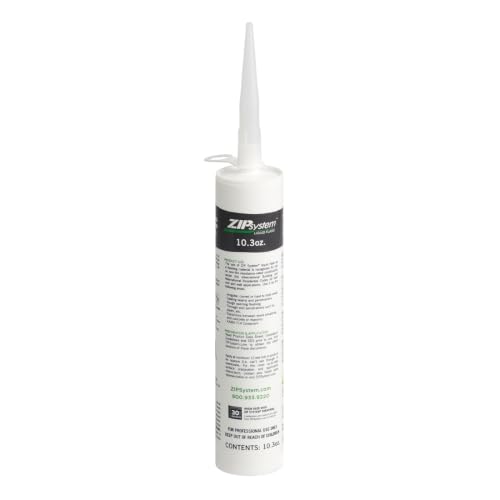
Built to chase water around awkward wall transitions that tape cannot wrap.
If your job is rough openings, windows, and doors, this fluid-applied flashing is aimed squarely at it. It is made with STPE polymer technology — a synthetic rubber chemistry that stays flexible and hugs irregular surfaces. That flex is the point: it forms a water-tight seal around complex wall transitions where a flat strip of tape would bridge and lift. It bonds to wood, OSB, plywood, concrete, masonry, metal, PVC, vinyl, and foam board, so most crews already own a surface it will grip.
The promised payoff is a continuous air and water barrier that does not need an additional house wrap. It qualifies for the ZIP System 30-Year Limited Warranty, which tells you the maker expects it to hold. It works great filling creases and nail holes, and on wood patio columns it took roughly one tube per column before paint went on.
Owners mention the applicator tip is the weak link. Several note the tube will not dispense properly, and the fix is often simply a missing tip rather than a bad product. Tubes left flimsier than expected can deform and stick in the gun, so keep a spare nozzle on hand. Adhesion quality draws mixed feedback for the same reason.
It is a little expensive per tube, and one tube per column adds up fast on a whole façade.
The honest read: effectiveness is the headline here — it seals complex transitions, resists harsh elements, and carries a 30-year limited warranty. What wins owners over is the multi-surface bonding that covers wood, concrete, metal, PVC, and EPDM without hunting for the right product.
The follow-up question: will the tube actually dispense? That depends on the tip, which is the single most-complained-about part of the package.
Who this is for: crews sealing rough openings, windows, and doors who want a fluid flashing that wraps irregular shapes.
Who should hold off: anyone without a backup tip on the truck — a missing nozzle stops the job.
4. Liquid Rubber Geo-Textile Fabric Roll, 4 Inch x 160 Foot
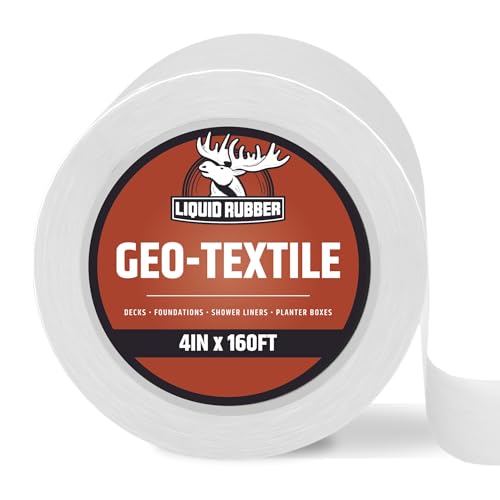
The reinforcing layer that turns a short-term patch into the repair that lasts.
This one is not a coating on its own — it is the fabric you embed into wet Liquid Rubber coatings to build plys and bridge gaps, cracks, joints, seams, vents, and skylights. It is stitch-bonded polyester, a tear-resistant fabric built for roofing. A 4-inch by 160-foot roll gives you a long, narrow band that fits seams and corners where a sheet would be overkill.
The technique reads like doing a drywall joint. Roll on a heavy coat of coating, cut the fabric to size, lay it into the wet coating, and work it through so it bleeds. Then add more coats over the top as needed. It pairs with waterproof sealant, RV roof coating, foundation sealant, polyurethane sealants, and deck coatings, so it slots into whichever Liquid Rubber product you already run.
Where it shines is cracks and wall-floor joints over a solid, dry surface. Owners use it on basement cracks and floor joints and report the leaks stop for years. However, the fabric has no adhesive of its own.
That is the trade-off to respect. On uneven footer or block joints, the fabric gaps and will not sit flat, and adhesion suffers. It wants a smooth, sound, dry surface. If your substrate is crumbling block, no fabric is the answer — fix the surface first.
Where it earns its keep
- Stitch-bonded polyester for tear-resistant crack bridging
- Bridges cracks, joints, seams, vents, and skylights
- Works with multiple Liquid Rubber coatings
- A 160-foot roll lasts across many repairs
The fine print
- No adhesive of its own — it must be embedded in wet coating
- Gaps on uneven footer or block joints
- Needs a smooth, dry surface to bond well
Pair it with: a Liquid Rubber coating when you need a repair to hold past one season on crack and seam work.
Skip it for: crumbling or uneven block — the fabric has to sit flat to do its job.
5. Blue Barrier Liquid Flashing 2-Pack, 20oz Sausage Tubes

A stiff, weather-resistant bead that firms up in under an hour and holds a frame.
Here is the number that matters on a production window install: tack-free in 30-45 minutes. That is how long the bead stays workable before it skins, which is fast enough to keep a crew moving and slow enough to tool the edges. It is 100% solids, so there is no solvent evaporating away, and it cures in 8+ hours depending on conditions. Application ambient and surface temperatures run 40-100°F, so it holds up in cold-morning and hot-afternoon installs alike.
Once cured, the film feels stiff rather than gooey, with a Shore A Hardness of 55-65 (a scale for how hard a rubber is), a tensile strength of 300-350 PSI (pounds per square inch, a measure of how much pull it takes to break), elongation of 200-250% (how far it stretches before breaking), and adhesion in either wet or dry conditions. It bonds to concrete, metal, CMU block (concrete masonry unit, like cinder block), untreated OSB or plywood sheathings, gypsum, and ICF (insulated concrete forms). Compliance with ASTM E84, AAMA 714-715, and NFPA 285 under many wall assemblies is what makes it a legitimate air barrier.
It behaves a lot like the ZIP fluid flash minus the color, and owners find it adheres to nearly everything. The tube, though, is flimsier than the ZIP cartridge and can deform and stick in the gun. Expect some mess — this is a very sticky product, and a small smudge on a glove goes a long way. Acetone cleans it well.
You get two 20 oz sausages, so on a small job you are covered and on a large one you are back to the store.
What stands out: 100% solids content, tack-free in 30-45 minutes, and a 40-100°F application window make it a true four-season fluid flashing. The 200-250% elongation keeps it flexing with the wall instead of cracking.
The honest catch: it is sticker and messier than silicone, so gloves and acetone are part of the kit, not optional.
Built for: window and door crews who want a fast-skinning, low-VOC bead that flexes with the wall.
Not the pick if: you need a thin, clean-applying sealant you can wipe off with a dry rag.
6. Liquid Rubber EPDM & TPO Primer 1 Gallon
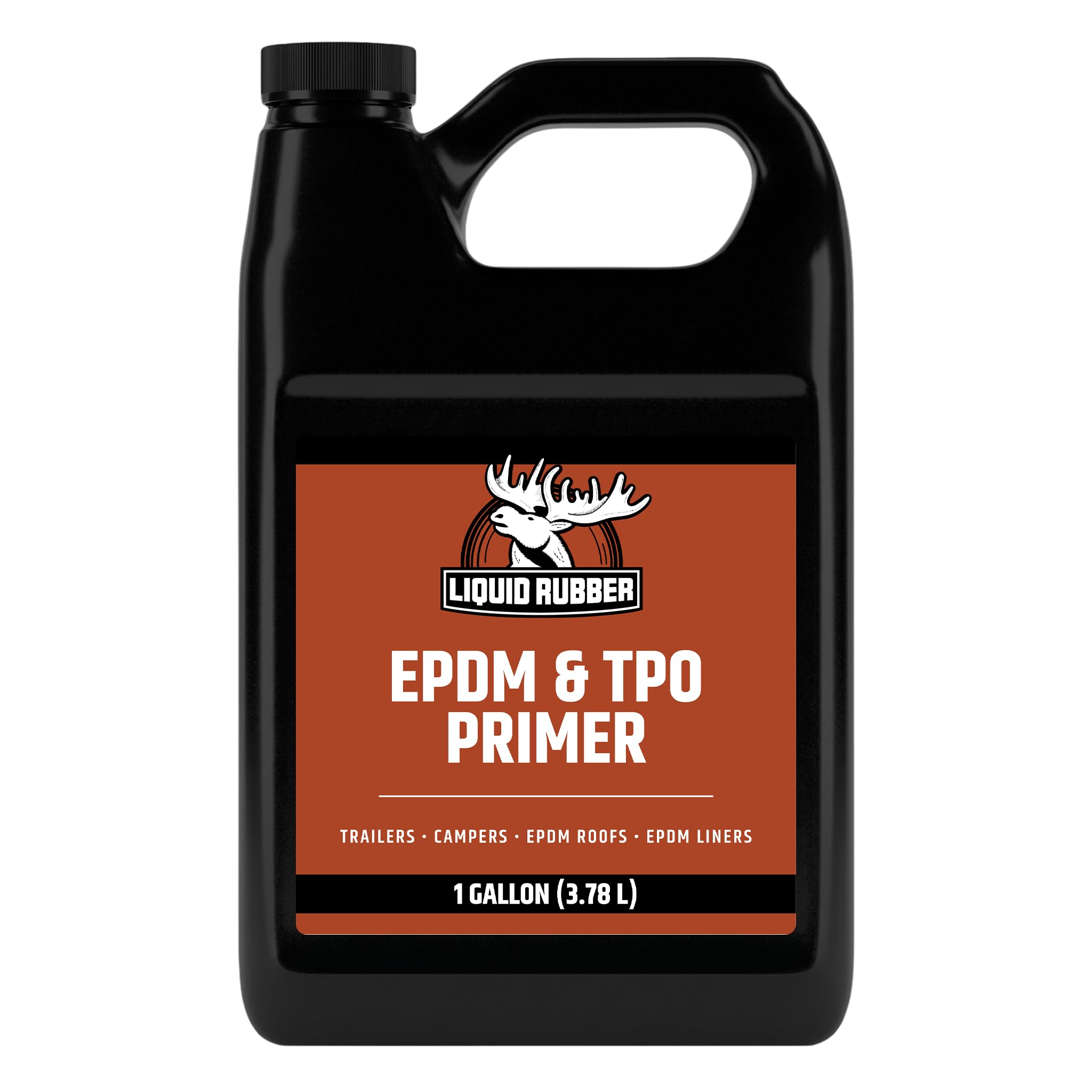
The prep coat that makes an old rubber RV roof willing to hold a new coating.
Rubber roofs are the one surface a flashing coating will not stick to on its own, and this water-based rubber polymer primer is the fix. It exists to raise adhesion on EPDM surfaces — the synthetic rubber sheet common on RV, camper, and trailer roofs — before you roll on a top coat. One gallon covers 250 square feet, which is plenty for a typical RV roof, and it dries in 24 hours.
It applies with a conventional brush or roller, or can be sprayed with the right delivery system and nozzles. The routine owners run is clean, dry, and sound surface first, primer coat, then the RV roof coating on top. On a 29-foot Class C, that meant three primer coats and three top coats, roughly a gallon of each, over four days in cool, low-humidity weather. The primer is meant to go down tacky, and the roof came out leak-free.
Fair caution: the surface must be genuinely clean, dry, and free of anything that makes it uneven or not sound. Skip the cleaner step and the primer has nothing to bite into.
A gallon is also a lot for a small camper, and the biggest complaint is that it does not always cure as fast as hoped in humid conditions. Prep it right and wait for the right temperature range, and it behaves as intended.
What it delivers
- Water-based rubber polymer primer built for EPDM adhesion
- 1 gallon per 250 sq ft covers a full RV roof
- Applies by brush, roller, or spray
- Dries in 24 hours
Before you commit
- Adhesion is inconsistent — some roofs bond, others let go
- Cure can lag in humid weather
- A gallon is more than a small camper needs
Get this if: you are re-coating an EPDM, TPO, or rubber RV, camper, or trailer roof and the top coat needs a primer to hold.
Pass on it if: your roof surface is metal or fiberglass — this primer is tuned for rubber.
7. Flex Seal Liquid, Rubber Coating Sealant, 1 Gallon, Black

Liquid rubber you pour anywhere a leak hides — roofs, basements, trailers, and masonry.
When the leak is not at a window sill but on a cargo trailer roof or in an asphalt driveway crack, this is the product people reach for. It is liquid rubber you brush, roll, dip, or pour, and it self-levels on flat surfaces. The coating is flexible, breathable, and UV resistant, and it resists rust, corrosion, and chemicals. It self-levels on flat surfaces and seals out water, air, and moisture.
What wins owners over is the sheer range of applications. It stops water migration on roofs, fills driveway cracks, and coats exterior wood. In extreme temperatures from 100°F to -40°F, one owner ran it on exterior wood and it showed no cracking or shrinkage, and regular paint went over it fine. On a plywood cargo trailer roof, multiple layers delivered a waterproof seal.
Two things to plan for. Vertical surfaces need thin coats or the liquid runs, and brushing it over large areas is slow work. Also budget your applicator — it is easier to throw away the brush than to clean it.
It attracts dust almost like a static charge while it is fresh, though it cleans off with a hose and a soft brush once cured. Durability draws mixed feedback; some report it holds up well while others see cracking in cold weather.
Why it earned a slot: a gallon of rubberized coating you can pour, plus UV resistance and protection against rust and corrosion, makes it the most flexible tool on this list. Deep driveway cracks backfilled with sand and topped with this self-leveled and dried within 24 hours in summer heat.
Where it falls short: cold-weather cracking shows up in some reports, and it needs thin coats on vertical surfaces to avoid runs.
Made for: broad leak repair on trailer roofs, basement walls, driveways, and masonry where a pourable coating beats a detail bead.
Not your tool if: the job is a clean bead around a window frame — that calls for a sausage-tube flashing, not a pourable gallon.
Know the Specs
Tack-Free Time
This is how long the material stays workable before a skin forms on the surface. A short tack-free window, like the 30-45 minutes on a fast-setting fluid flashing, means you apply in small sections rather than covering a whole wall at once. Push a large area too slowly and the coat skins over before you can smooth it, leaving ridges and laps that water can catch.
Elongation and Hardness
Elongation is how far the cured membrane stretches before it tears, and hardness is how stiff the film becomes once set. A flashing with 200-250% elongation flexes as the building moves through the seasons instead of splitting. Hardness on a rubber scale then tells you whether the coat stays tacky and pliable or firms into a stiff skin that resists scraping. Both matter more than raw thickness for a repair that has to survive a winter.
Common Questions
Does liquid flashing work on wet or damp surfaces?
How long before the flashing can get rained on?
Do I need a primer before applying liquid flashing?
What is the difference between liquid flashing and flashing tape?
How much area does one tube or gallon cover?
Can liquid flashing be painted over once it cures?
Is liquid flashing safe to use around windows and doors?
How do I clean up liquid flashing after application?
Will Flex Seal Liquid bond over an existing rubber roof coating?
Does a fabric reinforcer need to go under the coating?
The Bottom Line
For most jobs, the liquid flashing winner is the Prosoco R-Guard FastFlash Liquid Flashing Membrane because it bonds to most common building materials without a primer, skips the reinforcing tape entirely, and skins fast enough to seal sills and corners in one pass. If you want a broad-area membrane for a shower or wet room, grab the USG DUROCK Brand Liquid Waterproofing Membrane. And for rough openings where the wall transitions get complicated, the ZIP System Liquid Flashing is the one to reach for. If your leak is on a rubber RV roof or a battered trailer, the primer-and-coating route with the Liquid Rubber EPDM & TPO Primer and Flex Seal Liquid handles the wide stuff a detail tube cannot reach.
How we choose
We do not accept paid placement. Every pick is matched to a real buyer and a real use-case; we do not hands-on test units.
Sources
Specifications: manufacturer listings and product documentation. Review insights: verified customer reviews, as of October 2026. Pricing: not shown on this page (it changes often); check the current price via the retailer link.
As an Amazon Associate, Aappliancez earns from qualifying purchases. This does not affect which products we feature.