Disclosure: Some links in this post are affiliate links. As an Amazon Associate I earn from qualifying purchases, at no extra cost to you. Learn more
Specs are compiled from manufacturer listings and verified buyer reviews and can change over time — please confirm the key details on the product page before buying.
Dry, gritty eyes that feel sandpapered by mid-afternoon usually mean one thing: the watery layer of your tears is fine, but the oily outer layer that stops them from evaporating is missing. That is the gap lipid-based drops are built to fill. This guide cuts straight to the five options worth your shelf space, who each one actually suits, and which details decide the purchase.
This guide is built by comparing the manufacturers’ published specifications and the patterns across verified customer reviews, so you get each pick’s real strengths and trade-offs instead of marketing spin.
You will see how a lipid component, a preservative-free format, and single-use versus multi-dose packaging change daily comfort. Below are the five strongest picks for anyone searching the best lipid based eye drops for evaporative dryness.
The most useful thing to understand up front is that “lipid based” is not a single formula. Some drops add plant-based oils or castor oil to slow evaporation, some add hyaluronic acid to hold water in place, and some simply skip preservatives so you can dose often without irritation. Knowing which of those three you actually need is nine-tenths of the decision.
Where buyers get stuck is the packaging question. Single-use vials stay sterile and travel well but waste leftover liquid, while a multi-dose bottle is more economical yet lives or dies by how well its dispenser works. Several picks below hinge on exactly that trade.
Top Picks

How To Choose The Best Lipid Based Eye Drops
With drops, the label tells you almost everything — if you know which words to look for. Here is what actually separates a formula that lasts all day from one that fades in an hour.
Look for the lipid, not just the lubricant
A basic artificial tear replaces water. A lipid-based drop does the extra job: it adds an oily layer so your tears do not evaporate the second you blink. On the label this shows up as castor oil, flaxseed oil, or a lipid nano-emulsion (a blend of oil droplets suspended in liquid). If those words are absent, you are buying a water-only drop.
Preservative-free matters for frequent use
Preservatives let a bottle sit open without growing bacteria, but they can irritate eyes you dose many times a day. Preservative-free drops skip them, which is why they tend to come as single-use vials or in a special no-preservative multi-dose bottle that keeps the liquid sterile another way.
Vials versus a bottle — a real daily trade
Single-use vials are sterile, portable, and impossible to contaminate, but you toss whatever you do not use. A multi-dose bottle is cheaper per drop and less wasteful, yet everything depends on the dispenser. A stiff or collapsing bottle can turn a good formula into a daily fight.
Match the format to your lens and lifestyle
If you wear contacts, check that the drop says it is lens-compatible before you buy. If you dose at a desk all day, a bottle you can squeeze one-handed wins. If you travel or keep a supply in a bag, the sealed vial is the safer bet.
Side-by-Side Comparison
| Model | Best For | Format | Preservative | Key Lipid Ingredient | Amazon |
|---|---|---|---|---|---|
| REFRESH OPTIVE MEGA-3★ Best Overall | All-day relief & heavy use | 30 single-use vials | Preservative-free | Plant-based flaxseed oil | Amazon |
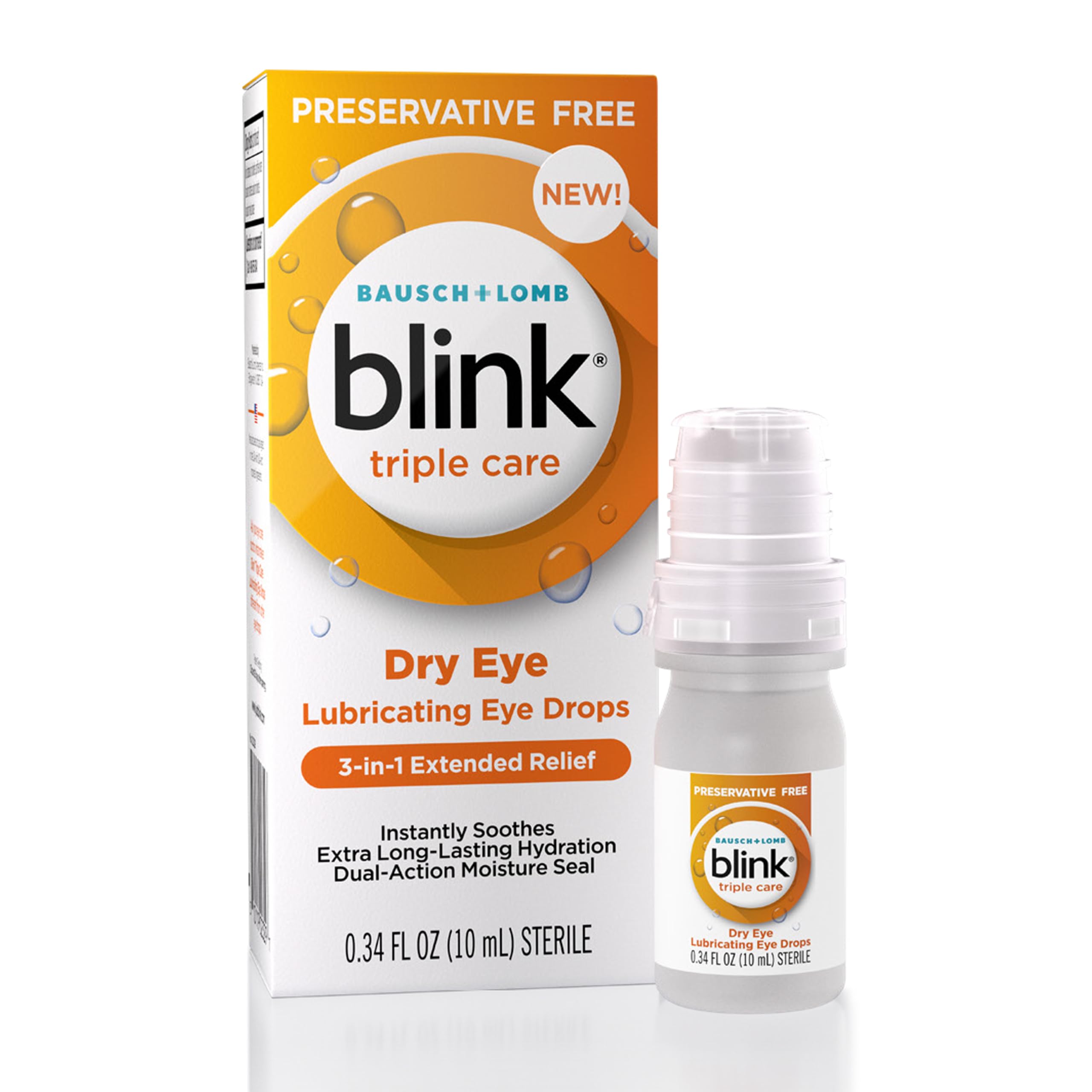
| Blink Triple CareBest for Evaporative Dryness | Evaporative dryness & MGD | Multi-dose bottle | Preservative-free | Castor oil + lipid nano-emulsion | Amazon |
| TearRestore OneDrop | Contact lens wearers | Multi-dose bottle | Preservative-free | Contains sodium hyaluronate | Amazon |
| REFRESH OPTIVE Advanced | Gritty, burning morning eyes | Twin pack | Purite | HydroCell with glycerin | Amazon |
| OCuSOFT Retaine Allergy | Itchy, allergy-driven eyes | 2.5 mL dropper bottle | Preservative-formulated | Olopatadine 0.2% (an antihistamine) | Amazon |
Detailed Reviews
1. REFRESH OPTIVE MEGA-3 Eye Drops
Our pick — over 4.5★ from 19,000+ verified ratings; the strongest balance of quality and price.
The one-drop, 10-hour workhorse that has quietly become the standard-issue dry eye staple.
If you want the safest first pick for evaporative dryness, this is it: the crowd favorite, rated 4.7 stars across 19,000+ owners. The formula does three jobs at once — it lubricates, it hydrates, and it protects your tears from evaporating, which is exactly the oily-layer job a lipid drop exists to do. The lipid piece is plant-based flaxseed oil, listed among the inactive ingredients, and it supplies omega-3s.
The format is the other half of the appeal. You get 30 sterile single-use vials, so there is nothing to contaminate and nothing to carry back home. One drop is rated for 10+ hours of relief, and buyers report stretching a single vial across several days. The label is also preservative-free and FSA and HSA eligible, so pre-tax dollars may cover it depending on your plan.
You can stretch the value of each vial by reusing it with a replacement cap, a trick a couple of owners mention. The trade-off is bulk: at 3 x 6 x 4 inches, this carton is 38% larger than the Blink Triple Care bottle, so it eats more drawer space than a compact bottle. One small gripe: the vial arrives half-filled, so you tip out liquid you never get to use.
What earns its keep
- One drop is rated for 10+ hours of relief, so a morning dose can last into the evening.
- 30 sterile single-use vials — no preservatives, nothing to contaminate, easy to keep in a bag.
- Preservative-free and gentle enough to use as often as needed on sensitive eyes.
Where it asks patience
- Vials are single-use, so leftover liquid goes to waste unless you recap and reuse.
- The carton is 38% larger than the Blink bottle.
Reach for this if: you want one reliable, preservative-free drop for chronic dryness and you value sterility over squeezing out every last cent.
Look elsewhere if: you cannot stand throwing away a partially used vial.
2. Blink Triple Care Eye Drops
The castor-oil formula built for tears that evaporate too fast, in one squeezable bottle.
This is the most explicitly lipid-forward pick in the group, and that is the reason to shortlist it. The formula pairs hyaluronic acid, which holds water in place, with a lipid nano-emulsion and natural castor oil that stops your tears from evaporating. Blink describes it as a visco-elastic formula that thins and thickens between blinks — a drop that firms up on the eye to stabilize the tear film. It is a strong fit for evaporative dry eye and for MGD (meibomian gland dysfunction, where the oil glands in your eyelids stop feeding enough oil into your tears).
This bottle packs small. At 0.64 ounces and 4.13 x 1.73 x 1.34 inches, it is about 2% heavier than the TearRestore OneDrop bottle, but holds the full supply in one container, so both travel about the same, but this one holds your full supply in a single container instead of 30 separate vials. That is the difference between a drawer full of tiny plastic and one bottle. Owners mention strong staying power — several get a single morning drop to last through to the evening.
Now the honest catch, and it is the one thing to weigh seriously. The preservative-free bottle is stiff. The recurring gripe, which buyers put bluntly — “Only ~10 uses before unusable despite 3/4 full” — is that the collapse-prone bottle resists the squeeze and leaves product stranded. If the mechanism matters to you, treat this as friction, not a dealbreaker, because the drop itself performs. It also cannot run on autopilot: a bottle that refuses to give up the last third is a genuine annoyance.
The formula, plainly: hyaluronic acid holds moisture while castor oil and a lipid nano-emulsion slow evaporation — the two jobs lipid drops are meant to do in tandem.
Weigh this before you buy: the preservative-free dispenser is the weak point, so expect to work for each drop and to lose some product to the collapsing bottle.
Best fit: anyone whose dryness is evaporative or tied to meibomian gland function, since castor oil and the nano-emulsion target that exact layer.
Think twice if: you have hand weakness — the stiff squeeze bottle is the one thing that gives buyers trouble.
3. TearRestore OneDrop Eye Drops
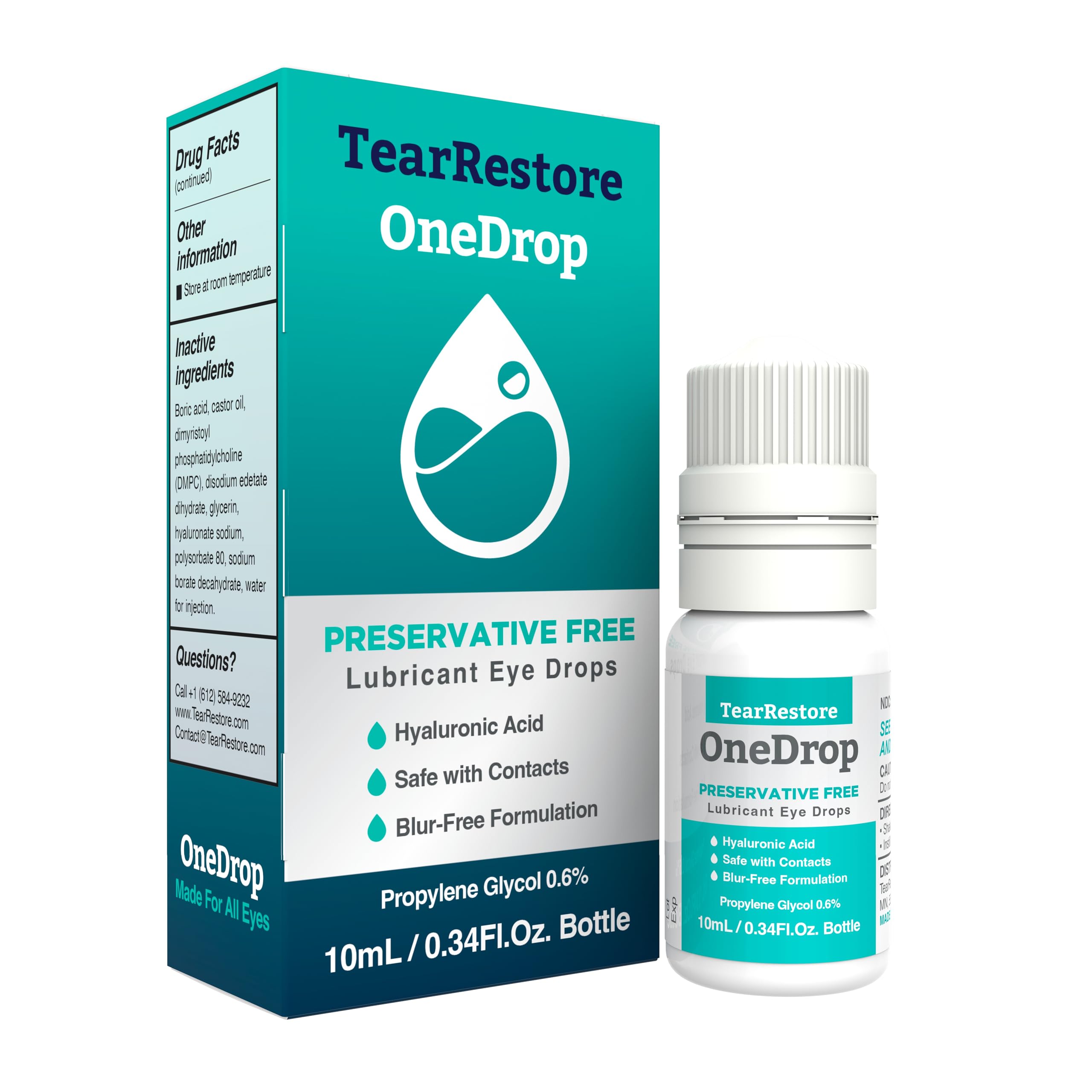
The lens-friendly bottle for people who need drops on and off all day.
Start with the ingredient that decides this pick for lens wearers: sodium hyaluronate, the same moisture-holding molecule used in the formula above but framed here around contact compatibility. This drop is explicitly built to moisturize without removing your lenses, which is the single most useful feature if you wear contacts and dose throughout the day. The eye health focus is what owners pick up on most, and the formula is preservative-free in a multi-dose bottle that uses advanced bottle technology to stay sterile without a preservative.
At 0.63 ounces, this is the lightest option here in the hand — close enough to the Blink bottle that the two are a wash for travel, but that featherweight build is what lets the whole supply sit in a bag pocket. Buyers describe it as soothing, smooth, and non-greasy, with no scent and no aftertaste, and it costs noticeably less than the drugstore counter for the same refillable supply. A multi-dose bottle means precise dosing without the vial waste — exactly the tension around leftover liquid in the pick above.
Two honest notes. The bottle can be hard to squeeze and the drop size is inconsistent, a few owners mention. And the formula is not for every skin type — a sensitive-skin owner reported, “But after a couple of weeks I developed dermatitis under my eyes and on the eyelids.” That is the trade-off for a potent preservative-free formula; it suits the right user beautifully and not the wrong one at all. Worth sampling before you commit to a multi-bottle habit.
Why lens wearers shortlist it: it is the only pick here that names contact-lens compatibility outright, and it moisturizes without pulling the lens.
Suits: contact lens users and sensitive-eye owners who want a multi-dose, preservative-free bottle in a pocket-sized package.
Skip for: anyone with known sensitive skin around the eyes, given the one verified report of eyelid reaction.
4. REFRESH OPTIVE Advanced Eye Drops
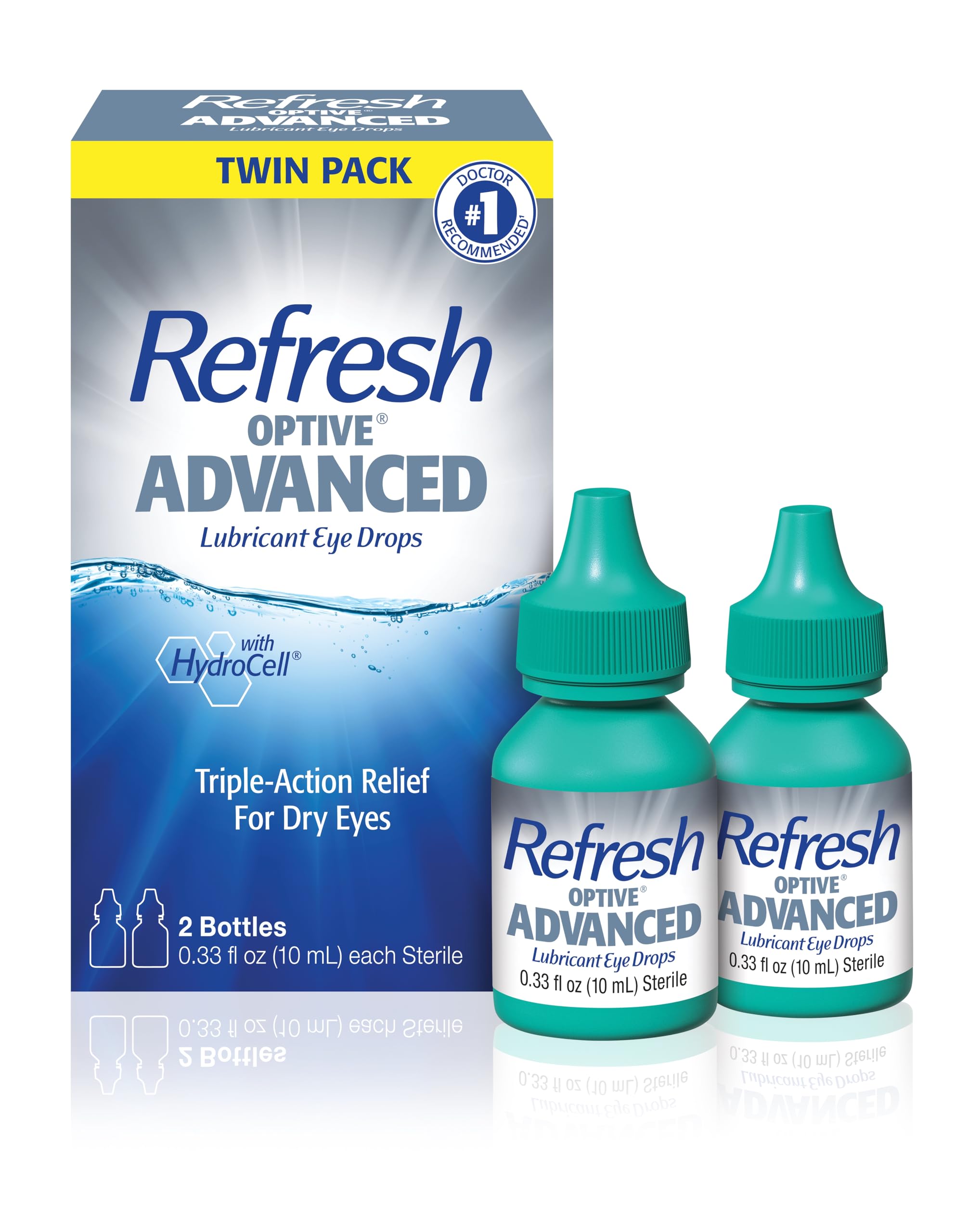
The twin-pack staple for gritty, burning eyes that need soothing morning and night.
If your eyes sting and feel scratchy rather than merely dry, this is the pick for you — the triple-action formula is built to soothe, lubricate, and help prevent tears from evaporating. what separates it mechanically is HydroCell technology, an NaCl-free solution (no sodium chloride, a salt common in basic drops) that uses glycerin to hydrate by balancing osmolarity (the eye’s water-to-salt ratio). In plain terms, it pulls the eye’s water balance back toward normal instead of just wetting the surface. In this category the two things buyers weigh most are effectiveness and how soothing a drop feels, and this formula targets exactly those two jobs.
Two things to know honestly. A dose of buyers find the twin pack the better value while others call it expensive, and the same split shows up on whether the drops burn at all and how long a dose lasts. That variability is why this one rewards a sample first. The dispensing bottles are slim and light, so refilling a travel kit is easy, but if you are highly sensitive to a sting on application, test before buying the pair.
Why the formula stands out
- HydroCell with glycerin balances osmolarity, so it tackles the water balance rather than just coating the eye.
- The Purite preservative breaks down into natural tear components in the eye.
- Soothes and lubricates, aimed at burning and irritated eyes, not dryness alone.
The fine print to weigh
- Owners split on value — the twin pack reads as a bargain to some and pricey to others.
- Some report a burn on application and disagree on how long a dose lasts, so sample before committing.
Good match for: anyone whose tired eyes burn and water rather than just feel dry, who wants bottled convenience with a gentle preservative.
Second-guess it if: you react to preservatives or stinging drops, since this contains Purite rather than being fully preservative-free.
5. OCuSOFT Retaine Allergy Eye Drops, 2.5 mL Dropper Bottle
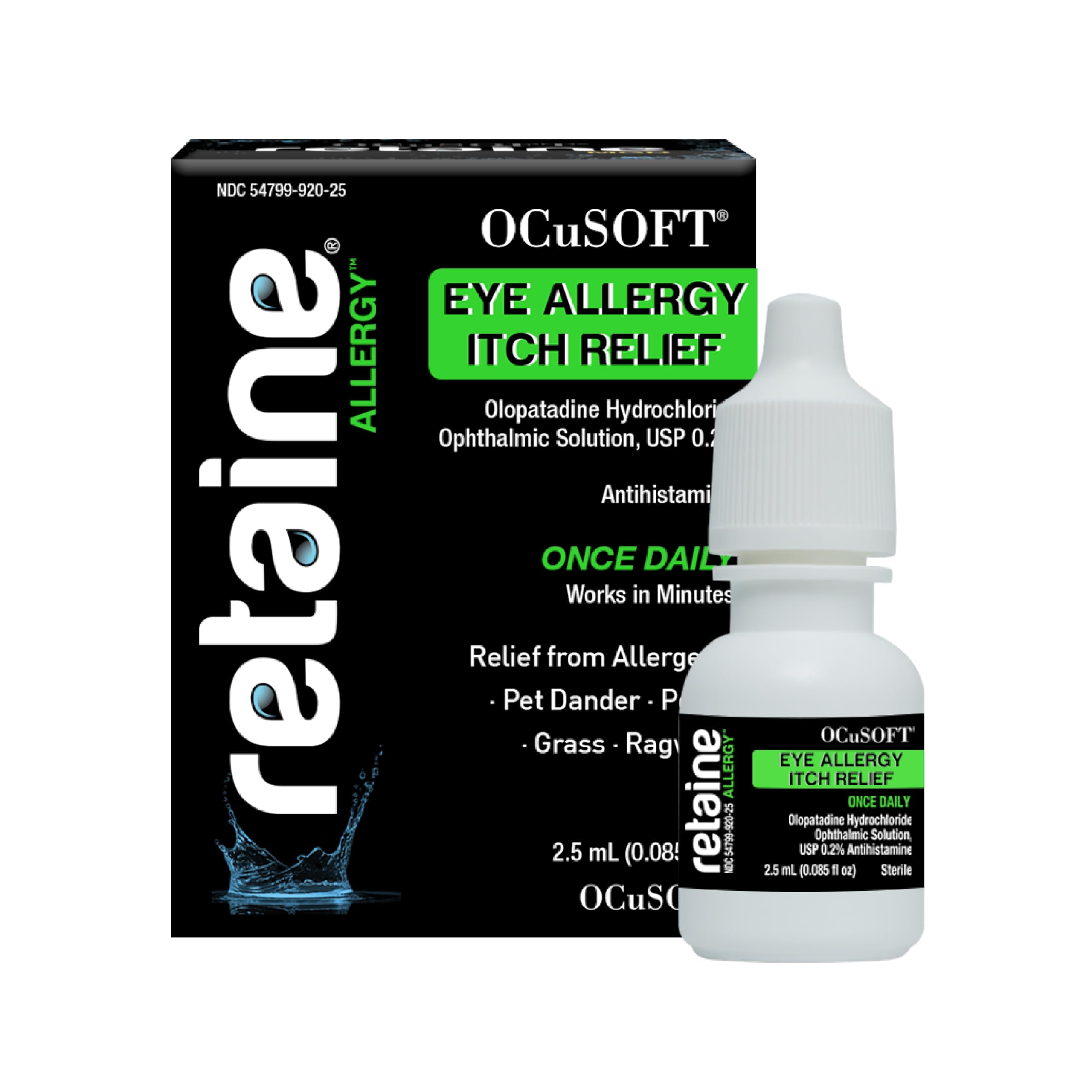
The one-drop-a-day antihistamine for eyes that itch because of pollen and dander.
This is the odd one out in the best sense: it is not a lubricant first, it is an antihistamine. The active ingredient is olopatadine 0.2%, an antihistamine ophthalmic solution aimed at temporary relief of itchy eyes from pollen, ragweed, grass, animal hair, and dander. If your eyes are itchy and watery in allergy season rather than simply dry, this is the pick that targets the cause. A single 2.5 mL dropper bottle is dosed once daily, so one bottle provides a 30-day supply.
The convenience of once-a-day dosing is the standout here. You apply one drop in the affected eye, and that is your day — no carting a vial to the office or reaching for the bottle every few hours. Customers note it eases itching and redness quickly, and its soothing action is what reviewers reach for next after effectiveness. It is a warm-weather staple that earns its place beside a true lubricant, not instead of one.
The caveat is what you get versus what it costs: owners happily describe the drops as effective but note you do not get much product for the money. Treat it as a targeted seasonal tool rather than a bulk lubricant. Because it is an ophthalmic solution with an active drug, follow the drug facts label and directions on the bottle, and keep it for the allergy itch it is designed to treat.
Where it wins: one daily drop of olopatadine 0.2% combats pollen and dander itch, and a single bottle carries you through the month.
The honest limit: it is a targeted antihistamine, not a hydrating lipid drop, so for plain dryness pair it with a lubricant.
The right buy for: seasonal allergy sufferers whose main complaint is itching, who want a once-a-day single drop.
Not the one for: everyday evaporative dryness alone — reach for a lipid lubricant like the picks above instead.
Know the Specs
Lipid components — castor oil, flaxseed oil, nano-emulsion
This is the whole reason to choose a lipid-based drop. Water-only tears evaporate fast, so formulators add an oily layer that slows the process. You will see it listed as castor oil, plant-based flaxseed oil, or a lipid nano-emulsion — tiny oil droplets suspended in the liquid. More of that oil layer tends to mean a drop that lasts longer between applications.
Preservative-free versus a gentle preservative
Preservative-free drops are gentler for frequent dosing, which is why they come as single-use vials or a special sterile multi-dose bottle. Bottled drops can instead use a preservative such as Purite, designed to break down into natural tear components. Neither is “better” outright — it is a choice between bottle convenience and the gentlest possible formula.
Hyaluronic acid and sodium hyaluronate
These are the moisture-holders. Hyaluronic acid and its salt form, sodium hyaluronate, draw and retain water on the eye’s surface. Paired with a lipid, they cover both jobs at once: hold the water in, then stop it evaporating out.
Single-use vials versus multi-dose bottles
Vials are sterile and travel-proof but send leftover liquid to the bin. A multi-dose bottle is economical and less wasteful, yet it depends entirely on the dispenser — a stiff or collapsing bottle can strand product no matter how good the formula is.
Common Questions
What does lipid based actually mean in an eye drop?
Are lipid based eye drops safe to use with contact lenses?
How many times a day can I use preservative free eye drops?
Should I choose single-use vials or a multi-dose bottle?
Is a lipid drop better than an antihistamine drop for itchy eyes?
Why is my preservative free bottle hard to squeeze?
How long should one drop of a lipid based eye drop last?
Can I use lipid based eye drops after LASIK or cataract surgery?
Are lipid based eye drops FSA or HSA eligible?
The Bottom Line
For most people hunting the best lipid based eye drops, the win is the REFRESH OPTIVE MEGA-3 — a flaxseed-oil formula rated for 10+ hours of relief per drop, sealed in 30 sterile vials. If evaporative dryness or MGD (meibomian gland dysfunction, when your eyelid glands stop making enough oil) is your specific battle, the Blink Triple Care bottle brings castor oil and a lipid nano-emulsion (tiny oil droplets that mix into the drop) in one compact, portable container. And if your itch is seasonal, the once-daily OCuSOFT Retaine Allergy drop is the targeted tool to keep beside your lubricant. The wisest nudge here is simply to sample: most of these rewards are in the dispenser and the formula, and a small trial tells you which feel your eyes prefer before you commit to a full supply.
How we choose
We do not accept paid placement. Every pick is matched to a real buyer and a real use-case; we do not hands-on test units.
Sources
Specifications: manufacturer listings and product documentation. Review insights: verified customer reviews, as of October 2026. Pricing: not shown on this page (it changes often); check the current price via the retailer link.
As an Amazon Associate, Aappliancez earns from qualifying purchases. This does not affect which products we feature.