Disclosure: Some links in this post are affiliate links. As an Amazon Associate I earn from qualifying purchases, at no extra cost to you. Learn more
Specs are compiled from manufacturer listings and verified buyer reviews and can change over time — please confirm the key details on the product page before buying.
You want to get dragged behind a boat at speed and still be able to breathe, which is why the vest that matters here is one that stays zipped shut and sits tight at the shoulders. Buy too loose and it rides up around your ears mid-turn. Buy the wrong material and you are wearing a soggy sponge between runs. The picks below split cleanly into snug performance vests for active tubers and roomy general-purpose vests for the family boat.
This guide is built by comparing the manufacturers’ published specifications and the patterns across verified customer reviews, so you get each pick’s real strengths and trade-offs instead of marketing spin.
Fit decides everything out on the water, so the list starts with the vest that zips snug and holds position through a hard tube turn, then widens out to roomier rides. Each pick below is sized and sorted by how it holds up on a tow.
Top Picks


How To Choose The Best Life Jacket for Tubing
Tubing punishes a loose vest differently than sitting at a dock does. When the tube whips sideways, the water grabs the foam and tries to pull the vest up over your head. The fix is a front zipper closed first, then buckles cinched tight, rather than a single belt around the waist.
Zipper plus buckle beats buckle alone
A vest with only buckles can loosen as you bounce. Look for a front zipper that closes the panels together, with buckles layered on top to take the shock. The Hyperlite and O’Brien vests both use a buckle and zipper combination. The Hardcore two-pack and the Onyx four-pack rely on adjustable straps and straps plus chest belt instead, which is fine for a slow pontoon ride but looser under speed.
Match the flotation type to where you actually ride
A Type III PFD (a vest built to float you face-up in calm water when you lean your head back) suits a lake, a river bend, or a tow behind a boat where rescue arrives fast. That covers lake, river-bend, and boat-tow tubing. If you ride open ocean or fast-moving current, that is a different conversation with a different vest.
Neoprene versus plain polyester
Neoprene (a rubbery, stretchy lining) hugs the skin and dries quicker between runs. Polyester cordura (a tough woven shell) is more abrasion-resistant but holds water longer and feels stiffer. The Hardcore Premium mixes both — polyester shell with neoprene at the sides and shoulders — which is why it feels softer at the seams than a plain polyester vest.
Side-by-Side Comparison
| Model | Best For | Closure | Lining Material | Stated Weight | Amazon |
|---|---|---|---|---|---|
| HyperLite Men’s Elite Life Jacket★ Best Overall | Snug fit for active tubing and wake sports | Buckle / Zipper | Neoprene | — | Amazon |
| O’Brien Men’s Traditional NeopreneLow-Bulk Pick | Riders who want a low-bulk neoprene vest | Buckle, Zipper | Neoprene | 1.2 pounds | Amazon |
| Hardcore Water Sports Premium Neo/Poly | Bigger frames that are hard to fit | Buckle (4 × 2 inch) | Neoprene at sides and shoulders | — | Amazon |
| Hardcore Life Jacket 2 Pack Paddle Vest | Two riders on a budget | Quick-release buckles | Polyester | 2 pounds | Amazon |
| Onyx General Purpose Life Vest (4-Pack) | Boat extras for the whole family | Zipper | Nylon | 4.1 pounds | Amazon |
| Sea-Doo Airflow Adult Unisex PFD | Long, hot days on the water | Buckle | Stretch lining fabric | — | Amazon |
Detailed Reviews
1. HyperLite Men’s Elite Life Jacket
Our pick — 4.5+★ from 200+ verified ratings; the strongest balance of quality and price.
The vest that clamps on and refuses to shift when the tube whips sideways.
Tubing has one job for a life jacket: stay wrapped around your ribs while something fast pulls you sideways. This Hyperlite is built around that exact problem, with a buckle and zipper closure (a front zip that pins the panels together, then buckles that take the shock load) and a neoprene lining that grips the skin. It is a level 70 buoyancy aid in men’s XL sizing, which is the fit range this vest was cut for.
What wins people over is the build — the foam quality is the detail the review pages circle back to most. The zipper and buckle system keeps the vest planted, and the panels are shaped so your arms still swing free. That matters on a tube: a vest that binds at the shoulder stops you reaching the rope handle. Families buy this one and come back for a second, which tells you the sizing logic holds across a household.
The honest catch is sizing. This is cut for a snug, secure fit on purpose — Hyperlite calls it “if it zips, it fits” — so if you are between sizes or carry weight in the chest, the panels feel tight before the water does. Riders who like a loose, float-around vest should look at the Onyx four-pack below instead. Think of this as a performance vest for someone who actually wants to get pulled fast, not a lounging vest.
What earns its place at the top
- Buckle plus zipper closure keeps the vest locked down during a hard tow
- Neoprene lining grips the skin and dries quicker than plain woven shells
- Panel shaping leaves your arms free to hold the tow rope
- Cut in men’s XL, one of the harder sizes to find on a shelf
Where it asks you to compromise
- Deliberately snug — bigger chests will feel the panels press
- One colorway and one size band, so fit is not adjustable across body types
Made for: the rider who wants a tight, performance-style vest for fast tubing and wake sports.
Pass on it if: you want a loose vest you can slip on and off without unzipping.
2. O’Brien Men’s Traditional Neoprene USCGA Life Jacket
At 1.2 pounds, this is the vest you forget you have on between runs.
Weight is the headline. This O’Brien tips the scale at 1.2 pounds — noticeable when you lift it, and even more noticeable when you compare it to something like the Hardcore two-pack below, which is listed at 2 pounds. Eight-tenths of a pound sounds small until you are wearing it for four hours in the sun. The foam core is shaped into constructed buoyancy panels so it hugs the torso instead of ballooning out.
The neoprene shell is soft against the skin, dries fast, and keeps you afloat without the bulky marshmallow feel. It is approved by both the US Coast Guard and Transport Canada, which matters if you tow a tube across the border. What a lot of people run into is the sizing: this one runs small. Someone at 5’11” and 168 pounds wearing a large called it tight but fine once zipped — workable, but you should size up rather than trust the label.
The zipper is the split opinion. Some love the front zip for locking the fit down; others find the interior folds over on itself at the bottom hem, which is a small irritation, not a safety problem. If you want a vest that floats you quietly and lets you move, this is the one.
Why it earns position two: 1.2 pounds of neoprene and a soft feel against bare skin, which is exactly what you want when you are pulling yourself back onto a tube for the tenth time.
What to size around: plan to go up one size — the cut runs narrow through the chest.
Go with this if: low weight and a soft neoprene feel outweigh a generous cut for you.
Also know: the front zip collects a little fabric fold at the hem, so break it in before a long day.
3. Hardcore Water Sports Premium Neo/Poly Life Jacket
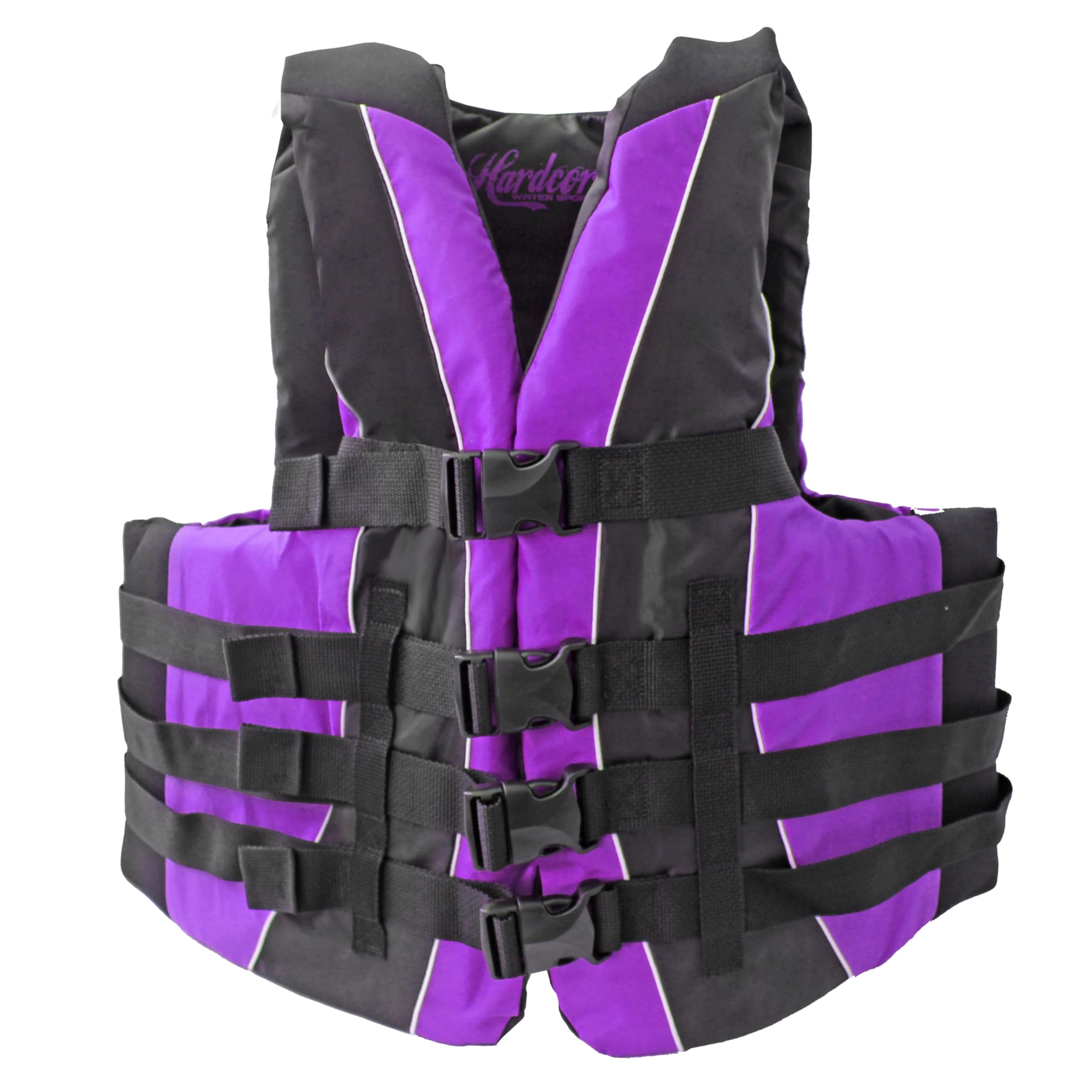
Four heavy buckles and a roomy cut built for the rider other vests leave out.
Most vests on this list cinch down and call it a fit. This one opens up. It is a US Coast Guard approved Type III PFD (a vest rated to float you face-up in calm water with your head tilted back), and it carries four 2-inch buckles across the front with webbing straps that pull the fit in for a range of body shapes. The polyester cordura shell is tough; the neoprene sits at the sides and shoulders, where it softens the rub points.
For bigger riders, this is the vest that finally closes. Someone at 240 pounds who could not get into a men’s extra-large in another brand found this one roomier and the fit right. That is the whole pitch: a roomy cut for a body the standard size chart ignores, backed by Type III flotation rather than padding alone. The front panels adjust easily, and the closed cell PE foam keeps the float without turning the vest into a sweat box.
The trade-off: with buckles only and no zipper, this is not a performance vest for high-speed tow sports. It works for tubing — the four buckles do hold — but a zipper-and-buckle vest locks down tighter when the water grabs the foam. That is the honest line: roomy and stable, but the loosest hold of the zippered vests here.
The sizing advantage
- Four 2-inch buckles with adjustable webbing straps pull a secure fit on bigger frames
- Neoprene at the sides and shoulders, polyester cordura across the body for abrasion
- Type III PFD rated for calm inland water and fast rescue
- Roomier than a men’s extra-large from a competing brand, at 240 pounds
The performance gap
- Buckle-only closure, no zipper, so it loosens more than a zipped vest at speed
The fit that solves a problem: if standard sizing has shut you out of a snug vest, this is the one that lets you tube comfortably.
The limit to note: buckle-only closure means less lock-down on a hard tow — fine for family tubing, not a performance fit.
4. Hardcore Life Jacket 2 Pack Paddle Vest for Adults
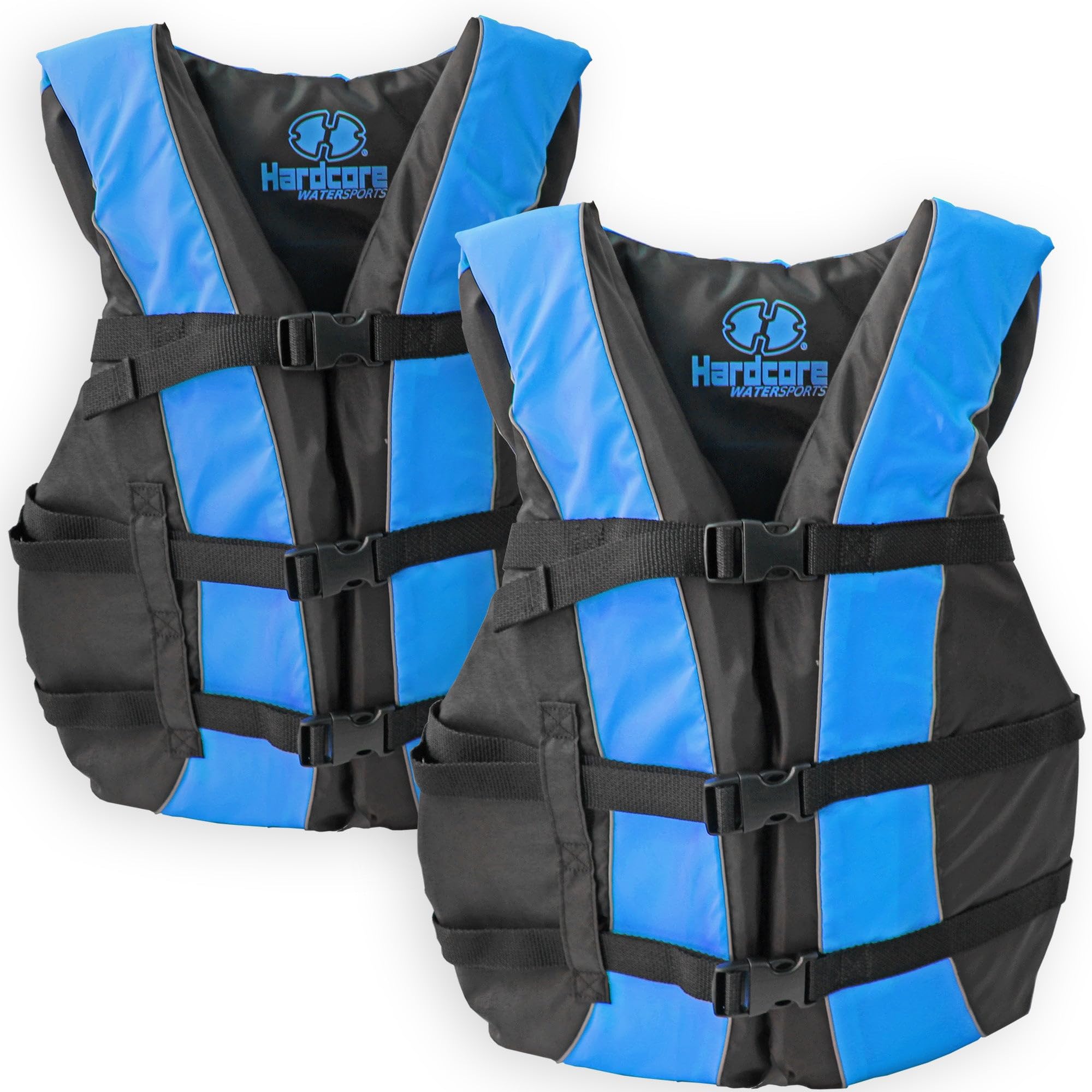
Two Coast Guard approved vests in one box, built for the average-sized rider.
If you need a second vest fast, this is the practical answer. It is a two-pack of UL listed, US Coast Guard approved Type III PFDs with quick-release buckles and 1-inch adjustable straps — enough to get two adults on the boat legally. The polyester shell and closed cell PE foam handle jet ski, wakeboard, kayak, and tubing duty. Each vest lists 2 pounds.
The straps are the sticking point. The adjustability runs to a limit, and a rider wearing an XL found the straps fully extended and still not loose enough. The other running theme is that the size band skews toward small and average adults rather than a full-grown, larger frame. Read that as a two-pack for a family of moderate size, not for the biggest person on the boat.
Here is the real-world read: for two riders who fit the average bracket, the value is hard to argue with. For one large adult and one small one, you end up buying a different vest for the big rider and keeping one of these as a spare. That is a sizing mismatch, not a defect — the buckles, straps, and foam are sound.
Who it actually serves: households with two average-sized riders who want a compliant pair without hunting down two separate vests.
The caveat to plan for: the strap adjustability tops out early, so a broad-shouldered XL wearer will want a different cut.
Pick up the pair if: you are outfitting two riders of ordinary build and want one purchase to finish the job.
Skip the pair if: anyone riding weighs in with a wide chest and needs a long strap run.
5. Onyx General Purpose Life Vest, Adult Universal (4-Pack)

Four vests and a breather bag — the pontoon boat’s spare-jacket kit in one box.
This is a boat-supply buy, not a performance buy. You get four adult universal general purpose vests, each approved and rated for persons over 90 pounds, with a chest range of 30 to 52 inches. Belts and a chest strap keep the vest from sliding up, and the whole set packs into a clear mesh bag with a carry strap so the vests breathe between trips instead of mildewing in a locker. Lightweight durable flotation foam and large armholes keep them wearable for a full afternoon.
Families keep these on the boat for guests, and that is the smart use. The universal cut stretches across a lot of bodies — one user’s whole family fitted in from small to extra large. The big limitation is the same one that makes a universal vest universal: it runs small on true adults. A 200-pound man will not get a good fit, and one family ended up buying extra vests for the bigger adults. For tubing specifically, the fit is loose and the vest can ride up in the water, so treat this as a legal spare, not a tow-sport vest.
What makes it worth owning is the storage and the quantity. Four vests in a mesh bag is the difference between a compliant boat and a scramble when the officer pulls alongside. The floatability feedback flags a ride-up tendency in open water, so the tighter vests above are the better call for anyone actually being towed.
Why boat owners keep this set aboard
- Four vests plus a clear mesh storage bag with carry strap
- Chest strap and adjustable belts resist the ride-up that plagues loose vests
- Rated for persons over 90 pounds and a 30 to 52 inch chest
- Lightweight flotation foam and large armholes
Where it falls short for tubing
- Universal sizing runs small on larger adults
- Loose fit in open water, so it can climb up during a tow
Built for: the family boat that needs four compliant spares packed and ready.
Not built for: the person being dragged behind the tube who wants a snug, planted vest.
6. Sea-Doo Airflow Adult Unisex PFD (Ecoprene)
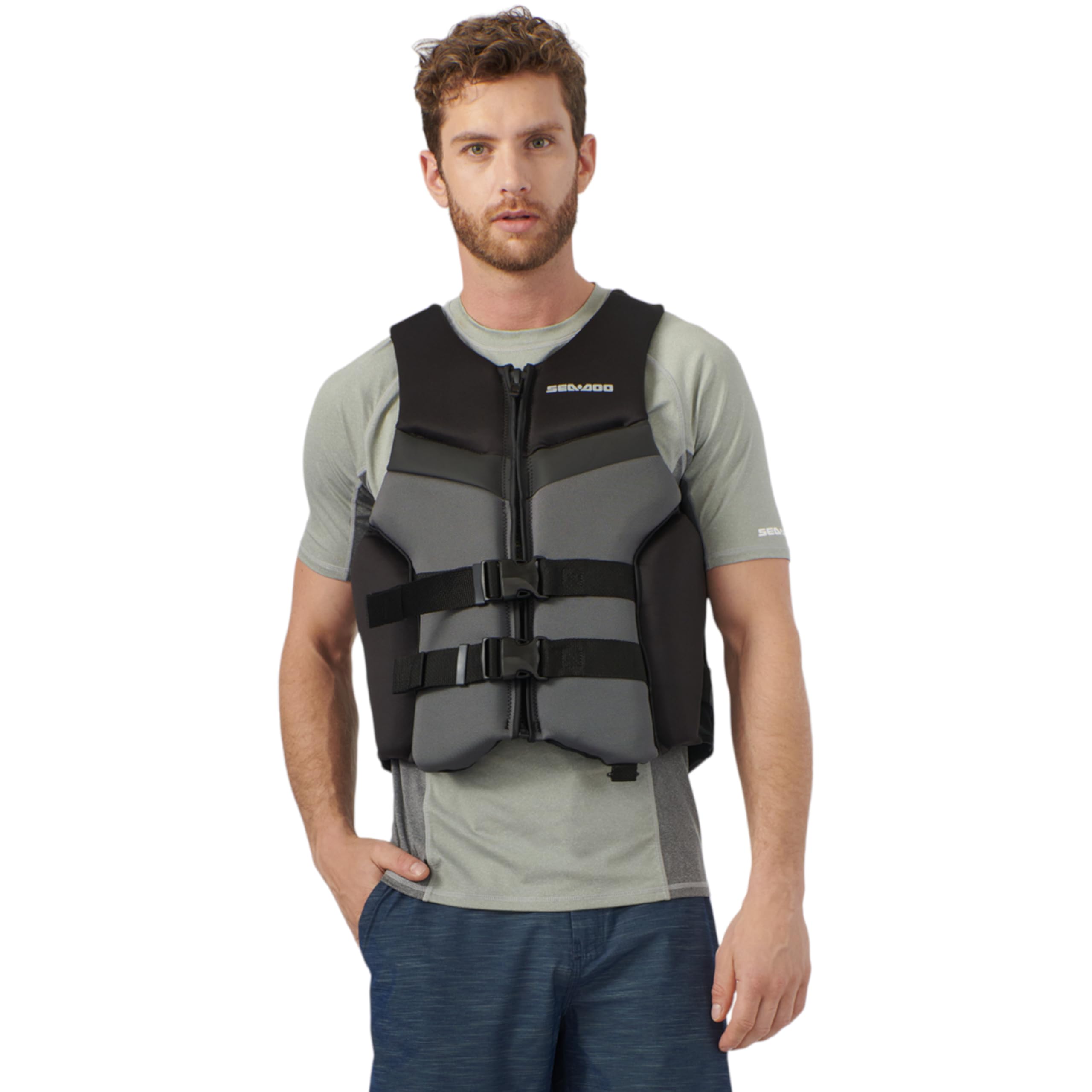
Molded interior channels lift the shell off your skin so a hot day stops feeling like a sauna.
The Airflow name is literal. Inside this vest, a molded EVA interior (a shaped foam layer with raised channels) keeps the shell off your skin, and a mesh panel drains water and lets heat out. The lining is stretch fabric at the side panels, the armholes are cut large, and the lumbar zone carries extra padding across your lower back — the spot that usually aches when you are bracing against a tow. The front zipper is YKK, and there is a D-ring for a key lanyard plus a neck loop for goggles.
It is also the most eco-minded build here: PVC-free Gaia foam insulation with an ecoprene shell that is rubber-free, flexible, quick-drying, and breathable. For a rider who spends the whole afternoon wet, that breathability is the reason to pay up. Sizing is genuinely mixed — some find it runs a little large, others a little small, so the fit varies by body shape rather than sticking to one trend.
Here is the real caution: this is the one vest on the list where color fade has surfaced. A black vest reportedly turned green after about 40 days of use. That is not universal, but it is worth knowing if you leave your vest on the boat deck in the sun all season. Otherwise, riders who switched to it after struggling with other fits have been happy with the comfort and the ride.
The comfort case: a molded interior that floats the shell off the skin, plus a lumbar pad and stretch side panels — a real difference on a long, hot tube session.
The thing to manage: store it out of direct sun, since UV fade has been a noted issue on the black colorway.
Reach for this if: heat and skin contact are what ruin a vest for you, and you ride hard enough to want the airflow.
Think twice if: your vest lives on an open deck in full sun all summer.
Know the Specs
Flotation Type (Type III PFD)
A Type III PFD is a vest-style flotation aid rated to keep you face-up in calm water when you lean your head back, and it is the type most tubing vests carry. It is designed for general boating where fast rescue is likely. That covers a lake or a slow river. It is not built for rough open water or long self-rescue, so match the rating to where you actually ride.
Closure System: Zipper vs Buckle
A zipper closes the front panels together and pins the foam against your torso; buckles layered on top absorb the shock of a hard pull. A buckle-only vest relies on strap tension alone, which loosens as you bounce. For tubing at speed, a zipper-plus-buckle vest holds its position better than a strap-only design.
Lining: Neoprene vs Polyester
Neoprene is a stretchy, rubbery lining that grips the skin and dries fast, so it feels soft and stays put between runs. Polyester cordura is a tougher woven shell that resists abrasion but holds water longer and feels firmer. Many vests combine the two — a polyester body with neoprene at the high-rub points like the sides and shoulders.
Chest Size and Weight Rating
The chest range and the rated body weight tell you whether a vest will actually close around you. A universal vest quoted at a 30 to 52 inch chest and rated for persons over 90 pounds will cover many adults but run small on a large frame. Always check the quoted range against your own measurement before you buy, not after.
Common Questions
Will a life jacket for tubing stay down when the tube whips sideways?
Is a Type III PFD enough for tubing on a lake?
Do tubing life jackets run small?
Does a neoprene life jacket dry faster than a polyester one?
Can I use a general purpose life vest for tubing?
How heavy should a tubing life jacket be?
Will a life jacket fit over a rash guard or swim shirt?
Does a life jacket need to be US Coast Guard approved?
How do I keep my life jacket from fading in the sun?
Is a two-pack or four-pack better for tubing with a group?
The Bottom Line
For most tubing days, the life jacket for tubing winner is the HyperLite Elite because its buckle-plus-zipper closure keeps the vest locked on through a hard tow, and its neoprene lining stays soft and quick-drying. If you want a lighter, low-bulk neoprene vest that you barely feel, the O’Brien Traditional at 1.2 pounds is the pick, just size up. And if you need room for a bigger frame, the Hardcore Premium Neo/Poly is the vest that finally closes around the rider the standard size chart leaves out.
How we choose
We do not accept paid placement. Every pick is matched to a real buyer and a real use-case; we do not hands-on test units.
Sources
Specifications: manufacturer listings and product documentation. Review insights: verified customer reviews, as of October 2026. Pricing: not shown on this page (it changes often); check the current price via the retailer link.
As an Amazon Associate, Aappliancez earns from qualifying purchases. This does not affect which products we feature.