Disclosure: Some links in this post are affiliate links. As an Amazon Associate I earn from qualifying purchases, at no extra cost to you. Learn more
Specs are compiled from manufacturer listings and verified buyer reviews and can change over time — please confirm the key details on the product page before buying.
Lichen and black roof streaks are the slowest outdoor stains you will ever fight, and the honest answer is that you should stop fighting them with a brush. A lichen remover goes on wet and then works over days to months while rain, wind and sun wash the dead growth away. If you want the widest coverage in one jug, the Rust-Oleum Jomax 308764 is the one to beat — a single gallon of concentrate mixes up to 5 gallons of solution and cleans up to 1,500 square feet. For smaller touch-ups on stone, fencing or headstones, the Wet & Forget 64oz trigger bottle is the grab-and-go option.
This guide is built by comparing the manufacturers’ published specifications and the patterns across verified customer reviews, so you get each pick’s real strengths and trade-offs instead of marketing spin.
Below you will find how each formula actually behaves in the weather, which surfaces it belongs on, and how long you should expect to wait before the green turns grey and washes away. Whether you are clearing a shaded driveway or a mossy fence line, the right lichen remover depends on coverage per bottle and sprayer type.
Top Picks

How To Choose The Best Lichen Remover
The first thing to understand is that lichen is not dirt. It is a crusty growth that grips stone and roofing with root-like threads, so any product that claims to wipe it off in seconds is telling you something about its marketing rather than its chemistry. The formulas that genuinely work here are the ones that soak into the growth, break it down, and then let weather carry the dead residue away. That means your two real decisions are the surface you are treating and how much ground you need to cover.
Match the formula to the surface, not the stain
A bleach-free concentrate like the Rust-Oleum Jomax belongs on siding, fences, decks and roofs, where you want an even spray and no corrosive residue left behind. A peroxide-based cleaner such as Simple Green Oxy Solve is the better match for wood, vinyl, concrete, brick and composite because the foam lifts weather staining as well as organic growth. On a headstone, planter or fountain, you want a ready-to-use trigger bottle that needs no mixing, because you are working in small squares rather than whole rooflines.
Read the coverage number before you read the label
Coverage is the single figure that decides whether one jug is enough for your job. A 32 oz ready-to-spray bottle of Bonide MossMax is rated at 5,000 square feet, while a 64 oz bottle of Wet & Forget treats 60 to 180 square feet — porous, heavily stained surfaces absorb far more and shrink that number fast. If you are treating a full roof, a concentrated gallon that dilutes into a larger volume of mixed solution will always stretch further than a ready-to-use bottle. On a small patio or a set of porch steps, the ready-to-use bottle wins on convenience.
Respect the temperature and the weather window
These products rely on staying wet long enough to soak in, so applying them in blazing midday heat or just before a downpour wastes the whole jug. Wet & Forget asks you to spray on a cool day and avoid any rain forecast within 4-5 hours, and to work above 32° F. Bonide MossMax carries an upper limit too — you cannot apply it above 85°F, which rules it out for warm-climate work in the middle of summer. Check the temperature ceiling and the rain window before you mix anything.
Side-by-Side Comparison
| Model | Best For | Form | Coverage | Volume | Amazon |
|---|---|---|---|---|---|
| Concentrated Surfactant for Herbicides Non-Ionic 32oz★ Best Overall | Boosting a weed killer you already own | Liquid concentrate | Improved | 32 fl oz | Amazon |
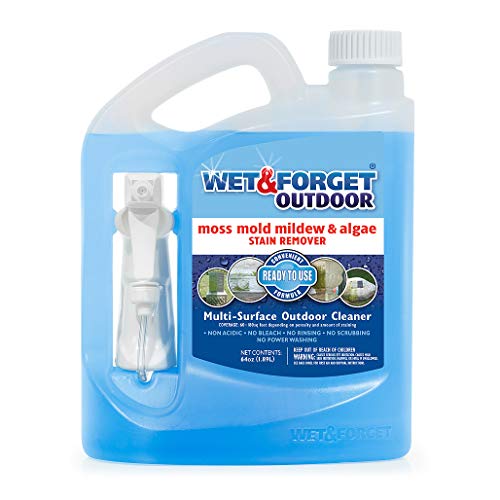
| Wet & Forget Outdoor Cleaner & Stain Remover 64ozBest for Stone | Headstones, planters and small stone patches | Ready-to-use liquid | 60 – 180 sq ft | 64 fl oz | Amazon |
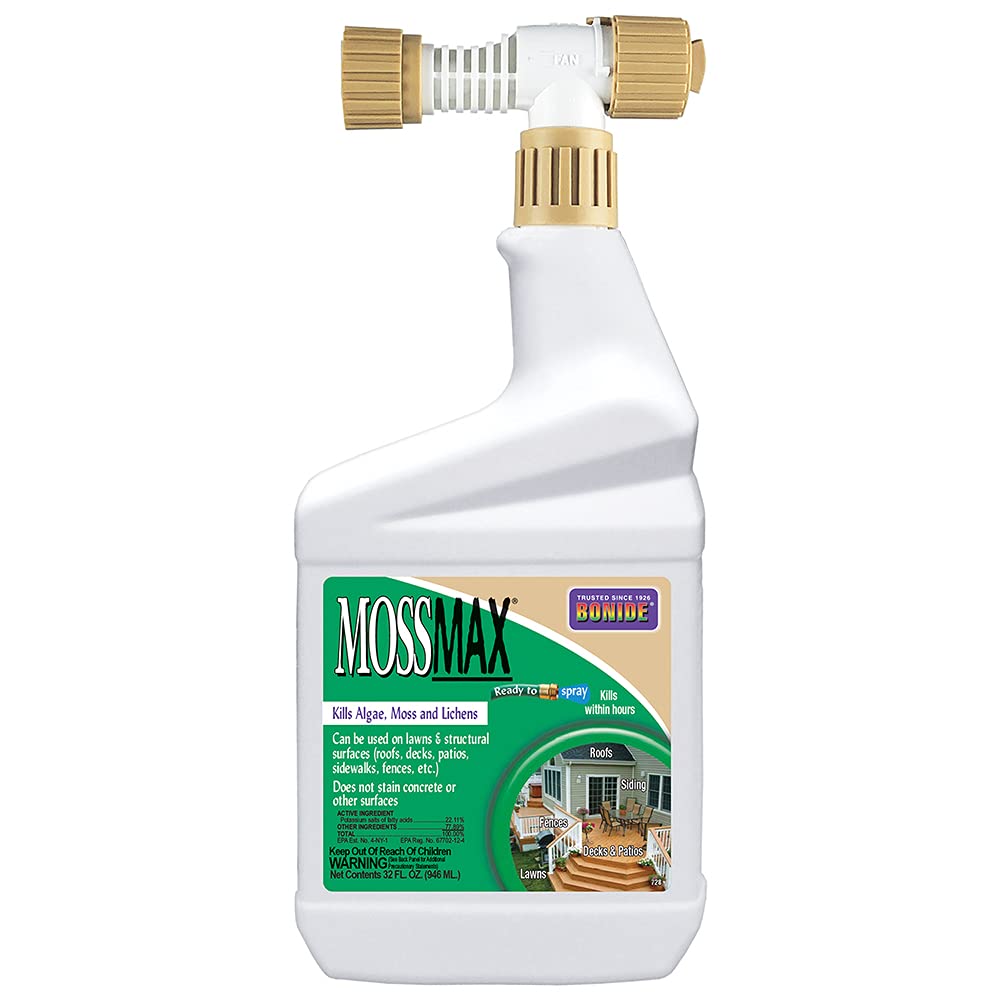
| Bonide MossMax 32 oz Ready-to-Spray | Moss and lichen on roofs and hard surfaces | Ready-to-spray liquid | 5,000 sq ft | 32 fl oz | Amazon |
| Simple Green Oxy Solve Total Outdoor Cleaner Concentrate | Wood, vinyl, concrete and brick around the home | Concentrate, manual or pressure washer | Up to 6,400 sq ft | 1 gallon | Amazon |
| Rust-Oleum Jomax 308764 Spray Once | Roofs, siding and large weathered surfaces | Concentrate, pump sprayer | Up to 1,500 sq ft | 1 gallon | Amazon |
Detailed Reviews
1. Concentrated Surfactant for Herbicides Non-Ionic 32oz
Our pick — 4.5+★ from 800+ verified ratings; the strongest balance of quality and price.
The jug that makes the spray you already own actually stick to the leaf
The thing most people get wrong about clearing stubborn growth is that the killer is rarely the weak link — the delivery is. A surfactant is a wetting agent, a liquid that breaks the water tension in a spray mix so the droplets flatten out and cling to the surface instead of beading and rolling off. That single change is why this Liquid Harvest concentrate earns its place at the top of the pile for anyone already using a herbicide on lichen, ivy or tough ground cover. It does not kill anything by itself; it makes whatever you pair it with work properly.
What makes it a genuine improvement over plain water is spread and absorption. This 32 fluid ounce bottle blends with a wide range of liquid and granular formulations, and the maker rates it for improved coverage, deeper penetration and reduced runoff, which means less of your expensive spray ends up on the driveway instead of the plant. It weighs 2 pounds, so the jug is easy to carry while you mix. Reviewers describe exactly the shift you would hope for — weed death visible within 36 hours rather than the week it takes without it, and the cleared area staying clear longer.
Where it gets awkward is if you bought it expecting a standalone lichen killer. It is not one, and it will not strip green growth off a roof on its own. It is also not sold in California or Washington, which is worth checking before you order. Treat this as the booster that turns a mediocre spray day into a decisive one, and it earns its keep fast.
What earns it the top spot
- Makes a herbicide spread evenly and penetrate the leaf instead of beading off
- Cutting runoff means less wasted spray in the mix and fewer missed spots
- 2 pound jug is light enough to carry while you blend a batch
- Drops into both liquid and granular formulations you may already own
Where it falls short
- Not a lichen remover on its own — it needs the herbicide to do the killing
- Not for sale in CA and WA, so check eligibility before ordering
Reach for this if: you already own a spray and want it to actually finish the job on hairy, waxy leaves where droplets normally slide off.
Look elsewhere if: you need a bottle that removes lichen by itself with no other chemical in the tank.
2. Wet & Forget Outdoor Cleaner & Stain Remover 64oz
The trigger-spray bottle for headstones, planters and porch steps
The strength of this formula is that it removes its own work: spray the surface, walk away, and let rain and wind wash the dead growth off over the following weeks. That is a real advantage on anything you cannot blast with a pressure washer. On granite gravestones, buyers report that a 3″x6″ black stain was nearly gone after repeated passes, and that a stain sitting there for 50 years turned tan and sandy before rubbing away. An occasional user does note it will not shift colour out of black granite at all, so treat it as a cleaner for green and black organic staining, not a restorer of dark stone.
Timing matters more here than with any concentrate. You spray on a dry surface on a cool day, you do not rinse, and you want no rain forecast within 4-5 hours and temperatures above 32° F. Then you wait: the maker says green stains clean up within 1-2 weeks, heavy black stains can take several months, and long-established growth may need 6-12 months before surfaces stay clean. Reapplication over a season is normal rather than a failure. If you want same-day results, this is the wrong bottle.
Two practical details shape daily use. Each bottle treats 60 to 180 square feet, and heavily stained porous surfaces absorb toward the low end of that range, so a big flagstone patio will drink the whole jug quickly. And at 4 pounds of liquid in a 64 fluid ounce bottle, it is genuinely heavy to hold for extended spraying — one buyer with arthritis managed about two hours thanks to the easy trigger, but found the stream nozzle setting dispensed far more product per pass than the mist setting.
Why it suits delicate stone: the bleach-free, non-acidic formula goes on without scrubbing, rinsing or pressure washing, which is exactly what you want on headstones, fountains and planters where abrasive cleaning risks damage.
Plan the calendar, not the afternoon: results arrive over weeks rather than hours, and stubborn black staining can take several months of repeated application.
Worth it for: small, precious, awkward surfaces — masonry you want to treat carefully and then leave alone.
skip it if: you need a whole driveway cleared, since the coverage and the patience required both fall short of a diluted concentrate.
3. Bonide MossMax 32 oz Ready-to-Spray
One 32 oz bottle claims more ground than anything else on this list
If coverage per bottle is your deciding number, nothing here comes close. This ready-to-spray bottle is rated at 5,000 square feet — against the 60 to 180 square feet of the Wet & Forget trigger bottle, that is a different order of magnitude entirely, which is the whole reason it belongs on a roof or a long stretch of fencing rather than a single headstone. It hooks to a hose-end sprayer, a mist blower or a pressurized hand sprayer, mixes instantly with water, and is labelled non-staining, so it is not supposed to leave marks on concrete or siding.
Speed is the other half of its pitch — actively growing moss and algae are meant to die within hours, and it is also used on roofs, decks, patios, sidewalks and fences. On a roof, owners mention the black algae streaks disappearing within about a month and the roof looking considerably better afterwards. Elsewhere, the experience is more mixed: some report it seeming to do nothing at first and then the moss dying off quickly, while a few find it kills some growth but not all of it. Realistically, one pass in cooling weather will not finish a badly fouled roof.
One limitation deserves flagging before you buy, because you will only find it on the label: you cannot apply this above 85°F. In a warm climate that effectively rules out midsummer work, and several customers note that restriction should be stated far more prominently. Non-staining is also claimed rather than guaranteed on every surface — a minority report streaks left on the roof, so test a small patch first. Apply it in early spring or autumn, when temperatures stay under 85°F.
The coverage argument: 5,000 square feet from a single 32 oz bottle is the kind of reach that turns a two-weekend job into one afternoon of spraying.
Read the temperature limit: the 85°F ceiling makes this a cool-season product, and results on heavier growth are reported as uneven rather than total.
Pick this one for: large roofs and long runs of fencing where you want the maximum square footage out of the smallest bottle.
Think twice if: you garden in a hot climate through summer, because the label temperature ceiling will keep the bottle on the shelf for months.
4. Simple Green Oxy Solve Total Outdoor Cleaner Concentrate
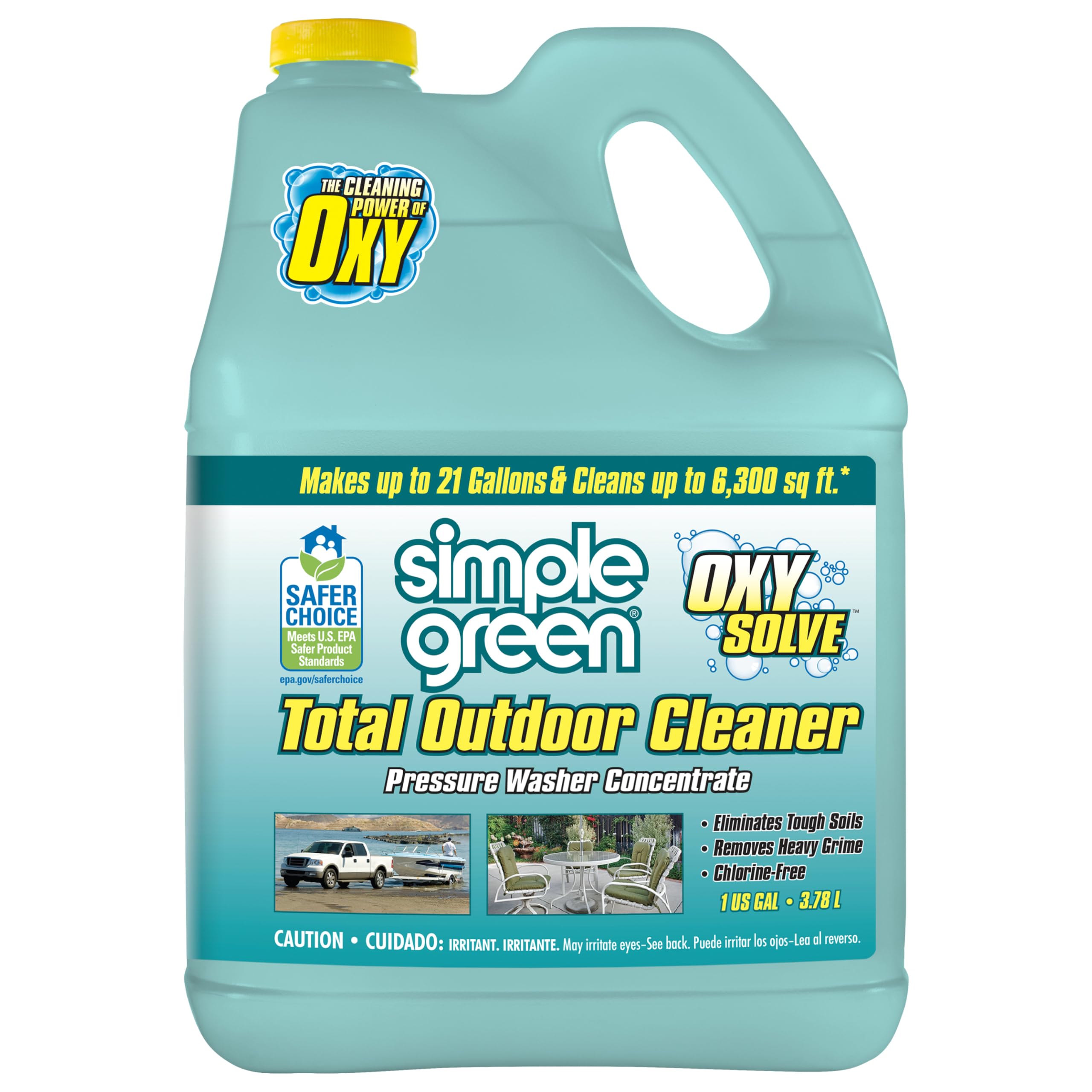
The oxygen-powered jug that works with a bucket or a pressure washer
This one is built for people who want a single bottle for the whole spring clean-up rather than a specialist for one stain. It is a peroxide-powered concentrate, which means it lifts dirt and organic growth by oxidising it rather than by caustic burn, and it is EPA Safer Choice Certified. That certification is the reason it suits households with children and pets around the yard — you are not leaving harsh chemical residue on a deck the family uses. It covers up to 6,400 sq. ft. per bottle, so a single gallon jug handles a multi-car driveway with room to spare.
Surfaces are where it separates itself from the other picks. Wood, vinyl, concrete, brick and composite all fall inside its stated range, and it can be applied manually with a bucket and brush or run through a pressure washer. The practical method that shows up again and again is letting the foam dwell for three to five minutes so the peroxide has time to break down embedded staining, then rinsing before it dries on the surface. Pre-scrubbing tyre marks with a stiff broom first makes a noticeable difference on a driveway.
The honest catch is that “total outdoor cleaner” is broader than “lichen remover”. Buyers describe it performing well on turf, patios, walkways and siding, while a portion find it does not shift dirt and grime from heavily soiled homes and gutters — so on a black-stained roof, one of the dedicated concentrates will serve you better. The low chemical smell is a plus rather than a compromise, and the pump-and-spray approach is simple, but this is a surface cleaner first and a specialist growth killer second.
Where it wins: one concentrate, one jug, and it works across wood, vinyl, concrete, brick and composite without harsh chemicals — the widest surface range here.
The real limit: effectiveness on set-in grime divides opinion, so treat it as a general outdoor cleaner that handles light lichen and algae rather than a dedicated roof treatment.
Best matched to: a whole-property clean-up where decks, siding, walkways and patios all need attention and you would rather own one jug than four.
Not the one for: a black-stained roof or heavy long-standing lichen, where you want a purpose-built concentrate instead.
5. Rust-Oleum Jomax 308764 Spray Once, 1 gallon

One gallon of concentrate that mixes into five gallons of working solution
The reason this takes the roof crown is the maths on the jug. It is a bleach-free concentrate, and that single gallon dilutes into up to 5 gallons of cleaning solution, enough for up to 1,500 square feet of siding, fencing, decks, patios and roofs. Compare that with the 60 to 180 square feet you get from a ready-to-use trigger bottle and the gap on a big roof becomes obvious. You apply it with a pump-up garden sprayer, then let natural weather conditions do the rest — no scrubbing and no rinsing on your part.
Application is genuinely low-effort, which is the thing owners come back to. You mix, spray, and walk away while wind, rain and sun work the staining loose over one to two days, and the clean tends to hold for a season. Diluting the concentrate is straightforward, with one caveat worth planning for: pouring from a full gallon splashes easily, and the trick several buyers use is drilling a small hole above the liquid level to let air in and control the flow. Wear eye and skin protection, avoid spraying into wind or before rain, wet plants first, and keep it away from electrical equipment and HVAC units.
Expectation-setting matters here more than anywhere else on the list. This is not a pressure washer in a bottle. Some find the first pass disappointing and only see the difference about a week later, particularly on spots that have been sprayed more than once, and it does not clear every stain. Used on vinyl siding, though, buyers describe a visible improvement that a hose alone never delivered. Give it a week and a second pass on stubborn spots.
The value read: a single gallon replacing up to 5 gallons of mixed solution and covering up to 1,500 square feet makes this the most economical route to a whole-roof treatment.
Give it a week: results are described as visible after one to two days, not instantly, and stubborn staining may need a repeat application.
Your pick if: the job is a roof, a long fence line or a whole house exterior and you want to dilute once and spray from the ground.
Think again if: you want a bottle you can use straight from the shelf on a single small stain.
Know the Specs
Coverage: The Number That Decides Your Jug Count
Coverage tells you how much ground one bottle will actually treat, and it is the fastest way to compare a ready-to-use trigger bottle against a concentrate. A 32 oz ready-to-spray bottle here is rated at 5,000 square feet, while a 64 oz ready-to-use bottle covers 60 to 180 square feet. Heavily stained, porous surfaces such as old concrete or rough stone absorb far more product, so they always land at the low end of any stated range. Match the bottle to the square footage, not the other way around.
Form: Ready-to-Use, Concentrate or Surfactant
Ready-to-use means exactly that — no mixing, straight onto the surface, best for small patches. A concentrate needs diluting with water, usually into a pump-up sprayer, and stretches much further per bottle. A surfactant is different again: it is a wetting agent that improves how a spray spreads and clings, so it never removes growth alone and is always paired with another product. Match the form to your sprayer: hose-end and trigger bottles for small patches, concentrates for pump sprayers and whole roofs.
Common Questions
How long does it take to see lichen actually die off?
Can I use these on a roof without damaging the shingles?
Is a bleach-free cleaner strong enough for black roof streaks?
Do I need a pressure washer to get results?
What temperature is safe for applying a lichen remover?
Will these cleaners harm my plants, lawn or pets?
How much ground does one jug actually cover?
What is a surfactant and do I need one for lichen?
Will a lichen remover leave marks on concrete or stone?
How often will I need to reapply it?
The Bottom Line
For most people treating lichen across a roof, a fence line or a whole exterior, the lichen remover winner is the Rust-Oleum Jomax 308764 because one gallon dilutes into up to 5 gallons and treats up to 1,500 square feet with no scrubbing or rinsing. If your stains are on a headstone, a planter or a short run of porch steps, grab the Wet & Forget 64oz trigger bottle, which needs no mixing and no equipment. And for whole-property clean-ups across decks, siding and walkways, the Simple Green Oxy Solve concentrate is the one to reach for, thanks to a surface range that spans wood, vinyl, concrete, brick and composite.
How we choose
We do not accept paid placement. Every pick is matched to a real buyer and a real use-case; we do not hands-on test units.
Sources
Specifications: manufacturer listings and product documentation. Review insights: verified customer reviews, as of October 2026. Pricing: not shown on this page (it changes often); check the current price via the retailer link.
As an Amazon Associate, Aappliancez earns from qualifying purchases. This does not affect which products we feature.