Disclosure: Some links in this post are affiliate links. As an Amazon Associate I earn from qualifying purchases, at no extra cost to you. Learn more
Specs are compiled from manufacturer listings and verified buyer reviews and can change over time — please confirm the key details on the product page before buying.
Oncoming high beams at dusk make you squint, flinch, and slow down when you would rather not. The fix is a pair of yellow or amber tinted driving lenses that soften oncoming headlights while keeping lane markings and signs readable. This guide sorts through the real options for night driving, from cheap over-glasses to photochromic sunglasses, so you can pick the pair that fits your prescription, your face, and your commute.
This guide is built by comparing the manufacturers’ published specifications and the patterns across verified customer reviews, so you get each pick’s real strengths and trade-offs instead of marketing spin.
Glare is not one problem but several: high beams, wet-road reflections, and bright dashboards all hit your eyes differently, so a lens that helps on a lit freeway may not suit a dark country road. Below is the shortlist of lenses for driving at night that actually fit over your glasses and cut the worst of it.
Top Picks


How To Choose The Best Lenses for Driving at Night
Start with the frame question, because it decides everything else. If you wear prescription glasses behind the wheel, you need either a clip-on that snaps onto your own frames or a fit-over pair that slides over the whole frame. If you have perfect vision, a standalone pair is lighter and simpler.
Measure your frames before you buy a fit-over
Fit-over glasses only work when the outer frame is wider and taller than what you already wear. The LVIOE wrap-around pair, for example, is 144 mm wide and 44 mm tall at the lens, and the brand advises buying only if your prescription frame is under 140 mm wide and under 40 mm tall. Measure the widest and tallest points of your own glasses before ordering, because an oversized frame can turn a comfortable fit into a pinch.
Decide between tint and photochromic lenses
A fixed yellow or amber lens filters the harshest part of the light and enhances contrast on a dark road. A photochromic lens changes its own darkness based on ultraviolet light, so one pair can serve in sunlight and shade. The catch is that photochromic layers can respond slowly or barely at all, so if you want a reliable night tint, a fixed yellow lens is the safer bet.
Check that the polarization is real
Polarized lenses are built to block the reflected glare bouncing off wet pavement, chrome, and windshields. Several of the picks here ship with a small polarized test card, and you can hold two lenses at a right angle to each other — a true polarized pair will go dark where they overlap. Some buyers who tried that test found their pair did not respond, so test yours the day it arrives rather than on a rainy night.
Side-by-Side Comparison
| Model | Best For | Wear Style | Lens Type | Stated Weight | Amazon |
|---|---|---|---|---|---|
| Oilway Blue-Light Blocking Glasses★ Best Overall | Screen and low-light strain relief | Standalone frame | Clear blue-light lens | 3.52 ounces | Amazon |
| 2 Pack Clip On Night Driving GlassesBudget Champion | Prescription wearers, cheap | Flip-up clip-on | Tinted night lens | 0.63 ounces | Amazon |
| Anti Glare Polarized Night Vision Tac GlassesMost Reviewed | Day and night, one pair | Standalone frame | TAC polarized | 3.21 ounces | Amazon |
| LVIOE Wrap Around Night-Vision Glasses | Wide coverage over RX glasses | Wrap-around fit-over | Polarized yellow | 0.91 ounces | Amazon |
| Polarised Night Driving Glasses Yellow Sunglasses | Simple yellow tint on a budget | Standalone frame | Polarized yellow | — | Amazon |
| Night Vision Driving Glasses HD Polarized Fit Over | Everyday fit-over comfort | Fit-over frame | Polarized yellow | — | Amazon |
| URUMQI Night Vision Driving Glasses | Wide field over RX glasses | Wrap-around fit-over | Nano yellow polarized | — | Amazon |
| Polarized Clip-On & Flip-Up Driving Glasses | Flip up for tunnels and shade | Flip-up clip-on | Polarized yellow | — | Amazon |
| YIMI Polarized Photochromic Driving z87 Sunglasses | Day and night in one lens | Standalone frame | TAC polarized photochromic | 2.82 ounces | Amazon |
| BIRCEN Night Vision Glasses for Driving | Long-wear comfort behind the wheel | Standalone metal frame | TAC lens | — | Amazon |
| Anti-Glare Headlight Glasses | Lit freeway and city running | Standalone frame | Gradient amber-to-yellow | 3.53 ounces | Amazon |
Detailed Reviews
1. Oilway Blue-Light Blocking Glasses
Our pick — 4.0+★ from 6,500+ verified ratings; the strongest balance of quality and price.
The pairing that quiets a bright dashboard before you pull out of the driveway.
If your challenge is the glowing dash and infotainment screen glaring back at you, this is the pair to reach for first. A clear lens blocks the blue part of screen light — the short-wavelength slice that reads as harsh — which is why so many people keep one pair in the car and another at the desk. With 4.0+ stars across 6,000+ ratings, it is the most-reviewed pick here. That volume matters: it means the frame and lens combination has been stress-tested by a lot of ordinary drivers, not just a handful of early adopters.
The biggest draw is build quality, which is also the most-discussed thing about it. The impact-resistant PC (polycarbonate — a tough plastic that resists cracking) frame and metal hinges are the reason so many people come back to buy a second pair. Effectiveness ranks right behind it, and that is exactly the role you are buying it for: lower glare off the interior screens so your eyes are fresher when you actually start moving. The thin arms are built not to squeeze the sides of your head, which is the usual complaint with cheap frames.
Be honest about what this pair is not. It is a screen-light filter, not a headlight filter — it will not dim the beam from an oncoming car the way an amber tint does. It is also the heaviest option here at 3.52 ounces, roughly five times the weight of the clip-on picks, though the lightweight PC build spreads that across your nose. The arm hardware is the recurring weak spot over months of daily use, so treat the hinges gently and avoid stuffing them loose in a glovebox.
What earns it first place
- Two pairs per order, so one can live in the car and one at the desk
- Impact-resistant PC frame with metal hinges holds up to daily in-and-out use
- Thin arms avoid the head-squeeze that makes drivers take glasses off after ten minutes
- Clear HD lens keeps colors true so road signs and dash readouts stay recognizable
What to expect going in
- No amber or yellow tint, so it will not cut the worst of oncoming high beams
- Heavier than any of the clip-on or fit-over picks here
- Arm hardware can loosen after months of daily wear
The right call for: anyone whose problem is screen glare from the dash, GPS, or phone mount on the way home.
Look elsewhere for: a pair whose main job is muting oncoming headlights on an unlit road — the tint on the LVIOE or URUMQI picks does that better.
2. 2 Pack Clip On Night Driving Glasses
Two featherweight clips for prescription wearers who want a cheap upgrade.
This pair takes the frame-swapping problem out of night driving: you clip it onto what you already wear instead of buying prescription sunglasses. The 180-degree flip-up hinge lets you flick the tinted lens above your eyes the moment you hit a tunnel or a well-lit car park. At 0.63 ounces, it is the lightest thing in this whole lineup — a sizeable step down from the 3.52-ounce Oilway, and light enough that it disappears once clipped on.
Glare reduction is what wins people over, by a clear margin over any other talking point about this pair. The tinted lens tames the harsh wash from headlights without turning the road into a murky yellow smear. Buyers report it clipped over a prescription frame and folded up out of the way when the sun came out, which is exactly the workflow a clip-on is meant to serve. The metal alloy clips are described as non-shrinking and shatter-proof, so you are not buying something that will snap on the second insertion.
The honest catch is sizing and QC. Clip-ons require a close match between the clip width and your frame width, and this model asks you to measure both the height and the width of your own glasses before ordering. The lens surface and edge finish are a point of debate — some find it clean, others find it less polished than a fit-over. Owners mention receiving two in the pack with one broken on arrival and still usable, so inspect both the day the box lands. The upside is that you get a spare right there in the pack.
The value read: two pairs, a case, and a cleaning cloth for the price of a single cafe lunch — and it is the only clip-on here that flips up one-handed, which is a genuine safety advantage in changing light.
Wear it if: you already own prescription glasses and want a low-risk way to try night lenses without a new pair of eyeglasses.
Steer clear if: you have thick plastic razor-style frames with unusual shapes — check the clip width against your own glasses first.
3. Night Driving Glasses Anti Glare Polarized
The one with the biggest audience and a sizeable single-lens footprint.
The 66 mm wide and 36 mm tall TAC lens is the defining thing here — a big lens catches a lot of the road before it reaches your eye. It is stated as scratch-resistant and comes with 400 UV protection, so it doubles as a daytime sunglasses lens for the drive home in low winter sun. The metal frame with adjustable silicone nose pads lets you tune the fit high enough to keep the lens out of your field of view while driving.
Build quality leads the conversation, then functionality, then the night-driving use case. That order is about what people actually care about: it feels like a pair of glasses, not a novelty. A light-sensitive driver describes it as eliminating glare from oncoming and behind headlights and brights with only a mild yellow tint and no loss of night visibility — the exact trade-off you want. Someone with cataracts notes a slight halogen glare reduction, better lane-marking visibility, and a brighter reading of the surroundings. When the tint is the only complaint, the tint is doing its job.
The mixed areas are fit, tint, and the amount of glare it removes. The 66 mm lens is large, which is great for coverage but can feel oversized on a narrow face. If you want the truest color reading of the world at night, an amber or yellow lens will color everything — that is the physics of the product, not a defect. The value question is real, though: a few people find the fit and build below what they expected for the name, so buy with a return window in mind and check the frame for straightness out of the case.
Who it wins for: the driver who wants a large-lens standalone pair that works day and night and looks like sunglasses when you are not behind the wheel.
Where it asks you to compromise: the yellow cast is unavoidable, and the oversized lens is the wrong shape for a narrow face.
Pick it up when: you want your night glasses to pull double duty in daylight and you have a medium-to-wide face.
Skip it when: you need lens color accuracy or prefer a small, discreet frame.
4. LVIOE Wrap Around Night-Vision Glasses

Side-blinders for glasses wearers, shaped to stop light leaking past the temple.
The wrap-around silhouette is the whole point. Standard fit-overs catch the light in front of you, but a curved frame extends around the side of your face and blocks the glancing light coming through the driver’s window or the gap between your nose and the lens. The stated 144 mm frame width and 44 mm lens height sit over an average prescription frame with room to spare, and the full kit includes a hard case, soft bag, cleaning cloth, and a polarized test card.
Fit is what people like best about it, and it is fit that makes a fit-over usable on a long drive. The spring hinge and flexible earpieces are the design details that keep it from pinching after the first half hour. Customers note it sits comfortably over a prescription frame — one specifically measured a 5.25-inch-wide frame — and toned down the intensity of high beams. The wrap-around shape also frames the road well enough that drivers describe not needing to look away when a beam swings toward them.
Two honest limits. First, the yellow tint is real tint: it will make everything yellow, and the lens is not a neutral sun filter, so a mid-day drive will feel dimmer than you might expect. Second, the plastic side panel is the part that breaks — one buyer had a panel pop off within the first week, and another had a lens come away from the frame after a short time. Treat the hinges and side panels carefully, and if it arrives with a loose part, use the return rather than forcing it back.
Why drivers hang onto it
- Wrap-around lens kills the light that peeks around the side of standard fit-overs
- Lens and frame are sized up front at 144 mm by 44 mm so you can measure before ordering
- Full kit with hard case, cloth, bag, and polarization test card
- Weight comes in under an ounce, which keeps the nose from feeling loaded down
Where it falls short
- Yellow tint changes the color of everything — real tint, not a subtle wash
- Thin plastic components on the side are the weak link for a daily-use pair
- Too wide on a small face, which is the most common fit complaint
Its best owner: the glasses-wearer who drives dark rural roads and wants light blocked from the side, not just the front.
Less suitable for: the day-and-night user who wants a neutral lens — the tint is committed to the yellow side.
5. Polarised Night Driving Glasses

A plain yellow lens, priced to let you test the idea before committing.
This one sells the single idea of a yellow polarized lens doing one job: filtering excessive glare and boosting contrast on signs and lane markings when you are driving through fog, rain, or a wet road at night. The standalone frame means no clip, no prescription — you simply put it on like a pair of sunglasses. If you have ever wondered whether night lenses could work for you at all, this is a low-risk pair to find out.
The effect is described as real but not magical. Reviewers point out LED headlights from oncoming traffic become more bearable and less blinding, and one describes clear lenses that do a good job at reducing glare. Yellow is specifically the tint called out for taking the edge off harsh LED beams at night. What the lens will not do is make an astigmatism-level problem disappear, so if your struggle is more than glare — streaking and double vision from headlights — expect only modest help.
The frame is the place this pick cuts corners to hit its price. The temples and hinge are thin, and a few people report the plastic breaking early, so this is not a pair to jam loose into a door pocket. There is also the polarization question: the brand calls the lens polarized, and at this price point a polarized test card is a useful sanity check. Hold it up to your phone screen through the lens at an angle; if the brightness does not change, the polarization is not doing real work.
The opening offer: a cheap, comfortable way to learn whether a yellow night lens matches how your eyes actually process oncoming light, without buying a prescription pair or a fit-over rig.
Reach for it if: you are new to night lenses and want to trial the yellow tint with a standalone frame.
Hold off if: your biggest issue is astigmatism-related streaking, which the tint alone will not fix.
6. Night Vision Driving Glasses Men Women
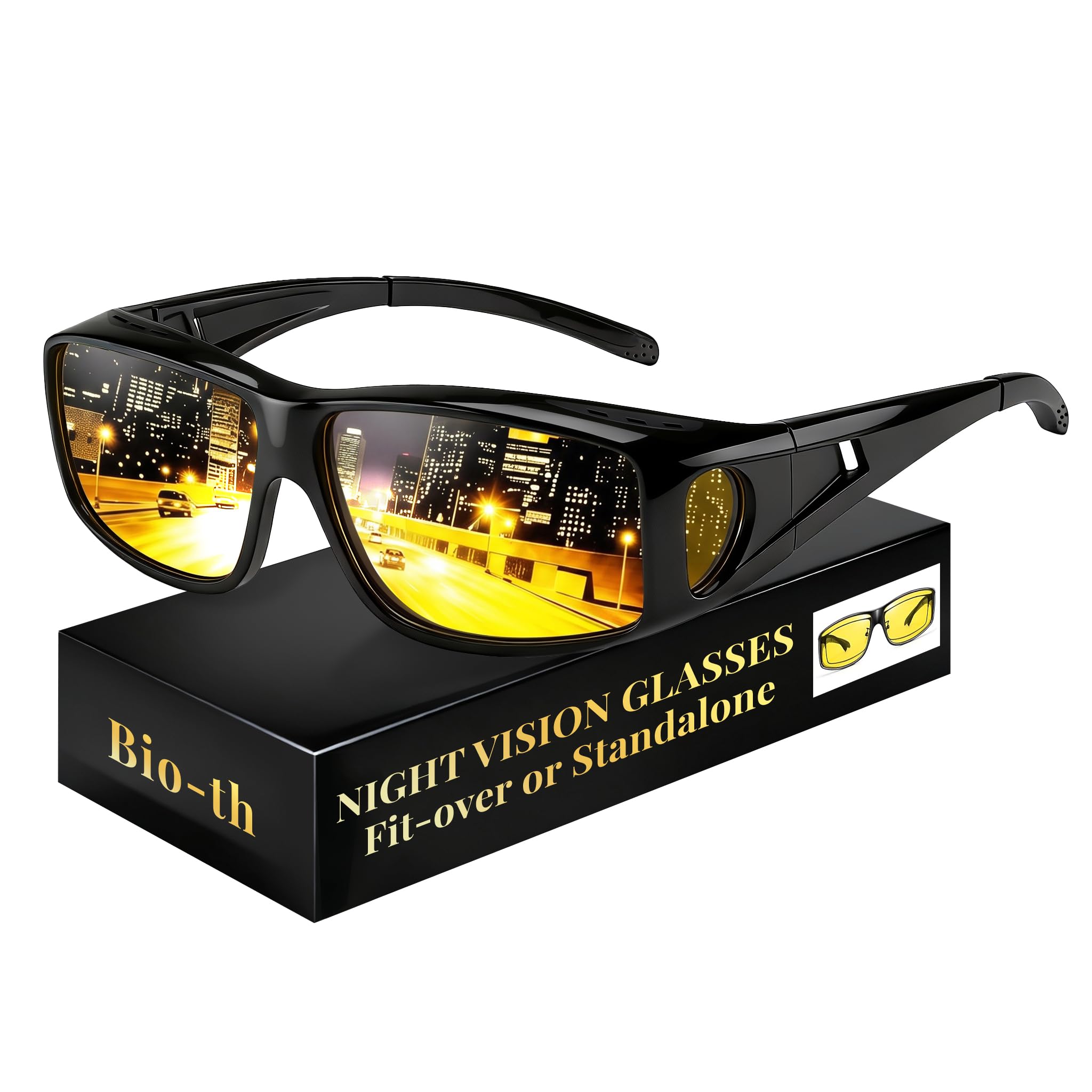
The lightweight fit-over that treats comfort as its headline feature.
A featherlight TR90 frame — a flexible plastic that bends instead of breaking — is the star of this pair. TR90 is the material used in sports glasses because it can take a knock and spring back, and it keeps pressure off the ears and nose. Over-glasses shape means you wear your prescription glasses underneath and save the cost of another prescription pair. Stated purpose is night driving, but the brand also positions it for cycling, hunting, and foggy conditions — a yellow lens that serves more than one low-light job.
Quality is the most-praised thing, with glare reduction and value for money right alongside it. The description matches what most drivers want from a fit-over: slotted over an existing frame with no bulky overhang at the ears, and no fighting between two pairs. Shoppers say the yellow lens brightens the road without darkening it, which is the crucial difference between a useful fit-over and a pair that dims the world too much to read a shadow. In rain or fog, buyers also report improved contrast on the road ahead.
What deserves a flag is consistency. The pair is a fit-over, so fit depends on how much frame you already have on your face, and the frame can be snug enough to warm up your face on a long drive. A few people find the effect below expectations, but the more reliable takeaway is the durability question: build it into your routine to leave it in the case rather than the door bin. Its 4.0+ star average reflects steady owner satisfaction without overpromising.
Tried-and-true approach: a flex-yellow over-glasses that gets you the night tint without shelling out for prescription sunglasses — a practical second pair that can live in the glovebox.
Ideal if: you wear prescription glasses every day and want a fit-over that flexes to your face and does not crowd your ears.
Try something else if: your prescription frame is oversized and would push this one up off your nose.
7. URUMQI Night Vision Driving Glasses
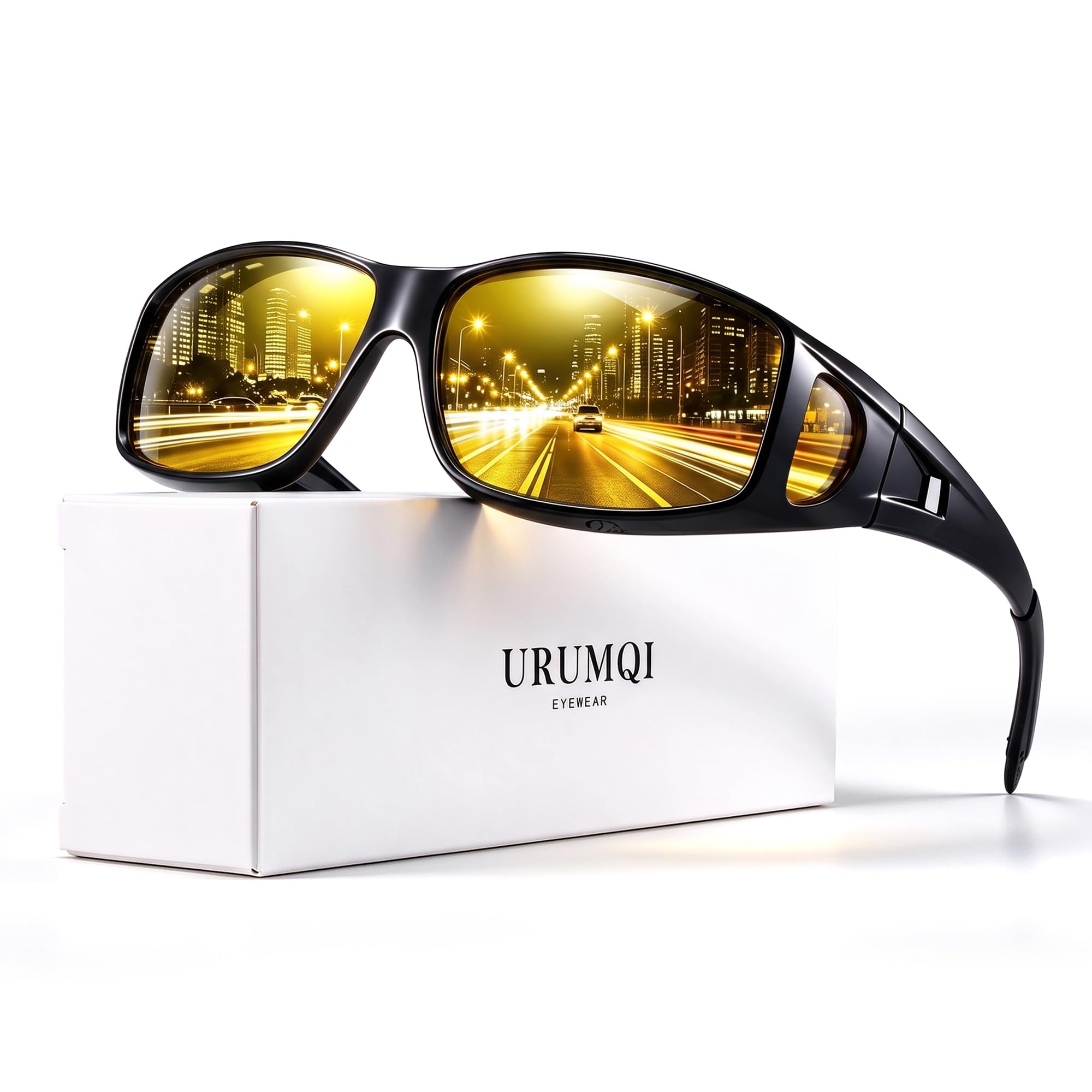
Two extra side lenses that widen what you can see before the beam hits.
The wrap-around design here is specifically built to be worn over eyeglasses, and the two small side lenses are the distinguishing spec — they open the field of view and add protection from glare coming from the side. The main lens uses a polarizing coating plus a Nano yellow factor to boost contrast on foggy or snowy days. Frame material is TR90, the memory polymer that bends and returns, and the full kit includes a polarization test card, cloth, and pouch.
Appearance and fit are the two things people talk about most here, and both serve the same purpose: you will actually wear these, so they need to look and fit like something you want to keep on. A driver notes the coverage with clear peripheral vision and describes the polarized lens as cutting glare well for sensitive eyes. The close-to-180-degree coverage they describe is the direct benefit of the side lenses. Another buyer reports a snug fit over the ears that stays comfortable, and one mentions no slip down the nose — the two places fit issues usually show up.
One important limitation is stated by the brand itself: the side lenses are ordinary, not polarized — the polarization is in the main front lens. The tint is also strong enough that a few people find it too dark for night vision, which is a real fit question rather than a defect. If you drive unlit country roads with no streetlight help, a less aggressive tint may suit you better; on lit freeways and city roads, this tint is doing exactly what it should. Read the included instructions on the tint and judge your first drive in daylight before relying on it after dark.
The case for the URUMQI
- Side lenses add real peripheral coverage over a prescription frame
- TR90 flex frame takes knocks without fracturing
- Nano yellow factor boosts contrast on fog and snow
- Polarization test card, cloth, and pouch included
The trade-offs to weigh
- Side lenses are clear, not polarized — only the front lens is
- Tint can feel too strong on fully unlit roads
- Wrap-around profile is bulky on a narrow face
Go with it for: light-sensitive eyes on lit roads where side glare through the driver’s window is part of the problem.
Pass for: pitch-black country driving where you need every bit of ambient detail preserved.
8. Polarized Clip-On & Flip-Up Driving Glasses
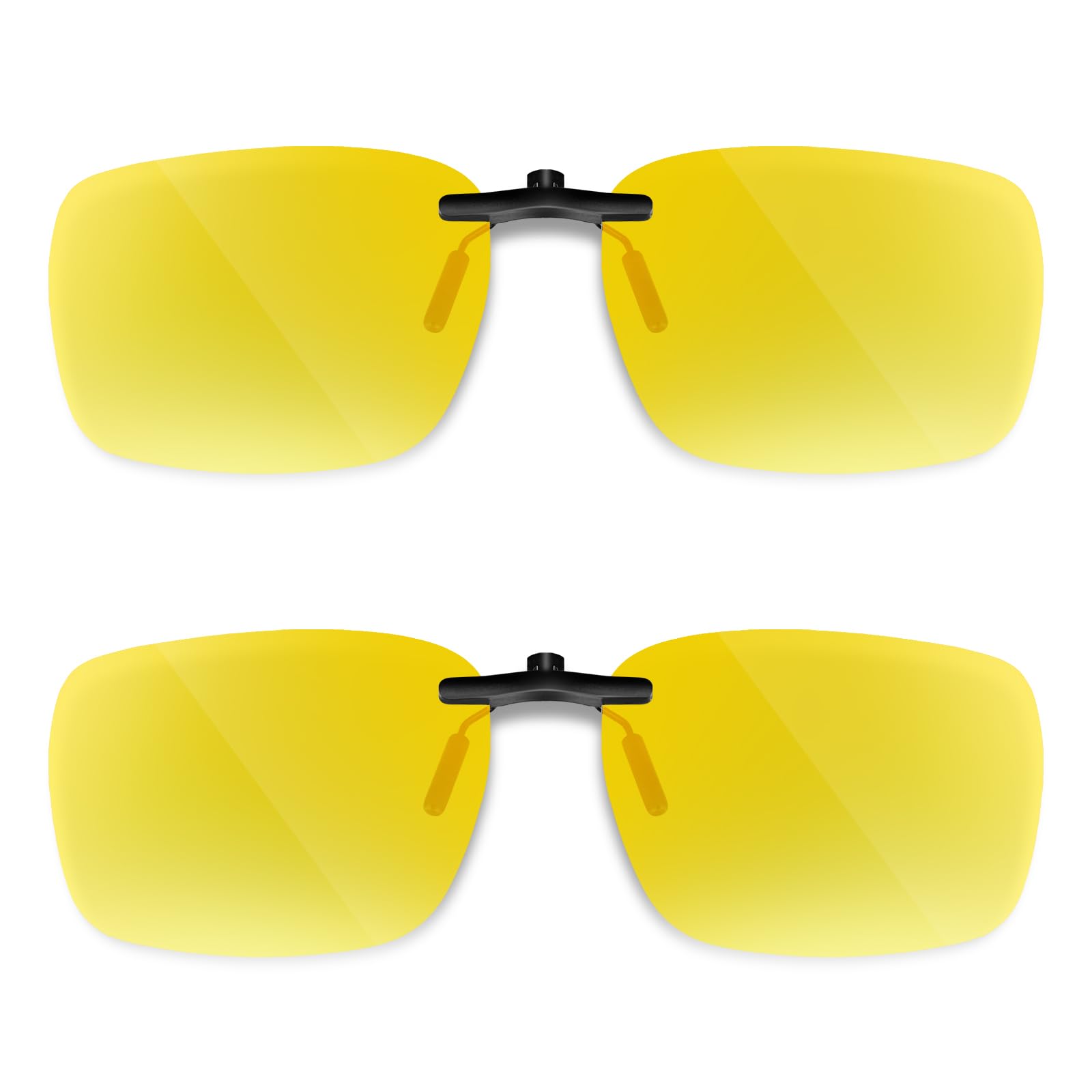
One finger, one flick, and the tint leaves your field of view at the tunnel mouth.
The flip-up hinge is the feature that earns this pair its place. Moving from a lit street into a dark underpass, or from shade into a sunlit stretch, is exactly the moment a fixed tint becomes a nuisance. Here the lens tips up on a hinge with one finger, so you stay focused on the road. The frame is designed to fit most prescription glasses without adding bulk, and the soft pads protect your own frames from scratches. If your commute involves a lot of light change — tunnels, parking garages, tree-lined roads — that hinge is worth the extra complexity.
Functionality is the aspect people praise most, followed by appearance. The working set of tricks — flip up, clip on, UV400 daytime protection — all do what the product description promises. Buyers report it cut glare from streetlights, construction zones, and halogen headlights, and one specifically describes the blue-blocking helping them see further into the water while fishing and not squint into sunrise and sunset. Another uses it as a daytime sun clip and a night clip on the same commute, which is the use case the flip lever was built for.
Two areas that warrant a careful first week. The clip-on mechanism is a fit lottery with thicker plastic and aviator-style crossbar frames — the clip needs a flat edge to bite. A few people also report a pair coming apart on arrival; in most cases it snaps back together or takes a small dab of glue. Glare reduction is not universal, and a small number of users find it weaker than hoped, so test it on a rainy night within the return window rather than committing on a single bright one.
The single best use: commuting drivers who weave through tunnels and car parks each day and want a lens they can flip out of the way without stopping.
Best paired with: a simple rectangular prescription frame with a flat upper rim.
Not a match for: aviator-style glasses with a top crossbar, which the clip cannot grip.
9. YIMI Polarized Photochromic Driving z87 Sunglasses

One lens that tries to be your daytime sunglasses and your night pair.
The concept is what makes this pair interesting: a photochromic lens that darkens in UV light and lightens indoors, so you leave home in sun and arrive at dusk without swapping glasses. Add spring hinges, adjustable silicone nose pads, and the stated 100% UVA/UVB protection, and you have a driving pair that reads premium on paper. The aluminum magnesium alloy frame keeps it light at 2.82 ounces. It is the heaviest standalone pair here after the Oilway, but the weight is distributed across a springy, athletic frame.
Comfort and appearance sit at the top of the list for this pair — and one detail worth knowing is that the lens is a modest 57 mm, so the fit is closer to a classic sunglass than a wide-driving lens. The tint is described as darkening slightly in sun. Owners mention the pair being comfortable for drive-time wear, looking and feeling more expensive than the price, and the included case being of genuinely high quality. That case detail shows up more than once, so it is not sales copy.
The photochromic function is the honest caveat. This is not a lens that goes from clear to black instantly, and some customers note very little visible change between sun and indoors. The TAC polarized lens will block real glare, but the tint transition is the weaker half of the duo. If your day includes a lot of light change, you get more consistent results with the flip-up clip or a dedicated fit-over, so think of this as the best option for a driver who wants one pair and does not want to fuss.
Why it earns a premium pick
- Photochromic lens covers daytime and low light without swapping
- Stated 100% UVA/UVB protection with polarized glare filtering
- Comfortable spring-hinge frame in aluminum magnesium alloy
- High-quality hard case included — rated the best case in the box
Where it asks for patience
- Photochromic tint changes slowly or barely at all for some users
- Narrower 57 mm lens is not a wrap-around for wide faces
- Polarization strength is the weak half of the story
Reach for this: the commuter who hates changing glasses at 5 p.m. and wants the convenience of one pair.
Think twice if: you need a guaranteed strong tint at the push of a switch — a mechanical flip is faster than photochromic chemistry.
10. BIRCEN Night Vision Glasses for Driving
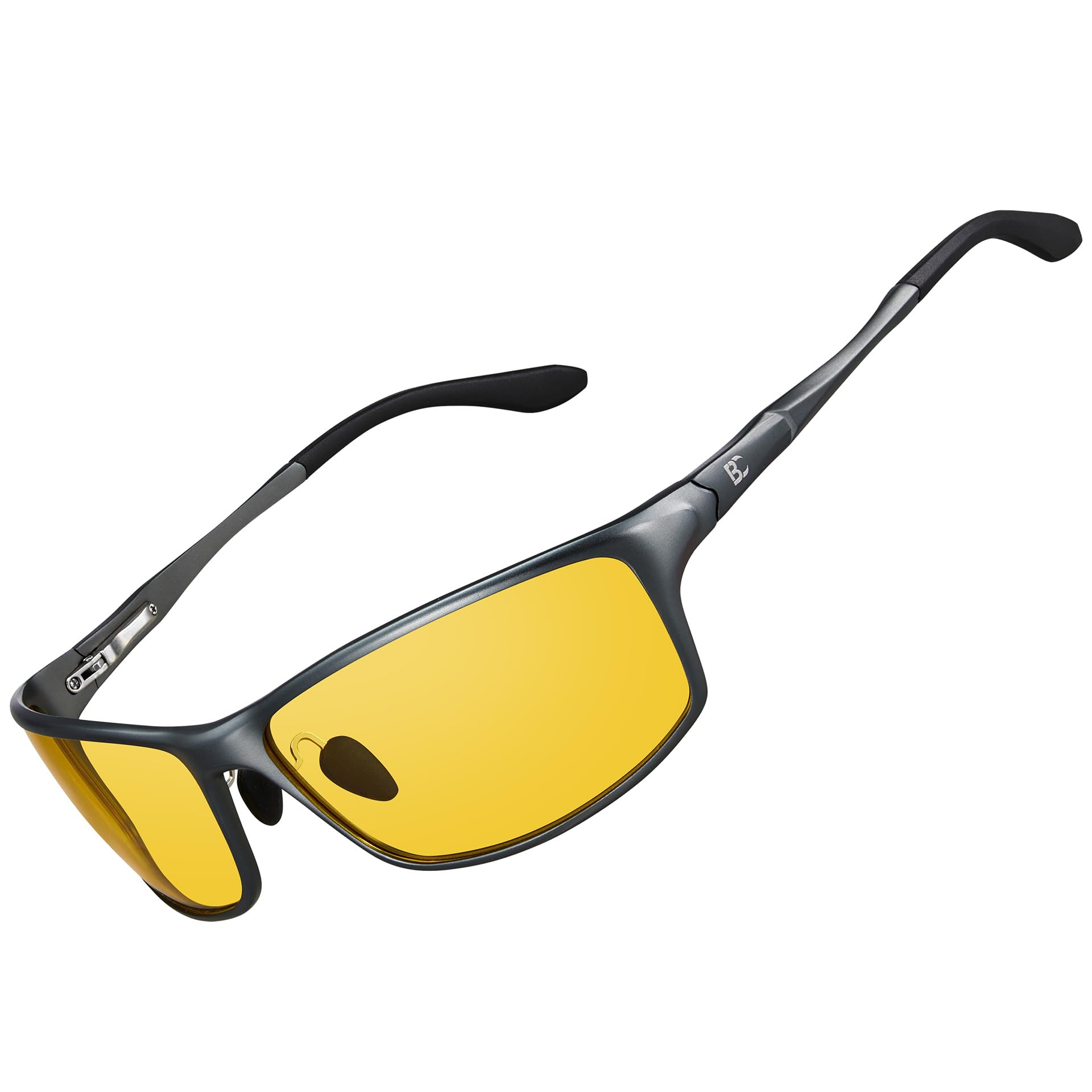
The metal-frame pick for drivers who want hours of wear without pinching.
Build quality is what this pair hangs its hat on, and that is a deliberate design choice. The Al-Mg (aluminum-magnesium) frame brings a metal feel and a lighter load than plastic, and the TAC lens supplies the anti-glare layer. A spring hinge lets the temples flex outward to fit your head shape, and the soft nose pads carry some of the weight. These are the details that decide whether you reach for a pair on a long drive or leave it in the glovebox.
Quality leads the conversation about this pair, with value right behind. Buyers describe wearing it for hours without discomfort and note it does not pinch at the temples; the wrap fit is called out as wrapping well around the eyes. A driver with glaucoma reports real help with glare at night, and another uses the pair as shooting glasses because the tint cuts down on reflected light. It is enough of a pair to be used beyond driving, which is a good sign the lenses are not just lightly tinted plastic.
The honest trade-off is that yellow tint cuts glare differently for every pair of eyes. A buyer with upgraded cataract surgery lenses reports the tint only shows light yellow and does not reduce the glare from headlights, brake lights, or street lights. That is not the product failing — it is a reminder that night vision is person-specific, and if your eyes are post-surgery, test on a return-friendly basis. The pair is well-made, but it will not outperform a genuinely effective tint on an eye that does not respond to yellow filtering.
The strongest card: a metal frame with spring hinge and soft pads, built for wearers who keep their glasses on for the whole shift.
The card to weigh: at 4.0+ stars, the base is solid, but eye-to-eye response to yellow tint is the variable no spec can predict.
Worth the pick for: long-haul drivers who prioritize comfort and a sturdy metal build over a bargain frame.
Worth a pause if: your tint needs to be strong on first wear — this is a subtle pair, not a heavy filter.
11. Anti-Glare Headlight Glasses
Darker at the top, near-clear at the bottom — built to keep your dash readable.
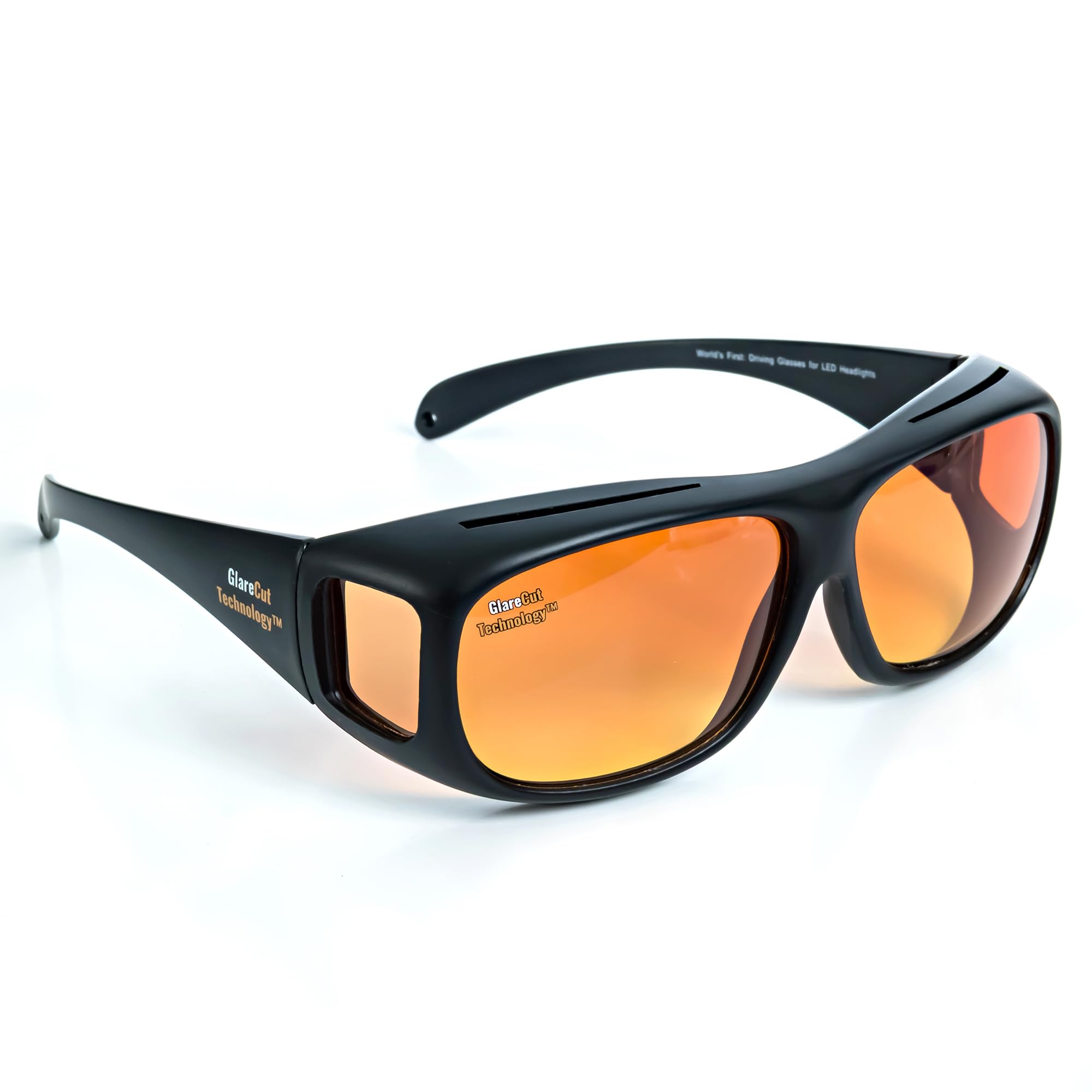
The gradient amber-to-yellow lens is the unusual spec here. A darker tint across the top blocks the headlight wash from ahead, while a near-clear bottom edge lets you glance down at your gauges and nav screen without taking the glasses off. It comes with a visor-mounted keeper so you can hang it from the sun visor between drives. At 3.53 ounces it is a substantial standalone pair, not a featherweight clip, and the design will feel like sunglasses rather than a discreet add-on.
What people report most is that it genuinely helps in the conditions it was built for. Functionality scores best, and drivers describe it being a great tool for visibility; on well-lit freeways and city streets, the gradient design was made for exactly that environment. The near-clear bottom edge lets you read the instrument cluster while you drive, which is a point of genuine functional advantage over the solid-tint picks. One buyer describes it as the best night-driving pair they tried and calls the amber-to-yellow gradient unique.
The counterpoint is where the tint wins and where it loses. On unlit country roads, drivers say the pair is too dark — fine on a lit freeway, less helpful on a dark rural road where every detail matters. The lens layer is a second area to check: a few find the lenses pop out of the frame easily, so treat the visor keeper as the right way to hang it, not a metal hook. At 3.5+ stars, most owners find it useful on lit roads even if it is not a universal night-drive fix.
What it does well
- Gradient tint keeps gauges readable while cutting headlight wash
- Visor keeper helps keep it accessible and not loose in the car
- Works on lit freeways and city roads without dimming the view
- Substantial standalone frame, no prescription required
Where it needs care
- Too dark for unlit country roads
- Lenses can pop out of the frame if dropped
- Stated price relative to cheaper two-pack picks is ambitious
The pick for: freeway and city commuters who drive mostly under streetlights and want their dash readable through the lens.
Not the pick for: rural drivers who need maximum remaining visibility on unlit road — a lighter tint will serve you better.
Know the Specs
Tint color and strength
A yellow or amber tint filters the harshest part of the light and boosts contrast — that is why lane markings and road signs read more clearly at dusk or in fog. The trade-off is that a strong tint also dims the world, so a pair that works on a lit freeway can be too dark on an unlit country road. If you drive a mix, a gradient lens that is darker at the top and closer to clear at the bottom is a useful middle ground.
Polarization and UV protection
Polarized lenses are built with a filter that blocks light reflected off flat surfaces — wet pavement, chrome trim, and windshields — which is the glare that makes you squint hardest. Real polarization is testable: hold the lens over a phone screen and rotate it, and a true polarized lens makes the screen go dark at one angle. UV protection is a separate layer, listed on several of these picks as 400UV or 100% UVA/UVB, but it protects your eyes from sunlight and is not what cuts headlight glare.
Fit-over width and height
A fit-over pair only works when its frame is larger than the prescription glasses underneath. That is why the wrap-around picks publish exact numbers — the LVIOE pair, for example, is listed at 144 mm wide and 44 mm tall at the lens, with a recommendation to buy only if your own frame measures under 140 mm wide and 40 mm tall. Measure the widest and tallest points of your eyeglasses with a ruler before you order, because a pair that grips too tight will pull off your nose on a long drive.
Wear weight and frame material
Weight decides whether you leave a pair on for the whole drive. A clip-on can be as light as 0.63 ounces and disappear onto your existing frames, while a standalone pair at 3.52 ounces carries more on the nose. Frame materials matter too: TR90 and PC are flexible plastics that spring back after a knock, while metal frames with spring hinges offer a stiffer feel and a more formal look. None of these is better on its own — they trade weight against durability and looks.
Common Questions
Can night driving glasses really help with oncoming headlights?
Do night driving glasses work over prescription glasses?
Are yellow lenses better than clear lenses for night driving?
How do I tell if a pair is really polarized?
Will a photochromic lens darken enough for night driving?
Can I wear night driving glasses during the day?
Why do some night glasses make everything look yellow?
Do clip-on night glasses fit any prescription frame?
How long does a pair of night driving glasses last?
Do night driving glasses still help in rain or fog?
The Bottom Line
For most drivers, the winning pair among these lenses for driving at night is the Oilway Blue-Light Blocking Glasses, because the two-pair kit puts one set in the car and one at the desk, and the impact-resistant frame survives daily in-and-out use. The honest limit is that it filters screen light rather than headlights, so if oncoming beams are your problem, the LVIOE Wrap Around Night-Vision Glasses or the URUMQI wrap-around pair does that job better. And for drivers who live through tunnels and parking garages, the flip-up hinge on the Polarized Clip-On & Flip-Up Driving Glasses is the feature that matters more than any spec on the box.
One last thought before you buy: the feature that actually decides whether a pair stays in your car is fit. A solid handful of these picks ask you to measure your own glasses first, so take the ruler to your frame before you order. A well-fitting pair at a modest rating beats a premium-looking frame that pinches your nose every drive.
How we choose
We do not accept paid placement. Every pick is matched to a real buyer and a real use-case; we do not hands-on test units.
Sources
Specifications: manufacturer listings and product documentation. Review insights: verified customer reviews, as of October 2026. Pricing: not shown on this page (it changes often); check the current price via the retailer link.
As an Amazon Associate, Aappliancez earns from qualifying purchases. This does not affect which products we feature.