Disclosure: Some links in this post are affiliate links. As an Amazon Associate I earn from qualifying purchases, at no extra cost to you. Learn more
Specs are compiled from manufacturer listings and verified buyer reviews and can change over time — please confirm the key details on the product page before buying.
Your lawn slopes, and every mower you have tried slides, spins its rear wheels, or scalps the grass on the way down. A machine that works fine on flat ground turns into a wrestling match on a grade, so the real question is which mowers are actually built to hold traction on a hill. This guide separates the ones that genuinely grip from the ones that only claim to.
This guide is built by comparing the manufacturers’ published specifications and the patterns across verified customer reviews, so you get each pick’s real strengths and trade-offs instead of marketing spin.
The picks below split into two families: ride-on tractors and zero-turns that put you in the seat, and robotic mowers that climb the slope for you. Traction is the deciding factor on a grade, which is why this list leans hard on drive type and slope rating.
Top Picks

How To Choose The Best Lawn Tractor for Steep Hills
On flat ground, almost any mower will do the job; on a grade, traction decides everything. On a grade, the machine either grips or it does not, and that single trait decides whether you finish the lawn or spend the afternoon dragging a mower out of a rut. Here is what actually separates a slope-worthy mower from a flat-lawn machine.
Start with the slope rating, not the horsepower
Slope ratings are usually written as a percentage, and the percentage is the rise over run — an 84% slope is steeper than most people picture when they say “a bit of a hill.” Match the rating to your steepest real section, not the average. A mower rated for a modest grade will struggle on the one nasty bank at the back of your property.
Drive type decides whether you slide
Two-wheel-drive tractors push power to the rear wheels only, so a wet or loose slope can break traction fast. All-wheel drive sends power to all four corners for more grip. Tracked machines spread the load across a wide rubber belt, which is why they handle soft, steep, and rough ground that stops a wheeled mower.
Transmission and control on a downhill run
A hydrostatic transmission (a fluid-driven setup with no clutch pedal) lets you creep downhill at a steady pace instead of fighting a geared box. On a remote-controlled or robotic mower, look at how steering and speed respond — a machine that jumps to full speed on a turn will dig into turf and lose grip on a slope.
Cutting height and deck behavior on rolling ground
Rolling terrain is where a deck scalps. A wide cutting-height range lets you keep the deck high on the crowns and dips so you are not shaving the grass down to dirt. Floating or adaptive decks follow the ground instead of digging in.
Side-by-Side Comparison
| Model | Best For | Cutting Width | Stated Slope Rating | Drive / Power | Amazon |
|---|---|---|---|---|---|
| Husqvarna Z254F★ Best Overall | Large yards, fast mowing | 54 inches | — | Hydrostatic zero-turn, 23 HP Kawasaki | Amazon |
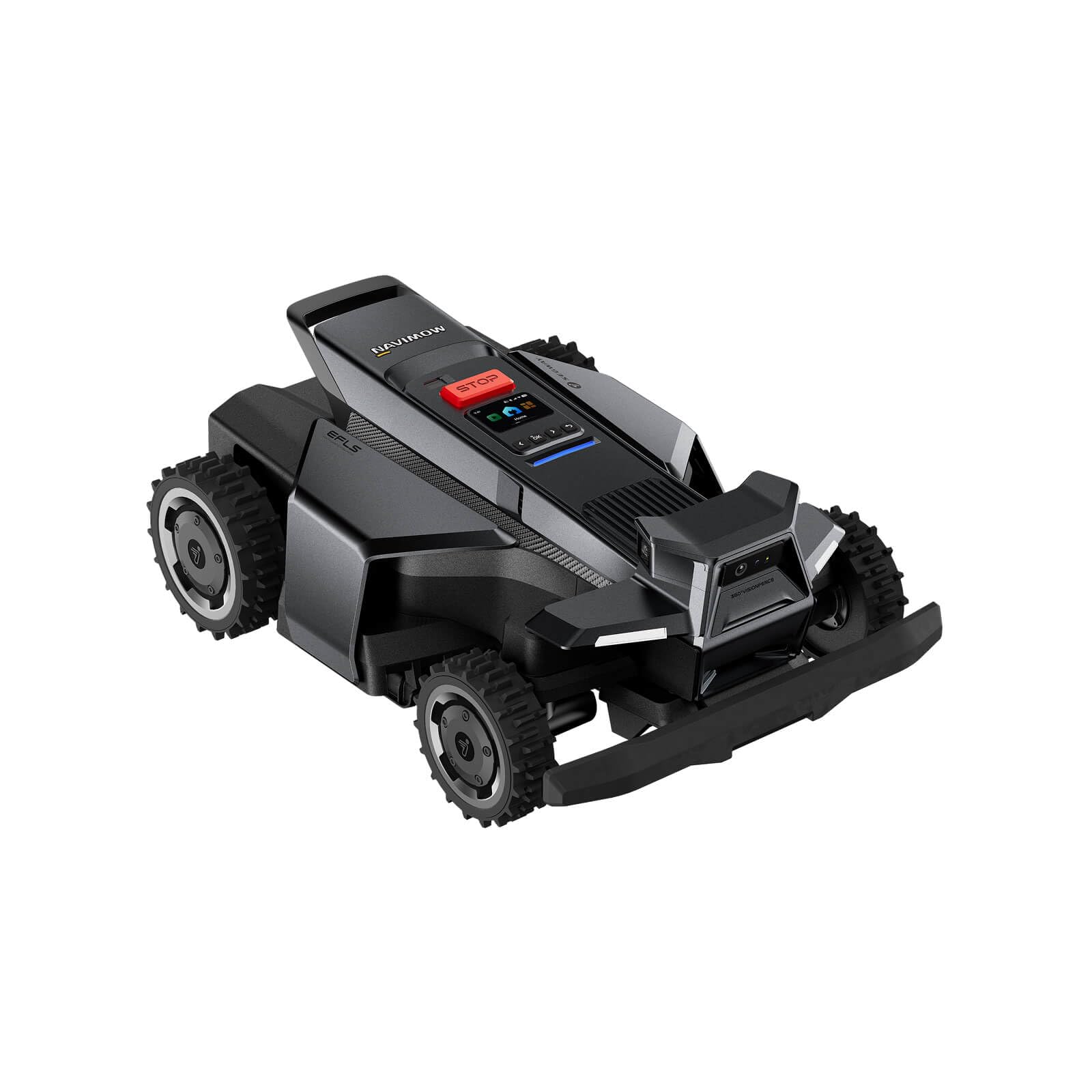
| Segway Navimow X430Steepest Climber | Hands-off slope mowing | 17 inches | 84% (40°) | 4WD, 2 × 180W motors | Amazon |
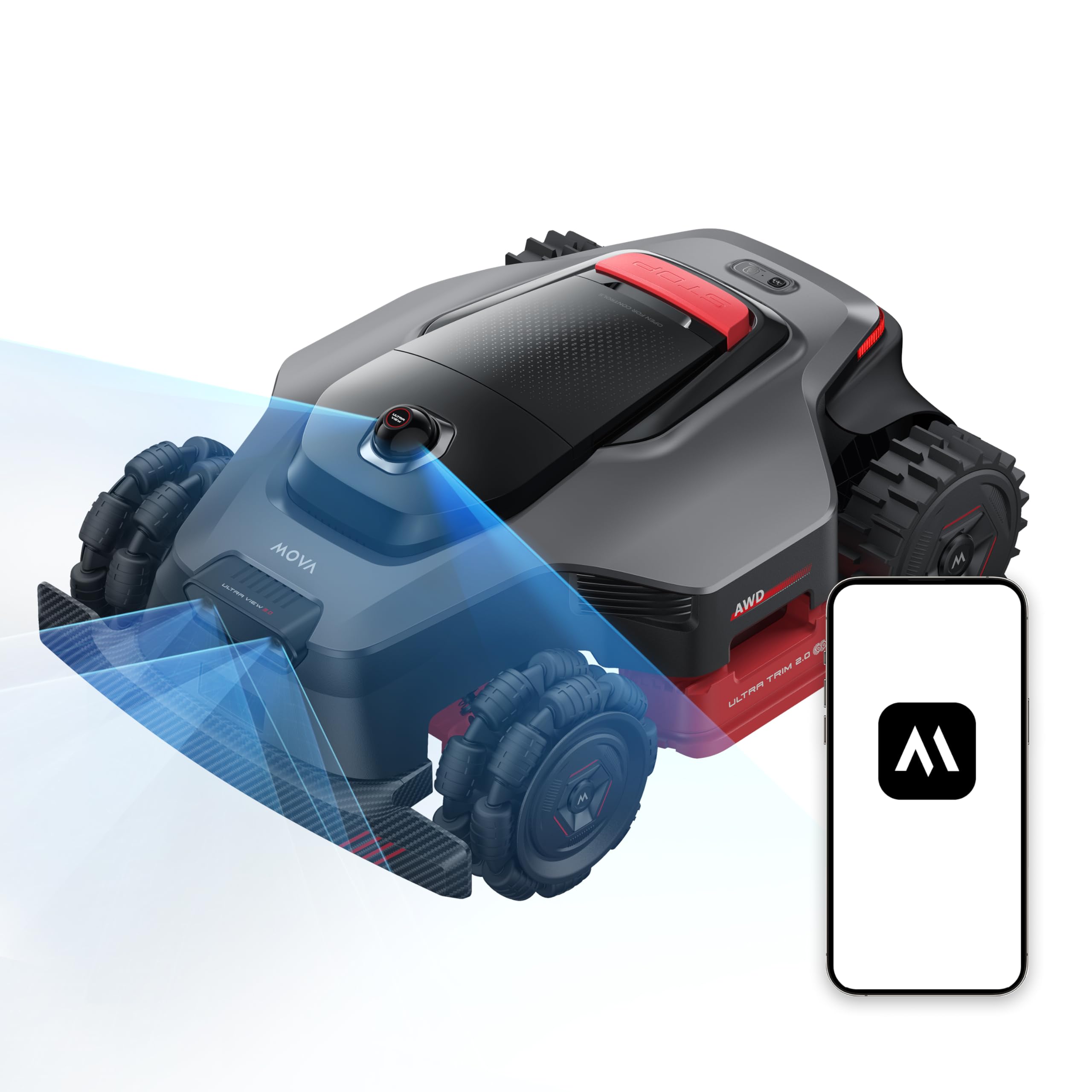
| MOVA LiDAX Ultra 3000 AWDNo RTK Required | LiDAR mapping, no RTK | 15.8 inches | 80% | AWD, four 116W hub motors | Amazon |
| Husqvarna Automower 430X | Shaded, tree-heavy lawns | 9.45 inches | 45-degree slopes | Wired boundary navigation | Amazon |
| Greenworks 60V 30″ Riding Mower | Quiet battery riding mower | 30 inches | 15° | Battery, 16 HP gas equivalent | Amazon |
| AIWEIYA Remote Control Crawler | Extreme banks and brush | 21.6 inches | 100% (45°) | Tracked, 1600W brushless | Amazon |
| WORX Landroid Vision Cloud WR344 | No-antenna robotic setup | 8.7 inches | 84% (~40°) | 4WD, RTK Cloud | Amazon |
| Mammotion LUBA 3 AWD 3000 (Cleaning Stand) | LiDAR + AI navigation | 15.7 inches | 80% (38.6°) | AWD, 2 × 165W motors | Amazon |
| Mammotion LUBA 3 AWD 3000 (Alt. Listing) | LiDAR + AI navigation | 15.7 inches | 80% (38.6°) | AWD, 2 × 165W motors | Amazon |
| Mowrator S1 4WD | Remote slope control | 21 inches | 75% (37°) | 4WD, 1000W | Amazon |
| EGO Power+ TR4204 | Big battery riding mower | 42 inches | — | Battery, 20,000W | Amazon |
| MechMaxx VBM86 | Ditch banks behind a tractor | 86 inches | Pivots 90° up / 55° down | PTO, 65HP gearbox | Amazon |
Detailed Reviews
1. Husqvarna Z254F 54 in. Zero-Turn Riding Mower
Our pick — 4.5+★ from 60+ verified ratings; the strongest balance of quality and price.
The big-deck zero-turn that eats a rolling property fast, as long as the grass is dry.
If your slope is gentle-to-moderate and you simply want the mowing done quickly, this is the pick. The 54-inch ClearCut deck (the housing that holds the blades) covers a wide strip so you make fewer passes, and the hydrostatic transmission — a fluid drive with no clutch pedal — lets you creep along at a controlled pace. It runs a 23 HP Kawasaki engine with a top speed of 6.5 MPH, so a big acreage does not take all afternoon.
What wins people over is straight performance: the engine fires reliably, the cut is clean, and the machine feels near-commercial in build. The deck lets you discharge, mulch, or bag, though the mulching kit and bagger are sold separately. Cutting height adjusts across six positions from 1.5 centimeters at the low end up to 4.5 inches.
Here is the honest catch on a hill: traction. Buyers report “Needs better rear tires does not do well on wet grass,” and that is the recurring gripe — the rear wheels can spin and dig up turf when the ground is damp or steep. On dry, moderate ground it is excellent. On a wet, sharp bank, it will struggle where an all-wheel-drive machine would not.
What earns it the top spot
- 54-inch deck clears wide strips per pass, so big lawns finish sooner
- Hydrostatic drive gives smooth, controlled speed with no clutch work
- 23 HP Kawasaki engine and a 6.5 MPH top speed suit large properties
- Three clipping options — discharge, mulch, or bag
Where it can let you down
- Rear traction is the weak point on wet or steep grass
- Mulching kit and bagger are extra-cost add-ons
- 595 pounds is a lot of machine to store and maneuver
Reach for this if: your slope is moderate and mostly dry, and you want to finish a large lawn fast with a wide, clean cut.
Look elsewhere if: your worst bank stays damp — the rear tires will spin, and an all-wheel-drive pick lower on this list will hold far better.
2. Segway Navimow X430 Robot Mower, 4WD
The mower that climbs an 84% grade so you never have to walk it.
Here is the number that decides everything on a steep yard: this robot is rated to climb 84% slopes, which is about 40 degrees, and it does it on four driven wheels with an off-road-tuned suspension. It also clears obstacles up to 2.8 inches tall, so roots and low borders do not stop it. For comparison, the Husqvarna zero-turn above relies on rear-wheel grip alone and slides when the grass is wet — this one puts power to all four corners.
It also has real muscle to match: two 180W motors drive the cutting discs, and the 17-inch cutting width is paired with EdgeSense to trim margins to under 2 inches. Setup is wire-free with one-tap auto mapping and no antenna needed, and it handles navigation with a tri-frequency RTK network (a satellite-correction signal accurate to the centimeter) plus 360° vision that recognizes over 200 obstacle types.
Owners rave about the zero-turn steering that avoids tearing turf, and the performance is the thing most talked about. The honest trade-off is speed and battery: the robot mows in schedule-friendly passes rather than one fast sweep, and some find it slow for a large area, so two passes may be needed for a tidy finish. It is also a big, heavy unit at 63.7 pounds to move for maintenance.
Climb-first design: An 84% slope rating with 4WD (power to all four wheels) is the headline, and it is the single biggest reason a genuinely steep yard works here — the machine grips where a wheeled tractor spins.
Smart but not instant: Wire-free mapping and obstacle avoidance are strong, yet expect to schedule it as a background task rather than watch one quick cut, and clear low branches that confuse the cameras.
Best for: a genuinely steep, obstacle-strewn yard where you want the climbing done for you and never have to push a machine up a grade.
Skip if: you want a fast single sweep or plan to mow a large area in one shot — its measured, scheduled pace suits patience, not urgency.
3. MOVA LiDAX Ultra 3000 AWD Robot Mower
LiDAR maps your yard with no base station and no boundary wire at all.
Most robotic mowers make you install either a perimeter wire or a fixed antenna base. This one skips both. A 360° 3D LiDAR scanner (a spinning laser that measures distance to everything around it) builds an accurate map on its own, and it holds four 116W hub motors — one per wheel — for all-wheel drive rated to climb slopes up to 80%. That is a strong slope rating from a machine with no wire in the ground.
The cutting is efficient for its size: a 36V 243Wh battery (a mid-size pack) drives dual discs with 12 blades across a 15.8-inch cut, and UltraTrim 2.0 leaves only 1.2 inches of uncut edge. It avoids over 300 obstacle types using the LiDAR plus AI vision, and it comes with three years of free 4G so you can track its location and get theft alerts.
Where it needs a clear-eyed look: it is rated for a smaller area than some rivals, it is a premium machine, and a front-wheel slide on horizontal slope cuts is the kind of quirk buyers work around with no-go zones. Owners who get through setup find the mowing meticulous on half-acre slopes — 4.5 hours unattended is the sort of figure that turns a chore into a background task.
Wire-free and precise: Skipping the RTK base station entirely is the draw here — you power it on, it maps, and it cuts, with edge precision down to 1.2 inches of leftover grass.
Sized modestly: This is a machine for a compact-to-mid lawn, not an estate, and it is priced in the premium tier. If you have a small yard, the capability is overkill; if your slope is at the extreme end, the Segway’s higher rating edges it out.
Choose this: for a half-acre-ish sloped yard where you refuse to trench a boundary wire or mount an antenna.
Think twice if: your lot is large — the per-charge coverage is modest, and you should compare any total against a mower rated for more acreage before deciding.
4. Husqvarna Automower 430X Robotic Mower

A boundary wire sounds old-fashioned until your lawn sits under heavy tree cover.
The thing a wire gives you that satellite correction sometimes cannot: a clear, consistent signal. That is the whole reason this mower is here for shaded, tree-heavy slopes. A physical wire around the perimeter and a guide wire hold the line even where signal-based mowers lose their fix. It handles 45-degree slopes and narrow passages, and at 29 pounds it is a fraction of what a riding tractor weighs.
At 9 inches, the cutting width is the narrowest of the ride-on crowd by a wide margin — the Husqvarna Z254F above cuts a 54-inch strip — so this is a machine that works slowly and steadily rather than quickly. Its area capacity is 1,430 square feet per hour, with a cutting height range from 2.03 to 6.1 centimeters. You control schedules and tracking through the Automower Connect app, Amazon Alexa, or Google Home, and it carries GPS theft tracking, an alarm, and a PIN lock.
The self-install kit is included, but laying that boundary wire is the real labor — and the recurring caution is that the mower can clip its own wire if the sensor misreads the boundary. Plan for a careful install, or a dealer quote, and expect the machine to grow more efficient as it learns your yard. The quiet operation is a genuine plus on a shaded property, where you can run it early without waking the neighbors.
Why a wire still wins here
- Boundary wire holds a steady signal under heavy tree cover
- Handles 45-degree slopes and tight passages
- GPS theft tracking, alarm, and PIN lock built in
- Very quiet running and easy app control
The install reality
- Burrowing or laying the boundary wire is the time-consuming part
- The mower can cut its own boundary wire if the sensor misreads a border
- 9-inch cutting width means slow, methodical coverage
Pick it if: your sloped lawn is heavily shaded and you want a dependable perimeter it can follow without dropping signal.
Don’t pick it if: you want no wire work at all — a wire-free AWD mower like the MOVA or Segway saves you that install day.
5. Greenworks 60V 42″ Riding Lawn Mower
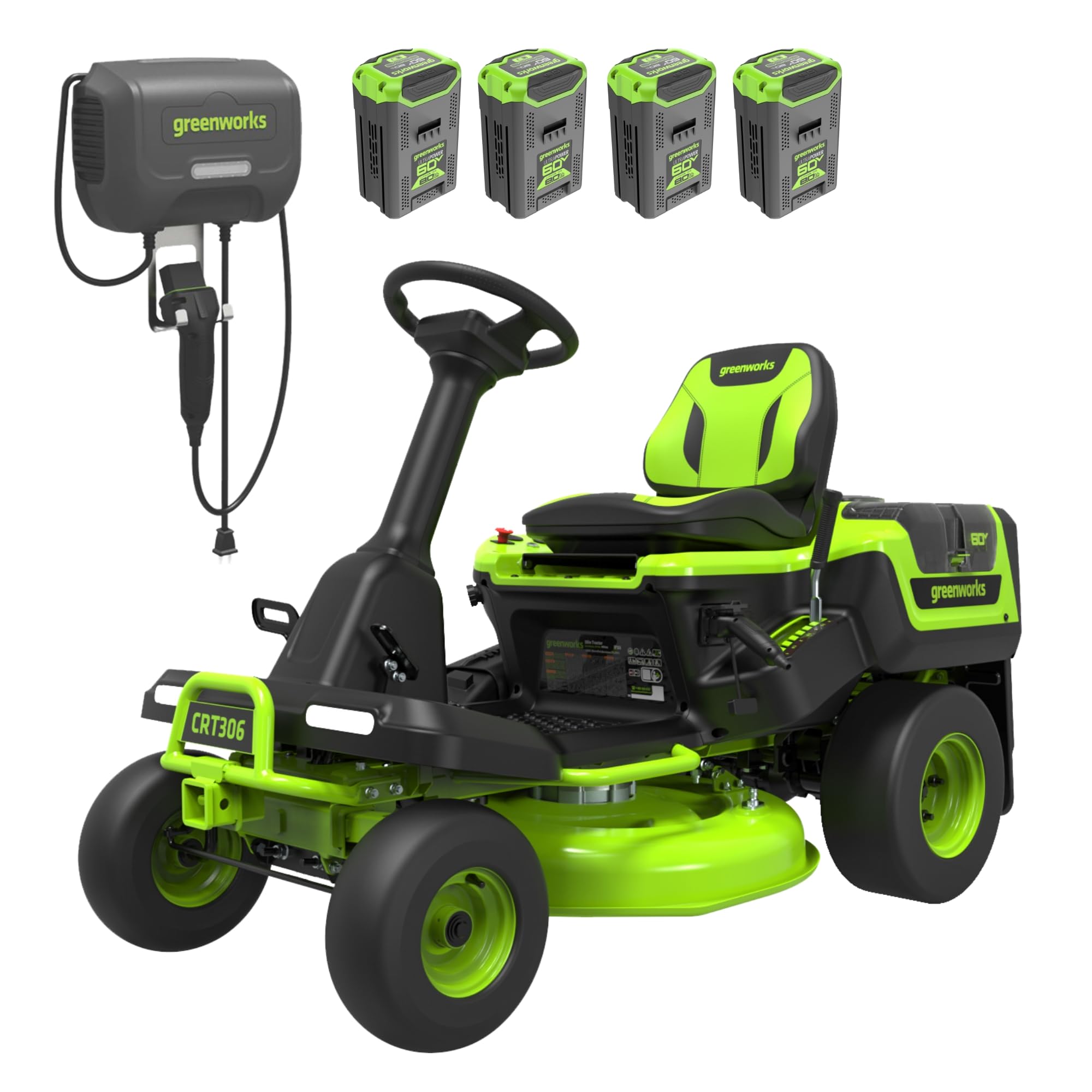
Four batteries, a 42-inch deck, and enough traction control to hold a gentle grade.
This is the pick for the person who wants to sit down, go quiet, and mow a moderate slope without smelling gasoline. It runs four 60V 8.0Ah batteries — up to a 1,920 Wh total — and Greenworks calls the brushless motor the equivalent of a 16 HP gas engine. Cutting speeds reach 6 MPH, and it covers up to 1.25 acres on those batteries, though real runtime depends on grass condition and how you drive it.
On the slope question, be honest about the number: it handles slopes up to 15°. That is a gentle-to-moderate grade, not a steep bank. Adaptive traction control works to keep the mower straight and prevent sliding on hills within that range. The 42-inch stamped steel deck adjusts across 7 positions from 1.5 to 4.5 inches with a single lever, and a rear hitch tows up to 200 pounds for a trailer or pull-behind attachment.
What lands well is performance and battery life — a property that fits the coverage finishes without a recharge. What some owners hit is handling: the steering gets called out as difficult to maneuver and the ride as rough on uneven ground. It is a mower for a flat-to-gentle property, not a hill specialist, and you should read the 15° limit as the real ceiling.
Where it shines: battery life and quiet running carry this one — four packs let a mid-size property finish without a mid-cut recharge, and there are no belts or pulleys to clog.
Where to check yourself: 15° is the honest limit, and the steering takes some getting used to on bumpy ground. On a genuinely steep bank, this is the wrong tool for the job.
Best for: a moderate, mostly rolling yard where you want electric quiet and a real seat to sit in.
Wrong pick if: your grade runs steep — the 15° ceiling leaves no margin, unlike the 75%+ all-wheel-drive mowers on this list.
6. AIWEIYA Remote Control Crawler Mower
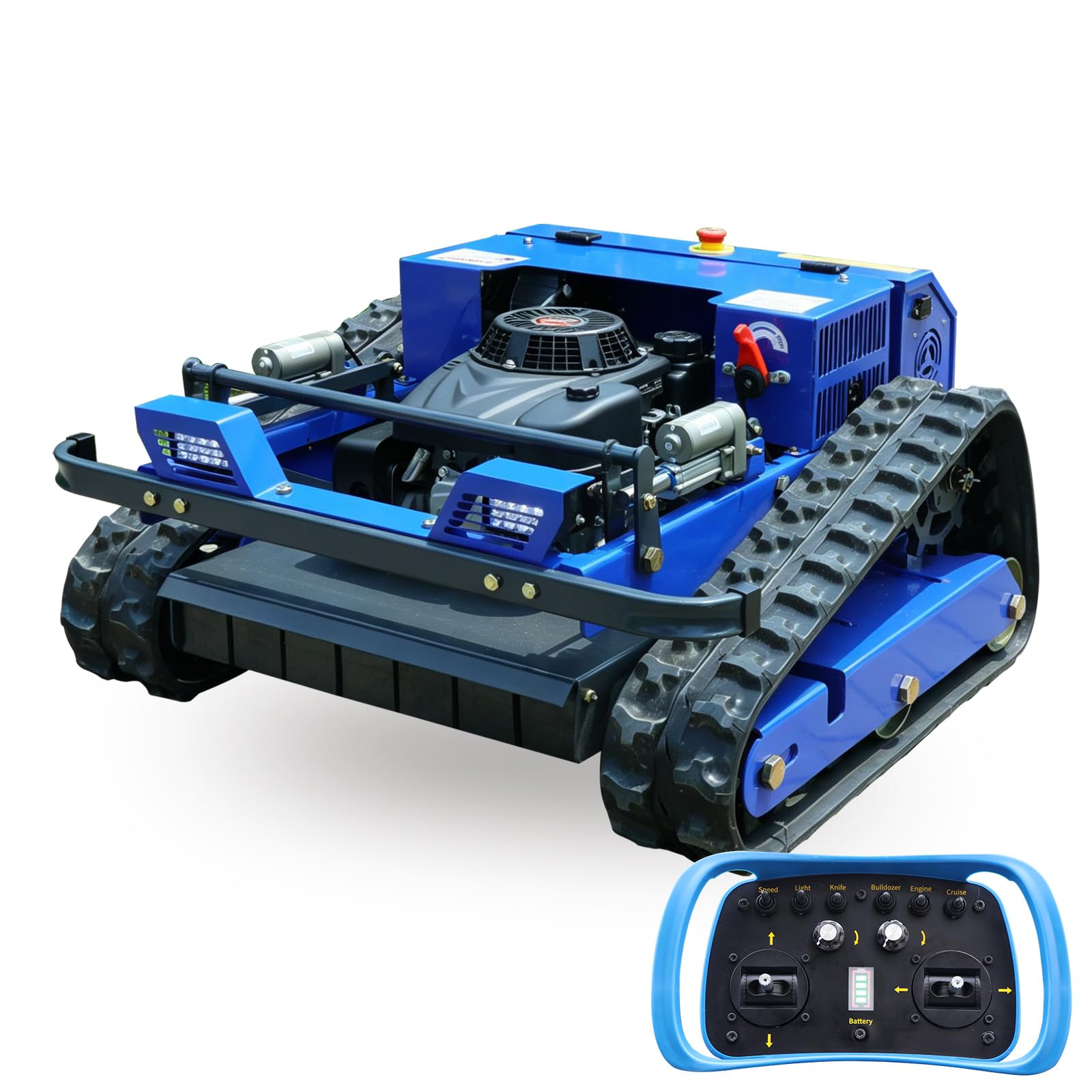
Rubber tracks that claw up a full 45-degree bank while you stand well back.
For the slope that scares every other mower on this page, this is the answer. It runs on rubber tracks rather than wheels, and the manufacturer rates it for a 100% slope, which is a full 45 degrees. A 1600W 24V brushless motor and gearbox drive those tracks. You control it from a handheld remote, so you steer it up a bank you would never sit on, and it turns 360 degrees on the spot.
The build suits rough ground: a 21.6-inch cutting width, cutting height adjustable from 1.1 to 5.9 inches, and it mulches and cuts through tall grass, brush, vines, and small trees. The two-piece manganese blade keeps a fine cut. This is a machine for banks, terraces, reeds, and orchard edges rather than a manicured front lawn.
The honest limits come from the small print. A 1.1-to-5.9-inch range on tracks means it is happiest on rough, thick growth — not precision lawn stripes. It weighs 286 pounds, so it is not easy to shift on your own. And buyers consistently note the manual is thin, so plan on learning by doing; a few also found the battery life unremarkable. Get it for terrain, not for a pristine finish.
Built for the banks
- Tracks and a 100% (45°) slope rating reach ground no wheeled mower can
- 1600W brushless motor with a gearbox for steady torque
- Remote control keeps you off the slope entirely
- Mulches tall brush, vines, and small trees
Know before you buy
- The manual is sparse; expect to learn by trial
- 286 pounds makes it awkward to haul around
- It is a rough-terrain tool, not a precision lawn finish
Right for you if: you have a bank, ditch, or overgrown slope that nothing else can safely climb.
Not for you if: you want a tidy residential stripe — this is a working crawler for rough ground.
7. WORX Landroid Vision Cloud WR344 Robot Mower
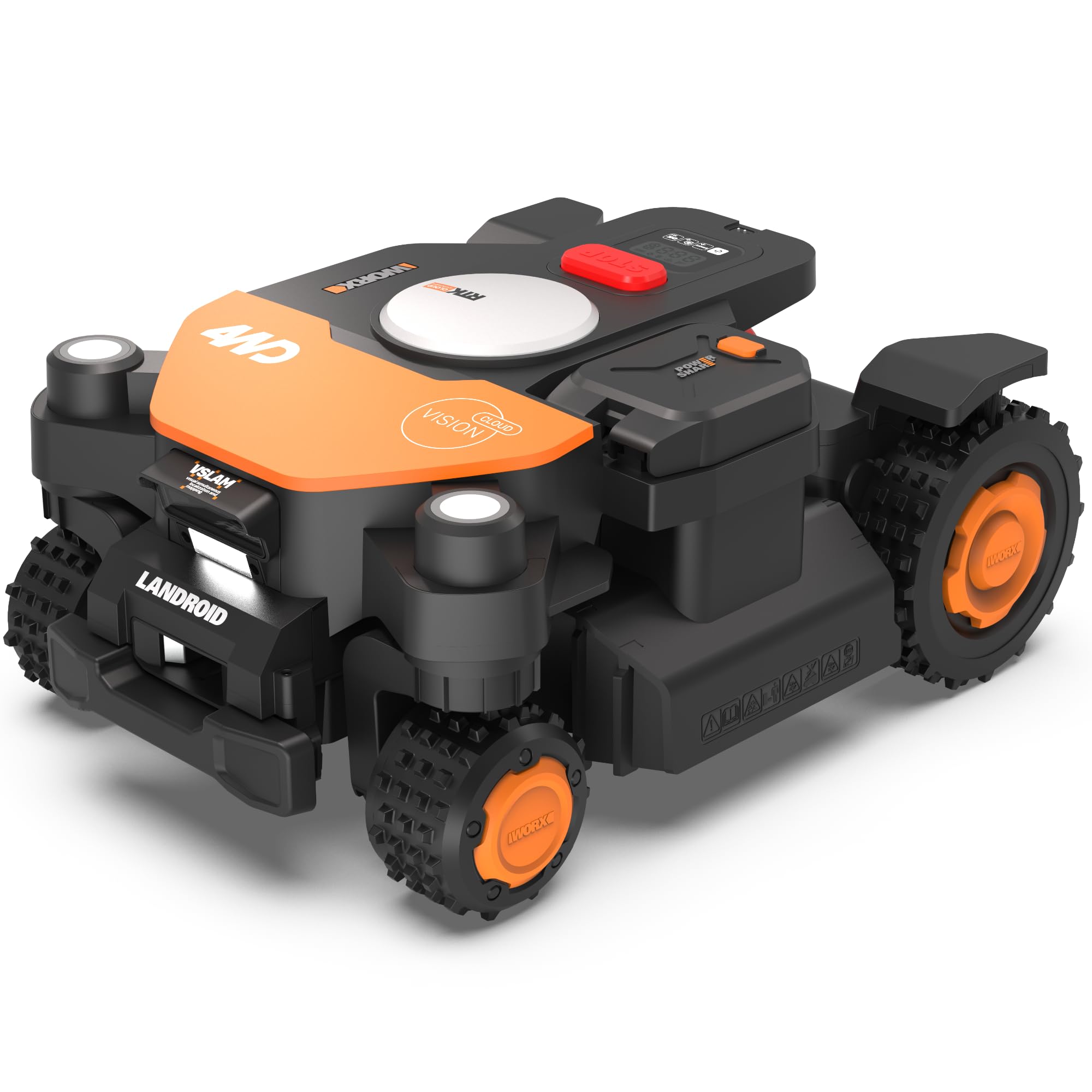
Centimeter navigation pulled from the cloud, with no pole to mount in your yard.
RTK is the satellite-correction tech that keeps a robot mower within centimeters of where it should be — and normally you have to install a fixed base antenna to get it. This mower pulls that correction from the cloud instead, so you mount nothing. It is rated to climb 84% slopes (about 40 degrees) on four driven wheels with front-wheel steering that turns without tearing turf.
The number that jumps out is cutting width: 8.7 inches, well below the wide-deck tractors and the 15.7-inch Mammotion below. That narrow width plus a walking pace makes it a slow, deliberate mower. It compensates with pattern choice — parallel, checkerboard, diamond, or natural stripes — and Cut-to-Zero edge trimming that reduces the manual string work. GPS tracking and cellular let you find and lock it remotely.
The thing to respect is that it is a fine-lawn machine, not a brush cutter. It likes a maintained lawn and steady WiFi; connection trouble is the recurring stumbling block, and it is slow by nature. When it is set up correctly, the low profile and quiet motor make it easy to forget it is working.
The draw: cloud-based RTK with zero antenna install is genuinely convenient on a sloped yard, and the 84% slope rating means it climbs real grades.
The caution: a narrow 8.7-inch cut moves slowly, and it depends on a solid WiFi connection — sort your network before you buy.
Suits you when: you want centimeter guidance without mounting a base station, and your sloped lawn is already fairly well kept.
Better to choose something else if: you have rough, overgrown ground or weak WiFi — this one rewards a clean lawn and a stable network.
8. Mammotion LUBA 3 AWD 3000 Robot Mower with Cleaning Stand
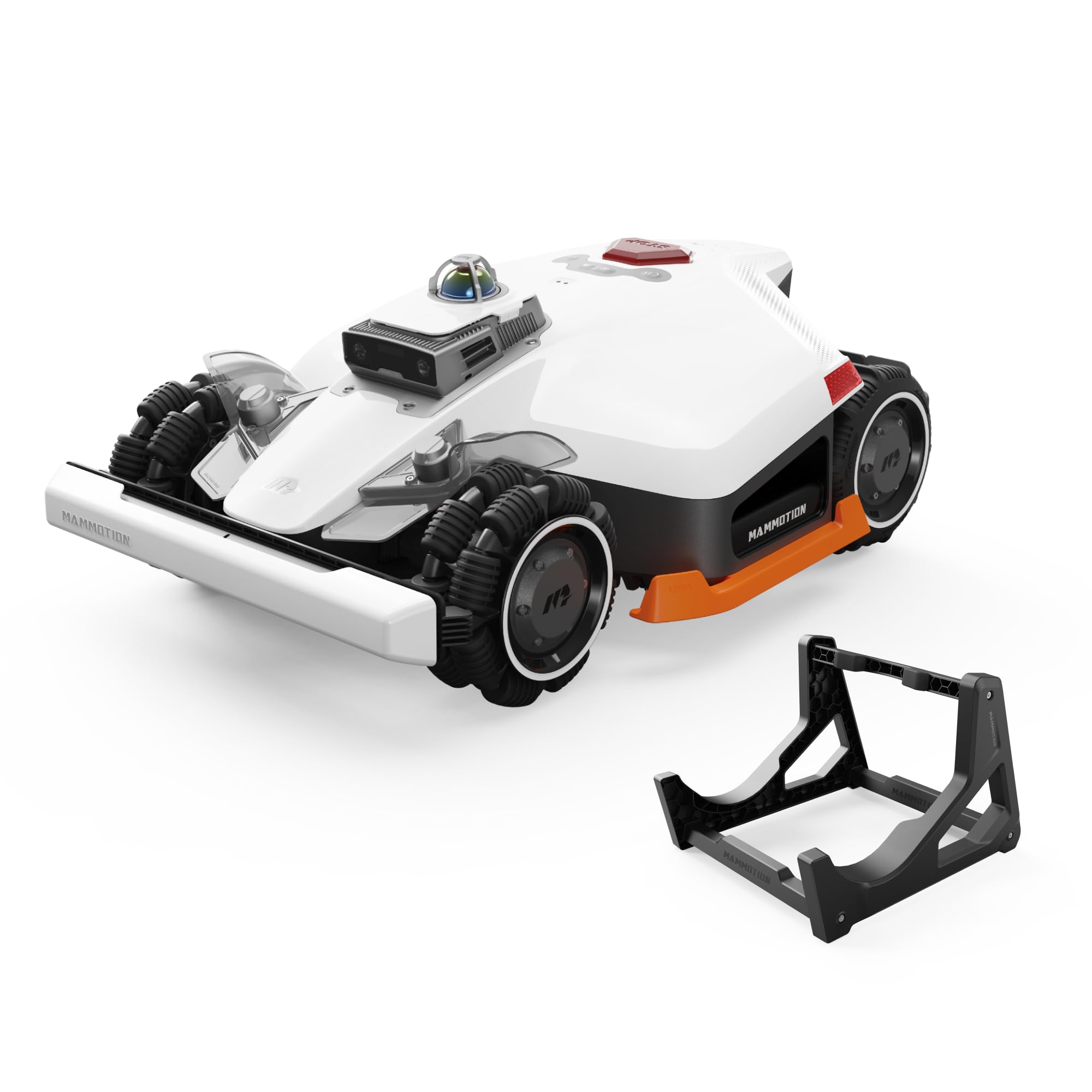
LiDAR, satellite correction, and AI vision fused into one all-wheel-drive climber.
Three sensing systems is the pitch here, and it matters on a slope where one system can fail. A 360° LiDAR scanner (a sweeping laser that maps everything from ground level up to tree canopies) pairs with NetRTK correction and dual-camera AI vision. The mower switches between them automatically, so losing line of sight under a tree does not mean losing its place. Four independently driven wheels climb slopes up to 80% (38.6 degrees), and an adaptive suspension steps over curbs and roots up to 50 mm high.
The cutting hardware is serious: two 165W motors spin six-blade discs across a 15.7-inch cut, backed by a battery that runs up to 175 minutes and covers up to 500m²/h. The LiDAR range reaches up to 230 ft, and the AI identifies over 300 obstacle types. You can set up to 30 mowing zones with no-go areas. A cleaning stand ships separately with the unit.
What people notice first is how energy-thrifty it is — the running cost is genuinely low versus gas — and how reliably it holds its mapped boundary. The honest gripe is evenness of cut: it lacks the grass-lifting suction of a conventional deck, so tall or wet grass can need a second pass, and heavy wheels push grass down. Set the height around 2.3 inches and consider a grid pattern if evenness matters to you.
What earns the praise
- LiDAR plus NetRTK plus AI vision keeps navigation steady on complex ground
- 80% slope rating handles genuinely steep yards
- 30 zones and no-go areas give fine control over a big property
- Very low running cost versus a gas mower
The honest shortfall
- Evenness of cut is the mixed point — tall or wet grass often needs a second pass
- No grass-lifting suction like a conventional deck
- Heavy, and the cleaning stand ships separately
The mower for you if: your steep lawn is complex enough that you want three sensing systems that back each other up.
Look past it if: you expect a putting-green finish in one pass — the cut is reliable but flatter, and taller grass will want a second run.
9. Mammotion LUBA 3 AWD 3000 Robot Mower (Alternate Listing)
The twin listing of the same LiDAR climber — same hardware, same 80% slope rating.
You will see this mower twice on the market, and it is the same machine under a second listing rather than a different model. Everything in the specs matches: the 360° LiDAR, NetRTK correction, and dual-camera AI vision; the four independently driven wheels that climb up to 80% (38.6 degrees); the 15.7-inch cut from two 165W motors; and up to 175 minutes of run time covering up to 500m²/h. The cleaning stand still ships separately.
The practical read is simple: check both listings before you commit, because the hardware is identical and only availability differs. On a steep yard this climber earns its keep — it pivots on an omni wheel for clean turns and steps over roots and thresholds up to 50 mm without stalling.
One real-world tip from living with it: use three-point turns to reduce turf tearing and ruts, especially on sandy patches. And as with its twin above, the cut is reliable rather than showcase-perfect, so tall grass can want a second pass. If the other listing is out of stock, this is your route to the same machine.
Identical twin: Same ASIN-level hardware as the pick above — the only reason to choose one over the other is which listing is actually available when you buy.
Same caveat: Even cut needs help from you — set a sensible height and pattern, and expect a second pass on thick growth.
Buy this one when: the sibling listing shows no stock and you still want the same 80%-slope LiDAR climber.
Compare first if: both are available — they are the same machine, so pick whichever is in stock and stop agonizing over it.
10. Mowrator S1 4WD 12Ah Remote Control Mower
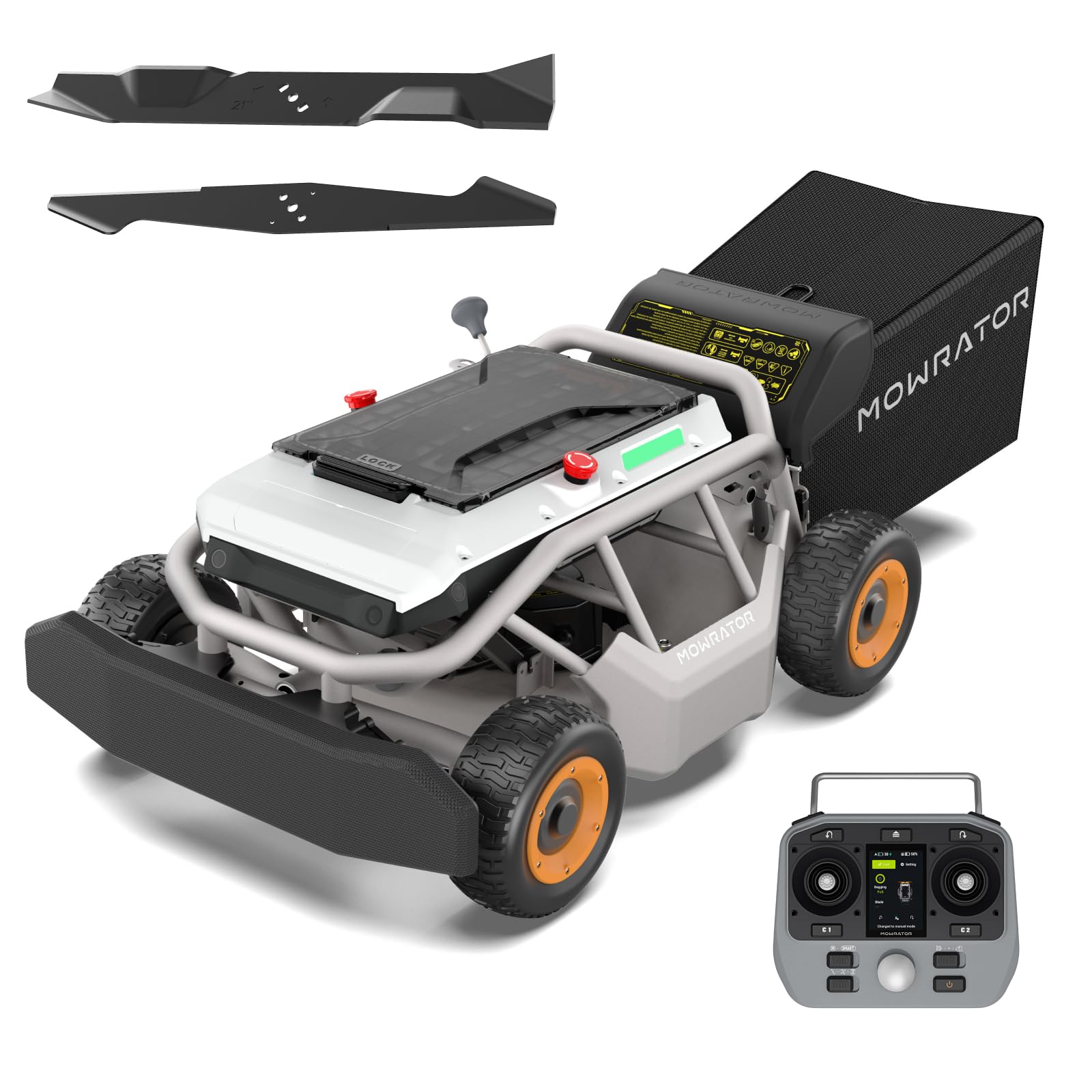
A joystick instead of a seat, and 4WD that climbs grades a riding mower cannot.
This one puts you on the ground with a remote in your hand while the machine does the climbing. A 1000W all-wheel-drive system drives it up slopes rated to 37 degrees (75%), and it clears ditches, pond edges, and tree roots. The blade motor peaks at 1985.6W with up to 3200 RPM, adjustable from the remote, and an FOC E-Brake stops it precisely. The low-latency remote responds in as little as 5 ms, so steering feels immediate rather than laggy.
The battery is a 56V 12Ah LiFePO4 pack (a lithium chemistry chosen for longevity) that covers up to 0.75 acres per charge with up to 1.5 hours of runtime, and the included 600W charger refills it in 70 minutes. It runs at just 63 dB and produces zero emissions. The 21-inch cutting width lifts grass before cutting, and it does mulching, rear discharge, and bagging.
What owners clearly enjoy is the traction — it “climbs steep hills a riding mower can’t” and has “great battery life,” as buyers describe it. The recurring weakness is the turning: a zero-radius turn can jump to full speed and dig into the dirt on a slope, so the joystick does not always modulate gently. It also needs a clear line of sight, and the sensors will occasionally halt it on simple ground. That is the price of remote control.
Why the remote works here
- 37° (75%) slope rating with a 1000W 4WD system
- 3200 RPM blade motor, adjustable from the remote
- Up to 1.5 hours runtime, recharged in 70 minutes
- Quiet 63 dB operation with no emissions
Where the control fights back
- Zero-radius turns can jump to full speed and dig into a slope
- Needs clear line of sight; sensors can pause it on easy ground
- Battery and runtime assume ideal grass conditions
Reach for it when: you want to stand safely below a steep bank and drive the cut with a remote.
Pass if: you would rather sit down or want smooth, gentle steering — the turn speed takes practice.
11. EGO Power+ TR4204 42″ Electric Riding Mower

Six swappable batteries and a 42-inch deck, with no belts to replace.
This is a serious electric riding mower for a moderate-grade yard. It combines up to six EGO 56V batteries for up to 20,000 watts — the maker rates it equivalent to a 21-horsepower gas engine — and comes with six 6.0Ah packs. A 42-inch stamped steel deck with dual brushless cutting motors means no belts to wear or replace. Cutting speeds reach 6 MPH, and there are 12 cutting-height positions from 1.5 to 4.5 inches.
On the hill question, this is a mower for gentle-to-moderate slopes, not a steep bank. That is why it sits toward the bottom of a slope-focused list. But as an electric riding mower it is well equipped: an LCD display with three blade settings, three drive speeds, and cruise control; LED lights; a USB port; Bluetooth; and a rear tow hitch. It works with all EGO 56V ARC Lithium batteries, and it carries a 5-year tool warranty.
The caution is battery reality versus the headline. The maker claims up to 1.5 acres on a charge, but owners mention draining much faster on a slope or in tall grass — one noted the capacity claim was optimistic after a partial cut on a slight incline, and 6.0Ah packs run down quickly. Handle the six batteries as a chore, charge in the tractor with the included adapter, and you will get along fine. It also rides firmer than a heavy gas tractor on rough ground.
What it does well: a belt-free brushless deck, six swappable batteries, and a full console of settings make this a comfortable, low-maintenance electric ride for a level-to-rolling lawn.
Set your expectations: the advertised acreage is optimistic on any slope, and the six batteries need management. On a genuinely steep bank, an all-wheel-drive machine is the smarter call.
The right buy if: your property is moderate and you want a true electric riding mower that shares batteries across EGO tools.
Choose differently if: your slope is steep or you want one-charge acreage without managing packs — battery life is the real limit here.
12. MechMaxx VBM86 Offset Ditch Bank Flail Mower
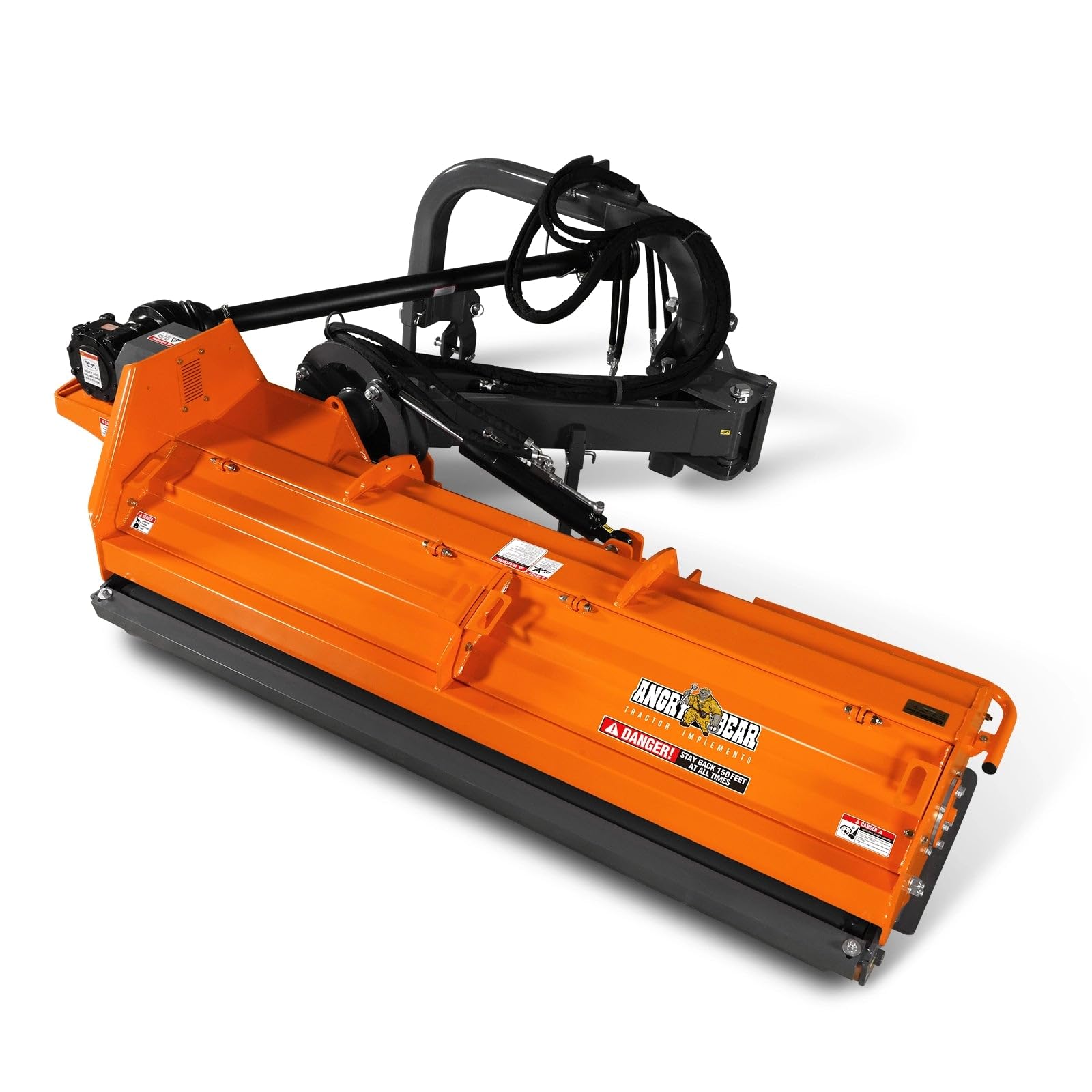
It does not climb the bank — it reaches sideways from a tractor already on top.
This is not a self-propelled mower like the rest of this list. It is not a self-propelled mower; it is a PTO-driven attachment (powered by your tractor’s power take-off) that hangs off a Category 2 tractor and reaches out over a bank. It pivots 90 degrees up and 55 degrees down, so you drive the tractor along the top of a ditch and the 86-inch flail head works the slope below. A 65HP CMR gearbox from Italy drives forged hammer flail blades.
For the right landowner this solves a problem nothing else can: it mulches material up to 6 inches in diameter in a single pass, shredding cuttings into a fine, fast-decomposing mulch that drops straight down. An adjustable rear roller sets the cutting height on uneven ground. It is heavy-built metal, and it makes quick work of banks, roadsides, ditches, and shorelines.
The catch is honest and practical: it only works if you already own a tractor with enough power. One buyer running a 32hp John Deere found it bogged down in thick grass and brush and wished for a bigger tractor. And the machine exceeds the lift gate on delivery — you must arrange your own forklift or unloading platform. Get it for real ditch and bank work behind a capable tractor, not for a residential lawn.
What it solves
- Reaches 55 degrees down and 90 degrees up a bank from the tractor seat
- Mulches material up to 6 inches in diameter in one pass
- 65HP Italian gearbox and forged hammer flail blades
- Adjustable rear roller keeps the cut even on uneven ground
What you must plan for
- Needs a Category 2 tractor with enough horsepower to drive it
- Bogs down in heavy growth behind an underpowered tractor
- Exceeds lift-gate delivery — arrange your own forklift or unloading platform
Made for: the landowner with a capable tractor who needs to mow banks, ditches, and shorelines that no self-propelled mower can reach.
Not your tool if: you do not own a tractor — this is an attachment, and it needs a proper power source to work at all.
Know the Specs
Slope ratings, in percent vs degrees
Manufacturers write slope ability two ways, and mixing them up makes a mower look safer or scarier than it is. A percentage is the rise over the run — a 100% slope is a full 45 degrees, while a 75% slope is about 37 degrees. When you compare a mower rated in percent against one rated in degrees, convert both to the same scale before deciding. A higher number means it is built to climb more, but always leave margin below the rating for wet grass and soft soil.
Drive type: 2WD, AWD, and tracks
Rear-wheel drive pushes only two tires, so a slick slope can break grip fast. All-wheel drive sends power to all four wheels for more traction and is the common setup among slope-rated robotic mowers. Tracked machines wrap a rubber belt around the drive, spreading weight and gripping soft, rough ground that stops a wheeled unit. On any drive type, tread pattern and grass condition decide the final result, so a wet slope is harder than the rating suggests.
Transmission and control
A hydrostatic transmission uses fluid to drive the wheels with no clutch pedal, which lets you hold a steady crawl downhill. A geared box needs more careful throttle work on a grade. On a remote-controlled mower, look at remote latency (the delay between your input and the machine’s response) — a low figure in milliseconds means tighter, more predictable steering on a slope.
Cutting height range and deck float
A wide cutting height range — say from around an inch up to several inches — lets you keep the deck high over the crowns of rolling ground so you do not scalp. A floating or adaptive deck follows the terrain instead of digging in. On robots, the height setting also affects cut evenness, so taller grass often calls for a higher pass first.
Common Questions
What slope percentage can a riding mower really handle?
Is all-wheel drive worth it on a sloped lawn?
Will a robot mower handle a steep hill or should I buy a riding tractor?
Do these mowers need a boundary wire or RTK station?
How do I stop a mower scalping grass on rolling ground?
Is a tracked mower better than a wheeled one on a steep bank?
How much runtime should I count on from a battery slope mower?
Can a robotic mower handle a sloped yard with trees and obstacles?
Can I run a slope mower in wet grass without losing traction?
How steep is too steep to mow safely?
The Bottom Line
For most sloped yards, the mower worth backing is the Husqvarna Z254F if your grade is moderate and mostly dry, because its 54-inch deck and hydrostatic drive cut a big lawn fast and clean. If your bank is genuinely steep, though, the climb becomes the whole job — and that is where the Segway Navimow X430 earns its place with an 84% slope rating and all-wheel drive that puts power to every wheel instead of sliding.
Want the slope handled without any wire or antenna install? Reach for the MOVA LiDAX Ultra 3000 and let its LiDAR map the yard on its own. And if your slope is so extreme that no wheeled mower should be on it, the tracked AIWEIYA crawler climbs a full 45 degrees while you steer from solid ground. On a steep yard, traction is the whole purchase — buy the machine that grips your worst bank, not your average one.
How we choose
We do not accept paid placement. Every pick is matched to a real buyer and a real use-case; we do not hands-on test units.
Sources
Specifications: manufacturer listings and product documentation. Review insights: verified customer reviews, as of October 2026. Pricing: not shown on this page (it changes often); check the current price via the retailer link.
As an Amazon Associate, Aappliancez earns from qualifying purchases. This does not affect which products we feature.