Disclosure: Some links in this post are affiliate links. As an Amazon Associate I earn from qualifying purchases, at no extra cost to you. Learn more
Specs are compiled from manufacturer listings and verified buyer reviews and can change over time — please confirm the key details on the product page before buying.
If your lawn has that one brown patch the mower always finds, the fix is usually the head, not the whole system. A sprinkler head decides how far water reaches, how evenly it lands, and whether the wind steals half of it before it hits the grass. Match the head to your spacing and pressure, and the rest of the watering routine falls into place. This guide covers the head styles that actually hold up across a full summer of cycles, with the real trade-offs each one carries.
This guide is built by comparing the manufacturers’ published specifications and the patterns across verified customer reviews, so you get each pick’s real strengths and trade-offs instead of marketing spin.
Some heads are built to be buried in a zone and forgotten, while others sit above ground and get dragged around the yard. The picks below are grouped by whether you’re replacing a buried head or buying a hose-fed sprinkler. Every pick below is a hands-on option to replace or upgrade your lawn sprinkler heads without tearing up the whole zone.
Top Picks


How To Choose The Best Lawn Sprinkler Heads
The first question to answer is whether you’re replacing a buried head or buying a portable sprinkler that sits on the lawn. Those are two different jobs, and a head built for one rarely does the other well. Once you know which camp you’re in, the rest narrows fast.
Buried head or portable sprinkler
A buried pop-up head threads onto a riser in the ground and retracts flush with the turf when the zone shuts off. It’s the right call if you already have a piped system and just need to swap a broken or worn head. A portable sprinkler connects to a garden hose and gets dragged or toed around the yard. It suits a garden bed, a small strip, or a rental where digging isn’t an option.
Spray distance and arc range
Spray distance is how far the water reaches from the head, listed in feet. Match it to the spacing between your heads so the patterns overlap rather than leaving gaps. Arc range is the fan of coverage — a full circle throws water all the way around, while a part-circle setting lets you aim water away from a driveway or fence. The wider the adjustable arc range, the more setups one head can handle.
Nozzle sets and precipitation rate
Precipitation rate is how fast water lands on the grass, and it’s controlled by the nozzle screwed into the head. A matched nozzle set lets you dial the rate up or down without swapping the whole head. Heads that ship with a nozzle tree give you options from the start; heads that ship bare mean buying nozzles separately. Check what’s in the box before you order.
Inlet thread size
The inlet is where the water enters — a 1/2-inch NPT threaded inlet is the common residential size, and it needs to match your riser or the head won’t seat flush. Portable sprinklers usually run a 3/4-inch hose fitting instead. Measure your existing connection before ordering so you’re not making a second trip for adapters.
Side-by-Side Comparison
| Model | Best For | Spray Distance / Coverage | Max Flow Rate | Inlet Size | Amazon |
|---|---|---|---|---|---|
| Rain Bird CP3504PC Rain Curtain Professional Rotor★ Best Overall | Buried zone replacement with adjustable arc | 15–35 ft | 15 gpm | 0.5 inches | Amazon |
| Orbit 55201 Pulse XL Pop-Up Impact SprinklerBest for Wide Gaps | Pop-up impact head for medium grass | 30–45 ft spacing | 4 gpm | 0.5 inches | Amazon |
| Eden 96093 Multi-Adjustable Flex Design Set | Custom garden shapes with riser extensions | Up to 1,020 sq. ft each | 4.8 gpm | 0.5 inches | Amazon |
| Rain Bird 1804VAN 1800 Series Pop-Up | Four-pack of fixed spray heads for a whole zone | Up to 15 ft | — | 0.5 inches | Amazon |
| STYDDI Metal Rotating 3-Arm Sprinkler | Hose-fed coverage for small lawns and beds | Up to 1,384 sq. ft | 5.5 gpm | 0.75 inches | Amazon |
Detailed Reviews
1. Rain Bird CP3504PC Rain Curtain Professional Rotor
Our pick — 4.5+★ from 750+ verified ratings; the strongest balance of quality and price.
The adjustable-arc workhorse that throws big droplets instead of a wasteful mist.
If you’re pulling a broken head out of a buried zone, this rotor’s 15 gpm flow ceiling and 40°–360° arc make it the strongest replacement on this list. It’s a gear-drive rotor — a head with an internal gear that turns the nozzle in a slow sweep — rated to 15 gpm (gallons per minute), the highest flow rate on this list. That headroom means it can push a big volume of water through a large arc without straining.
What wins people over is how simply it adjusts. A flat-head screwdriver sets the spray distance anywhere from 15 to 35 feet, and the arc runs 40° to 360° part-circle or reversing full-circle in one head. That range means one model covers a corner, a narrow strip, and an open lawn. The Rain Curtain nozzles it ships with produce large water droplets that resist windblown overspray and keep close-in watering gentle, which is what stops the dry ring right at the head. The whole unit is smaller than most pop-ups on this list — 2.18 x 2.18 x 6.88 inches — so it seats easily in a tight riser.
The honest catch is the nozzle tree. The six nozzles aren’t pre-installed, so you have to pick the right one and screw it in, and some owners have gotten a bag with no nozzles at all. Buyers report swapping out a dozen failed contractor rotors for this model in one go, which tells you the reliability story is real. The 1/2-inch NPT female bottom inlet is the standard residential thread, so it drops onto most existing risers without adapters. As owners put it: “Replaced 12 failed contractor Hunter rotors with Rain Bird CP5004PC Pro Rotors.”
What earns the top spot
- Adjusts 15 to 35 feet with a single flat-head screwdriver — no special tools
- 40° to 360° arc range in one head covers corners, strips, and full circles
- 15 gpm max flow handles a large zone without starving the pattern
- Rain Curtain nozzles throw big droplets that fight wind drift
- Quick-check arc feature lets you set the pattern while it’s running
Where it asks a little more
- Nozzles arrive loose in the box — you install the one you want yourself
- A few buyers opened a bag with no nozzle tree at all
- Buried install means digging to swap it, unlike a hose-fed unit
Built for: Anyone replacing a worn rotor in a piped zone who wants adjustable arc and a heavy flow ceiling.
Look elsewhere if: you want something you can drop on the grass without digging.
2. Orbit 55201 Pulse XL Pop-Up Impact Sprinkler in Canister
A pop-up impact head built to clear medium grass and reach across wide spacing.
Impact heads work on a different principle than rotors — a spring-loaded arm smacks the water stream and the recoil spins the head. The result is a distinctive pulse of water and a reach that can cross a big gap. This one covers up to 45 feet of spacing, and its 3-inch pop-up riser lifts the head above medium grass so the spray isn’t blocked by blades. That’s the practical win if you have a large yard with heads spaced far apart.
On paper the flow rate is modest — 4 gpm max — and the head itself is a compact 5 x 5 x 9.5 inches, so it threads into a 1/2-inch inlet and sits low in its canister. It’s made of plastic, which keeps it light at 15.2 ounces. The adjustment range lets you dial the distance and arc to suit the zone. Owners fit these as direct replacements for three worn heads at a time, and it’s been used as a stand-in for Rain Bird Maxi-Paw internals by swapping the lid to sit flush.
Here’s the trade-off worth knowing before you buy: impact heads are more mechanical than rotors, and the moving arm is the part that wears. The recurring note is that some units stop rotating or arrive without a full spray pattern, so check the box on arrival. The inlet size is also worth verifying — the listing shows a 1/2-inch and 3/4-inch option, but some batches ship only the 1/2-inch bottom, which means adapters and a deeper dig for a 3/4-inch setup. Get the right one and it’s a solid value for wide coverage.
Why owners reach for it: The 30 to 45 foot spacing reach and 3-inch pop-up give it an edge on wide-spaced, grassy zones where a low-spray head would get blocked. Quality and value come through as the strongest points.
The check worth making: Verify the inlet thread on arrival and watch the rotation — the moving arm is the part that gives trouble on a small share of units, and a 4 gpm flow won’t cover as much area as the 15 gpm rotor on this list.
Pick it for: Wide head spacing and medium grass where you need the spray to clear the blades.
Think twice if: you’re on a tight spacing and want the simplest, lowest-moving-part head available.
3. Eden 96093 Multi-Adjustable Flex Design Garden Sprinkler

For gardens that aren’t a rectangle — nine pieces you place exactly where the water needs to go.
Not every yard is a flat square lawn, and this set is built for the yard that isn’t. It’s a configurable system of spikes and heads — nine items in the box — that you place exactly where you need water, then adjust the spray angle from 5° to 360°, the direction, and the flow without pulling the spike out of the ground. That adjustability lets you build a layout that follows a flower bed’s curve or a raised garden’s edge instead of fighting a fixed pattern.
Each head covers up to 1,020 square feet at 60 PSI, and the combined system reaches up to 2,100 square feet depending on how you arrange it. The included three 5-inch riser tubes lift the spray over taller plants and shrubs so the lower foliage still gets water. Flow maxes at 4.8 gpm with a 1/2-inch inlet connection. The thing everyone raves about is how easy it is to set up and aim — quality and ease of use lead the feedback by a wide margin.
The real catch is the hose. Eden’s own garden hose model 94051EDAMZ is required and not included, and standard-thickness hoses run into trouble at the side ports. The ports want a light-to-medium, smaller-diameter hose; thick heavy-duty hose won’t fit, and you’ll be cutting and capping hose ends to build the run. That’s a couple hours of setup the listing doesn’t spell out. The other honest note: durability feedback is mixed, so roll it up and store it indoors over winter like the longtime owners do.
Where it shines: The 5°–360° spray range and 2,100 square feet of combined coverage let you water a curved bed and a patch of grass from one layout, and the riser tubes clear tall shrubs.
What to plan for: Budget the right smaller-diameter hose and an afternoon of setup — thick hoses won’t seat at the ports, and the hose is a separate purchase.
Reach for this if: your garden has an irregular shape and you want to place heads by hand rather than install a buried zone.
Skip the hassle if: you want a five-minute install — this is a build-it-yourself layout.
4. Rain Bird 1804VAN 1800 Series Pop Up Sprinkler Head
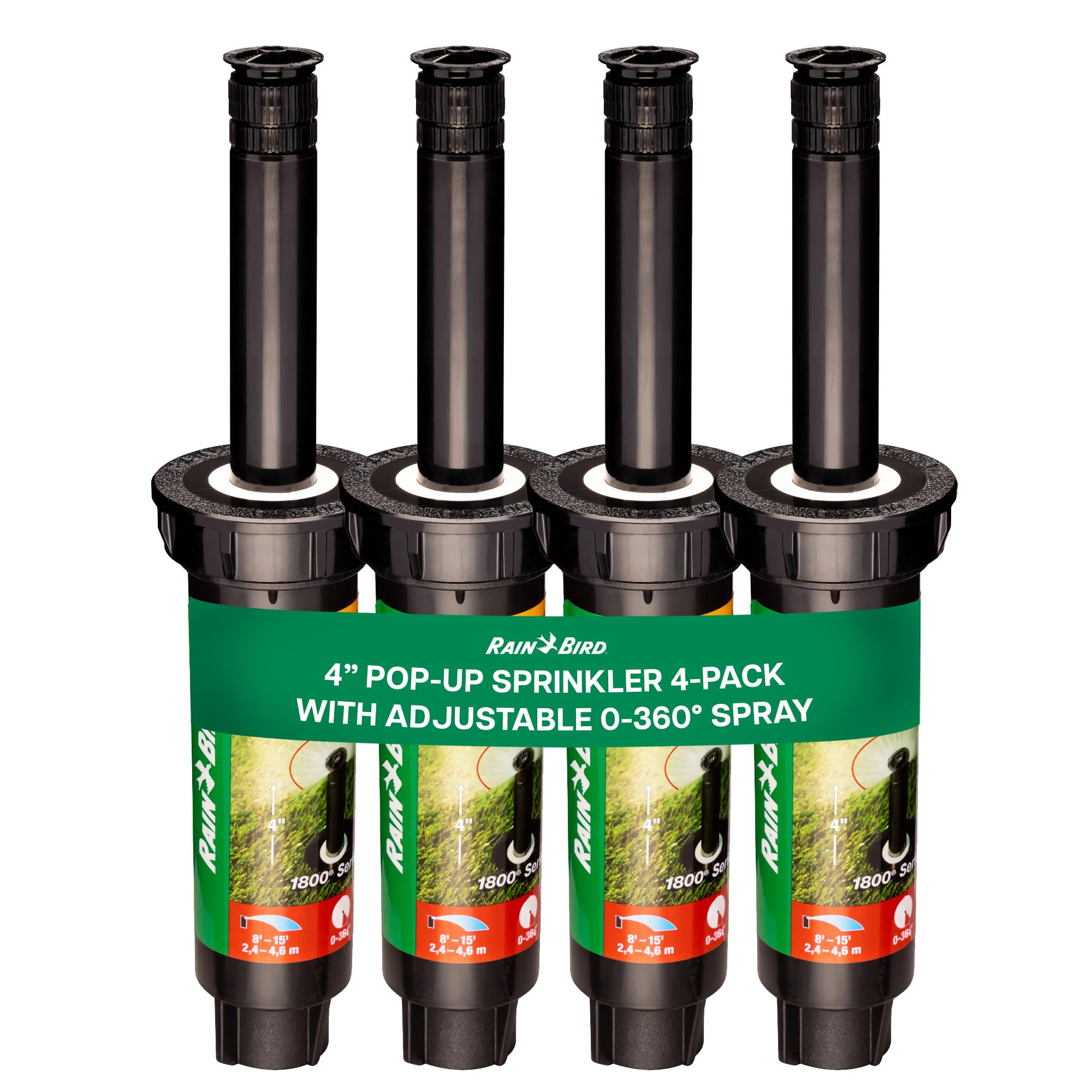
Four heads in one box, each with a no-tools arc collar you twist by hand.
When a zone needs more than one head replaced, buying singles gets old fast. This pack puts four 4-inch pop-up heads in your hands, and each one carries a textured adjustment collar you grip and twist to set the arc anywhere from 0 to 360 degrees — corners, narrow strips, or full circle, no tools required. The variable arc nozzle is what makes one box cover so many spots.
Each head throws a fixed spray up to 15 feet with matched precipitation, so heads in the same zone land water at an even rate across the lawn instead of leaving one strip soaked and the next dry. The 4-inch pop-up lifts the head clear of the turf, and the heavy-duty stainless-steel spring pulls it back flush every time the zone shuts off. A patented pressure-activated wiper seal keeps water from leaking around the stem. The 1/2-inch NPT threaded inlet drops onto standard residential risers. Quality and functionality come through as the strongest points in owner feedback.
The honest caveat: a fixed-spray head like this throws a set pattern rather than the adjustable-distance reach of a rotor, so it suits a set spacing you already have. Spray consistency gets mixed feedback — some owners want more even coverage than a fixed nozzle gives. And a few units in a pack occasionally arrive not popping up; the replacement service handles it, but it’s worth a quick test on install day before you bury anything. The 4-inch body is the tallest here, so it clears grass the shorter heads might not.
What the four-pack delivers
- Four heads per box so one order handles a whole zone
- 0–360° variable arc collar adjusts by hand, no tools
- 4-inch pop-up and stainless-steel spring retract flush every cycle
- Up to 15 ft matched-precipitation spray for even coverage
What to keep in mind
- Fixed-spray reach of 15 ft rather than adjustable distance
- Spray consistency draws mixed feedback from some owners
- An occasional head in a pack needs a replacement test on install day
Made for: Replacing a full zone of fixed-spray heads in one go, with a variable arc that handles any corner.
Not the call if: you need to fine-tune spray distance from 15 to 35 feet — a rotor does that better.
5. STYDDI Metal Rotating Water Sprinkler

All-metal arms that whirl across the yard, built to survive brutal sun.
The aluminum alloy base and three aluminum alloy arms are what set this sprinkler apart from plastic hose-fed units. The STYDDI is put together from an aluminum alloy base and three aluminum alloy arms with two plastic wheels and leak-proof brass fittings. That metal build suits a yard baked by relentless sun, where plastic sprinklers get brittle and crack. You connect a garden hose, turn the spigot, and the water pressure spins the arms like a pinwheel, spraying in a circular pattern that reaches up to 1,384 square feet.
A swivel coupling with a knob lets the head lay flat without fighting the hose, and a second connector lets you link several units off one spigot so a large lawn gets watered without moving anything. Owners mention it waters a larger area in about 30 minutes: “This sprinkler is great, waters a larger area in about 30 minutes.”
The catch is the spin. Rotation and leakage are the honest weak spots — the water pressure drives the arms, so anything blocking the spin stops the pattern, and this head needs fairly level ground to keep turning. Long grass touching the arms can stall it, and on a small share of units the arms arrive without clear spray openings. When the arms spin freely, it covers a small yard with a gentle, even spray that won’t beat up flower beds.
What stands out: The all-metal arms and base handle high pressure and hard sun where plastic models fail, and the 0.75-inch inlet feeds it a bigger flow than the 1/2-inch heads on this list.
The honest limit: It needs level ground and clear grass around the arms to keep whirling — a blocked or stalled spin kills the pattern, and durability feedback is mixed.
Best fit: Hose-fed watering of a small lawn or bed in harsh sun, where an all-metal body matters.
Pass on it if: your lawn is uneven or the sprinkler spot sits against tall grass.
Know the Specs
Flow rate (gpm)
Flow rate is how many gallons of water pass through the head each minute. A higher gpm head can push a bigger volume across a large arc without losing pressure at the far end. For a hose-fed portable sprinkler, flow depends on your spigot; for a buried head, it depends on the zone’s pressure. Match the head’s flow to what your system can supply, or the spray will fall short.
Spray distance and arc
Spray distance (in feet) is how far water reaches from the head, and arc is the fan of coverage. Full-circle throws water all the way around; part-circle lets you aim away from a driveway. Set the distance to match your head spacing so patterns overlap instead of leaving gaps, and set the arc to fit the shape of the zone.
Inlet size and thread
The inlet is the threaded connection where water enters. A 1/2-inch NPT threaded inlet is the standard residential size for buried heads, and it needs to match your riser. Portable sprinklers often use a 3/4-inch hose fitting. Measure the existing connection before you order so the head seats flush.
Nozzles and precipitation rate
The nozzle screwed into the head sets the precipitation rate — how fast water lands on the grass. A matched nozzle set lets you tune that rate without swapping the whole head. Heads that ship with a nozzle tree give you options; heads that ship bare mean buying nozzles separately. Check the box contents so you’re not caught short mid-install.
Common Questions
Will a Rain Bird rotor fit my existing buried riser?
What is the difference between a rotor and an impact sprinkler head?
How far should I space my sprinkler heads for even coverage?
Do the Rain Bird CP3504PC nozzles come pre-installed?
Can I run more than one STYDDI sprinkler off a single hose?
What hose do I need for the Eden 96093 set?
Why does my impact sprinkler stop rotating?
How long do pop-up sprinkler heads typically last?
Can I replace just the head without digging up the whole zone?
Is a fixed-spray head or an adjustable-arc head better for my lawn?
The Bottom Line
For most lawns, the lawn sprinkler heads winner is the Rain Bird CP3504PC Rotor because it adjusts from 15 to 35 feet, runs a 40° to 360° arc, and pushes up to 15 gpm through Rain Curtain nozzles that resist wind drift. If you want a hose-fed all-metal unit that survives brutal sun, grab the STYDDI 3-Arm Sprinkler. And for replacing a whole zone at once with hand-adjustable arcs, the Rain Bird 1804VAN four-pack is the one to reach for. Check your riser thread and existing spacing before you order to avoid a second trip for adapters.
How we choose
We do not accept paid placement. Every pick is matched to a real buyer and a real use-case; we do not hands-on test units.
Sources
Specifications: manufacturer listings and product documentation. Review insights: verified customer reviews, as of October 2026. Pricing: not shown on this page (it changes often); check the current price via the retailer link.
As an Amazon Associate, Aappliancez earns from qualifying purchases. This does not affect which products we feature.