Disclosure: Some links in this post are affiliate links. As an Amazon Associate I earn from qualifying purchases, at no extra cost to you. Learn more
Specs are compiled from manufacturer listings and verified buyer reviews and can change over time — please confirm the key details on the product page before buying.
Yellow underarms, grey pillowcases, socks that used to be white in another life — the fix is not always a jug of liquid bleach. A good laundry whitener lifts embedded grime, yellowing and body-oil residue without the fabric-eating harshness of chlorine, which is why more households now keep a powder or sheet instead of thin, hole-riddled t-shirts. The five products below cover the whole job: liquid sanitizers that strip odour at the source, oxygen powders that revive whites, and concentrated whitener sheets you toss straight in the drum.
This guide is built by comparing the manufacturers’ published specifications and the patterns across verified customer reviews, so you get each pick’s real strengths and trade-offs instead of marketing spin.
You’ll see which formulas work in cold water, which ones are safe around coloured trims, and which are gentler on fabric than the bleach you’re used to. By the end you’ll know exactly which best laundry whitener suits your wash routine.
Top Picks

How To Choose The Best Laundry Whitener
There’s no single best whitener for every load, because a crib sheet and a pair of grass-stained football socks need different chemistry. What matters most is matching the format — powder, liquid, or sheet — to the fabric you’re washing and the temperature you wash at.
Powder, liquid, or sheet — what each form does
A powder whitener dissolves in the drum and is the format that usually carries oxygen bleach plus enzymes, so it works as both a whitener and a stain booster. A liquid additive is poured into the fabric softener drawer or the rinse cycle, which makes it the easiest fit for anyone who doesn’t want to measure powder every wash. Sheets are the no-measuring option — you drop one in with the load and throw it away when the cycle ends. If you’re simply trying to make whites brighter and not chase specific stains, a sheet keeps the routine simple.
Check the temperature your washer actually runs
Whitening performance drops noticeably when the formula can’t activate in cool water. That’s why the product you choose needs to list the temperatures it works at — some oxygen powders and liquid sanitisers are explicitly built for cold washes, and that matters if you mostly run eco cycles. Warm or hot water usually speeds up whitening, but if cold is your default, only pick a whitener that states cold-water performance in its own details.
Side-by-Side Comparison
| Model | Best For | Format | Colour Safe | Chlorine Bleach | Amazon |
|---|---|---|---|---|---|
| Lysol Laundry Sanitizer Liquid★ Best Overall | Odour-heavy loads, towels and gym gear | Liquid additive | Yes, per label | 0% bleach | Amazon |
| Rit Dye Laundry Treatment Whitener and Brightener PowderGentlest on Trim | Whites with coloured trims or prints | Powder | Yes, per label | Chlorine free | Amazon |
| Binbata Eco Laundry Whitener Sheets 78 Count | Simple toss-in whitening for everyday loads | Sheet | For whites and lights, per label | Chlorine free | Amazon |
| Biz Laundry Detergent Powder, Stain and Odor Eliminator, Unscented, 37.5 Ounce | Boosters for grass, sweat and chocolate stains | Powder booster | Yes, per label | Chlorine free | Amazon |
| OxiClean Triple Action White Revive Laundry Whitener Powder | Whites, brights and canvas sneakers | Powder | Yes, per label | No chlorine bleach | Amazon |
Detailed Reviews
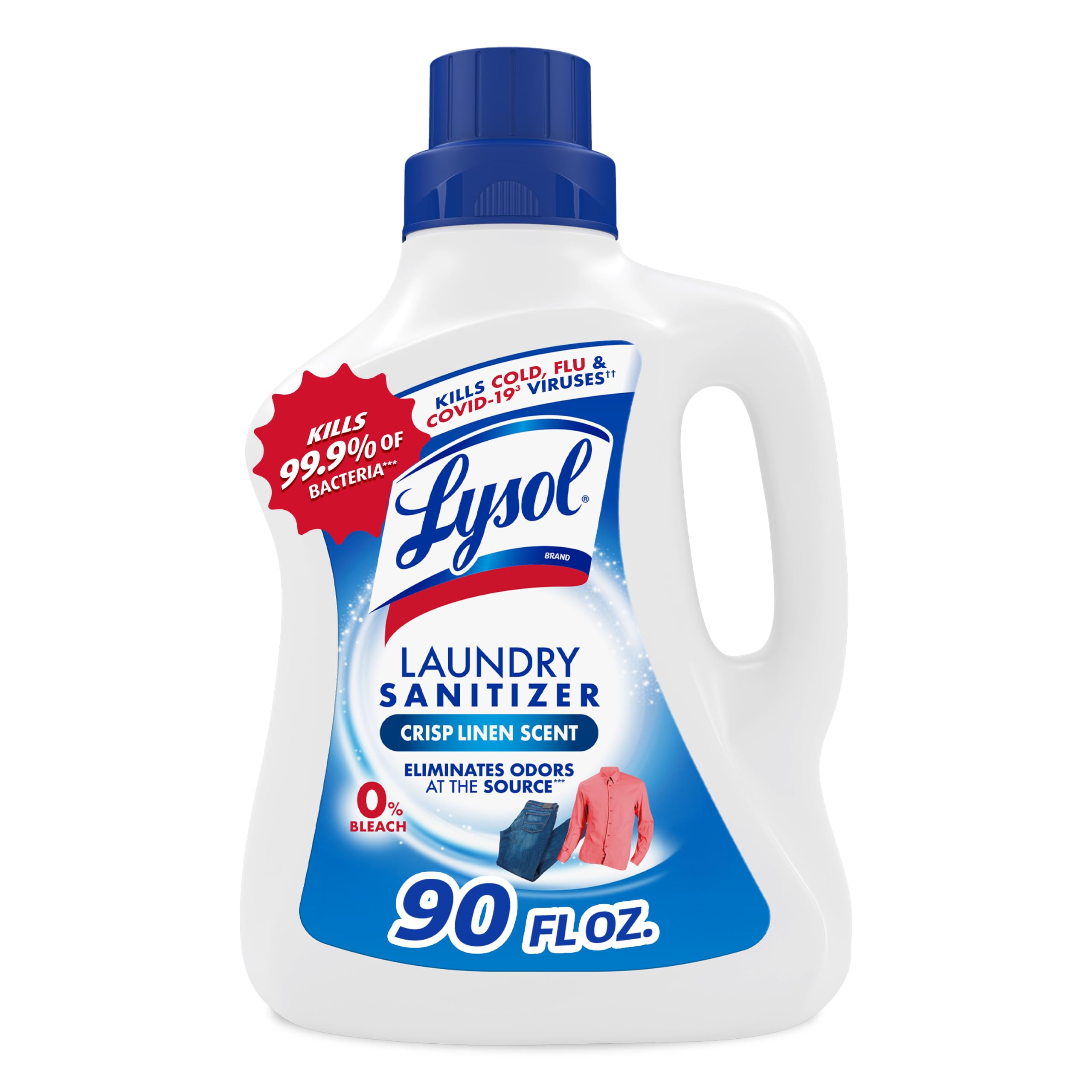
1. Lysol Laundry Sanitizer Liquid
Our pick — 4.5+★ from 113,500+ verified ratings; the strongest balance of quality and price.
Whites that look clean but still smell faintly of sweat are carrying bacteria your detergent left behind. This is a liquid additive (a pour-in that works alongside your regular detergent rather than replacing it), and the label states it kills 99.9% of bacteria on clothes, towels and sheets. That claim covers Staphylococcus aureus and Klebsiella pneumoniae tested at 21°C, plus Influenza A, Human Coronavirus and RSV when you use it as a pre-soak.
Its real whitening value is deodorant buildup and underarm stains, the residue that turns white shirts grey-yellow over time. Wash after wash, that residue is what turns crisp white into a tired grey-yellow, and a bacteria-targeting additive undercuts it at the source. It pairs naturally with an oxygen whitener: sanitize with this in the rinse, brighten with a powder in the wash.
The size difference here is real. This 90oz bottle measures 4.16 x 7.5 x 11.31 inches, while the Binbata sheet pack above runs 14.72 x 10.43 x 0.59 inches — genuinely different footprints on a laundry shelf. It’s also 0% bleach and labelled safe for whites and colours, delicates, undergarments, baby clothes and bed sheets, so it won’t strip colour the way chlorine can. Cold-water use is explicitly supported, which matters if your machine defaults to an eco cycle. The measuring cap holds 100 mL, and a full cap is what the label calls for on a front-loader.
What holds up in the wash
- Kills 99.9% of bacteria on laundry per the label’s own testing
- 0% bleach and labelled safe for whites, colours, delicates and baby clothes
- Works in cold water and in both HE and standard, front- or top-load machines
- 100 mL cap makes a front-load dose a single scoop with no mess
Where it asks a little of you
- It’s an additive, not a whitener on its own — pair it with a brightening powder for true white revival
- Top-load dosing differs from front-load, so you’ll need the pack instructions
Reach for this if: your whites are hygienically clean but still carry a smell, or you wash towels, gym clothes and bedding in cold cycles and want a bacteria-focused additive.
skip it if: you want a single product that does the whole whitening job — this handles odour and bacteria, and works best as one half of a two-step routine.
2. Rit Dye Laundry Treatment Whitener and Brightener Powder
A chlorine-free powder for whites with coloured trims and printed cotton
Most whiteners assume you’re washing plain white cotton. This one is formulated for the awkward middle ground: white shirts with coloured trims, printed cotton, and whites you can’t risk dunking in bleach. The formula is chlorine-free and concentrated, and the pouches are unscented. Each 1 oz pouch is sized for roughly 1 pound of dry fabric, or about 3 yards of medium-weight material, and the pack contains three of them.
It’s a genuinely niche strength, and it wins on two fronts: brightening dingy towels and delicate pieces without stripping the colour next to them, and pulling accidental dye transfer out of white fabric. The kind of mess that ruins a dress shirt — a load of dark clothes washed alongside something white — is exactly the scenario this powder is aimed at.
The honest limit is dosage scale. At 4 ounces of powder total across the 3-pack, this is a small-format product aimed at targeted rescues rather than a weekly whole-load whitener. The Binbata sheet pack weighs 9.14 ounces for comparison — 2.3× more product by weight. If you wash whites in every load, the pouch size will run out faster than a full-size powder will. A second caveat: the label says colour-safe and chlorine-free, but at least one cloth was ruined by a user who applied it to colours, and residue left in the drum can carry over to the next load. Keep this strictly on all-white items and run a rinse cycle after.
Where it stands out: a dedicated whitener that pulls dye bleed out of white stripes and brightens printed cotton — the kind of job liquid bleach simply can’t do without eating the colour.
The catch to size up: 4 ounces of concentrate across three pouches is aimed at targeted rescues, not the family’s weekly whites load.
Solid pick if: your problem is a specific dyed-white shirt, a dingy set of towels, or printed cotton that’s gone grey-yellow.
Not the one if: you want a single scoop for every white load in the house — buy the powder by the pound instead.
3. Binbata Eco Laundry Whitener Sheets 78 Count

78 unscented sheets you drop in the drum and throw away
If the reason you don’t use a whitener is the tidying-up afterwards — scoop, cap, powder trail on the shelf — this format removes that excuse. You drop a sheet in with the load per the label’s dosing rule: 1 sheet for general laundry, 2 for clothes with more grey shades, 3 for heavier loads like bedding and towels. Throw it away when the cycle ends. The pack gives you 78 sheets, and they’re biodegradable with no animal testing.
The low-effort build has real advantages. The compact packaging is designed to reduce 95% fuel consumption and carbon emissions during transport, per the maker’s claim, with zero plastic and zero waste as the target. The sheets dissolve into fine spherical particles the maker says disperse quickly and penetrate the fabric for deeper cleaning. They’re safe in HE machines and septic systems, and the whole package is unscented — no added fragrance competing with your detergent. The pack measures 14.72 x 10.43 x 0.59 inches and weighs 9.14 ounces, so it lies flat on a shelf or slides into a travel bag.
Be clear-eyed on what you’re buying. This is a low-cost entry to whitening sheets, and the review record reflects that: the aspect owners raise most is effectiveness, and it’s split, with some reporting whiter results than liquid bleach and others hitting yellowing they didn’t want. Some loads need a second sheet — a user reported that dingy items call for 2, while 1 sheet made theirs noticeably whiter with more improvement possible on the next wash. The maker’s do-not-use list is specific here too: avoid wool, silk, coated textiles, leather and upholstery.
Worth trying if: you want a no-measuring, low-carbon, unscented way to add whitening to ordinary loads and you’re comfortable adjusting the sheet count for dingy items.
Look elsewhere if: you’re chasing a heavy-duty revival on badly yellowed whites, or you wash wool, silk, leather or coated fabric — those are on the maker’s avoid list.
4. Biz Laundry Detergent Powder

The enzyme-and-oxygen booster for set-in sweat, grass and chocolate stains
Some whitening problems aren’t about whiteness at all — they’re set-in stains that make a white shirt look permanently mottled. This powder booster adds four stain fighters to your regular detergent: enzymes, powder detergent, oxygen bleach and whitening agents. It’s designed to be used on top of detergent, not in place of it, and it works at any water temperature in standard or HE machines.
The stand-out use pattern here is pre-treatment. The label supports three modes: a booster you add before the clothes, a pre-soak, and a pre-treat paste for the spots that won’t shift. That last option is what makes it different from the sheet and liquid formats in this list — you can concentrate this powder directly onto a stain, which the others can’t do. It’s colour-safe and chlorine-free, so it works on whites and brights without bleach harshness. It’s also unscented, which matters if you’re sensitive to added fragrance.
A recurring note from the review pages is that the powder delivers where dedicated stain removers struggle — sweaty underarms on coloured tops, dried-in sweat on air-dried fabric. It also does well on whites that yellowed from overuse of bleach itself. On value, opinions split: some find it a strong deal, others say it’s not. Worth knowing before you buy in.
What it’s built to do: four working agents stack cleaning on top of your existing detergent, and the pre-treat paste mode lets you concentrate the powder directly on a stubborn spot.
A trade-off to weigh: some owners feel the size-to-price doesn’t add up as neatly as the performance does — worth checking locally before committing to bulk.
The right call if: your whites are being dulled by specific stains — sweat, grass, chocolate, grease — rather than overall greying, and you want a booster that works as both a wash additive and a spot pre-treat.
Better fit elsewhere if: you just want brighter whites across every load with no stain-chasing — an oxygen whitener built for overall brightening does that more directly.
5. OxiClean Triple Action White Revive Laundry Whitener Powder
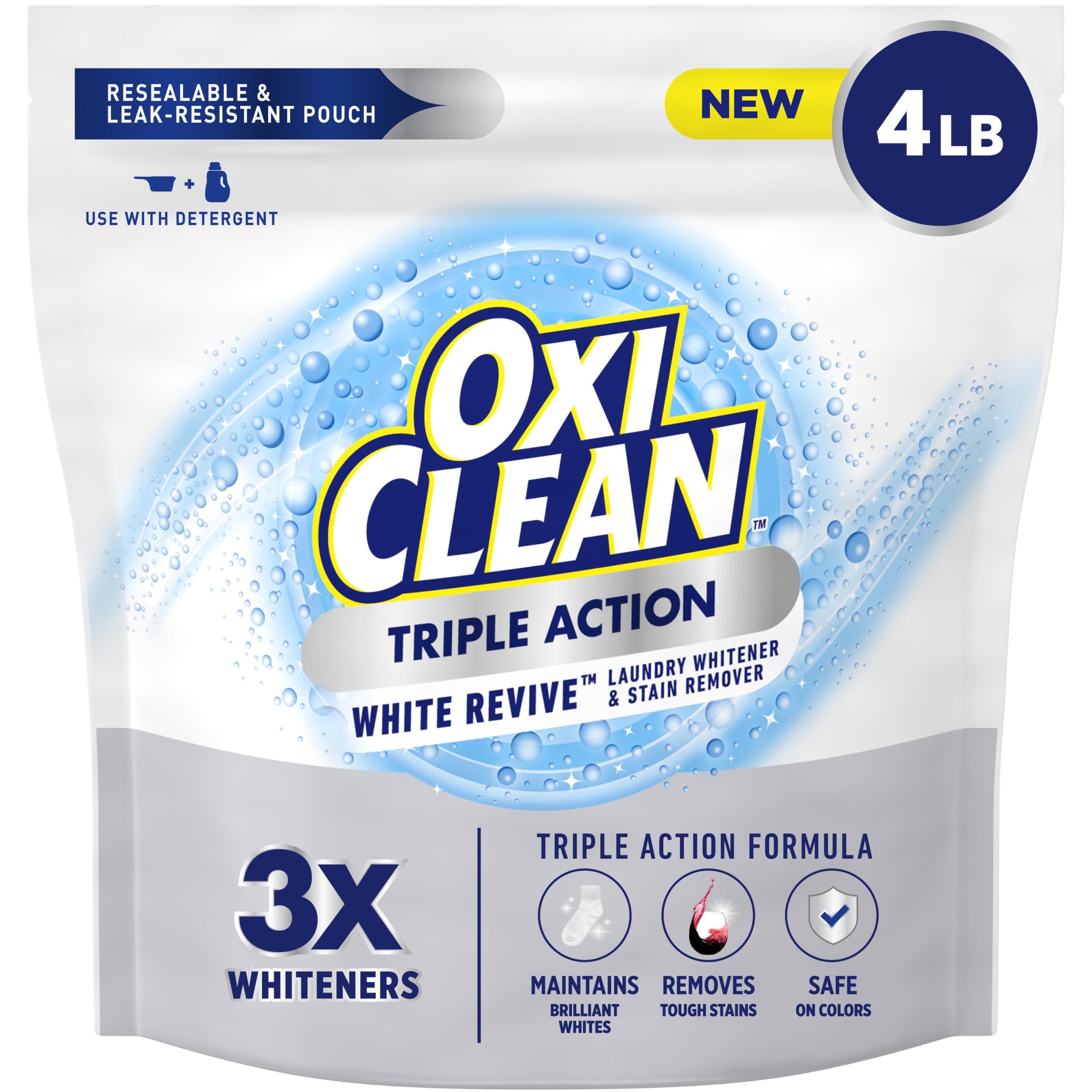
The 4 lb oxygen powder for whole loads of whites, brights and canvas sneakers
If your whites have gone that tired off-white that no amount of regular detergent will pull back, this is the powder built for the job. It’s an oxygen-powered whitener — meaning it brightens by releasing oxygen in water rather than using chlorine — and the label states it delivers 3X whiteners vs. the leading value detergent alone per load. It comes in a 4-pound resealable pouch, works in standard and HE washers at all temperatures including cold, and carries no chlorine bleach.
The stain list is unusually broad for a whitener: oil, grease, coffee, wine, chocolate, ketchup, berries, fruit juice, grass, mud, blood, ink and washable paint. Target fabrics include bedding, towels, socks, sports uniforms and canvas sneakers — the same pieces that tend to go yellow at the toe or the collar first. It can be used two ways: added to the wash with detergent before the clothes, or as a pre-soak for stubborn whites. The maker designed the pouch to be leak-resistant and ship-friendly.
Cold-water performance is the standout spec for anyone whose machine defaults to eco cycles — you don’t need to run hot to activate this whitener. The trade-off worth knowing: the scent divides owners. Some read it as clean and fresh, others find it stronger than they’d like. It’s described as three-in-one — brightening whites, brightening colours and removing stains — so a mixed white-and-bright load isn’t a problem.
Buy this one if: you want a high-capacity whitening powder that treats whites, brights and canvas shoes in the same wash and works in cold water without chlorine.
Choose differently if: heavy added fragrance puts you off — the scent is the most split point in the review pages, and an unscented alternative is the better pivot.
Know the Specs
What “chlorine-free” and “oxygen-powered” actually mean
Chlorine bleach whitens by a strong chemical reaction that can eat fabric fibres over time — which is why repeated bleach use leaves whites looking thin and yellowed rather than bright. Oxygen-based whiteners release oxygen in the water to lift stains and yellowing, and are typically gentler on fabric. If a label says “chlorine free” or “oxygen bleach”, it’s working the gentler route, which is why it’s often the pick for delicate items and repeated wash cycles.
Dosing by format — one scoop, one cap, or one sheet
Getting the dose wrong is the most common cause of disappointing results. Powder whiteners are measured by scoop into the wash or a pre-soak, liquid additives are poured by cap into the rinse or a presoak, and sheets are used per-load with a sheet count that scales with how dingy the load is. Match the format to your routine: cap-and-pour for rinse-cycle additives, scoop for stain-treating, sheet for no-measuring convenience.
Common Questions
Is a laundry whitener the same thing as chlorine bleach?
Can I use a whitener on whites with coloured logos or trims?
Will a whitener work in cold water?
How much of a whitener should I use per load?
Do whiteners remove stains as well as whiten?
Can I mix a whitener with my regular detergent?
Will a whitener damage delicate fabrics like wool or silk?
Can whiteners be used in a high-efficiency washing machine?
How long do whitener products last once opened?
Will a whitener work on greying caused by hard water or rust stains?
The Bottom Line
For most buyers, the best laundry whitener winner is the Lysol Laundry Sanitizer because it handles the yellowing and odour that detergent doesn’t touch — bacteria-fighting action in cold water without any bleach. If your priority is brightening whites with coloured trims or rescuing dye-stained white shirts, grab the Rit Dye Whitener. And for whole-load whites, bedding and canvas sneakers that need a heavier oxygen-powered hit, the OxiClean Triple Action White Revive is the one to reach for.
How we choose
We do not accept paid placement. Every pick is matched to a real buyer and a real use-case; we do not hands-on test units.
Sources
Specifications: manufacturer listings and product documentation. Review insights: verified customer reviews, as of October 2026. Pricing: not shown on this page (it changes often); check the current price via the retailer link.
As an Amazon Associate, Aappliancez earns from qualifying purchases. This does not affect which products we feature.