Disclosure: Some links in this post are affiliate links. As an Amazon Associate I earn from qualifying purchases, at no extra cost to you. Learn more
Specs are compiled from manufacturer listings and verified buyer reviews and can change over time — please confirm the key details on the product page before buying.
You want to know whether your pan, griddle or pizza stone is actually at the heat you think it is — and you want to know it without touching anything or guessing. A laser thermometer for cooking does exactly that, and the picks below differ mainly in temperature range, distance-to-spot ratio and whether they include a meat probe. Start with the Klein Tools IR07 up top: it reads surfaces from a distance and still has a fold-out probe for internal meat temps.
This guide is built by comparing the manufacturers’ published specifications and the patterns across verified customer reviews, so you get each pick’s real strengths and trade-offs instead of marketing spin.
Below are picks split by cooking job, a comparison table and plain-English spec explainers to help you choose the best laser thermometer for cooking.
Top Picks


How To Choose The Best Laser Thermometer for Cooking
For cooking, a temperature gun reads the surface of a pan, stone, griddle or oil from a safe distance — never the inside of a roast. That distinction decides if you need a probe model or a beam-only gun. If you mainly cook meat, you need a probe as well as a beam.
Distance-to-spot ratio and how far you stand
The ratio, written like 12:1, means for every 12 units you stand back from the target, the gun reads a circle 1 unit wide. A 12:1 gun held about 14 inches away measures a narrow patch, so you can pinpoint one burner zone. A wider ratio like 50:1 lets you measure a pizza oven floor from outside the mouth of the oven.
Temperature range versus what you actually cook
Most cooking jobs sit between freezing and 500°F or so. Frying oil and pizza ovens sit higher, and a kiln or forge sits far higher. Pick a range that covers your hottest job, because a gun that tops out low will error out at the top of your oven.
Emissivity and why shiny metal fools the beam
Emissivity is a number from 0.1 to 1.0 that tells the gun how strongly a surface emits heat. Bare or polished metal gives misleading readings, so adjustable emissivity lets you tune it for the surface. If you test bare cast iron or stainless, this setting matters more than the laser.
Surface beam or meat probe
A beam cannot tell you the middle of a chicken breast. If you cook roasts, poultry or thick chops, a 2-in-1 model with a fold-out probe gives you both surface and internal readings from one tool. For griddles, grills and oil, the beam alone is enough.
Side-by-Side Comparison
| Model | Best For | Temp Range | Distance-to-Spot | Probe Included | Amazon |
|---|---|---|---|---|---|
| Klein Tools IR07★ Best Overall | Surface plus internal temps | -40°F to 752°F | 8:1 | Yes | Amazon |
| MESTEK IR05AHigh Heat Pick | High-heat and industrial jobs | -40°F to 2912°F | 50:1 | Yes, K-type | Amazon |
| Etekcity Lasergrip 774Best Value | Quick everyday kitchen checks | -58°F to 842°F | 12:1 | No | Amazon |
| Kizen LP300 | Griddles, candy and ovens | -58°F to 1112°F | — | No | Amazon |
| TempPro TempScan CORE | Fast pan and vent checks | -58°F to 1022°F | 12:1 | No | Amazon |
| Etekcity Lasergrip 1080 | All-round kitchen and HVAC | -58°F to 1130°F | 12:1 | No | Amazon |
| ROOKPRO 2-in-1 | Grill and BBQ meat readings | 0°F to 1022°F | 12:1 | Yes | Amazon |
| TempPro TempScan PLUS TP450 | Pizza ovens and garage work | — | 16:1 | No | Amazon |
| Temirup IR02C-OR | Humidity and oven checks | -58°F to 1472°F | 12:1 | Yes, K-type | Amazon |
| Klein Tools IR5 | Dual-laser aiming precision | -22°F to 752°F | 12:1 | No | Amazon |
| ennoLogic eT650D | Certified professional work | -58°F to 1202°F | — | No | Amazon |
Detailed Reviews
1. Klein Tools IR07 Dual Infrared (IR) and Probe Thermometer
Our pick — 4.5+★ from 1,000+ verified ratings; the strongest balance of quality and price.
Beam the pan, then stab the meat — one small orange tool handles both readings.
Two tools in one pocket-sized body is the reason this sits at the top. The IR side reads surfaces from -40°F to 752°F (-40°C to 400°C), which covers frying oil, a hot griddle and a pizza stone with room to spare. The fold-out probe then takes contact readings in air vents, ducts and liquids, so you can check a pot of stock or a roasting pan without pulling a second gadget out of the drawer.
Aiming is helped by the target laser pointer, which marks roughly where the sensor is looking. The 8:1 distance-to-spot ratio (a spec that says how wide a circle the gun reads at a given distance) means the beam widens faster than a 12:1 gun. Stand close over the pan and the reading is tight; stretch your arm out across a hot oven and you will read a broader patch, which for cooking is usually fine and more accurate than guessing.
The whole thing weighs 1.44 ounces and measures 6.5 inches long — matched against the Etekcity 774’s 4 ounces and 6.14 inches, it is the lighter but slightly longer of the two. Accuracy is what carries this one: it is the quality that wins people over most, followed by how easy it is to carry around the house. The recurring honest note is durability, with a small share of buyers seeing one fail early; treat the housing with a little care and it holds up as a general tool.
The honest trade-off comes buried in the fine print: this is a non-medical device and is not intended for use on people or animals, so ignore any temptation to point it at a forehead. It also ships with a custom pouch and batteries, so it is usable the day it arrives.
probe and IR together
- IR and contact probe in one 1.44-ounce body
- -40°F to 752°F range covers oil, griddles and ovens
- T1-T2 differential mode compares two readings fast
- Pouch and batteries in the box
emissivity fiddling
- 8:1 ratio reads a wider patch than a 12:1 gun
- A few owners see one give out early
- Not for body temperature
dual-tool pick: you want surface and internal temps from one tool and you are cooking on the griddle one night and roasting the next.
probe-only fans: you only ever point at a hot pan and a plain beam would do the same job for less.
2. MESTEK Infrared Thermometer High Temperature Gun, 50:1 Dual
For pizza ovens and kilns where the wall is far hotter than any pan.
Nothing on this list reaches as high. The IR side measures from -40°F to 2912°F (-40°C to 1600°C) with an average accuracy of ±2%, so a wood-fired oven floor, a kiln or a forge is well inside its comfort zone. The included K-type thermocouple probe then handles contact work from 14°F to 932°F (-10°C to 500°C) at ±1.5% average accuracy, which is where it earns its keep for food and griddle testing.
The 50:1 distance-to-spot ratio is the standout number for cooking. Stand well back from a roaring oven and the gun still reads a narrow circle rather than a wide smear of hot air, so you can check the stone without holding your hand near the flames. Dual non-contact lasers mark the target, and a reading lands in about 0.5 second. It also throws MIN/MAX/AVG/DIF modes, high/low alarms and adjustable emissivity from 0.10 to 1.00, all on a color backlit screen.
Owners rate it as a quality tool, with surface temperature the one argument point — most trust it and a few feel the numbers drift from other measurements. The one honest caution worth knowing is the laser alignment. Buyers report “laser sights are severely misaligned from IR optics”, and fixing that takes real effort since the lasers sit in factory-glued ball joints. For most cooking the beam is a rough pointer and the emissivity setting does the accuracy work, so this matters more if you rely on the laser dot being exact.
50:1 far focus: if your cooking tops out at a skillet, you are paying for range you will never use — but if a pizza oven or kiln is on the menu, few guns get near 2912°F.
dot size guesswork: the laser is a pointer, not a precision reticle, so trust the emissivity setting and the reading rather than the red dot.
long-distance buy: high-heat cooking, oven floors and workshop jobs where 752°F would not be enough.
close-range cooks: you want a dead-centre laser dot as your main aiming guide.
3. Etekcity Infrared Thermometer Laser Temperature Gun 774
The cheap, light gun that still tells you if the oil is ready.
If you want one simple job done well — reading a hot pan, a griddle or a pot of frying oil — this is the value pick. It reads from -58°F to 842°F (-50°C to 450°C), a range that covers every stovetop and oven task in a home kitchen. The trigger pulls a readout onto the backlit LCD in under half a second, and the 12:1 distance-to-spot ratio means a tight reading at around 14.17 inches from the surface.
A detail worth understanding: this model displays the average temperature of the circle the sensor is reading, not a single point. That makes it steadier on a wide griddle, though it means the number reflects the patch, not one pinpoint spot. The max-temperature display lets you catch the hottest reading in a sweep across the pan. It runs on two AAA batteries, both included.
Accuracy is honest but not lab-grade — owners mention it can sit “off by ~2–3°F vs other measurements—fine for approximate use, not for high precision.” For cooking, 2–3°F rarely decides whether a steak or a pancake comes out right, so most people will never notice. It weighs 4 ounces, its one real cost against the lighter Klein IR07 at 1.44 ounces, so it lives in a drawer rather than a pocket.
kitchen all-rounder
- -58°F to 842°F covers everyday cooking
- 12:1 ratio reads a tight patch up close
- Sub-half-second display on a backlit screen
- Batteries included
high-heat ceiling
- Readings can drift a few degrees from other tools
- 842°F ceiling rules out pizza ovens and kilns
- No meat probe
starter kitchen gun: frying oil, griddle zones and oven checks on a tight budget.
searing needs: you cook on a pizza stone or want a probe for roasts, which this cannot do.
4. KIZEN LP300 Infrared Temperature Gun
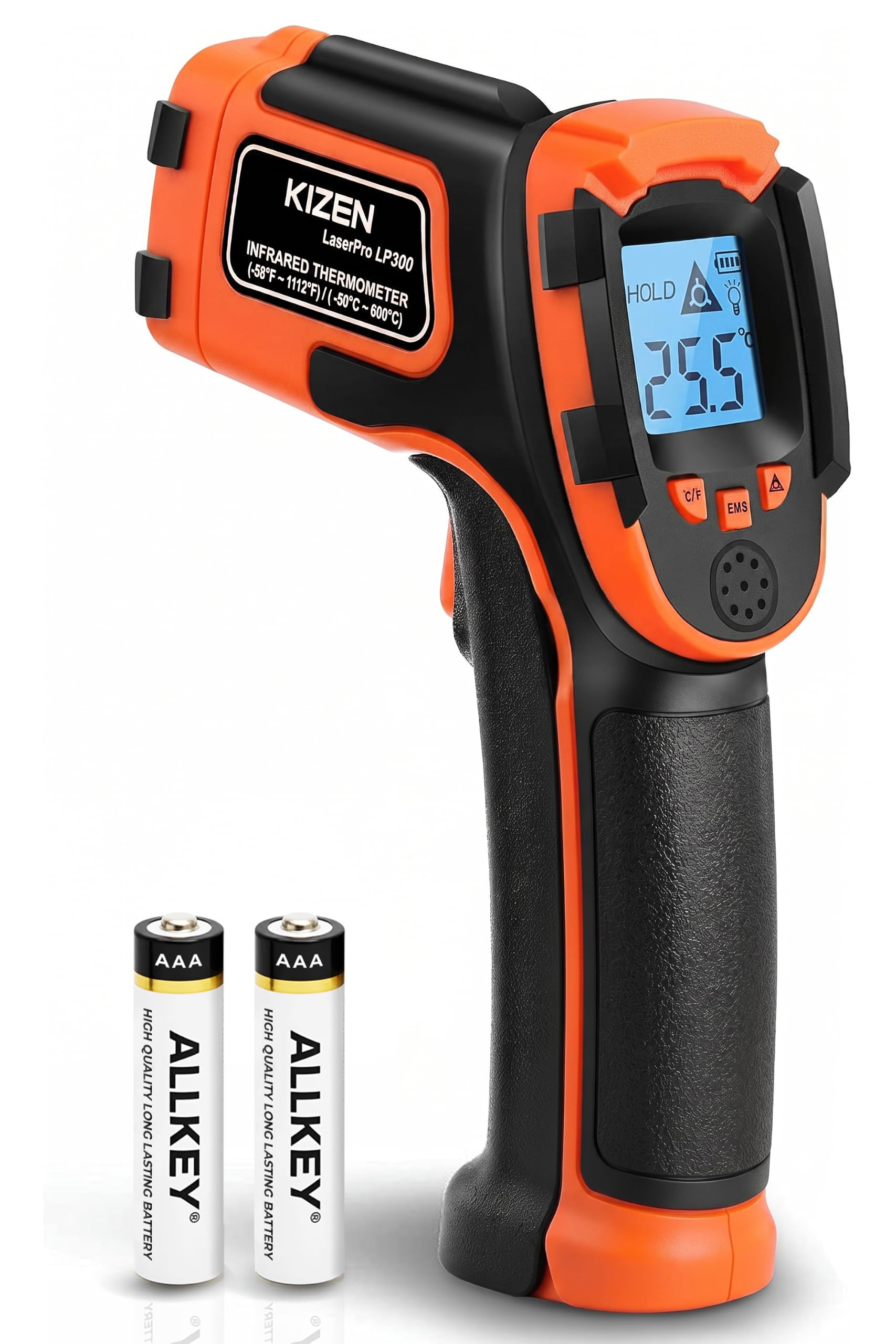
The one candy makers and soapers reach for when a few degrees break a batch.
Candy, chocolate and soap making reward a tool that reads fast and reads a specific spot. This gun hits -58°F to 1112°F (-50°C to 600°C), which comfortably clears the high side of sugar work without tip-toeing near its limit. Emissivity runs from 0.1 to 1.0, so you can tune it for a shiny metal pan or a matte surface and get a consistent number either way. The display is a large backlit LCD that stays readable on a dim countertop at night.
Aiming is helped by the laser dot marking the spot, and the recommended stance is about 14 inches from the target. The trigger reads instantly on release, then the gun auto-offs to save battery. It ships with two AAA batteries, so nothing stands between you and the first test batch. Build is plastic and light, which is normal at this point on the shelf — this is not a shop-floor tool, it is a kitchen-counter one.
The honest limit is precision expectation. The build is inexpensive and the readings are close rather than certified, so a candy maker who needs absolute accuracy should treat the number as a strong guide, not a lab result. For most home cooks, the fast trigger and adjustable emissivity outweigh a few degrees of drift at this price.
instant read speed: a quick trigger pull and a bright screen mean you can check a pan and pull it off the heat before a delicate batch scorches.
narrow temp band: plastic housing and close-enough accuracy — great for hints and zones, not for a certified reading.
fast-check pick: candy makers, chocolate temperers and grill and griddle cooks who want speed.
candy makers: you need a probe to check meat or a certified reading for records.
5. TempPro TempScan CORE Infrared Thermometer Gun
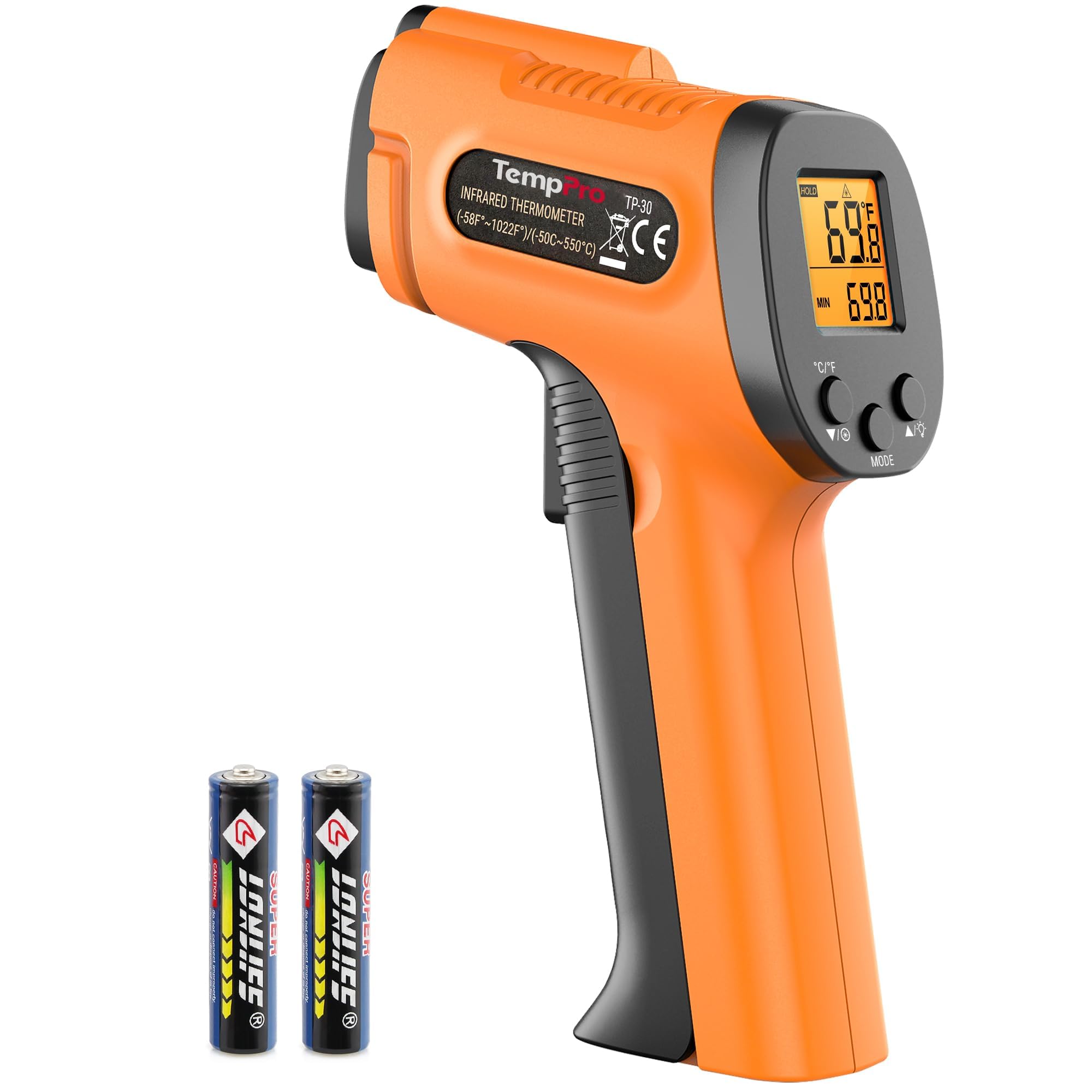
A one-press gun for grill, griddle and AC vents with a tidy little body.
Short trigger presses are what people love about this one — squeeze, glance, done. TempPro builds it around a thermopile sensor rated to ±1.5% accuracy, with emissivity adjustable from 0.1 to 1.0 so you can match the surface you are reading. Range is -58°F to 1022°F, wide enough for grill and oven work, and the 12:1 ratio plus a response time under 500ms means readings appear the instant you pull the trigger.
The screen shows MAX/MIN/AVG of the last scan, which is handy when you sweep across a griddle looking for the hot end. The backlit LCD is easy to see in low light, and the gun auto-offs after 90 seconds of no activity so the two included AAA batteries last. It is one of the smaller options here at 3.74 inches long and 128 g, so it tucks into a drawer or a grill side shelf without taking up room.
Reliability and ease of use are the two things that keep this one in a bag on jobs across cooking, vents and car engines. The trade-off is that it is a surface-only tool with no probe and no extreme high-heat range, so if your pizza oven runs hot or you want internal meat readings, you are looking at a different pick. For everyday cooking checks and home repairs, it does the job without fuss.
everyday scanner: the cook who also checks air vents, engine bays and fridge temps with the same tool.
barbecue purists: with no probe, it will never tell you the centre of a roast.
6. Etekcity Lasergrip 1080 Infrared Thermometer

The kitchen workhorse that does oil, pizza ovens and fridge checks in one pull.
This is the crowd favorite — 4.5+ stars across 37,000+ owners — and it earns that on range and simplicity. It reads -58°F to 1130°F (-50°C to 610°C) and returns a number in 0.5 seconds, with a max display so a quick sweep shows the hottest spot. The 12:1 distance-to-spot ratio means a tight read at about 14.17 inches, and the backlit LCD carries a °F/°C toggle for anyone switching units.
What wins people over, above everything, is build quality — this is the quality most owners talk about, ahead of how it functions and how accurate they find it. The number 1080’s appeal is durability for the money: it gets bounced around a kitchen, a garage and an HVAC kit and keeps reading. The professional EMS mode with an emissivity range of 0.1 to 1.0 lets you adjust for different surfaces, and a 15-second auto-off plus a low-battery indicator keep it usable when you grab it months later.
The honest trade-off is a matter of aiming. The laser is a pointer and the reading reflects the patch in front of the sensor, so keep your distance steady and re-check on reflective surfaces like polished steel. It is longer and heavier than the compact picks — 6.4 ounces — but that bulk is part of why it feels solid in the hand for cooking checks and automotive work alike.
wide useful range: 1130°F takes you to pizza oven and frying-pan temperatures without leaving the display blinking an error.
surface-only reads: reflective surfaces can need a close, steady aim, so re-read shiny metal rather than trusting one pull.
safe default buy: one gun that reads pans, ovens, oil, air vents and engines without a second purchase.
internal temp seekers: no probe, so pair it with a separate instant-read for thick cuts.
7. ROOKPRO 2-in-1 Infrared Thermometer Gun with Meat Probe

A BBQ tool for the cook who wants the grill surface and the meat middle.
This one is built around a single idea: one tool for the whole cookout. The IR sensor reads surface temps at a 12:1 ratio with a response under 500ms, so you can scan the grill grate for hot zones. The 180° fold-out stainless probe then takes internal readings to ±1°F in about 0.5 second, across a range from 0°F to 1022°F. For a backyard cook that covers oil, pizza oven, and a thick steak alike.
Reliability is what buyers value most here, ahead of temperature control. The shape is easy to hold, the backlit screen is big, and the fold-out probe stores away so it does not jab at you in a drawer. Auto shut-off and a data-hold function round out the daily handling. It also handles household tasks beyond the grill — checking a pool, an engine or an air conditioner — so it earns keep on more than barbecue season.
The honest part is a word of caution on precision and longevity. Some owners question the accuracy, and a share report the unit failing after light use. Set your expectations to a home-grill tool rather than a workshop instrument. The 2-in-1 idea is good, so use the probe for meat and the beam for the grate, and treat it as the practical tool it is.
bbq companion: cooks who want one pocket tool for surface and meat temps on the same cookout.
indoor-only cooks: you need certified precision or a tool that lives in a work truck.
8. TempPro TempScan PLUS TP450 Infrared Thermometer

Two lasers and a 16:1 beam take the guesswork out of where you are aiming.
Dual lasers change the aiming game. Two dots frame the measurement circle as they converge at the target, so you see the patch you are reading rather than hoping one dot is centred. Combined with a 16:1 distance-to-spot ratio, you can measure a hot pizza oven floor from outside the mouth without standing in the heat. Accuracy is rated to ±1.5% with emissivity adjustable from 0.1 to 1.0 for different surface types.
The response time of 0.5 seconds keeps the flow quick, and the MAX/MIN/AVG display lets you track fluctuation in a smoker or check that an engine is cooling as it should. This is a kitchen-and-garage crossover: pizza ovens and griddles up front, HVAC vents and overheating engine parts behind. It runs on two AAA batteries, both included, and the backlit display stays legible in low light.
Owners describe it as hands-on friendly, with intuitive buttons and a clear screen, and it proves especially handy for outdoor pizza ovens. The honest limit is that this is a surface beam only — no probe and no humidity reading — so meat internal temps and moisture checks need a different tool. For a pizza-oven cook or a home DIYer who wants a precise aim, the double laser earns its place.
precise laser aiming: two converging lasers make it easy to frame the exact circle you want on a stone or a grate.
no meat probe: surface-only, so pair it with a probe if meat doneness is part of your cook.
aim-focused pick: pizza oven cooks and DIYers who want the reading to land where the dots say it will.
probe hunters: you need internal meat temps from the same tool.
9. Temirup IR02C-OR Infrared Thermometer
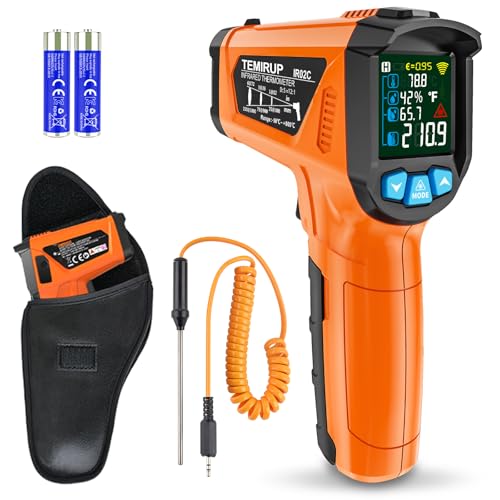
A do-everything gun that also reads humidity, dew point and spoilage risk.
Feature-loaded is the fair description. The IR side reads -58°F to 1472°F (-50°C to 800°C) at up to ±1.5% and a sub-half-second response, and a K-type probe adds contact readings for food and surfaces. A French HTU20 sensor and a laser head show ambient temperature and humidity, dew point and spoilage temperature alongside the surface and interior readings. For a cook who also monitors the pantry, fridge and wood store, that is a lot of utility in one body.
The HD color VA display with backlight is easy to read in low or no light, and the unit switches between °C and °F, holds MAX values and shows a low-battery indicator. Auto-off at 25 seconds protects the battery life, rated at 8 hours.
The honest catch is that this is a surface and contact tool, not a medical or body-temp device, and the many modes take a bit of learning before you instinctively know which screen you are on. Owners tend to praise the readable display and the broad temperature range once they settle in. Add the 24-month support and the included K-probe, and it is a strong bundle for the hobbyist who likes to measure everything.
tinkerer’s choice: bakers, BBQ fans and home inspectors who want surface, probe and humidity readings from one gun.
set-and-forget users: you only want a fast pan reading and would rather not learn the menus.
10. Klein Tools IR5 Infrared Thermometer
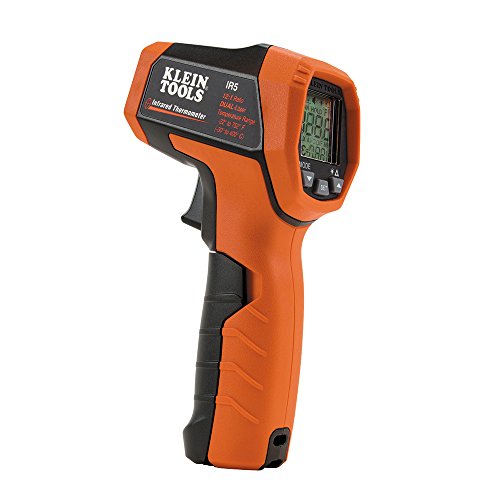
Built like a shop tool, with dual lasers that frame the reading spot.
This is the twin-laser sibling of the top pick, and it shows in the build. The body is well-made and durable, and reliability is the thing that keeps people coming back to it. It reads -22°F to 752°F (-30°C to 400°C) with a 12:1 distance-to-spot ratio, so cooking tasks at grill and oven level sit comfortably in range without the extreme-heat headroom. The dual targeting laser helps you place both edges of the measurement circle on the target before you commit to a reading.
The feature set is built for the working user rather than the kitchen gadget buyer. Auto scan, max/min/avg/diff modes, high/low alarms, a backlit display, auto power off and adjustable emissivity from 0.1 to 1.0 all come standard. It is 6.82 inches long and 0.3 kg, heavier than the pocket guns and clearly meant to be held with authority in a garage or on an HVAC job. It works within a couple of feet and reaches further with the laser for aiming.
The honest read is that precision and value split opinion. Some find the readings inconsistent and the price high for what you get, and the battery life and dual lasers get mixed marks — general function is what people praise, not lab-grade accuracy. If you want a rugged tool that reads surfaces across the shop and the stove, it fits; if you want a cheap single-purpose kitchen gun, the value pick up the list suits better.
rugged dual targeting: a solid, well-made body that survives being tossed around a garage or a job site.
premium price tag: readings can vary and the price is premium for a 752°F ceiling, so buy it for the build if at all.
tool-first buy: for the workshop user who wants a tough gun that doubles for surface cooking checks.
budget shoppers: you want maximum temperature range or a tight kitchen-cheap budget.
11. ennoLogic eT650D Temperature Gun with NIST Certificate

The only pick here shipped with a calibration certificate, for work that needs one.
Step into the premium tier and the value shifts from cooking speed to accountability. The eT650D ships with a NIST traceable calibration certificate, a 10-year warranty, and FDA and FCC compliance — the paperwork a food-safety inspector or facilities team needs on file. Range is -58°F to 1202°F, with dual lasers and adjustable emissivity for accuracy on varied surfaces. Scan and Hold, High and Low alarm, and Min, Max and Average displays are all there for real work.
The certificate version is the one to pick if you need the paperwork — the certified option includes a certificate with a set validity period, so check which option you are choosing. Hands-free mode and a large bright backlight make longer inspection sweeps easier, and the certification is what closes the deal for professional buyers. As a cooking tool it also reads oil, oven walls and range tops with high accuracy, and the Scan mode lets you watch oil temperature rise toward a smoke point you set as an alarm.
Owners describe it as performing like pricier instruments and find it good value despite the premium tier. The honest caveat is practical: read distances around 8 inches can be tricky in tight spots, and the 9V battery connector has been fiddly for a small share of users. For a home cook it is overkill; for a professional buyer or a serious pizza and BBQ cook who wants certified precision, it is the tool worth paying for.
certified-proof pick: professional users and certification-dependent cooking where a traceable reading matters.
casual cooks: unless you specifically need the certificate, a value gun does the cooking job.
Know the Specs
Distance-to-spot ratio
This number, shown like 12:1 or 50:1, tells you how wide the measurement circle is at a given distance. At 12:1, standing 12 units back reads a circle 1 unit wide; at 50:1 the circle is far narrower. A tight beam lets you read one pan zone instead of the whole stovetop. For cooking at close range, a 12:1 gun reads a tight patch around 14 inches away, which is why most kitchen guns use it.
Emissivity
Emissivity is a number from 0.1 to 1.0 that describes how strongly a surface gives off heat for the sensor to read. Shiny or polished metal reflects heat and can fool the beam; matte surfaces read reliably. Adjustable emissivity lets you set the gun for the surface in front of you, so a cast-iron pan and a stainless one both give numbers you can trust.
Temperature range
Pick a range that clears your hottest cooking job. A pan or griddle is well within range for most guns, but frying oil, pizza ovens and kilns push higher. A gun that tops out below your target will show an error, not a number, so check the high end against the hottest surface you plan to measure.
Response time and modes
Response time is how fast the display updates after you pull the trigger, often under half a second. MAX/MIN/AVG modes let you track the hottest, coolest or average reading across a sweep — handy for finding the hot end of a griddle. A high/low alarm warns you when a surface crosses a set line, useful for oil at its smoke point.
Common Questions
Can a laser thermometer read the inside of a roast or chicken?
What temperature range do I need for a pizza oven?
Why does my gun give a false reading on shiny metal?
Does the laser dot show exactly where the gun is reading?
Can I use one of these to check frying oil temperature?
Can I point a cooking thermometer gun at a person or pet?
How far should I hold the gun from the food or pan?
Is a 2-in-1 thermometer worth it over a plain surface gun?
What does NIST certification on a thermometer actually mean?
Do these guns work on a cold fridge or freezer?
The Bottom Line
For most cooks, the laser thermometer for cooking winner is the Klein Tools IR07 because it covers both surface and internal temps from one small tool, with a probe that reaches where a beam cannot. If you want a simple, dependable kitchen gun for the pan and the oil, the Etekcity Lasergrip 774 does the everyday job well. For pizza ovens and far higher heat, reach for the MESTEK IR05A with its 2912°F ceiling.
One honest nudge: if you are cooking meat, pick a 2-in-1 over a surface-only gun. The Klein IR07’s fold-out probe tells you your steak’s internal temp, not just that the grill is hot.
How we choose
We do not accept paid placement. Every pick is matched to a real buyer and a real use-case; we do not hands-on test units.
Sources
Specifications: manufacturer listings and product documentation. Review insights: verified customer reviews, as of October 2026. Pricing: not shown on this page (it changes often); check the current price via the retailer link.
As an Amazon Associate, Aappliancez earns from qualifying purchases. This does not affect which products we feature.