Disclosure: Some links in this post are affiliate links. As an Amazon Associate I earn from qualifying purchases, at no extra cost to you. Learn more
Specs are compiled from manufacturer listings and verified buyer reviews and can change over time — please confirm the key details on the product page before buying.
A laser pointer is only as good as the dot you can actually see at the back of the room. Buy the wrong one and your green dot washes out on a bright projector screen, or your rechargeable battery dies halfway through a lecture. The eight options below are the ones worth your attention, sorted by what they are actually built to do — classroom presentations, everyday carry, workshop pointing, weapon mounting, or thermal inspection.
This guide is built by comparing the manufacturers’ published specifications and the patterns across verified customer reviews, so you get each pick’s real strengths and trade-offs instead of marketing spin.
Some of these are presentation clickers with a laser built in, some are flashlight-and-laser hybrids, and one is a thermal camera with a pointer for targeting. Start with the use case, then check the laser class and battery type. The eight entries below cover the realistic spread of options, so you can stop guessing and find the right fit for laser pointers.
Top Picks

How To Choose The Best Laser Pointers
Before you pick a laser pointer, decide what the pointer has to do. A presentation remote and a weapon-mounted laser share almost no parts. The right pick depends on the job.
Beam color decides whether the dot survives room lighting
A red laser is fine in a dimmed room but can vanish on a bright projector screen. A green beam at 532nm (the wavelength printed on some of these listings) reads far more visible to the human eye under ambient light. If you present in lecture halls with the lights on, the beam color matters more than any other spec.
Laser class tells you the output ceiling
Handheld laser pointers sit in class 3R or class IIIA, both meaning the beam output stays at or below 5mW (milliwatts, a measure of light power). That ceiling is what makes a pointer legal to point with and safe to sweep across a whiteboard. If a product lists a much higher output, it is not a presentation pointer.
Battery type sets your daily routine
A USB-C rechargeable pointer charges from the same cable as your phone. An AAA-powered remote can run a claimed 12 months on one battery. Both are valid choices — the question is whether you would rather hunt for batteries or find a cable before a class.
Mounting only matters if the laser rides a rail
Weapon light and laser combos attach to Picatinny or M-LOK rails. The specs that matter are rail length fit, weight, and whether the dot holds zero (stays where you aimed it) after recoil. Desk pointer buyers can ignore all of it.
Side-by-Side Comparison
| Model | Best For | Laser Color | Power Source | Max Range | Amazon |
|---|---|---|---|---|---|
| OLIGHT ArkPro★ Best Overall | Everyday carry | Green | USB-C + magnetic | 205 m (light) | Amazon |
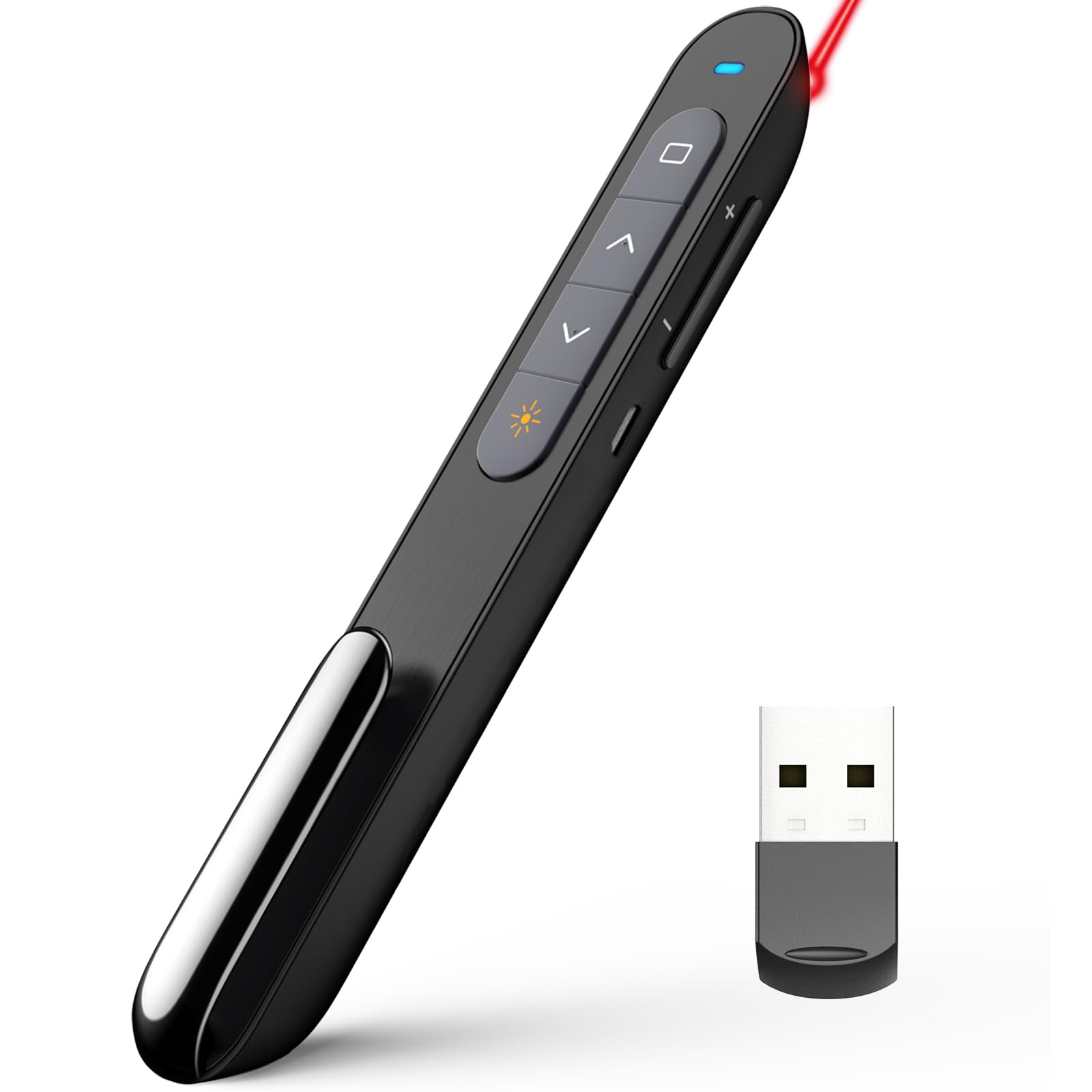
| Norwii N76Classroom Standard | Teachers and classrooms | Red | Rechargeable 360mAh | 328 ft wireless | Amazon |
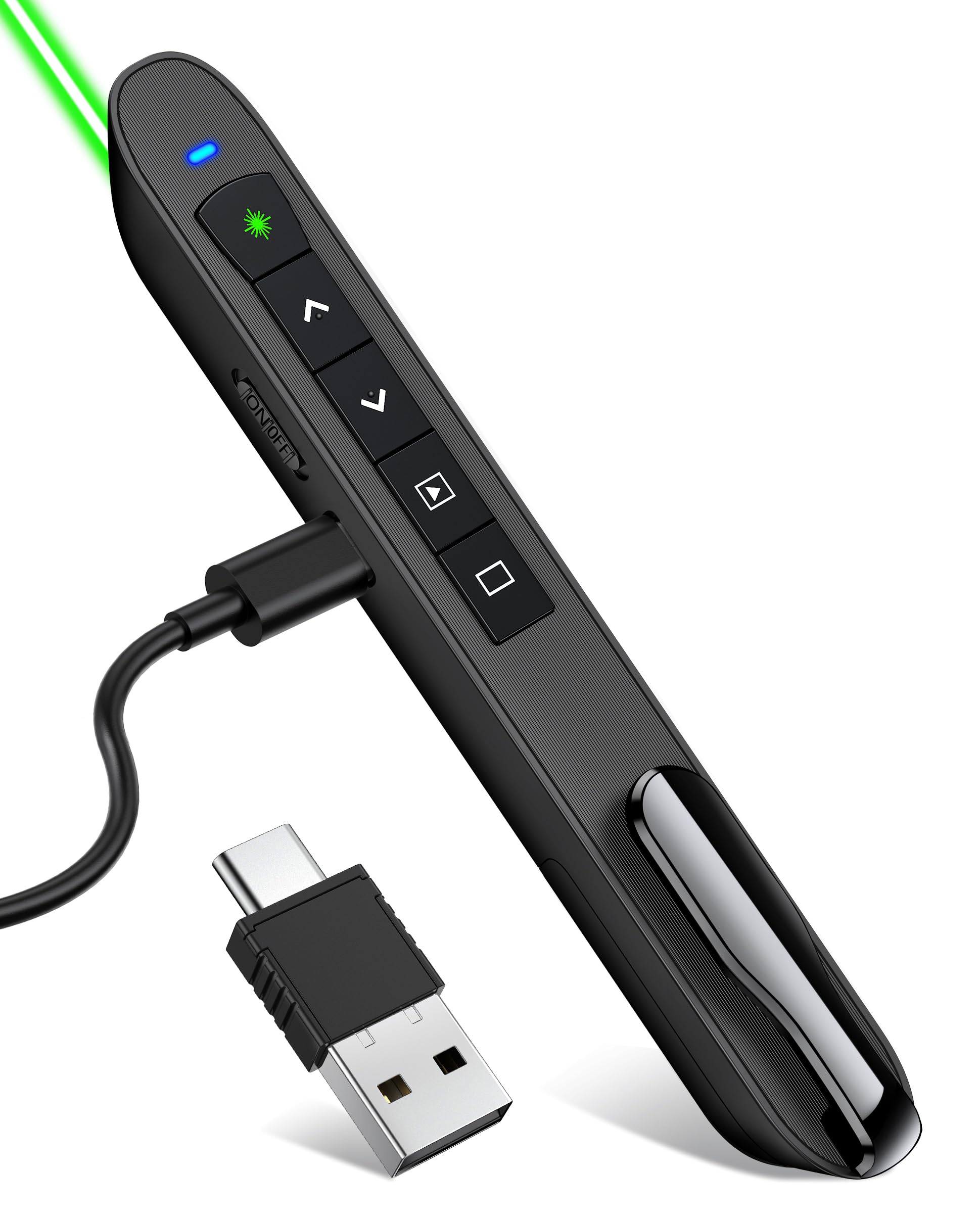
| TITIANCOOL Green ClickerBest for Big Rooms | Large lecture halls | Green 532nm | USB-C rechargeable | 50 m | Amazon |
| Logitech R500s | Hybrid USB/Bluetooth use | Red | AAA battery | 20 m | Amazon |
| DEFENTAC 1600 Combo | Rail-mounted rifles | Green | Integrated rechargeable | 2000 m (laser, night) | Amazon |
| Klein Tools 56074 | Electricians and mechanics | Green 510–530nm | USB-C rechargeable | — | Amazon |
| GOPLANT 1750 Combo | Home defense pistols | Green 510–530nm | Magnetic rechargeable | 500 m (laser) | Amazon |
| HSFTOOLS HF96 | Thermal inspection | Laser pointer (targeting) | Built-in rechargeable | — | Amazon |
Detailed Reviews
1. OLIGHT ArkPro EDC Flat Flashlight
Our pick — 4.5+★ from 1,500+ verified ratings; the strongest balance of quality and price.
A green pointer, a floodlight, and a UV beam folded into a pocket wedge the size of a pocketknife.
If you want one tool that points, lights, and checks for stains, the ArkPro is the pick here. Its green beam sits at ≤5mW in class 3R (the standard ceiling for a handheld pointer), and it runs on independent control — you tap the dedicated green button and the beam fires separately from the white light.
The headline output is a 1500-lumen floodlight, paired with an 800-lumen spotlight that reaches 205 meters. That reach makes a hallway or tree line readable at night, and it puts the presentation clickers in a different category entirely. Buyers report the laser reaches roughly 500 feet at night and around 535 feet indoors, so it works as a pointing tool in a large space — not just across a conference table.
Charging is dual-path: USB-C or the magnetic charger, with up to 14 days on moonlight mode. The flat body carries a dual-direction clip and a magnetic tailcap, so it clips to a hat brim or sticks to a steel panel for hands-free work. On moonlight mode, one charge covers a six-night Scout camp trip.
What the pocket crowd loves
- Green beam plus 1500-lumen floodlight and UV in one flat body
- Up to 14 days runtime on moonlight mode
- Dual charging via USB-C and magnetic pad
- Dual-direction clip and magnetic base for hands-free use
Where the honest math lands
- The 1500-lumen top level drains battery and heats the head
- Premium-tier pricing puts it above every other pick here
- Green beam is the only pointer color — no red option
Worth it if: you want a pointing beam, a real work light, and UV in one daily-carry tool.
Think twice if: a presentation-only remote is all you actually need.
2. Norwii N76 Presentation clicker
Ten feet of freedom for a classroom, not three — a red dot on a rechargeable stick.
The number that earns this pick its spot is 328 feet of wireless control range. That 328-foot range lets you change slides from the back of a lecture hall, unlike short-range remotes that drop signal a few rows from the laptop. It reaches through walls and cabinetry courtesy of radio-frequency pairing, not infrared line-of-sight.
Power comes from a built-in 360mAh rechargeable battery that fills in 2 to 3 hours. A full charge carries weeks of class sessions, and the pocketable 1.05-ounce body slides into a shirt pocket without a bulge. The clicker pairs to Windows, macOS, Android, Linux, and ChromeOS, and it controls PowerPoint, Prezi, Keynote, and Google Slides without installing software.
Six buttons cover slide forward, back, hyperlink clicks, and volume, and you can remap the keys through the Norwii Presenter software if the stock layout does not suit. Teachers are the loudest fans — one summarized it in a single line: “love it! light weight, easy to use! worth it for teachers!” The red dot is the one honest weak point; it is bright, but it lacks punch on a lit screen.
Why the classroom wins: the 328-ft range and week-long charge mean you can pace a room and never think about the remote.
The catch: red laser output is the mildest part of this remote — on a wash of room light, expect a fainter dot.
Grab it for: lecture-hall teaching, training classes, and anyone who walks while presenting.
Pass if: you present on a lit LCD wall where only a green beam reads clearly.
3. Green Light Presentation Clicker
A green dot built to survive the back of an auditorium, not just a small conference table.
Here the pitch is simple: 532nm green light. That specific wavelength is the reason the dot reads crisp on a projector screen and whiteboard where a red beam fades. It is the same physical principle the ArkPro leans on with its green beam, and it is what makes this clicker the pick for a 200-seat lecture hall rather than a six-person meeting room.
Wireless range is 50 meters, and a single 1-hour USB-C charge is rated to power weeks of daily presentations. The USB-C cable comes in the box, so the AAA-battery scramble on the morning of a class is gone. Setup is plug-and-play — the receiver snaps magnetically into the clicker when not in use, so it does not get lost in a bag.
Buttons handle slide advance and back, hyperlink clicks, window switching, black-screen toggle, and side volume. Six buttons give you slide, hyperlink, window, black-screen, and volume control without touching the laptop. The honest caveat is the screen-blank button sitting directly below the advance button; the layout works, but a thumb can find the wrong one mid-sentence. The receiver’s protruding dual-sided USB dongle also juts out of a laptop.
The winning detail: 532nm green — a beam that stays visible under room lighting where red dots disappear.
One rough edge: the blank-screen button sits close to the forward button, so slow your thumb on the transition.
Built for: teachers and trainers who present under lights in a large room.
Check first: if your laptop has no USB-A port and the dual dongle does not seat cleanly, plan for a snug fit.
4. Logitech Wireless Presenter R500s

The remote with a spare identity — Bluetooth when you have no port, a USB receiver when you have no pairing.
Logitech builds this to work either way: USB receiver or Bluetooth low energy, and the receiver docks inside the remote body so it does not rattle loose in a laptop bag. That dual path is what makes it the one pick here that travels well across a MacBook, an iPad, and a conference-room PC without a dongle swap. The 20-meter range covers a 65-foot room, which is medium-to-large territory, not a stadium.
Battery life is a claimed 12 months on a single AAA. When power drops, the R500 goes into a power-saving mode that disables the laser to stretch the remote for about a week more — a small smart touch that buys time before you hunt for a replacement cell. The laser is red, so it behaves like the Norwii’s: clear in a dim room, weaker under strong light.
The Logitech Presentation App (Mac and PC only) lets you remap buttons, watch battery level, and set an on-screen timer. Three buttons mean less to learn than the six-button remotes above, and the next-slide button is the large one — a deliberate layout choice owners notice immediately. The honest limit is reach: in long rooms the Bluetooth drop-off shows up sooner than the rated number suggests.
Best attribute: dual connectivity plus a docked USB receiver — one remote that adapts to whatever podium you inherit.
The trade-off: the 20-meter range is the shortest of the group, so treat big halls with caution.
Reach for it: when you switch between a tablet with no USB-A port and a laptop that prefers a receiver.
skip it if: you need a green dot, because the R500s only carries red.
5. DEFENTAC 1600 Lumens Green Laser Light Combo for Rifle
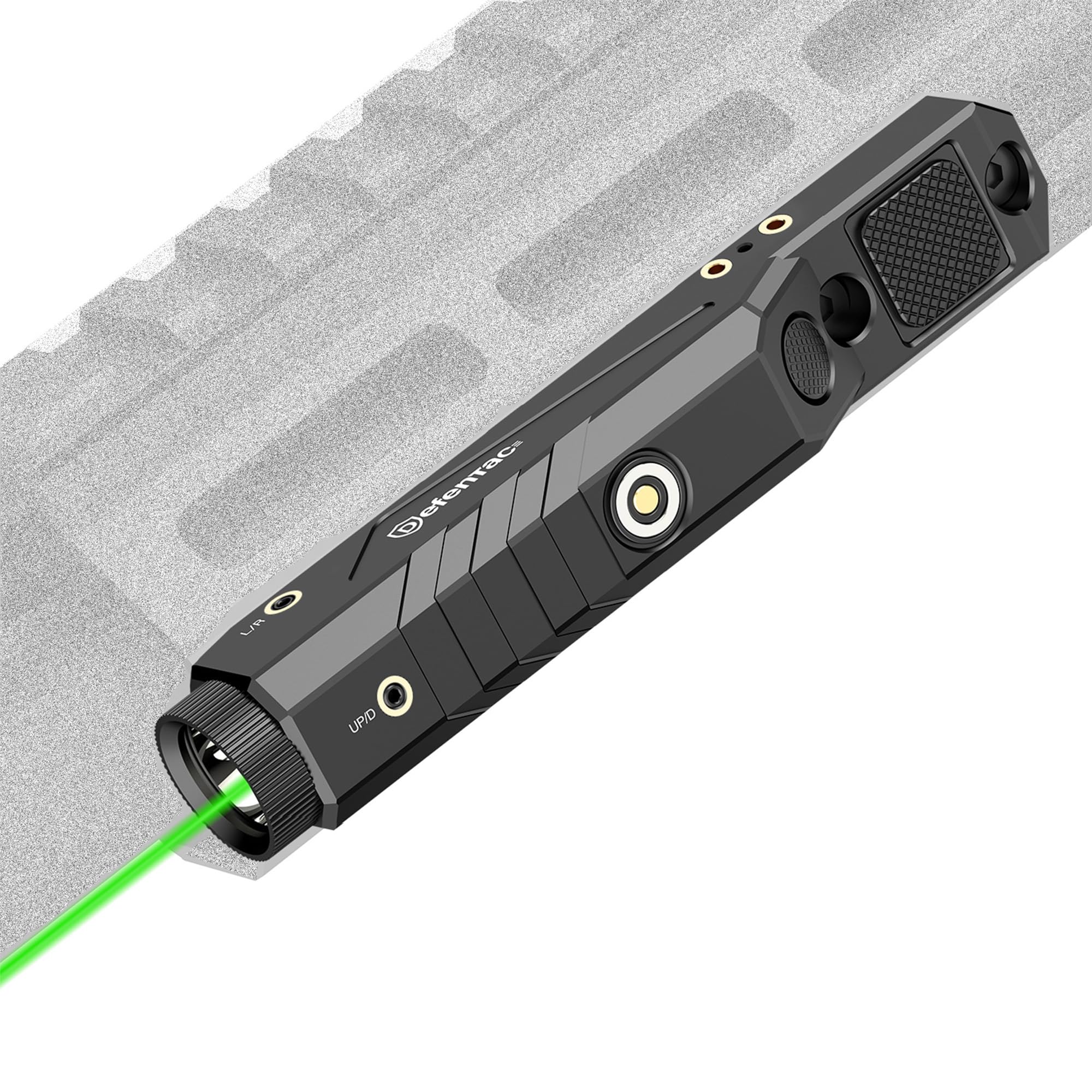
A rail-mounted beam pairing a 1600-lumen throw with a green laser long enough to claim 2000 meters at night.
Start with the beam reach, because it is the claim that sets this combo apart. The flashlight throws 240 meters, and the green laser output is less than 5mW in class IIIA — the standard ceiling — with a rated beam reach of about 200 meters in daylight and 2000 meters at night. No handheld pointer here comes close to that 2000-meter night reach.
The body mounts on Mlok, Picatinny, or Weaver rails and supports 45 or 90 degree installation. It weighs 78 grams, and the low-profile head does not block the scope. A built-in pressure-switch pad handles the triggers without a wired remote, so the rail stays clear. It also runs a 3-color power indicator — red under 30%, yellow 30%-70%, green 70%-100% — so you can see the battery state at a glance.
Owners cite brightness and value as the reasons this earns its place. The honest trade-off is zero retention. The laser holds zero well enough on soft setup and 12-gauge recoil, but the recurring note across reviews is that the dot can shift after a few rounds of sustained fire. For range use and home defense, that is manageable; for duty-grade precision, it is the one thing to watch.
What earns it a slot: 1600 lumens with 240 meters of throw, a sub-5mW class IIIA green laser, and a 78-gram body that fits both Mlok and Picatinny.
What to weigh: zero retention after sustained fire is the soft spot — check and re-zero if you run it hard.
Fits: range setups and home-defense rifles that want a bright light and a long-reaching green dot in one mounted unit.
Think again if: you need duty-grade zero retention under continuous recoil.
6. KLEIN TOOLS 56074 Pocket Flashlight

The pointer a mechanic reaches for mid-job — a green beam, a side floodlight, and a magnet that sticks to a hood.
Klein builds this for people who point at something they are also working on. The side floodlight is rated to 150 lumens with up to 12 hours of runtime, and the main beam tops out at 1000 lumens with three brightness modes plus a turbo step. That means a bright throw for a dark panel and a soft wash for close-in detail.
Laser output is under 1mW in class 2 at 510 to 530nm — a green beam, but a stripped-down one. At under 1mW, it is the lowest laser output here, which keeps the dot safe and clean for pointing at ceiling fixtures. The magnetic end cap mounts the light to steel, and the dual-direction clip slides onto a pocket or hat brim. USB-C charging comes with a battery-level LED indicator.
Trade buyers are the loud fans of this one. A firefighter wrote about using it daily, and a mechanic reported it charges in 2 to 3 hours and lasts 1 to 2 business weeks of work. The clip runs tight from the start, which is a small annoyance at first — a short break-in and it settles. Body length is 7.25 inches, so it is a pocket light, not a keychain light.
The core strength: 1000-lumen main beam plus a 150-lumen floodlight and a green class 2 laser, with a strong magnet and USB-C charging.
Small friction: the dual-direction clip starts stiff and needs a couple of weeks to loosen up.
Made for: electricians, mechanics, and anyone pointing inside a panel or under a hood.
Not the one if: you need a presentation remote that drives slides.
7. GOPLANT 1750 Lumens Laser Light Combo

The pistol-mounted combo with the longest green reach on the list — and a metal body to back it up.
Output here is 1750 lumens with a 200-meter throw on the LED, and a green laser at 510 to 530nm with a rated reach of 500 meters. That 500-meter green laser reach is the longest here, well past the DEFENTAC’s 240-meter flashlight throw and shorter laser reach. The 3.81mW output sits in class 3R. The body is aviation-grade aluminum and tested to 1.0-meter drops and IPX7 (submersion-rated) waterproofing.
Rail fit is the specification to read carefully. The light is 3.43 inches long and needs at least 2.55 inches of rail space, with about 2.34 inches from the rail to the tail for a clean seat. Manual screw tightening adapts it to both Glock and Picatinny rails, and an Allen wrench in the box lets you adjust laser zero. The magnetic charger tops it up in 1.5 hours and the charging-port cover is dust- and splash-proof.
Where the DEFENTAC’s weakness is zero retention, this one’s recurring gripe is heat — the light warms quickly when the flashlight runs long. The compact body and fast magnetic charge make it a natural pick for a home-defense pistol, not a long-range duty rifle. The windage and elevation adjustment works, but the printed instructions are thin enough that you should expect a learning curve on setup.
Why it stands out: 1750 lumens, 500-meter green laser reach, IPX7 waterproofing, and a 1.5-hour magnetic charge.
Honest limit: the head heats up fast when the flashlight runs at full output.
Reach for it: if your home-defense pistol needs a bright light and a long-reaching green dot.
Look elsewhere if: your rail is shorter than 2.55 inches — verify fit before you buy.
8. HF96 Thermal Camera

A laser pointer that rides along with a heat camera — target the wall, then read its temperature.
This is the outlier of the group. The laser here is a targeting aid, not the main event. The device fuses a thermometer, a thermal camera, and a laser pointer in one body, so you aim the dot at an object in low light or a tight space, then read its surface heat from the live heatmap. Measurement spans -4°F to 1022°F with ±3.6°F accuracy.
Thermal resolution is 240×240, enhanced live by super-resolution processing, with sensitivity below 50mK (a measure of how small a temperature difference it can detect). That sensitivity catches swings as small as 0.05°C. A 50° field of view covers a wide scan, and the camera auto-tracks hot spots, cold spots, and center spots so you are not hunting for the anomaly by eye. Seven color palettes and 7-image 4 GB of storage handle the rest.
The hardware is built for a jobsite: a 6.6-foot drop test and IP54 protection (resistance to dust and splashes), plus up to 11 hours of continuous battery. The laser’s honest limitation is that it only fires during capture, not as a free-running pointer. Anyone wanting a beam to swing around a room should pick a clicker or the OLIGHT; anyone wanting to point at a wall and see its heat signature should start here.
The standout: thermal imaging at 240×240 with sub-50mK sensitivity plus a laser pointer for targeting in dim spaces.
The one caveat: the laser only works with capture, so it is a targeting tool rather than a free pointer.
For you if: you hunt air leaks, insulation gaps, or hot electrical components and want a laser to target the scan.
pass on it if: you need a pointing beam for a lecture or a workshop.
Know the Specs
Laser Class (3R vs IIIA)
A laser class is the safety tier of a beam, defined by its output power in milliwatts. Class 3R and class IIIA both cap the beam at 5mW or less, which is why handheld presentation lasers and mounted combo lasers carry one of these labels. Lower numbers mean a safer, dimmer beam — the Klein’s class 2 laser sits under 1mW and is the safest of the group. The class tells you what the beam is allowed to do; it does not tell you how far the dot reaches, so check the laser reach spec separately.
Beam Wavelength (532nm green vs red)
Wavelength is the color of the beam, measured in nanometers — 532nm is a specific green, and plain red sits at a longer wavelength. Green reads as brighter to the human eye than red at the same power, which is why a 532nm clicker keeps its dot visible on a lit screen where a red pointer fades. That visibility gap is why bright-room presenters choose a green beam over red. If you present in a bright room, the wavelength matters more than the power rating.
Battery Type and Runtime
Rechargeable pointers charge from USB-C or a magnetic pad; battery-powered remotes take AAA. Rechargeable is the everyday win — 1 hour of USB-C charging gives weeks of classroom use on the TITIANCOOL, and the Norwii fills in 2 to 3 hours. AAA buys you a claimed 12 months on the Logitech. Battery type matters most for how you prep before a session. Runtime spec, meanwhile, is measured under specific conditions and rarely matches your real use — treat it as a ceiling.
Range and Rail Fit
Range comes in two flavors. Wireless control range (how far the remote reaches the receiver) is the 328-foot Norwii, 50-meter TITIANCOOL, and 20-meter Logitech. Laser reach (how far the dot carries) is a separate number, like the DEFENTAC’s 240-meter flashlight throw. For mounted units, rail fit is the spec that decides whether the product works at all — check the minimum rail length and the distance to the tail before buying.
Common Questions
Can a laser pointer be seen on a projector screen during the day?
What does laser class 3R or IIIA mean for everyday use?
Is a green laser pointer better than a red one?
How far can a presentation clicker reach from the laptop?
Will a USB presentation clicker work with a MacBook Air?
Why does a weapon laser lose zero after firing?
Does a rail-mounted light and laser fit my pistol?
Can I use a rechargeable laser pointer while it charges?
Do I need a thermal camera to use a laser pointer?
What should a laser pointer weigh for all-day pocket carry?
The Bottom Line
The best overall pick for most people is the OLIGHT ArkPro. It packs a green pointer, a 1500-lumen floodlight, and a UV beam into one flat pocket body with dual charging, so it handles pointing, lighting, and inspection in one tool.
For a pure classroom remote, the Norwii N76 is the value call — 328 feet of range and a week of charge per session. And if your needs run to mounted hardware, the GOPLANT 1750 delivers 1750 lumens and a 500-meter green laser reach on a small pistol rail. One honest nudge: the ArkPro’s 4.5+ rating across 1,700+ owners is the strongest in this list, so it earns the top slot on real feedback, not just specs.
How we choose
We do not accept paid placement. Every pick is matched to a real buyer and a real use-case; we do not hands-on test units.
Sources
Specifications: manufacturer listings and product documentation. Review insights: verified customer reviews, as of October 2026. Pricing: not shown on this page (it changes often); check the current price via the retailer link.
As an Amazon Associate, Aappliancez earns from qualifying purchases. This does not affect which products we feature.