Disclosure: Some links in this post are affiliate links. As an Amazon Associate I earn from qualifying purchases, at no extra cost to you. Learn more
Specs are compiled from manufacturer listings and verified buyer reviews and can change over time — please confirm the key details on the product page before buying.
Large hydroponic systems live or die on two things: how much water the reservoir actually holds, and whether the pump moves enough air to keep roots alive. Most buyers get talked into pod counts and colorful LED panels. The systems that keep harvests coming are the ones with real tank volume, honest oxygen delivery, and a frame that does not wobble under the weight of wet plants. This guide walks through nine systems built for serious indoor growing, from compact two-layer gardens to full vertical towers.
This guide is built by comparing the manufacturers’ published specifications and the patterns across verified customer reviews, so you get each pick’s real strengths and trade-offs instead of marketing spin.
Every pick below is judged on capacity, airflow, lighting, and what actually happens after a few months of running. By the end you will know which of these large hydroponic systems fits your space, your crops, and your tolerance for maintenance.
Top Picks

How To Choose The Best Large Hydroponic Systems
The hardest part of buying one of these is that the marketing leads with pod counts and ignores the two numbers that keep plants alive. Water volume and dissolved oxygen decide whether your crop thrives or wilts. Read those first, then worry about looks.
Match water volume to how often you travel
A reservoir measured in liters is your buffer against forgetting things. A two-tank garden holding 20 liters split across two chambers needs topping up more often than a 32-liter tank, and far more often than an 8-bucket DWC setup holding 151.4 liters. If you are away for a week, reservoir size decides whether your plants come back healthy or wilted.
Airflow is the quiet spec nobody brags about
In deep water culture, roots sit in water and need oxygen pumped in. The pumps are rated in liters per minute of airflow — the VEVOR moves 25 L/min and the Spider Farmer pushes 28 L/min. Higher airflow generally means more oxygen at the roots, but pump noise rises with the L/min rating. A weak pump is the single most common complaint on bucket kits, so check the airflow number before anything else.
Light bars versus integrated LED towers
Strip lighting and full-spectrum panels serve different jobs. A four-tier greenhouse cabinet running 24W total strips is enough for seedlings and herbs. A vertical tower with built-in LED arms carrying 60 plants needs far more light coverage, and a 53W dual-mode panel on a two-layer tabletop garden is tuned for leaf and fruit stages. Match the light to your actual crops — 24W of strips for seedlings and herbs, a 53W dual-mode panel for leaf and fruit stages — rather than chasing the highest wattage in the listing.
Frames, seals, and what you clean
A system full of water is heavy — the VEVOR kit alone lists 25.4 pounds of hardware, and the 60-pod Growell tower ships 28 pounds of material. Look for steel or thick PP construction, watertight silicone seals where offered, and wheels on floor-standing towers so you can move them without draining the reservoir first.
Side-by-Side Comparison
| Model | Best For | Capacity | Plant Sites | Light / Pump | Amazon |
|---|---|---|---|---|---|
| Ahopegarden 44-Pod Indoor Garden★ Best Overall | Two-layer tabletop growing | 20 liters | 44 pods | 53W dual-mode LED | Amazon |
| VEVOR DWC 8-Bucket SystemMost Water Volume | High-volume leafy greens | 151.4 liters | 8 buckets | 10W pump / 25 L/min | Amazon |
| Bstrip Indoor Greenhouse CabinetBest for Seed Starting | Seed starting and propagation | 4-tier shelving | Shelves, not pods | 24W LED strips | Amazon |
| MARS HYDRO DWC 4-Bucket | Recirculating DWC plus drip | 5 gallons per bucket | 4 buckets | 11W air pump | Amazon |
| Spider Farmer 4-Bucket DWC | Larger per-bucket volume | 7 gallons per bucket | 4 buckets | 11W pump / 28 L/min | Amazon |
| Growell 60-Pod Vertical Garden | Tall multi-level indoor farm | 32 liters | 60 pods | 60W (30W x2) LED | Amazon |
| AC Infinity AI Grow System Compact 2×2 | Automated climate control | 16 cubic feet tent | 1-plant kit | 100W Samsung LM301H LED | Amazon |
| Gardyn Studio 2 | Decor-friendly vertical tower | Vertical column design | 16 plants | LED with sunrise/sunset modes | Amazon |
| ALTO GARDEN GX Tower | High-site vertical farming | 10 gallons | 24 net pots | Broad-spectrum LED with timer | Amazon |
Detailed Reviews
1. Ahopegarden Hydroponics Growing System 44 Pods
Our pick — 4.5+★ from 200+ verified ratings; the strongest balance of quality and price.
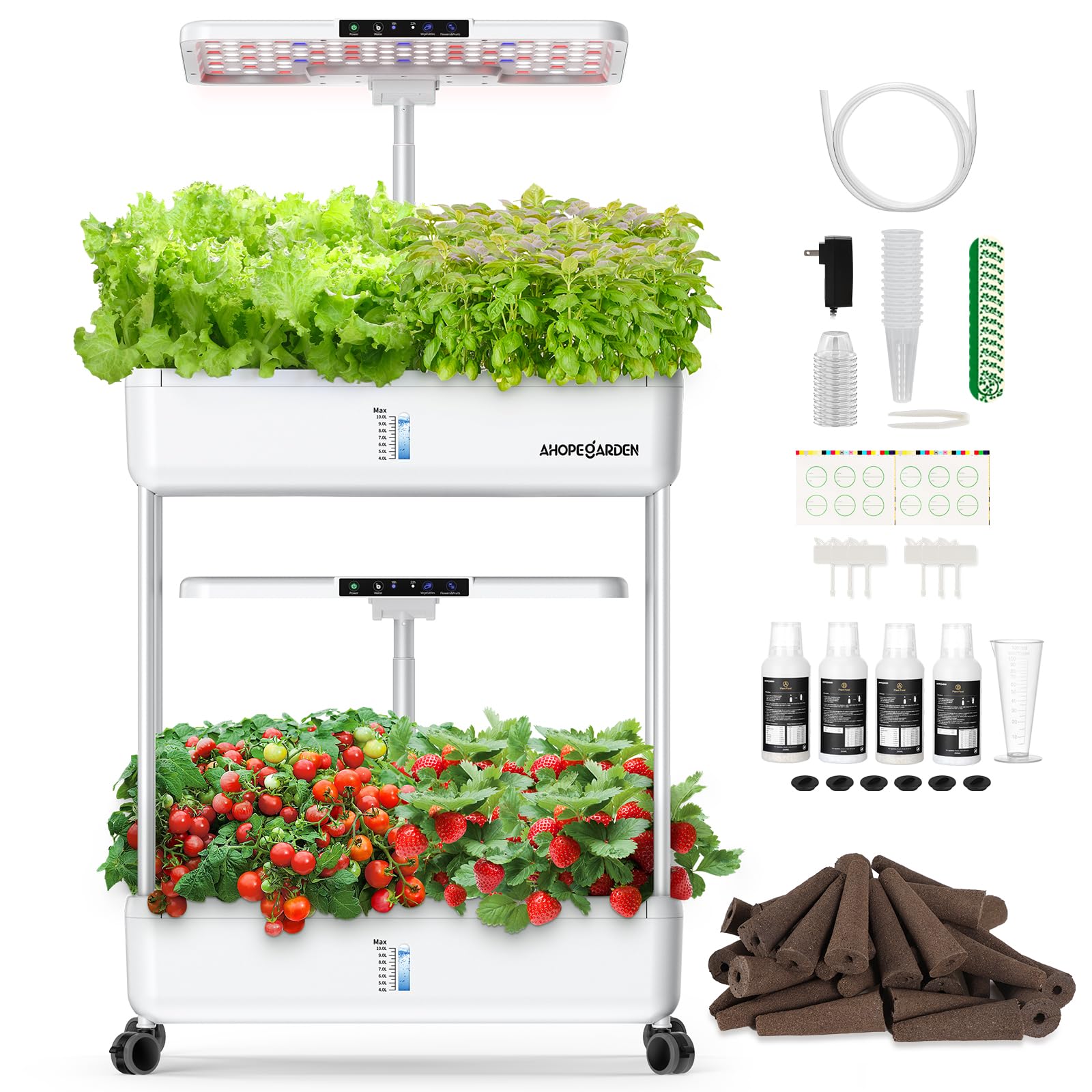
Two separate 10-liter tanks let you run herbs and peppers on different feeding schedules.
What makes this one the pick for most people is the zoning. Each of the two tanks has its own independent pump, so you can push heavier nutrients into one chamber and a gentler mix into the other. That is genuinely rare in a tabletop unit — most split their water across a single shared loop and force every plant onto the same diet. The 20-liter total capacity across 44 pods is enough for a family that cooks with fresh herbs daily.
The lighting is where the spec sheet earns its keep. You get 53W of LED run through two modes, with a 16-hour and a 22-hour timer option. The long setting is aimed at fruiting crops like tomatoes, and the maker claims it lifts yields and raises sugar content — a manufacturer claim, not a lab result. The light post adjusts to 14.68 inches, so seedlings and taller plants both sit under usable light without stacking books underneath. Buyers report quick germination, with one noting “Day 3: multiple pods sprouting.”
The trade-off is real but manageable. Several long-term growers find the light output gentle — it will not scorch leaves, but it also will not push heavy fruiting crops hard without help. The panel sits about 14 inches above the deck, which is fine for basil and lettuce and tight for tall peppers. Noise comes up in feedback as a mixed point, so if you sleep in the same room, plan around it. Cleaning takes roughly an hour every three weeks based on owner notes, and the kit ships with 44 grow sponges, 22 domes, four nutrient bottles, and blackout paper to get started.
What earns it first place
- Two independent 10L tanks with separate pumps let you feed different crops differently.
- 53W dual-mode LED with 16-hour and 22-hour timers covers leaf and fruit stages.
- 44 pods and 20 liters of water in a footprint that fits a kitchen counter.
- Adjustable light post reaches 14.68 inches for taller plants.
Where it asks for patience
- Light intensity is gentle — tall peppers will feel cramped under the 14-inch clearance.
- Budget about an hour of cleaning every three weeks, and expect the pump to be audible.
Made for: anyone who wants two crops running at once without buying two separate gardens.
Think twice if: you plan to grow tall fruiting plants and need strong overhead light.
2. VEVOR DWC Hydroponic System, 5 Gallon 8 Buckets
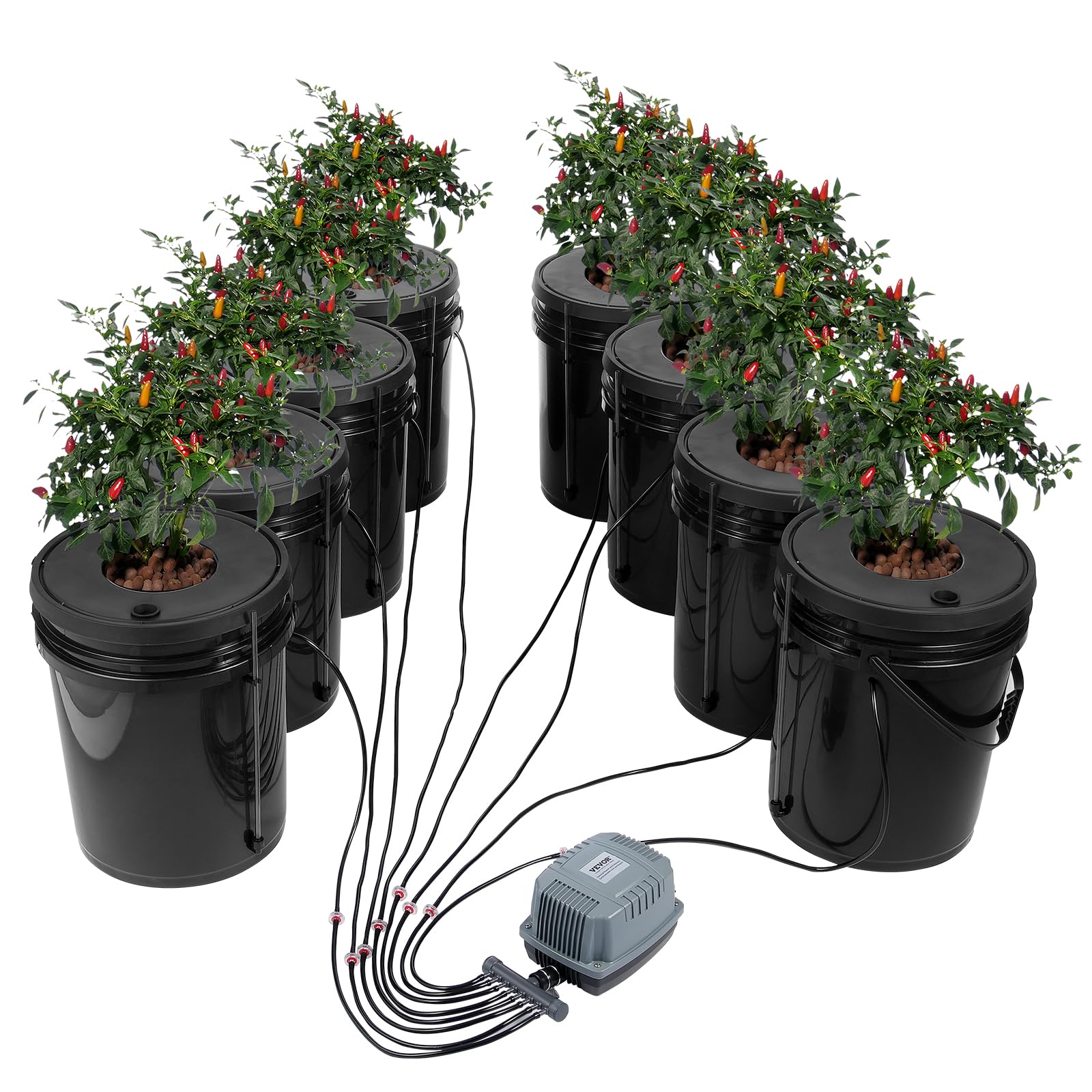
Eight five-gallon buckets holding 151.4 liters — the most water in this lineup by a wide margin.
For sheer reservoir volume nothing here gets close. The Ahopegarden tops out at 20 liters; this VEVOR kit carries 151.4 liters across its eight buckets. If your idea of a large hydroponic system is a full grow room of leafy greens, that comparison is the whole argument. Each bucket gets a 5-inch basket and its own side-mounted water level device, so you can read the level without lifting a lid.
The oxygen side is where the design gets interesting and where owners get vocal. The air pump is rated at 10W producing 25 L/min of airflow, feeding eight air stones through 12 meters of hose. Inline check valves stop water flowing backward when the pump cycles off. What wins people over is the build — the PP buckets, tight seals, and complete accessory kit including clay pebbles add up to something that feels made to last. Setup is straightforward once you read the instructions properly, as one five-star buyer put it: “Read the instructions and look at the images, and it will be set it up right.”
Here is the honest part. The pump is the limiting factor, and it is the most-discussed problem in the feedback. Splitting 25 L/min across eight stones means each bucket gets a modest share of dissolved oxygen — fine for lettuce and herbs, thin for demanding crops. Owners mention it plainly: “Like everyone says, pumped too weak.” Leaks show up in some reviews and not others, so check every seal at fill time. This is the right kit if you want volume and are willing to add a stronger pump.
Who it serves: growers who want the most water storage and do not mind upgrading the air supply. The 43 owner mentions of quality against 15 for value says the hardware lands well; the 18 negative air-pump mentions says the pump is the weak link you should budget around.
Best fit: a dedicated grow space for greens where eight simultaneous buckets make sense.
Know going in: plan on a stronger air pump and a careful seal check on day one.
3. Bstrip Indoor Greenhouse with Grow Light Oxford Cover
A 59-inch-tall four-tier cabinet for anyone raising seedlings rather than harvesting heads of lettuce.
This one is not a DWC bucket system — it is a controlled environment for starting plants. The frame stands 29.5 inches long, 13.8 inches wide, and 59 inches tall with four shelves, each offering 29.5 by 13.8 inches of growing floor. Compare that to the VEVOR bucket footprint of 11.81 by 11.81 inches and the difference in usable surface is obvious: this is a propagation station, not a reservoir garden.
The lighting spec is precise and worth reading carefully. Four 24W LED strips deliver 660nm red-weighted full spectrum, and at 4 inches below the bar the PPFD — the measure of usable light reaching the leaf — reads 343.7 μmol/㎡/s. That is real light for seedlings and succulents, not decoration. A built-in timer offers 4, 9, or 14-hour schedules, and the Oxford fabric cover with reflective aluminum lining holds humidity in. EVA door panels let you look without unzipping, and two vent flaps adjust airflow. What wins people over is how easily it goes up — the quality and assembly both land strong in owner feedback, and tool-free assembly means you are growing the same afternoon.
The recurring gripe is minor electrical flakiness. Lights can occasionally flicker or drop out and then reset themselves, and one owner recommends adding a small USB fan for air movement. Worth knowing: the total is 24W across four strips, so heavy flowering crops will want more light than this provides. For seed starting, herbs, and tropical houseplants, the coverage is honest.
The read: a genuine propagation cabinet with measurable output — 343.7 μmol/㎡/s at 4 inches is a real number, not a vibe.
Pick it when: your goal is raising dozens of seedlings before moving them outdoors or into a bigger system.
Look elsewhere when: you want to harvest full heads of lettuce from the unit itself.
4. MARS HYDRO DWC 4-Bucket Hydroponic System with Pump & Drip
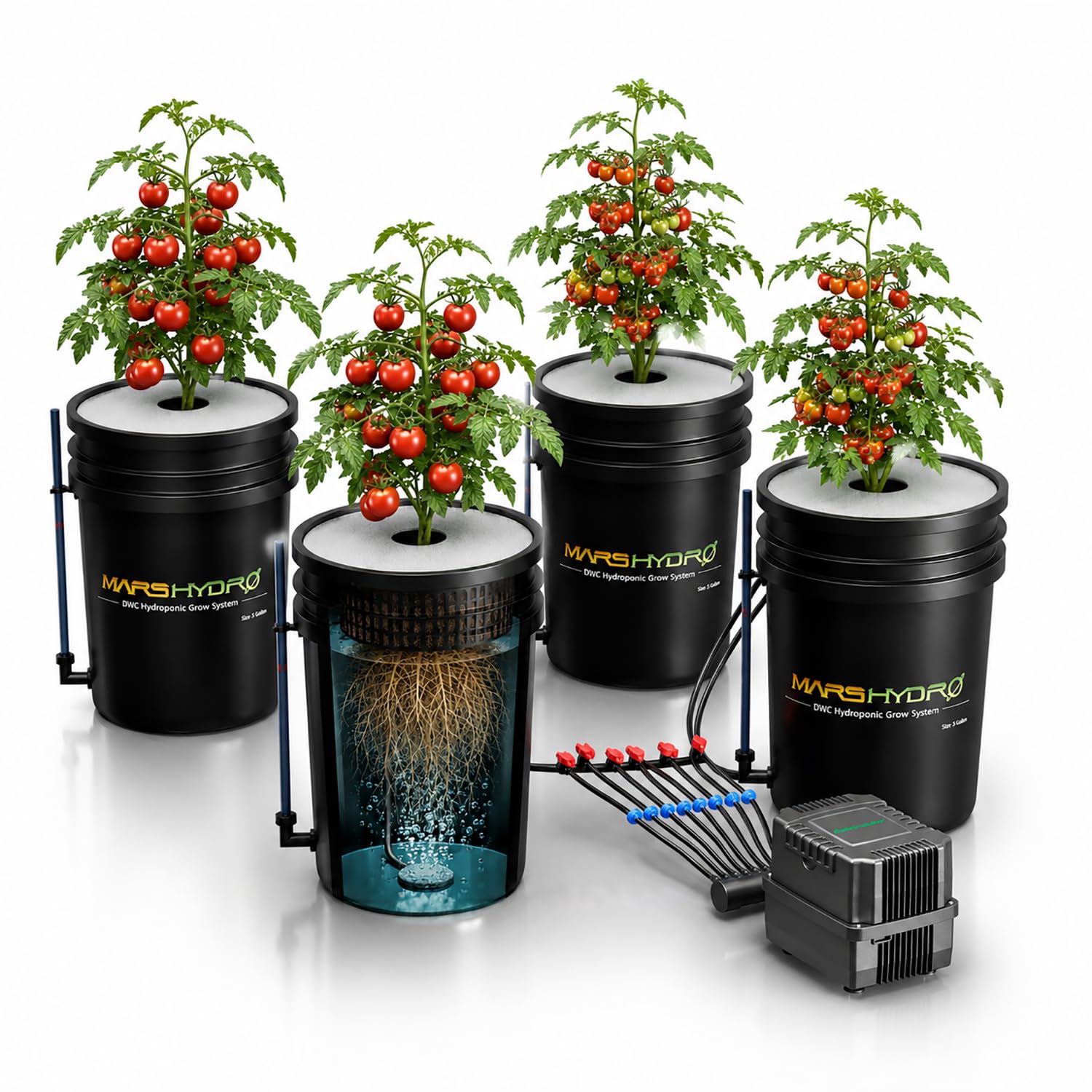
Four five-gallon buckets running deep water culture and top-drip recirculation at the same time.
MARS HYDRO built this as a 2-in-1: roots sit in oxygenated water while a drip ring keeps fresh nutrient solution cycling over the top of the net pot. The point is that water never stagnates and roots get fed from both directions. Four buckets at 5 gallons each, an 11W air pump, four drip kits, net pots, clay pebbles, air stones, and all the tubing come in the box — no separate shopping list.
Setup is the standout. It leads the feedback by a clear margin, ahead of quality and value, and the design decisions support that. Visual water level indicators, adjustable air flow regulators, and precise drip rings mean you are not guessing at anything. Seals hold tight on most units, and plants take to the system quickly. The one knock on the physical side is threading the air hoses through the rubber seals — a fiddly job, and the inline check valves must be oriented the right way, with the markings harder to read than they should be.
Instructions are the weakest link, and they come up as the most-mentioned negative. They are hard to read, and the assembly only clicks once you work it out yourself. The air pump is another honest note: it is functional and adjustable, but loud enough that owners mention it, and the power cord is short and non-adaptable. For someone running this in a garage or a tent, that is background noise. For a bedroom, it is not.
Why growers rate the design
- Recirculating DWC plus top drip keeps nutrients moving instead of pooling.
- Setup leads owner feedback, with visual water levels and adjustable air regulators doing the work.
- Complete kit — buckets, pump, drip rings, net pots, pebbles, stones, and tubing.
The honest caveats
- Instructions are genuinely hard to follow, so expect to work out the assembly yourself.
- The pump is audible and the power cord is short and non-adaptable.
Go for it if: you want both drip feeding and oxygenated roots without buying two systems.
Hold off if: the unit will sit in a quiet room where pump noise matters.
5. Spider Farmer DWC Hydroponics Growing System Kit 4 Buckets
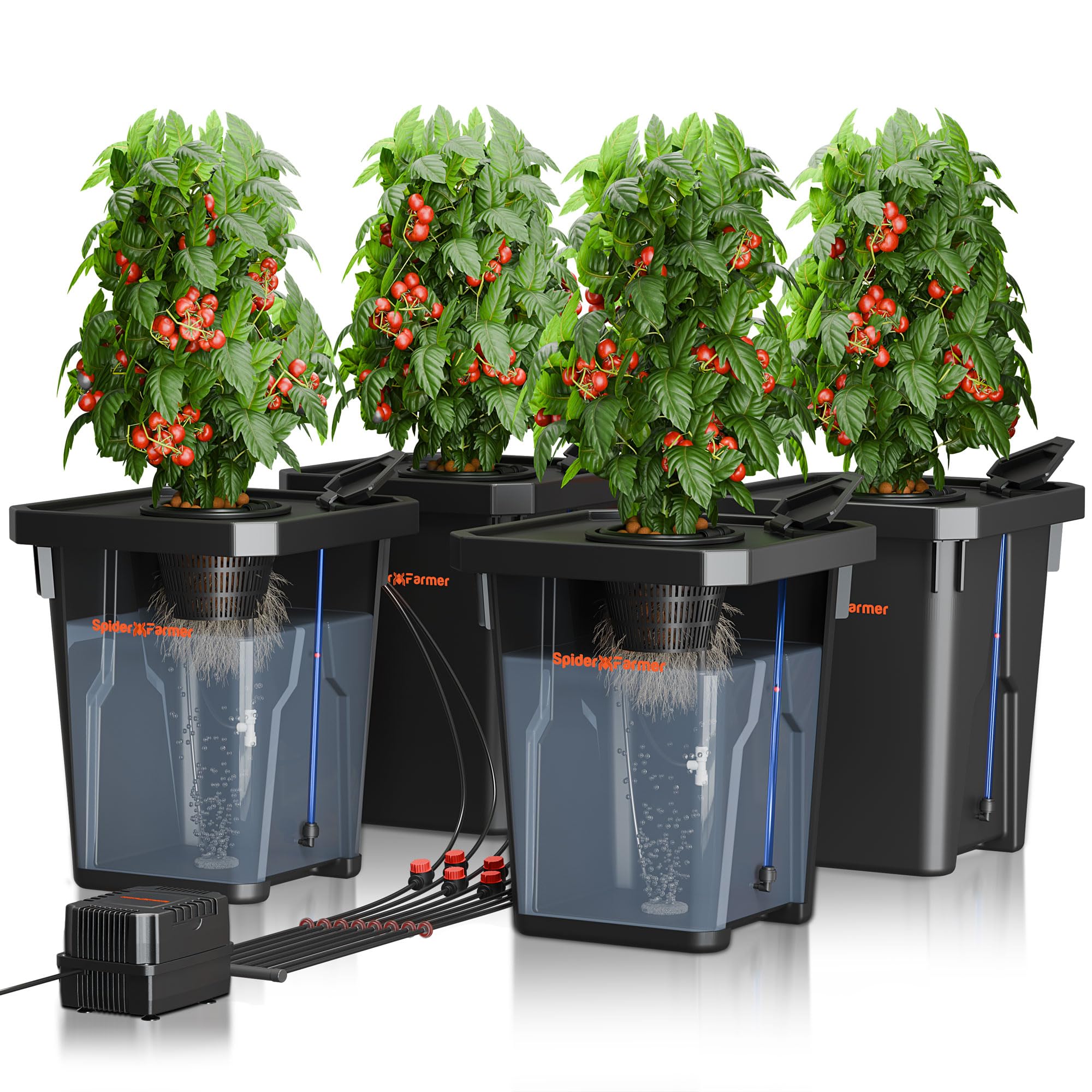
Each bucket holds a full 7 gallons — two more per bucket than the MARS HYDRO sits beside it.
If root mass is your bottleneck, this is the kit that solves it. Four buckets at 7 gallons each give a single tomato plant or a fat pepper bush far more room than a 5-gallon bucket allows. The triangular cover design is a small but smart touch: it lifts off so you can top up water and check pH without wrestling a round lid out of place. Corrosion-resistant PP construction means the buckets stay clean season after season.
The airflow is the strongest of the bucket kits here. The 11W pump pushes a maximum of 28 L/min, and a regulator lets you dial it back for gentler crops. Air stones in each bucket distribute that oxygen into the root zone. A 6-inch net cup built from high-tenacity PP holds a substantial plant without sagging. Quality is the thing everyone raves about, followed closely by how quick it is to set up — and once built, it just runs. Customers note leaving it going full blast without trouble.
Two parts of the picture deserve a fair warning. Durability feedback is split — most find it solid, some question long-term wear. Pump power is also mixed: the 28 L/min rating is decent for four buckets, but one buyer found it not strong enough for what they wanted. Drainage comes up as a mixed point too, so plan your water changes with a bucket and a towel handy. Nothing here sinks the kit; it just tells you this is a workhorse, not a showpiece.
The verdict in one line: strongest airflow and biggest buckets in the DWC group, with a removable cover that makes maintenance genuinely easier.
Choose it for: heavy feeders and large-rooted plants that need elbow room in the reservoir.
Skip the upgrade path if: you need a pump rated for more than four buckets — this one is sized for exactly the kit.
6. Growell Hydroponics Growing System Kit 60 Pods

Sixty pods across a floor-standing tower, with a split 24-liter plus 8-liter tank doing the watering.
The capacity story here is two numbers working together. The tank system splits into a 24L plus 8L pair for 32 liters total, and the tower itself carries 60 pods across its vertical face. The pump circulates automatically, moving water so oxygen and nutrients reach every root without you hauling a watering can. Leave it for a week and the reservoir holds up — that is the whole point of the large-tank design.
Lighting splits into two modes with their own timers. Vegetables Mode pushes leafy growth; Flowers & Fruits Mode pushes bloom and fruit set. You get 60W total from a pair of 30W full-spectrum panels, with a 16-hour or 22-hour timer to pick from, and each layer’s lights can be run independently. The maker claims plants grow up to three times faster than in soil — a manufacturer figure, not an independent measurement. The panel height adjusts, so short greens and tall plants both get usable light. Setup draws praise, and the growth results are what owners talk about most after quality.
Here is what to weigh. The tower stands 51.5 inches tall with a 10.2 by 36.6 inch footprint, so it needs a real wall. Assembly is straightforward but the unit is substantial — 28 pounds of hardware before water goes in. This is the pick for someone who wants to farm a wall of greens, not for a countertop grower.
Fit check: 60 pods at 32 liters is the highest pod count on the list, and the two-mode lighting means you are not locked into greens only.
Right for: a dedicated wall space and a household that eats a lot of greens.
Wrong for: tight kitchens — the 51.5-inch height and wide footprint need floor room.
7. AC Infinity AI Grow System Compact 2×2, 1-Plant Kit
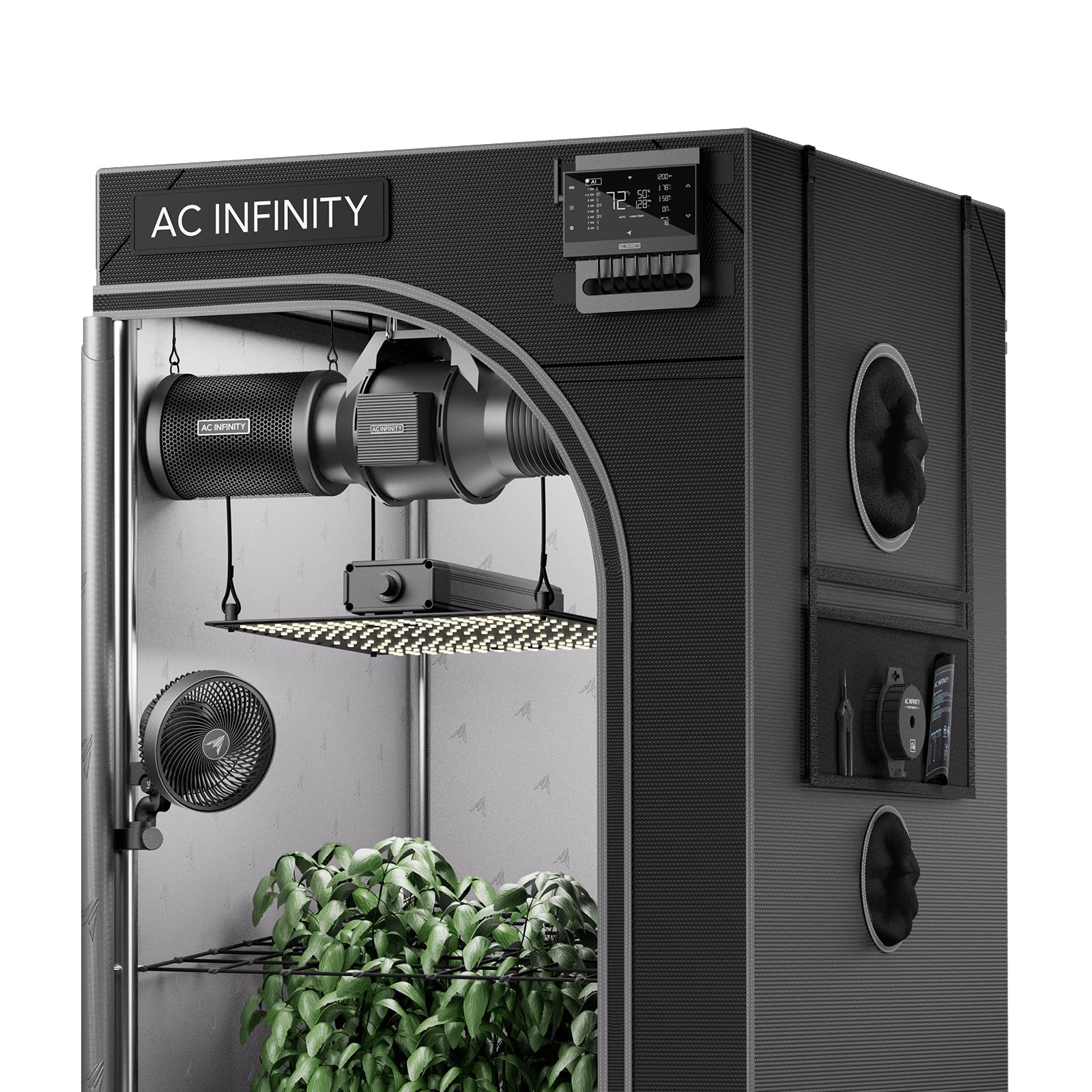
A complete 2×2 tent where the controller watches the climate and adjusts the gear for you.
Everything in this kit lives inside one sealed tent: a 2×2 grow light running 100W of Samsung LM301H LEDs, a 4-inch EC inline fan, a 6-inch oscillating clip fan, and an AI-driven controller tying them together. The 24 by 24 by 48 inch tent uses lab-tested reflective Mylar on the walls and a taller viewing window than the standard build. Airflow and lighting both respond to the controller automatically instead of you opening and closing flaps by hand.
The AI piece is the reason to pick this one. The controller reads real-time and historical data to predict shifts in the climate, then auto-adjusts the connected devices to keep conditions steady. Pair it with the WiFi app and you get insights, guides, and a chatbot from anywhere. That is genuinely a different purchase from a passive bucket kit — it handles the thinking. Size is the top thing owners praise by a wide margin, ahead of assembly and value, and the tent assembles cleanly with a light-blocking design that actually blocks.
The catch is the control system itself, which draws mixed feedback. Some find the automation brilliant; others hit snags getting the behavior they expect. Budget for a learning curve on the app and controller before you trust it to run unattended. And note this is a one-plant kit — the volume is 16 cubic feet, sized for a single substantial plant or a tight canopy, not a field of greens.
The automation pitch
- AI controller reads live and historical data and auto-adjusts connected devices.
- 100W Samsung LM301H LED paired with a 4-inch EC inline fan and a 6-inch clip fan.
- Reflective Mylar tent with a taller window and enhanced light blocking.
Before you commit
- Control system feedback is mixed — expect to spend time learning the app.
- 16 cubic feet holds one substantial plant, not a multi-crop garden.
Made for: growers who want the tent to regulate itself while they are at work.
Not the one for: anyone who wants to raise twenty plants at once.
8. Gardyn Studio 2 Hydroponics Growing System — 16 Plants

Sixteen plants in the footprint of a single potted plant, with a camera watching every leaf.
The spatial claim is the selling point. Gardyn squeezes 16 non-GMO plants — herbs, vegetables, fruits, flowers — into a vertical column that takes the same floor space as one large houseplant. The unit stands 54 inches tall on a 17 by 12 inch base, so it tucks into apartment corners and kitchen alcoves where a multi-bucket DWC setup simply will not fit. It reads as decor before it reads as equipment.
The maintenance design is unusual in a good way. The growing columns are sealed with watertight silicone, which means no interior cleaning and no mineral buildup to scrape out each season. A high-resolution camera captures the whole garden so you can check plant health remotely, and the Kelby AI assistant pairs with it to deliver monitoring and care guidance. LED lighting now runs sunrise and sunset modes that ramp the light up and down through the day instead of snapping on. The starter kit includes the tower, lights, seed kit, and sensors.
Two things to accept going in. This is a closed ecosystem — the plant pods come from Gardyn, so you are not free to drop in any seed you like. And the tower runs on a smart system, so the app is part of daily life. Buyers who want a plug-and-play herb supply love that; tinkerers who want to hand-mix nutrients will find it restrictive. Budget generous lead time too; a fresh unit carries a limited review history.
The trade: design-led convenience over DIY flexibility. The sealed columns and remote camera are genuine labor savers, but the pod supply is locked to the brand.
Suits you if: the tower has to look good in a living space and you want the system to handle care reminders.
Not for you if: you want to grow whatever seeds you choose.
9. GX Hydroponic Tower 24 Net Pots
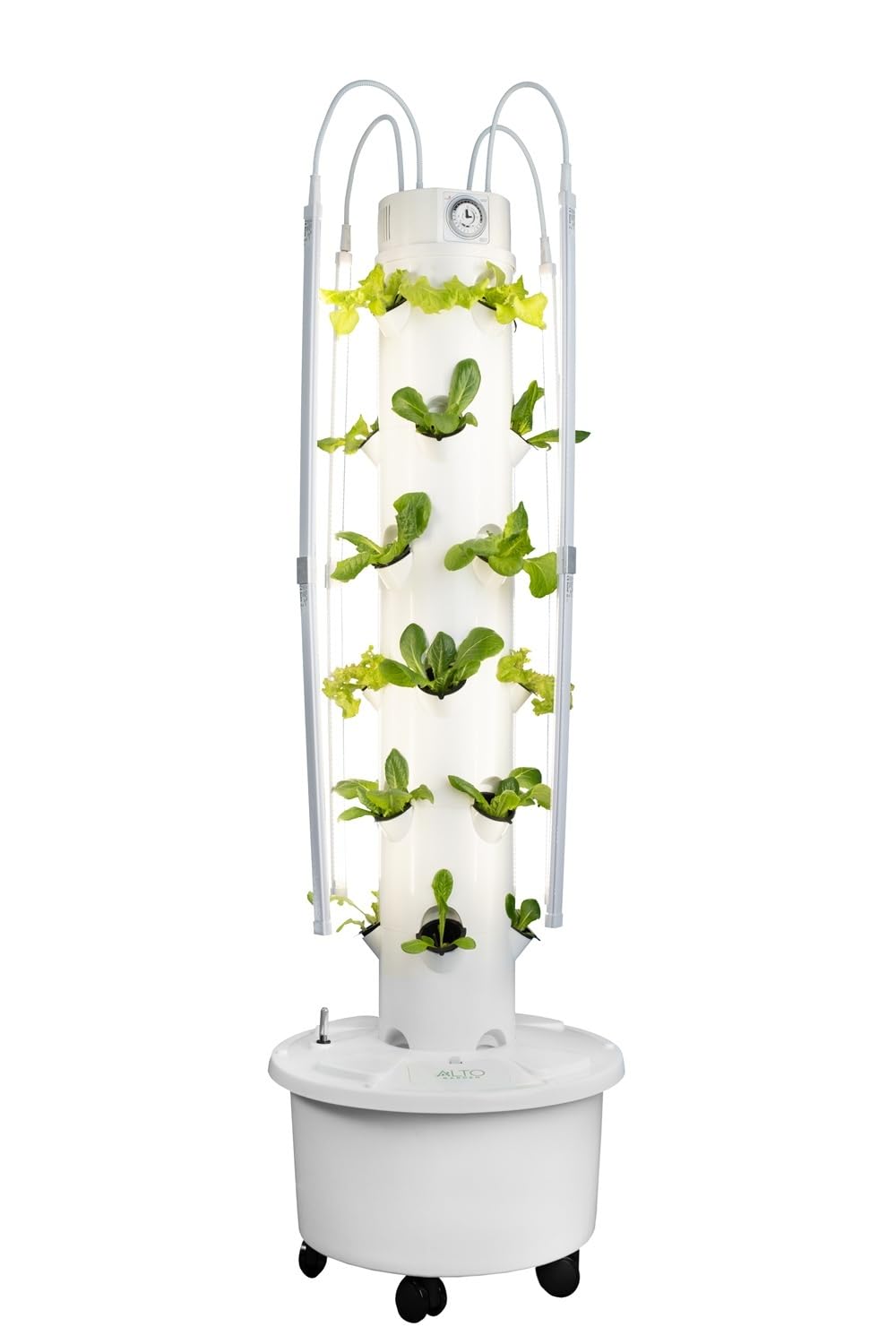
Six solid 360-degree levels with 2mm walls, 24 net pots, and a 10-gallon tank that rolls.
Build quality is the headline. Each layer of this tower is constructed as a full 360-degree cylinder from 2mm-thick walls, which is thicker than most vertical planters on the market and directly addresses the leaky-joint problem that plagues cheaper towers. Twenty-four net pots spread wide so plants grow without crowding each other, and the 10-gallon reservoir sits on casters so you can wheel the whole thing out of the way for cleaning. Reliability is the thing owners praise most, and the airtight construction supports that reputation.
The accessories package is unusually complete. In the box: all tower components, the wheeled reservoir, adjustable LED lights with a built-in timer, a water pump with its own timer, 24 net pots, 30 rockwool cubes, A+B plant nutrients in 10-ounce bottles, a digital pH test pen, a four-head germination light with a clamp, and a water gauge. You can run a full crop without buying anything extra — the timers handle watering and lighting automatically, with no app and no subscription. The maker claims three times faster harvests, 30 percent greater yields versus soil, and 95 percent water savings from the aeroponic recycling design — all manufacturer figures, not independent measurements.
The real-world limits are about space and weight rather than performance. At 66 inches tall on a 20 by 20 inch base, it needs a full-height spot and clear headroom. A full 10-gallon reservoir is heavy — the wheels help, but moving it while full is a two-hand job. And as a recycling-tower design it depends on the pump running; a power cut during a heat wave is worth planning around.
Bottom line: the most complete starter package on this list, and the 2mm 360-degree walls are the spec that justifies the position.
Built for: growers who want maximum sites, no subscription, and a complete kit on arrival.
Plan space for: a 66-inch tower and a 10-gallon reservoir that is heavy when full.
Know the Specs
Reservoir capacity in liters
This is how much nutrient solution the system holds before you refill. A larger reservoir means fewer top-ups and steadier water chemistry — 151.4 liters in an eight-bucket DWC lasts a week away, while a 20-liter two-tank garden needs refilling sooner. Match the number to how much you travel and how many plants you run.
Airflow in liters per minute
Pumps for deep water culture are rated in L/min, and that figure tells you how much oxygen reaches the root zone. More airflow generally supports healthier root mass, but on multi-bucket systems each air stone only gets the pump’s total L/min divided by the bucket count. A pump rated for four buckets will feel thin on eight — that is why bucket count and pump rating need to match.
Common Questions
How many plants can a large hydroponic system actually support?
Do I need to change the water in a DWC bucket system weekly?
Is a DWC bucket system better than a vertical tower?
How loud are hydroponic air pumps?
What does PPFD mean on a grow light spec sheet?
Can I grow tomatoes in a two-layer tabletop garden?
Do vertical hydroponic towers need a subscription?
Will an indoor greenhouse cabinet work for flowering plants?
How much floor space does a floor-standing hydroponic tower take?
Can a hydroponic system run while I am on vacation?
The Bottom Line
The best of these large hydroponic systems for most people is the Ahopegarden 44-Pod Indoor Garden, because its two independent tanks let you run different crops on different feeding schedules without buying two gardens — and its 53W dual-mode LED covers both leaf and fruit stages. If sheer water volume is your priority, the VEVOR DWC 8-Bucket System at 151.4 liters is in a class of its own, provided you upgrade the air pump. And for a complete vertical farm that arrives with every accessory, the GX Hydroponic Tower delivers 24 sites, a 10-gallon wheeled reservoir, and no subscription — a full starter kit that lets you begin growing the day it lands.
How we choose
We do not accept paid placement. Every pick is matched to a real buyer and a real use-case; we do not hands-on test units.
Sources
Specifications: manufacturer listings and product documentation. Review insights: verified customer reviews, as of October 2026. Pricing: not shown on this page (it changes often); check the current price via the retailer link.
As an Amazon Associate, Aappliancez earns from qualifying purchases. This does not affect which products we feature.