Disclosure: Some links in this post are affiliate links. As an Amazon Associate I earn from qualifying purchases, at no extra cost to you. Learn more
Specs are compiled from manufacturer listings and verified buyer reviews and can change over time — please confirm the key details on the product page before buying.
Buying a large bookshelf speaker is really a bet on cabinet size. A deeper cabinet gives the woofer more internal air to move, which is what turns a 6.5-inch driver’s output into bass you feel rather than just hear. Every pick below earns its spot on real driver size, real cabinet volume, and how it behaves in a normal living room. Start with the Polk ES20 pair if you want the safest all-round call — it’s rated 4.5+ stars across 800+ ratings.
This guide is built by comparing the manufacturers’ published specifications and the patterns across verified customer reviews, so you get each pick’s real strengths and trade-offs instead of marketing spin.
You’ll see powered pairs with a built-in amp and passive cabinets that need a receiver, so the choice depends on your room size and the gear you already own. Here is the honest, spec-by-spec breakdown of the best large bookshelf speakers for a real living room.
Top Picks


How To Choose The Best Large Bookshelf Speakers
Most people assume a speaker with a big woofer number automatically thumps harder. That’s only half the story. What actually moves air is the woofer’s surface area working inside a cabinet with enough internal volume to support it. A 6.5-inch driver in a shallow box can sound thin, while the same driver in a deep cabinet sounds full.
Match the woofer size to your room
A 5-inch driver like the one in the Fluance Ai41 suits a desk, a bedroom, or a compact apartment. Step up to a 6.5-inch driver and you get more low-frequency push for a living room. An 8-inch driver — the Mackie CR8BT and the KLH Model Three both use one — moves the most air and gives the deepest natural bass without a subwoofer. Measure your shelf or stand depth first, because these cabinets run deep.
Decide if you want a built-in amplifier
Powered speakers like the Fluance Ai41 and Ai61 have the amplifier built into one cabinet. You plug in a turntable, TV, or phone and you’re done — no receiver, no separate amp. Passive pairs like the Polk ES20 or the Klipsch RP-600M II need an amplifier or AV receiver to make any sound at all. Passive gives you more upgrade room later; powered gives you a shorter cable run today.
Plan for the rear bass port
Many of these cabinets breathe through a port on the back. That port needs a little breathing room from the wall behind it, or the bass turns muddy and boomy. If your shelf sits flush against a wall, budget for stands or leave a gap. Front-ported and acoustic-suspension designs (the KLH Model Three uses a sealed acoustic-suspension cabinet) are more forgiving of tight placement.
Side-by-Side Comparison
| Model | Best For | Woofer | Powered or Passive | Amplifier / Power | Amazon |
|---|---|---|---|---|---|
| Polk Audio Signature Elite ES20★ Best Overall | Best overall all-rounder | 6.5 inches | Passive (pair) | 4- and 8-Ohm compatible | Amazon |
| Polk Audio Monitor XT60Tower Value Pick | Floor-standing tower value | 6.5 inches | Passive (single tower) | Hi-Res, Dolby Atmos ready | Amazon |
| Dayton Audio Classic T65Budget Tower Pair | Budget tower pair for vinyl | Dual 6.5 inches | Passive (pair) | 150W power handling | Amazon |
| Fluance Ai41 | Compact powered desktop setup | 5 inches | Powered (pair) | 90W integrated | Amazon |
| Mackie CR8BT | Studio and gaming monitors | 8 inches | Powered (pair) | Built-in tone control | Amazon |
| Fluance Ai61 | Powered set with USB-C input | 6.5 inches | Powered (pair) | 120W integrated | Amazon |
| Klipsch RP-600M II | Horn-loaded detail for home theater | 6.5 inches Cerametallic | Passive (pair) | Bi-wiring / bi-amping | Amazon |
| ELAC Debut 3.0 DB63-BK | Balanced audiophile value | 6.5 inches aramid fiber | Passive (pair) | 42Hz to 38KHz response | Amazon |
| KLH Model Three | Mid-century statement piece | 8 inches | Passive (each) | 3-position acoustic balance | Amazon |
Detailed Reviews
1. Polk Audio Signature Elite ES20 Bookshelf Speaker Pair
Our pick — 4.5+★ from 800+ verified ratings; the strongest balance of quality and price.
Warm, detailed bass from a pair that punches well past its size.
If you want one pair that does music and movies without a fuss, this is it. The ES20 pairs a 6.5-inch woofer with a 1-inch Terylene tweeter, and Polk’s Power Port design pushes bass about 3dB louder than a conventional ported speaker. That extra bump means you don’t immediately feel the need to add a subwoofer for everyday listening.
What wins people over is the sound. Owners keep describing how these pull detail out of familiar recordings they hadn’t noticed before, and the volume holds together without turning harsh. In a 23-by-29-foot apartment they filled the room comfortably. The value story holds up too — one long-time owner put it plainly: “Solid value for money,” noting they compete with speakers costing many times more. The power port bass was even confirmed on a measurement graph by a reviewer.
Here’s the catch you need to hear before you buy. These are deep cabinets that dwarf a thin modern TV, and despite what some listings imply, they aren’t wall-mountable without your own hardware. Plan on floor stands or a genuinely deep shelf. The walnut finish looks good on the shelf but reads a little synthetic up close, and the treble arrives bright from the start before settling after break-in.
Where It Earns Its Keep
- Power Port bass runs about 3dB louder than standard ported designs, so music has real weight
- 4- and 8-Ohm compatibility widens the pool of amplifiers and AV receivers that can drive it
- Timbre-matched to the Signature Elite line, so a later 5.1 build blends cleanly
- Buyers report non-fatiguing sound across a three-hour, multi-genre test session
Where It Asks For Patience
- Deep cabinets need stands or deep shelves — no built-in mount hardware
- Treble is bright from the start and smooths out after a few hours of play
- The faux wood finish looks better from across the room than up close
Reach for this if: you want a passive pair that handles music and movies equally well and you already own an amp or receiver.
Hold off if: your shelf is shallow or wall-mounted — you’ll want stands first.
2. Polk Audio Monitor XT60 Tower Speaker
A floor-standing tower that solves the depth problem the ES20 creates.
You get a 6.5-inch woofer plus two more 6.5-inch passive radiators, all inside a cabinet that already stands on the floor. Passive radiators are extra unpowered cones that move with the bass, adding low-end push without a port to manage. That means no stands, no deep shelf, and no rear-wall spacing headache. Note this listing is a single speaker, so a stereo pair means buying two.
The sound is the reason to pick it. Owners describe mids and highs that feel close and detailed — one reviewer noted they sit right on top of the snare drum — and several call these the best speakers they’ve owned. It handles Hi-Res Audio, Dolby Atmos, Auro 3D, and DTS:X formats. A 6.5-inch driver cabinet also fits neatly into a small corner of a music room, a spot many bigger towers can’t squeeze into.
Placement gain: rubber feet suited to both carpet and hardwood mean it stays stable without buying pads, and the floor-standing shape sidesteps the mount problem entirely.
The trade-off: a single tower is not a stereo setup. Budget for two, or match it with a bookshelf pair from the same timbre-matched Monitor XT line.
Fits best when: floor space exists but shelf space doesn’t, and you want Atmos-compatible formats in the cabinet.
Think twice when: you assume one order gives you a pair — this is a single speaker.
3. Dayton Audio Classic T65 Tower Speaker Pair
A 39-inch tower with dual woofers that brings the bass for the money.
This is a full-size cabinet standing over 39 inches tall. The height is not vanity — it puts the 1-inch silk dome tweeter right at ear level, and the big internal volume lets two 6.5-inch bass drivers push real low end. The 150W power handling means it can take a party without strain. A true crossover splits the signal between woofers and tweeter, and gold-plated binding posts accept banana plug speaker cables.
For vinyl at reasonable volumes the bass is genuinely powerful and balanced without a sub. Owners mention it performs well above its price, and the wood finish arrives double-boxed in foam, so shipping damage is rare. One master’s-degree-holding owner found it clearly better than a replaced 2.1 system, though the midrange isn’t the most detailed in this group and the soundstage is narrower than pricier picks. The manual notes a 30+ hour break-in, and the top end benefits from a slight EQ lift.
Durability is the mixed note here — it reads as solidly built for the money, but there are reports of an occasional unit arriving with damage, so inspect the boxes on delivery. If you want deep bass without a sub and you’re not chasing a wide soundstage, this is the value play.
The Strong Points
- Dual 6.5-inch bass drivers in a 39-inch reflex cabinet generate punchy bass
- Silk dome tweeter keeps treble accurate rather than harsh
- 150W power handling covers easy listening and louder gatherings
- Double-boxed foam packaging protects the wood finish in transit
The Shortfalls
- Midrange lacks the last bit of detail and the soundstage is narrow
- Bass can run pronounced; be ready to trim it from your receiver
- Expect about a 30+ hour break-in before it fully opens up
Pick this when: you want a tower pair for vinyl and casual listening with bass that doesn’t demand a subwoofer.
Look elsewhere if: you need pinpoint midrange detail or a wide, airy soundstage.
4. Fluance Ai41 Powered Bookshelf Speakers

The one that skips the receiver and pairs to your phone in seconds.
A 90W amplifier lives inside the cabinet, so there’s no receiver to buy and no separate amp to wire. You get RCA and optical inputs plus Bluetooth 5.0 for wireless streaming, and a subwoofer out when you want more low end. The 5-inch woven glass fiber drivers and neodymium tweeters are built into internally braced MDF cabinets with a rear bass port. Bluetooth range reaches up to 15 meters, so your desk or couch works fine as a listening seat.
Versatility is the headline. Turntable, TV, PC, phone — all reach the Ai41 through those inputs, and the front-panel color-coded controls mean you’re not hunting a remote. Owners talk about a wide sound field and clean playback at full volume. One buyer swapped out a full TV-and-amp rig for these and found the bass deep and controllable at a compact size. The treble and bass trim on the remote is a small but genuinely useful touch.
The honest limit is how loud they go. The built-in amp (the amplifier inside the speaker) caps output, so if you push maximum bass and treble together at full tilt you may hear a touch of distortion. They also top out quieter than a passive pair (speakers that need a separate amp) fed by a big receiver. For a bedroom, a desk, or a mid-sized room that’s more than enough — just don’t expect these to fill a large open space.
A natural fit for: a desk, bedroom, or turntable setup where you want great sound with zero add-on gear.
Less ideal for: a big open-plan room where you need wall-to-wall volume.
5. Mackie CR8BT Powered Studio Monitors

An 8-inch woofer that brings real low end without the subwoofer.
A powered monitor pair with the biggest woofer in this group — 8 inches — paired with a silk dome tweeter. A tone knob shapes the output, a location switch flips between desktop mode for close listening and bookshelf mode for couch distance, and there’s a built-in headphone output. Connectivity covers TRS and RCA for audio interfaces, a 3.5 mm input for consoles and PCs, and Bluetooth for phones.
Customers note big, crisp, rich sound, and reviewers rate the 8-inch woofer (the driver that handles bass) as class-leading for the money in its class. One buyer replaced 34-year-old studio monitors and found all frequency ranges represented, with good bass and no sub needed. A separate owner happily pointed out that a better-known speaker costing more sounded muted beside these. The Work/Play knob is a smart touch — flat for recording, hyped for casual and commercial listening.
Check your desk depth before ordering. These are substantially deeper than the older monitors they replace — one owner had to pull their desk six inches from the wall — and they carry real weight. Volume opinions are mixed depending on how you set the tone control. For studio work, gaming, and parties in one pair, they’re the biggest-woofer answer in this list.
Big-driver advantage: the floor-rumbling bass comes from the 8-inch woofer itself, so you can hold off on a subwoofer longer than you could with a 5-inch pair.
Plan for the depth: this cabinet needs a deep room behind it, so measure your desk or shelf clearance first.
Best suited to: musicians, gamers, and desktop listeners who want the deepest bass and a tone knob to tune it.
Give it a miss when: your desk sits flush against a wall — the depth matters.
6. Fluance Ai61 Powered Bookshelf Speakers

More driver, more amp, and a USB-C port the smaller Ai41 skips.
Step up from the Ai41 to a 6.5-inch woven glass fiber driver and a 120W integrated amplifier. It adds a USB Type-C input alongside RCA, optical, and Bluetooth 5. The Bluetooth range reaches up to 100 meters, and latency sits at 200 milliseconds if you’re doing video work. Internally braced MDF cabinets with a rear bass port keep the sound warm and controlled.
Owners describe balanced sound with clean highs and a real soundstage, and it’s dead quiet at idle and standby — no hiss. A mid-sized office user found it natural across mid and low ranges for calls and music, with no need for a sub. The USB-C, optical, RCA, and Bluetooth inputs mean it handles a laptop, TV, and phone without swapping cables.
Two things to know going in. Bluetooth and general function drew mixed notes from owners — some report flawless operation, others ran into connection trouble — so buy from a source with a clean return path. Also note that plugging in a subwoofer cable cuts the sub frequencies even without a sub attached. And the cabinets are large for a desk, plus they need a wall outlet since they’re powered.
Worth grabbing if: you want a powered pair with real 6.5-inch bass, USB-C, and no receiver cluttering the shelf.
Consider the smaller Ai41 instead if: desk space is tight or you’d rather have a longer Bluetooth range to roam.
7. Klipsch Reference Premiere RP-600M II Bookshelf Speakers

Horn-loaded clarity that makes movie dialogue cut through the room.
The defining feature is the larger 90° x 90° silicone composite hybrid Tractrix horn — that horn spreads sound wide in both directions and boosts clarity. Behind it sits a 1-inch LTS titanium diaphragm tweeter in a vented housing for low distortion. A 6.5-inch Cerametallic woofer and Tractrix ports handle the low end, and dual input terminals allow bi-wiring or bi-amping to separate highs and lows. The magnetically attached grille transitions from showpiece to discreet in a second.
This is a passive pair, so it needs an amplifier or AV receiver. Owners with a Marantz 2265B found the highs and mids wonderful and the handoff to a wireless sub smooth, and home theater users rate it a big upgrade over entry-level bookshelf speakers like the ELAC Debut 2.0 B5.2. Efficiency is high — one owner ran it cleanly off a 3.5W SET tube amp in a 12×12 room — so it’s tolerant of smaller amps.
Brightness is the thing to manage. The RP-600M II leans bright and forward, so cheap bright amps make it harsher; pair it with warmer amplification and give it about 20 hours of break-in and it settles. The synthetic wood veneer looks convincing but isn’t real wood. For home theater and lively music, the horn detail is the draw.
Why It Draws Attention
- 90° x 90° Tractrix horn spreads sound wide for clear dialogue and detail
- 1-inch LTS titanium tweeter keeps distortion low at high volume
- Bi-wiring and bi-amping terminals let you separate high and low frequencies
- High efficiency pairs with modest amplifiers
What To Watch
- Leans bright; harsh with cheap bright amps
- Needs amplification to work at all — it’s passive
- About 20 hours of break-in before it sounds settled
Land on this if: you run a home theater and want dialogue and detail that cut through a big room.
Steer clear if: you prefer a laid-back, warm tone or you don’t have an amp.
8. ELAC Debut 3.0 DB63-BK Bookshelf Speakers, Black Ash (Pair)

A 42Hz-to-38KHz response and punchy bass that fills a 20-foot room.
The headline numbers are the frequency range — 42Hz to 38KHz — and a 6.5-inch aramid fiber woofer that’s stiffer and better damped than paper or polypropylene. A 1-inch aluminum dome tweeter with a newly designed wave-guide and phase-plug spreads highs wide and tames brightness. Internal bracing cuts cabinet vibration so sound comes from the drivers, not the box, and the magnetically attached grilles give a clean, hardware-free look.
Owners describe balanced, detailed highs and an accurate midrange with punchy, non-boomy bass that holds together at high volume. One buyer mentioned they sound like speakers costing far more, and another compared them directly against the Triangle Borea 4 and Wharfedale 12.2 before choosing these. A rear port adds low-end depth, and the phase plug keeps the aluminum tweeter from turning harsh. The sub is only genuinely needed for EDM or hip hop.
The fair caveat is a slightly thin, hollow character with a soundstage that sits vertically high, and the rear-facing terminals are close together. A class D amp with no room correction can underline that. For balanced, even response in a smaller room, this is one of the strongest value plays on the list.
Made for: listeners who want balanced, even sound and real bass in a modest room.
Rethink if: you need a huge, room-shaking sub-level bottom end.
9. KLH Model Three Bookshelf Speaker
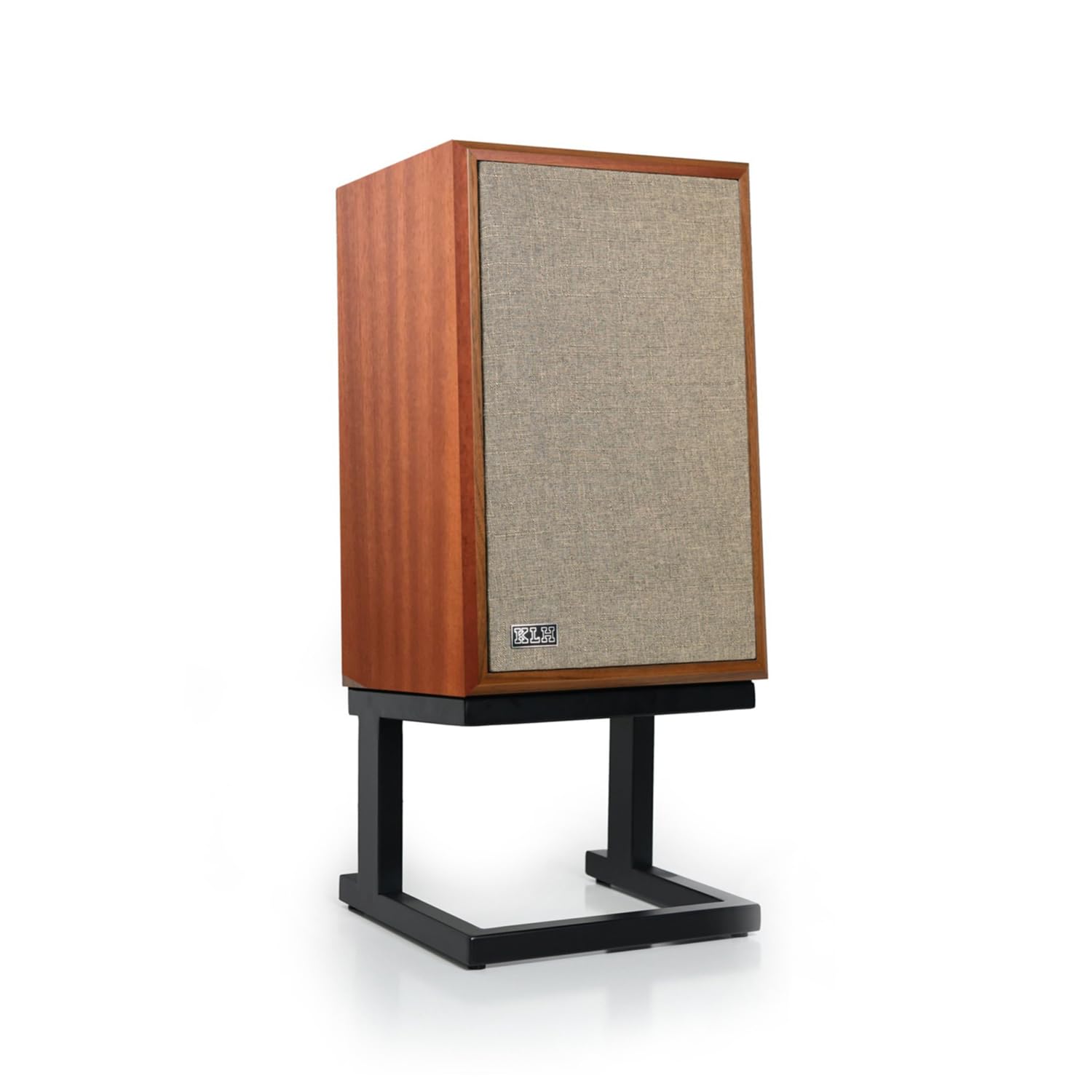
Sealed 8-inch cabinetry with mid-century looks that belong on display.
This is a passive, single speaker built on an acoustic suspension design — meaning the cabinet is sealed rather than ported, which KLH calls the most accurate and linear enclosure type. The 8-inch woofer moves the most air in this group, and each speaker ships with its own 8° slant riser base made of powder-coated 14-gauge steel. A three-position acoustic balance control tailors output for difficult rooms, and 5-way gold-plated binding posts handle the wire. Note the listing is one speaker, so a pair means buying two.
The finish is the draw: West African mahogany and iconic mid-century styling that owners describe as beautifully made and stunning in a den. Sound runs excellent and warm, with one buyer comparing it to old Advent speakers from decades past. Plan on about a week of break-in — one buyer found it bright for roughly 20 hours before smoothing into “close to magic.”
Two practical warnings. It’s larger than most people picture when they read “bookshelf,” and it’s sold singly, so the entry cost for a stereo pair is the highest in this list. The riser base cleverly tilts it back for a better listening angle, but it still wants wall clearance behind the sealed cabinet.
The design win: the sealed acoustic-suspension cabinet with a three-position balance control tames boomy rooms without a subwoofer.
The reality check: you’re buying one speaker per box — a matched pair doubles the outlay — and the 8-inch cabinet is bigger than the name suggests.
Choose this when: furniture-grade looks and a sealed, accurate cabinet matter as much as the sound.
Skip if: budget or shelf width is tight — it’s the priciest per-pair and the widest cabinet here.
Know the Specs
Woofer Size
This is the diameter of the main driver that handles bass, measured in inches. Bigger moves more air, so an 8-inch woofer like the Mackie CR8BT’s pushes deeper low end than a 5-inch driver. A 6.5-inch is the common middle ground for a room-filling bookshelf speaker. Match the size to your space: 5-inch for a desk, 6.5-inch and up for a living room.
Powered vs Passive
A powered pair has the amplifier built in, so you only run a power cable and plug in a source. The Fluance Ai41’s 90W and Ai61’s 120W amps are examples. A passive pair needs an external amp or AV receiver — you supply the power. Powered is easier to place; passive gives more upgrade headroom.
Rear Bass Port
A port is a hole that lets air escape to strengthen bass. Because it sits on the back of many cabinets, it needs a gap from the wall — flush against a wall and the bass turns muddy. Sealed acoustic-suspension designs skip the port and tolerate tight placement better.
Sensitivity and Ohms
Sensitivity is how loud a speaker plays for a given amount of amp power; higher is easier to drive. Ohm rating tells you what amps it matches — the Polk ES20 handles both 4 and 8 Ohms, widening your options. The Klipsch RP-600M II is efficient enough to run on small amps like a 3.5W SET tube unit in a small room.
Common Questions
Do I need a subwoofer with a 6.5-inch bookshelf speaker?
Can I put large bookshelf speakers on a wall shelf?
What is the difference between powered and passive bookshelf speakers?
How long does break-in take on large bookshelf speakers?
Can you mix a Klipsch bookshelf with a Polk subwoofer?
Is an 8-inch woofer too big for a small room?
Do large bookshelf speakers need a special amplifier?
Can these bookshelf speakers fill a large living room?
Should I bi-wire or bi-amp a bookshelf speaker?
Is an acoustic suspension speaker better than a ported one?
The Bottom Line
For most buyers, the best large bookshelf speakers winner is the Polk Audio Signature Elite ES20. Its Power Port bass (a port that aims low notes into the room) and detailed sound hold up across music and movies, and its 4- and 8-Ohm compatibility (Ohms measure how hard a speaker is for an amp to drive) widens your amp options. If you need floor-space bass without a sub, grab the Dayton Audio Classic T65 pair. And if you want to skip the receiver entirely, the Fluance Ai41 is the one to reach for. The Polk ES20 backs that up with 4.5+ stars across 800+ ratings, but the bigger win is matching your speaker’s tone to your room before you spend more.
How we choose
We do not accept paid placement. Every pick is matched to a real buyer and a real use-case; we do not hands-on test units.
Sources
Specifications: manufacturer listings and product documentation. Review insights: verified customer reviews, as of October 2026. Pricing: not shown on this page (it changes often); check the current price via the retailer link.
As an Amazon Associate, Aappliancez earns from qualifying purchases. This does not affect which products we feature.