Disclosure: Some links in this post are affiliate links. As an Amazon Associate I earn from qualifying purchases, at no extra cost to you. Learn more
Specs are compiled from manufacturer listings and verified buyer reviews and can change over time — please confirm the key details on the product page before buying.
You want to know one thing: will the glue you buy actually hold a retaining wall, a capstone, or a wobbly fire pit stone through rain, frost, and July heat? A tube of synthetic resin adhesive is the right call for bonding block, brick, and stone outdoors, and a can of spray foam is the right call for filling gaps and stopping leaks — they are different tools for different jobs. This guide covers four landscape adhesives, each with the honest strengths and limits real buyers run into.
This guide is built by comparing the manufacturers’ published specifications and the patterns across verified customer reviews, so you get each pick’s real strengths and trade-offs instead of marketing spin.
You will see which adhesive suits block walls, which suits gravel, and which is really a gap filler in disguise. Whether you are repairing a single loose capstone or locking down a whole gravel path, this breakdown of best landscape glue helps you pick the right tube the first time.
Top Picks

How To Choose The Best Landscape Glue
The single biggest mistake buyers make with outdoor adhesives is picking one product to do three jobs. Bonding a capstone to a block wall, locking gravel in place on a driveway, and stopping a trickle through pond rocks are three different problems that want three different products. Sort your job into one of those three buckets before you shop, and the product choice follows.
Match the adhesive to the job, not to the label
A cartridge adhesive that lists concrete, stone, and masonry as compatible materials is built to bond solid pieces to each other. A pump bottle of liquid resin is made to soak into loose material like gravel or mulch and bind the particles. A spray foam can fills a gap, expands to seal it, and blocks water. Buying a foam can to bond a heavy paving slab usually ends in frustration, and buying a hard structural glue to bind a gravel path wastes it.
Read the cure time before you start
Full cure time is how long the adhesive needs to reach its final strength. A 24-hour full cure is common, and that means you should not walk on, lean against, or stress the joint the same day. Plan the job so the piece sits undisturbed overnight. Setup time is a different number — that’s how fast the adhesive grabs and stops the piece sliding, which matters when you are holding a capstone level with one hand.
Check the coverage math for your project size
Coverage tells you how far one container goes. A 10-ounce cartridge run as a 1/4-inch bead covers 30 linear feet, so a small retaining wall cap is comfortably within one tube. Larger paths and gravel beds come in gallon or 32-fluid-ounce sizes, and getting the volume right upfront saves a second order mid-job.
Side-by-Side Comparison
| Model | Best For | Form | Size | Full Cure Time | Amazon |
|---|---|---|---|---|---|
| Liquid Nails LN-905★ Best Overall | Block walls and capstones | Liquid cartridge | 10 oz | 24 hours | Amazon |
| Commercial Grade All-Weather Rock Glue | Gravel driveways and paths | Liquid bottle | 1 gallon | 24 hours | Amazon |
| Oycevila Mulch Rock Glue | Mulch and gravel touch-ups | Spray bottle | 32 fl oz | — | Amazon |
| Red Devil 0916 Spray Foam | Pond leaks and gap filling | Expanding foam | 12 oz | — | Amazon |
Detailed Reviews
1. Liquid Nails LN-905 Landscape Block Adhesive
Our pick — 4.0+★ from 650+ verified ratings; the strongest balance of quality and price.
The cartridge that holds a retaining wall cap still — and grabs fast while you level it.
Start with the number that decides most jobs: a 10-ounce cartridge run as a 1/4-inch bead covers 30 linear feet. That is enough to lay a full cap course along a garden wall without running back to the store. The adhesive itself is a synthetic resin that bonds wood, concrete, stone, and masonry, and it carries ASTM C-557, a published standard for this type of adhesive.
What wins people over is raw effectiveness on solid surfaces. It sets quickly, grabs the block fast, and does not need you to stand there holding a capstone level for ten minutes. A gas fire pit rebuilt with it, a loose fire pit stone pressed back into place, concrete blocks bonded to a cement pad — these are the jobs it handles cleanly. It is also low VOC, which means less solvent smell while you work near the house.
The recurring gripe is drying time on certain stones. Some blocks stay tacky far longer than a day, and adhesion on some stone types is unpredictable — the honest way to read that is as a fit issue, not a product-wide failure. It is also not recommended for immersion applications, so keep it out of the pond. The crowd backing is solid: 4.0+ stars across 600+ ratings. And if you want a gap filler rather than a block bond, the Red Devil 0916 does that job instead — the two solve different problems.
What it does well
- 30 linear feet of coverage from one 10-ounce tube at a 1/4-inch bead
- Fast grab holds caps and blocks while you align them
- Weatherproof bond rated for garden walls, planters, walkways and steps
- Low VOC formula keeps solvent smell down near the house
Where it asks for care
- Drying can stretch well past a day on certain stone types
- Not recommended for immersion, so no pond or submerged use
- Full cure time of 24 hours means no traffic on the joint that day
The right call for: bonding capstones, block courses, brick repairs, and fire pit stones where you need a solid structural bond.
Look elsewhere for: binding loose gravel or sealing a water leak — this is a bond, not a binder or a gap filler.
2. Commercial Grade All-Weather Rock Glue 1 Gallon
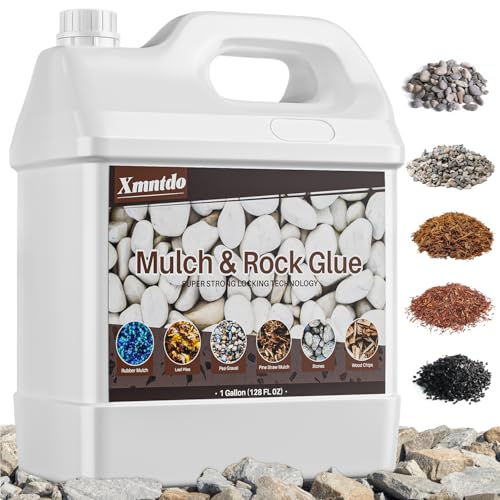
A gallon of clear resin for locking a whole gravel path, not just a single stone.
This one is built for volume and looseness rather than structural bonds. The format is a 1-gallon bottle of liquid resin, and the compatible materials list reads like a ground-cover catalogue: rocks, wood chips, crushed stones, sand, shells, pine needles, pebbles. You are pouring or spraying it into the surface and letting it bind the particles into a mat you can walk on. It dries to a clear, UV-stabilized finish, so your decorative stone keeps its natural colour instead of yellowing in the sun.
Where it earns its place is the durability story. The maker pitches resistance to heavy rain, snow melt, UV rays, extreme heat, and freezing temperatures, and lists a 24-hour full cure. For a residential driveway or a garden path that keeps scattering gravel into the lawn, that is the exact problem this format solves. It also carries a non-toxic label and a fast-drying claim on the spec sheet.
Now the honest part. This is a thin listing with very little owner history behind it, and the early feedback is mixed on how well it locks loose stone. The lesson from that: mix it exactly to ratio and test a small patch before you commit the whole gallon. If you are bonding a heavy capstone to a wall, skip it entirely and take the Liquid Nails LN-905 instead — that is a true structural adhesive.
The volume advantage: a full 1-gallon bottle covers a serious stretch of path or driveway in one go, and the clear UV-stabilized finish keeps gravel looking like gravel.
The caution worth reading: this is a newer product with a thin review base, so buy it for a surface you can test in a corner first rather than a job you need right the first time.
Reach for this if: you have a gravel driveway, garden path, or mulch bed that keeps scattering and you want to bind the surface in one pass.
Wait a moment if: you need proven performance on a high-visibility hardscape — the owner history here is still short.
3. Oycevila 32oz Mulch Rock Glue for Landscaping

The spray bottle for touch-ups — 32 fluid ounces of clear resin you mist onto mulch and gravel.
Trigger-spray application is the whole appeal here. Instead of pouring a gallon, you mist a 32-fluid-ounce bottle of clear resin over mulch, gravel, rocks, or other landscaping material. The container is listed at 1.25 liters, the finish is clear and transparent, and the formula is labelled water resistant and UV-stable for outdoor use. For a small bed, a border, or resealing a patch that has started to scatter, that reach and control is genuinely useful.
The spec sheet is honest about its limits. Water resistant is a lower claim than waterproof, so this is for surfaces that get rained on rather than surfaces that sit in standing water. It also lists fast drying and strong as its headline features, with no full cure time published.
The catch a buyer should know before ordering is that this is a newer listing with a modest review base, so there is less owner feedback to lean on than the Liquid Nails cartridge has. Treat it as a maintenance spray for loose mulch and gravel you can easily reapply, not a structural bond for stonework. For a wobbly capstone, it will not do the job.
What the spray format buys you: pinpoint control over where the resin lands, which keeps mulch beds and gravel borders looking tidy instead of soaked in puddles.
The trade-off in plain words: water resistant is not waterproof, and a short review history means you are buying on spec rather than on a long track record.
Suits you if: you want to lock down mulch or gravel in a small area and prefer a spray bottle over pouring from a gallon.
Wrong tool for: bonding block to block or holding a heavy stone in place — that calls for a resin cartridge.
4. Red Devil 0916 Spray Foam & Fill Landscape Adhesive Foam

Not a glue in the bottle sense — a gap filler that stops water running through landscape rock.
Here is the head-to-head that matters most: the Red Devil 0916 is an expanding foam in a 12-ounce can, while the Liquid Nails LN-905 is a synthetic resin cartridge. The foam fills and seals; the resin bonds solid pieces. Confusing the two is the most common buying mistake in this category, and getting it right is why this can earns a slot.
The niche it owns is water management. The maker pitches it for directing water flow in ponds and waterfalls and for creating a watertight barrier between retaining wall levels. It bonds to rocks, stones, cement, masonry, and wood, and the black colour disappears against rock and shadow. The straw and mechanical valve are reusable if you clean them properly, which is a real departure from one-shot straw foams. The downside of that cleanup is that it needs a solvent, so keep one on hand.
The honest limit is dispensing reliability — the reputation here is mixed on whether the can sprays cleanly, and it does reward working quickly. The trade-off is worth naming: when a can sprays properly, it glues stones hard and blocks a leak completely; when it dribbles, you lose foam and patience. It is also a fixed-volume 12-ounce can with 15.2 ounces of product weight, so a big waterfall rebuild may take more than one.
The jobs it nails
- Water-resistant seal for ponds, waterfalls, and retaining wall levels
- Bonds rocks, stones, cement, masonry and wood
- Reusable straw and mechanical valve when cleaned properly
- Black finish hides into rock and shadow
What to expect going in
- Dispensing is inconsistent across cans, so work fast once it flows
- Cleanup needs a solvent, not just water
- 12-ounce can is fixed volume and may not cover a large rebuild
Pick this one for: sealing a pond leak, blocking water between wall levels, or filling a crevice weather is finding a way through.
Not the one for: laying capstones or holding a heavy slab — expanding foam fills gaps, it does not replace a structural adhesive.
Know the Specs
Container Form and Coverage
Form decides what a product can do. A cartridge of liquid resin dispensed as a bead is for bonding solid pieces. A bottle of liquid resin is for soaking into loose material. An expanding foam can is for filling gaps. Coverage follows form: a 10-ounce cartridge yields 30 linear feet at a 1/4-inch bead, while larger landscape projects come in a 1-gallon bottle or a 32-fluid-ounce spray. Match the container to the size of the surface you are treating.
Full Cure Time and Weather Claims
Full cure time is how long the adhesive needs before it reaches final strength — 24 hours is common, so plan to leave the joint undisturbed overnight. Setup time is separate and much shorter; it is how fast the product grabs. Weather ratings describe what a cured bond should handle outdoors, such as rain, UV, heat, and freeze. Note the difference between water resistant and waterproof on a label — they are not the same promise.
Common Questions
What is the difference between landscape glue and landscape foam?
How far does a 10-ounce tube of landscape adhesive go?
Can landscape glue hold a retaining wall capstone in place?
How long do I need to leave the adhesive before walking on it?
Will landscape glue work on gravel and mulch?
Is water-resistant the same as waterproof on a landscape adhesive label?
Can I stop a pond leak with landscape foam?
Do these products need a solvent to clean up?
Can I use landscape glue to repair a loose fire pit stone?
How do I keep gravel from scattering out of a driveway?
The Bottom Line
For most block, brick, and stonework jobs, the Liquid Nails LN-905 is the one to buy — it grabs fast, lays 30 linear feet at a 1/4-inch bead, and it is the adhesive with the strongest owner track record of the four. If your problem is water finding a path through landscape rock, reach for the Red Devil 0916 foam, which fills and seals where a bond cannot. And if you are locking down loose gravel across a driveway or path, the Commercial Grade All-Weather Rock Glue in the gallon bottle is built for that surface. The LN-905 backs that top spot with 4.0+ stars across 600+ ratings, and the fast-grab bond is what those buyers keep citing.
How we choose
We do not accept paid placement. Every pick is matched to a real buyer and a real use-case; we do not hands-on test units.
Sources
Specifications: manufacturer listings and product documentation. Review insights: verified customer reviews, as of October 2026. Pricing: not shown on this page (it changes often); check the current price via the retailer link.
As an Amazon Associate, Aappliancez earns from qualifying purchases. This does not affect which products we feature.