Disclosure: Some links in this post are affiliate links. As an Amazon Associate I earn from qualifying purchases, at no extra cost to you. Learn more
Specs are compiled from manufacturer listings and verified buyer reviews and can change over time — please confirm the key details on the product page before buying.
If your ladder rocks, slides, or sinks the moment you put weight on it, the fix is not a new ladder — it is a levelling foot that gives each leg a flat, grippy base to stand on. That is exactly what a ladder leveler does: it gives each leg a flat, grippy base so the ladder stops rocking. Below you will find the seven options that consistently hold up on grass, gravel, stair treads, and sloped driveways, sorted by what each one is actually good at.
This guide is built by comparing the manufacturers’ published specifications and the patterns across verified customer reviews, so you get each pick’s real strengths and trade-offs instead of marketing spin.
You will see the difference between a rubber mat that sits under the feet and a steel platform that rebuilds the floor beneath them. By the end you will know which shape suits your job, your ground, and your ladder width. Here is how to pick the right ladder leveler without guessing at the spec sheet.
Top Picks
How To Choose The Best Ladder Leveler
Buying a leveler is really a matching job. You are matching one tool to two things: the surface you stand the ladder on, and the ladder you own. Get either one wrong and even a 500 lb-rated platform will not sit flush under your ladder.
Match the tool to your ground, not just your ladder
Soft grass, wet soil, and loose gravel need something wide that spreads the load — that is the mat-and-grip family. A brick driveway slope needs a rubber face that bites and resists sliding. A staircase needs a flat platform that replaces the missing floor entirely. Those are three different products, and no single design handles all three equally well.
Take your ladder’s base width before you order
This is where most returns come from. Platforms list a maximum base width, and if your ladder’s feet sit wider than that number, the ladder will straddle the rails instead of sitting inside them. Measure the outside-to-outside distance of the two feet, and compare that to the platform’s stated limit before you buy.
Decide how precise your levelling needs to be
On grass, “close enough” is fine. On a stairwell, it is not — you are chasing a straight, vertical ladder on a sloped, stepped surface. Look at the adjustment increments: a tool that moves in small steps gets your ladder plumb, while a tool with a loose pin-and-hole height range leaves you hunting for a setting that sits close.
Side-by-Side Comparison
| Model | Best For | Load Capacity | Footprint | Weight | Amazon |
|---|---|---|---|---|---|
| Ladder Leveller Anti-Slip Mats★ Best Overall | Soft grass, gravel, and sloping ground | — | 9.84 x 7.09 x 2.76 in | 4.22 lb | Amazon |
| Renovatio Stair Ladder PlatformStair Specialist | Stairwells and stair treads | 450 lb | 24″ x 5.5″ platform | 4.79 kg | Amazon |
| Mr IRONSTONE Ladder Stabilizer | Gutters and roof stand-off | 500 lb | 14.56 x 4.99 x 43.3 in | 3.8 lb | Amazon |
| VEVOR Ladder Extender | Stairs and uneven terrain on a budget | — | 23.4″ x 5.8″ surface | 9.35 lb | Amazon |
| Ladder Extender Pro | Stairwell painting and tall extension ladders | — | 23.7″ x 7.5″ platform | 11 lb | Amazon |
| Stable Platform Ladder Leveler | Roofs and uneven ground, no bolts needed | 500 lb | 19.5″W x 23″H | 10 lb | Amazon |
| TP2 Pro Stair Platform | Spiral and quarter-turn staircases | 330 lb | 29.5″W x 36.6″H | 9 kg | Amazon |
Detailed Reviews
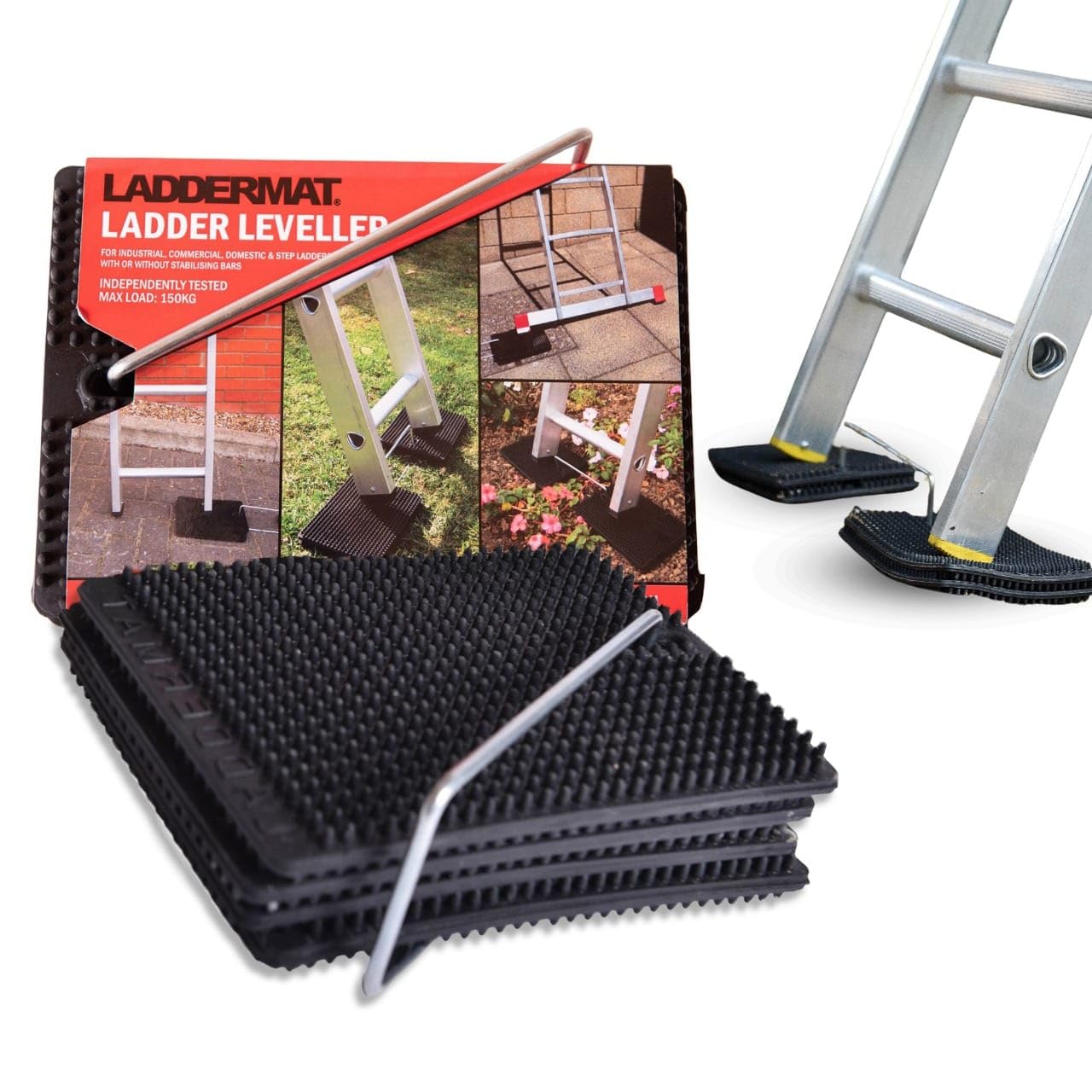
1. Ladder Leveller Anti-Slip Mats | Ladder Safety Accessory
Our pick — 4.5+★ from 900+ verified ratings; the strongest balance of quality and price.
A pair of rubber mats that stop your ladder sinking, rocking, and shifting under you.
This is the pick that solves the most everyday problem: a ladder on ground that is not flat. Two rubber-booted mats sit under the legs and give each one a solid, non-slip base — a grip face that holds on smooth, wet, or polished floors and resists sliding on soft ground. Where a bare aluminum foot digs into wet grass or skates on a driveway, the mat spreads the load and stays put.
Owners keep coming back to one thing: these mats stop the ladder moving on ground that used to betray them. As buyers report, “We have areas around the house that have landscape rock and wood bark chips. In the past if I put a ladder on them it would shift. When I put these down under the ladder’s legs it doesn’t move.” The same story repeats on wet grass after days of rain, where the mats kept the legs from sinking under weight. On slopes, the grip let a painter climb higher with confidence.
Know the catch before you buy: this is a base, not a self-levelling jack. It stops slipping and sinking, but it cannot correct a steep slope or stop a ladder tipping if your weight shifts hard. One buyer on a steep driveway found the mats did their job but could not fight gravity. Setup is the easy part, since they install and remove in seconds, and the whole pair weighs 4.22 pounds. That makes them a permanent resident of your truck or toolbox. The 4.5+ star rating across 900+ owners points the same direction: this is the accessory most people should start with.
Stops the slides
- Rubber grip face holds on wet, smooth, and polished floors
- Wide base keeps legs from sinking into mud, dirt, and soft grass
- Installs and comes off in seconds, with no tools to fumble
- 4.22 lb pair fits in a truck, toolbox, or garage shelf
Where it stops short
- It is a base, not a levelling jack — a steep slope still needs care
- Two mats only; you get no extra feet or hardware in the pack
- On very loose ground it will not lock the ladder in place on its own
Buy this if: your ladder lives on grass, gravel, bark chips, or sloping ground and you want a fast, cheap fix that stays put.
Know this: it corrects the base, not the angle — pair it with a careful setup on steep grades.
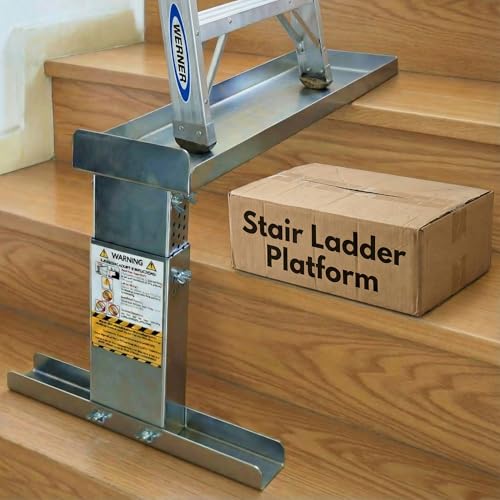
2. Renovatio Stair Ladder Platform
A steel platform that gives your ladder a flat, level floor across the stair treads.
What this does is rebuild the missing floor. The Renovatio sits over the steps and presents a 24-inch by 5.5-inch flat surface for the ladder’s feet, so you are not balancing one leg on a tread nose and the other in mid-air. The frame is galvanized 14-gauge carbon steel, which is a thicker-gauge steel dipped in a zinc coating so it resists corrosion and weather outdoors. It is rated to support up to 450 lbs — a load ceiling that sits comfortably above a person plus gear at the top of a ladder.
Owners praise one thing above all: how many different jobs it opens up. It is the top-cited strength in the review pages, and it comes from the fact that one platform handles painting a stairwell, wiring a landing, or reaching a high window. As the review pages put it, “I just used this on my side job in a stairwell and it worked great.” Another owner fixing a vaulted ceiling called it the tool that reached “those impossible places” over the stairs.
You get finer levelling than most platforms here: the height adjusts in 3/32-inch (0.12-inch) steps, so you can chase a true horizontal on an uneven stair set. Two honest snags are worth flagging before you order. The hardware pack has arrived with acorn nuts instead of the six wing nuts one owner expected, which meant a 45-minute hardware-store run. And the platform is built for ladders with a base up to 24 inches wide and feet up to 5.5 inches long, so a wider ladder simply will not sit inside it. Measure first, as the review pages repeatedly advise.
What it fixes: a flat, load-rated platform on stair treads, with 3/32-inch height steps and rubber stabilizer feet that protect the stairs from scratches.
The trade-off: the adjustment runs on long bolts and wing nuts, which owners find fiddly, and the 24-inch limit rules out oversize ladders.
Reach for this if: you work stairwells and want a solid steel base that will not buckle.
Look elsewhere if: your ladder’s base is wider than 24 inches or you want tool-free height changes.
3. Mr IRONSTONE Ladder Stabilizer

The wide-armed stand-off that keeps your ladder off the gutter and clear of the wall.
Different job, different tool. This one clamps onto the top of your ladder and spreads its arms wide, holding the ladder away from the wall so you can work at the roofline without crushing a gutter. It fits ladders 15 to 27 inches wide, mounts with U-bolts in about a minute, and carries a 500 lb weight capacity. The forged steel construction, one-piece rather than welded, is what lets it take that load without flexing.
Compare the reach to the Renovatio platform: the Mr IRONSTONE spreads 43.3 inches across its longest dimension, against 2.76 inches of thickness on the Renovatio’s footprint. It is a completely different shape, built to span a wall gap rather than sit under the feet. Owners notice the difference in use; on the roof it feels locked in, and the four rubber contact points sit flat on the tiles instead of digging in.
Owners do flag two things. The 3.8-pound weight adds a bit of top-heaviness, so removing the ladder from the roof takes a moment more care. And it fits ladders up to 27 inches wide — if your ladder is wider, it will not clamp. One buyer on a Little Giant M17 had to modify the mount so the ladder could still fold to its shortest position, though it worked fine once installed. The 4.0+ star rating across 250+ owners reflects a solid tool with a small learning curve.
Why roofers like it
- Holds the ladder off the gutter, so the wall and roofline stay clear
- Four rubber contact points spread the load evenly
- Mounts in about a minute with the included U-bolts
- 500 lb weight capacity with forged steel arms
Plan around this
- Some ladders with folding mechanisms need a tweak to fit the U-bolt mount
- Only fits ladders 15–27 inches wide
- Adding the stabilizer makes the top of the ladder feel heavier to lift
Go with this for: gutter cleaning, roof access, and any job where the ladder needs a stand-off from the wall.
Think twice if: you need a base for grass or a platform for stair treads — this tool holds the top, not the bottom.
4. VEVOR Ladder Extender 23.4×5.8-Inch
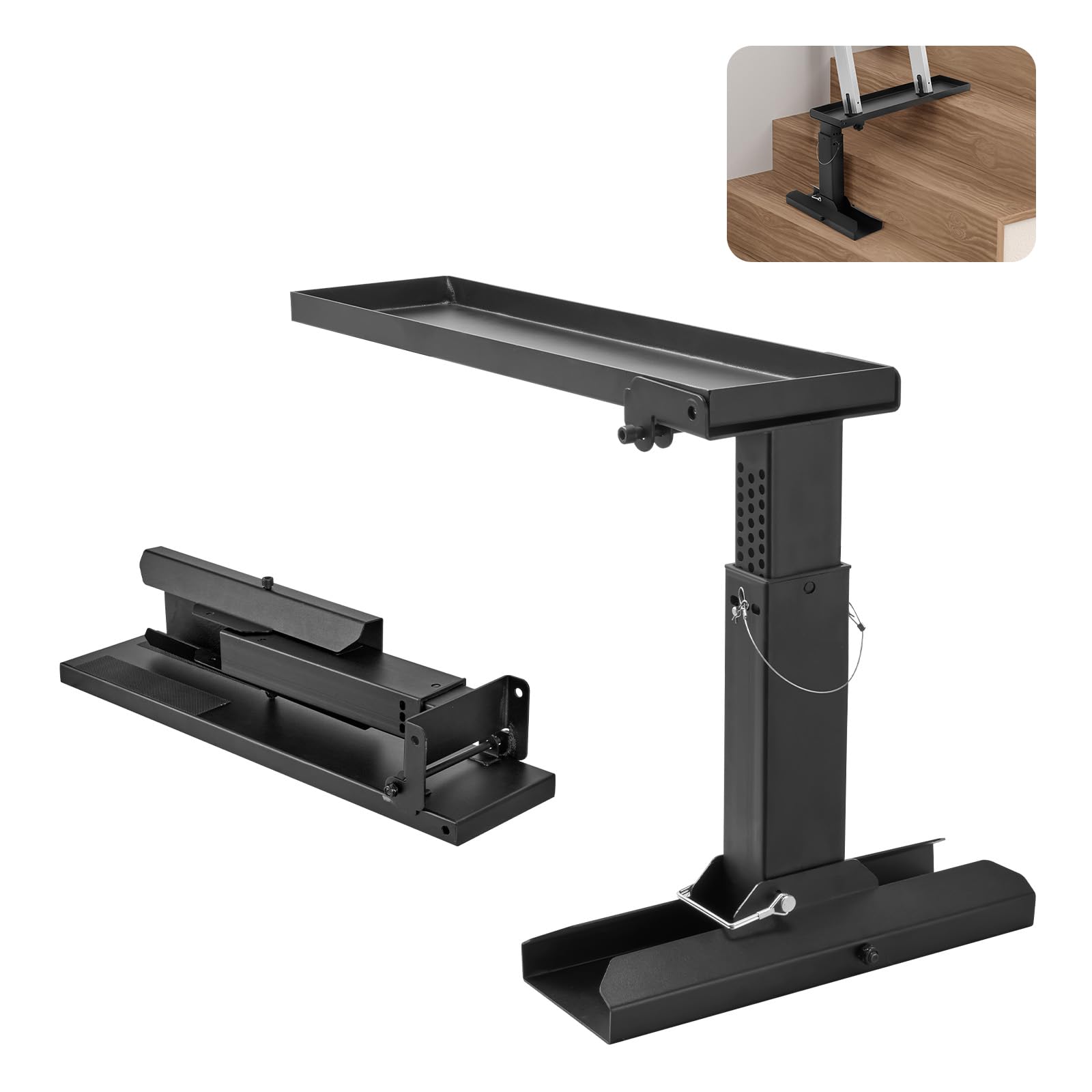
A folding steel platform that reaches from 11.4 up to 18 inches to meet your stairs.
Here is the number that defines the VEVOR: the support surface adjusts from 11.4 to 18 inches in height across a 23.4-inch by 5.8-inch top. That height range is what lets it meet the gap between a ladder leg and the ground when the ladder is standing over a step. An adjustable locking plate holds the chosen setting, and non-slip rubber feet keep the whole unit planted on whatever surface it lands on.
At 9.35 pounds it is heavier than the rubber mats, but the payoff is that it folds down for storage, so it tucks into a garage corner rather than owning a shelf. What owners notice first is the surprise — the doubts before the first job and the relief after. As owners mention, “I’ll admit, I was a little skeptical about this working but it is absolutely amazing.” The same owner used it to fix soffit and gutters over porch steps and found it easy to assemble and easy to store.
The honest note: the height adjustment relies on a wire-rope pin through holes, and one owner swapped that for dual stainless bolts and wing nuts for extra redundancy, plus added Velcro to keep the foot in place during transport. That is a preference tweak rather than a flaw. The 4.5+ star rating across 100+ owners reflects a machine that does the job without fuss — the platform is solid, the fold is convenient, and the price keeps it in reach of the casual DIYer.
what separates it: a folding high-strength carbon steel frame with a 11.4–18 inch height range and a 23.4 x 5.8-inch platform — enough to clear a step and still fit in a car boot.
Fair warning: the height pin is the one piece worth upgrading, and at 9.35 pounds it is not the lightest option to walk up a stairwell.
Best for: the DIYer who wants a height-adjustable platform that folds away and does not need a toolbox to set up.
Skip if: you want the very lightest kit for a single grass job.
5. Ladder Extender Pro, Ladder Stabilizer High Strength
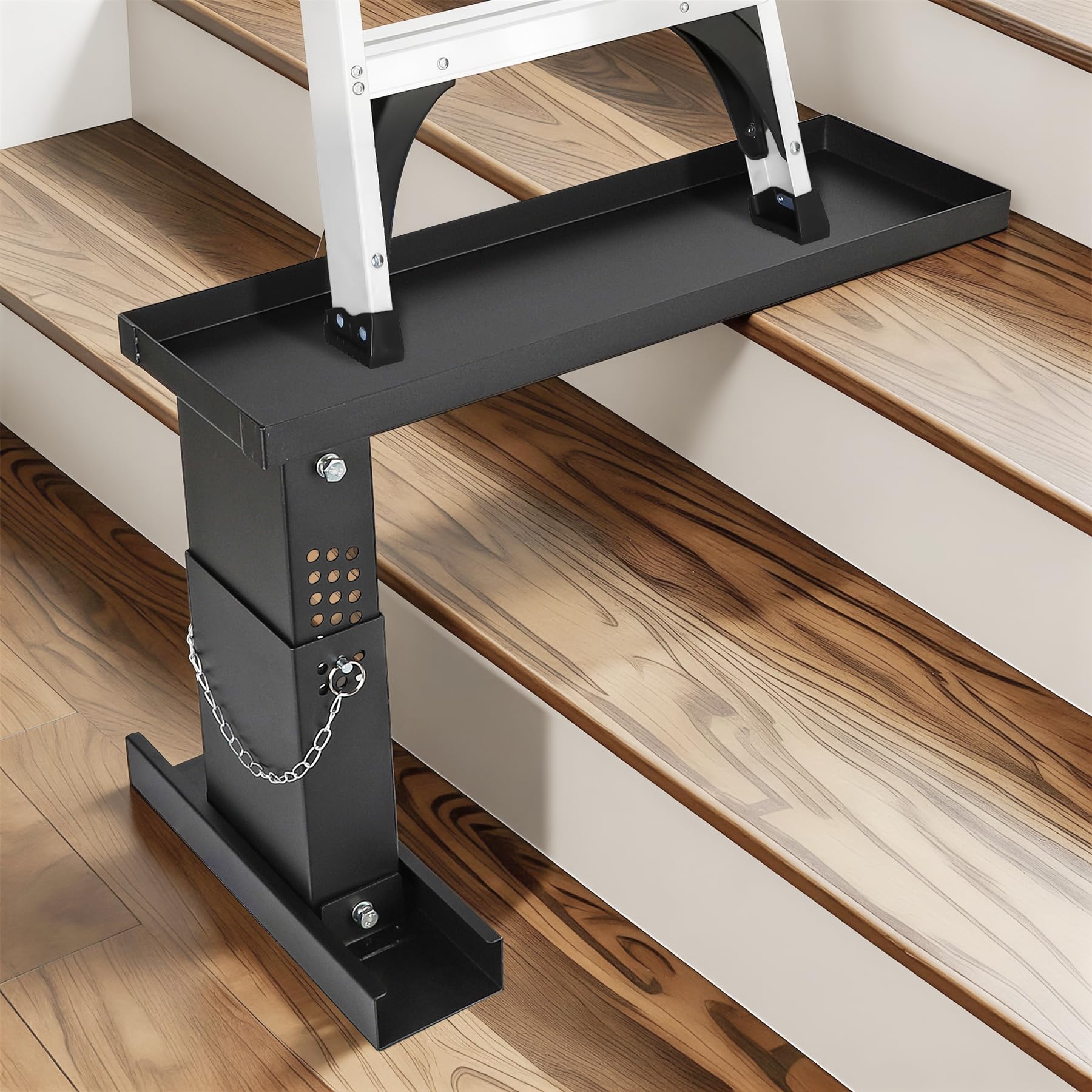
The heavy-duty platform that holds a 20-foot extension ladder on a stairwell.
Start with the biggest platform in this group: 23.7 inches by 7.5 inches of flat surface for the ladder’s feet. That is a wider landing than the VEVOR’s 5.8-inch width, and the extra span is why it handles longer ladders. It fits steps with a rise between 10.2 and 16.5 inches and adjusts in 1/8-inch increments, so you can dial the base to a true level on a stepped surface. The frame is powder-coated steel, a finish applied as a baked layer that resists corrosion and wear.
Sturdiness is what wins people over here — it is the most-cited strength in the review pages, and it shows up in what owners do with it. One owner worked alone on carpeted stairs with a 16-foot extension ladder nearly fully extended. Another held a 20-foot extension ladder on the platform for a stairway wall job and skipped hiring help entirely. The gripper bases are built for hard surfaces, and the detachable frame means nothing bolts permanently to your ladder.
Watch the fit. The platform handles ladders up to a certain base width, and one owner with standard 8-foot and 16-foot ladders found they did not fit even on the Pro version — a measure-first situation. At 11 pounds it is the heaviest tool in this group, so hauling it up a staircase is a two-hand job. The 4.5+ star rating across 300+ owners still points to a platform that earns its place for anyone who paints or repairs stairwells regularly.
Built for tall ladders
- Holds a 20-foot extension ladder without drama
- 23.7″ x 7.5″ platform — the biggest landing in this group
- Adjusts in 1/8-inch steps for precise levelling
- Detachable frame, so no permanent marks on your ladder
The honest limits
- Some standard ladder widths do not fit — measure the base first
- At 11 pounds, it is the heaviest to carry up a stairwell
- The pin-and-hole height setup rewards patience over speed
The clear pick for: stairwell painting and tall extension ladders that need a wide, stable base.
Not the pick for: tight storage or a ladder whose base is wider than the platform accepts.
6. Stable Platform Ladder Leveler

One rubber-gripped tool that works as a leveler, a ladder jack, and a tool tray.
The Stable Platform Ladder Leveler is the shape-shifter. It carries a 500 lb load rating, and the ribbed rubber grip locks into place on stairs, roofs, and uneven ground. The triangle frame is the reason it takes weight without sagging, and the same design lets you hang it directly on a ladder, use it as a tool box, or set it between two ladders as a jack. There are no bolts or clamps to install — you set it down and work.
What wins people over is how many jobs it covers. Owners have used it to steady a ladder on a lawn, to reach a 15-foot wall on carpeted stairs, and to hang exterior lights above a second-floor roofline. One bought it for rooftop work and found it more useful up there than on the ground. The rubber feet give real traction — slippage has not been a theme.
Two things need setting. It ships disassembled, and the directions are not the best — the review pages tend to solve that by going off the picture instead. And it is bulky: one owner found it larger than expected, though that same bulk is what makes the platform feel solid. The 4.5+ star rating across 200+ owners reflects a tool that holds firm once it is built. Assembly is the one step that separates a smooth purchase from a frustrating one.
What it brings: a 500 lb rated, rubber-gripped platform with a triangle frame, built to serve as a leveler, a tool box, and a stand-off on a slope — all without a bolt or clamp.
The catch: it arrives in pieces with thin directions, so budget a slow first assembly; the bulk also makes it a garage resident rather than a truck passenger.
Choose it if: you want one kit that does stairs, roofs, and slopes and you do not mind a build-it-yourself first run.
Pass if: you want something that works straight from the box.
7. TP2 Pro Stair Platform, 330lbs Load Capacity – Silver

A telescopic aluminium stair platform for ladders up to four steps — and staircases that turn.
This is the one for the awkward staircase. The TP2 Pro is built with telescopic rails that adjust in both length and height, so it fits straight stairs, spiral stairs, or quarter-turn stairs where a fixed platform would not sit. The non-slip plate gives a safe base for ladders up to 4 steps, and an integrated level lets you set the platform horizontal without hunting for a spirit level. The frame is high-grade aluminium, rated to 330 lbs.
The feature that earns its place is that levelling system. On a turning staircase, a small error at the base becomes a wobble at the top, and the built-in level removes the guesswork. Owners solve problems with it that stalled them for years. One had hunted for five years for a way to set a ladder on a stair that turns 90 degrees halfway up, and now uses it on the landing to reach high windows for cleaning. Another tried several platforms that claimed to work on stairs, all of which failed, before this one performed.
Be honest about the trade-offs. It weighs 19.84 pounds, so it is the heaviest pick here and best carried with two hands; it folds down to 2.36 inches for storage, which helps. The vertical supports lack a stop, so they can fall out if you overextend them — check each leg before climbing. And it is premium-tier, so the outlay is real. The 4.5+ star rating across 130+ owners backs the investment for anyone who works stairwells often.
The winning feature: telescopic rails that adapt to straight, spiral, and quarter-turn stairs, plus a built-in level that takes the guesswork out of a horizontal setup.
Worth knowing: at 19.84 pounds it is a commitment to carry, and the unstopped vertical supports need a careful check before every climb.
This one is for: turning or spiral staircases and anyone who climbs them often enough that a true level matters.
Look elsewhere if: your stairs are straight and simple, or your load exceeds the 330 lb rating.
Know the Specs
Load capacity
This is the maximum weight the manufacturer rates the tool to support, printed in pounds. It is not just your body weight — it is your weight plus the ladder plus any tools you carry up. A 500 lb rating gives a comfortable margin for a heavy extension ladder and a person plus gear. Always check the rating against your heaviest realistic load, not your lightest.
Platform size
The size of the flat surface your ladder’s feet sit on, given as width by depth. A larger platform gives more room for the feet and less chance of one leg sliding off the edge. Width tells you how wide a ladder base it can hold; depth tells you how much front-to-back room you get. A platform narrower than your ladder’s base will not sit flush.
Adjustment range
How far the tool can be raised or lowered to meet the uneven surface, and in what steps it moves. A range like 11.4 to 18 inches covers a range of step heights. The step size matters too: small increments (like 1/8 inch or 3/32 inch) let you hit a true level, while a wide pin-and-hole spacing leaves you approximating.
Grip surface
How the tool holds its place on the ground or stairs. Rubber feet resist sliding on smooth, wet, or polished floors; textured rubber adds bite on stairs and tiles. A wide footprint spreads the load on grass and loose ground so the legs do not sink. Grip is the difference between a leveler that stays put on wet concrete and one that skates.
Material and weight
What the frame is made from, and what it weighs. Steel is heavier and stiff; aluminium is lighter and tends to flex a bit under load. A tool’s own weight matters for hauling it up a stairwell. The weight also tells you how easy it is to drag into place and store — a heavier tool is more solid but more awkward to carry.
Ladder compatibility
Which ladder types the tool fits, and its size limits. Look for the maximum base width, the maximum foot length, and the ladder types listed (extension, step, telescopic, fiberglass, aluminium). Measure your ladder’s base width before ordering; if it is wider than the platform’s limit, the ladder will straddle the rails and the tool will not work.
Common Questions
Will a ladder leveler work on a staircase, or do I need something else?
How do I know if my ladder will fit a stair platform?
What does a load rating of 330 or 500 pounds actually cover?
Can a leveler stop my ladder slipping on a smooth or wet floor?
Do these tools stop a ladder sinking into soft grass or mud?
Is a ladder stabilizer the same as a ladder leveler?
How much does a stair platform weigh and will I need help to carry it?
Can I leave a ladder leveler on my ladder permanently?
Is it worth paying for a premium stair platform over a basic mat?
The Bottom Line
For most people, the right ladder leveler is the Ladder Leveller Anti-Slip Mats, because they solve the everyday problem — a ladder that slips or sinks on grass, gravel, or sloping ground — with two 4.22-pound rubber bases you set down in seconds. If your work happens on a staircase, the Ladder Extender Pro is the wider, heavier-duty platform with a 23.7″ x 7.5″ landing that holds a 20-foot extension ladder steady. And for gutters, roof access, or any job where the ladder needs a stand-off from the wall, the Mr IRONSTONE Ladder Stabilizer clamps on with U-bolts and carries a 500 lb rating. Match the pick to where your ladder stands — grass, stairwell, or roofline — and it will do the rest.
How we choose
We do not accept paid placement. Every pick is matched to a real buyer and a real use-case; we do not hands-on test units.
Sources
Specifications: manufacturer listings and product documentation. Review insights: verified customer reviews, as of October 2026. Pricing: not shown on this page (it changes often); check the current price via the retailer link.
As an Amazon Associate, Aappliancez earns from qualifying purchases. This does not affect which products we feature.